We’re reclaiming the word. Here’s what it means now.
The word “tankie” was coined by British Trotskyists for use against leftists who did not oppose the USSR intervention in Hungary in 1956 and resurrected after 2011 by pro-regime change leftists who used it to mock leftists who opposed the destruction of the Syrian state.
But the self-definition of “tankie” can be derived from Lenin’s advice to the socialists in WWI. When most of the socialists of Germany, Russia, and France were lining up with their own governments, Lenin advocated what was called at the time revolutionary defeatism. He wrote: “During a reactionary war a revolutionary class cannot but desire the defeat of its government.” He wanted socialists, rather than celebrating their countries’ achievements in overt or covert war, to take up the struggle in their own countries: “one cannot be a sincere opponent of a civil (i.e., class) truce without arousing hatred of one’s own government and bourgeoisie!”
In my view, this is no different from what Chomsky has advocated for decades. As he was wont to do, he repeated this message constantly in the hopes that it would stick (it didn’t):
“…One of the most elementary moral truisms is that you are responsible for the anticipated consequences of your own actions. It is fine to talk about the crimes of Genghis Khan, but there isn’t much that you can do about them. If Soviet intellectuals chose to devote their energies to crimes of the U.S., which they could do nothing about, that is their business. We honor those who recognized that the first duty is to concentrate on your own country. And it is interesting that no one ever asks for an explanation, because in the case of official enemies, truisms are indeed truisms. It is when truisms are applied to ourselves that they become contentious, or even outrageous. But they remain truisms. In fact, the truisms hold far more for us than they did for Soviet dissidents, for the simple reason that we are in free societies, do not face repression, and can have a substantial influence on government policy*.”
This idea – that we’re supposed to think about the effects of our work and therefore focus on the crimes of Western imperialists, not the crimes of their enemies – is one Western tankies take seriously.
If you’re wondering why the small group of us on social media around my podcast (the Anti-Empire Project) and Sina’s (The East is a Podcast) affectionately call each other “tankies” and the politics behind it, read on.
For the purposes of this post, a tankie is someone who doesn’t want the destruction of states that are currently targeted by the US.
Tankies are glad that Stalin defeated Hitler in WWII and that the Red Army stopped the Holocaust. Tankies didn’t want Syria, Libya, Yugoslavia, or Iraq destroyed. Tankies don’t often get what they want, as you can see. Tankies don’t want Cuba, Venezuela, Iran, Russia, or China destroyed.
There are other causes on which tankies and other kinds of leftists agree, like wanting a Free Palestine. But on the question of regime change in Syria and other countries, we split.
There are three main premises to being a “tankie”.
The US Empire, and the British Empire that it took over, which could be called the Anglo-American Empire, is the only empire today. To tankies, Russia, China, and Iran – the only countries really ever accused of also being imperialists – are not.
The Anglo-American Empire is uniquely genocidal and destructive. There are other bad things that happen in the world, but in almost every international political situation, with brief and occasional anomalies that quickly revert to pattern (like when they supported Stalin in WW2 or fought their own ISIS creations briefly in Syria and Iraq), victory for the Anglo-American imperialists will lead to more death and destruction than defeat.
No matter how much imperial propaganda you have managed to cut through, you are more propagandized than you think. It’s a safer assumption that every single claim made by the imperialists is a lie and work from there.
A few points about the reasoning behind these premises:
Premise 1: There’s only one empire. The hundred-year long debate about imperialism goes back to when Lenin used the concept, which he’d read in Hobson, to explain the origins of the First World War. The Great Powers – England, France, Germany, Japan, the US, Austria-Hungary (not really in the game any more) – had divided the whole world up into colonies from which they drained resources and which they used as captive markets. The whole world being divided up, the game had become zero-sum and the only way these powers could advance was by taking colonies from one another. The strongest powers would take the most, but relative strength would change and the only way to truly test strength was to go to war, hence imperialist war was inevitable. So argued Lenin about a century ago. But another way of looking at World War I (and WWII, and the Cold War) is as a war successfully waged by the Anglo-American Empire to subordinate potential rivals into a global system. Today Germany and Japan host US bases, the Five Eyes and France are subordinate to the US. The Western elite is disciplined, willing to subordinate local interests for US or Israel’s interests, and 100% behind Israel’s holocaust in Gaza.
Another definition of imperialism that I like, that you don’t have to listen to a 100+ hour history podcast to get a handle on, is arrived at by studying value transfer, for example through Jason Hickel et al.’s work, “Imperialist appropriation in the world economy: Drain from the global South through unequal exchange, 1990–2015”. The imperial countries are the ones receiving the value transfer, the colonized are those whose wealth is drained by trillions every year. The Global North / the Golden Billion / the Combined West, is the metropole. The Global South is the colony.
What of China, with its dealmaking in Africa, Pakistan, and elsewhere? If you’re not willing to listen to 50+ hours about the genocidal insanity that the West brought to Africa during the Scramble, you should at least know that China isn’t in Africa chopping children’s hands off or killing ⅓ of all Congolese: they’re building roads and custom phone networks and buying minerals. That’s not what the West did – or does – in Africa.
What of Iran, which exercised influence in Syria until recently and exercises influence in its neighbouring country, Iraq? Historically Persia was incorporated into the Anglo-American global empire as a “semi-periphery”, like China, then became a firm member of the Global South, complete with at least one CIA overthrow in 1953, and is now back in the Global South as a sanctioned country whose economy is targeted for destruction. Not looking for colonies, not draining anybody’s wealth, not imperialist.
Russia? The USSR supported anti-imperialist struggles, notably Cuba and Vietnam, while it lasted from 1917-1991. The post-Soviet Russian Federation has shrunk from the USSR borders, with former members of the USSR increasingly hoisting the US flag over military bases that encroach on Russia and US-sponsored covert operations trying to regime change Russia and break it up (notably starting with Chechnya). Like Iran, Russia had some brief influence in Syria, but it gave that up. The war between Russia and Ukraine is akin to a Western-sponsored civil war, which the US explicitly says it is using to try to destroy Russia. As an economy, Russia spent decades recovering from the destruction wrought by the end of the USSR and the privatization of the USSR’s assets (what author Austin Murphy called the Triumph of Evil). Russia isn’t draining the Global South. It’s not imperialist.
Premise 2. The Anglo-American Empire is uniquely genocidal. The Spanish, Portuguese, and Dutch empires are the only empires that could compete with the sheer horrors of the Anglo-Americans, but the scope and scale of the Anglo-American genocides is worse and only the Anglo-American Empire is effectively threatening to end human civilization either through environmental collapse or nuclear war (or both). The worst things in human history were the genocides of the Americas, the enslavement of Africans, and the colonization of Africa and Asia. All were conducted by the Anglo-Americans – where others like France, Belgium, and Germany, eagerly participated, they did so in a system organized by the Anglo-Americans. The German Nazis were sponsored by the Anglo-Americans until WWII started, then these Allies briefly fought the Nazis, then as soon as the war ended the Allies rehabilitated the Nazis and brought them into the heights of Western research, industry, and military coordination through Operation Paperclip. In all the major post-WW2 holocausts, the US was either doing them directly or deeply involved. The Rwandan genocide could not have occurred if the US had not organized the war and invasion of Rwanda the way it had. In the DR Congo, millions died in a war in which abusive local militias faced truly genocidal invaders from Rwanda. The abusive militias were bad; the genocidal invaders were qualitatively worse. As you would expect, the Americans supported the genocidal invaders. The ongoing Gaza holocaust by Israel could not be conducted without daily airlifts of weapons from the US and fuel and food sent daily to Israel by allies organized by the US.
Opposing the Anglo-American empire is opposing genocide. Tactically supporting any western-led regime change campaign is supporting the most genocidal system that has ever existed, and it’s beneath contempt.
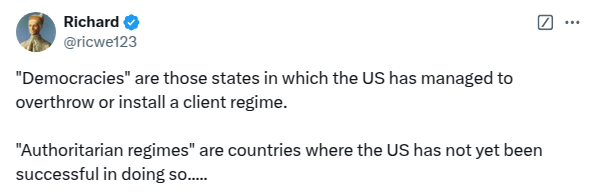
Principles vs Campism: Regime changers claim to be loyal to higher principles than anti-imperialist “campists”. Campists, they claim, support authoritarianism, just not if the Anglo-Americans are doing it. Whereas regime changers, with their exalted principles, are against authoritarianism regardless of who’s doing it. Let’s leave aside the fact that “authoritarianism” is itself a term only ever applied to official enemies. Based on Premise 2, it is true that the authoritarianism of targeted regimes is the lesser evil.
Regime changer principles applied to the real world amount to endorsements of the greater evil – dismemberment of countries and genocides of populations. Politics isn’t about abstractions, but how principles are applied on the ground. And they are applied unevenly. Regime changers can perform the mental operations necessary to oppose Iran on women’s rights principle and endorse HTS removing all female judges from their jobs in Syria in practice. The regime changers’ claim to higher principles is empty.
Premise 3. You’re more propagandized than you even think. Leftists who have come to understand that the US empire is a force for evil in the world but then think that all the people the US are trying to destroy are also evil, have half-emancipated their own minds and given imperial propagandists a loophole to win them back: by lying about the targets, they win potential anti-imperialists back to pro-imperialism or useless nihilism.
The lies are voluminous, systematic, repetitive, mutually contradictory, uninterrupted, flexible, and intense. You watched them do it throughout this genocide in Gaza. Lies about beheaded babies, mass rape, human shields, Palestinians bombing themselves, and tireless ceasefire efforts. But after watching the whole campaign of lies about Gaza, and the genocide continue through it all, regime changers have nonetheless readily accepted fantastical stories about Syria under Assad and the virtues of those occupying, partitioning, and destroying Syria now. Regime changers criticize Venezuela’s economic policies, or Cuba’s, or Iran’s, as if these countries aren’t being sanctioned by the US with the open purpose of destroying their economy.
If you’ve broken the grip on your mind that tells you that the West is uniquely benevolent, or benevolent at all, congratulations. But your work isn’t done. You have to look at what else the West is telling you (to hate all its enemies on its schedule) and break those grips too. Believe nothing they tell you about official enemies. Make that your default stance and change it only if there is overwhelming evidence.
The regime change left exists to wreck antiwar work – and for no other reason
I’m not here to own liberals in online debates. I don’t want to talk to regime changers at all.
But the regime change leftists do want to talk to us. That’s all they want to do, in fact.
Why? Because their only value in the world is their value to imperialists and they provide this value by disorganizing and disorienting antiwar potential.
Imperialists don’t care what pro-Palestine leftists think. It doesn’t matter whether these leftists are tankies or regime changers. Leftists are in no position to materially help the assassins and mercenaries assembled at various border points preparing to destroy imperial targets. Regime change leftists’ only value is in harassing and disrupting any potential antiwar movement. As Jean Bricmont wrote a decade ago in his article about the “Wishful Thinking Left” (also about Syria):
“the main defect of… the humanitarian interventionist Left… is: to whom are they talking? The rebels in Syria want as many sophisticated weapons as possible… Those rebels want Western governments to provide them with such weapons – they couldn’t care less what the Western Left thinks. And those Western governments hardly know that the wishful thinking Left even exists. And if they did, why would they listen to people with no serious popular support, and so no means of pressuring governments? The best proof of that is given by the cause to which so many signatories have devoted a good part of their lives: Palestine. Which Western government pays any attention to the demands of the “Palestine solidarity movement”?
The main effect of the regime change left is to undermine antiwar work. It
“weakens and confuses what is left of antiwar sentiments, by stressing that “our” priority must be empty gestures of solidarity with a rebellion that is already militarily supported by the West. Once this mindset is acquired, it becomes psychologically difficult to oppose U.S. intervention in the internal affairs of Syria, since intervention is precisely what the revolutionaries that we must “support” want.”
Bricmont continues: regime changers
“will probably say that “we” must denounce both U.S. imperialism and the oppressive regimes against which the “people” revolt. But that only shows the depth of their delusions: why claim doing two things at once, when one is not capable of doing either, even partly?”
Regime change leftists will lie, scream, use identity politics, hijack left-wing rhetoric, and smear us relentlessly. What they won’t do is set out what it is they want to achieve, nor their strategy. Because what they want to achieve is screwing anti-imperialists up and their strategy is simply to wreck everything we try to do.
On the other hand, I can tell you exactly what we want: An end to these genocides and regime change wars, a world where sovereign Global South countries keep the fruits of their own labours, where Indigenous peoples take care of their own lands. I can tell you our strategy too. It is to try to develop a constituency inside the West that is strong enough to stop imperialism.
I admit, it’s not going all that well. While we let regime changers pretend they’re on our side (but with some nuance), it will keep not going well.
The best we can do now is try to find our friends, exclude our enemies, and avoid distractions.
Americans in the War on Terror… tankies oppose this.
Israelis in Occupied Palestine… tankies oppose this.
Note:
*Watching the way this genocide has unfolded, I am no longer so sure that we “can have a substantial influence on government policy” and still working out what that means… but let’s leave that for future exploration.
The international order appeared to be one thing, but it’s something else. Better learn its rules.
Racial Aristocracy: Nearly every polity in Asia, Africa, and the Americas was destroyed at least once by European colonialists who built an ideological edifice to rationalize their rule. Europeans, led by Anglo-America, taught this ideology – racism – to themselves and their colonial subjects. In their world view, the earth belongs naturally to the superior races, who needn’t respect law, truth, or life when dealing with their inferiors.
Sovereign States: Over a long struggle, many colonized peoples expelled their colonizers and tried to build states strong enough to defend themselves. Postcolonial states joined international covenants and institutions like the UN in the hopes that it could protect their futures from new waves of depredations. In the international order they thought they were building, concepts like sovereignty, territorial integrity, and international law were enshrined as an answer to colonialism.
But the former colonizers still have most of the power and their plan is to roll things all the way back. Better learn the rules they plan to impose.
“Grand Racial Aristocracy”
At the beginning of the 20th century a group of conspirators from Britain, the US, Canada, and South Africa, the Anglo-American Establishment as described by Carroll Quigley, advanced a plan for the world domination of their “master race”. The ringleader of the project was Alfred Milner, whose proteges, called “Milner’s Kindergarten”, filled all the important positions of England at the height of imperialism. Milner described himself as “an Imperialist and not a Little Englander, because I am a British Race Patriot.”
The geopolitical concept of these men was to embroil the Eurasian continent in perpetual war, explained by imperialist theorists Alfred Thayer Mahan and Halford Mackinder; the economic concept was to plunder the resources of colonized Africa (one of them, Schreiner, wrote in 1923 that “all white nations have regarded Africans mainly as a means of producing or procuring wealth.”), Oceania, Asia, and the Americas using colonial methods, explained best by anti-imperialists Lenin and Hobson. Racial conspirators were more public about it then than they are now. Hitler imbibed their concepts so well that his famous book was a love letter to them.
The most direct statement of their vision for the world was articulated by racialist Jan Smuts at a speech in Kimberly before the Great War. Smuts would later become a WWI strategist for Britain and still later one of the leaders of apartheid South Africa. Before all that, he celebrated colonialism: “as the new world is the home of popular democracy, so the mission of the Newer World – if I may use the term – is a grand racial aristocracy.” They believed in progress in history: If popular democracy was a high stage of civilization, racial aristocracy was an even higher stage.
And a racial aristocracy is exactly what they built. It is the world order we live in. Understood properly, it’s not a world of double standards. There’s no hypocrisy at all: the supreme good is upholding the racial hierarchy, and any other ethical frameworks are secondary.
Dan Freeman-Maloy described Anglo racial theorist John Buchan’s work in an article in Race & Class called “Remembering Balfour”. Dan describes how Buchan wrote a series of adventure novels starring the character Richard Hannay. In the novel Greenmantle, Hannay says the British are ‘the only race that can produce men capable of getting inside the skin of remote peoples.’ The book sold 34,000 copies in 1916. In another book, one of Buchan’s characters says: “I define Imperialism as the closer organic connection under one Crown of a number of autonomous nations of the same blood, who can spare something of their vitality for the administration of vast tracts inhabited by lower races, – a racial aristocracy considered in their relation to the subject peoples, a democracy in their relation to each other.” He also said: “Remember, our democracy is a white man’s democracy, and we are not moved by any foolish Rousseauism about the rights of man.”
Today there are people working for the dismantling of a postcolonial state like Syria on the basis of authoritarianism or human rights violations – criticisms that can apply to any state. Whether by support for partition, Turkish conquest goals, Israel’s expansionism, Takfiri sectarianism, or American theft of resources, the end result is good work for the racial aristocracy.
Genocide
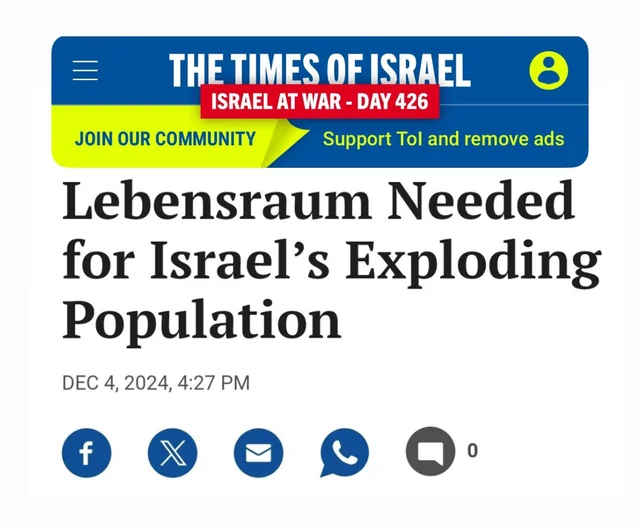
Genocide is a tool of the racial aristocracy and they use it without hesitation or conscience. When committing genocide in Africa, German racial aristocrat von Trotha gave a signed extermination order. He said at the outset of the war with the Africans he was genociding that their ‘uprising is and remains the beginning of a racial struggle’. Chief of the German General Staff Schlieffen, who came up with the plan to invade France through Belgium, wrote of von Trotha that ‘He wants to exterminate the whole nation or drive it out of the country. In this, we can only agree with him … Once racial war breaks out it can only finish with the annihilation of one of the parties.’ Other German theorists laid down all the elements of Western genocidal thinking – applied vigorously now by the Israelis – at the end of the 19th century. Friedrich Ratzel made a geographical theory about the “struggle for existence” of the races and the search for “Lebensraum” – and founded the German colonial society.
Lebensraum talk isn’t out of fashion in this world
Ratzel believed that inferior races must be actively destroyed by superior races – his successful examples: North America, New Zealand, Australia – and South Brazil.
In 1912 a German named Rohrbach wrote a book called German World Policies, which made arguments you could read in pro-Israel twitter, the WSJ, or an Israeli news site: “It is not right either among nations or among individuals that people who can create nothing should have a claim to preservation. No false philanthropy or race-theory can prove to reasonable people that the preservation of any tribe of nomadic South African Kaffirs … is more important for the future of mankind than the expansion of the great European nations, or the white race as a whole. Should the German people renounce the chance of growing stronger and of securing elbow room for their sons and daughters, because … some tribe of Negroes … has lived its useless existence on a strip of land where ten thousand German families may have a flourishing existence and thus strengthen the very sap of our people?”
In 1907, he published German Colonial Commerce: ‘In order to secure the peaceful White settlement against the bad, culturally inept and predatory native tribe, it is possible that its actual eradication may become necessary under certain conditions.’
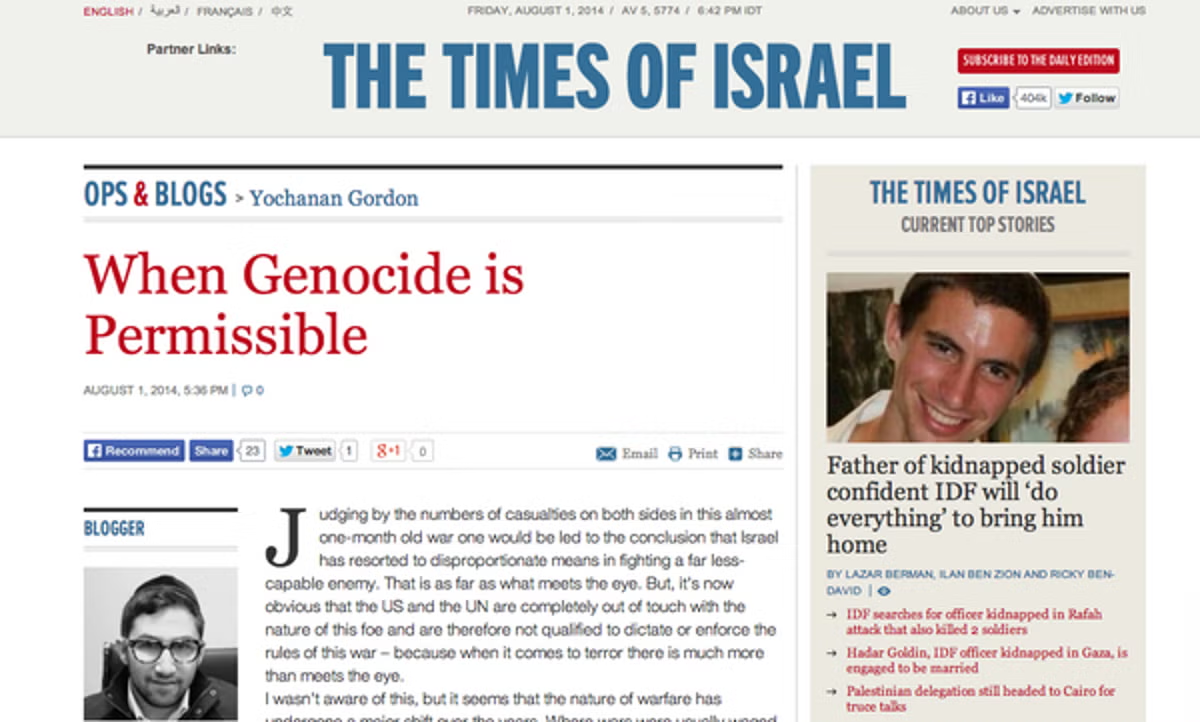
We’re ruled by people who think genocide is permissible
Law
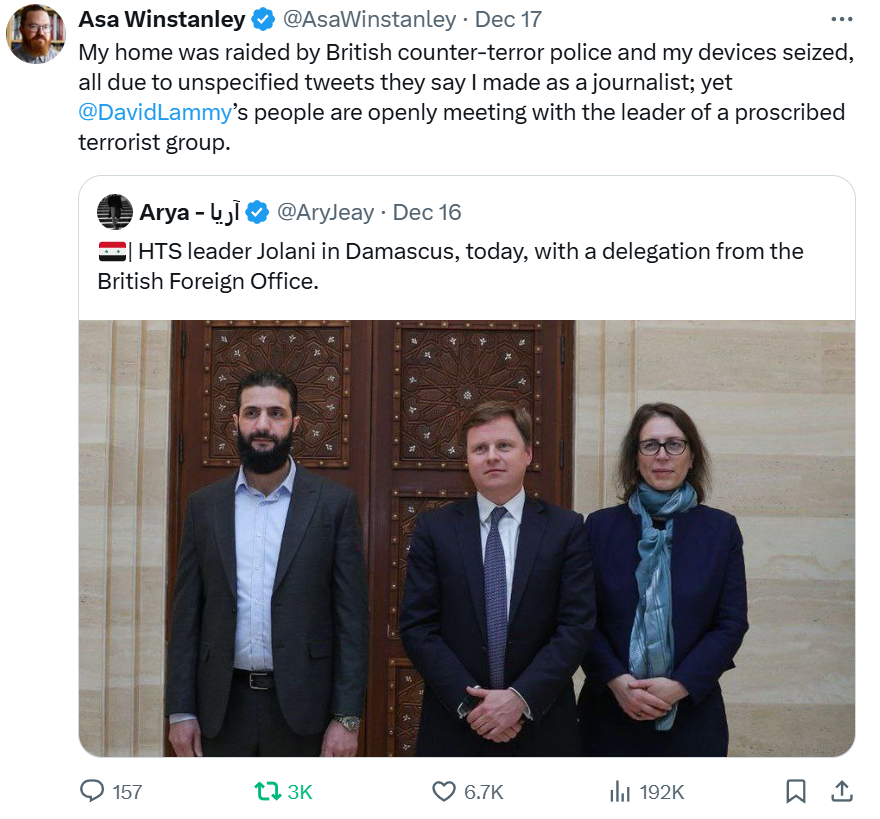
Apparently this is a world of international law, international courts, and a genocide convention, a United Nations Security Council that can pass resolutions that stop countries in their tracks. All are set aside if the racial aristocrats want to commit a genocide or violate the law. Anti-terrorist police are used to seize the electronic devices of ordinary journalists like Asa Winstanley while UK officials meet with the leader of an organization on their own terrorist list.
Sovereignty and territorial integrity is suspended…
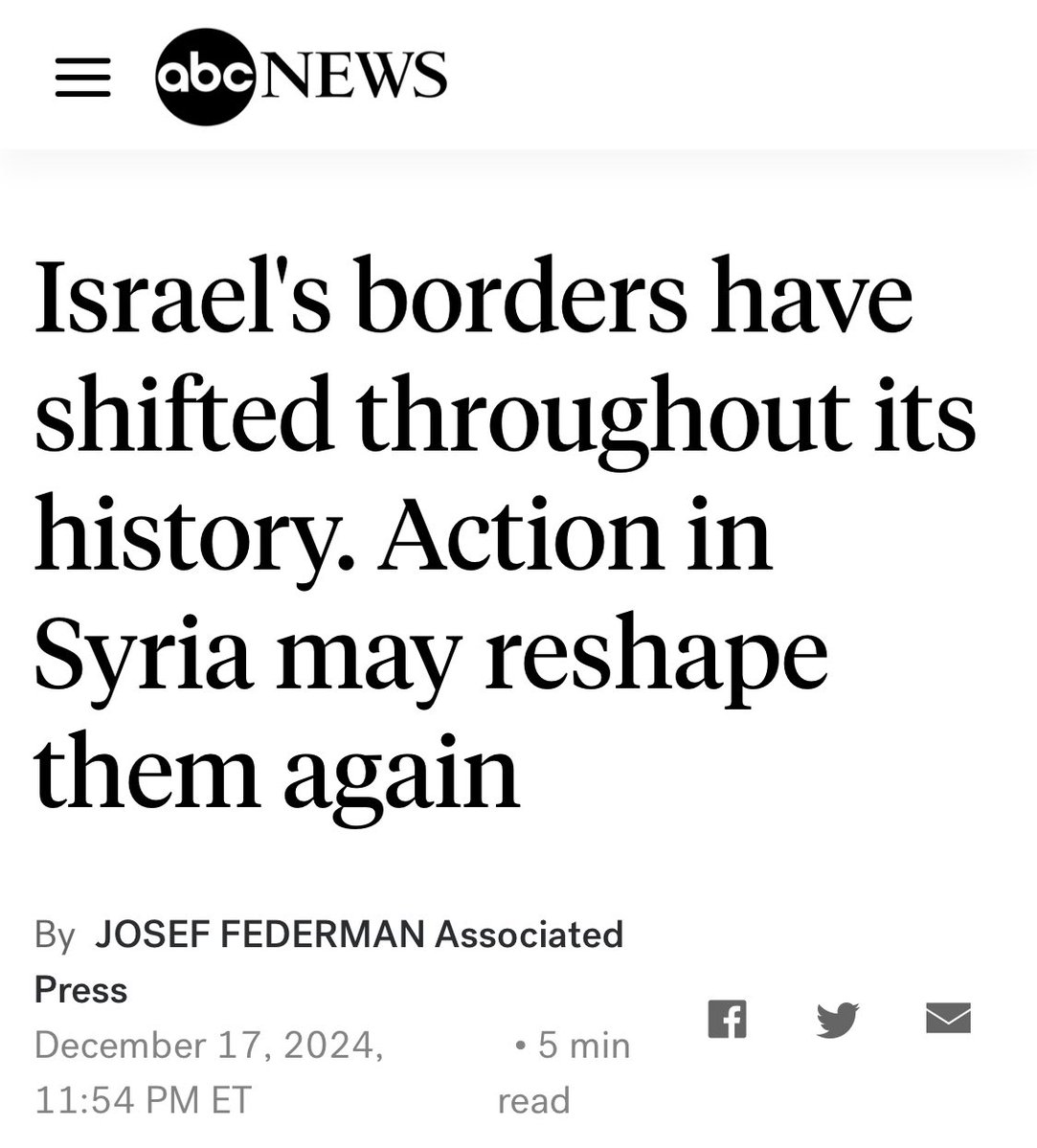
… if the racial aristocrats want to redraw the map of Syria and invoke conquest to do it.
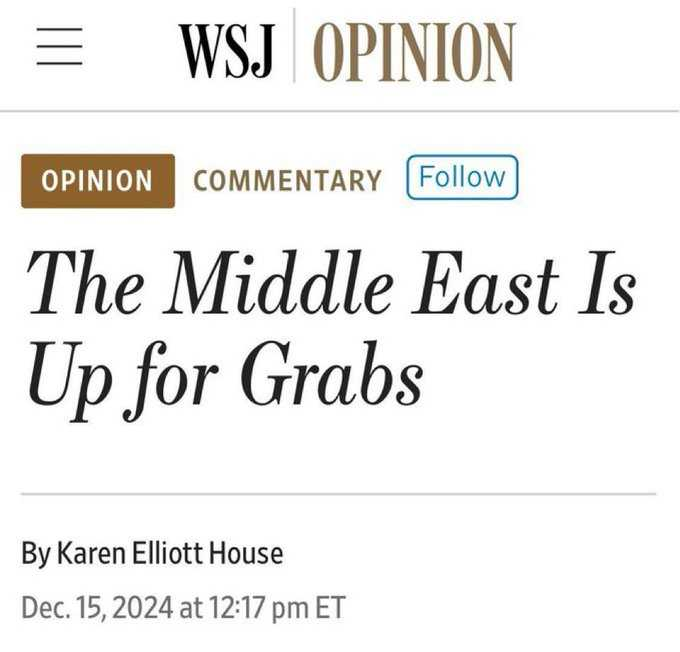
While the colonized make strategies for state building, colonizers make plans to grab
Criminal law does not apply to our racial aristocrats: it is they who define crime and dish out punishments. By definition they cannot be criminals.
Crimes on the books? Torture? Murder? Rape? All are permissible if committed by the right people and in the cause of upholding the actual world order of racism and genocide. So no, the law does not apply to all. It is just another instrument in the hands of our rulers.
Truth
The law is a marvelous tool indeed, but it’s the power over the truth that the racial aristocrats especially appreciate: what is true is what they say it is. They define “terrorism”, they define “racism” and “antisemitism”, teaching these things from childhood school textbooks to legacy and social media.
They tell lies to test our loyalty to them. The atrocity propaganda they use to justify the genocide, the lies about “human shields” they repeat after every massacre in this genocide: it is not up to us to judge their truth or falsity, it is up to them to judge us based on how intensely we express that we believe them.
Professionalism and its standards for truth are secondary to racialist loyalty. Journalistic, academic, or scientific methods for finding truth are useful but so is overriding them to uphold racial rule. Debunking lies is allowed, but only when it’s too late to make a difference. Interfering with any aspect of an ongoing genocide is a crime, whether it is through trying to boycott, trying to debunk atrocity propaganda, or trying to stop the flow of weapons.
Shiny Objects
It’s been a grand year for the grand racial aristocracy. They’ve genocided Palestine and destroyed Syria. The Israelis have targeted Iran for destruction; the Americans are aiming at Russia and then China. While it’s true that the West’s rivals are building hypersonic weapons and miraculous technologies, corridors and win-win business relationships, what do these matter when the Anglo-Americans “get into the skin of remote peoples”? Racial aristocrats convince the very people they’re destroying to do their fighting and their building for them. Iranian strategy is patient and thoughtful, Russian arms are fearsome, and the Chinese economy is without rival now. None of that will matter if they can be regime-changed and convinced to self-destruct or intimidated into retreat and self-sabotage.
Russia and China have said that they want to replace the US-centric world with a multipolar one of win-win deals, shared prosperity, common security, the UN charter, and international law. To the Anglo-Americans, these things are nothing but shiny objects to fool the stupid lower orders of the world. To them, we are dirt: the only rules left are those imposed on us by those who believe they rule by racial right.
As for those who work to destroy postcolonial states: they serve the racial aristocracy very well.
On empathy and historical investigation as research methods
American writer Ta Nehisi Coates has a new book called The Message and has been saying some things that make sense about Palestine, apparently in the book and during his promotion of it. I am not sure what to make of Coates. He’s a writer, he teaches writing, as he’s been reminded on television recently, he’s been given great awards and accolades and publishes in the highest literary circles of America (all of which, he was reminded on CBS, can be taken away). From what I’ve seen (I will read the book but I have not yet) the book is intended for writers. I’ve always had some discomfort with the idea of identifying as a writer. Writing is a tool; you should identify with the reason you’re using the tool. Hassan Nasrallah’s principal activity was preparing and delivering speeches, but I wouldn’t have called him a public speaker. I have made a lot of youtube videos this past year, but I wouldn’t call myself a youtuber. As for the accoladed writers, there seems to be an agreed-upon illusion that their words have some kind of unique power beyond that of normal writers. You might find the same facts (with or without the citations) or the same insights elsewhere, but there is something special about it when it’s given to you by a Writer. I’m not even above that feeling – I like reading the work of an exalted Writer as much as anyone. I just think it’s a shared illusion that we’re all partaking in. And it isn’t a great time to have illusions. Not about this.
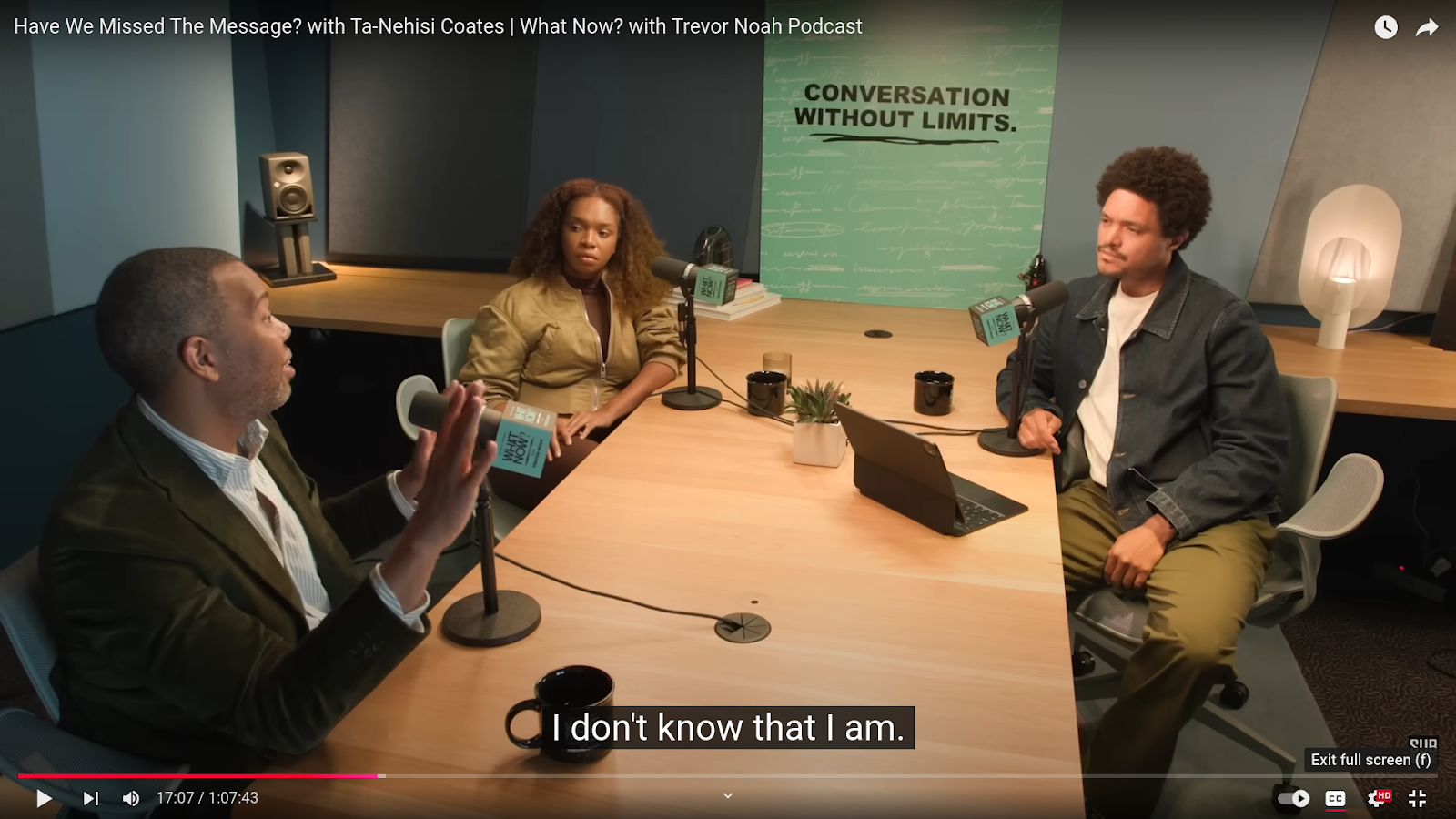
Here I’m not writing about the viral CBS interview clip where some pro-Israel TV host threw all the regular talking points at Coates, who answered them with great ease. I want to look instead about his debriefing of that and discussion of the Palestine part of his book with Trevor Noah and co-host Christiana Mbakwe Medina, on Noah’s podcast. I think some of you may have guessed the part of it that I want to talk about.
Both Noah and Coates say a lot of good things worth listening to in here, for example:
Noah points out that no pro-Israel friend of his can argue that Israel *isn’t* an apartheid state
Coates points out that there can be no justification for apartheid, and that in trying to justify it, Israel’s defenders admit that they believe there can be justifications for racism, apartheid – and now genocide as well.
But among these good things, Coates gets to a moment, around minute 14, where he talks about October 7th, and the discussion here pretty well cancels out the good he does elsewhere in the interview.
He says, “I try to maintain my great horror at October 7th… because human life really matters to me.” A minute later, he continues, asking the rhetorical question: “Is there room in the world… to have genuine genuine horror about what happened on October 7th? And I’m not Palestinian, I’m Ta Nehisi Coates. There’s no reason that I can apprehend to justify anything like that.”
In his recent interview with Middle East Eye, Coates talks about how he writes much better when he can actually go and see for himself. Indeed Trevor Noah commended Coates for going and seeing for himself and bringing back the words after doing so. But Coates didn’t see October 7th. I have seen everything available to the public that happened on October 7th; I have heard descriptions from journalists who attended the Israeli screening of the footage they assembled for the express purpose of trying to create support for genocide.
What happened on October 7th was an early morning raid by trained, disciplined guerrilla forces on the Israeli bases that maintain the siege on Gaza, a raid whose goal was primarily to take military prisoners that could be exchanged for the thousands of Palestinian prisoners that Israel keeps and tortures. Prisoners who, if Israel has its way, will never be free. One group of fighters from the Qassam brigades, Hamas’s armed wing, were surprised to encounter a rave party, the Nova Music Festival, whose location beside an Israeli air force base had only been announced to attendees just before. Israelis trying to flee this music festival were slaughtered from the air by Israeli helicopter gunships. When Qassam fighters infiltrated into the fortified villages that enclose Gaza, Israelis were also slaughtered in these villages by tank fire from the Israeli army who happily killed Israelis for the chance to kill Palestinians – the new rules that Israel lives by, as I’ve discussed in a previous post.
The “great horrors” that circulated as stories after October 7th, about 40 beheaded babies, about rape being used as a weapon of war – turned out to be fabrications, sourced back to a small number of Israelis whose stories fell apart, as Max Blumenthal details in the film Atrocity Inc.
Here’s the point: Coates didn’t “go and see” for himself. He doesn’t appear to have done any investigation at all. Instead, he has simply accepted the lies told by the colonizer. Given the importance of analogies in Coates’s writing, he should know that colonizers lie about the people they oppress. He should know the kinds of lies they tell, the nature of atrocity propaganda, and the purpose of it in preparing the public for genocidal violence against the oppressed. How many times has this specific pattern of lies recurred in American history? Where has it led, each time? Coates needs to make this connection.
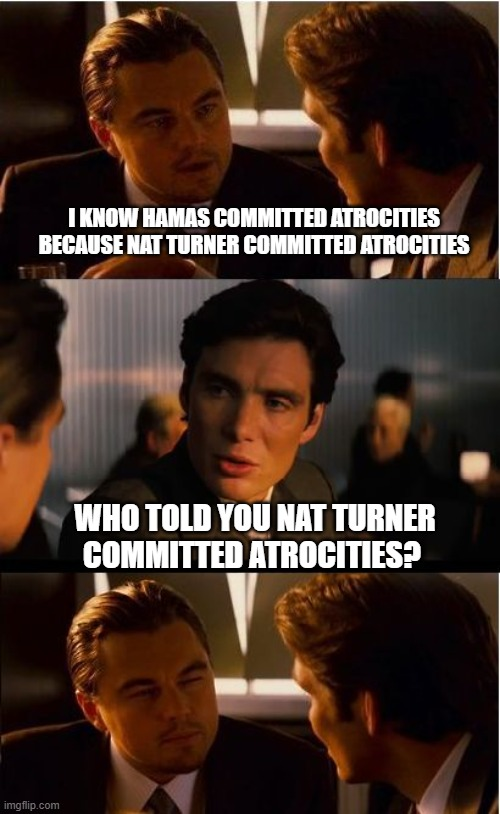
When he does make an analogy to American history, Coates tells the story of Nat Turner’s rebellion – and does so also in a way that doesn’t seem to recognize that slavers could lie about what rebellious slaves did. About Nat Turner, Coates says, “this man slaughtered babies in their cribs.” In fact, as I mentioned in our last tankie therapy session, my first thought when I heard Normal Finkelstein first make this analogy last year (the analogy of October 7th 2023 with Nat Turner’s 1831 rebellion) was that perhaps Nat Turner didn’t commit atrocities either. Having watched the construction of atrocity propaganda in real time this year, it is hard to imagine the slaver society told the truth about Nat Turner’s rebellion in 1831 (by the way I covered this rebellion in my historical podcast about four years ago now). It is incorrect to rely on a history written by the enslavers about atrocities committed during a slave revolt 100 years ago as analogical evidence that atrocities were committed during a guerrilla operation last year.
No babies were slaughtered in their cribs on October 7th. No babies were beheaded. There was, according to the Ha’aretz list, one child who was killed by accident in one of the Israeli villages of the Gaza Envelope. The Palestinian Resistance fighters who attacked fortified Israeli bases on that day were not acting out the degradation of their lives (probably neither was Nat Turner). They were enacting a military strategy and doing so according to their (Islamic) military ethics, which do not allow harm to civilians nor sexual violence. If Coates can listen to Israelis, can give them a hearing, he should also be able to give a hearing to the voices of the Resistance: spokespeople, political leaders, intellectuals. I’ll return to that point below, but let me address how Coates made it even worse:
At 15:48, he says: “I’ve done this thought experiment for myself over and over. Does the degradation and dehumanization of slavery make it so that you can look past something like that? And I think I can accurately imagine that there were enslaved people that said this is too far, I can’t do that. Now here’s the flip side of it. And I haven’t said it out loud. Were I 20 years old, born into Gaza, which is a giant open air jail – if my father is a fisherman and he goes too far out to the sea he might get shot, if my mother picks the olive trees and she gets too close to the walls she might be shot, if my sister has cancer and she needs treatment and if I can’t get the right permit for it she might die? And I grow up under that oppression and that poverty. And the wall comes down. Am I also strong enough or even constructed in such a way where I say, this is too far. I don’t know that I am.”
This thought experiment has nothing to do with reality. Coates has tried to use empathy and imagination but he doesn’t have the factual foundation to get where he is trying to go. It’s true, the conditions in Gaza are like he describes – worse, in fact – but that has not installed in Palestinians a drive to go and commit “great horror”. Palestinians have a drive to be left alone in their land. Palestinians have a drive to study and pursue education. Many Palestinians have a drive to take care of the land in their Mediterranean ecosystem of olive and orange trees. The Gaza-grown, vengeful Ta-Nehisi that Coates is trying to imagine doesn’t exist. The real people weren’t waiting for a chance to get even, or inflict the degradation they’ve suffered on their oppressors. They were waiting for a chance to get their freedom and to get their land back, and they did so in an organized armed struggle, not chaotic violence. There’s no need for this kind of imaginative exercise when the facts are available.
Immediately after this interview, some cartoonish Israeli writers took this thought experiment and ran with it to defame Coates. By using his imaginative exercise to defame the Palestinian Resistance and by avoiding investigating for himself what actually happened on October 7th, Coates rendered himself defenseless against the pro-Israel lobby’s smears. Coates first decided to believe the lies about “horrors” on October 7th, then said he didn’t know if he had the strength to not commit such horrors. This was all unnecessary: the facts of what happened don’t match his implication and the logic of the Resistance exists entirely outside of the idea of inflicting reciprocal degradation.
Coates is a writer who uses autobiography and his background is an open book. His father was a Black Panther and the publisher of Black Classic Press, which published many important Black intellectuals. Some of what Coates says on Noah’s podcast suggests that he missed many of the important points that these intellectuals were making. He says that in Israel, he saw “some of the nationalist impulse that I grew up under”, but “taken to the Nth degree.” But Zionism is nothing like Black Nationalism taken to the Nth degree. Zionism is a form of colonialism, and Black Nationalism is an anti-colonial ideology. At 24:45, he says about Zionism:
“I can feel the parallels, the fraternity for it and the sympathy, I understand it. But you see where it goes. And a people who have been repeatedly degraded over the centuries, massacred, killed, chased, ethnically cleansed themselves out of Spain, can go somewhere and create a system of dire inhumanity against other people. That was a challenge for me as a Black person, because I started thinking, what would we be if we had power? What would we do? “
[One day I might return to this historical question of medieval Spain, which I happen to know a lot about – but it’s a huge mess and Coates bringing it in here adds more muddle to the thinking, not less.]
The belief that Coates holds that Black people, in power, would become Zionists, is incorrect. Not because it isn’t humanly possible – of course it is – but because it shows a lack of understanding of what Zionism is. Coates relies too much on the analogy he has made between two things that are much unlike one another – the Black nationalism published by W.P. Coates’s press (John Henrik Clarke, Bobby Seale, Amiri Baraka) – and the Zionism of Herzl and Jabotinsky, of Bill Clinton and of Netanyahu. Zionism, as I’ve documented here in an eight-part series, is an anti-Jewish ideology. And as I’ve documented in my historical podcast, it was an ideology of its time – and that time was the Scramble for Africa – and that ideology was of European colonization. You can like it or hate it, but Black Nationalism has nothing to do with this. Coates knows this, but it seems to slip through his fingers in his over-empathizing and his over-connecting of these ideologies.
The tree from which Zionism springs is the Anglo-American colonialism whose settler colonial branches live in Canada, the US, Australia, New Zealand, and whose devastated post-colonies in Asia and Africa continue to pay trillions in tribute (tribute given various names: repatriated profits, brain drain, suppressed wages, interest on debts…) to their former colonial masters.
The tree from which Black Nationalism springs is the tree of resistance to all of this, and it shares much with other ideologies of national liberation from colonialism around the world. European colonization of the world is a few centuries old and in terms of technological and ideological sophistication (including specifically the deployment of lies) it is unique. When Coates says that it isn’t unique to Zionism but it is a “human problem”, it’s another case of over-empathizing, this time with European colonialism:
“This doesn’t work if you can’t see yourself within Israel and within Zionism. If you think this is just evil people doing some evil thing, you’ve missed it. This started somewhere. Once I started reading the documents about Zionism, on one level, I recognized the colonialist discourse, but the other part was I recognize the yearning.”
But Zionist yearning, for a colony, could not have been more different from Black Nationalist yearning, for liberation. To achieve hegemony over the Jewish community, Zionists had to defeat both religious and secular Jewish traditions and identities. There were Jews who yearned for liberation from European racism, who Coates should empathize with. But they were not Zionists.
In an article about The Message, one of Coates’s friends said that Coates goes through a very public learning process. He’s approached his study from the wrong direction, starting with Zionist intellectualism and discovering the evils that occur as it’s applied on the ground. For the next phase of the learning process, the Resistance’s intellectuals should be the avenue of approach. As a writer’s writer, how about the late Refaat Alareer? Ghassan Kanafani would be a good one to have on the shelf. Salman Abu Sitta is way underrated. Hassan Nasrallah’s speeches. Abu Obeida’s speeches. Yahya Sinwar’s novel too. Since Coates has already said that he doesn’t care about the awards and accolades, that he wants to be a writer to go into those kinds of places, that’s the direction to head in. More historical investigation. More reading the words of those who never had illusions about Zionism in the first place.
Briefly straying from my lane to make a quick point
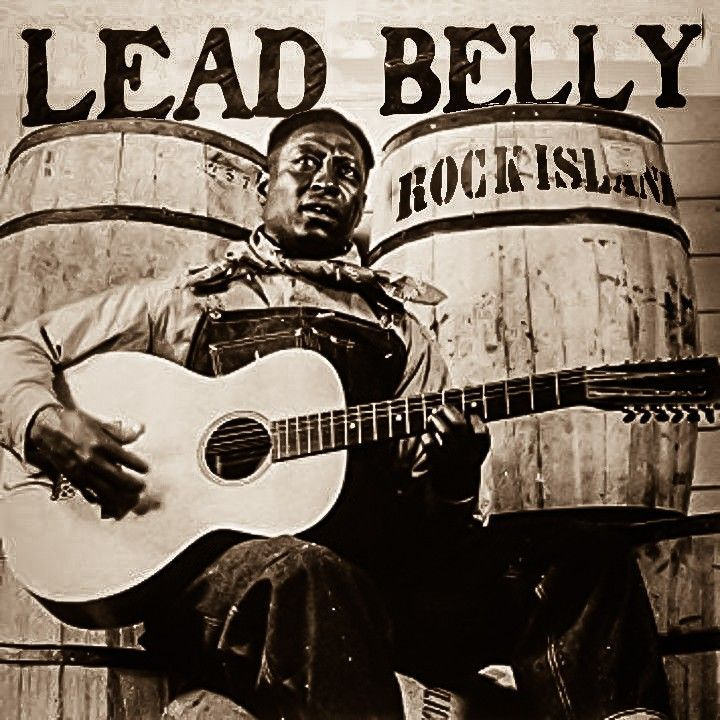
A Black American folk singer, Lead Belly, enjoined listeners in 1938 to ‘stay woke’ in a song about a false accusation against a group of young black men in Alabama. A century later and the word is exclusively used as an epithet, a code word that identifies its speaker as someone who has some opposition to left-wing politics.
That isn’t how the anti-’woke’ would put it, of course. Champions of the liberal value of free speech, right-wing anti-wokes believe that left-wing orthodoxies have gone too far and stifled these once widely available liberal freedoms. When asked for examples, the anti-wokes will generally present examples like drag shows, pronoun etiquette, and trans women competing in sports.
There are details and ongoing areas of study and work when it comes to how to implement these values in a way that allows everyone to be who they are (trans rights, sex and gender equality, etc.) There’s a lot to know about these issues and readers know this isn’t my lane. But to my eyes, comparatively untrained on these issues, the selected anti-woke examples look like a distraction or an outrage engine, like the way most of these same anti-wokes talk about immigration, crime, or terrorism.
Anti-imperialism is, and like all left-wing ideologies is based on the core value of equality. And the anti-’wokes’, whether they justify it as naturally ordained by science or divine will, generally hold a core value of hierarchy. It’s an irreconcilable difference.
Almost all anti-woke criticism is just right-wing politics and therefore holds nothing of interest for leftists.
There is one legitimate complaint in the antiwoke arsenal, which is against the language-policing that takes place in mainstream, liberal institutions. But language-policing in such corporate environments has nothing to do with equality and therefore nothing to do with anything truly left-wing. It is nothing more than an office game, in which the winner is the one who can master the language and the bureaucratic rules. Words and concepts that were developed in communities fighting for liberation – or even survival – have been stolen, appropriated by liberal professionals for use in their office power games. But the theft of these words and concepts doesn’t discredit the projects of liberation from which they emerged.
Now we can come back to my lane. You know the old saying that when you scratch a liberal a fascist bleeds? The Gaza genocide has scratched the liberals and the fascists alike. Turns out that when Palestine comes up, the right wing (squealing for police to crush speech and deport protesters) doesn’t care about free speech or assembly and liberal professionals didn’t mean anything they said about the liberation of oppressed groups by race, class, gender, and sexuality.
Anomalous exceptions aside, both antiwokes and the liberal professionals they claim to despise have revealed themselves to be enthusiastic supporters of genocide who hate us much more than they hate one another. There’s no use contemplating alliance with these people or searching for common ground.
I have over the decades, every few years, written something to protest left-wing language-policing and the adoption of liberal professional games. But leftists will find no allies among the anti-’woke’. They don’t want us and we don’t want them. They mock social justice warriors and they mock being woke, but it’s better to be a warrior than a coward and it’s better to be awake than asleep.
False friends are everywhere. Lead Belly warned us about them, and told us the state we need to be in, to remain vigilant.
There is no case of nonviolent anticolonial struggle
The US struggle for civil rights, remembered as the nonviolent movement of Martin Luther King, was also the movement of the Deacons for Defense in Louisiana, the movement of the Mississipi Regional Council of Negro Leadership which could “speedily mobilize substantial and deadly firepower” including E.W. Steptoe who had “guns all over the house, under pillows, under chairs”, of Robert Williams of Monroe, North Carolina’s NAACP who said in 1959 that “we must be willing to kill if necessary”, the movement of a night-long battle with police in Albany, Georgia in 1962 and in Birmingham, Georgia in 1963, when “every day of riots was worth a year of civil rights demonstrations”.
The Indian Freedom struggle, remembered as the nonviolent movement of MK Gandhi, was also the movement of the Hindustan Republican Army, of Chandrasekhar Azad and of Bhagat Singh, of the Telengana Uprising of 1946, of the Tamil Nadu anti-feudal struggle of 1943, of the underground guerrilla struggles after Quit India in Odisha, West Bengal, Bangalore and elsewhere, of the Toofan Sena in Maharashtra, of Indian National Army of Subhas Chandra Bose, and of the Naval Mutiny of 1946.
The two most iconic tales of the deployment of strategic nonviolence turn out, upon historical examination, to have been armed struggles, replete with violence.
Through an analysis of the work of Gene Sharp (“Gene Sharp’s Neoliberal Nonviolence” part 1 and part 2), writer and academic Marcie Smith has revealed the existence of a sort of “nonviolence industrial complex”, a network of institutions linked to the US foreign policy establishment, dedicated to two things: 1. steering opposition to US-backed states and projects in nonviolent directions, and 2. to using methods of nonviolent insurgency as a part of a set of tactics (including covert, violent action) to destabilize US targets.
The jewels in the narrative crown of this nonviolence network are the US civil rights movement and the Indian Freedom Struggle, which is why I devoted the two previous articles in this series to showing that these were in fact armed struggles.
The narrators of the nonviolence network have one other weapon: quantitative analysis. But this weapon too, turns out to be a plastic replica.
In their book Why Civil Resistance Works, Erica Chenoweth and Maria J. Stephan claim to have proven through statistical analysis that nonviolence is more effective than violence. Their analysis is worth detailed examination since it claims to have the authority of a huge dataset and logistic regression proving the chances of success are higher with nonviolence.
But what did they actually do? They made a list of several hundred revolutions from the 20th century (nearly all of which were in fact violent), coded some struggles as violent and others not, coded some struggles as successful and others not (in fact many of the successes delivered the countries and their economies directly over for imperialist plunder), and then after a quantitative assessment which amounts to counting the number of successful cases of each type, found that their “nonviolent” coded struggles had a higher chance of success. These nonviolent-coded struggles include:
the South African struggle (including its armed wing, Umkhonto we Sizwe);
and the many East European color revolutions.
the Palestinian Intifada;
A quick skim of any of these histories show that these were all violent struggles. The data reveal the conclusion the authors believed at the outset and for which they coded their data. Why Civil Resistance Works is historical falsification covered with a quantitative mystique.
To determine the veracity of their analysis we need examine only those events coded as both nonviolent and successful. Nonviolent failures are of no interest, since they do not bolster the nonviolence narrative. Neither violent successes nor failures are of interest either, since to the nonviolence industry armed struggles are already failures.
The database published with the book contains 57 nonviolent successes. There are two types of movements analyzed in the database: movements for regime change and movements for secession. There are no nonviolent successes for secession movements: all 57 nonviolent successes are regime change successes. There are only 4 secession successes out of 46 attempts in the database (Croatia, Tigray, Bangladesh, and Aceh from Indonesia starting in 1976-2005). All of these were violent.
Philosophers of science know that there is a complicated set of human decisions that go into the translation of things occurring in nature into statistical data. Even such decisive phenomena as birth and death can only be entered in a spreadsheet as “0” and “1” by the declaration of a doctor. Of all the types of data to translate into “0”s and “1”s on a spreadsheet, historical data is the worst. Was the French Revolution a success, a failure, or is it too early to tell? In history, some failures are necessary prerequisites for future success; some processes simply cannot be classified as one or the other (Chenoweth and Stephan include a “limited success” category to try to capture these).
The relevant point here is that the coding of these 57 events as both “nonviolent” and “successful” ranges from deeply problematic to utterly preposterous.
Going through them:
In this database, the Palestinian liberation struggle apparently started in 1973, was violent, and a failure. The Intifada, 1987-1990, is considered a nonviolent partial success. The 1979 overthrow of the Shah of Iran, which I won’t dispute was successful, is coded as a nonviolent process – which would be a surprise to the guerrilla fighters and defectors who fought the Shah’s soldiers in the streets. The 2005 Cedar Revolution in Lebanon is coded as a success, but it did not change the regime and Lebanon’s political system continued as before.
The Cedar Revolution is not the only “color revolution” (short-hand for a US-backed regime change operation in a US enemy country led by US-trained political and media cadres) coded as a nonviolent success. Indeed a good part (14 of the 57) of the nonviolent successes are East Europe color revolutions: 1989 Germany, 1981 Poland, 1989 Hungary, 1989 Czech, 1989 Slovakia, 1989 Bulgaria, 1990 Russia, 1989 Estonia, 1989 Latvia, 1989 Lithuania, 2001 Ukraine, 2003 Georgia, 1989 Kyrgystan, 2005 Kyrgistan. In the background of all of these color revolutions was the threat of US-led NATO expansion and US nuclear war, as well as the fact of US violent covert operations. Three more of these East Europe nonviolent successes – 1999 Croatia, 2000 Yugoslavia, 1989 Slovenia – are from the incredibly violent US-led dismembering of Yugoslavia in a series of civil wars (described in, e.g., Michael Parenti’s book To Kill a Nation and Diana Johnstone’s book Fool’s Crusade).
NATO bombed bridge in dismembered Yugoslavia, 1999, one of the nonviolent successes in the database.
In Africa, in addition to coding the South African anti-apartheid struggle as nonviolent (which would be news to umKhonto we Sizwe, the armed wing of the African National Congress), and the Ghanaian, Zambian, and Malawi Independence struggles as nonviolent (they were not), the majority of African nonviolent successes in the database were mass mobilizations to press for elections. These were: 1989 Mali, 2000 Ghana, 1993 Nigeria, 2001 Zambia, 1992 Malawi, 1991 Madagascar, 2002 Madagascar, 1985 Sudan (in active civil war at the time).
In East Asia, the 1960 April Revolution in Korea (in which 186 people were killed) is coded as a nonviolent success, as is the 1986 People Power Revolution in the Philippines (after decades of guerrilla struggle and notable defections from the military). East Timor, widely recognized to have suffered a genocide from the 1970s to the 1990s, is coded as having had a nonviolent success in 1988, despite Independence coming in 1999 after a long guerrilla war. A 1973 popular uprising in Thailand, that had bomb explosions and dozens of deaths in riots, is coded as a nonviolent success. So, too, in Thailand, a long-running political crisis in 2005 that culminated in a military coup in 2006, is coded as a nonviolent success.
In the Americas, the database includes as nonviolent successes a 1931 naval mutiny in Chile, a 1944 armed revolution in Guatemala, 1958 Venezuela (which featured attacks on security services headquarters and resulted in the awful Punto Fijo pact), a clear failure to overthrow the system in Mexico in 1987, and struggles against dictatorships in Argentina (1977 and 1986), Uruguay (1984), and Chile (1983), all of which had prominent guerrilla movements. The database cites 2002 in Venezuela as a nonviolent success, but there were two things that happened in April 2002 in Venezuela: a violent coup against Chavez and its reversal when the army refused to endorse the coup: the coup failed, the the successful reversal of the coup involved military moves.
In Europe, a 1974 military coup in Portugal is coded as a nonviolent success. Of the churning conflicts, revolutions, and civil wars in Germany in the 1920s that culminated in the rise of Nazism in the 1930s and the most violent events in human history so far, 1923 in Germany is coded as a nonviolent success.
There is, however, a specific type of conflict coded as a nonviolent success in the database that recurs in different parts of the world, in which a spent dictatorship gives way, in the face of a basically nonviolent popular movement, to an election. About eight of the 57 nonviolent successes belong to this pattern: 1963 and 1974 in Greece, 1977 in Bolivia, 1984 in Brazil, 1985 in Haiti (which led to a military coup and additional years of mobilization until Aristide was elected, then violently overthrown again…), 1990 Guyana, 2000 Peru, and 2001 in the Philippines. This particular set of eight cases (five of which took place in the Americas) could be used as evidence for the argument that, under the right circumstances, largely nonviolent popular mobilization can reverse a stolen election or force a weakened government to agree to elections. It does not prove at all that nonviolent movements have a better chance of success than violent ones. But even in these cases, the threat of violence existed.
There is value in analyzing and comparing movements of resistance in history. There may even be value in coding them and calculating probabilities. But there is no value to be had in building a model for probability of success based on violence and nonviolence by miscoding failures as successes and armed struggles as nonviolent.
We never needed a database to tell us that under some circumstances a social and political struggle can be kept on the nonviolent plane. The key factor is the investment elites have in maintaining the policy that is being challenged. Union struggles can often succeed in winning wage and working conditions improvements nonviolently. Every election where the loser congratulates the winner and there is a peaceful transfer of power is an example of a successful nonviolent struggle. But colonialism, struggles over land, in which oppressors have racial ideas of superiority over the oppressed? In these cases, whether it succeeds or fails, armed struggle alone has a chance. Only by wielding falsified histories and models can the nonviolence storytellers argue otherwise.
Palestine 2018: the final proof of the uselessness of nonviolence in anticolonial struggle
And so we turn to Palestine, a colonial struggle over land, in which the oppressors have racial ideas of superiority over the oppressed and are, since 2023, engaging in active genocide. Palestine has been an area of focus for the nonviolence industry for decades.
A February 2024 paper by the Center for Constitutional Rights has shown that US anti-terror legislation was “driven by anti-Palestinian agendas from the beginning.” The nonviolence industry has had a similar Palestine focus from the beginnings of Gene Sharp’s Albert Einstein Institute. The 1987-1989 Intifada was an object of fascination for Sharp and for the nonviolence industry. Sharp’s Journal of Palestine Studies article in 1989, “The Intifadah and Nonviolent Struggle”, identifies him as the author of the 1973 book The Politics of Nonviolent Action as well as the author of Almuqawama Bila Ounf (Nonviolent Resistance), published in Jerusalem by the Palestinian Center for the Study of Nonviolence in 1986. In the article, Sharp argues – quantitatively again – that 85% of the intifada has been nonviolent. He simply asserts that armed struggle and nonviolent struggle are “not easily mixed to advantage” – and so the Palestinians should go from 85% to 100% nonviolent. After the usual arguments absolving Israelis of responsibility for the violence they mete out on Palestinians and the normal nonviolence argument that the the colonial repression faced by the victims is their fault for provoking their oppressors, Sharp suggests Palestinians go on a 21-day hunger strike, followed by “whistling or wailing at night, especially in dark streets” and “having the youths standing peacefully, not fleeing, holding small Palestinian flags, their right hands outstretched in a gesture of friendship.” Sharp dangles recognition before well-behaved Palestinians: “The shift to fully nonviolent struggle would also make possible more active support for Palestinian independence in Western Europe and the United States.”
After months of genocide, starvation, and the gleeful mass murder of tens of thousands of children, all filmed and celebrated across Israeli society and by Israel’s supporters in the West, Sharp’s arguments are striking for their absurdity as well as their vulgarity.
But Sharp was not alone.
Pakistani activist and academic Eqbal Ahmed made the argument to Palestinians numerous times. He reported to journalist David Barsamian in 1996 (published in the 2000 book Confronting Empire) that he’d told a group of Arab students in the US after the 1967 war that “armed struggle was supremely unsuited to the Palestinian condition,” that “Israel’s fundamental contradiction was that it was founded as a symbol of the suffering of humanity at the expense of another people who were innocent of guilt,” and that “you don’t bring (the contradiction) out by armed struggle. In fact you suppress this contradiction by armed struggle.” He told them in 1968 that
“This is a moment to fit ships in Lebanon and say, ‘we’re not going to destroy Israel. That is not our intent. We just want to go home.’ Reverse the symbols of Exodus. See if the Israelis are in a mood to sink some ships. They probably will. Let them do so. Some of us will die. Let us die.” Eqbal Ahmed imagined if Arafat were to “take on the role of a Gandhi or a Martin Luther King and announce tomorrow, ‘I must stop these settlements. They violate the spirit of Oslo. We are committed to peace. You are making war. We do not want to use violence against you. Peacefully we will march against you. We will sit in. We will clog the roads, start a full-scale movement, and discipline the Palestinians not even to throw stones, intifada-style, because Israelis will use and justify bullets against stones. They will use soldiers against children. Don’t even give them that.’ Israel will divide. It will divide as a society the way America divided. I would keep it divided until it makes peace.”
But Eqbal Ahmed, despite being an insightful anti-colonial strategist, was wrong about the histories he cited (Gandhi and Martin Luther King) and wrong about what would happen in the face of Palestinian non-violence, which did not divide Israel but incited Israel to ever-more intense racism.
Norman Finkelstein wrote a whole book (What Gandhi Says) trying to assimilate lessons from Gandhi to the Palestinian struggle. His conclusions are ambivalent to say the least, since at times he writes things like “it might fairly be said that Gandhi fostered a death cult.” The book ends up being a presentation of the self-contradictory politics in Gandhi’s writing, not the practical manual of civil resistance Finkelstein may have hoped to create when he picked up Gandhi’s 100 volumes of writing as an aid for the US-based academic and activist “to think through a nonviolent strategy for ending the Israeli occupation of Palestinian lands.”
Palestinians took up these ideas in good faith for years – in better faith than the method deserves. Hundreds of Palestinians died trying to do nonviolent struggle. So too did a handful of friends of Palestine, including Rachel Corrie, Tom Hurndall, and others in the International Solidarity Movement.
Eqbal had suggested finding out “if the Israelis were in the mood to sink some ships.” They were – they already had been in 1967, if we count the USS Liberty – but in 2010 a nonviolent flotilla tried to go to Gaza*. Israel boarded the ships, killed some of the activists, and arrested, mistreated, and deported the rest.
Israelis attacked the Mavi Marmara as it tried to break the blockade on Gaza in 2010
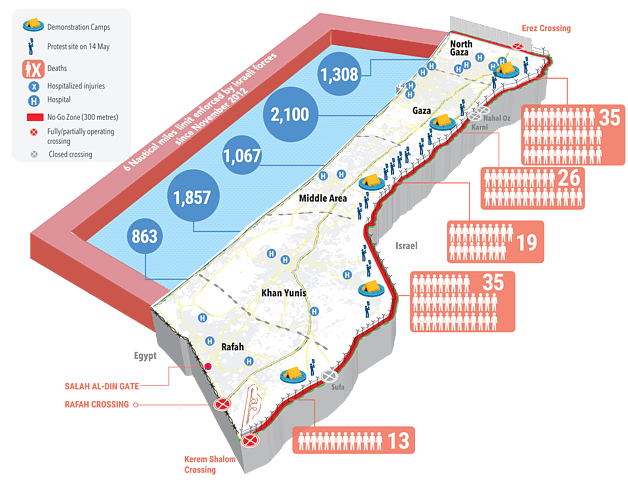
But the culmination of the nonviolent vision, the maximum horizon of all nonviolence, the controlled scientific experiment of perfect nonviolence, occurred in the Great March of Return in Gaza in 2018. It proved that nonviolence does not work. From a scientific standpoint, the nonviolence debate ended in 2018.
As Gene Sharp’s article on the First Intifada opened the debate on nonviolence in Palestine, Jehad Abusalim’s article, “The Great March of Return: An Organizer’s Perspective”, in the same journal, closed the debate on the topic.
The Great March of Return started, Abusalim reports, with a facebook post by Abu Artema on January 7, 2018. Abu Artema asked, “What could the occupation bristling with arms do to a mass of human beings advancing peacefully? Kill ten, twenty, or fifty of them? And then what? What could it do in the face of an unwavering mass peacefully marching?” Abu Artema and others worked to make it happen and organized for months, calling for a date in March:
“To the surprise of all concerned, an estimated 30,000–45,000 people showed up on the first day of the Great March of Return. And on that day, Israeli snipers shot dead 17 Palestinians and injured some 1,400 others.32 The mainstream international media instantaneously referred to the carnage as “rioting” and “clashes” but to those on the ground in Gaza, it was beyond shocking: how could nonviolent protests unleash such fury as to cause Israel to kill 17 peaceful protesters and maim or injure another 1,400? That is how, from the very first day, bloodshed came to define the protest.”
By the end of the protest, cold-blooded Israeli snipers had killed 226 Palestinians and methodically injured 30,000. For the Israelis, it was sport. The Western media fluidly and easily lied about the march, its nature, and the murderous Israeli response. Neither Israel nor its sponsors faced any crisis or internal division about what they were doing to the Palestinians. Neither Israel nor the West paid any cost for inflicting these tens of thousands of Palestinian casualties.
Abu Artema, the protest organizer interviewed by Abusalim in the article, seems bereft of ideas at the end – he feels that more international mobilization is needed, some tool that prevents Israel from “targeting Palestinians in such a horrific way” and to “prevent the occupation from using propaganda to prime the public for slaughtering us.” The nonviolence industry was unable to come up with any such tools: the slaughter of Palestinians at the Great March of Return was not the fault of the nonviolent protesters any more than the genocide in 2023-24 was the fault of the Palestinian armed groups. Israel is a genocidal state: then as now, it is doing what it is organized to do.
Six years later, Palestinians are waging an armed struggle against the Israeli military in Gaza and the West Bank. The Israeli military has chosen to accept military casualties and defeats on the battlefield (including the methodical destruction of its armored vehicles and groups of soldiers) to focus entirely on conducting a genocide against Palestinian civilians, with the central goal being the destruction of all of Gaza’s hospitals and educational institutions and the murder of patients and medical personnel, while blocking food and water from reaching people. Palestinians’ allies in Lebanon, Iran, Syria, Iraq, and Yemen are all engaging militarily with Israel and its Western sponsors. In the region, for the time being, the nonviolence case is closed.
Back in America though, in the solidarity movement, with the expansion of campus protests in April 2024, along with police repression all over the US, the nonviolence debate will rise again.
anti-genocide students face the cavalry in Texas
Anti-genocide students demand universities – which turned out, to the surprise of the students and faculty, to be investment banks that sometimes teach classes – divest from the military industry feeding the genocidal state. The pro-genocide establishment has called the police to crush the protests. What will be the outcome? Nonviolent or violent? Success or failure?
*As I write this, another nonviolent international flotilla is planning to leave from Turkey to Gaza.
Justin Podur: I’m here to discuss nonviolence with the panelists Sina Rahmani and Zeyad Nabulsy. And I wanted to start with the philosophical. And Zeyad is kind of a philosophical person who’s here.
Zeyad Nabulsy: Okay, I’ll introduce myself. I’m Zeyad and most of my research is on modern African intellectual history including African philosophy and history of science.
Justin Podur: It was your idea to discuss nonviolence.
Zeyad Nabulsy: I think in terms of the philosophical angle. So, so here is one way to explain why nonviolence is prevalent as a kind of trope that gets invoked in a lot of contemporary political discourse and in a lot of contemporary moral discourse. So think of like somebody who’s a Kantian, if you look at a certain approach to moral philosophy, it’s saying, okay, look, the world is a horrible place, basically, and I want to get out of this world with my hands as clean as possible. I think that’s more or less an accurate gloss of like what a Kantian would think. Once you have that point of view, I think then it becomes about fetishizing things like non-violence, fetishizing non-violence, and it becomes sort of a normative debate about what is right and wrong from a moral standpoint. And it’s not that these debates are not important, but I think when we’re talking about politics we’re talking about what is also efficacious, because sometimes the way people talk about this, they say something like violence never works, which, as a descriptive claim, is utterly false. So I that that’s where I think we should focus. That’s my view.
Justin Podur: So, normative. You mean, how one should behave?
Zeyad Nabulsy: Yes, precisely.
Justin Podur: So if you want to make the world a better place, you shouldn’t do violence. That kind of idea, because violence hurts the person you’re doing violence to.
Zeyad Nabulsy: Right. And it hurts you. So some people say, it dehumanizes you.
Justin Podur: Is that true?
Zeyad Nabulsy: Here’s the problem. I think the normative or moral standpoint becomes very inadequate for actually understanding concrete political issues. Under what conditions is violence acceptable? We don’t actually discuss any concrete case studies. So Palestine will be one of our central case studies. So my inclination is to think about how do these organizations work? What is efficacious? I know that sounds sort of Machiavellian, and it is. But I think that’s also like an element of Marxism is to, like, reject this moralistic, normative discourse.
Justin Podur: I’m all for moralistic discourse. I am. I think it’s a great thing to do to figure out how to be a good person and what what to do to be a good person in the world. You can build that abstract kind of house out of a series of premises. But when you get into a concrete political situation, then you have many, many, many more variables. And then to say that if someone is trying to kill you, if someone is doing Machiavellian, cold blooded politics against you, for you to say, I’m not going to do that in return, that could be immoral. You could be enabling something worse. So there are norms that work in simple situations or laboratory situations that don’t translate to the real world. So maybe that’s reason enough to reject starting from a normative perspective. I don’t know, are nonviolent people better people?
Sina Rahmani: This is bullshit. This is all bullshit. Like this entire idea, the world is this infinitely diverse place full of thousands of years of civilizational violence and and terror. The idea that you can break off history at a nice fictional point and say, oh, from now on, we do no violence. It’s a stupid liberal idea that ultimately says more about the discourse itself and the people who are trapped in it, i.e. all of us. Because once again, we have to realize that, like we talk about politics, we actually live in extremely depoliticized societies. All of us, especially in the English speaking world at least, whereby corporate media and the cultural wars that are curated by corporate media in alliance with academia curate a set of talking points for every semester, all pre-prepared. There’s a very small agenda of what gets discussed and it’s all done within this tiny bandwidth or narrow spectrum of this option. So all of this entire discourse is itself false, because what we’re doing is just doing political theory. The political theory of what is good and what is bad, which is totally stupid. And especially when it comes to the question of violence. A definition of violence is the guy with a Kalashnikov and a Keffiyeh as if that’s the only form of political violence, as if there isn’t political violence unfolding every day in late capitalist society everywhere. And it’s class and it’s race and it’s gendered, and it’s got all kinds of all kinds of complications and nuances based on the social context. And so the very idea that we can speak in theoretical terms, global theoretical terms about a stupid fake thing called nonviolence, it’s one of the one of the weird things that we absorbed as radicalism, which is sold to us as radicalism. So like WTO protest and all that stuff that the Gen X kids did. My contention is that this is just this is the conversation itself is false. But we should read this article.
Justin Podur: To skip ahead to the conclusion of this whole discussion from my perspective, is that the entire dichotomy is fake. The debate is fake, the dichotomy is fake. There’s no meaningful way to debate violence versus nonviolence in politics.
Sina Rahmani: It’s all a big red herring conversation.
Justin Podur: Violence. There’s no nonviolence. Both are always present. To divide it artificially into one and the other, it’s like, I can’t think of a great analogy. I’ve been thinking about analogies, and I think it’s like, imagine dividing fighting into punches with your right hand and punches with your left hand, and saying punches with your left hand are off limits, but punches with your right hand are are fine. You create this taboo when there’s no meaningful difference between those two things.
Zeyad Nabulsy: And can I just add something with that analogy? You’re banning using your left hand only on one side. So it’s asymmetric. That’s very important because your opponent doesn’t care. They’re like, okay, you’re an idiot, then I’m going to take advantage of it. Thank you.
Sina Rahmani: It’s a symptom of the fact that our depoliticized era is trapped under this stupid memorial rubble of World War two, the defeat of the Nazis and the rise of American Pax Americana as some kind of end of epoch in human history. Nonviolence and the institutionalization of it through activists and through the work of Gene Sharp, specifically the the presentation of the Third Reich as the antithesis to liberalism itself, with its with its weird, diabolical cousin, communism. Both of these are two wings of authoritarian politics that were thorough handedly defeated by liberalism in 1991, such that mediocre neocon philosophers were announcing the end of history.
Justin Podur: Let’s take it back to Domenico Losurdo’s book about nonviolence. Losurdo is a philosopher. But great history. He wrote The Counter History of Liberalism, which I would highly recommend to everybody. And then he has this book about nonviolence. And a lot of it’s got Gandhi, but the the chronological thing that he starts with is the so-called non resistors. So there were these abolitionists, white abolitionists, Christian religious people who were against slavery in the mid 19th century. You know, it’s from 1808 when when Britain, stopped the slave trade, they were pushing for abolition in America. And these people were they were very, very specific that they did not support any slaves uprising. So they were very careful. They broadcast that from everywhere. They were like, we don’t want slaves to take up arms. We don’t want slaves to rise up. Slaves should suffer and show their by their suffering that they’re human beings, Christians, etc and Losurdo talks about what happened in the 1840s. There were these thousands of riots, most of them against abolitionists, lots of them to do with politics and elections and stuff.And some of these some of these white abolitionists were lynched. They were killed by pro-slavery people. And he kind of tracks some of these non-resistance people. And the changes in their views as more and more of them are getting killed by pro-slavery and they gradually start at least supporting some kind of defensive violence, at least for themselves. They may not support a slave revolt, but they start saying, well, these people are, you know, we’re against violence, against human beings, but these are not human beings. William Lloyd Garrison being the the biggest example of this. Of course, there were black abolitionists like the people described in a book called Force and Freedom who were always about armed abolition, and John Brown put an end to the debate. He was like, “yeah, we’re not going to have this nonviolence debate anymore.” And, you know, so that that kind of was the closing of that chapter of nonviolence.
Sina Rahmani: But then they had an entire war about slavery. That’s how much nonviolence means to the United States. They had a full scale war across the entirety of their country.
Justin Podur: You know Brown wanted to start that war sooner, right? Brown was like, “we need to get this war going.” And a lot of his abolitionist Christian comrades were like, no, we we can’t have slaves, doing violence. That would be violence, right? And Brown just wasn’t having it. He didn’t win that debate at the debating society. But he did win it.
So the next time we pick up the nonviolence thread in terms of global movements is Gandhi. And Losurdo talks about how Gandhi wants organized medics, medical brigades to fight for the British in World War One. And his whole thing was like, we don’t have to shoot or kill people, but we can show how courageous we are on the battlefield. And by showing that we are real men, we could convince the British to let us free, give us freedom. Losurdo says that it’s more about co-optation than nonviolence than nonviolent resistance. There’s a whole discussion worth having about what the difference is.
So now we’re into modes of resistance. So if we’re talking about resistance we’re talking about trying to fight back. And, you have Gandhi, you have Martin Luther King a little bit later. And these people are talking about fighting back. So how about how about the efficacy of nonviolent resistance?
Zeyad Nabulsy: We can’t really discuss efficacy without talking about context. So global context is one factor. So for example in evaluating the success or failures of Gandhi, the movement for independence in India, you have to look at the global context. You have to look at like the internal balance of power. But people just want to talk abstractly how “nonviolence works”. Maybe under some circumstances it does. Other circumstances, it simply doesn’t. I’ll give you an example where it didn’t: in the 50s, the PAIGC (African Party for the Independence of Guinea and Cape Verde), the party which liberated Guinea-Bissau and Cape Verde eventually from Portuguese rule, at first they tried having, peaceful worker strikes and so on. In 1959 [note: the Pijiguiti massacre in Port of Bissau, August 3, 1959] there was this massive massacre, basically the Portuguese just shot the protesters. And after that they turn towards a people’s guerrilla war because it’s clear in this context that the Portuguese will not give up without a struggle. And there is a political economy explanation for that. Because Portugal was so weak as an economic power, it couldn’t have a neocolonial relationship with its African colonies. It’s not like France, not like Britain. So after the Portuguese left they were not the main neocolonial power in either Guinea-Bissau or Cape Verde or even Angola. That’s why I think the history itself is very important beyond just the normative philosophical debates about “is nonviolence good or bad?” They’ve been given an outsized importance.
Sina Rahmani: In 2021, the idea that you can confront some of the most powerful police institutions, instruments of state violence, most advanced in the world are deployed on any population. Modern police is two centuries old. It developed in the colonial setting. The very fact that we can even be at this point where where the tiny, irrelevant class of eggheads and liberals and writers and journalists and all of their hangers on, the tiny class of them, circulate position papers around this abstract topic as if it means anything to anyone. It’s more of a reflection of the poverty of our discourse. Our understanding of politics is so juvenile that we could even entertain this logic, that if you just protest enough, the state will change its mind, because that’s how democracy works. This is not how states work.
Justin Podur: We have Gandhi and Gandhi’s got a really interesting history because he joins the Congress when the Congress is really like a loyal opposition talk shop. So they’re just talking, right? They’re signing petitions, they’re writing letters. It really is a cooptation machine. And Gandhi gets them into so-called organizing, mobilization, mass mobilizations. He involves millions of people. That’s a whole other level above what they were doing. Right? But there is another history of the Independence movement, outside the Congress Party, over the decades that Gandhi was involved. And I have yet to study this properly. I have been trying to find sources. It’s hard to find sources. But there was lots of terrorism. There was lots of bomb throwing. There was lots of violence. I mean I’ve talked about 1857. I’m trying to sort out what was going on prior to Indian independence in the decades before. There was Bhagat Singh, who threw a bomb and was hanged. There were lots of people who were hanged. During World War two, there was the Indian National Army of Subhash Bose, who was trained by the Japanese.It was a sign to the British that he was able to recruit and organize an actual military invasion of India. There was apparently a mutiny in 1946 of sailors in India.
So the writing on the wall in terms of violence was also going on. And there’s also critiques of Gandhi by people like Ambedkar, who was one of the leaders of the untouchables, who was saying… Gandhi would go on a fast to try to coerce untouchables not to seek certain affirmative action type provisions in the law. And Ambedkar had this thing where he was like: that’s great, Gandhi, that’s so great that you’ve chosen this non-coercive method of, non-violent coercion against me and the untouchable community. So what happens if you finish your fast and die of hunger on your hunger strike? Do you think that all of your gentle, kind supporters will not be enacting reprisals against the untouchable community? Because I sure think they will. I sure think this this non coercion threat is actually a massive gun pointed at the head of our community if you die.
On the Martin Luther King front, there’s a book called Negroes with Guns. There’s a book called We Will Shoot Back. There’s another one called This Non-Violent Stuff Will Get You Killed. They talk about how many of these Martin Luther King followers were actually armed and walked around armed because they’re like, are you crazy? Of course I’m armed, you know? But so for them, nonviolence was not a way of life. It was a very specific tactical choice.
Sina Rahmani: We know so little about the outside world that we could go so far and tell things to other people that, oh, this kind of politics is bad. This kind of politics is good. But of course, what we are doing is reacting to the media we consume. Right? Which is itself ridiculous. No, you’re not talking about world politics. You’re talking about the thing you saw on the nightly news broadcast.
Justin Podur: So fraudulent liberals in the US, these non resisters were saying it’s wrong to do violence to try to change slavery. But they’re not counting the lashes, right? Like every lash. You would think that every lash that takes place in the field to get somebody to speed up their cotton harvesting, you would think that would be considered violence, because if someone’s lashing a white person, that sure as hell counts as violence, right? Does daily violence count?
Zeyad Nabulsy: Does it count? I was reading this this book, it’s sort of like an oral history of Nasserism, in Arabic. He talks about these villages in Upper Egypt or southern Egypt where up until like the 50s if you’re like a regular peasant or something, if you’re walking and you see one of the notables of the town, you have to dismount, you bow down. That’s a form of violence!
Justin Podur: Of course it is. What if you don’t do that? What if you are walking along and don’t do that? What will happen to you if you don’t do that?
Zeyad Nabulsy: Imagine you’re a dad with your kids and then you have to grovel in front of this guy, just like on a daily basis. But this violence is rendered invisible.
Justin Podur: Okay, so when you first brought up the idea of doing an episode on nonviolence, I immediately thought of this two part article by Marcie Smith on the non-site dot org (part 1, part 2). And it’s about Gene Sharp. And Gene Sharp is what Marcie Smith describes as a defense intellectual. He worked at Harvard his whole life, starting in the 50s. And there’s a whole ideology, a really well developed ideology from the 1950s on that Gene Sharp takes up. He calls his institute the Albert Einstein Institute. He gets some kind of early endorsement from Einstein, and he takes up these symbols: Gandhi, Martin Luther King, these different nonviolent icons. But he develops a whole system. The ideological system is: the contradiction in the world is between violence and nonviolence. Violence is when you impose your will on someone else, when you do harm, to impose your will on someone else. And out in the world, the people that are doing this the most are states, regardless of their political orientation. Nation states are doing violence to people every day. And the way to combat this violence is by overthrowing these states in a nonviolent way, through non-revolutionary nonviolence.
So under this rubric of revolutionary nonviolence, there’s a whole playbook of 198 tactics to undermine the legitimacy of the regime. You go and you get beaten up before the cameras to show the regime no longer has legitimacy. You involve more and more people because it’s nonviolent. So more people can, in theory, get involved than if it was a violent struggle where it biases it towards men. They do training in, in nonviolent skills. And we’ll get to like the effect on the American movement first next. But one important premise in Gene-Sharpism is: the contradiction is not class, okay? The contradiction is violence and nonviolence. It’s states. It’s dictatorship versus something called authoritarianism.
Sina Rahmani: Stupidest fucking premise in the world.It’s such a liberal view of the world, a bourgeois liberal. Exactly what Marx talks about: this bourgeois reification of the world as located in this private individual, circulating freely as a commodity, as an object of the market, and subject to the rules of some kind of agreement or like whatever social contract with the state.
Justin Podur: And Smith also puts it in a Cold War context where because there’s this danger of nuclear war with the Soviet Union at any point and because there’s McCarthyism, so you can’t be a communist in the US. The result is that to make an assault against these communist regimes, the US is very interested in nonviolent organization and nonviolent movements that are not going to escalate into war, but they’re still trying to overthrow the regimes. They’re trying to take away the ability of communist states to do both good things and bad things, destroy the whole state.
Zeyad Nabulsy: The authoritarian non-authoritarian taxonomy is very interesting because this is such an abstract way of thinking about these things. People don’t think of the US as an authoritarian state. For example a black kid in some like heavily policed inner city area – for you, the US is an authoritarian state. Of course, I’m the cop, you know, like walk by something. He makes you stand there for three hours or something just to humiliate you, maybe physically beats you. So it’s always the question of where in the state is authority being used and the threat of violence is being invoked, and against whose interests and for whose interests.
Justin Podur: Us have concentration camps? Yes. The US have prison camps.
Sina Rahmani: The US has prison camps. Slave labor. But the US isn’t authoritarian because I can tell Trump to fuck off. As if that is the beginning and end point of political subjectivity. And then on top of that, the US is also the source of the world’s most nasty “revolutionaries”. So in the case of all those regime change operations that will probably get to in this conversation, those people are “revolutionaries” and the US supports them. So on the one hand, the US fights its own revolutionaries with the most violent political, legal, juridical police force that’s ever been enacted. Like if you do anything against the state in your court in this country, you are going to jail for decades, and maybe you can get five years off if you rat on all your friends and they will hammer you and they will destroy your family’s finances, your finances, your name. They’re so authoritarian. They go and fish for collaborators and get people to offer things. They conduct political assassinations, like against the Black Panthers. I remember there’s some neocon critic, some general who was critical of the neocons. He died of a heart attack. Gee, I wonder. And then this is the liberal viewpoint that no, I am civilized subject. I’m a subject, a modern subject of a civilized liberal state and enshrined in the legal fictions of all.
Zeyad Nabulsy: The funny point about this liberal approach is it’s almost like there is this idea that there is an interiority that’s not expressed in your actions. So you could have a history of like murdering people for 150 years. But you’re not a murderer. It’s what you are inside that counts. It’s this essence that never expresses itself in action. It’s hidden somewhere.
Sina Rahmani: Sharp was working directly with the American deep State. Yeah. The idea that you can have transformational change in the state apparatuses or plural of them, whatever you want to call them, that, that can take some sort of radical form like, and the symbols that we recognize to this day, like the raised fist and all that stuff, like, I mean, that has its own weird history too, right? Because it was appropriated from the Panthers. There’s probably a deeper story, probably. But like that image, though, the image of radicalism as a performance. It’s a performance.
Understanding that in how many examples could we start at the top of our head? Ukraine? How obvious is it to say what happened in Ukraine? Was this colour revolution that that the US has more or less admitted? I mean, that’s the thing, like with all these fucking deep state operations or whatever, like it’s not even like we’re the tinfoil hat. They admit to this stuff. They’re happy to because of course, the Empire, this is all in pursuit of the Empire. And fundamentally, most Americans either don’t care or approve of their empire’s actions because they implicitly understand. And this is what they realise is one of the few things they actually understand about politics, that the comforts of their lives are built directly upon the exploitation of the global South.
Justin Podur: In Sharp’s ideology, exploitation is not violence. Okay, so capitalism is not violence. All the profit and paying someone peanuts. That’s not violence, right? Campaigning non-violently to lower the minimum wage is not violence.
So everybody heard about the color revolutions. And a lot of I think conspiracy people are like, this is George Soros behind it. But George Soros may be funding these kinds of operations, but the thinking, the playbook is not conspiratorial. It’s called Strategy for a Living Revolution. And it’s a book and it’s translated. Just read it.He tells you what they’re doing.
Sina Rahmani: All of this is to say that the things that we recognized and are represented to us as revolutions fit this mold, and the ones that don’t trouble us and need to be turned back.
Justin Podur: So Hong Kong, the Arab Spring, even the Tiananmen Square movement had Gene Sharp fingerprints on it.
Sina Rahmani: Libya, Ukraine, Egypt, Egypt. Like they were getting that money, too, right? And they came out against Mubarak, their own ally. They were feeding the enemies of their own ally. This training, this cookie cutter training. They had their own satellite phones. It’s a playbook. And there’s literally an author to it. And they published it.
Zeyad Nabulsy: So it’s not even a conspiratorial thing. I just want to go back to Justin’s point about like whether exploitation is violent or not. And I think it’s not even that we have to say that exploitation is violent. But why is exploitation, a thing which might lead to massive violence or presupposes massive violence, not important for somebody like Gene Sharp?
Justin Podur: And it’s like you were saying, the threat of violence is is what underlines the whole thing. You want to find out if you if you live in a non-violent society, try to organize a union at your workplace. And tell your boss. Hey, boss, we’re a union now and we demand a raise. See what happens. So tell your boss we’re now taking over decision making in terms of investments. See what happens to you. See how that works for you, right? Any institution you’re in? It depends on the threat of violence.
Zeyad Nabulsy: And I think the point about action is really important because you could have a society that’s authoritarian, that allows some kind of freedom of expression, but doesn’t allow you to organize freely because that’s really the significant threat.
Sina Rahmani: Scream all you want about it. Nothing will change. If that doesn’t summarize American life, that they can’t even get basic health care. Like the country that crows about human rights all around the world that has a whole class of people, a diverse Benetton ad class of people, professionals who themselves identify as human rights professionals. And they’re a product of a culture that doesn’t even feed its own citizens properly.It’s a failed state, and it’s designed to be a failed state.
Justin Podur: We have gun rights in America. Do Black people have gun rights in America? Did Philando Castile not get shot for having a gun, by a police officer?
Sina Rahmani: It’s all so insulting that as if the violence of everyday life, the class racialized gendered like across these multiple axes of power and privilege and how society values certain lives and disowns others figuratively and literally, the fact that we can’t even articulate them, and instead we have these asinine conversations about other countries and then deem them to be good or bad. And then meanwhile, our state, our own state apparatus are supporting the most violent forces that ever existed, reactionaries that would never succeed by any liberal test. Like all the US academics who promoted the the proxy war on Syria as some kind of liberation, as if they would even be in the same room as some FSA people.
Justin Podur: But listen, George Lakey is the protege of Gene Sharp, that brings nonviolent revolution to America in a big way and through various movements. There’s a great letter in this Marcie Smith article by a guy who left the nonviolence movement. And he became a Marxist, and he explained why he doesn’t buy this Gene Sharpism anymore. So Lakey’s ideology, which gets into the Ruckus Society, which gets into Central America, gets into the Battle of Seattle, the anti-globalization movement. It’s full of nonviolence. So imposing your will on other people is nonviolent is violence. Hierarchy is violence. So you construct your movement out of affinity groups, and decision making is done by consensus. There’s no hierarchy, there’s no leadership, there’s diversity of tactics. And they do these trainings, nonviolence trainings. It’s always nonviolence training and skills. And they’re everywhere. And then there’s an academic component, there’s academics who wrote this quantitative study called Why Civil Resistance Works: The Strategic Logic of Nonviolence. So they classified all these movements, hundreds of movements across the world, and they rated them as a “1” if they succeeded. If they didn’t succeed, they got a “0”. And it turns out that you’re twice as likely to succeed if you’re nonviolent than if you are violent! These are the numbers. The numbers don’t lie. So he brings it home.
There was a debate that I watched just before during the anti-globalization movement between Ward Churchill and George Lakey – violence, nonviolence. And unfortunately, Churchill said some of the stuff we’re saying here. Lakey said if you have a violent strategy, I’d like to hear it. And he laid out his nonviolent strategy for revolution. So it was kind of like a vacuum thing, right?
Because anti-communism clears out anything that smacks of Leninism. Build a party, build unions. Organize the people, arm the people, take over, make change. That’s what the different communist parties do. So that’s not allowed. You can’t even talk about that because of McCarthyism. So now there’s this vacuum. And then here comes Sharp and Lakey with revolutionary nonviolence, affinity groups, freedom, overthrow the state, attack its legitimacy, overthrow it and keep overthrowing it until something good happens. Right?
Zeyad Nabulsy: A game of chance, until you get a good hand.
Justin Podur: But ultimately, here’s the thing. Because I read Why Civil Resistance Works. And I looked at the data, they published their, their data set, and I tried to do some analysis of their data. And it’s interesting how you code it, right? How you code it, because I think the First Intifada in Palestine was coded as a success.
Sina Rahmani: What are they fucking talking about? American academics are so stupid.
Justin Podur: Where I’m going is this: I think that the Palestinians are the ultimate target of this whole thing.
Sina Rahmani: The US is the ultimate target.
Justin Podur: No, I don’t think so. I think the whole thing is leading to, why can’t Palestinians be nonviolent? And if you think about it, Finkelstein wrote a book about this too. Finkelstein wrote a book called What Gandhi Says.
Sina Rahmani Shut up.
Justin Podur: He read thousands of pages of Gandhi’s writings, he wrote a book about what Gandhi actually says. So he creates these tables about what Gandhi says. And he was like, I studied Gandhi because I wanted to know about the efficacy of nonviolence for the Palestinian movement. And during the brief war on Gaza in 2021, Finkelstein was in an interview, I think, on The Katie Halper Show. And he was like, I’m really sad about this because I think it’s going to discredit nonviolence.
Zeyad Nabulsy: I just pulled it up on my phone because I wanted to get the dates. Right. So if you look at the nonviolent marches in Gaza, right? March 2018. Palestinians were being shot down, and what were these nonviolence people doing?
Sina Rahmani: Collecting checks as professionals of nonviolence.
Zeyad Nabulsy: At the performative level, they remember that nonviolence is actually important to them when Palestinians fire back, when they do violence. But otherwise they have this amnesia. They’re like, oh, I don’t know, violence, non-violence. I have no idea. Honestly, it’s not even a serious project.
Justin Podur: That’s exactly what what Finkelstein said. He said, look, people, you know, Hamas people have said, we tried nonviolence in 2018. And I just think it’s a shame because now they’re going to think that violence…
Zeyad Nabulsy: …and they would be right to think that. Any rational human being faced with these circumstances would arrive at that conclusion. It’s not some crazy, fanatical thing. It’s like, okay, we tried this.
Sina Rahmani: It’s an irrelevant thing for us to even think about. The location of our critique in this conversation is always extraterritorial. his is what it’s like from outside, based in the most violent society ever to have existed, that sits atop a mountain of indigenous people’s skulls and bones.Every day that we’re digging up their children that we eradicated in schools. And then we have the audacity to sell this. The fundamental, profound, blood stained legacy of the supposed European enlightenment, as if it is ever something that could ever be even discussed, as nonviolent, as if the French Revolution was some nonviolent thing. Are you kidding me? The guillotine memes that still circulate. Politics is violence, and revolutionary violence is part of any political struggle. If it was a real struggle to overturn something important enough that somebody would fight back. If something was so easy to throw over, you could just bring out a bunch of corny ass placards and perform for the camera so you can get 30 seconds of airtime in the Buffalo fucking NBC affiliate. That’s this is about how we consume the world.
Zeyad Nabulsy: If you look at historically when Israel has made concessions, it’s always sort of in the aftermath of a war when you inflicted material damage on them or you made them think, okay, actually, we could get screwed over here. That’s it. There is no other path to success with Israel.
Justin Podur: Revolutionary nonviolence does not say we move their conscience. They attacked the regime’s legitimacy.
Sina Rahmani: Legitimacy to what audience?
Justin Podur: Orwell talks about why Gandhi worked on the British because the British have a free press. And Gandhi wouldn’t have worked on the Nazis because they were more authoritarian.
Sina Rahmani: Blah blah.
Justin Podur: So I’ve gone to nonviolence trainings. You know, when I was in the protests in Quebec City in 2000 and April 2001. April. So before September 2001. There were nonviolence trainings by people who came up from the US like trained types. The international solidarity movement that was doing nonviolence in solidarity with Palestinians. I did that in 2002. And occupy was nonviolence, too, in 2010. I was already kind of aged out. I didn’t do very much with occupy in 2010. But I did go, I visited occupy a few times. They did all those nonviolence things, the consensus process. It’s criticized by Marcie Smith in her article too. The insistence on consensus actually makes it very difficult to get anything done. It gives everybody a veto, including people who want to sabotage your your thing. And so there’s all kinds of underhanded things, I suppose, that people do to make sure that, you know, they don’t get consensus blocked. But if you’re not sophisticated enough to do that…
Zeyad Nabulsy: Can we say something like briefly about the global effects of that? Because I think one of the global effects is it’s basically hollowed out all of these historically radical parties and various parts in the global South and turned them into activists who go attend workshops. You see that in every like Communist party, in every country in the world, now I’m working for this NGO. So it has this very pernicious effect globally.
Sina Rahmani: They manufacture a class of people who have an inordinate amount of discursive power to set a kind of media agenda.
Zeyad Nabulsy: Yeah, it’s like a managerial class for politics, basically political activism. Instead of, you know, you work in a bank or something, you’re some human rights activist.
Justin Podur: You’re an organizer.
Sina Rahmani: Never trust anyone who has human rights in their professional biography.
Zeyad Nabulsy: I think that sage advice.
Sina Rahmani: Is that a good way to end this episode?
[Friends: You can catch up with what I’ve been doing for the past few weeks at Youtube, where I’ve been posting a series of sit reps on the war. Meanwhile, friend of the Anti-Empire Project, Anna Zalik, sent me this letter to the editor that the Globe and Mail declined, after publishing a long and embarrassing op-ed consisting of advice for the left, which is behind a paywall and only available to hardcore Globe and Mail readers. The op-ed is of what I call the “left’s best friend” genre, in which someone who despises you and your cause gives you advice about how you should be going about your work.]
Driving Canadian Democracy to Oblivion: The Ideological State of the Canadian Establishment
Anna Zalik, Toronto
In a poorly written OpEd published in the Globe and Mail on January 27th, embittered UofT humanities PhD Stephen Marche offers a “painfully clarifying reflection on the ideological state of the Canadian establishment.” In a conflation of facts, weakly organized examples, and cherry-picked polling data, Marche tries and convicts a group of people – various employed by universities- who allegedly postered an Indigo bookstore in downtown Toronto. Studiously avoiding reference to Israel’s genocidal attacks on Palestinians which the Canadian government and Reisman’s Heseg Foundation materially support, nor the destruction of all of Gaza’s universities, Marche’s piece could easily have been written by those in the Ontario government seeking to defund public post-secondary education. Precisely what ‘ideology’ Marche refers to is never clarified, but it is clear that his own is the same old elite populism that maintains the status quo – berating racialized and transgender activists, and defending police violence.
Particularly disturbing, Marche shields himself behind a non-sensical invocation of liberal multiculturalism that “leaves its shoes at the door”. Leaving one’s shoes at the door seems to consist of acquiescence to the new McCarthyism all around us. Indeed, despite a hat-tip to Netanyahu’s fascism, Marche’s piece never uses the words Palestine or Palestinians, nor does he acknowledge that various of his favoured targets, including Naomi Klein and Lesley Wood, are Jewish. If it’s best not to scratch the itch activists purportedly pose, why does Marche do so?
Ultimately, Marche does his part to drive Canadian democracy to oblivion.
Part 8 of 8 on Zionism as an anti-Jewish, racist ideology
Until Western scientific racism became dominant in the 19th century, Jewish was a religion – what else could it have been? It was race science and race-science based, organized anti-Semitic organizations that racialized Jewish people. Though a debate continues about whether or not the Jewish identity ultimately must rest on a religious foundation, non-religious Jews are accepted and claimed widely as Jews in their own communities. Zionists are hostile to both religious and secular Jews.
Zionists are openly hostile to those religious Jews who understand and identify with Judaism through religion. Yakov Rabkin in A Threat From Within: A History of Jewish Opposition to Zionism (pg. 46-48) quotes historian Noah Efron: “Nowhere are Haredi Jews as feared and hated as in Israel. Israel is a bastion of a classic sort of anti-Semitism, aimed not against all Jews, but against the ultra-Orthodox, the overly Jewy Jews.” Quoting Efron at length, Rabkin argues that “Zionism’s promoters have simply refined the hateful image of the traditional Jew as painted by Voltaire and Fichte”
“One need not search hard to find denigrating images of the Altjtude traditional Jew] in Zionist rhetoric and pamphletry. Herzl had already noted in 1894 that Jews had “taken on a number of antisocial characteristics” in the ghettos of Europe, and that Jewish character was “damaged.” [The poet David] Frishman [1859-1922, of Russian origin] opined that “[traditional] Jewish life is a dog’s life that evokes disgust.” [Another Russian poet,] Joseph Haim Brenner, [1881-1921] likened Jews to “filthy dogs, inhuman, wounded dogs.” [Yehuda Leib] Gordon [1831-1892, an active opponent of Judaism, also of Russian origin] wrote that European Jews were parasites. [Micha Joseph] Berdyczewski [1865-1921, a poet and a philosopher bom in the Russian Empire] christened traditional Jews “spiritual slaves, men whose natural forces had dried up and whose relation to the world was no longer normal,” and elsewhere, “a non-people, a non-nation — non-men, indeed. (Efron 1991,88-89)”
Rabkin (pg. 49) quotes the well-known critic of Zionism, Yeshayahu Leibowitz, who argued that Zionists were “seeking a national identity that exists only in and for itself, for they no longer have any concrete, empirically observable ties with Judaism.”
Leibowitz feared that national identity would “be transformed into statism and will to power; into a national identity in the Mussolinian sense.”
Rabkin believes that Leibowitz’s analysis reveals “seeking a national identity that exists only in and for itself, for they no longer have any concrete, empirically observable ties with Judaism… the national consciousness of the Jews had only Judaism as a shared basis, and the state’s founders openly opposed it.”
But Leibowitz, opposing this, tried to remind his readers that “The state exists to serve men; men do not exist for their state.”
Rabkin quotes the Chief Rabbi of Britain, Jonathan Sacks, who criticized the disunity of the Jewish community: “we have fissured and fractured into different edot [congregations]: Orthodox and reform, religious and secular, and the many subdivisions that continue to atomize Jewish life into non-communicating sects and subcultures.”
Among all this, Rabkin reflects, it is Israel alone that provides the sense of belonging:
“For three decades, Zionist organizations have been inculcating belief in the centrality of Israel in most non-Haredi Jewish schools of the Diaspora. This vicarious “Israelism” replaces the traditional Jewish identity all the more easily because the new identity makes far fewer demands. Since Jewish identity is based on obedience to the Torah and to the commandments that it articulates, it affects both the most intimate of precincts (such as food and sex) and public behavior (such as the non-use of automobiles on the Sabbath or dressing modestly). Contrariwise, Israelism imposes no particular obligation, while at the same time transmitting a feeling of belonging. “I identify with Israel because it is the last refuge of the secular Jew,” a friend confided to me one day. While interested in Judaism he denies it any nor mative significance. “Without Israel I would be obliged either to observe the Torah commandments or to stop being a Jew.” When I passed on his remark to Rabbi Moshe Dov (Baer) Beck, perhaps the most prolific of the anti-Zionist thinkers, he replied, to my astonishment: “What’s wrong with being a non-Jew?” In other words, why would those who do not observe the Torah insist on remaining Jewish? A secular Jewish identity is obviously nonsensical for Rabbi Beck.”
In the religious view, being a Jew means no more or less than being a follower of the religion and fulfilling obligations of faith and conduct to that religion. If you don’t want to follow the religious rules, the Rabbi asks, “What’s wrong with being a non-Jew?” But to Nazis steeped in scientific racism, adherence to the religion or not is irrelevant – to Nazis, Jews are a racial group. Zionists also adopt a racial view of who is Jewish, and not a religious one.
The Zionist founders of Israel believed in colonial conquest and the nation’s will to power. Rabkin (pg. 56):
“According to the Israeli intellectual Boaz Evron, “Zionism is indeed the negation of Judaism” (Leibowitz, 133)… “Ben-Gurion saw Judaism as the historical misfortune of the Jewish people and an obstacle to its transformation into a normal nation” (Leibowitz, 144).”
Criticizing Hindu right-wing nationalism in the 2008 book 1857: War of Civilisations, Indian author Amaresh Mishra pointed out that all fascists are atheists, since they ultimately believe in earthly power and will. Religion is another tool to be used in the quest for power, whether to Zionists or the Indian ideologists of Hindutva like Golwalkar and Savarkar.
Holders of these ideologies are not capable of sincere religious belief.
In New York-based Rabbi Yaakov Shapiro’s 1382-page book The Empty Wagon: Zionism’s Journey from Identity Crisis to Identity Theft (2018), the author argues that early Zionists needed to “neutralize the Torah”, for “if the Torah would continue to be perceived as the defining principle of Jewish identity, Zionism would never get off the ground… The Zionists realized they would be unable to successfully deny the centrality of religion in the Jewish consciousness. Instead, they decided to enslave it and channel it for their own cynical agenda.” He quotes Ben Gurion: “I will never agree to the separation of religion from the State, because I want the state to hold religion in the palm of its hand.” In the Zionist integration of religion and state, it is religion that is subordinated. To religious authorities like Shapiro, this is blasphemy.
“I will never agree to the separation of religion from the State, because I want the state to hold religion in the palm of its hand.” – Ben Gurion
Can the army teach you how to be Jewish?
Shapiro describes the specific role of the Israeli military in undermining Jewish religion and subordinating it to political goals of Zionism. Reviewing the IDF officers’ training course, Shapiro finds lectures on:
What is Judaism?
The uniqueness of the Jewish people
The people and the land in a Jewish perspective
War and the army in a Jewish perspective
Is Judaism a religion, a way of life, or a constitution?
The identity of the Jewish people
“Suffice it to say,” Shapiro continues, “the IDF version of Judaism and Jewishness is not the same as the Torah’s… while the information disseminated is certainly destructive from the Torah perspective, the problem here is not just the content, but also the fact that these topics are being taught by a national army at all. The reality is that the IDF is the army of Israel, not the army of the Jewish people. But consistent with Zionism, the Israeli army is not portrayed as just the army of Israel, but of all the Jews.”
Zionist abuses of religious Jews from Yemen
Zionist abuses of religious Jews from Yemen are recorded by Yakov Rabkin in A Threat from Within (pg. 43). “The Yemeni Jews, well known for their devotion to the Torah and for their Judaic erudition, were subjected upon their arrival in Israel in the late 1940s to secular re-education campaigns, often in isolated camps. This measure was aimed primarily at the young, who, while not actually kidnapped, were nonetheless forced to endure ideological pressures designed to estrange them from tradition. Many sources concur: physical violence was employed, particularly when the young secular camp commanders forbade access to young religious Jews who wished to assist the internees.”
Rabkin quotes one Israeli parliamentarian saying in the Knesset:
“I cannot employ any other terms to describe the situation in these camps than those of spiritual constraint and inquisition against the Jewish religion. I see nothing in what is being done in these camps but the cultural and religious murder of the tribes of Israel.”
Rabkin continues: “Their Zionist educators apparently forced the young Yemeni Jews to harvest oranges on the Sabbath, to walk about bareheaded and to cut off the side-curls the Yemeni Jews had worn for centuries.” He quotes one Yemeni Jew describing this: “here, they treat us with contempt, and force our people to profane the Sabbath. They mock us; laugh at our traditional beliefs, our prayers and the religious observances of our Holy Torah.” In addition to religious abuse, these Yemeni Jews were also tested for “negro blood”, according to a June 16, 2017 report by the Times of Israel. The report was based on investigations for the “Knesset Special Committee on the Disappearance of Children from Yemen, the East and the Balkans”.
Jewish babies in Israel were taken from their parents who were lied to about it in the “Yemenite Babies Affair”
The kidnapping of thousands of Yemeni Jewish babies for forced re-education is now known as “The Yemenite Babies Affair”. Rabkin: “ The government apparently assured the parents that their children had died. It was not until many years later, when some of the parents received military call-up notices for their children, that they began to smell a rat.”
But the religion can’t be discarded; so it must be subordinated
For all of Zionists’ hatred of the Jewish religion, they are unable to discard it and adopt a purely “racial” definition of Jews, since no “race science” can produce a coherent “race” of any kind, let alone a “Jewish race”. Those Zionists who adhere most strongly to a “racial” definition of Jews are also the most inclined to discriminate against Jews of Arab, Asian, or African ancestry. In a video interview, Rabbi Yaakov Shapiro pointed out this contradiction in Israel’s Law of Return: while an atheist of Jewish origin could become an Israeli based on the Law of Return, a person of Jewish origin who converted to, e.g., Christianity, could not. Zionism is about subjugating religious Jews and using the religion as a cover, not sincere adherence to faith.
Zionism’s secular enemy: the Jewish left
Jewish culture goes beyond religion only, and there are non-religious participants in Jewish life. Zionism is inimical to these as well.
Describing her background in a 2021 video on her “journey away from Zionism”, Jewish-American activist Maya Edery said she had been “accidentally a Zionist” because she “didn’t know there was another way to be Jewish,” but her upbringing and understanding of “Judaism as a form of practicing social justice” made it impossible to reconcile her understanding of Judaism with the oppression of the Palestinians.
The late David Graeber described left-wing Jewish traditions in a video coming to the defence of Jeremy Corbyn against false accusations of anti-Semitism. Graeber argued that it was preposterous to argue that the left was anti-Semitic partly because “to some degree what we now think of as the left is a product of Jewish thought and the Jewish tradition.”
The right-wing in Europe is obsessed with the historical connections between Jewish culture and left-wing emancipatory politics. Right-wing ideologies, including Nazism and Fascism, arose as both anti-Left and anti-Jewish ideologies and remain so to this day. The list of Jewish left-wing historical figures hated by the right-wing (and revered by the left to this day – Marx, Luxembourg, Trotsky, Goldman, Chomsky…) is very long indeed.
Herzl, Jabotinsky, Weizmann, and other Zionist leaders offered a solution to the “Jewish problem” to anti-socialist, anti-Jewish racists. They accepted the right-wing premises that Jews are a degenerate, impure “race,” and that one of their flaws is apparently socialist agitation. Zionists interpret the participation of Jews in socialist struggles as a “racial flaw” to be remedied by their removal from Europe.
In 1948, the Jewish Labor Bund – a socialist labor organization that developed in parallel and in opposition to Zionism with a left-wing philosophy, argued in a pamphlet that while Jews could of course live in Palestine, that “the fight against anti-Semitism, for full equality, and for the full national and cultural development of the Jewish people must be waged – as it has been until now – side by side with the democratic and Socialist elements of the non-Jewish population in those countries.”
An emergency bulletin of the Bund, when the Jewish left tried to stop Israel from inflicting the then-beginning Nakba on Palestinians
In a section of the same pamphlet titled “We Will Not be Bullied”, the pamphleteers described how “The entire Jewish press, dailies, weeklies, and scores of other publications, united in taking the Bund to task as a traitor to the Jewish cause. All shades of Jewish public opinion united in mobilizing the Jewish communities against us – simply because we dare criticize the wisdom of the establishment of a Jewish state in Palestine… Be this as it may, we wish to assure our political antagonists that we shall not allow them to terrorize us into silence.”
Zionists treat the Jewish left, whether in Palestine or in the Diaspora, as an enemy.
Zionists try to redefine Jewish identity
If neither religious worship nor secular left tradition are allowed by Zionists, what is left of Jewish identity after Zionism is done with it?
Rabkin (A Threat From Within, pg. 38) quotes Rabbi Blau, who believed that “Zionism had inflicted worse harm upon the Jews than upon the Arabs. The Arabs may have lost their land and their homes, but the Jews, by accepting Zionism, had lost their historical identity (Blau, A., 2-3).”
In a 2020 +972 mag article, journalist Etan Nechin explored the consequences of Israel’s Nation State Law, through which, Nechin argued, “Israel’s religious right is deciding who is a Jew.” Nechin cites the 1947 “status quo” letter from Ben Gurion to Orthodox Jewish leaders, which produced a lasting arrangement whereby “secular society would operate with limitations in areas such as transportation on the Sabbath, laws around marriage and death, and others. In return, religious communities would turn a blind eye to certain deviations from the rabbinate, Israel’s highest Jewish religious authority, such as the immigration of hundreds of thousands of Jews from the former Soviet Union who have not been recognized as Jewish by the rabbinate.”
The resulting definition of Jewish, Nechin argues, is a purely negative one:
“Passed by the most right-wing, nationalist-religious government in the country’s history, the law exposes the hypocrisy of the religious right in Israel: the only definition it can propose of being Jewish is “not an Arab.” Judaism is not defined as a vibrant religion with manifestations all around the world, but a state identity that guarantees superiority over people of different faiths under its rule, as well as over Jews living outside Israel. In other words, in Israel, Judaism is a synonym for power.”
In the 2013 book The Tragedy of a Generation: The Rise and Fall of Jewish Nationalism in Eastern Europe, Yeshiva University scholar Joshua Karlip traces movements for two roads not taken by Jewish Nationalists, roads that were ultimately folded into Zionism: Yiddishism and for Diaspora Nationalism. Karlip analyzes these roads through a study of three leading Russian-Jewish nationalist intellectuals – Elias Tcherikower, Yisroel Efroikin, and Zelig Kalmanovitch.
All of these leaders ultimately opted for Zionism because they feared assimilation above all, and felt especially strongly that the Soviet Union and socialism were guaranteed to end with assimilation. Their own anti-communism led them to a rejection of the Jewish left; their secularism meant they couldn’t accept a religious basis for their identity.
As one of these three intellectuals, Tcherikower, moved towards Zionism, he argued that Soviet Jewry was in the process of ‘“death by the kiss” of assimilation.’ Despite official support in the Soviet Union for Yiddish culture, Tcherikower came to see it as a dead end: “Why specifically Yiddish? If there is no national, historical or, dare we say, religious feeling of connection with the collective then why be a Jew in a country where you can freely partake of the general rich culture? Why send the children to a Yiddish school when the general ones prepare them much better for practical life?”
Another one of the trio, Kalmanovitch, concluded that Yiddish was “bankrupt. What kind of a movement can it be whose program is to read a Yiddish book and to go to the Yiddish theater once in a while?” Wherever they lived, Jewish people would “need to buy bread and repair their shoes and work; they need to do it in the language of the country in which they live… the only solution is for Jews to have their own country, where they can live a normal life.”
Describing the views of these three intellectuals on Nazism in the 1930s (before the Nazi genocide): “Tcherikower, Efroikin, and Kalmanovitch all viewed Nazism as a potential catalyst for the reconstitution of Jewish communal consciousness.” Karlip quotes one of these at length, stating that “Tcherikower even recognized a positive side to the rise of Nazism:”
“And who knows, perhaps the Jewries in the Fascist and half-Fascist lands would have been devoured internally if not for Jewish historical providence, which imparted to the contemporary Hamans the idea to build the anti-Semitic movement on principles not of religion but rather of race. And from this standpoint, it is perhaps true that “the Holy One Blessed Be He made a blessing for Israel” that this illogical [racial] theory has rendered apostasy purposeless. What would become of these Jews, if they would be able to save their lives and property through conversion?”
In this Jewish nationalist perspective, defining Jews racially instead of religiously had the benefit of providing a bulwark against assimilation.
The experience of the Anglo-American settler colonies (US, Canada, Australia, New Zealand) shows that a settler colonial state is no foundation on which to build a culture: such a state creates an identity based on theft and cultural appropriation.
Tcherikower mocked Yiddish culture, but whatever is not European in Israeli settler culture – from language to place names and food – is based on appropriation from Indigenous Palestinian culture. Having trampled on Jewish religious and secular traditions, Zionists have arrived at an empty, negative definition of Jewish identity as Nechin noted, someone who is “not an Arab”, while defining everyone who opposes them as an “anti-Semite”.
In this way, centuries of lively Jewish culture and tradition are effaced and replaced with this ideological dead end.
[This concludes the series. There will be an epilogue on the Hannibal Doctrine and how it, too, is anti-Jewish in effect.]
This one is less a flowing argument and more of a short, extremely non-comprehensive litany of horrid anti-Jewish abuse from Zionists.
If it was upsetting that the Jerusalem Post would declare those Jews deemed anti-Israel to be “herem”, wait until you see the anti-Jewish stereotypes and imagery that Zionists go-to as a first resort when justifying an Israeli attack on Gaza.
(1)
On Henry Kissinger’s 100th birthday, the Jewish Daily Forward published the remarks of a man whose diplomatic efforts did more for Israel than many other US officials. Kissinger is reported to have said: “If it were not for the accident of my birth, I would be antisemitic… Any people who has been persecuted for two thousand years must be doing something wrong.”
“If it were not for the accident of my birth, I would be antisemitic… Any people who has been persecuted for two thousand years must be doing something wrong.” — Henry Kissinger
The Zionist worship of power, and contempt for Jewish people based on a stereotype of their weakness, is apparent in Kissinger’s remark.
(2)
Cartoonist Eli Valley reported some comments by twitter owner Elon Musk who, after visiting PM Netanyahu in Israel said that “massive demonstrations for Hamas in every major city in the West” were ‘funded by naive Jewish philanthropists who support movements seeking their own annihilation.’ Valley called this a “basic tenet of Zionist antisemitism.”
(3)
Elsewhere, a group of Orthodox Jews holding a Palestinian flag on a sidewalk were approached by an elderly Zionist who told them “Hitler made one big mistake. You should have all been put in gas chambers.”
(4)
As they prepared for the ground invasion of Gaza in late October 2023, the Israeli Army took a photo of the Torah with a knife on it.
Commenting on this photo, US-based Jewish activist Morgan Artykukhina explained in a tweet: “A sefer Torah is so sacred that Jews treat it almost (but not quite) equivalent to a human life. Jews have died to save Torah scrolls from danger, Muslims literally called us “people of the book” b/c of our love for our Torah. Placing an instrument of death upon it is a threat.”
Elsewhere on twitter, Artykukhina argued that diaspora Jews don’t owe Zionism any loyalty since – as you have learned reading this series so far – Zionists hold them in contempt: “Israel doesn’t deserve the support it gets from the Jewish diaspora. Israeli Zionists hate us & haven’t hesitated to use the same old antisemitic tropes against us to cast themselves as “reborn” from being lowly & pathetic diaspora Jews.”
Artykukhina screenshotted an excerpt of “We are Not One”, which included quote from Zionists Joseph Chaim Brenner who called diaspora Jews “Gypsies and filthy dogs”, A.D. Gordon describing diaspora life as the “parasitism of a fundamentally useless people”, Jabotinsky calling them “ugly, sickly kids” and calling on Zionists to “eliminate the Diaspora or the Diaspora will eliminate you”. A.B. Yehoshua told American Jews they were “playing with Jewishness” ‘while Israelis lived it every day’.
(5)
A Zionist threat against pro-Palestine supporters serves as another example of Zionists using a horrid anti-Jewish stereotype. “If you keep saying ‘free Palestine’, us Jews are gonna take it, we love free stuff.”
(6)
When in 2016 the US ambassador to Israel, Dan Shapiro, said that Israel had different legal standards for Israelis and Palestinians in the West Bank, one of Netanyahu’s former aides called Shapiro a “little Jewboy”.
(7)
Demeaning the victims of the Nazi genocide, one Israeli politician in December called for Israel to make Gaza “look like Auschwitz”.
We conclude with the winner, the worst example so far:
(8)
In 2015, a settler group called the Samaria Council used Nazi imagery to criticize the Israeli left in a cartoon. They didn’t apologize afterwards.
Here are some images in case you skip watching the cartoon. The plot of the 2-minute cartoon is: one Mr. Sturmer is reading what is obviously the Ha’aretz newspaper, and asks “The Jew” (Israeli left-wing human rights groups) to provide him with evidence that can be used against Israel. He tosses “The Jew” a coin, and the cycle repeats until eventually he tells “The Jew” to “take care of himself”, at which point “The Jew” hangs himself as well.
This is hate speech. It isn’t acceptable because it is phrased in first-person plural as “us Jews”. It is an indictment of the anti-Jewish ideology that produced it. That ideology is Zionism.
Part 6 of a series on Zionism as an anti-Jewish, racist ideology
[A note before we begin here: since the last entry in this series a reader made me aware of a pamphlet by the UK Communist Party’s Harpal Brar, on the same subject matter as Part 5 of this series. People are apparently being arrested for distributing it, but it’s in the UK so no surprise there. Reading the pamphlet made me aware of Lenni Brenner’s work on the topic, the 1983 book Zionism in the Age of the Dictators, and the follow up 51 Documents. Both works are well documented and cover similar ground in case you want to continue studying this topic. OK, on we go.]
In Part 5 of this series I mentioned that the goal of the WW2-era Zionists was to get “human material” for their colony – the material being Jewish people. The acquisition of this “good human material” involved cruel measures by the early Zionists at several key moments in Jewish history, as the book by Yosef Grodzinsky of that title (renamed in the English version to In the Shadow of the Holocaust). One review of Grodzinsky’s work can be found here.
Grodzinsky describes a moment when Zionists resorted to cruel measures against Jews in order to acquire this “human material”.
It was the immediate aftermath of WW2, when the Nazi displaced persons (DP) camps were taken over by the Allies. Grodzinsky writes: “thousands of children were lingering in the DP camps, their suffering generating empathy and a desire to help. Perched on bunks amidst the filth like all survivors, their weak bodies were, more than the rest, suffering from malnutrition and disease.”
Organizations from the Allied countries made plans for the expedited rescue of orphans to France, England, and elsewhere. But Zionist leaders objected:
‘“The specter of Jewish children going to European countries seemed threatening to them, as it ran counter to their project—to bring all surviving children to Palestine, as part of Ben-Gurion’s vision “to populate Palestine with multitudes of Jews.”’
The British Jewish envoy, Shalom Adler-Rudel was sent to negotiate with the Zionist leadership – to try to get them to agree to let the children leave to Europe. The Zionists refused to let the children leave the camps until their transfer to Palestine was arranged: “I am a good Zionist,” he told them. But “your decision is not right.”
Another postwar moment Grodzinsky describes is when Zionists attempted to recruit Jewish survivors from the camps into the military to fight the Palestinians. One reporter from the camps, Moshe Ajzenbud, described the mood in a New York socialist magazine:
“Most Jewish refugees who had been through the hell of the ghetto, slavery and death camps under the Nazis, Soviet forced-labor camps, and other disasters, yearn for some quiet place. Regardless of their views on current events in Palestine, they feel physically drained, and have no desire to go into the fire again. They rightfully ask—even the Zionists among them—why do we, having been so pained and tortured, need to go back into the fire?”
When only 700 signed up, the Zionists imposed conscription. “Employees were fired, residents were evicted from their apartments, others were fined, or denied the supplementary food rations that the JDC was distributing to all camp Jews; others were simply beaten up.” Grodzinsky adds these recruitment methods were not anomalous, but systemic:
“Violent incidents were numerous: The archives are replete with hundreds of official documents describing brutal methods and actions carried out in an identical manner in a large number of camps in Germany and Austria, taking place mostly between March and August 1948. The archives also contain testimony and affidavits about “waves of Zionist harassment” in the camps,as well as vile descriptions, coming from various camps, of forced removal of Jews objecting to the draft from Camp Committees, arrests, and beatings. In a camp near Ulm, for example, “a father of Giyus evader Wecker was beaten up, as was the father of one who did not register; in another case an old father—Richter Aizik, was beaten because his son Moshe Richter did not register…”
The Zionists were more than willing to resort to violence against Jews to make sure the latter were available as “human material” for their colony.
Zionists suppressed diverse Jewish cultures inside Israel
Once they ended up in Israel, the culture Jews brought with them was negated and erased by the Zionists who had already settled there (referred to as Sabras in the quote that follows). American-Israeli blogger Matt Adler wrote in 2018 that “many Jews arrived (and indeed, arrive) to Israel, Sabras greeted them with hatred. Iraqi Jews were shamed for speaking Judeo-Arabic. Ashkenazi Holocaust survivors were not only attacked for speaking Yiddish, they were also called “sabonim” or “soap”…because of the rumor that Hitler made soap out of their families’ bodies.”
In The Seventh Million: The Israelis and the Holocaust, Israeli historian Tom Segev described the Zionist campaign of assimilation of the German Jews who went to Israel as refugees from Hitler (called yekkes). When German newspapers sprang up, Zionist activists suppressed them.
“The aim was “to get the German newspapers out of our lives.” Some of the participants said it meant war. One of them proposed demanding of advertisers that they refrain from buying space in the foreign-language press—and demanding of Hebrew newspapers that they not accept ads from those who advertised there. Coffeehouses, barbershops, and hotels should also be told not to offer foreign-language newspapers to their customers.’”
The campaign was ultimately successful, but not before some dramatic moments:
“The intolerance and fanaticism that characterized the campaign to promote Hebrew offended many, the German Immigrants’ Association warned in its newsletter, adopting a heroine for itself: a fourteen-year-old girl, a pupil at a Jerusalem school, to whom a classmate had said, “Go back to Hitler.” The brave and proud girl slapped her classmate on the cheek.”
Yemeni Jews got it even worse. Yakov Rabkin (A Threat From Within, pg. 43) describes their situation:
“The Yemeni Jews, well known for their devotion to the Torah and for their Judaic erudition, were subjected upon their arrival in Israel in the late 1940s to secular re-education campaigns, often in isolated camps. This measure was aimed primarily at the young, who, while not actually kidnapped, were nonetheless forced to endure ideological pressures designed to estrange them from tradition. Many sources concur: physical violence was employed, particularly when the young secular camp commanders forbade access to young religious Jews who wished to assist the internees… Their Zionist educators apparently forced the young Yemeni Jews to harvest oranges on the Sabbath, to walk about bareheaded and to cut off the side-curls the Yemeni Jews had worn for centuries.”
Zionists wanted to craft the “human material” of Jews into a specific type of colonist. The cultural diversity of Jewish life in the diaspora was disdained.
Zionists set out to destroy Jewish diaspora life in Iraq and Egypt
Zeev Sternhell in the 1998 book, The Founding Myths of Israel: Nationalism, Socialism, and the Making of the Jewish State, discusses Zionism’s negation of the diaspora:
“a hatred of the diaspora and a rejection of Jewish life were a kind of methodological necessity for Zionism… not only was Jewish history in exile deemed to be unimportant, but the value of living Jews, Jews of flesh and blood, depended entirely on their use as raw material for natural revival.”
The project of colonizing Palestine has required Zionists to destroy diasporic Jewish life. Zionists used terrorism to destroy the relationships between Jewish communities and the countries in which they lived.
Iraq terrorist bombings 1949-1952: John Cooley, in the 2005 book Alliance Against Babylon: the US, Israel, and Iraq, cited Naim Giladi, Rabbi Elmer Berger, and Mordecai Ben-Porat about a series of five terrorist bombings against the Jewish community in Baghdad between 1949-52 that helped spark the exodus of Iraq’s Jewish community to Israel.
One bomb on March 19, 1950, at the American Cultural Center and Library in Baghdad;
The next April 8, 1950, a grenade attack at the Dar-el-Beida cafe. “That night and the next day, leaflets scattered in Jewish neighbourhoods called on Jews to leave Iraq immediately.”
Another grenade attack followed on May 10, this time against a Jewish owned car dealership; another on June 3, 1950 in the wealthy Jewish neighbourhood of El-Batawin. “The Zionist emigration activists asked Tel Aviv to raise the quota for immigration from Iraq.”
Another bomb next to the Jewish-owned Stanley Shasghura building on June 5. “Most members of the Baghdad Jewish community believed that extremist Iraqis, probably all Muslims, wanted to kill them or drive them out, so as to seize their property and money.”
On January 14, 1951, a major grenade attack hit a synagogue full of Kurdish Jews, killing two children and one adult and injuring dozens. By March, “the tempo of flights increased to three or four a day.”
By the end of the exodus, just 5,000 Iraqi Jews remained of a community that had numbered 130,000. Once the damage was done, the Iraqi authorities caught a man named Yehudah Tajjar, who gave them the names of 15 conspirators. Israel’s emissary, Mordecai Ben-Porat, wrote a book, To Baghdad and Back, (cited by Cooley) that argued that Israel was innocent of wrongdoing. “A series of letters and affidavits, attached to the official Israeli findings, seem to show that the three Jews executed were innocent and framed, and that the attacks were the work of Iraqi officialdom.”
One of the Iraqi Jews who was part of the exodus to Israel after these bombings was Avi Shlaim, who would become one of the so-called Israeli ‘New Historians’. In his book, Three Worlds: Memoirs of an Arab Jew, he concludes that the Zionist underground was responsible for three of these bombings, but that two others were the work of other Iraqi factions. His evidence includes the initial Baghdad police report, which Shlaim believes “constitutes undeniable proof of Zionist involvement in the terrorist attacks that helped to terminate two and a half millennia of Jewish presence in Babylon.”
The Lavone Affair / Operation Susannah, Egypt 1954: The Iraq bombings were repeated in Egypt with a series of bombs in Cairo and Alexandria in 1954. In Shlaim’s description:
“A number of Egyptian Jews were arrested for planting bombs in public places and in the US Information Service offices in Cairo and Alexandria. This was an Israeli false flag operation designed to create bad blood between the revolutionary regime headed by Gamal Abdel Nasser and the Western powers. Israel’s military intelligence had recruited, trained and equipped the Jewish spy and sabotage ring. The arrest of one member led to the collapse of the whole ring, a well-publicised trial of its nine members, the execution of two of them and the capture of the Israeli officer in charge: Meir Max Binnet, the same Max Binnet who had directed the false flag operations in Baghdad a few years earlier. In 1954 he was a lieutenant-colonel in the military intelligence branch of the IDF. He committed suicide in the Cairo prison by cutting his veins with a razor blade after being tortured and hearing that the Iraqi authorities had requested his extradition.”
See also Shlaim’s fellow “New Historian” Joel Beinin’s 1998 book, The Dispersion of Egyptian Jewry: Culture, Politics, and the Formation of Modern Diaspora, Chapter 4.
Shlaim calls these operations “Cruel Zionism” and argues in his book that while the Palestinians were the “main victims of the Zionist project”, the “Jews of the Arab lands” were a “second category of the victims of the Zionist movement”. The conspiracy and terrorism against Jewish people in Iraq and Egypt is another example of the anti-Jewish nature of Zionism.
In their acquisition and shaping of “human material” for their colony, Zionists have shown no compunction about the ruthless destruction of Jewish lives, cultures, and traditions.