In the West, the university is dying for three reasons.
-
Financialization. The Western university is based on generous public endowments of land (in North America, endowments of stolen Indigenous land) and public resources intended to produce an increasingly large educated public (in Western countries the goal was, quite recently, universal higher education) the better to innovate and develop the whole society intellectually, scientifically, and technologically.
-
But led by US propaganda (white backlash against the racial diversification of the student body and against desegregation progress, the presentation of everything as a form of consumption…), support for public education has eroded. Higher education is seen as an (increasingly false) promise of individual prosperity for which an individual (and their family) should have to pay (and borrow), generating hundreds of billions of dollars of business for banks and comparable amounts in private tuition revenue for institutions.
-
The generous endowments of land and government subsidies for teaching and research have come to be understood by the institutions as collateral for investment portfolios, land deals, and financial trickery.
-
Research collaborations are focused on legitimizing Israel’s genocide and providing intellectual cover and innovation in genocidal weapons and methods of dehumanization, policing, and control.
-
After decades of this, the stated mission of the university – teaching and open-ended (non-genocidal) research – is quite incidental to the financial, real estate, investment, and genocidal operations that are the highest priority of Western societies.
-
-
Genocidality. To be successful, academic inquiry and teaching require a wider range of tolerance of views and their expression (“academic freedom”), including on the most important questions of the time.
-
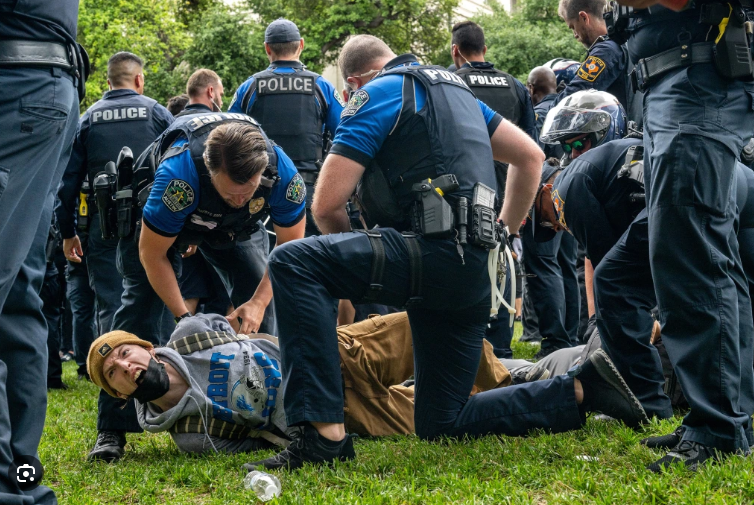
To have a society whose most important priority is the commission of genocide, as Western societies exist today, requires the range of expression and thought to be extremely narrow and for inquiry and teaching to be physically suppressed. This suppression has been established through the destruction of student university encampments in 2024, progressing to the deportation and imprisonment of students for their views in 2025.
-
Meanwhile what you actually learn in university has to conform to Western genocidal ideology, and continues to narrow (because most knowledge actually threatens that ideology)
-
The university, like social media, has become a trap: individuals are drawn to these institutions with the promise of free expression, but then arrested, beaten, and jailed for actually expressing themselves, if those expressions are anti-genocide.
-
The consequences of this have yet to be fully felt and may not be as bad as anticipated here, but the promise of a place for young people to grow intellectually through debate, study, and even activism has been broken. It is unclear whether young people will want to take on immense debt when the university reality is so far from the university ideal.
-
-
AI. The actual activities of studying at university include: listening to lectures, reading, writing essays and assignments, perhaps taking midterm and final examinations. Through repetition of these activities and taking into account feedback from professors and tutorial leaders, learning happens.
-
Lectures and readings are now available online, and you’ll probably be able to find something better than your average lecture on youtube. There are interactive elements that aren’t available by listening to a podcast or a youtube video, but they would have to be built in consciously by your instructor – and aren’t, always.
-
Essays and assignments can be written by AI. In principle AI could be used to increase productivity which could be shared across society. In practice it’s a trillion-dollar industry whose main use case seems to be the facilitation of cheating in schools and universities – a use case for which AI is excellent. The temptation to use it is irresistible. The use of it is undetectable. The main weapon of the university professor – the writing assignment – is now obsolete. Most of the adaptations proposed for dealing with this are variations of “just let them use it.” We can switch to in-person, pen-and-paper testing, oral exams, and interviews, but only until they put their trillions towards using wearables to cheat on those too.
-
The promise of university was: spend some years on an idyll, meet friends for life, learn and grow, challenge yourself and challenge society, get a valuable credential for your future. The promise of university today is: mortgage your future to finance genocide today, suppress your conscience or be punished, use robots to write your assignments that will probably be graded by robots, and get a dubious credential that might be denied to you if you get a conscience at any point.
If this is true, there should be an opportunity to create a different kind of Academy.
The abilities to write, read critically, apply logic, and evaluate evidence, will continue to be valuable. Developing these abilities by practicing them through challenges designed and evaluated by a teacher who gives you progressively more difficult tasks and feedback along the way and peers who you can learn with socially, will continue to be an excellent – maybe even optimal – way to learn.
The university is ultimately professors and students. Its history is longer than the current genocide, longer than its current corporate form, longer even than capitalism and colonialism. Many liberatory projects have included an academic component: The Black Panthers, SNCC, movement schools and freedom universities.
Over a year ago, during the dismantling of the encampments, when the possibility of a massive purge of academics from US universities seemed to be on the table, I talked in a sit rep about building a university that could absorb the purged academics as teachers and the purged students as learners. We don’t need the land or buildings, the extortionate tuition or the investment portfolios. We could charge students enough that the teachers could make a good living teaching; publish research and writing directly to the web without the extortions of the journal publishing monopolies; and students could come out of their programs with portfolios and credentials showing exactly what they did (since we’d be unlikely, for reasons I’m about to mention, to get the same legislatures that ordered the purges to give our academy degree-granting status). These would be real courses, with real work and real feedback, not merely watching (even great) lectures on an online platform, chained together in a progression to make a real program.
This Academy need not have its entire curriculum focused on Palestine. Ideally students could learn all the subjects that they would learn at a Western university. But Palestine would not be a taboo and that alone would differentiate it from all other universities in North America. Students could study Israel, Zionism, apartheid, and genocide; at the journalism school students could develop their skills without worrying about the pro-Israel censor, etc. We might even get a brief reprieve from AI: for as long as AI is trained on data from the corporate web currently monopolized by genocidal maniacs, students would have to write their own papers to meet the anti-genocide criteria of this Academy.
There are several hurdles in the way of establishing the anti-genocide Academy.
-
Web infrastructure and payment systems can be attacked and shut down. Genocidals like to infiltrate all spaces and, if these spaces threaten their racist goals (or feelings), shut them down. An institution dependent on the web (currently monopolized by the aforementioned genocidal maniacs) would have this vulnerability. It can be mitigated, but not completely eliminated.
-
The credential obtained would be worthless to mainstream genocidal institutions (though not, perhaps, elsewhere). On the other hand, the skills would be real and the credential itself would be true badge of honor in an anti-genocide community that might be bigger than many of us realize.
-
Institution-building is very difficult and no one trained in mainstream institutions is very good at working together. Political, ideological, and organizational splits doom most organizations. This risk is also always present.
This is the kind of thing that we could try to start small and see where it goes; we could have multiple groups trying it different ways. If I’m right and there is real demand for this, there could well be enough demand for many academies. I think we should go for a labor-intensive model, where more students means more teachers – the niche of trying to mega scale is already filled.
When I talked about this idea about a year ago, many of you came forward to tell me that you would want to participate. Here, I am fleshing out the idea further. Let’s discuss.