Cancellation Court: The Media Trial

Another instalment of fiction about justice after the genocide

[Dear readers: The genocide has started again and I will be returning to reporting on it. But here is a story I’d been working on earlier that I need to get out there first. After writing the Hodeidah Tribunal, I wondered about what justice would entail for the media incitements that have been so visible throughout this genocide. This story deals with the less clear-cut cases of media figures who laundered the genocide by claiming either balance or even anti-genocide credentials while returning the debate to genocider talking points…]
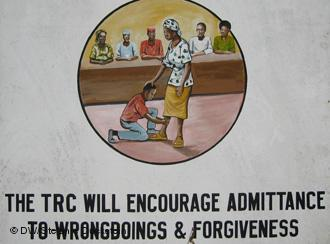
Graphic from South Africa’s TRC

Towards the end of the revolution, the National Revolutionary Authority of North America (NRA-NA) issued a declaration, called the Declaration to Social Media (DSM), that outlined some of the genocidal crimes they would punish upon arrival in power. The DSM was a warning to media figures and social media users to stop their incitement to genocide, for there would be consequences for these incitements. Written in a moment of revolutionary enthusiasm, its legal consequences had to be developed by a number of legally trained revolutionaries after the victory. Sushil was a veteran revolutionary lawyer, and had been defense counsel for many of the NRA revolutionaries since the early days. He was trusted, known, and he knew the law. The leadership collective had invited him to help them develop the document.

The initial DSM had been a very simple list of crimes.

DECLARATION TO MEDIA AND SOCIAL MEDIA ON INCITEMENT TO GENOCIDE

The National Revolutionary Authority declares the following to be crimes that will be punishable by law:

SECTION 1: INCITEMENT TO GENOCIDE

The following acts on social media or media will be considered punishable incitement to genocide:

1.1 – Atrocity Propaganda. Posting or stating lies about atrocity crimes, by the victims, while the genocide against them goes on, will be punishable.

1.2 – Willful or Pretended Ignorance. Media figures or officials who pretend to be, or speak publicly while actually unaware of well-documented and ongoing genocidal crimes or statements, are considered offenders and will be punished.

1.3 – Excusing Genocide. Labeling the victims as “terrorists” or any use of the doctrine that genocide, civilian murder, or destruction of civilian infrastructure is justified because “terorists” are “embedded among civilians”, will be punishable.

When Sushil had begun to study the declaration, he fretted as he tended to do, because Sections 1.1 through 1.3, while precise, encompassed so many acts by so many social media influencers, NGO actors, politicians, and media spokespeople, that it would be impossible to punish them all except by turning the entire revolutionary bureaucracy towards the sole purpose of punishing the complicit. What to do?

Sushil knew that the worst actors could be deported to the Hodeidah Tribunal, but the sentences there were long and even capital punishment was possible under those clauses. Back here, though, the NRA-AN (pronounced “niraan”) had the challenging task of separating the worst actors from the mere social participants, the big genociders from the small.

Having studied it more carefully than most, Sushil had never been fooled by Rwanda’s post-genocide Gacaca court system (1), but the system’s stated principles made sense. People accused of participation in genocide were compelled to face the community and tell their truth, which would be corroborated or disputed by community members at the trial.

Gacaca had been designed for a country of a thousand villages. Sushil had to adapt it for the online community. Instead of an outdoor meeting at picnic tables in a field in the village, the DSM trials would have to take place online, publicly, on the web. The South African Truth and Reconciliation Commission (TRC) had been televised. The DSM trials would be livestreamed. But like Gacaca and the South African TRC, physical custody of the offenders was necessary.

For today’s trial, the offender was brought into a studio in his usual suit and made to sit in a witness box with a camera before him.

Gorman had been a television commentator his whole career, and he’d be allowed to tell his truth in his own element: live to the web. He sat with his chin forward, in a posture familiar to his millions of online viewers.

Gorman’s arrest hadn’t been difficult to effect. NRA agents had an easy time apprehending most of the people they wanted for these trials. Anonymity is hard enough to achieve for anyone: The life of a social media influencer is fundamentally incompatible with good security practices. Gorman was no man of action either. The agents had come to his door, and walked him into custody. He’d been interrogated and debriefed by one of the Hodeidah Tribunal prosecutors, who’d evidently gotten whatever she needed from him. He’d asked if he could be suited and appropriately powdered for his DSM trial, and Sushil had granted the request.

Now Gorman sat looking comfortable – imperious even – in the box, and it was Sushil’s turn. No stranger to grandstanding in the courtroom, Sushil was nonetheless uncomfortable and nervous. Precedents were being set, and this hybrid between a court and a television program was halfway between his world and Gorman’s. That was, after all, why Sushil had designed the trial to work the way that it was going to.

“Mr. Gorman, you are here today before us to tell your truth, after which we will decide whether you will be deported to Hodeidah for the trial of major media genociders or whether you will be able to be reintegrated into the community. Do you understand the process and what is at stake here?’

“I do,” Gorman said, “– and I’d just like to say that –”

Sushil held his hand up and Gorman’s microphone was immediately cut. “No, Mr. Gorman, not yet. When it comes time you will be able to speak freely about your truth, but not before. Thank you for telling us all that you understand the process and its possible outcomes. Now please, in a single yes or no answer, will you answer all of our questions truthfully?”

Gorman moved his mouth without sound several times before finally squeezing out, “yes.”

Sushil was the closest thing to a judge at these proceedings, Gorman the defendant. Both looked to the jury: a group of anti-genocide media figures, including many who had been harangued on Gorman’s show, some of whom had been arrested, had devices seized, homes raided, deported for their media work. A couple of journalists who had survived the genocide in Gaza and Lebanon were present as well, and a few who had simply entered a lottery for the chance to be in the audience during any DSM trial. Some thirty in all, they radiated an expectant and contemptuous energy in Gorman’s direction, reminding Sushil again of the care he needed to take to give this trial the gravity it deserved, despite the somewhat ridiculous figure Gorman cut.

Sushil began abruptly: “First of all, Mr. Gorman, I have to ask: do you condemn the genocide?”

Gorman had been expecting this one. “I have always maintained that Israel was excessive in its response, and I have held Israeli officials accountable and asked them what they thought was a proportional response.”

Sushil replied: “But do you condemn the genocide? Do you condemn Israel?”

“I don’t agree that it was a genocide,” Gorman said. “I think it was self-defense, but I think at times, it was disproportionate.”

Sushil got his pen, made a note of the exact time, wrote it down, and wrote next to the timestamp: 1.3. Excusing Genocide.

“So you don’t condemn Israel then,” Sushil said.

“You’re not going to get me to make a blanket condemnation, I think any state would have to defend itself after a horrendous terrorist attack like the one of October 7th.”

Sushil looked at the time again, wrote it down, and next to it: 1.1. Atrocity Propaganda.

Sushil said: “I’m glad you said that, actually. In your program you repeated lies about October 7th, for which there was no evidence, even implying that you had yourself seen videos of rapes or beheadings, allegations for which no evidence existed. Do you admit that you were lying?”

Gorman said: “I never lied. I said there were atrocities recorded on GoPros and reports of rapes.”

Sushil wrote the timestamp again next to his 1.1. Atrocity Propaganda.

He said: “So you don’t admit these were lies and you continue to claim there was evidence for these atrocities even though you haven’t seen them yourself? Or do you claim to have seen them yourself.”

Gorman said: “Now hang on, because now you’re not letting me respond –”

Sushil interrupted. “– It’s a simple question,” he said. Sushil looked at the audience, and as he suspected, some were enjoying watching Gorman on the receiving end of constant interruption and harangue. “… and it sounds like you’re not going to answer it. So, you’re refusing to admit you lied and you’re avoiding answering the fact that you repeatedly said things that suggested you’d seen evidence you in fact never saw.”

Gorman replied: “I never lied, you’re not going to get me to say I lied no matter how much you interrupt me.”

Sushil paced toward the audience, then turned back on Gorman. “Another question, then. On your show, one of your guests told you about the murder of Hind Rajab, a little girl who was killed with her family in a car while crying for help, and the medics who came to rescue her also were murdered. The same guest told you about a mother who was killed trying to save her son. The guest had just seen videos of these murders. Do you remember?”

Gorman said: “I said I hadn’t seen those particular videos.”

Sushil said: “Have you seen them now?”

Gorman said nothing.

Sushil wrote the time, and wrote down: 1.2. Pretended Ignorance. He continued the questioning until he had accumulated a long record of admitted violations of most of the articles of the DSM.

“I believe we have heard enough,” he said. “Mr. Gorman, your incitement to genocide has been so thoroughgoing, so systematic, and so influential, to such a large audience over the whole period of the genocide, that it shocks the conscience of this court and of the world. You have engaged in atrocity propaganda, in willful ignorance, and of excusing genocide, right here in this court before us and before the livestream audience watching these proceedings. I see no choice,” Sushil said, “but to have you remanded to the Hodeidah Tribunal for a full trial as one of the principal defendants in the media trial.”

“But wait!” Gorman said. “I gave voice to many of you people on my show. I put hard questions to Israeli officials on my show. I have been much more even handed than so many in the media. How could you punish me?”

“I would leave that for the Hodeidah judges to decide,” Sushil said, “but for the benefit of those listening now and for the court’s records, I will say that your phony debate format was transparently stacked in favor of the genociders, and even when the anti-genocide side got a zinger or two in, your own genocidal bias and the destructive effect of your program were apparent to all right-thinking people.” Sushil turned to the NRA agents. “Take him away to get him ready for deportation.” Looking at the cameras, he said: “This session is over for now.”

In the back offices of the studio, he found one of the trial lawyers from the Hodeidah Tribunal waiting for him. He put his hand to his chest and bowed modestly, and she slid a file to him across the table.

“This file,” Wardah said, “is a challenge.”

Sushil sat down with a sinking feeling. He knew who she meant before even looking. As he rifled through the gathered transcripts, his ambivalence only grew.

“My inclination was to just leave this one alone,” he said.

“Ours too. But then…”

“What changed?” Sushil asked.

“He turned himself in.”

It was another debater. To Sushil’s reading, the energetic Ghassan had developed a following over years with a skill of being quick on his feet and a knack for sounding principled even while being slippery when it mattered. He was proud of himself for being pilloried by all sides – that, to Ghassan, was a sign that he was on the right track. Both pro- and anti-genocide people thought he was wrong – to Ghassan, this indicated that he was a teller of uncomfortable truths. Everyone on the anti-genocide coalition had watched him: some enjoying his one-liners, others in disgust of his half-truths, and still others watched him as a bellwether: his positions indicated where public opinion was headed, what it was safe to say out loud at any given moment.

But things started to change for Ghassan when the tide of the war turned decisively. He was on tour with his book, a memoir of his hardest-hitting debates and the importance of free speech, when an audience member asked him if he regretted repeating genocidal talking points. He had answered with his usual speed and vigor, but the disgust and disappointment in her face had stayed with him. He was never a man used to adulation, he just didn’t bring that out in people, but his self image included the belief that he was a man of principle. The questioner had shaken him. Then it happened again, at the next venue. And again. One evening the audience seemed to be full of people who hated him. One had asked: “Why aren’t you on trial?” And the next time, almost no one was there.

He was a decisive man, and so he decided to resolve this problem the same way he’d lived his life: through a public debate. He had turned himself in to the revolutionary authorities and thrown himself on their justice. He wanted to have his day in court. He would speak his truth.

Sushil said, “it sounds like you don’t want him, and we don’t want him. He’s a good debater and fast on his feet, comfortable in the online environment and likely to question our credibility. Will it hurt our cause for him to be tried?”

Wardah gave an unworried look. “I have confidence in the system we have set up. Ghassan wants to speak? Let him speak.”

The cameras and bright lights on him once again, Sushil called Ghassan to the stand.

Ghassan strode confidently forward, unescorted by court officials. The audience reaction was mixed. Some applauded, others watched in cold silence. Opponents of the genocide uniformly hated Gorman, but opinion on Ghassan had always been divided.

He knew how to play to the crowd though. Sushil sat down without a further word and Ghassan walked slowly to the exact right spot for visibility to the most people and the camera.

“Have a seat, Ghassan.” Sushil said. “The court is to decide on what to do with you.”

Ghassan cleared his throat. “That is why I asked to be here today. To start with, I’d like to clarify that I’ve been vocally against this genocide from the very beginning. I’ve always been pro-Palestine!”

Sushil paused for a moment. “While your own crimes were not nearly on the level of Mr. Gorman, you also have engaged in atrocity propaganda. You’ve minimized the genocide by comparing it to situations that are not comparable. You’ve campaigned electorally for genocide perpetrators, arguing that voters set the genocide aside since both sides were genociders.”

Ghassan, composed, replied: “It’s morally consistent to oppose barbarism, war, and occupation no matter who does it. The fact that you and your court are now allied with some unsavory powers isn’t going to silence me.”

Sushil said: “Thank you for mentioning that. As you know, this court has several options short of remanding suspects to Hodeidah for trial. According to the Hodeidah authorities, your case falls below the threshold for the major media criminals, people like Gorman or people who actually provided targets for assassination.”

“Well I’m glad to hear that at least you understand that,” Ghassan said.

Sushil replied: “But you contributed in your own way to the vilification of the resistance and to the perpetuation of falsehoods.”

“I disagree,” Ghassan said.

Sushil continued as if Ghassan hadn’t spoken. “You built a following taking pro-Palestine positions, but you also smeared the movement alleging that Muslims en masse were anti-Semitic.”

“That’s just dealing with uncomfortable truths,” Ghassan said.

“You’ve also never addressed the facts of the Resistance’s conduct of the war, and have deferred to the accounts presented by the pro-genocide forces of what happened.”

“That is how you win debates, sir,” Ghassan said. “You show that your opponent’s logic is incorrect even if what they’re saying is true.”

“No, Ghassan. The facts matter,” Sushil said. “I won’t rebut you point by point. Go ahead and take ten minutes and say everything that you want to say.”

Ghassan looked solemnly at the camera, and at the crowd, and entered into the record a passionate defense of himself and his conduct during the genocide. Knowing that his reactions were being filmed, Sushil practiced keeping his face neutral and willed himself to not shake his head involuntarily with every point.

“Is that all?” Sushil said, when Ghassan stopped.

“Not quite,” Ghassan said, and went on for another ten minutes. “Now I’m finished,” he said.

“Let’s take a break and let the jury deliberate,” Sushil said.

When they returned, Sushil said only: “Let’s hear from the jury.”

The head of the jury stood up, one of the journalists from Gaza who had managed to survive the genocide, and cleared her throat: “For justice to be served, the punishment has to fit the crime. In your case, the jury believes that most of the infractions you have committed have been committed in the search for attention. And so, the punishment is a five-year period of cancellation. You will not be allowed on any live streams, prerecorded videos, television appearances, posts, or opinion columns. No one in the world will know your opinion for a period of five years. The jury recommends that you spend that time reading and learning things you don’t know.” She sat down, composed.

“But,” Ghassan said, appealing to Sushil, “if the goal is for me to learn, I learn best through the cut-and-thrust of intellectual debate.”

“Not this time,” Sushil said. “This time you’re going to have to be humble and learn by listening, not talking.”

“You know,” Ghassan thrust back, working himself into the quick-witted, quick-replying mode that everyone knew so well, “this government’s detractors will say that you’ve set up another totalitarian system and that the so-called revolution is just imitating the anti-freedom policies of your Chinese, Russian, and Iranian sponsors.”

“They might say that,” Sushil said. “But that won’t stop justice.”

Ghassan switched to a pleading mode: “But… five years. Surely that’s excessive? Disproportionate?”

Sushil looked to the audience. “Should we revisit in a year?” The court staff arranged a poll to the livestream, and the audience voted by a majority to meet with Ghassan in a year’s time. “Spend a year. Read. Write. Contribute something to society that isn’t your opinion. And we’ll talk to you then and see whether you have something worth listening to and maybe we’ll shorten your sentence. Until then, though, Ghassan, you are cancelled.”

The bailiffs didn’t touch Ghassan, but walked on either side of him out of the studio. “This isn’t the last you’ve heard from me!” he said.

“It literally is,” Sushil said. And thought: At least for a year.

Notes

  1. To understand why Sushil feels this way, it’s unfortunately necessary to read a great deal. The book America’s Wars on Democracy in Rwanda and the DR Congo covers the main points. To get into it here would be a distraction.
Partyism

An analytical error

When America sends the National Endowment for Democracy, the National Democratic Institute, and the International Republican Institute abroad, they are teaching the rest of the world the best political system invented so far, the worst one except for all the others as Churchill said, the system at the end of history as Fukuyama declared, the system that peoples around the globe fought and bled for, multiparty democracy.

Ideally, two-party democracy, so that people have a choice, but not too much choice.

Never mind that rather undemocratic means can be used to keep other parties out of the game; or that begging rich people for campaign money is the principal activity of American politicians; or that politicians do not do what they promised; or that decisions like investment, pricing, money supply, energy and military planning are either jointly private-public or entirely private matters outside of democratic control.

There’s a jest in the East that in the Chinese system you can change the policy but not the party, while in America you can change the party but not policy.

This is another thing the genocide should have taught us. After an American election season where both parties promised enthusiastically to continue the genocide of Palestinians, while in other Western countries parties compete to show the most fealty to the genocidal state, Western electorates have never been more helpless. Given the opportunity to change the party, they’ll change the party. But it makes no difference.

In the Global South, elections often matter. They’re high stakes affairs for several reasons. First, a real alternative might get into office and engage in actual wealth redistribution, land reform, or measures towards economic sovereignty. Second, if voters dare to vote for such an alternative the country will face US-backed coups, sanctions, and sabotage.

In the West, though, democracies are more mature. The most important policies won’t be changed through something as capricious as the public will. Americans who want Medicare For All, for their police to kill fewer of them each year, or simply an end to the genocide, can’t vote those in. The notion of asking the public to vote on regime change, covert wars, or overt ones, in Eastern Europe or West Asia – is even more ridiculous.

Analytical energy is being wasted on what the Biden administration is trying to do before Trump comes in, or how Trump might want to take on the deep state but for now he has to bide his time, or in Canada how hapless the liberal leader is and how prime ministerial the conservative candidate looked in the latest podcast video with an immensely popular, totally conventional pro-Israel commentator who is of course portrayed as an outsider and maverick.

In the West, these frothy shows known as elections are of tremendous value to the corporate interests and owners of private fortunes that decide whether the masses of the Global South will have peace or genocide, whether the masses of the Global North will have public health care and education or crumbling infrastructure. To name a few of these benefits:

  • Elections channel nearly all the mass energy for change into the false hope of change, stabilizing corporate rule and hiding it behind the scenes.

  • The media / social media spectacle employs otherwise idle journalists, professionals, and political operators, while circulating and laundering billions of dollars.

  • It’s a huge distraction and diversion of attention, pre-empting the possibility of large numbers of people working – or even strategizing about what it would actually take – to change policies.

The belief that established Western political parties offer meaningful differences in policy from one another has taken different forms.

Advocates of lesser-evilism admit that the differences between what parties do in power are actually very small, but argue that these small differences matter and so it’s important to go and vote for the lesser evil.

Advocates of strategic voting argue that you need not like a party or candidate but that you should vote for them anyway to fulfill some broader strategic objective, which is usually blocking the party you don’t like from coming to power.

I propose subsuming these variants and coining the word, partyism, for any form of the belief that Western political parties are meaningfully different on important policy matters. Partyism can never be disproven, since we could never know what the loser would have done had the winner not won. We could only ever speculate. But circumstantial evidence against partyism is presented every time a party betrays their electoral promises – something that does happen from time to time, though notably, neither Harris nor Trump were willing even to make a promise to end the genocide that they could later renege on.

Instead of falling into the partyist trap, look at a country’s billionaires, the statements by the chambers of commerce, the policies advocated for the country in America’s business newspapers (regardless of which country you’re in). Political scientists Martin Gilens and Benjamin Page have done a big study twenty years ago and another ten years ago to show that politicians listen to the rich, not to you.

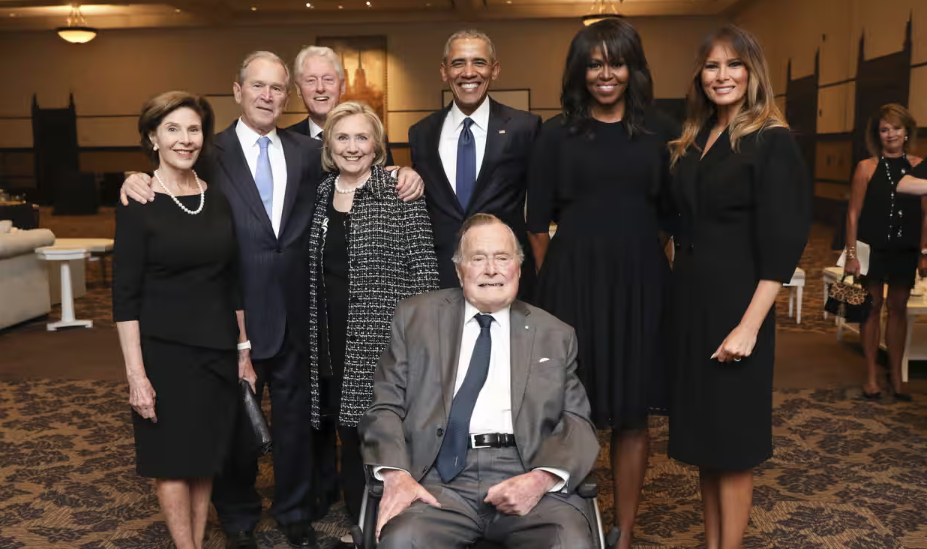
You know who’s not in this picture? You.

Zionists resort to horrible anti-Jewish stereotypes and imagery at the drop of a hat

Part 7 on Zionism as an anti-Jewish ideology

This one is less a flowing argument and more of a short, extremely non-comprehensive litany of horrid anti-Jewish abuse from Zionists.

If it was upsetting that the Jerusalem Post would declare those Jews deemed anti-Israel to be “herem”, wait until you see the anti-Jewish stereotypes and imagery that Zionists go-to as a first resort when justifying an Israeli attack on Gaza. 

(1)

On Henry Kissinger’s 100th birthday, the Jewish Daily Forward published the remarks of a man whose diplomatic efforts did more for Israel than many other US officials. Kissinger is reported to have said: “If it were not for the accident of my birth, I would be antisemitic… Any people who has been persecuted for two thousand years must be doing something wrong.”

“If it were not for the accident of my birth, I would be antisemitic… Any people who has been persecuted for two thousand years must be doing something wrong.” — Henry Kissinger

The Zionist worship of power, and contempt for Jewish people based on a stereotype of their weakness, is apparent in Kissinger’s remark. 

(2)

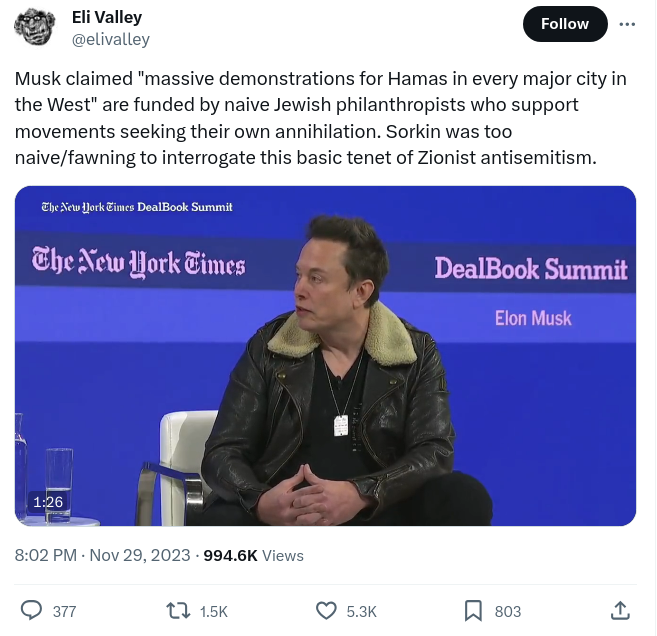
Cartoonist Eli Valley reported some comments by twitter owner Elon Musk who, after visiting PM Netanyahu in Israel said that “massive demonstrations for Hamas in every major city in the West” were ‘funded by naive Jewish philanthropists who support movements seeking their own annihilation.’ Valley called this a “basic tenet of Zionist antisemitism.”

(3)

Elsewhere, a group of Orthodox Jews holding a Palestinian flag on a sidewalk were approached by an elderly Zionist who told them “Hitler made one big mistake. You should have all been put in gas chambers.” 

(4)

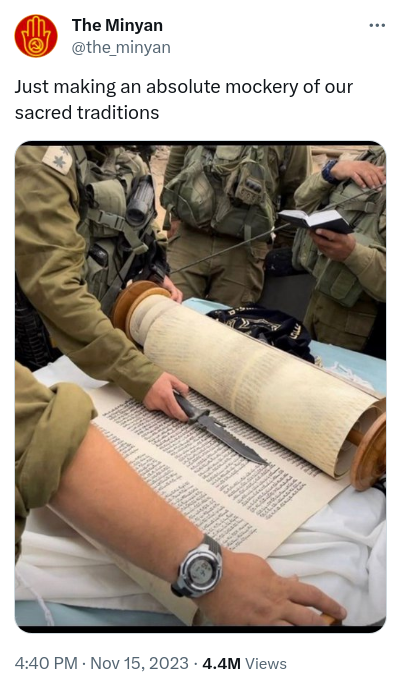
As they prepared for the ground invasion of Gaza in late October 2023, the Israeli Army took a photo of the Torah with a knife on it. 

Commenting on this photo, US-based Jewish activist Morgan Artykukhina explained in a tweet: “A sefer Torah is so sacred that Jews treat it almost (but not quite) equivalent to a human life. Jews have died to save Torah scrolls from danger, Muslims literally called us “people of the book” b/c of our love for our Torah. Placing an instrument of death upon it is a threat.”

Elsewhere on twitter, Artykukhina argued that diaspora Jews don’t owe Zionism any loyalty since – as you have learned reading this series so far – Zionists hold them in contempt: “Israel doesn’t deserve the support it gets from the Jewish diaspora. Israeli Zionists hate us & haven’t hesitated to use the same old antisemitic tropes against us to cast themselves as “reborn” from being lowly & pathetic diaspora Jews.”

Artykukhina screenshotted an excerpt of “We are Not One”, which included quote from Zionists Joseph Chaim Brenner who called diaspora Jews “Gypsies and filthy dogs”, A.D. Gordon describing diaspora life as the “parasitism of a fundamentally useless people”, Jabotinsky calling them “ugly, sickly kids” and calling on Zionists to “eliminate the Diaspora or the Diaspora will eliminate you”. A.B. Yehoshua told American Jews they were “playing with Jewishness” ‘while Israelis lived it every day’. 

(5)

A Zionist threat against pro-Palestine supporters serves as another example of Zionists using a horrid anti-Jewish stereotype. “If you keep saying ‘free Palestine’, us Jews are gonna take it, we love free stuff.” 

(6)

When in 2016 the US ambassador to Israel, Dan Shapiro, said that Israel had different legal standards for Israelis and Palestinians in the West Bank, one of Netanyahu’s former aides called Shapiro a “little Jewboy”. 

(7)

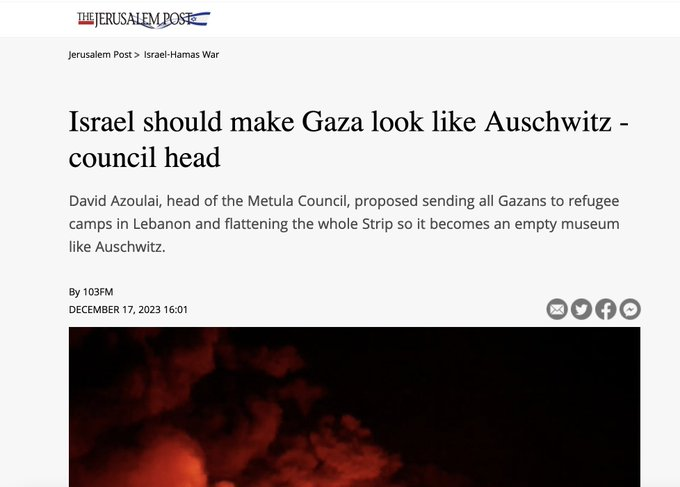
Demeaning the victims of the Nazi genocide, one Israeli politician in December called for Israel to make Gaza “look like Auschwitz”. 

We conclude with the winner, the worst example so far:

(8)

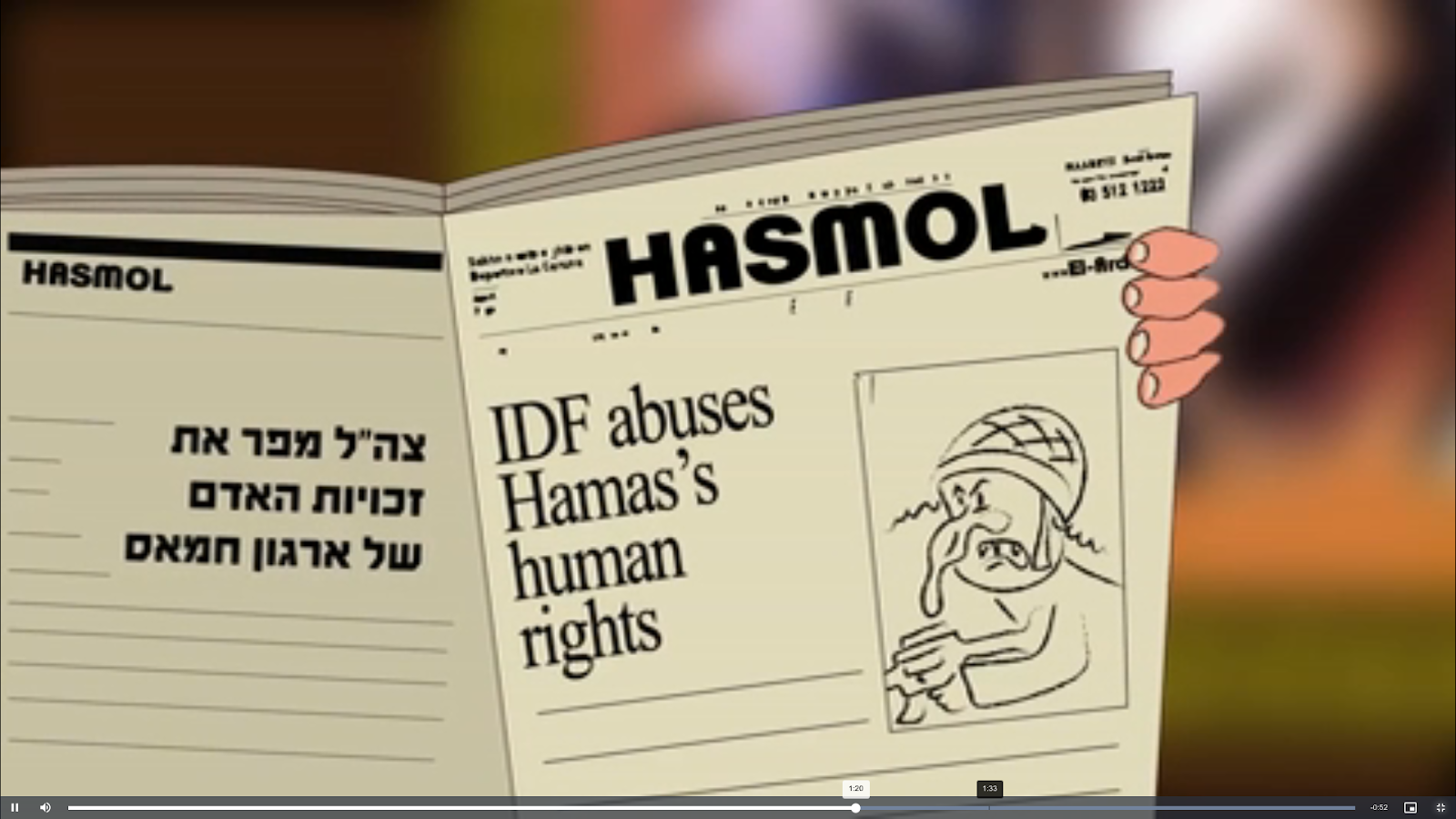
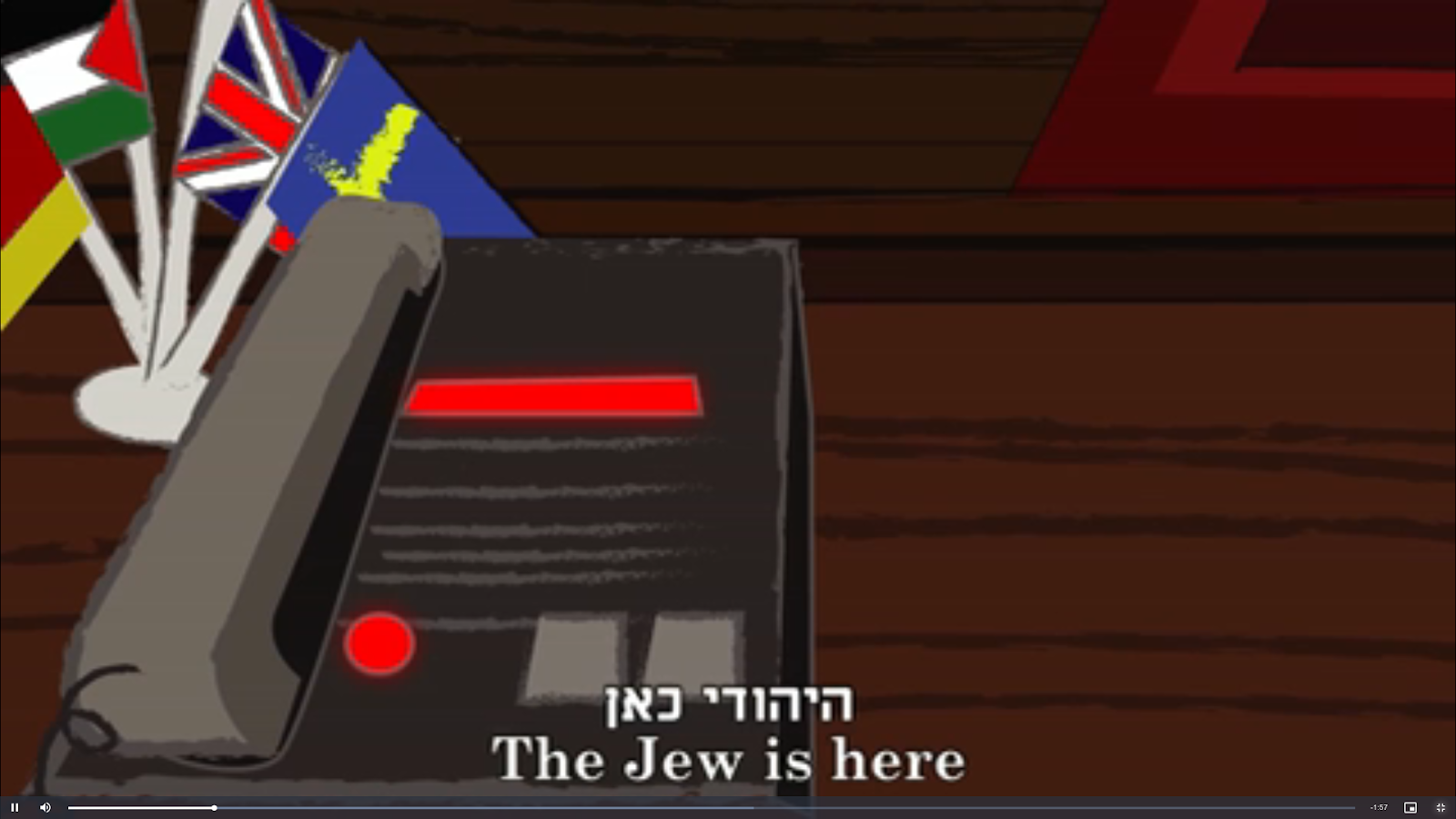
In 2015, a settler group called the Samaria Council used Nazi imagery to criticize the Israeli left in a cartoon. They didn’t apologize afterwards.

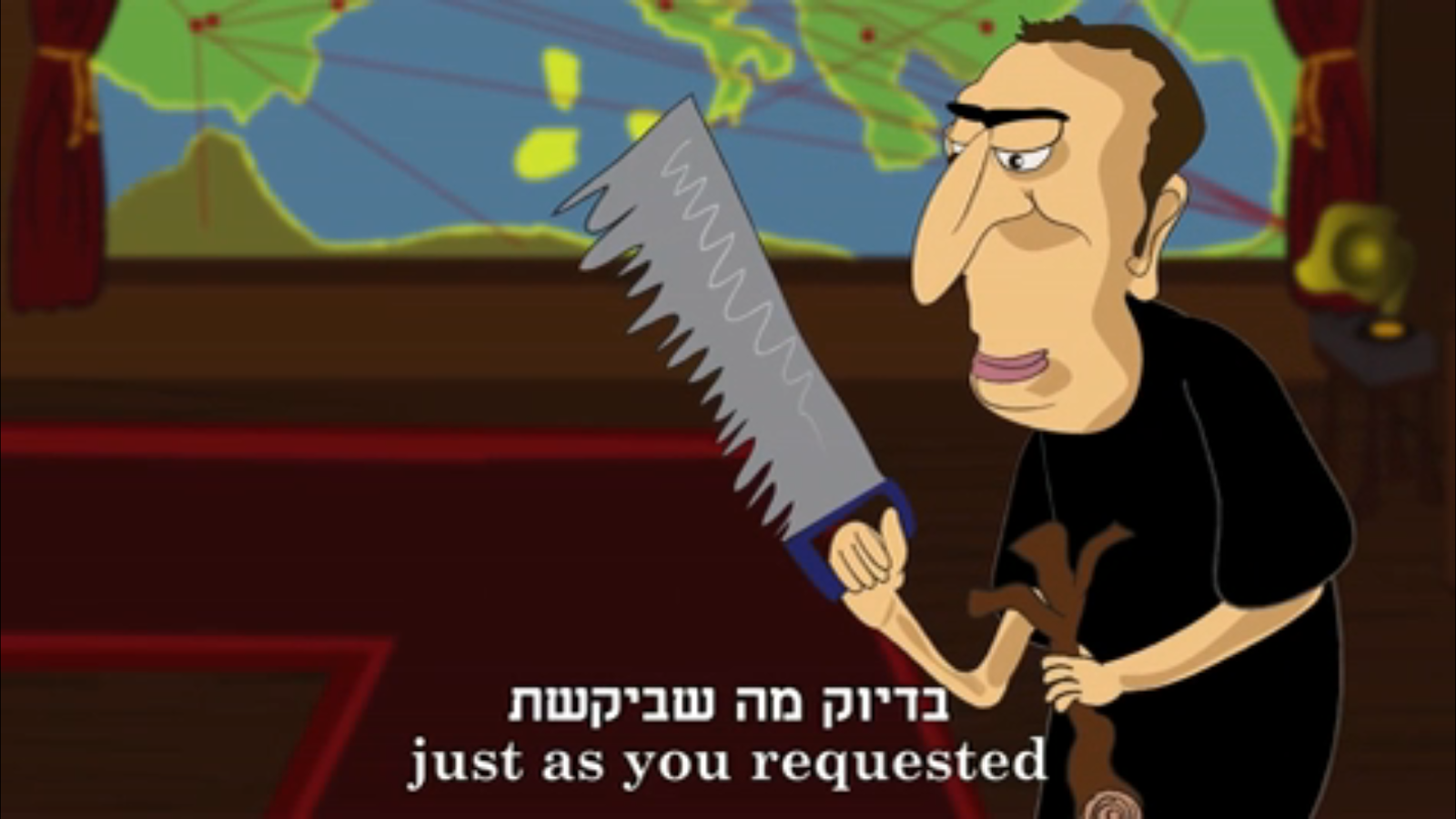
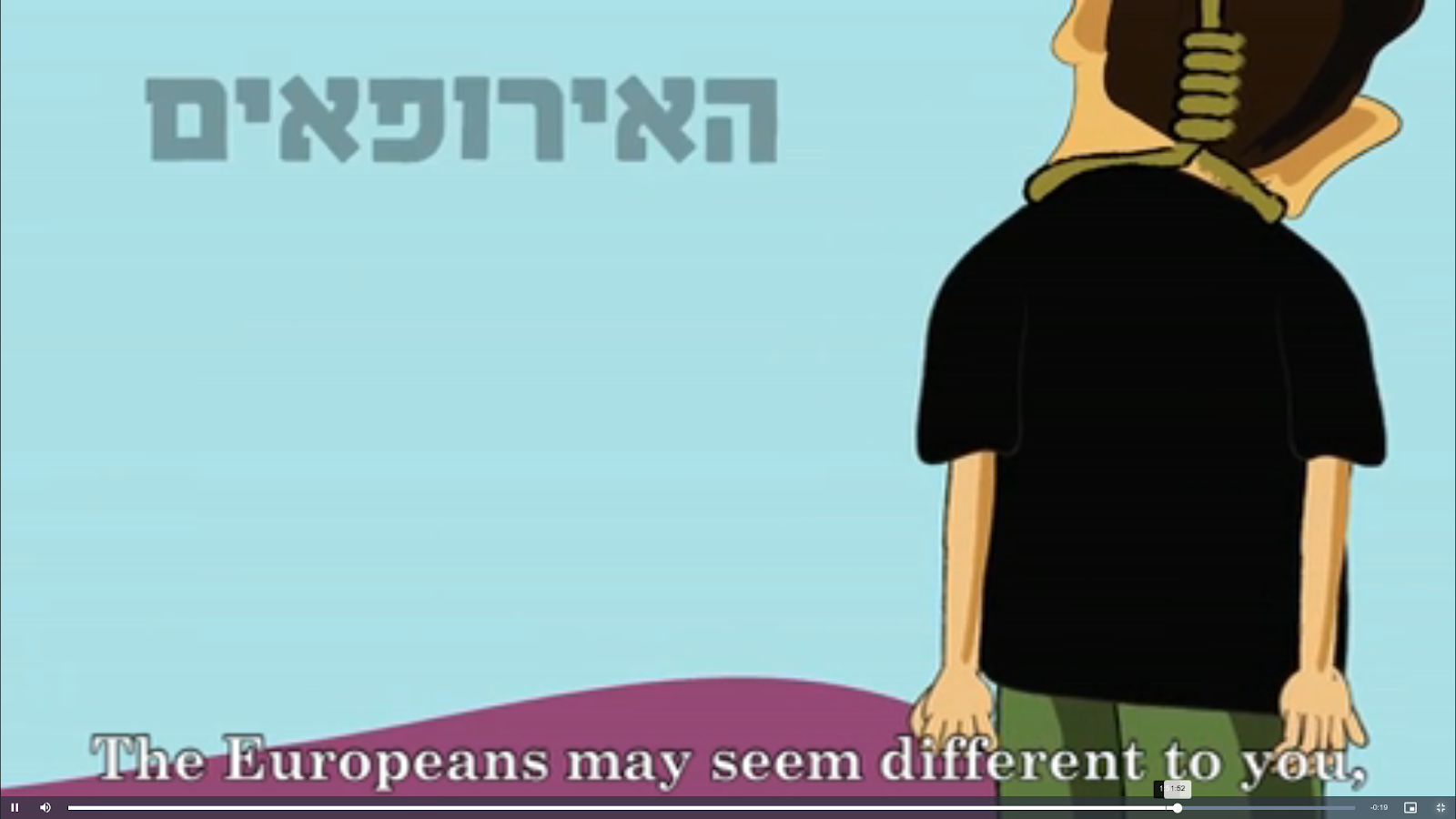
Here are some images in case you skip watching the cartoon. The plot of the 2-minute cartoon is: one Mr. Sturmer is reading what is obviously the Ha’aretz newspaper, and asks “The Jew” (Israeli left-wing human rights groups) to provide him with evidence that can be used against Israel. He tosses “The Jew” a coin, and the cycle repeats until eventually he tells “The Jew” to “take care of himself”, at which point “The Jew” hangs himself as well. 

This is hate speech. It isn’t acceptable because it is phrased in first-person plural as “us Jews”. It is an indictment of the anti-Jewish ideology that produced it. That ideology is Zionism.

Zionists have taken the phrase “anti-Semitism” from antiracists. We will not get it back.

On House Resolution 894: Part 1 of a series on Zionism as an anti-Jewish, racist ideology

[Sorry it has been a while. I have been compiling a document on all the ways in which Zionism is specifically anti-Jewish racism. While anti-Palestinian racism is inherent in Zionism, Zionist ideology’s anti-Jewish history is less well known. When the document crossed the 11,000 word mark, I realized it would be better to send it out in readable pieces. So here’s the first. I’ll compile the whole thing into a resource at podur.org once it’s all out there.]

US Congress has completed the conflation of anti-Zionism and anti-Semitism in House Resolution 894, passed 311-14 two months and tens of thousands of Palestinian deaths into the Gaza genocide on December 5, 2023. In it, the House “clearly and firmly states that anti-Zionism is anti-Semitism.” 

House Resolution 894 should be taken as a signal that it is time for anti-racists to retire the phrase, anti-Semitism. 

It was coined by Austrian orientalist and Zionist Moritz Steinschneider during the rise of biological race theory. The phrase was a critique of French biological racist philosopher Ernest Renan’s theories of Aryan superiority over Semitic races and first written in print in 1860. By 1879, German racist journalist Wilhelm Marr published a pamphlet arguing that the Jewish Spirit had triumphed over the German Spirit and Marr organized the Anti-Semitic League to combat the “Jewish Spirit” and expel Jews from Germany. The German Nazi leader Goebbels declared in 1938 after Kristallnacht that “the German people is anti-Semitic.” A few years later, Nazi Germany invaded the Soviet Union to enslave the Slavs, who they viewed as an inferior race, and to exterminate the Jews, who the Nazis believed were the real power behind the USSR: to the Nazis, the Soviet Union was ruled not by Bolshevism, but by “Judeo-Bolshevism”, as elaborated in, e.g., Paul Hanebrink’s 2018 book A Specter Haunting Europe: The Myth of Judeo-Bolshevism

In the age of colonialism, anti-Semitism was based in biological racism at a time when its proponents like Marr and Goebbels and its opponents like Steinschneider and even Antenor Firmin accepted the division of humanity into races (a biologically indefensible position – Firmin accepted that there were races but argued that the races were equal, but biological science today is very clear that there is only a single human species and that race is a social, not a biological construct). 

Open anti-Semitism of the Wilhelm Marr/Joseph Goebbels type was discredited with the general discrediting of race science (really pseudoscience) after the defeat of Nazi Germany. “Closet” anti-Semitism continues to exist and be adhered to by adherents of biological racism generally. Without laws supporting it, it remains covert and its overt manifestations are (correctly) punished according to the law. 

After the creation of Israel, a new concept called the “new anti-Semitism” was declared. This “new anti-Semitism” always had a relationship to the criticism of Israel. The notion was that there was some line between the criticism of Israel and the new anti-Semitism, and that it was on critics of Israel to demonstrate that they hadn’t crossed that line and that they were not, in fact, new anti-Semites. Pamphlets about “Anti-Semitism on the Left”, “How to criticize Israel without being anti-Semitic”, etc., are propagated especially intensely during periods of Israeli atrocities and wars. This has culminated in the IHRA definition of anti-Semitism (criticized by, e.g., Independent Jewish Voices) and the aforementioned House Resolution 894. 

The re-definition of the word “anti-Semitism” to mean “criticism of Israel” or of Zionism has been successful. It is not worth fighting over the word. If Zionists wish to take over the use of the word “anti-Semitism” so that it means “any critique of Israel” or “anti-Zionism”, let them have it. 

It is a legacy of a time when the scientific establishment was so racist that it believed that there were different human races – that constant callback to scientific racism alone (implicit reference to “Semitic” race and implied reference to other “races” like Aryan, etc.) is enough for antiracists to phase it out. But another reason is that the terms of discussion have been so stacked that there is no way anti-Zionists can prove that they are not “anti-Semitic” by the Zionist definition of the word.

Anti-racists should abandon the word altogether. 

We call it “anti-Jewish racism” because “Semitic” is an orientalist category invented by race scientists.

Antiracism necessarily implies being against anti-Jewish racism. 

Antiracism, Zionism, and Anti-Zionism

Antiracist theory, adopted in universities and other institutions in North America as official policy, holds that people must not be discriminated against for, among other things, religion. Public events are often preceded by an anti-discrimination statement stating that “the organizers of this event stand against all forms of discrimination, whether by sex, gender, race, ethnicity, or religion, including antisemitism and Islamophobia.” A previous Anti-Empire Project pamphlet argued that these anti-discrimination statements need to be updated to include anti-Palestinian racism as a separate category of discrimination (For the most part, they have not been). 

It follows from anti-discrimination principles that discrimination against Jewish people is unacceptable and sanctionable. Jewish people are minorities in the countries where they live: minority rights must be guaranteed in law and in practice, protected by the majorities. For the majority to respect minority rights is one of the foundations of antiracism. 

Antiracism does not protect any political position, however. Zionism and anti-Zionism are nothing more than political positions – not protected identity categories. 

Whatever their faith or cultural background, Zionists cannot appeal to anti-discrimination law or practice for protection of their ideology. The Zionist desire to erase symbols of Palestinian culture and nationalism from public space is itself anti-Palestinian racism and is not protected by antiracism.

Zionism is not a religion, not a race, and not an ethnicity. 

Anti-Zionism is not discrimination by religion, race, or ethnicity. 

Jewish is an identity, Zionism is a politics and ideology

The question of “who is Jewish” involves not only religion and culture, but also identification, being claimed by a community, history, languages such as Yiddish and Hebrew, racialization by European Nazis, the role of the state of Israel and Zionism, and other factors as well. It is a complex one and will be revisited again and again in this series. 

What can be said is: however “Jewish” is defined, Zionism is anti-Jewish. 

Zionism is a political ideology with roots in 16th-17th century English Protestant Christian religion that states that Palestine should be colonized by Jews.

In the 19th century, Zionism was further developed in Europe into an ideology that Palestine should be colonized by European Jews. The 19th century version absorbed other ideologies including European colonialism and the accompanying racialist concepts. 

Yakov Rabkin, in the book What is Modern Israel? defines Zionism as an “ideology of protestant Christian origin that propounds the assembly of the Jews in Palestine.” We’ll have much more to say about the Christian, Protestant origins of Zionism later in this series.

Zionism is a political position, a colonial claim on Palestinian land, a political allegiance held by millions of people, a plurality of whom are Jewish but millions of whom are not. 

If Zionism is the political position of support for the European colony in Palestine, the majority of Zionists are not Jewish

A substantial number, though not the majority, of people opposing Zionism are of Jewish faith, Jewish culture, or have Jewish identity and communal roots. The number of Jews opposed to Zionism is probably in the millions. 

It was stated above that antiracist theory is of no use protecting Zionists from anti-Zionists because these are political ideologies. It is useful, however, to investigate the political ideology of Zionism from an anti-racist perspective. Can the core tenet of Zionism, the prescription that European Jews should colonize Palestine, withstand antiracist scrutiny? 

Political adjudication and Zionist safety

Zionist attacks on campus and other Palestine solidarity or pro-Palestine expression is framed in terms of “feelings of safety”, sometimes “feelings of Jewish safety”. A judge struck down a pro-Palestine resolution by a student union at McGill University in Montreal citing such concerns. Columbia University banned not only Students for Justice in Palestine, but also Jewish Voice for Peace, oblivious to the absurdity of banning a Jewish student group out of concern for Jewish safety. 

On North American campuses, Zionist organizations doxx pro-Palestine students, often targeting Black students and other students of color in a display of racial bias, but also targeting Jewish students whose politics are deemed by them to be anti-Zionist. 

Noah Zatz, law professor at UCLA, has argued that employers could legally require a political, Zionist loyalty oath to employers (as Germany will be requiring for immigrants), but in fact they have (so far) not: 

“Title VII of the Civil Rights Act of 1964 (proscribing race, gender, national origin, and religious discrimination in employment) would raise no bar to the nation’s leading law firms simply demanding that their employees pledge adherence to a U.S. foreign policy of unconditional support for Israeli war efforts. But, unsurprisingly, the law firms are not taking that tack.”

Instead, they argue that expressions for Palestine make Jewish employees feel unsafe – an argument that conflates being Jewish with being Zionist. Zatz argues that the feeling of non-safety is legally insufficient: 

“… employers cannot shield themselves from liability through such arguments. An employer’s obligation to prevent what’s known as “hostile work environment” harassment extends only to such environments that in fact are created on a discriminatory basis (here, antisemitically). Moreover, subjective experience, however genuine, is insufficient; liability attaches only when workers “objectively,” that is, “reasonably,” experience the environment as hostile or abusive.”

What is really occurring in these workplaces is not adjudication according to discrimination law or policy, but political adjudication based on Zionism, a political ideology. And if the topic is Palestine, those who feel unsafe by the topic are Zionists, not Jews. 

As a matter of logic, Jewish people have a diversity of opinion and feeling about any flag and slogan, including the Palestinian one. There is no such diversity for Zionists, because Zionism has a specific position about expressions of Palestinian identity (succinctly expressed by Golda Meier: “There are no Palestinians. They don’t exist.”) .

“Jews feel unsafe when they see a Palestine flag” is false. What is true is that “Zionists [who may or may not be Jewish] do not want to see expressions of national identity from the Indigenous group they believe should be erased.”

Anti-Jewish racism is a European ideology of the 19th and 20th centuries, the most extreme form of which is Nazism. The anti-Jewish racist ideologies of Nazism and Fascism have been undergoing a resurgence in recent years: the entire Canadian parliament recently rose to give a standing ovation to Nazi Yaroslav Hunka. Notably, they did so in the presence of the Zionist president of Ukraine, Volydymyr Zelensky.

Palestine solidarity has nothing to do with it.

AER 123: The fruit of 5 years of demonizing China in Canada

The CSIS leaker gives the gift that keeps on giving

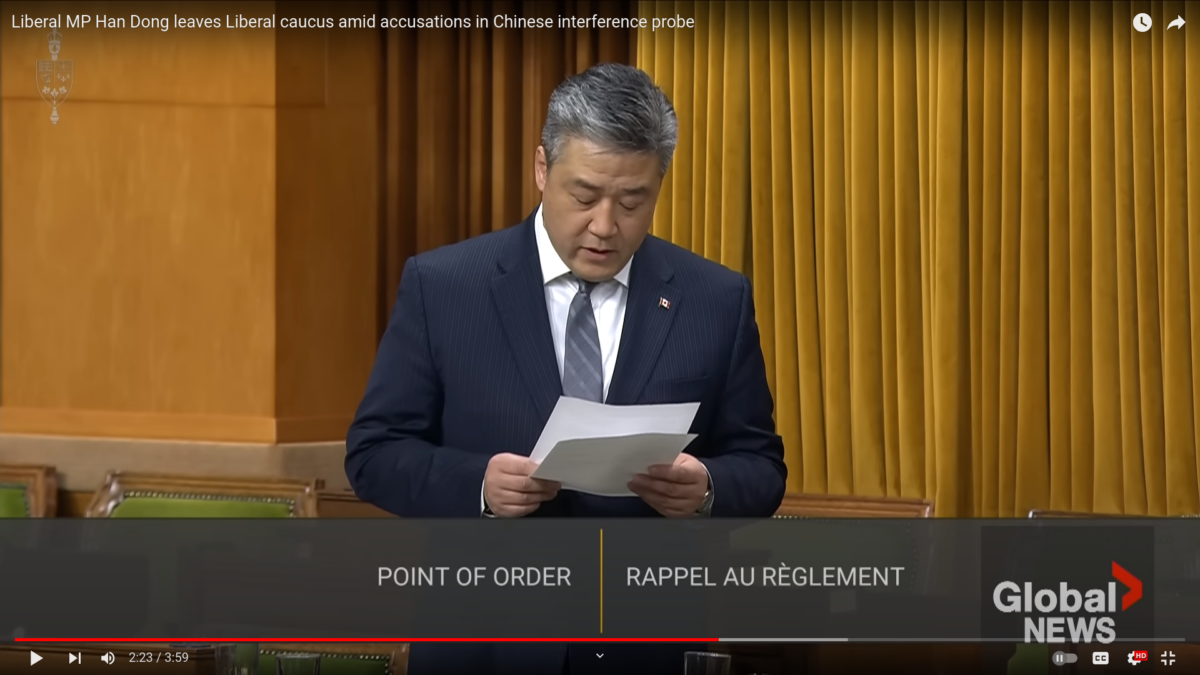
I’m joined by Dock Currie with another episode on the gift that keeps on giving, the CSIS-leaking China panic in Canadian politics. We talk about the recent walk-back from the most ridiculous allegations against Han Dong, the pivot to more aggressive demonization of China in Canadian culture starting in 2018, the Meng Wanzhou case and where things are headed. Dock is an articling student in BC and on twitter at Dock_Currie

Some basics of journalism to evaluate these CSIS stories

Have professional guidelines been followed here?

Since the Canadian media engulfed itself in a Sinophobic panic fueled by some probably racist CSIS leaker and credulous reporters (that I have referred to previously as CSIS-GM) a small number of people in independent media have tried to create some kind of response. While we have at least a couple of good pieces in e.g. The Canada Files and in Passage, we are definitely talking about, if not voices in the wilderness, honourable exceptions to a dishonourable unanimity. There is no debate going on here, at least not yet. 

On the other hand, there is nothing that upsets a monopolist more than the slightest sign of a crack in their racist wall of anti-China coverage. And so it is that we are treated not only to the unfolding defamation campaign against Chinese-Canadians, but also to several of the most fervent of the campaigners sniveling – because of the lack of credulity in these little pockets of twitter about what CSIS-GM is selling – about how the public doesn’t understand the complexity of journalism. 

Like the ungrateful public that refuses to understand how what looks like food prices being driven up by monopoly is actually much more complex, the ungrateful public refuses to understand how what looks like fiction from a racist spy agency is actually the apogee of professional journalism. If they only knew. 

Shall we take up the challenge? Shall we pick up the gauntlet thrown down by the Canadian media? Perhaps we can take a look at some foundational resources for journalists, from the place you know all Canadian journalists look for foundational resources – the US.

How does the CSIS-GM reporting of the past few months stack up against, for example, the Society of Professional Journalists’ Code of Ethics? Here are some principles from the code for you to compare with the behavior of the Canadian media in recent weeks. They include:

  • Verify information before releasing it.

  • Consider sources’ motives before promising anonymity. 

  • Diligently seek subjects of news coverage to allow them to respond to criticism or allegations of wrongdoing.

  • Provide access to source material when it is relevant and appropriate.

In recent years there have been real journalists and sources who have suffered real persecution by the US and its allies for reporting within the above code of ethics. Wikileaks, after a painstaking process of harm reduction to ensure no danger would come to US spies and military personnel, published whole troves of source documents – the Iraq War Diary, the Afghan War Diary, Cablegate – so that the public, journalists, researchers could do their own analysis and their own verification on the documents directly. The source, Chelsea Manning, was punished severely and the publisher, Julian Assange, is in jail, his life in danger. Edward Snowden, after getting himself to safety, came out in his own name and defended his decision to become a source on the NSA’s universal surveillance program. 

Meanwhile the CSIS leaker was given space in the Globe and Mail to defend his honor as well – to defend, that is, his decision to engage in political manipulation and defamation behind a cloak of anonymity. He will continue to be defended by the journalists who published his narratives and by the spy agency that employs him, even as Assange languishes in prison.

Let’s go over now to the Comittee of Concerned Journalists. There we find similar ideas about sources and verification, which is “a consistent method of testing information — a transparent approach to evidence — precisely so that personal and cultural biases would not undermine the accuracy of their work.” How is that working out in Canada? Also in the CCJ principles you will find the idea of publishing in the public interest: “journalists must continually ask what information has most value to citizens and in what form.” The more the CSIS-GM leak material that seems by perfect coincidence to vindicate their approach and assumptions, the more it’s revealed that the goal is narrow political and personal agendas and not what “has most value to citizens”. 

A third resource. While I wouldn’t want to imply that Associated Press follows its own ethics, it too has guidelines that are being mocked by the CSIS-GM operation. 

“ Under AP’s rules, material from anonymous sources may be used only if: 1. The material is information and not opinion or speculation, and is vital to the report. 2. The information is not available except under the conditions of anonymity imposed by the source. 3. The source is reliable, and in a position to have direct knowledge of the information.”

If the CSIS-GM information has passed these tests, there is no way to know it from the story. It doesn’t look like information (#1 failed) and the source says things that make absolutely no sense (#3 failed). With #1 and #3 failed there’s no way to even think about #2, since some of the leaks sound like pure inventions. 

Like any other important endeavour, journalism involves both skill and insight that develop over time and practice. Verification, for example, is a complex method. Seeing with your own eyes is better than hearing from a witness; two witnesses are better than one, but not all that much better if they coordinate their stories before talking to you. Documents are good but can be faked. How much trust you can put into, e.g., a Wikileaks cablegate cable depends on how much you know about what was going on at the time, how well the information fits with what else you know, the nature of the official denial, the motivation of the leaker and of the publisher. How to make a judgment about what is in the public interest and how to balance that with how well you were able to verify and how timely it all is (why now?). Infinite possibilities to do good work emerge from a fairly simple set of principles. 

Violating the principles leads to bad work – which is what has happened here. The social damage, as I’ve said before, is just beginning.

AER 105: Are your favorite academic theorists really CIA spooks? With Gabriel Rockhill

Is French Theory full of CIA spooks?

Talking to Gabriel Rockhill, professor and director of the Critical Theory Workshop. Ever wonder why the CIA thought it was worthwhile to sponsor European left-wing academic theories? We talk about Derrida, Foucault, Arendt, and why even if you think obscure academic theory isn’t important, you might be mistaken. Author or editor of nine books, Rockhill is currently working on a book tentatively titled The Intellectual World War: The CIA’s Failed Attempt to Kill the Idea of Communism.

Why you should subscribe to Dan Freeman-Maloy’s anti-racist substack

View this email in your browser

The holidays are approaching

With the holidays approaching, I suspect you must be thinking, “what encyclopedically researched anti-racist newsletters are there that I could subscribe to?” Well, you are in luck. Dan Freeman-Maloy’s substack, Check the Liner Notes, has come out with another newsletter and will be writing regularly. Support his work by subscribing. Maybe gift a subscription to a loved one (who loves to read long, well researched newsletters).

In other news, Dave Power and I are continuing our Scramble for Africa series, please check that out as we’re 10 episodes in with much more to come. And on Africa, I had an 8,000 word article about Rwanda (reviewing a new book about Rwanda) in Covert Action Magazine (in case your appetite for long-reads hasn’t been sated by Dan’s newsletter).

But here’s a sample from Dan’s latest: https://freemanmaloy.substack.com/p/what-does-the-white-mans-burden-mean

What does “the White Man’s Burden” Mean? by Dan Freeman-Maloy

December 1, 2021

The phrase “the White Man’s Burden” is, syllable for syllable, probably the most iconic thing ever written in the English-language history of racism. But what does it mean?

In short, it means gaslighting. The concept of gaslighting has moved into discussions of empire and racial myth from the field of relationship psychology. Fittingly, the term is adapted from a play, Gas Light, set in late Victorian England. The British Empire in the late decades of Queen Victoria’s reign (1837–1901) was a powerhouse of gaslighting the likes of which the world has rarely seen. One of its gifts to the world was the slogan, “White Man’s Burden.”

In 1955, in his inimitable Discourse on Colonialism, Aimé Césaire warned against getting too caught up in changes in imperial surface language, in his time or in ours. “Don’t let the subtleties of vocabulary, the new terminology, frighten you,” he said; “be reassured! At the start of the journey it may seem a bit difficult, but once you get there, you’ll see, you will find all your baggage again. Nothing will be missing, not even the famous white man’s burden” (p. 60).

Guidance of that sort seems to me too invaluable for us to forget.

For now, I reproduce the below as a follow-up to my last research note, “On Swastikas & Research Method.” In coming posts, I will dig deeper into the racially coded imperial myths that German wordsmiths tried to keep “unbewusst” (unconcious), that English wordsmiths tried to keep “inductive” (see my last note), and which Kipling boldly celebrated as “the lies I tell.”

Taking up the “White Man’s Burden” in Dixie

We can start with the Ku Klux Klan.

The single most accomplished Klan publicist of all time, Thomas Dixon, was a big Kipling fan. Dixon spent the early years of the twentieth century promoting Klan hatreds in a series of popular books. He entitled the first of these books in a double homage to Kipling, The Leopard’s Spots: A Romance of the White Man’s Burden (1902). While Dixon’s subtitle declared the selflessness of white-power politics, his title echoed one of Kipling’s tales of anti-Black racism.

These lies carried power and prestige. After the abolition of slavery in the United States, the terror squads of the Klan did not work in isolation. Their violence was the cutting edge of the white backlash. But it had wider support. The horror of lynchings, then, was inseparable from the wider U.S. assault on Black people after emancipation. This assault on Black life now stands exposed as “one of the most stupendous efforts the world ever saw to discredit human beings, an effort involving universities, history, science, social life and religion” (p. 55). Dixon helped to push it forward, doing his utmost to boost the worst white supremacists’ morale and reputation.

Dixon’s title, The Leopard’s Spots, took its cue from one of Kipling’s children’s stories, “How the Leopard got its spots” (1901). For twelve decades, this story has served as a tool of racist acculturation for any teachers or parents willing to resort to it.

The moral of the story is that dark skin is an irremediable, even a contagious, human fault. Kipling seized upon a phrase that was translated as follows in the King James Bible: “Can the Ethiopian change his skin, or the leopard change his spots? then may ye also do good, that are accustomed to do evil.” Kipling used this imagery to instill a hateful sense of anti-Blackness in the minds of all children who could be made to read along or listen.

Once upon a time, Kipling begins, “everybody started fair.” We will return to this word, fair. Then came darkness. Kipling taught (teaches?) children that darkness came to the leopard when “the Ethiopian put five fingers together . . . and pressed them all over the Leopard, and wherever the five fingers touched they left little black marks.” This is from Kipling’s Just So Stories. My copy, reprinted in 2000 by Penguin, features a leopard’s tail dangling provocatively across the cover.

You can see above how our cultural mainstream continues to gaslight. And in Klan terms, you can see why Dixon appreciated Kipling. The bogeyman of “race-mixing” or “miscegenation” was a favourite lynchers’ theme. Kipling’s story played it up.

Once again, however, the full title of Dixon’s book was The Leopard’s Spots: A Romance of the White Man’s Burden. And where Kipling really excelled was in the transition from the theme of the title of Dixon’s book to the theme of its subtitle, that is, from anti-Blackness to romantic white innocence.

This brings us back to the word “fair.” Modern English investors owed an enormous proportion of their wealth to the exploitation of Africans.1 English dictionary-writers were thus eager to make the virtues of whiteness a matter of definition. Little wonder that in standard imperial English, “fair” was a moral as well as a physical description. “Light as opposed to dark,” the Oxford English Dictionary explained, was one of the word’s meanings. But for the OED, to be fair was not only to be free of physical spots – “Clean, unsoiled, unstained” – but also to be clean in “character, conduct, reputation: Free from moral stain, spotless, unblemished.”2 This story was told by generations of well-financed experts in barrels of Oxbridge and Ivy League ink.

Now, Kipling celebrated the English racialist as a “Puzzler” in tribute to this history of deception. But here we encounter a mild contradiction. On the one hand, Kipling celebrated racial mastery as the property of Englishmen above all others. He never tired of this theme: “the English – ah, the English! – they are quite a race apart.” On the other hand, Kipling layered Englishness into a wider white supremacy. Racism is always a pack of lies – but its contradictions are not random.

Kipling’s supreme lie was that white-power politics are a generous service to non-Europeans targeted by empire. This is the key point. The equation of whiteness with selflessness, and of imperialism with charity, was the central theme of Kipling’s gaslighting. But for a moment, let us pick apart the more basic theme, “whiteness” . . .

. . . or not. In his classic bit about the “Romanian cracker” (timestamp 45:11), Chris Rock expressed a hilarious dismissal of the niceties internal to whiteness; “we don’t got time to dice white people up into little groups.” The point is as fair as it is funny, and I ask those impatient with the dicing to please skip the next section.

Details on Kipling’s supreme lie – white-power-as-charity – can be found below, under the heading “Don’t run. We are your friends.” But for those with the patience, let us first look for a moment at the specifically English or Anglo-Saxonist racism around which white nationalism really did develop.

White nationalism and the “Anglo-Saxon’s burden”

Paul Martin, Jr., featured in the photo above, modelled the “White Man’s Burden” with a sense of heritage. It was autumn 2004, and this Canadian prime minister was visiting Haiti to confirm Canada’s support for the overthrow of Haiti’s elected government and the repression of Haiti’s main mass-based political party. Enter the Globe and Mail, the principal newspaper of central Canadian capital.

Kipling could not have written it better. The Globe did not mention the name of the girl featured in its photo, whom it identified only as “a resident of the Timkatec orphanage in Port-au-Prince, Haiti.” But it found a way to present Martin’s cynical power politics as charity. Proud, prime ministerial fingers are shown directing a Haitian forearm to wave a Canadian flag for the camera.

“Bigre, mes chers collèges (comme on dit), je vous ôte mon chapeau (mon chapeau d’anthropophage, bien entendu).”

With Martin, all ambiguity is removed. This is not Johnny-come-lately whiteness but the thing itself, in all of its vintage prestige. But let us step back for a moment. Just who and what is “white”?

In earlier centuries, some claimed that Englishmen possessed this title almost alone. “The number of purely white people in the world is proportionably very small,” Benjamin Franklin wrote from Pennsylvania, in the days when it still fell under British rule. Franklin continued:

All Africa is black or tawny; Asia chiefly tawny; America (exclusive of the newcomers) wholly so. And in Europe, the Spaniards, Italians, French, Russians, and Swedes are generally of what we call a swarthy complexion; as are the Germans also, the Saxons only excepted, who, with the English, make the principal body of white people on the face of the earth. I could wish their numbers were increased.3

So for this racial storyteller, some of the Germans – the “Saxons,” i.e., those from Saxony – made the cut, as did the English, who according to modern racial lore were “Anglo-Saxons.” But that was about it.

The question of whether any very poor person could be considered fully white lingered for centuries. By the late nineteenth century, a leading French racialist, Gustave Le Bon, could also crudely gender his standard racist tropes. Le Bon wrote that even among the “superior races” of his imagination, “as among the Parisians, there are a large number of women whose brains are closer in size to those of gorillas than to the most developed male brains.” It was old wine in new bottles.

That is the basic story of racism: the recasting of old oppressive hierarchies in new naturalized forms. “The vulgar, primitive, over-simple racism,” observed Frantz Fanon, “purported to find in biology – the Scriptures having proved insufficient – the material basis of the doctrine.”4 Ergo, European Christendom was the best, and its rich better than its poor, and its men better than its women, etc., etc. Own enough universities and such self-serving prattle can be made to sound pretty. Plus ça change.

Meanwhile, the U.S. led the way toward white nationalism. Toward the end of Benjamin Franklin’s life, the U.S. break with Britain meant that British nationality was no longer in play. Congress invited all “free white persons” to become U.S. nationals. A whiteness including various European nationalities emerged, defined against an Indigenous and Black foil. Generations of racialist experts argued that to include more white people was to broaden the basis for white racial power over others. John Van Evrie, a Canadian-born white supremacist, was especially enthusiastic about this point.

After abolition, Van Evrie cheered on Klan violence from New York. He summarized his argument in an 1870 book entitled, White Supremacy and Negro Subordination: Or, Negroes a Subordinate Race, and (So-Called) Slavery its Normal Condition. What Orwell never really taught us was that slavery = freedom is above all a white lie, even if English patriots prefer to call it a red one.

For Van Evrie, “can’t we all just get along” was a battle cry for white-power hatreds. He wrote: “The Englishman believes that the English are alone truly Christian and civilized; the Frenchman honestly believes that La Belle France is at the head of modern civilization; even the advanced and liberal American Democrat thinks, and perhaps correctly, that the Americans alone are truly civilized.”5 Van Evrie’s message was that all white-on-white rivalry or violence was wasted energy, better poured into the unified violence of anti-Black and imperial politics.

So anti-Black and imperial violence defined the “White Man’s Burden.” But whiteness needed first to be made in order to be used as a weapon. In Kipling’s work, readers will thus find a dual commitment to white power and to Anglo-Saxon power. This logic was explicit. It was spelled out in Kipling’s day by the most influential U.S. racial theorist of the period, William Z. Ripley.

Visiting Britain in 1908, Ripley told his hosts that Kipling’s “burden” should really be split into two, especially in North America. Yes, Ripley insisted, it was great for the British to plunder India, for the Klan to gallop across Dixie, and for the U.S. army to devastate the Philippines. But white nationalism needed special attention. Ripley said:

You have your ‘white man’s burden’ to bear in India; we have ours to bear with the American negro and the Filipinos. But an even greater responsibility with us and with your Canadian fellow-citizens is that of the ‘Anglo-Saxon’s burden’ – to so nourish, uplift and inspire all these immigrant peoples of Europe, that in due course of time . . . the torch of Anglo-Saxon civilization and ideals, born by our fathers from England to America, shall yet burn as bright and clear in the New World, as your fires have continued to illuminate the old.6

Like all white supremacist theory, this was nonsense, but it was nonsense with a logic. Ripley was spelling out a program that combined the primacy of British conservative social norms – and the English language – with the pan-European demographic and striking force sought by Van Evrie.

Those who do not care about Canada should now really skip to the next section. But strictly speaking, while Ripley bracketed Canada together with the U.S., the situation here was a little different. In this case, there was no break with the British Empire: a specifically British dominance endured. Until the 1940s, there was not even a specifically Canadian citizenship. Canadians were officially classed as British imperial subjects. Relatedly, in celebration of this imperial connection, British Protestant sectarian groups like the Orange Order (do sample some Fenian-blood–lust) retained power at the expense of white nationalism as such. Not until after World War II was Canada’s British imperial connection painted over.

This brings us to Paul Martin, Sr., father to the twenty-first century Canadian prime minister. In 1946, it was Martin, Sr. who introduced the Citizenship Act for Canada. Thenceforth, Martin declared with white ecumenism, Canadians would be more than British nationals. Martin said: “No matter where we come from or what our origins, French, English, Scandinavian, Scottish, Ukrainian, Irish or whatever else, one thing at least we can all be, and that is Canadians.”7 In this telling, the story of British or dual British–French nationality gave way to a story of composite Canadian whiteness.

In a master stroke of hypocrisy, this record was then removed from the field of popular education and debate. Organized confusion is the upshot. “The truth,” one candid historian wrote as early as 1981, “is that we are a very confused people. We have invented for ourselves a false national identity to conform with the historical myth of Canadian nationalism which we have created from very little hard evidence.”8

Granted, layers of multiculturalist paint have since been applied to the old Canadian social structure. But specialists agree that the appearance is altogether misleading. It now falls to a few academics to joke at the expense of those of us who were kept in the dark about Canada’s imperial foundations. One quips: “To paraphrase Kipling, ‘What should they know of Canada who only Canada know?’”

It will take work to free these quips from specialists and develop a popular anti-racist discussion grounded in the historical record – as distinct from amnesiac national branding. What is meanwhile plain is that the strongest local traditions of gaslighting could not have developed in a few decades, or even in a few generations. They are as vintage as a Rosedale wine cellar. As C.L.R. James warned: “That calm confidence in its capacity to deceive is a mark of the mature ruling class.”

“Don’t run. We are your friends”

Finally, we return to Rudyard Kipling. So long as his mockery remains obscure, the roots of contemporary racist gaslighting are likewise hidden.

Hollywood put Kipling’s politics to film in its 1996 spoof, Mars Attacks! The film features a Martian invasion of earth. The invaders claim with a poker face that they come in peace. It is the plainest lie. But the confusion it causes on the part of earthlings is too convenient for the Martians to abandon. So even as the invaders raid and kill, they stick to the script. In one scene, satirized Martian shock troops storm a US street, firing their weapons while professing their innocence: “Don’t run. We are your friends.”

Eight decades before the spoof, Kipling’s take on this story was played out in India. It was then, in 1919, that the British Brigadier-General Reginald Dyer fired 1,650 rounds of live ammunition – by his own estimate – at Indian demonstrators who had dared to gather in public in their own country against British wishes. To think that British rule in India was ending, Dyer explained, was to be guilty, and the sentence against the crowd was open massacre. “I fired and continued to fire,” he boasted. “If more troops had been at hand the casualties would have been greater in proportion.”

Crucially, Dyer maintained that this massacre was an act of friendship to India – as British rule always was – and that Indians “ought to be thankful to me for doing it.” Kipling could only nod at his pupil’s wisdom: “He did his duty as he saw it.”9 The tradition of Kipling and Dyer was a tradition in which first-person compassion was asserted as an article of faith, all facts be damned.

What was empire, so the story went, if not a gift to those it conquered? Kipling joked about this ruse in an early poem entitled “Et Dona Ferentes,” from the proverb, “Beware Greeks bearing gifts.” Kipling made it clear to his readers that even the fiercest exploitation and hate should be made to sound kind, or at least kept quiet. In the idealized racist of Kipling’s poetry, “the hard, pent rage ate inward,” before striking out with sharp violence and then disappearing without a harsh word. Such was the mastery of the imperial figure whom Kipling idealized as the Puzzler: “When his lips are schooled to meekness, when his back is bowed to blows – / Well the keen aas-vogels know it – well the waiting jackal knows.”

In sum, Kipling’s “The White Man’s Burden” was an ode to the waiting jackal.

Kipling was a product of the British imperial community that ruled India, which had been wrapping the gift of empire in Dyer’s manner for generations. Empowered by its Atlantic exploits, Britain first broke through resistance to its advance in India in the eighteenth century. What followed was the plainest plunder. In the words of one English historian, “No eighteenth-century nabob, as the plunderers of India were called, pretended that he laboured for the benefit of the Indians. He laboured in order to become a millionaire.”10 Over time, the means became more subtle, but the profits continued to flow. By 1932, a British author could forget Kipling’s script and spell it out in dollars and cents. “It has been computed,” he wrote, “that every fifth man in Great Britain is dependent, either directly or indirectly, on our Indian connection for his livelihood.”

The Big Lie that British rule was a gift to India was a fateful and world-destructive joke. Never has wealth flowed from one country to another as wealth flowed from India to Britain during the colonial period. The scope of what happened is suggested by statistics published by the Organization for Economic Cooperation and Development (OECD). In 1700, on the eve of British expansion, India contributed nearly a quarter of the world’s Gross Domestic Product (GDP) against three percent for Britain. By 1870 India’s share had been cut in half while Britain’s had tripled. By late Victorian times, Indians were dying of famine while British wealth poured into universities that celebrated white fairness as an article of faith.

Kipling argued that the lessons of British India generalized: white power the world over should be wrapped as a gift from Europe to the rest of the world. This was the meaning of his poem, “The White Man’s Burden.” Kipling coached his readers to stick to the script, à la Mars Attacks! Proclaim white-power selflessness, Kipling told his readers; whatever the facts, say it again and again: “By open speech and simple, / An Hundred times made plain, / To seek another’s profit, / And work another’s gain.”

In the Canadian North-West as in India, colonized people were reeling from famines that the British authorities had ruthlessly exploited. Pretend, Kipling mocked, that empire comes to the colonized with no attacks and no malice, just bundles of food and medicine: “Take up the White Man’s burden – / The savage wars of peace – / Fill full the mouth of famine / And bid the sickness cease.”

Kipling aimed to define colonial oppression out of existence – white power equals charity equals white power – and in this way to make anti-colonial resistance to oppression a logical impossibility. One can resist oppression. But one cannot resist charity. To resist charity is not resistance at all: it is ingratitude, insolence. In anti-colonial resistance, Kipling therefore coached, racists should refuse to see anything but “The blame of those ye better, / The hate of these ye guard.”

But why would the bearers of empire’s gifts be blamed in the first place? Why would racists receive anything but thanks for, say, the friendship they would show in Jallianwala Bagh, or in Canadian residential schools? Kipling answered with six syllables of carefully crafted hate. He declared that colonized people were “Half-devil and half-child.” The phrase is sharpened to purpose like a knife’s edge. On the one hand, it restates the case for imperial tutelage: if colonized people are racially immature, so the story goes, then they must, in empire’s manner, be taught a lesson. On the other hand, the charge of demonic immaturity makes room for righteous hate even within empire’s educational mission. The result is a self-righteousness fitted to a cruelty both pious and profitable.

By the early twentieth century, Britain’s Lord Cromer could only smile. Cromer sat on an enormous family fortune from the trade in enslaved Africans. Then, without returning a dime, he helped to lead the Scramble for Africa. And after all of this, he felt confident demanding not only the continued European exploitation of Africans, but also their thanks. “Even the Central African savage,” Cromer quipped, “may eventually learn to chant a hymn in honour of Astraea Redux, as represented by the British official who denies him gin but gives him justice.” The mockery is astounding.

After Dyer, pushing Anglo-Indian friendship to its classical conclusions; after Cromer, marketing false humanitarianism as profitable (see the link immediately above); and after Kipling, with his pride in the “waiting jackal” – after all of this, the politeness of the powerful has lost all benefit of the doubt. Hateful words can be terrible. But silence can say just as much. All this time later, there is every reason to make Kipling’s warning the baseline for decent thought and action: “oh, beware my country, when my country grows polite!

Canada in Haiti: A retraction

I conclude with a retraction.

Some time ago, I wrote that Canadian policy in Haiti combined professed good intentions with oppressive policies. I began one article, now a decade old: “Over the course of the past decade, Canada’s leading officials and most prestigious commentators have learned how to approach Haiti in the spirit of cynical power politics and racist condescension (or worse) while maintaining a posture of national self-flattery.”

At the time, I did not know the precedents. But the claim that this dates to the first decade of this century is wrong. It is much older. In fact, empire’s twenty-first century arguments on Haiti were anticipated even by that distant imperial icon, Henry Dundas, whose legacy has loomed so large in the public architecture of Toronto.

Notwithstanding the error, that brief article does unpack the context for the ghastly Haiti photo featured above. You can refer to the article here.

1

The exploitation of Africans and their overseas descendants was a fulcrum of English and then British economic development throughout the modern period. The details are poorly publicized but well documented. Eric Williams, who went on to serve as the first prime minister of Trinidad and Tobago, established this point as early as 1944 in a landmark study available here <https://archive.org/details/capitalismslaver0000unse>. A fuller review of the record can now be found in Joseph E. Inikori, Africans and the Industrial Revolution in England: A Study in International Trade and Economic Development (Cambridge: Cambridge University Press, 2002).

2

Henry Bradley, A New English Dictionary on Historical Principles, Vol. IV, edited by James A.H. Murray (Oxford: Clarendon Press, 1901), 26.

3

As quoted in Matthew Frye Jacobson, Whiteness of a Different Color: European Immigrants and the Alchemy of Race (Harvard, Ma.: Harvard University Press, 1998), 40.

4

Frantz Fanon, “Racism and culture,” in Toward the African Revolution, translated by Haakon Chevalier (New York: Grove Press, 1967), 36.

5

J.H. Van Evrie, White Supremacy and Negro Subordination: Or, Negroes a Subordinate Race and (So-Called) Slavery its Normal Condition (New York: Van Evrie, Horton & Co., 1870), 67.

6

William Z. Ripley, “The European population of the United States,” Journal of the Royal Anthropological Institute of Great Britain and Ireland (38 (1908), 240.

7

As quoted in Sunera Thobani, Exalted Subjects: Studies in the Making of Race and Nation in Canada (Toronto: University of Toronto Press, 2007), 89.

8

John E. Flint, “Reflexions on British Imperial and Canadian History,” Canadian Journal of African Studies 15, no. 1 (1981), 53.

9

As quoted in Derek Sayer, “British reaction to the Amritsar massacre, 1919–1920,” Past & Present 131 (1991), 146 & 158.

10

A.J.P. Taylor, “Conquerors and profiteers,” in Essays in English History (Harmondsworth: Penguin, 1976), 30.

AEP 98: On the Canada Files, with Aidan Jonah

On the Canada Files

I’m joined by Aidan Jonah, editor of the new media outlet The Canada Files, which has an anti-imperialist point of view and an investigative journalism methodology. We talk about some of the Canada Files’s recent investigations, about the relative paucity of anti-imperialist perspectives on Canada (with noble exceptions of course), and about the ambitions plans for the Canada Files’s future. 

AEP 92: Q/A on Extraordinary Threat, our new book on Venezuela

Your Extraordinary Threat questions, answered

Joe and I answer some questions listeners sent in about our new book about Venezuela, Extraordinary Threat, from Monthly Review. Questions include: Was Venezuela “once-prosperous” before Chavez? Has Maduro been true to Chavez’s vision? What’s the COVID vaccination situation? Can we comment on Hong Kong? What is the internal social base of US imperialism in Venezuela? Can all the problems of Venezuela be placed at the feet of US imperialism? And more.