Interwar 16: The US Occupation of Haiti, 1915-1934
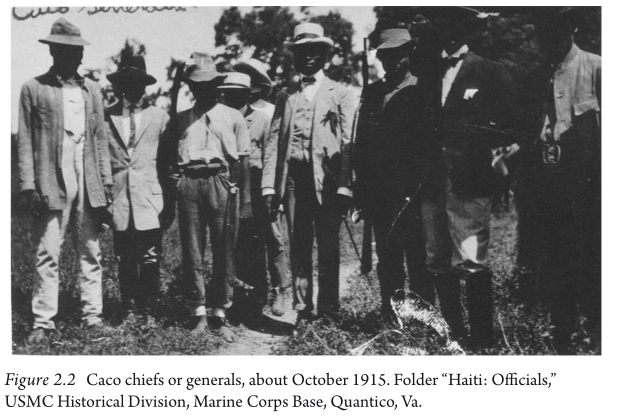
The sordid and criminal US occupation of Haiti 1915-1934 with resistance heroes like Charlemagne Peralte, occupiers like Smedley Butler, a young FDR who hoped he’d be remembered as a “Haiti man”… US racial obsessions and atrocities. And Haiti’s anomalous and scrupulous payment of the debts imposed on it, making it a paradise of American financial exploitation.

The myth of the belly of the beast

Why it’s hard to ‘go make a revolution’

The myth always starts the same. It’s a quote attributed to Che Guevara, by American antiwar activist Jerry Rubin. He visited Cuba and wrote about it in his book Do It! Scenarios of Revolution. Page 20:

“Che stood before us in the Ministry of Labor auditorium… We were 84 Amerikan students visiting Cuba illegally in 1964… As Che rapped on for four hours, we fantasized taking up rifles. Growing beards… Joining Che to create revolutions throughout Latin America. None of us looked forward to returning home to the political bullshit in the United States. Then Che jolted us out of our dream of the Sierra Madre. He said to us: “You North Amerikans are very lucky. You live in the middle of the beast. You are fighting the most important fight of all, in the center of the battle. If I had my wish, I would go back with you to North America to fight there. I envy you.”

Some questions arise.

  1. Did this happen? Jerry Rubin is the sole source, and his reliability is questionable. He abandoned activism in 1972 to become a businessman, selling wellness and supplements and producing quotes like “wealth creation is the real American revolution”, and books like The War Between the Sheets: What’s Happening with Men in Bed.

  1. Was Che being diplomatic? This was a diplomatic visit, after all. Che could have said this for any number of reasons – including wanting to send these Americans back home so they wouldn’t stay.

  1. Is this quote a sufficient basis to build a sense of where on the globe the most strategic location for a political “fight” would be?

I’m inclined to think that Che probably said something like this, to be diplomatic, and that it has been taken much more seriously than it should be. After all, after this Che Guevara went first to Congo, and then to Bolivia, not to the US. His revealed preferences show what sites he thought were strategic and which not.
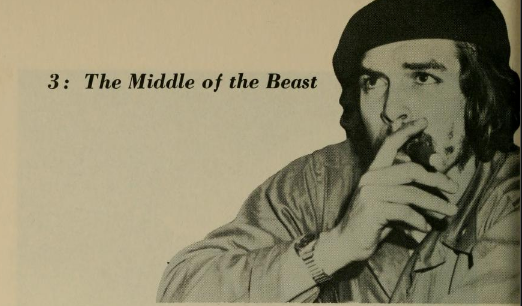
Did this man envy Jerry Rubin?

A few years after Rubin’s 1964 visit to Cuba, another Jewish American antiwar activist, in the course of setting out tasks for the American peace movement, argued in 1969 that the peace movement had not yet amounted to very much or had much influence on America’s consciousness. The more important variable, Chomsky argued, was the Vietnamese resistance. In American Power and the New Mandarins, he wrote: “Nevertheless, those who have devoted themselves to working for peace in Vietnam can only be saddened by the realization that they have failed to create the consciousness in this country that we have no right to win a military victory. It is the miraculous heroism of the Vietnamese resistance that has forced these tentative moves towards peace in Vietnam.

On the one hand, Rubin invoked Che Guevara to argue that the US revolution was the most strategic revolution; on the other, Chomsky recognized that the US movement had no meaningful effect on the situation, that only the Vietnamese resistance had changed the equation.


In 2012, Norman Finkelstein wrote a book called Knowing Too Much: Why the American Romance with Israel is Coming to an End. In April 2026, the Jewish Electorate Institute published a poll finding that, after 3 full years of openly committing genocide, rape, and torture before the world, Israel was understood by 87% of American Jews as having the “right to exist as a Jewish homeland.” 83% of American Jews believed that criticism of Israel was antisemitic.

In his 1980 book A People’s History of the United States, writer and nonviolence advocate Howard Zinn described the American system’s genius like this:

“The American system is the most ingenious system of control in world history. With a country so rich in natural resources, talent, and labor power the system can afford to distribute just enough wealth to just enough people to limit discontent to a troublesome minority. It is a country so powerful, so big, so pleasing to so many of its citizens that it can afford to give freedom of dissent to the small number who are not pleased.”

Zinn’s conclusion is right, but one premise is wrong. America is not “a very wealthy country” because it is “rich in natural resources, talent, and labor power.” America is a very wealthy country because it is a parasitic apparatus draining the wealth and resources of the entire Global South to it. Political economists like Jason Hickel, analyzing value transfer, unequal exchange, and drain, explain the dynamics. Everything from the dollar as reserve currency and dollar recycling mechanisms, monopolies of intellectual property and patents, the (low) pricing of raw materials from poor countries and (high) pricing of services from rich ones, to US control over international institutions (including financial ones), gives the US trillions of free, drained value from Asia, Africa, and Latin America.

America didn’t get into this parasitic position through “talent”, either. It nudged its predecessor, England, off the throne and into a gentle second-hand parasitic place. That America had the resources to nudge England off came from a prior theft: the theft of the North American continent (through genocide) and the theft of millions of African people whose labor and freedom was stolen (through slavery).

He goes on to explain why America hasn’t had a revolution:

“One percent of the nation owns a third of the wealth. The rest of the wealth is distributed in such a way as to turn those in the 99 percent against one another: small property owners against the propertyless, black against white, native-born against foreign-born, intellectuals and professionals against the uneducated and unskilled. These groups have resented one another and warred against one another with such vehemence and violence as to obscure their common position as sharers of leftovers in a very wealthy country.”

Zinn adds an ideological reason to his material argument: “The idea of saviors has been built into the entire culture, beyond politics. We have learned to look to stars, leaders, experts in every field, thus surrendering our own strength, demeaning our own ability, obliterating our own selves.” Fifty years later, every TV show, cartoon, and Hollywood blockbuster is some variant of superhero, “chosen one” narrative: things have gotten far more extreme than Zinn described.

He hoped that Americans could one day unite and “succeed in doing what the system itself has never done-bring about great change with little violence.” The tactics he believed would work were nonviolent ones: “demonstrations, marches, civil disobedience; strikes and boycotts and general strikes; direct action to redistribute wealth, to reconstruct institutions, to revamp relationships; creating-in music, literature, drama, all the arts, and all the areas of work and play in everyday life-a new culture of sharing, of respect, a new joy in the collaboration of people to help themselves and one another.” Such a nonviolent movement, Zinn said, “would be a new kind of revolution, the only kind that could happen, I believe, in a country like the United States.”

Zinn believed that the US had divided its population into prisoners and guards. The title of this rousing concluding chapter to his book? The Coming Revolt of the Guards.

To these Jewish American activist-writers of the 20th century, a major, nonviolent, but nonetheless revolutionary change in the American status quo was coming, at some point in the future. 14 years after Finkelstein’s prediction of the romance coming to an end, Jewish American support for genocidal Israel is basically total. Meanwhile, 46 years after Zinn’s prediction, is it safe to say the “Revolt of the Guards” is probably not coming? And if not, could the promise that it will appear around the corner itself not some kind of pacification, release valve?


Looking at the record since, say, 1917, there have been revolutions, near-revolutions, and successfully rolled-back revolutions in many countries, but nothing close to one in the US. It could well be that a revolution in the US, forcing elites into exile in places like England and Israel to plot their return, would be the most strategic thing that could happen. But that enthusiasm has to be curbed by the record, and the record would suggest that it is much harder to have a revolution in the US (or another Western country) than in the rest of the world. It could be that the conditions in the core are the least conducive to revolution and that revolution would only occur there after a lot of revolutions in the periphery.

If it were easier, or as easy, it would have happened already.

Because we’re trying to figure out the reason for the absence of something, the truth is it’s impossible to know. A few have ventured to name the reasons over the decades.

Material Bribery. Zinn’s hypothesis, that US elites give enough wealth to enough people that they identify with elites instead of the people, is an explanation that has been offered in many different forms from Lenin (“labor aristocracy”) to Sakai (“the mythology of the white proletariat”) and many times in between.

Psychological / status bribery. Beyond bribery, the idea from Du Bois that racism gives the privileged a “public and psychological wage”, suggests that elites have more than just cash and toys to distribute, but also psychological privileges and pleasures in a racist system. Watching Israeli society and its supporters publicly enjoying the razing of cities, agriculture, infrastructure, and the torture, rape, and killing of children shows that there is some kind of “psychological wage” at work in participation in genocide.

Propaganda. One of the major industries of the West is propaganda. Propaganda for the Global South is manufactured in the north. News media, social media, high culture, pop culture, the academy – all are manufactured at massive scale and weaponized from the core outwards. The principal targets and most brainwashed by propaganda are its Western producers. Those minds would be among the hardest to free.

Co-optation. America is also the epicentre of the production of ideologies specifically to capture and redirect dissent and revolutionary energy: the ideology of democracy and electoralism (in which parties all work for the same goals), the ideology of human rights and the rule of law (for some), the belief that free speech and awareness alone can make revolution, the idea that nonviolence can be a substitute for armed struggle, all work to ensure every movement fizzles. Co-optable movement leaders are promoted into electoral and non-governmental organization (NGO) machinery.

Murder and Prison. But the emphasis on, to put it crudely, the bribery of a privileged minority (Zinn’s argument), even when added to the world’s most comprehensive and sophisticated propaganda apparatus (Chomsky’s argument), and co-optation engine (through electoralism, nonviolence and free speech ideologies, etc.) can take emphasis away from a major factor that has been openly on display especially in the past three years: violent repression.

Chomsky used to claim that violent repression was something that happened in the Global South, but in the Global North the consequences of dissent were less severe because of past struggles and won freedoms. But that isn’t true. When the co-optation engine fails, George Jackson wrote (in Blood in My Eye, quoted in an MROnline article by Colin Jenkins): “Take protest too far, however, and they will show their other face. Doors will be kicked down in the night and machine-gun fire and buckshot will become the medium of exchange.”

Movement leaders in the US are assassinated before they can amass a large following (as occurred as recently as BLM in the 2020s). The US doesn’t just have a big middle class, it also has the world’s biggest prison population in a system of prison camps, surveillance, house arrest, parole, and custody. US police train in Israel and kill thousands of Americans every year. American tech companies, the foundation of the economy, have surveillance as their core business. Student encampments were crushed through force. Police raid, entrap, and infiltrate activist spaces as one of their core functions. Polls might show majorities want health care or are against a war – but majorities don’t get what they want. In the words of George Jackson: “The ultimate expression of law is not order–it’s prison.”


When leftists from the global north and the global south argue online, Westerners might end up getting shut down with something like: “Shut up and go make a revolution where you are.” Fine. Shut up, Westerner. It’s as good a way as any to end a pointless argument.

But those who would take that advice ought to know that while the global north is unequivocally more materially comfortable because of all the stolen wealth, it is not an easier location to “go and make a revolution”. Based on the lack of one in history, we can conclude it’s harder.

If Che Guevara wasn’t merely being diplomatic, if he really did envy Rubin, his envy was misplaced.

Interwar 14: Sandino battles the Americans for Nicaragua, 1927-1933
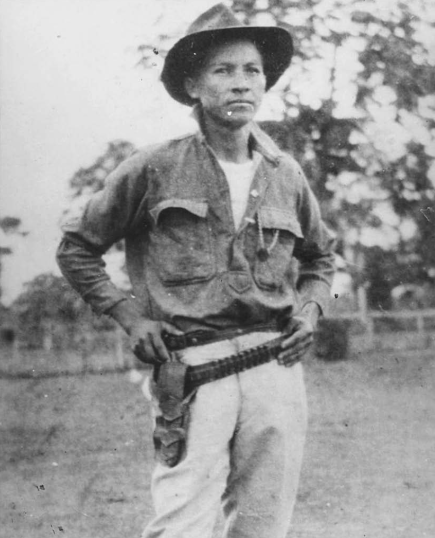
We go way back, at first, to the rise and fall of the filibustering William Walker, who wanted to be king of Nicaragua. You’ll meet Smedley Butler as well, but this episode on Interwar Nicaragua focuses on the rebel leader who dared to fight the American occupation, Augusto Sandino, who fought from 1927-1933 and has inspired fighters ever since.

Interwar 11: The Tulsa Race Massacre of 1921

Back when we covered the US Civil War, we talked about how the US ultimately un-did the Reconstruction. But undoing the Reconstruction went on and on, and the Tulsa Race Massacre (formerly known as the Tulsa Race Riot) was a major moment of the destruction of a prosperous Black community. The history, the aftermath, the coverup – Dave talks about some of the effects on US politics a century later.

Resisting Sanctions and Economic Warfare

Resisting economic warfare is possible. The main challenge for anti-imperial governments is military.

According to a paper published in the Lancet Global Health journal, economic sanctions imposed by the US on other countries have killed about 38 million people since 1970. A key feature of that economic warfare is the deliberate undermining of the currencies of countries singled out for punishment. In February, Trump’s Treasury Secretary boasted about how he brought about a collapse in the value of Iran’s currency. But it is not only sanctioned governments that must manage their currencies under the boot of the U.S. Empire. We’ll review the strategies governments have used to manage their exchange rates and conclude with a note on how economic warfare is inseparable from the real thing.

Basics of monetary policy under U.S. tyranny

Money is the inevitable result of goods and services being exchanged in a modern economy. If too little money circulates in an economy, the exchange of goods and services is restricted and unemployment can rise to excruciating levels. That often happens because central banks try to keep inflation very low by restricting the money supply (often done by raising the central bank interest rate on government bonds, making borrowing more expensive and disincentivizing it, thereby reducing the amount of money banks put into circulation through these loans). Too little money in circulation can cause deflation- a fall in the weighted average of all prices. But too much money printing can result if too much money chases after too few goods and services. It can cause the opposite of deflation, which is inflation. At excessively high levels inflation will prevent most people’s wages from keeping up with rising prices. When people lose purchasing power, they are impoverished. A state’s money policy should align with the real resources – labor, skills, natural resources including energy, infrastructures of various kinds – available in the economy. (Social classes within a country can have very different ideas about what a desirable money policy is).

A huge additional concern is foreign exchange. Unless a country is rich and powerful enough to have its central bank print a “reserve currency” like the U.S. dollar, then it also needs to worry about the international value of its currency. It is a global economy: all countries need imports, and they need foreign currency to pay for them. Today, about 57% of global central bank reserves are in U.S. dollars. The percentage was over 70% in 2000.

Using its dollar reserves to buy or sell its own currency is one way a central bank can impact the value of its currency (the exchange rate), selling dollars they have saved to buy back their own (eg., rials) in order to keep their own currency from depreciating too much, or buying dollars to build reserves when their own currency gets so strong that local industry is harmed by cheap and abundant imports. An alternative tool for protecting local industry, as someone taught Trump half a lesson about this term, is tariffs – but that’s a story for another newsletter.

If the value of a country’s currency drops too low relative to the US dollar, the cost of all imported goods people try to buy inside the country soar, which in turn can drive up all other prices, leading to an inflationary spiral. An overvalued currency, on the other hand, can stifle the development of domestic industry: when no other country can afford to acquire your expensive currency to buy what you’re selling, costumers will look for those goods somewhere cheaper. If you’re in the UK or the USA, you can go shopping on the world market with your strong currency and buy what you like, with no incentive to buy local, depriving your local businesses of the opportunity to sell to the local market. If you can’t sell in the local market the chances of succeeding globally are low. Deindustrialization results. Not a terrible outcome in the metropole, whose role in the global economy is to consume, not produce (even the flagship military industry is basically consumptive: its products are made to be blown up).

Ideally, the value of a country’s currency is stable and at a level that’s compatible with its economic development: not too high or too low relative to the U.S. dollar. (Again, social classes within a country can have very different ideas about what a desirable exchange rate is)

International trade also requires payment systems (ie., SWIFT). Because the U.S. dollar is still the world’s top reserve currency, the U.S. financial system remains the heart of the international payment system. As Andres Arauz, former head of Ecuador’s central bank, explained, when two countries in Latin America trade with each other – seemingly not involving the US at all – money still flows briefly through U.S. banks as part of the transaction. The U.S. Treasury then can claim jurisdiction over businesses in other countries, arresting foreign executives like France’s Robert Pierucci in what he called The American Trap. This is sometimes called “long-arm jurisdiction”, and it is one of many ways the U.S. exerts control over every economy in the world. The U.S. has tremendous coercive economic power that is ultimately backed by its military might.

There are various strategies governments have used to try to manage their currencies.[1]

Floats and pegs: options for the unsanctioned

A 1:1 Peg to the U.S. dollar (Argentina)

From 1991 until 2001, Argentina, under U.S.-backed rightwing governments, pegged its currency to the U.S. dollar. The government guaranteed that it would buy and sell Argentine pesos as if they were equal in value to dollars.

This strategy has been called a close cousin to dollarization. Dollarization is dispensing with your own currency entirely and using the U.S. dollar. What low inflation-obsessed economists like about a dollar peg and dollarization is that they greatly limit and eliminate, respectively, a central bank’s ability to print money.

In Argentina’s case, the dollar peg was credited with ending high inflation. But poverty and unemployment spiked after adopting the dollar peg. Then, in 1998, Argentina entered into the worst recession in its history. It continued for four years. Throughout the crisis IMF economists insisted that the dollar peg was not the problem – that Argentina simply needed to reduce wages and government spending (destroying health, education, human infrastructure, the social safety net…).

Taking IMF orders (and loans) during the crisis led to deflation, but it didn’t end the crisis. It made it worse. The crisis ended shortly after Argentina took three measures: 1. abandoned the peg, 2. let the peso devalue down to 25 cents, and 3. defaulted on $100 billion of government debt.

Argentina’s economy recovered quickly and living conditions improved steadily for over a decade. The key reason: Argentina began stimulating the economy rather than strangling it with austerity to try to save the dollar peg.

Sadly, because of imperial “long-arm jurisdiction”, the default led to Argentina being targeted by vulture funds: A U.S. businessman and funder of Philos Israel and other pro-Israel projects, Paul Singer, purchased Argentina’s debt and years after the default, sued Argentina in a U.S. court and was awarded $832 million of Argentina’s money by that court.

A managed float of the currency (Argentina)

Shortly after default and devaluation of 2001 Argentina imposed foreign exchange controls. High income exporters were forced to turn over dollar earnings to the central bank in exchange for pesos at the greatly devalued rate. That helped Argentina’s central bank build up dollar reserves so that it could implement a managed float of the peso.

If a central bank does nothing to impact where international supply and demand for its currency sets the exchange rate then it is said to allow the currency to “float”. With a managed float, the central bank does intervene to try to keep the exchange rate stable, but does not try to keep the exchange rate very far from where the international market would set it. A fixed exchange rate regime (a peg) is characterized by much more intervention by the state and a greater distance between the fixed exchange rate and the rate that would exist if the currency were allowed to float.

Argentina’s recovery happened mainly under the leftwing governments of Nestor Kirchner and later his wife Cristina Fernandez de Kirchner. The “Kirchner period” lasted from 2003-2015.

Thanks to Western democracy, Argentinian voters in 2023 were able to return economic madness and extreme Zionism to the presidency in the form of Javier Milei, who talks to his dogs that he named after right-wing economists like Milton Friedman and Murray Rothbard, bringing Argentina down to historic economic disaster, eating donkey meat and tree bark.

A reasonable peg to the dollar (Bolivia)

Under the leftwing Evo Morales government in Bolivia (2006 – 2019) the country greatly improved living conditions while maintaining a very stable exchange rate and low inflation.The poverty rate was cut in half, and extreme poverty by 60%. Bolivia’s currency (Boliviano) traded at about 6.8 for one U.S. dollar (about 15 cents) throughout this period The central bank intervened in the market to keep it remarkably stable.

To achieve that stability Bolivia built up massive central bank reserves that reached 48% of GDP by 2013, one of the highest in the world. The key to building huge reserves while also paying for public investment and social programs was a sevenfold increase in the government’s hydrocarbons export revenues. Morales ended loan agreements with the IMF whose economists had always opposed the nationalization of hydrocarbons.

Bolivia probably got carried away building reserves and should have plowed even more money into reducing poverty. A small reduction (say 10%) in its reserves would have gone a long way towards additional poverty reduction without sacrificing a stable currency. Could that have translated into additional public support – perhaps enough to have prevented the 2019 US-backed coup that ousted Morales? Possibly. Regardless, Bolivia’s approach to maintaining a stable and appropriately valued currency, while successful overall, was still very expensive both politically and economically. It illustrates the difficulty of operating within the US imperial system even when not subjected to crushing U.S. sanctions.

Dollarize your economy (Ecuador)

Decades of closely following IMF orders led Ecuador to disaster that drove unprecedented mass migration during the 1990s. Throughout the 1990s the central bank tried to keep the value of the sucre stable at a reasonable rate relative to the dollar but failed miserably. Constant devaluations were a feature of the catastrophic 1990s. In 1999 the banking system collapsed and in 2000 the government decided to adopt the U.S. dollar as its official currency.

President Jamil Mahuad, who made the decision to dollarize, remains despised in Ecuador, but dollarization is popular. More precisely, there is widespread fear that abandoning dollarization would mean a return to 1990s chaos and financial collapse.

Under the leftwing government of Rafael Correa in Ecuador (2007’-2017) it was shown that dollarization isn’t the policy straitjacket that both proponents and detractors assumed it was. Correa’s government defaulted on government bonds owed to foreigners then repurchased them at greatly discounted rates. It took advantage of the benefits dollarization can bring (low inflation, low interest rates, a minimal need to hold dollar reserves) to help pay for public investment and social spending. It used banking regulations and tariffs to work around the limitations dollarization imposes. The government actually created a very significant amount of money during its last years in office – not by printing US dollars of course- but through the banking system.

All that said, dollarization was, overall, a burden that the Correa government had to bear. Assessing Correa’s achievements it must be stressed that Ecuador was not under U.S. sanctions while he was in office. The U.S. was focused on undermining Venezuela. In a post-Gaza genocide world, it is impossible to believe Correa’s government would have gone un-sanctioned.

Use a gold standard (USA, UK, Zimbabwe)

A gold standard has been fiercely advocated by right wing extremists like Ayn Rand, Ron Paul and Alan Greenspan. If a currency must be backed by gold, then the government cannot print what gold standard advocates call “fiat money”. But note (as discussed above regarding Ecuador) that even if the government cannot print money (even if it used gold coins as its currency) it could still create money through the banking system. That’s why goldsmiths ended up becoming powerful bankers in seventeenth century England. Also, a gold standard exists by a government fiat (decree) just like money that’s printed when there is no gold standard.

Contradictions aside, there is no doubt that a gold standard imposes extremely tight restrictions on the government’s monetary policy. As economist Bill Mitchell has explained, the gold standard was used in the United States from 1873 to 1933. It made the Great Depression much worse than it would otherwise have been, and even its narrow record on keeping inflation low and prices stable was not good. Price stability improved in the U.S. after the gold standard was abandoned.

When there is hyperinflation (an inflation rate of over 50% per month), it is the main problem hurting an economy, so resorting to a gold-backed currency – to trigger deflation – may appear justified- as in Zimbabwe recently. But the government must eventually find ways to increase the money supply as Ecuador did under the constraints of dollarization. It has been about a century since the leading capitalist states subjected themselves to a pure gold standard – 55 years if you count the Bretton Woods system, a modified gold standard for international trade after WWII that the U.S. dismantled in 1971. That alone speaks volumes about the problems with a gold standard.

Cuba resists sanctions through multiple modes

Reserve currency rationing, multiple fixed exchange rates and barter (Cuba)

Almost immediately after taking power in 1959, Cuba’s government was subjected to economic warfare and other acts of war perpetrated by Washington. While Che Guevara ran the central bank (1959-61), all Cuban pesos were replaced with new ones printed in Czechoslovakia. The new pesos arrived in Cuba disguised as arms shipments. The old pesos, held in large quantities by the revolutionary government’s enemies in the U.S., were suddenly made worthless by Che’s surprise maneuver. Additionally, anticipating the US blockade, Che quickly ordered Cuba’s gold reserves moved out of the US.[2]

During the Cold War, Cuba’s socialist government used a fixed exchange rate relative to the Soviet ruble and the US dollar, but also tightly controlled foreign currency to ensure that its use was compatible with the government’s economic plan. By 1979 possession of US dollars was legal only for the government and tourists. The Cuban government set pesos equal to US dollars for the purposes of setting some prices. That was very different from the 1:1 peg to the dollar in Argentina which had a freely convertible currency and consumer prices set by markets.

Another huge difference was Cuba’s barter-type trade with the USSR which was deliberately set up to be favourable to Cuba. This offset not only the harm done by U.S. sanctions but also the harm US imperialism did (and still does) to unsanctioned countries through normal trade. In fact, passively accepting unequal exchange is the requirement for remaining un-sanctioned.

One of the most valuable products Cuba received from the USSR in exchange for Cuban exports, largely sugar, was oil. By the mid 1980s, Cuba’s re-export of Soviet oil became its largest source of foreign currency.

Post Soviet sellout: two currencies, one pegged 1:1 with the dollar (Cuba)

The USSR was formally dissolved in 1991. Cuba was cast into the infamous “special period”. Smelling blood, the U.S. intensified its sanctions.

Cuba quickly turned to tourism to get foreign currency it could no longer get through its trade with the defunct USSR. It legalized the circulation of the U.S. dollar in Cuba in 1993, but still carefully regulated and taxed its use. Legalization reduced the size of the black market for dollars which had grown as Cubans living in the U.S. sent increasingly large amounts of dollars to family members in Cuba.

In 1994 Cuba introduced the CUC, a peso that Cubans and tourists could exchange at par with the dollar. The CUC reduced the need to have as many dollars circulating in Cuba. The CUC circulated alongside the dollar in Cuba until 2004. Cuba’s regular peso, known as the CUP, exchanged for dollars at a very different fixed rate. In 1996 the rate was 1 dollar for 18 CUP.

Cuba also defaulted on foreign debt which was also key to it surviving the special period. By 1994 Cuba had not only survived the special period, in defiance of IMF predictions, but also returned to growth.

Beginning in 2000 barter-type trade with Venezuela helped reduce the pressure on Cuba to get dollars. Cuba doctors and other professionals worked in Venezuela in exchange for Venezuelan oil.

In 2004, the government concluded that the influx of dollars in a decentralized manner was not doing enough to alleviate Cuba’s dollar shortage. Cuba again centralized its control of U.S. dollars and other foreign currency. With rare exceptions, only the CUC and CUP were allowed to circulate in Cuba.

The CUC exchanged at 1 CUC to 24 CUP for Cuban consumers and 1 CUC to 1 CUP for state enterprises.

Slow transition towards currency and exchange rate unification (Cuba)

Cuba’s post-1993 reforms allowed rapid growth of the tourist industry which by the early 2000s became Cuba’s major source of foreign of currency. But it also caused problems and resentment. It created a two tier system where workers in industries like tourism who had ready access to CUCs had much higher incomes than those without. The system incentivized highly educated professionals to abandon their professions to work in the tourism industry if they could.

To some extent that problem was offset by the health care sector. The medical services provided by Cuban doctors working abroad became a very important source of foreign currency.

Beginning in 2013, the government stopped allowing some state enterprises to exchange CUC and CUP at a rate of 1:1. The 1:1 rate meant the enterprise was treating revenues and costs as the same whether in pesos or dollars – a massive cost to the government that often discouraged efficiency. So in 2013 some state enterprises were required to exchange at a rate of 1 CUC for 10 CUP.

As former Minister of the Economy, José Luis Rodríguez, explained, the goal was to gradually shift to one currency whose exchange rate was set through a managed float (discussed above).[3] Helen Yaffe, in her book “We are Cuba” described the extensive public consultations and debates that are always ongoing about public policy in Cuba. Cuban leaders were extremely careful to prepare the public for currency and exchange rate unification. The CUC was eliminated in 2021, eight years after the process was initiated, but multiple fixed exchange rates are still used for the CUP.

The long economic war on Venezuela

After suffering two U.S.-backed coup attempts in 2002-2003 Venezuela abandoned a floating exchange rate system in favor of foreign currency controls and a fixed exchange rate. By 2010 it began using multiple official exchange rates. It worked well enough until 2013 when it suddenly ran into problems with an inflation-devaluation spiral that was driven by a black market for dollars. This problem became vastly worse after the U.S. and its proxies deliberately crashed oil prices in 2014 to hurt Venezuela, Iran and Russia. The U.S began imposing broad economic sanctions in 2015, under Obama, which were intensified repeatedly through Trump’s first term.

Starting in 2019, Venezuela began to significantly relax foreign currency controls – to give Venezuelans many more legal ways to get dollars. In 2020, Venezuela also shifted away from indiscriminate fuel subsidies to a system that was far more targeted – and that recycled dollars back to the government. The economy has been growing since 2021 despite crushing US sanctions.

Contrary to western media lies about political repression, necessary economic reforms in Venezuela were delayed by the government’s remarkable tolerance for U.S.-backed subversives as we argued in our book “Extraordinary Threat”.

If a country has a market economy – which is the case for all the cases we reviewed except for Cuba – then it would appear that a managed float and single exchange rate appears to be best – if it is a realistic option politically. (It wasn’t realistic in Ecuador during Correa’s decade in office as we explained). However, even Cuba, which has a socialist planned economy, has a managed float and a single exchange rate as a long term goal. But extreme U.S. malevolence has obstructed Cuba’s efforts. That said, a one-size-fits-all conclusion about the best exchange rate system for all countries in all circumstances would be unwise.

China’s inimitable methods

Currency options are not a menu that a government can choose from, but historical choices arising from contingency and improvisation. Cuba has survived through so many crises because of its revolutionary trajectory and its ability to mobilize its people. China, on the other hand, was the largest economy in the world for most of history, passed through a century of humiliation, and is returning to its historical role. China has also had a revolution and shares with Cuba the ability to mobilize people for major undertakings. Its size and resources mean that it has passed from defending itself from US sanctions, to working around them, and is now reaching the point of challenging them directly.

Under U.S. economic sanction from 1949-1979, China used barter trade within the socialist bloc as well as with the capitalist bloc. The terms of the barter trade with the Soviet Union were a source of resentment and one of the causes of the Sino-Soviet split (documented in Shu Guang Zhang, Economic Cold War). For a long time, Hong Kong served as a bridge between China and the capitalist bloc. As China builds out the Belt and Road Initiative, they made specific deals, including infrastructure-for-resources deals, avoiding the U.S. dollar and its long-arm jurisdiction.

China’s socialist economy has successfully used a fixed exchange rate system – and China is far less vulnerable than Cuba to U.S. aggression. Even the IMF has conceded that China’s control over foreign currency flows allowed it to grow during the Asian financial crisis of the late 1990s when other Asian economies were devastated. In fact, China did well because it did the exact opposite of what the IMF coerced other Asian countries to do. After the Asian financial crisis, many countries built up massive dollar reserves to avoid ever having to go to the IMF for help. Standard capitalist economics textbooks don’t tell developing countries to build up reserves to defend against the kind of predators who teach economics at Harvard.

Since 2005 China’s exchange rate has gradually become more flexible – similar to a managed float.

In 2018, Canada under PM Trudeau was convinced to arrest the CFO of the flagship Chinese tech company Huawei, Meng Wanzhou, on behalf of the US, who wanted to prosecute her, alleging that Huawei was not complying with US sanctions on Iran. The analogy to Pierucci and the American Trap, which ended with the US-based General Electric acquiring the cutting edge part of the French giant Alstom, was obvious. But China did not hand Huawei over to the Americans. Instead, Canada ended up handing Mme. Meng back to China. This was one turning point in China’s history of being sanctioned.

Next, in 2022, the US and Europe scolded China for providing an economic lifeline to Russia, whose economy was supposed to collapse when the West stopped supplying it with Western goods. China expanded its trade with Russia, unfazed.

In 2026, with the Strait of Hormuz closed to the US and its allies in aggression and genocide, the US demanded that China stop trading with Iran lest its refineries face secondary sanctions. China employed a 2021 law called the “blocking mechanism”, declaring that any company complying with US sanctions would face severe legal consequences in China. This is another turning point in China’s history as it constitutes the most direct challenge yet to the US sanctions weapon.

Iran, Russia, and the other inimitable method: war

In 2026 Iran has discovered a unique and probably unrepeatable option for defeating a U.S. sanctions regime. When the U.S. and Israel initiated a unilateral war of aggression by assassinating Iran’s supreme leader and killing 180 schoolchildren in Minab, Iran responded by closing the Strait of Hormuz, charging a toll for ships passing through, and conducting both tolls and trade for its own oil in currencies other than the dollar. As a result of these war conditions, Iran has broken out of the sanctions regime that had been destroying its economy and is now selling more oil at higher prices than before the war, as well as exerting control over a significant portion of the economy of its enemies. Oil in West Asia was referred to in 1944 by the US State department as a “stupendous source of strategic power” and “the greatest material prize in world history”. Deployed since 1979 against Iran by the US, that stupendous power is now in Iran’s hands.

This option cannot be generalized because no other country has the capacity and the confidence to go to direct war against the U.S. To do so, a country would need a vast underground military-industrial complex, a huge, dispersed, and motivated leadership class that can recover from the assassinations of key figures, deterrent-level air defense, the ability to threaten to destroy a large amount of the world economy, physical control over one of a handful of key global logistical chokepoints, and the ability to fight a standoff war with the U.S. air force, navy, and all of its allies.

Or some similarly potent set of attributes – like Russia has.

Russia was supposed to collapse under the weight of sanctions in 2022. Biden boasted that the ruble was goint to turn into rubble. Instead, Russia has defeated the sanctions and used them to develop local industries including their own military-industrial complex. As with Iran, Russia’s success in defeating the sanctions was inseparable from their success on the battlefield. Russia chose a slow, casualty-averse attrition strategy knowing that NATO and the US could continue adding resources to match Russia, but knowing also that Russia’s military industrial production was a match for the West in a long war of attrition. Russia also had its own “stupendous source of strategic power” as a major oil and gas producer. When the US cut Russian gas out of European markets, Russia found markets for their energy in the east (as did Iran). With resources to sell, markets to sell them to, and currencies other than the dollar to trade in, there was no way the ruble was going to turn into rubble.

We conclude this newsletter with real war because economic warfare is inseparable from kinetic war and cannot be conducted without its threat. This year, the Trump dictatorship has bombed Venezuela, imposed a sadistic fuel blockade on Cuba, and launched a disastrous war on Iran. Trump has also threatened that Cuba will be invaded next. Economic wars on Russia and Iran were followed by the real thing; the US makes clear every day that it intends the same for China. Eventually, targeted countries (which eventually, will be everyone) will have to defend their economies on the battlefield.

NOTES

[1] The overview we provide for Argentina, Bolivia and Ecuador comes primarily from Mark Weisbrot’s 2015 book “Failed: What the “experts” got wrong about the global economy”

[2] Our sources on Cuba were two of the books Helen Yaffe wrote about Cuba: “We are Cuba” and “Che Guevara: The Economics of Revolution”. This article of Yaffe’s was also very informative.

[3] See page 42 of Cuban Economists on the Cuban Economy