
Chris de Ploeg is the author of Exterminating Empire: Capitalism’s War on Life, From Palestine to the Burning Planet (Monthly Review 2026). We discuss the wide-ranging book, some of his shocking calculations, and ideas on how to stop the war on life.
Category: Environmental Science
Did the war disrupt weather modification on Iran?
Speculations about post-war rainfall
In November 2025, Iran’s president Pezeshkian announced that Tehran could no longer remain the capital of Iran: drought would soon make the city of 10 million people unlivable. Scientific American diagnosed Tehran’s plight as “a perfect storm of climate change and corruption”, citing Michael Rubin of the American Enterprise Institute.
Six months later, Tehran was experiencing record rainfall and snow, and dams were overflowing in other parts of the country. The Iranian Embassy in Bulgaria posted a video of one such dam, at Paveh.
You can’t predict the weather. But “climate change and corruption” presumably didn’t change in six months. If the rain keeps up, what did change?
This note reviews some of the scientific literature on weather modification, with specific reference to well-funded weather modification programs based in the United Arab Emirates, which were damaged in Iran’s retaliatory strikes during the Ramadan war. The notion that the US military induced drought over Iran and/or Iraq is speculative; the notion that the US and UAE are engaged in active weather modification in Iran’s environs is established fact.
-
Cloud seeding
The focus of the UAE weather modification program is cloud seeding. Simply explained, cloud seeding involves aircraft spraying materials (usually silver or potassium iodide) into clouds around which water vapor will condense, growing clouds and inducing precipitation. The US military weaponized cloud seeding over Vietnam between 1967 and 1972, which they called Operation Popeye, to try to disrupt North Vietnamese logistics by extending the monsoon. Another US military weather modification project was called STORMFURY (not Epic Fury or Epstein Fury), and involved the manipulation of hurricanes (Willoughby et al. 1985).
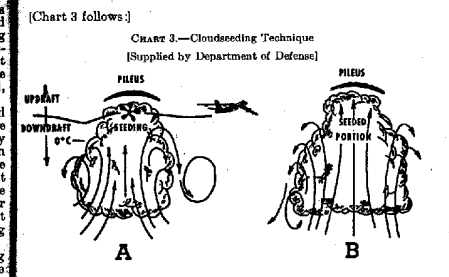
The UAE program is not limited to chemical interventions. In 2021, they tried what the BBC called “cloud-busting drones”. The drones delivered electric charge to clouds to attempt to aid condensation.
Evaluations of the UAE’s extensive cloud seeding program indicate success in enhancing rainfall (Hosari et al. 2021, Wehbe et al. 2023), and the physics of cloud seeding continues to advance, including in and around the UAE. Saudi Arabia reported a successful cloud seeding in 2025 (Alzahrani and Abdelbaki 2025).
-
Ground-based weather modification
German scientists have experimented with using lasers to create clouds – in lab conditions, but lasers aren’t the only option for ground-based weather modification. A 2009 paper by Beare et al., “Accounting for spatiotemporal variation of rainfall measurements when evaluating ground-based methods of weather modification” described a study in Australia of a system called Atlant, a ground-based ionization technology for affecting rainfall. The system’s functioning is described as follows:
“1. Initially, negative ions are generated from a high-voltage corona discharge wire array; the ions become attached to particles in the atmosphere which later act as cloud condensation nuclei; the ions are conveyed to the higher atmosphere by wind; the electric charges on these particles are transferred to cloud droplets; and the electrostatic forces on droplet interaction aid the coalescence of the cloud droplets, resulting in enhanced raindrop growth rate and ultimately increasing rainfall downwind from the Atlant ion emitter.”
Ground-based manipulation of the ionosphere through the emission of radiated power is the science of the US military’s HAARP (High Frequency Active Auroral Research Program). Emitters can add considerable energy to targeted areas of atmosphere. Ground-based ion emitters were used for cloud seeding in Oman in 2013 and 2014 in a trial reported in the Arabian Journal of Geosciences (Chambers et al. 2016).
-
Iran’s complaints
Iraqi scholar Salam Abdulqadir Abdulrahman (2024) described cloud seeding as “problematic” because of the transnational nature of clouds and disputes over water:
“Similar to water basins, there are cloud basins or cloud lines, shared by states.
“A cloud basin starts from where the clouds form and begin their journey and all the areas they travel over to where they disperse completely. For example, the northern areas of the Middle East, except for the northern part of Turkey, share a basin. Their clouds are largely formed over the Mediterranean Sea and move eastward. They travel over Israel and Lebanon, Syria, Iraq, south of Turkey, northern Iran and some other areas. It is believed that seeding clouds in one state, the upwind, reduces the amount of rain in another state, the one downwind; i.e. part of the rain of a downwind state is seized by an upwind state. The shift of rain causes security concerns for downwind states.”
Iran thus complained in 2018: “Brigadier General Gholam Reza Jalali, head of Iran’s Civil Defence Organisation, accused Israel in a press conference in 2018 of manipulating weather and making the clouds unable to rain over Iran. He alleged that Israel had stolen Iran’s snow.”
-
Rainfall in 2026
Two mechanisms are suggested for how a drought over Iran could be engineered through UAE-based weather modification.
-
First, cloud seeding over UAE could indeed have deprived Iran of rainfall in proportion to the extra rainfall received by UAE.
-
Second, if ground-based ionization can be used to encourage condensation, a similar process could be used to discourage condensation and prevent the formation of clouds.
One Iranian poster (@AcEpic69, April 15/26) speculated that THAAD radar arrays could be used to disrupt the formation of clouds over Iran. Another poster (@raminrnp, April 22/26) believes that weaponized weather modification against Iran will continue from other bases (Qatar, Bahrain), drones, HAARP emitters in the northern hemisphere, and more.
In this fourth section we have left the scientific literature and headed on to twitter. The evidentiary standard is lowered. Correlation is not causation. But the radars are destroyed, the UAE’s cloud seeding program is disrupted, and it’s raining in Iran again.

In Real Time with Stan Cox 15: Refugees, Wars, and Rebellious Scientists
Stan Cox is back to talk about climate refugees, rebellious scientists, and of course Gaza. Our monthly chat finds us both a bit discombobulated by the war, but we try to survey the climate situation anyway.
In Real Time 14: The Hubris of Plutocrats
In the August 2023 edition of In Real Time with Stan Cox (yes I know it’s September) we talk about his dispatch, “The Hubris of Plutocrats”, and the escape fantasies (and condos) of the super-rich. Stan argues they can’t escape the heat that’s coming, but at least some of our troubles stem from the fact that they think they can.
In Real Time 13: Do we need states to solve climate change?

Stan Cox and I talk about Kim Stanley Robinson (KSR)’s 2020 book, The Ministry for the Future, which is a hugely important book because it pictures how we could get from our current situation to a world where CO2 emissions were actually trending downwards, saving human civilization from catastrophe. We talk about the climate events in the book, the geoengineering technologies proposed, the international policies proposed, and then I have a long critique of KSR’s geopolitics, which I argue gives undue praise to India, has an undue dislike of China and Russia, and gives too short a shrift to the imperial mechanisms of plunder that underpin the global economy and its currency regime, which leads to problems with the proposed carbon coin. But for all my critiques, this is the book we’ve got and so we have to use it as a starting point for how to get there from here.
Strategies to reverse climate change
Kim Stanley Robinson’s 2020 sci-fi / cli-fi book The Ministry for the Future as a starting point for discussion
2023 is, as the cartoon goes, the hottest year we’ve ever experienced and maybe the coldest we will experience. Heat waves in more places than ever, record wildfires, the Greenland ice sheet disappearing as predicted. An appropriate time for trying to work out how, if we were to seriously try, we might go about reversing this situation.
Historically, utopian fiction has been used to criticize existing social institutions or to envision how things might be different. Centuries ago, Thomas More’s Utopia used Europe’s limited understanding of Indigenous societies in the Americas to envision a society that had contempt for gold and for greed. Edward Bellamy’s 1888 book Looking Backward imagined a socialist society; Ernest Callenbach’s 1975 Ecotopia imagined the technology of a sustainable separatist West Coast (guaranteed by a nuclear deterrent); Ursula K. LeGuin’s 1974 The Dispossessed imagined an anarchist society in a context of scarcity. These days, there are probably 10 dystopias produced for every 1 utopia, and as Kim Stanley Robinson (henceforth KSR) once said in an interview, anyone can write a dystopia by scanning the headlines — certainly a climate dystopia could easily be produced using that method in 2023.
The visionary utopian fictions I mentioned are, at this juncture, less important than another type of utopian fiction, which is strategic utopian fiction. The hardest thinking that needs doing right now isn’t about what a better world would look like, but about how we could get from here to there. And that is the value of KSR’s 2020 book The Ministry for the Future, focused intensely on the question of how the “international community” (led by the West, and specifically by an Irish diplomat working for the United Nations) could lead the planet out of the climate crisis. The definition of being “out of crisis” is that emissions, temperatures, and carbon dioxide parts per million (ppm) are all trending down, towards stable, pre-industrial levels. This is the situation achieved by the end of the book. The book is about how it was done.

To set up the strategic utopia, KSR starts with – and introduces at all major milestones – dystopian climate events. The book starts with a heat wave in Uttar Pradesh, India, that kills millions. There are further heat waves later on in the book in Iran and Pakistan, and another one in the southern US. By the later half of the book, there are more than 100 million climate refugees on the move, and their plight is explored in detail. There is a flood that pretty much destroys Los Angeles. These events all add urgency to the project of the characters and of the titular Ministry.
To fight this, KSR’s characters adopt a portfolio approach. Two decades ago, scientists Pacala and Socolow described such an approach as a series of “stabilization wedges”. No new technology was needed, they argued, to meet the world’s energy needs with technologies current even at that time. The portfolio adopted in the Ministry includes:
-
The spraying of aerosols into the sky to reduce the amount of solar energy reaching the earth – this is unilaterally done by India’s Air Force after the heat wave at the start of the book. [And it’s probably not a good idea].
-
Pumping water from the ocean surface to the top of the antarctic glacier to forestall sea level rise by re-freezing the glacier.
-
Converting petroleum corporations’ pumping infrastructure to infrastructure that pumps frozen carbon back into the ground.
-
Using high-tech sail power to do the world’s shipping (sails, but also electric and solar sails).
-
Habitat conservation, restoration ecology, regenerative agriculture (all good ideas).
The individual technological and geoengineering pieces are there to be critiqued, and KSR does a good job of referring to projects and ideas by their searchable names. For a fiction book, this is pretty good citation practice.
Beyond the speculations about climate events and technologies, Ministry also has its own geopolitical world view, its own – to use a favorite KSR phrase – structure of feeling about the world order and the powers that contend within it. This structure of feeling is where I have some divergences from KSR and where I would counter-propose some alternative analyses and strategic thoughts.
In Ministry’s geopolitics, India is central and Kerala in particular is central to India. As a huge democracy, India throws off BJP (and Congress) rule and points the way for a democratic and decentralized transition to a carbon-neutral economy for all. The US is so omni-present that it is invisible: US officials don’t sabotage the Ministry, the US military and police don’t green themselves or abolish themselves – it’s as if they never really existed in the first place. China is disliked – described by one of the point-of-view characters as “debt-laden, opaque, oligarchic, authoritarian.” Russia is largely irrelevant, a country of mafias, poisoning, assassination, and some high-tech weaponry that they make available for terrorists (including climate terrorists). Europe has some sort of occupy movement that doesn’t come to much; Europe’s struggles with taking on Global South climate refugees, and its functioning headquarters of the Ministry in Zurich, anchor the story – Europe is mostly benevolent and mostly functional, trying to help the world as much as possible.
So much of what happens in Ministry is based on these geopolitics that the events in the book couldn’t work, the strategies wouldn’t apply, if the world didn’t work the way KSR describes. Which is unfortunate, because the world doesn’t work this way: The geopolitics of Ministry are inadequate.
Ministry gets a state for Kurdistan, carved out of Turkey, Iran, Iraq and Syria; but the Palestinians are unaddressed. The US and UN sanctions against Cuba, Venezuela, Iran, Russia, the other 1/3 or so of humanity under sanction – unaddressed. US wars, coups and occupations of Iraq, Afghanistan, Syria, Libya, Haiti, Guantanamo, Puerto Rico, Hawaii — unaddressed. A student debt revolt leads to the nationalization of US banks – but there is no specific struggle by Black America nor do Indigenous struggles for Land Back play a role. Ministry is socialist, but shows a dislike for existing socialist countries (China especially, but also Cuba, Vietnam, DPRK). Ultimately Ministry puts its faith in liberal international institutions, elections, non-governmental organizations, and decentralization of power. It is unfavorable towards centralized states, central planning, and organized armed struggle.
The point about armed struggle is an important one because in Ministry, the international agreements and economic pacts are guaranteed by decentralized terrorism by a group based in India called the Children of Kali. These children crash all commercial airlines with drones on a day called Crash Day, killing 7,000 civilians; they assassinate all major corporate executives, again using drones; they kidnap all the dignitaries at the World Economic Forum at Davos for a week (and show them video lectures to try to deprogram them, without success); and they use swarming missiles to blow up container ships. This level of violence cannot be organized by decentralized terrorism, but only by organized states which would lead quickly to world war. Thus, the Children of Kali are a geopolitical hand-wave, a type of magic that achieves a global monopoly of violence without state power.
The other major hand-wave is that in Ministry, economic planning is substituted with “carbon quantitative easing”, whereby the Central Banks of China, Europe, and the US agree to spend “carbon coins” into the global economy for any projects that reduce the amount of carbon in the atmosphere (or prevent it from going into the atmosphere). There are other economic tools in Ministry besides the carbon coin, including carbon taxes, incentives for specific projects, etc., but the mainstay is the carbon coin. In practice, the carbon coin would mean de-dollarization, which in our world is being led by China and Russia, who appear to be signing up much of the Global South for the plan. Whether this is going to lead to world war remains an open question. But in Ministry, neither Europe nor the US fight hard to maintain a global system where they get trillions in value each year drained from the Global South (see, as I always find myself saying, Zak Cope, Utsa and Prabhat Patnaik, or Jason Hickel for more about this drain). In our world, they are fighting hard to maintain this global system and it is this fight – of neocolonialism imposed on the global south – that will determine what happens with the climate and therefore with human civilization.
To take the strategy presented in Ministry forward, we will sadly have to revise its attitude towards India (which shows no sign of throwing off fascism any time soon), China (which unlike the West is making non-apocalyptic plans on the basis that civilization will indeed continue to exist for centuries to come), the US and indeed the whole West (which isn’t neutral but a formidable and actively hostile opponent of climate action) centralization, states, and planning.
References:
Cory Doctorow has one and another excellent threads about this book.
I presented most of this critique in a podcast recording I made with Stan Cox for our In Real Time series.
A couple of years ago I wrote a piece about why Five Year Plans were a better model for resolving the climate crisis than Green New Deals were.
Renewable energy development is less important than stopping Chinese industry!
There’s a photovoltaic war to prove it – but China’s won it for now
Janet Yellen went to China and warned them there would be consequences if they didn’t adopt a market economy. There’s so many admissions in this little statement that shouldn’t go unnoticed. If the market system is the best and most efficient, as its proponents claim, why would Yellen complain about China using state subsidies or protections and interfering in it? Wouldn’t that just allow the US to use the market to win the game? If the market is the “cheat code”, as the gamers say, then how could China “cheat” by using non-market mechanisms? The flip side of the coin is also there. If the US, as its officials repeatedly cry, is desperate to stop the rise of China, why would they advise China to take steps (like market reforms) that should, according to market theory, only accelerate China’s rise? Perhaps it is because Yellen knows market reforms would actually destroy the basis of China’s growth and ensure its subordination to the US.
I want to talk about one of these Chinese industries that has grown up under state subsidy and protection that is – again according to Western environmentalists – very important in the struggle against climate change: photovoltaics (solar panels) and other renewable energy technologies.
There’s this video from a youtube channel called Tech Teller that outlines some details about the rise of China’s PV industry. The news hook for the video was the arrest of a Chinese PV executive, Pu Yonghua of Jiangsu Green Power New Energy, in Germany. It looked like Germany was going to pull a Canada (with the kidnapping of Meng Wanzhou of Huawei) and get into a pointless years-long conflict at US urging. But it looks like Pu Yonghua was released a few days later.
Tech teller’s video provides some “startling figures” about China’s dominance in PV:
-of 150,000 PV patents worldwide, Chinese companies hold 120,000 of them.
-The top ten PV companies in the world are all Chinese.
-Chinese PV has a market share of 60% in the US and peaked at 95% in the EU. EU’s domestic PV capacity accounted for 3% of market share there.
-200 countries are customers of Chinese PV products.
The EU’s attempt to raise its renewable energy use to reduce its dependence on Russian gas is ultimately a plan to transfer its dependence on Russia — to China.
China’s PV industry is so far ahead that the US and EU industries are going to have a lot of difficulty catching up. This despite, as the video tells, depraved and repeated attempts to stop China from developing by both the US and EU.
There are problems with PV, as environmentalists like Stan Cox have noted, including the mining footprint of rare earths and the use of fossil fuels in their production. But there is a Green consensus on the need to get off of fossil fuels and PV technology will be key to get there. The imperialist anxiety to stop the rise of Chinese industry conflicts with Green the green priority for a transition to renewables. It is another case of Western imperialism vs the environment. If you believe climate change is an existential issue for the species like nuclear war, you could use Chomsky’s phrase and consider it a choice between Hegemony or Survival.
Which do you think the US will choose?
In Real Time with Stan Cox 12: India dilemmas and how tech won’t save us
Stan Cox is back to talk about two essays. One, co-written with Priti Gulati Cox, “Between a Yoga Mat and a Hard Place”, about where India is headed. And another, “The Old Future is Gone and Technology Won’t Bring it Back”, by Stan himself. Justin goes on a mini-rant against doomerism at the end, and we talk about how next episode will be a bit of a KSR book club.
In Real Time with Stan Cox 11: Atlanta’s Cop City and Anti-Climate Legislation
Stan and I talk about two of his articles from April: the first on Atlanta’s “Cop City”, which one activist has already been killed by police over, and why it’s an environmental disaster as well as other kinds; and another article on Republicans trying to locally legislate to prevent any climate action from happening at the local level. Once again the US is blessed, instead of one big fascism the US has many small fascisms at the state level. In Real Time 11.
In Real Time 10: A 5-year and a 50-year farm bill
Back with Stan Cox on the environmental file. Stan’s written a dispatch on the Farm Bill. How the 5-year Farm Bills used to have consensus but how even that might be breaking, and then we talk about Wes Jackson’s ideas about a 50-year farm bill, thinking on the scale we probably need to be thinking on…