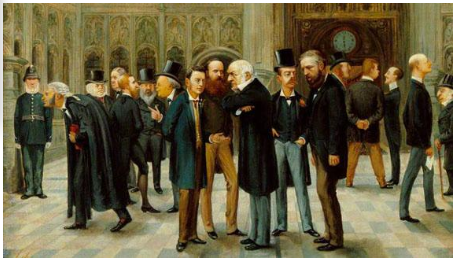
How close did Britain come to a civil war over the issue of Irish Home Rule? We talk about the long parliamentary road led by Parnell, the settler trick culminating in the seditious maneuvers in Ulster, and the final passage of the Home Rule Bill, rendered inoperative by World War I. This issue will be back before WWI is over, though – but the Easter Rising and 1916 is for a future episode.
It seems the Right has more military knowledge…
Some necessary differentiations
As long as the French and Haitian Revolutions have any bearing on our world, the categories of “left” and “right” will continue to be relevant. In other words, the “political spectrum” established by the seating arrangements at the French National Assembly of 1789.
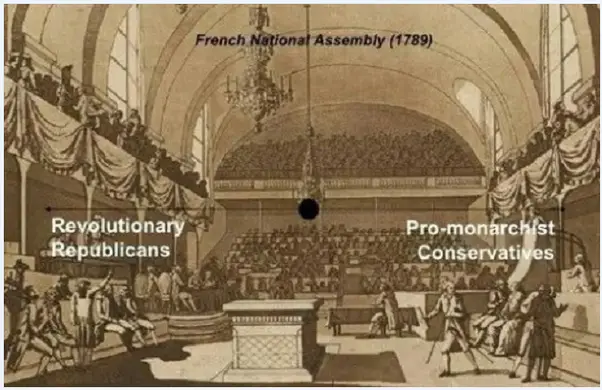
Unfortunately (as I will argue), the concreteness of seating arrangements has given way to some unhelpful abstractions and analogies.
Until recently, my own idea of the political spectrum was pretty basic, something like this.
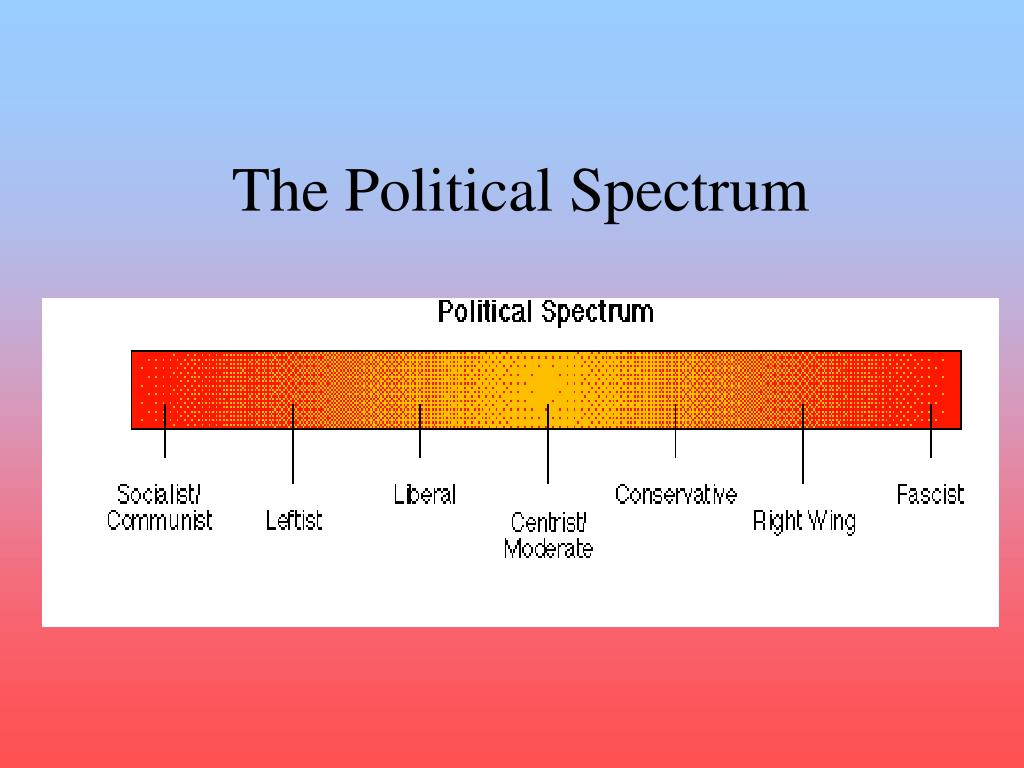
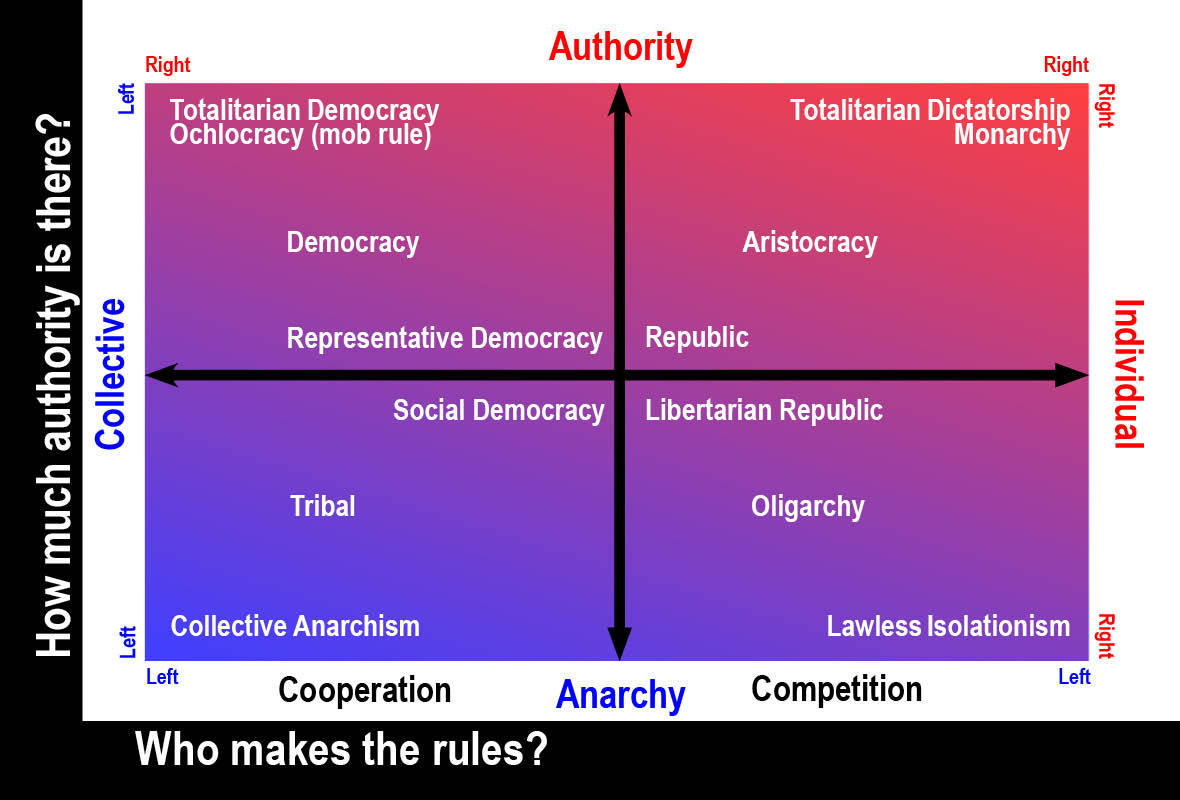
You’ve probably been seeing the ones with the quadrants on the web recently:
Or the horseshoe.

It may be better than the horseshoe, but I don’t even believe in the fish hook.
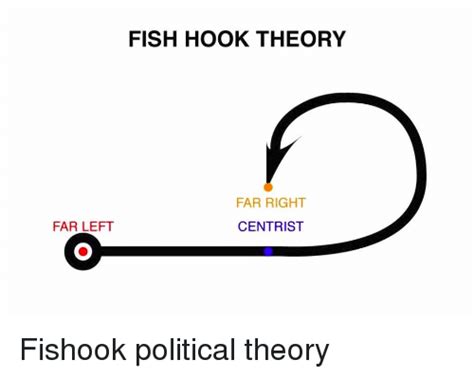
As with most attempts to graph political phenomena, I find these conceptual graphs to be much less helpful than writing out the concepts in full words and sentences. This is not a case of a picture being worth a thousand words. More like a picture needing a thousand words to undo the confusion it causes. Political relations – of commonality, difference, or opposition – cannot be mapped on a one-dimensional or two-dimensional spatial grid without missing most of the point, or worse. The adjacency relations don’t hold. The topology doesn’t make sense.
Even if I find the spectrum diagrams dubious, though, I find value in both the history and the labels. For most of my life, as I said above, I understood politics in terms of three:
Leftist – Liberal – Conservative
In Chomsky’s 1970 lecture, Government in the Future, he argues that leftism (he calls it socialism) is the logical conclusion of classical liberalism. Norman Finkelstein has a lecture on JS Mill arguing that the left needs to learn more from these classical liberals. On that basis, I did get the idea that leftist and liberal were topologically adjacent. For similar reasons I had an idea that, e.g., proportional representation in Canadian elections would lead to a stable left-liberal majority consisting of Liberal + NDP voters. On my own, especially after the last election in Ontario, I came to think it just as likely that proportional representation would lead to a stable liberal-conservative majority consisting of Liberal + Conservative voters (but I’ll leave that for another time, maybe).
Reading works like Chris Hedges’s Death of the Liberal Class, or Thomas Frank’s Listen, Liberal! I got the idea that liberals were some sort of lazy leftist, and as they abdicated their historic mission, Western leftists ended up with a task that was beyond our numbers and our resources to fulfill, having to take up the kinds of things liberals fight for as well as occupy the expected leftist space.
It was works like Domenico Losurdo’s Liberalism: A Counter-History and Gerald Horne’s The Dawning of the Apocalypse that made me conclude that liberals were part of a different tradition altogether from leftism, that historically, liberal politics are imperialist politics. The vitriol of liberals towards anti war politics when it came to Yugoslavia, Rwanda, Libya, Syria, Russia, etc. was also revealing that the (failed) coalition against the war in Iraq was more shallow than my optimistic hopes for it.
This has been on my mind because the Russia-Ukraine war has wreaked havoc on the spatial, “spectrum” diagrams that try to map political positions relative to one another. The “liberal” is “supporting” Ukraine, which seems to practically mean supporting the destruction of a generation of Ukrainians, the creation of millions of Ukrainian refugees, the poisoning of its land by depleted uranium supplied by the West, etc.. The small anti-war left are accused of “supporting Putin” and, searching the web for military analysis, find “pro-Russia” analyses coming from figures with conservative, right-wing views.
The conclusion isn’t horseshoe theory. Liberals and conservatives share more premises than either do with anti-imperialists. Liberals and conservatives alike believe in Western hegemony and Western superiority, they don’t care about sovereignty or development in the rest of the world, they believe in the jungle and the garden. But when liberals suppressed left antiwar voices, as they have for the past several decades, and invested themselves thoroughly in this war, they opened a space that right-wing voices have filled. Some of those right-wing voices are very knowledgeable about military affairs. They also loathe liberals, loathe leftists, and mostly don’t see a distinction between them.
For leftists who believe, as I used to believe, that liberal and leftist were mere variations on a theme, this raises questions about how to use these military analyses, coming as they do from right-wingers.
One way liberals operate politically is through something Matt Taibbi (a journalist who likes to present critiques of “right and left”) called an “ick factor”. Attaching “ick factors” to (in our lifetimes) Gaddafi, Iran, China, Palestinians, Putin — these act as an early filter on anti war efforts. If whole states, nations, populations, or their visible leaders are “ick”, then anyone should avoid them, and avoid talking about peace with them. The problem with following your “ick” is that since bigger media can sling more mud than smaller ones, “ick” will always be easier to attach to official enemies, whether the narratives are true or false. Avoiding “ick” cannot be a path to sound political analysis. Conservatives don’t care about “ick” and liberals cannot follow their own advice: the liberal pantheon of heroes were all genocidal racists. New liberal leaders that come up through non-governmental organizations or social media stardom inevitably fall in scandals or cash out and move on.
Historically, the left often has a lot of catching up to do when it comes to military matters. In the French and Russian revolutions, revolutionary governments attached political commissars to skilled military officers from the pre-revolutionary government, to make sure the military skills the revolutions needed were exercised in alignment with their politics. Chinese and Cuban revolutionaries built their armies in the course of the armed struggle, in special conditions in unique times and at great cost. These revolutionaries left a considerable body of interesting military theory, but also adopted and absorbed lessons from everywhere, including the enemies of their revolutions.
It’s no surprise that a lot of the better military analysis is coming from right-wingers now. If we have to use it, then I suppose we could do worse than follow the quote from Mao Zedong, which comes via Bruce Lee’s notes. Bruce was talking about martial arts, Mao was talking about directing a war, but I suppose it also applies to watching helplessly while preparing for the possibility of participating in an antiwar movement at some point in the future when conditions are better:
All military laws and military theories which are in the nature of principles are the experience of past wars summed up by people in former days or in our own times. We should seriously study these lessons, paid for in blood, which are a heritage of past wars. That is one point. But there is another. We should put these conclusions to the test of our own experience, assimilating what is useful, rejecting what is useless, and adding what is specifically our own. The latter is very important, for otherwise we cannot direct a war.
-end-
Check out: Excluded Headlines provides a weekly news summary of news from the Global South that was overlooked or downplayed by the mainstream media. By journalist and author, Tamara Pearson.
What did Yugoslavia have before it was dismembered?
I know not all of you who read the newsletter listen to the podcast, but we just did a 3-hour epic on the Balkan Wars 1912-1913 that led directly to WWI.
I know not all of you who read the newsletter listen to the podcast, but we just did a 3-hour epic on the Balkan Wars 1912-1913 that led directly to WWI. Researching it, I came across the dispatches of a war correspondent named Leon Trotsky, who wrote long profiles of all the players, talked to wounded soldiers, traveled all over the region while the wars raged and in their aftermath. Trotsky was no impassive observer, but an advocate for a specific solution to the raging Balkan conflicts of the time: a socialist Balkan Federation dedicated to the economic development of the whole region for the benefit of all its peoples, free from imperial intervention. Trotsky would live to see something like this implemented in the form of Yugoslavia, but Yugoslavia was dismembered decades later by nationalist wars and imperial intervention.
In the podcast I also quoted from Richard C. Hall, an academic who wrote about the 1912-1913 Balkan Wars and came to a similar conclusion as Trotsky:
“The large nationalist state as exemplified by Italy and Germany proved a poor model for the Balkan peoples. No such states were possible, because the nationalist claims of each Balkan state overlapped with those of its neighbors. Every attempt in the twentieth century to realize this goal has led to war and foreign intervention. Only the adoption of a post-nationalist perspective by the Balkan peoples can break the pattern of war and intervention.”
Writing just after the breakup of Yugoslavia, Hall found himself arguing for the necessity of something like it!
I was a teenager during Iraq War 1990/1. I was critical but not in any position to be aware of any anti-war sentiment in my city much less to, e.g., go to an antiwar protest. The first such protests I did attend were during the NATO war for the final dismemberment of Yugoslavia in 1999. A lot of people I knew, including fellow students from the Croatian diaspora in Toronto, actually celebrated when the NATO bombing began. Eastern Europe is not a context where I have a lot of background references in long-term memory and everything I have come to understand about it has been done analytically. Unlike some other parts of the world where I find I have some intuition that I can work from, in this context all I have is reading. As far as my feelings went, I simply felt a lot of horror and tragedy, and could not believe any of the arguments coming from NATO about the necessity of bombing.
I wrote one of my first letters to the editor when a Globe and Mail columnist took the occasion of the NATO bombing of the Chinese Embassy in Belgrade to talk about Chinese xenophobia.
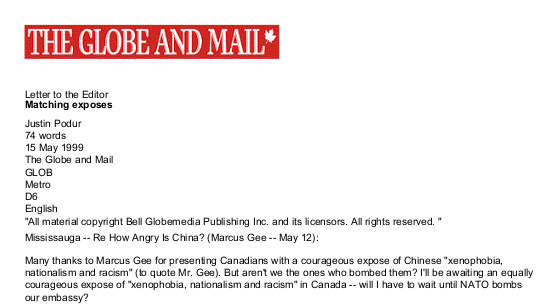
I would have written it a bit differently today but you probably recognize the tone.
At the time I thought of the destruction of Yugoslavia as a tragedy of self-destruction. The narrative structure, which I was reading in liberal authors like Michael Ignatieff (who wrote a travelogue of the Balkans as a theory of nationalism in his pre-Empire-Lite and pre-Canadian prime ministerial candidate years), was that these communist states suppressed nationalism which exploded all the worse for having been suppressed, and as the biggest nation in Yugoslavia, Serbia (or, the preferred term, “the Serbs”), had entrapped the others who naturally wanted to break away at the first opportunity. They broke away, “the Serbs” fought back to keep them in, committing so much war and genocide that NATO was forced to bomb them.
It was a compelling enough framework, since it’s impossible to understand any of the belligerents without an analysis of nationalism. What the framework could never explain was what the US was doing in there. The idea that Balkan nationalisms had become so disruptive to the world order that the US was forced to intervene – that was the best available explanation and it was simply preposterous. But it was not until much later that I got a sense of the full role of the US in the breakup of Yugoslavia, and why the US wanted Yugoslavia broken up. To understand all that, I had to go beyond the liberal analysis of rival nationalisms and get into economic analysis.
In search of an alternate, anti-war view of the Yugoslavia wars, I read Diana Johnstone’s Fool’s Crusade and Michael Parenti’s To Kill a Nation. But I found the economic arguments put together most effectively (including by these two authors) in a 2010 documentary by Boris Malagurski called The Weight of Chains.
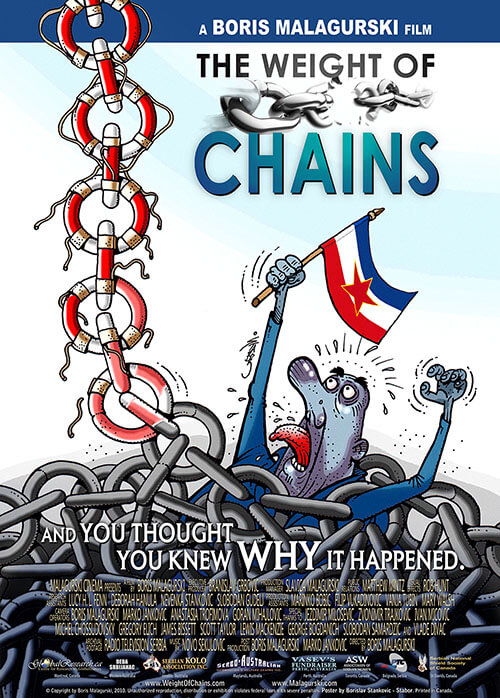
Malagurski grew up in Yugoslavia and links his economic analysis with the experiences his father had working in an industry that was ultimately dismantled along with Yugoslavia – which gives a clue to what was going on.
While it existed, Yugoslavia was a non-aligned country (indeed a founding member of the movement), with an economic model characterized as “market socialist”, trying to combine various elements of economic planning and welfare state protections with market competition. In various ways, it was very successful! Malagurski’s parents, like all Yugoslavs well into the 1980s, had free medical care and education, one month paid vacation, and the country had a 91% literacy rate. With state support and investment, Yugoslavia developed a considerable industrial base, including heavy industries (Malagurski’s film includes considerable detail about a motor plant – which I’ll return to below).
Because Yugoslavia was part of the nonaligned bloc, its leaders sought to maintain good relations with both the Soviet bloc and the West. For the West’s part, the idea of collapsing a socialist state and carving it up never lost its appeal. The collapse of the USSR (which will occupy future newsletters) made it possible. Yugoslavia, like the USSR, tried to reform to taking Western finance. Once indebted to Western banks, Yugoslavia was ready to be carved up.
Malagurski cites a National Security Council memorandum (#133, if you want to look it up), which, under president Reagan, stated a US policy of supporting a “market-oriented” Yugoslavia. In 1988, the National Endowment for Democracy sent advisors to the country, funding another group called the Center for Private Enterprise, which in turn funded the G17 – a group of 17 Yugoslavian free market economists including IMF and World Bank staffers. This Group of 17 ran the government bankruptcy program of 1989-90, forcing cuts to the social sector and forcing public and private enterprises into bankruptcy. About 1,100 enterprises were wiped out between January 1989 and September 1990; the standard of living declined by 18% and unemployment went up to 20% by the end of the decade.
Yugoslavia’s financial crisis was America’s opportunity. When Yugoslavia went to president Bush I in 1989, the US response was to declare that any republic in Yugoslavia could get aid — only if they broke away from the federal republic. Elections would be held only in the constituent republics and aid would only go through them. The US, in other words, used financial aid to begin the breakup of Yugoslavia already in 1990.
The aid worked as intended, and made the financial crisis worse: with inflation at 200%, Yugoslavia couldn’t pay interest on the debt or pay for the raw materials to run its heavy industries. Economic cooperation between republics failed, the communist parties lost elections to the nationalists, and unilateral declarations of independence followed – all of which were quickly recognized by the US. So quickly it was as if the US was waiting for them. The Balkan Wars of the 1990s followed, and the US sanctioned the federal state.
I’ll leave the military questions, which Malagurski covers from his point of view, for another time. Let’s keep following the economic story and US policy.
By 1993, 90% of domestic pharmaceutical production had stopped. Average caloric income was down 28% from 1990 levels, with 1.5 million considered undernourished. Unemployment was up to 60%. Monthly income dropped from $500 to $15. The inflation rate went to its highest in history.
The international financial institutions collected the external debts for each of the constituent republics – they were each saddled with debts, carefully partitioned from the central debt held by the federal republic of Yugoslavia. In 1995, Bosnia unveiled that it would be occupied by NATO and administered directly by the West (which was also Kosovo’s fate). Before the 1999 NATO campaign, the World Bank analyzed the likely effects of a Kosovo war, including plans for occupation.
NATO’s bombing campaign targeted Yugoslavia’s industrial base. A cigarette factory was bombed, later acquired by Philip Morris. The Yugo car factory was bombed, getting rid of competition for Western auto firms. Cement, oil industry, telecom facilities were all bombed.
There is, perhaps, one military note from this period worth making. That is, that while the US successfully bombed various industrial, civilian, and diplomatic targets (including the Chinese Embassy, as mentioned above), militarily the campaign was stalemated in 1999. NATO’s ultimate victory came from the imposition of a diplomatic settlement on Yugoslavia’s president Milosevic, who they later arrested and who conveniently died in in a NATO prison. The settlement was imposed not through victory on the battlefield, but through the threat of a genocidal bombing of civilians. The most detailed account of this is quoted by author Gregory Elich, who cites another source about a meeting between Finnish diplomat and Nobel Prize Winner Martti Ahtisaari and Milosevic:
Milošević took the papers and asked, “What will happen if I do not sign?” In answer, “Ahtisaari made a gesture on the table,” and then moved aside the flower centerpiece. Ahtisaari said, “Belgrade will be like this table. We will immediately begin carpet-bombing Belgrade.” Repeating the gesture of sweeping the table, Ahtisaari threatened, “This is what we will do to Belgrade.” A moment of silence passed, and then he added, “There will be half a million dead within a week.” Chernomyrdin’s silence confirmed that the Russian government would do nothing to discourage carpet-bombing. [6] – June 7, 1999, Il Giornale Milan, Ristic interviewed by Renato Farina.
The meaning was clear. To refuse the ultimatum would lead to the widespread death and destruction. President Milošević summoned the leaders of the parties in the governing coalition and explained the situation to them. “A few things are not logical, but the main thing is, we have no choice. I personally think we should accept… To reject the document means the destruction of our state and nation.” [7]
Once Milosevic signed, Kosovo was put under direct “internationalized” control and the next round of dismemberment of Yugoslavia followed. A German bank took over the banking sector the province. Telecom was sold to German Telecom. A Western consortium took control of the immense Trepca Mining Complex. A local company made butter for 200; Germany subsidized its 300 butter to sell at 150, making Serbia an importer of goods. A steel factory set up with a $600M loan was sold to a US company for $23M. In Croatia, the hotels are owned by German and Austrian companies, the fishing zone was given to the EU/Italy, and the entire island of Brijuni was sold. Bosnia’s new constitution included the Governing Board of the Central Bank being an IMF appointee, and stipulated not to be a citizen of of Bosnia or any neighbouring country. Central Bank independence taken to the extreme: these central banks are so independent that they are totally dependent – on the West.
As for the debt that got Yugoslavia into trouble in the first place: when united Yugoslavia went with its hat in hand to the West in 1988, the country was in serious trouble with $13.5B in debt. By 2010, the West had completely destroyed the country and split it into many republics, whose total debt was… $184B.
Health insurance was privatized, the education system was crashed, health insurance lost, pensions were cut. By the 2010s, close to 40% couldn’t pay their bills and 56% were hungry.
So, returning to the question in the title: before Yugoslavia was dismembered, it had: an industrial base, health care, education (including some of the highest standards in the world), subsidized transportation, and vacations.
Why might Africa want France gone?
Let’s count the ways
Let’s continue to follow the post-coup situation in Niger. We had Victoria Nuland travel to Niger, presumably to help organize the overthrow of the government since 1- that’s usually what a visit from Nuland portends and 2 – a “rebel movement” called the Council of Resistance for the Republic under the leadership of someone named Rhissa Ag Boula started just after her visit. If there is going to be a Western war over this coup, it is likely that Nigeria – the giant country in West Africa with 224M people, much bigger than all other countries in the region combined – will be a part of the intervention, as would France and presumably the US. Other countries of the region are lining up on one or the other side, with Burkina Faso, Mali, and Algeria all lining up with the post-coup Niger government, so we are in a scary situation.
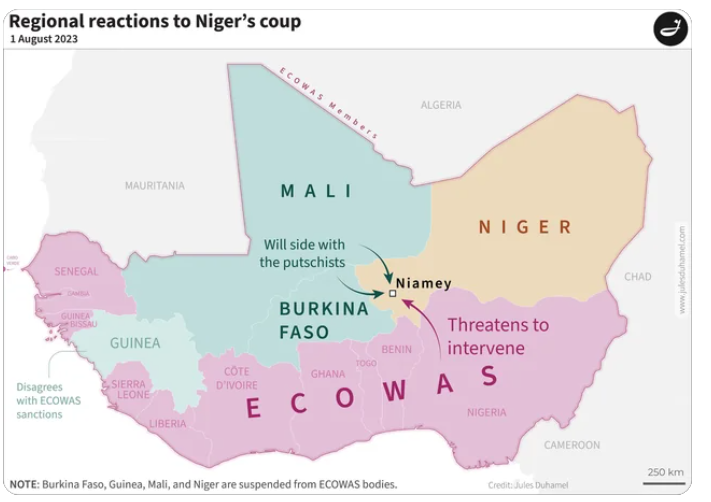
Like last time, I’ll discuss three angles on this situation.
-
Let’s add some detail about how France exploits its African neocolonies
-
I’ll tell you a story of how the US peels off French neocolonies so that it can plunder them (part of a pattern of how the US exploits its allies).
-
A brief mention of role of Nigeria in all of this and debates about it.
1. How France exploits its African neocolonies
I was doing research for the Scramble for Africa when I came across reference to a book called Africa’s Last Colonial Currency: The CFA Franc Story, by Fanny Pigaud and Ndongo Samba Sylla.
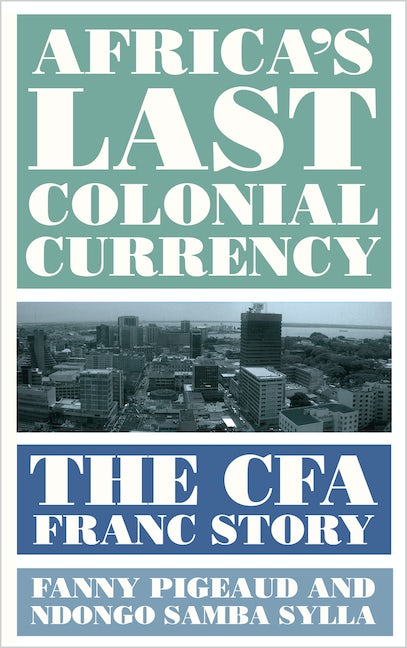
Going in, I had no idea what the CFA could possibly be but I assumed it was some mechanism France imposed to drain the resources of its colonies in Africa, which, like the British Empire’s mechanisms for draining India, were disconnected at Independence. But no, not disconnected at Independence.
Take a look at this table of countries in West Africa that still use it (while you’re looking, take a glance at Nigeria’s size relative to the other countries – we’ll use it later).
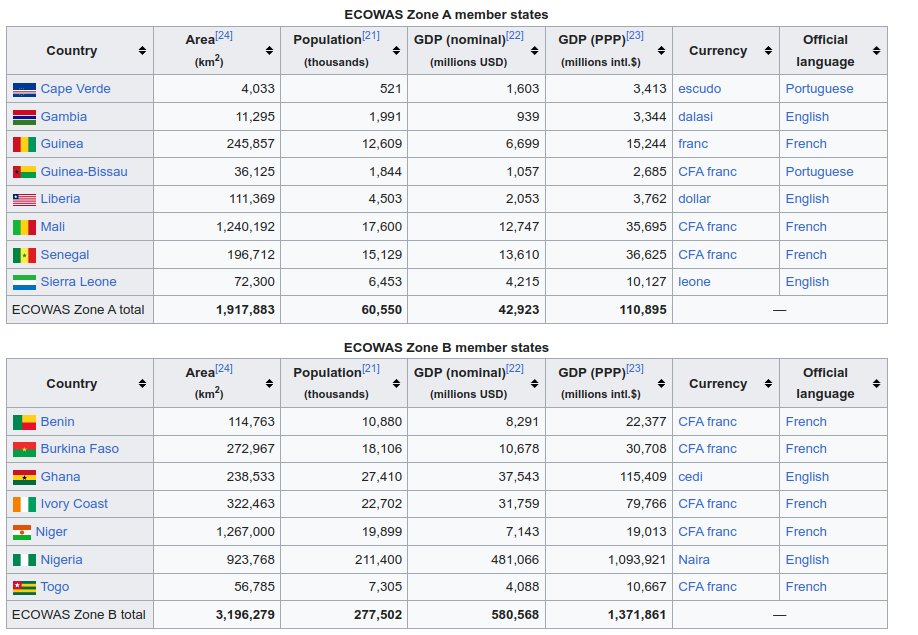
Reading the CFA Franc Story is like watching a Hollywood heist movie, except the thieves are finger-wagging, moralizing racists who steal by bureaucratic banality instead of plucky heroes with specialties like crisscrossing laser-triggered alarm rooms by doing gymnastics. The CFA Franc is fixed to the euro, and it is not convertible outside of the zone: “a citizen of the franc zone who goes to France will not find a currency exchange office willing to convert his CFA francs into euros or any other currency.” A Senegalese wanting to travel to Cameroon, as Pigaud and Samba Sylla write, will have to first exchange her Senegalese CFA Francs to euros, then change them back to Cameroon CFA Francs to use her money there. The central banks of these countries must hold their foreign currency reserves at the French Treasury (it used to be 100% of their reserves, now it’s 50%). France isn’t held to this rule and doesn’t keep its reserves in this pool. International business between these countries and third countries has to go through French banks, as Pigaud and Samba Sylla note:
Consider the example of a Malian company that sells cotton for a million dollars to a customer based in China. The million dollars owed to him by his buyer will have to go through the Parisian foreign exchange market to be traded in euros…
If you are familiar with the story of the US dollar as the global reserve currency, the concept of the petrodollar, and other concepts discussed in, e.g., the de-dollarization debates, you will see that the CFA Franc confers upon France the very thing that a French politician decried as the US’s “exorbitant privilege”. The shameless French politician complained about exorbitant privilege while doing the same thing to Africa via the CFA Franc! Pigaud and Samba Sylla note:
French representatives sit on the boards of the central banks as well as in their monetary policy committees, the bodies responsible for defining their monetary policy. This configuration has no equivalent in the world: no non-European citizen sits, for example, on the board of the European Central Bank, just as no non-US citizen is represented in the Federal Reserve.
To say simply what the effect is on African countries of having their currency pegged to that of France at the level that France decides: it means they pay too much for things from France and that France pays them too little for things from Africa. Pigaud and Samba Sylla:
The fact that the CFA franc’s parity was set at an artificially high level penalised African products: they were hard to sell on world markets, except in the context of the commercial preferences granted by the metropole. Conversely, the high external value of the CFA franc favoured imports, especially from the metropole.
Pigaud and Samba Sylla quote an extraordinary article from the eve of Independence, worth quoting at length:
While the path towards the independence of the CFA countries was underway, the French newspaper La Croix dedicated almost an entire page, in its 17 February 1960 edition, to an assessment of the franc zone. ‘It has allowed France to obtain supplies of various raw materials (lead, zinc, manganese, nickel, wood, phosphates, oilseeds…) without the need to disburse any foreign currency’, the article explained. ‘It is estimated that this has resulted in a saving of 250 million dollars a year. In 1954, the metropole purchased goods totalling 365 billion francs from the overseas territories (excluding Indochina), while it exported goods (mainly finished products) to those same territories for a total of 465 billion francs. It is estimated that the livelihood of 500,000 French people from the metropole depends on the economy of the franc zone.’
It amounts to free stuff for France – multiple countries, tens of millions of people, most of whose labor enriches France alone – and income deflation for all the African countries of the CFA Franc zone.
This is a vile system and no African leader would want to be a part of it. When Guinea under Sekou Toure escaped the system, France tried to overthrow him. Mali under socialist Modibo Keita escaped the system and introduced the Mali Franc in 1962; Modibo Keita was overthrown in a French-backed coup in 1968 and Mali re-entered the CFA franc zone in 1984. Socialist Sylvanus Olympio of Togo announced a sovereign currency for independent Togo in December 1962, and was assassinated in January of 1963. Togo stayed in the CFA Franc zone.
There is plenty more in this fantastic book, including a section called A Problematic Pegging, but I will leave some of it for another time.
The point is this: France enriches itself by imposing income deflation on the countries of the CFA Franc zone. It impoverishes the people, and perhaps also of note, humiliates the elites, who have their finances go through France’s banks instead of participating in the global economy like other African countries not subjected to the CFA Franc regime.
2. France offers protection to its colonies… just not from regime change, state collapse, or genocide
In my book America’s Wars on Democracy in Rwanda and the DR Congo, I tell the story of the long war that started in 1990 when the Rwandan Patriotic Front invaded Rwanda from Uganda, continued in 1996 and 1998 with successive RPF invasions of the DR Congo, and ended in around 2003 when Angola and Zimbabwe pushed Rwanda out of most of the Democratic Republic of Congo. The book took many years to write and most of those years were just used up figuring out what happened. What I want to do here isn’t reprise those 400 pages but look at the story from a different angle, as another example of the US attacking its own ally, in this case France.
Before Paul Kagame became the president of Rwanda and Rwanda became a part of the US orbit, the country was another part of the French system. Like other French neocolonies, Rwanda would call France to send an expeditionary force whenever there was some threat to stability. And indeed, when Kagame’s Rwandan Patriotic Front made its first forays into Rwanda from Uganda in the late 1980s, the French army was on call to fight the RPF off. That dynamic changed when the United Nations force was introduced, under the pro-US Canadian commander Romeo Dallaire. In my book I quote Dallaire’s autobiography, in which he speaks of his admiration for Kagame and of his contempt for France and of Rwanda before Kagame took it over. At one point Dallaire proudly relates that he “told New York that if the French were permitted to enter [through Kigali], I would resign my command; if French planes appeared at the airport, I’d shoot them down.” Official France found all of this confusing, since these were the sorts of things France did in all of its African possessions. But Kagame and Dallaire were with the US, not with France. The Rwanda and Congo wars of the 1990s were some of the worst events in the region’s history, but from the imperial perspective they were less about genocide, state collapse, and the deaths of millions of people and more about a handover of neocolonial control in Central Africa from France to the US.
But US and French neocolonialism work a bit differently, or at least, the neocolonialism of the 1960s-1980s worked differently from the way the US runs things after the 1990s. Shortly after Independence, the idea was to install parliamentary regimes that would follow Western rules or military dictators that would do the same. Stability was the goal. Since the 1990s, the neoconservative goal is to break states up and run covert military and economic operations in border areas. The US likes these “triangles of instability”, from which resources can be looted without negotiating with a central state and where insurgencies can be ramped up and down to put pressure on the next state.
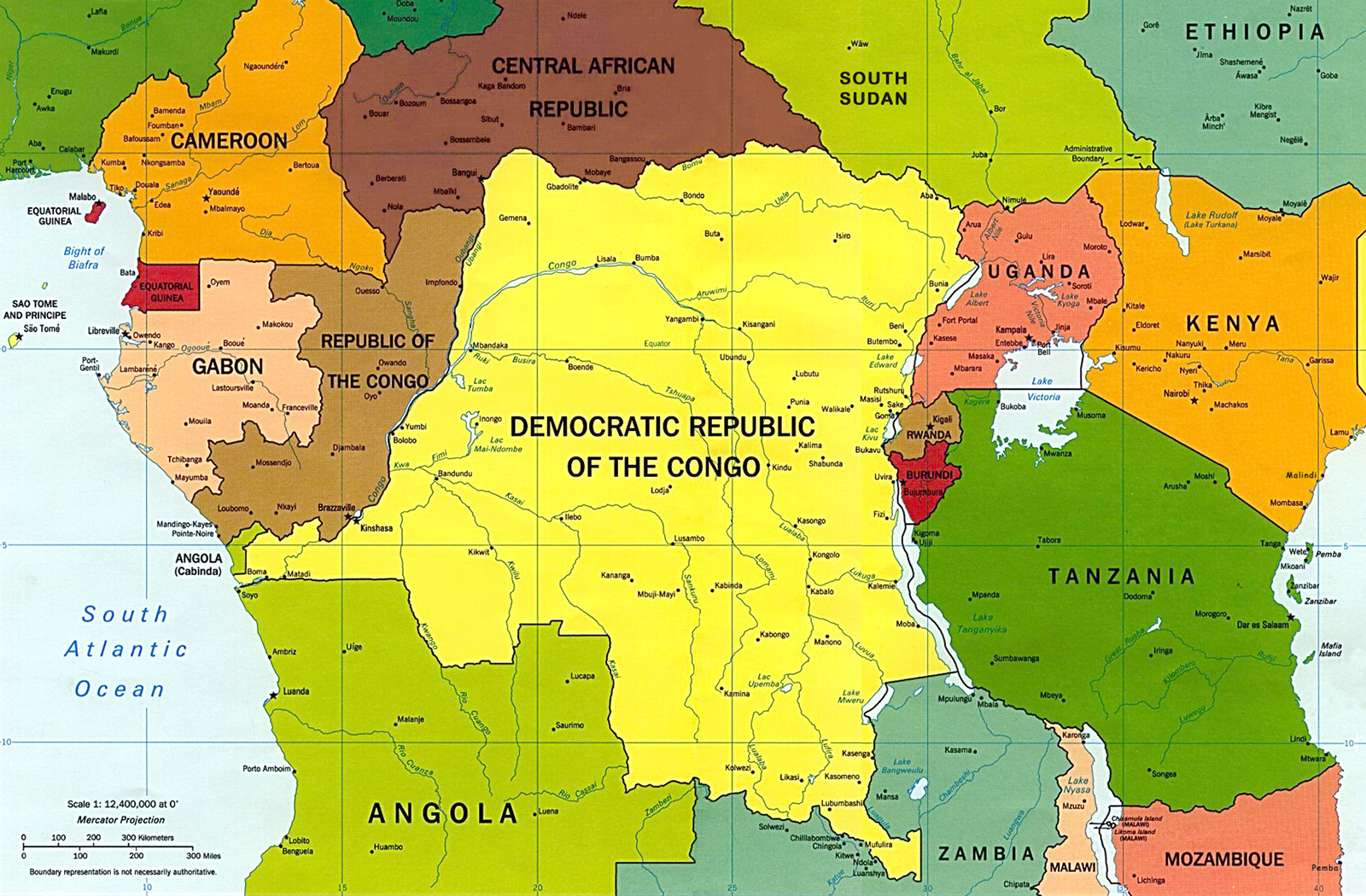
Think of the border between Rwanda, Uganda, and the DR Congo, where the mining resources are plundered. Or the territory of Syria bordering Iraq and Turkey, from which the US steals oil and wheat. Or the border regions of Mali, Burkina Faso, Niger, Chad, Cameroon, Nigeria, where US AFRICOM has operated freely since the destruction of the Libyan state in 2011 and where the various Islamic State insurgencies seem to roll on and on.
If US elites decide they want something – whether that something is a state collapse in a French ally, or a flagship French corporation like Alstom, France will hand it over. To say the least, this reduces the appeal of French patronage for its clients.
3. What will Nigeria’s role be?
Several signposts on the road to US-created chaos have been passed already. The Victoria Nuland visit. The declaration of a rebel group. And the identification of a regional power that has the capacity to intervene. The latter power is Nigeria. If Nigeria does invade Niger, it will be a country that doesn’t suffer under the CFA Franc fighting to keep another country within it.
The West African community, ECOWAS, is meeting in Nigeria at the moment and Nigeria’s president has signalled an intention to intervene since the coup happened. Within Nigeria, there’s opposition to intervention, on the argument that Nigeria doesn’t need to carry the West’s water, nor should Africans do the dying for the agendas of others. The Nigerian Senate has been trying pass a resolution to rule out intervention in Niger, arguing there’s already a US base there and there’s no need to deploy troops “to please Americans and other Western countries.”
There will be more to say about all this — from the Boko Haram insurgency to Nigeria’s other military interventions in, e.g., Liberia (1990-7), Sierra Leone (1991-8), Guinea-Bissau (1998-9), the Gambia 2017… but that will take this post in a different direction, so I’ll leave the Nigeria discussion here for now.
Last year, the now-ousted president Mohamed Bazoum said in an interview that Niger was France’s privileged partner. Fair enough: not all partnerships are equal. But for Africa, French partnership isn’t just unequal, it’s miserable. France offers an economic partnership that brings poverty and a security partnership that brings state collapse. The interview concluded with the following assessment by Bazoum:
“As for the growing discontent of the Nigerien population with the presence of foreign troops in the country, President Bazoum dismissed this attitude as the result of the exploitation of a different situation by the social media.”
World War Civ 21: Balkan Wars 1912-1913
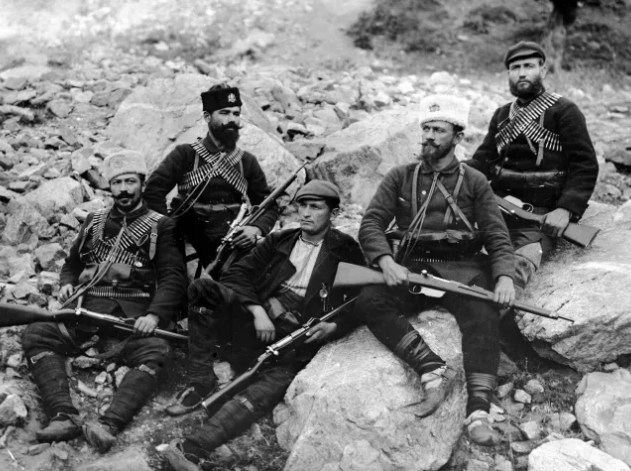
In the First Balkan War, Serbia, Bulgaria, Greece, and Montenegro attacked the moribund Turkey to take its remaining territories and get Turkey out of Europe. In the Second Balkan War, they fought one another over those same territories. The Balkan Republics model themselves after Italy and Germany and hope to unify their nations at the expense first of Turkey, then of one another. The Scramble for the Ottoman Empire cannot but bring colonial-style wars into Europe. The shocking atrocities, the Carnegie Commission, the proliferation of “National Questions”. One of our main guides to all this? A Russian journalist writing for a Ukrainian newspaper who believes only a Federation of the Balkans can resolve these problems. His name is Leon Trotsky…
The coup in Niger
Who was overthrown, who overthrew, some context
In the spirit of “every coup deserves a blog post”, here are some basics about the coup in Niger.
Caveats to start: I know a lot about coups, but I do not know a lot about Niger. What follows are from some readings I’ve been looking at, the most valuable being Rahmane Idrissa’s Historical Dictionary of Niger.
There are three threads that provide context for the Niger coup of July 26.
-
Western – and French in particular – exploitation of the country which, for various French/Western reasons, is deepening and making people more miserable.
-
Niger’s history of coups – and the recent regional coups in Burkina Faso and Mali.
-
The roiling and seemingly unending conflict between “jihadi” groups like the Islamic State in the Sahel, etc., and the “French-led” regional counterinsurgency against these groups. (The scare quotes will be explained below).
Let us begin.
1. French exploitation
In the series on the Scramble for Africa, we covered France’s scramble for West Africa in episode 15. After overthrowing the West African states, France re-organized the territories for exploitation. The colonial currency regime (called the CFA Franc, which persists today in many of these countries) is a part of this system. The key references for this are Walter Rodney’s How Europe Underdeveloped Africa and the more recent Africa’s Last Colonial Currency by Pigaud and Samba Sylla. Imposing famines, huge colonial massacres, and the continual drain of resources were the order of the day.
The murderous mission of Voulet-Chanoine
Probably here we should mention the famous expedition of Voulet-Chanoine. These two French officers left from Senegal in November 1898 to try to conquer and unify West Africa under French colonial control. They had a number of troops and hundreds of enslaved porters. The stuff the Europeans needed to scramble for Africa was carried around for them by enslaved porters in chains – in a project all justified at the time in the name of abolishing slavery.
Anyway, back to Voulet-Chanoine. When they reached the Niger outpost, they committed a series of massacres, including one where the French made a big show of murdering children (Sansanne-Haoussa) and another where they murdered thousands of people at Birni-N’Konni. After a number of these massacres, Voulet-Chanoine’s fellow Frenchman Jean-Francois Klobb (a Lt. Colonel who gave Voulet, a captain, a direct order relieving him of command) caught the column and told the French troops to stop, so Voulet killed him too. That night, Voulet tore the galloons off his uniform and told his troops: “I am no longer a Frenchman, I am a Black chief. With you, I will found an empire.” A couple of days later the troops mutinied and killed both Voulet and Chanoine. The expedition continued on and killed more Africans and some of the French leaders went on to have successful military careers.
The French, like the other Europeans in Africa, also exerted control through periodic, murderous “punitive expeditions”.
Hunger and famine in colonial Niger
Shortly after the French consolidated their position in what would become Niger, there was a famine – in 1902-3. And another in 1913. And another in 1920. And another in 1930. Perhaps you will say there were famines before colonialism, and there were. But France imposed qualitatively more hunger and famines than existed before. Walter Rodney cites a Brazilian study by Josue de Castro, which Rodney says “convincingly indicates that the African diet was previously more varied, being based on a more diversified agriculture than was possible under colonialism.” To ensure Africans worked for them, France would prevent them from gathering foods or having gardens and force them to pay taxes in francs. France’s plunder of Africa also included conscripting 164,000 African troops to fight for them in World War I — which caused, among other things, a race panic in Germany – a story for another day.
Uranium was discovered just before Independence in 1959 and its exploitation was organized by a French company. In its generosity, France allowed Niger 5%, then eventually 12%, of the royalties from the exploitation of this resource, which provides some 1/3 of France’s uranium and is 63% owned by French capital (and 37% by Niger).
IMF and World Bank austerity
Between French capital’s control of the country’s resources and infrastructure, neocolonized Niger continued to experience famine and food shortages in 1972-3. The IMF pressured the country to privatize 54 state companies in 1984; the credit union was privatized in 1985. At the end of 1989, the new government followed a World-Bank encouraged policy of drastic cuts to education funding, called Project Education III. Student protests followed with police killing several student protesters in 1990. In 1992, in desperate financial straits, the government got $50M in aid by recognizing Taiwan, which meant China broke diplomatic relations. In 1995, the government signed a structural adjustment package with the IMF, was overthrown in a coup in 1996, and the post-coup government also signed a structural adjustment package. In 1997, the World Bank demanded more public sector cuts, leading to more public sector strikes. In 1998, the IMF congratulated the government for its compliance with austerity, as public sector strikes shut the whole civil service down. In 2000, the prime minister asked deputies to forgo their entire salaries: “The coffers of the state are absolutely empty”, he said. The combination of drought and austerity policy led to a severe food shortage in 2004-5: The IMF took the occasion to force the government to raise taxes on milk, sugar, and corn flour. The government backed off of some of the taxes after a month long strike. Another food crisis followed in 2010-2011.
France needs Africa to subsidize it
Colonialists always present their pillage as a gift to the colonized, but the reality is that the rich countries are generously funded by the poor, and France’s CFA Franc zone is a fountain of free resources for France. Having decided that France is going to join the US in its confrontation with Russia and China, it needs to squeeze the global south – and especially Africa – for the resources to do so. It’s a dangerous plan.
2. A history of coups in Niger
In the years leading up to Niger’s independence, the socialist leader who appeared positioned to take the country into the future was Djibo Bakary of the Mouvement Socialiste Africain, whose party came to be known as Sawaba. He was elected to lead the government in 1957, but he was overthrown and exiled by France in 1958, two years before independence happened. The next elections were rigged and the Sawaba party was disallowed. A Sawaba uprising happened in 1964 and was crushed – hundreds of Sawaba were imprisoned as political prisoners and in one incident, twenty one were suffocated to death at Maradi’s prison.
Besides being a socialist and pan-Africanist, Bakary’s crime was opposing de Gaulle’s idea for a Franco-African community. With Bakary out of the way, the post-Independence government joined the Franco-African community and signed an agreement allowing French troops to occupy Niger (a situation that persisted until the 1974 coup).
Reviewing the Historical Dictionary of Niger, I counted six coups: 1958, 1974, 1996, 1999, 2010, and now 2023. Several of these coups were by military officers who promised to hold elections quickly – and then did so! Other military governments stayed in power for a decade or more.
But the dynamics of a coup are never entirely local, as a perusal of William Blum’s book Killing Hope will show. Alternating between military and civilian governments, intervening in electoral processes where possible and resorting to military coup as needed, was the preferred method for keeping pro-US / pro-Western governments in power all over Africa for many decades after independence.
In recent decades, however, the US strategy has changed, to prefer dysfunctional civilian governments with low-level insurgencies that are then fought, but never defeated, by Western-led counterinsurgency efforts. This way, African militaries are always engaging in counterinsurgency under broad Western command against African populations. African resources still flow to the global north, with illicit flows taking a good share of the total. In endless war situations, land-grabs and resource-grabs are easier to hide (see, e.g. the US in Syria).
Which leads to our next section:
3. The French and US militaries in the region
The governments of West Africa have been under French military control since independence. The US initially exerted its own interests through France, but in recent decades has exerted influence more directly, through AFRICOM, especially since the overthrow of Gaddafi in Libya in 2011. The Niger government signed agreements allowing the US to operate lethal drones in Niger, and declared its support early on for the rebels that would overthrow Gaddafi. There are a large number of Islamist insurgent groups operating in the countries of the region: both Al Qaeda-branded and Islamic State-branded groups murder civilians, attack police stations and military outposts, and kidnap people. The attacks can be severe. Luca Raineri, writing in the journal Terrorism and Political Violence, summarized a series of attacks in west Niger in 2019 alone:
in May, twenty-eight Nigerien soldiers were killed in an armed ambush by ISGS; in July, ISGS stormed a Nigerien military position near Inatès, killing eighteen soldiers; in October, five Nigerien gendarmes were also killed in an ambush by ISGS near Abarey; in November, ISGS attacked the Malian military base of Indelimane, just across the Nigerien border, killing fifty-three Malian soldiers; in December, ISGS mounted a large-scale attack against the military base of Inatès, which claimed the lives of seventy Nigerien militaries; and in January 2020, a new ISGS assault on a Nigerien military post in Chinegodar killed at least eighty-nine soldiers.
This is a little bit more than a state can be asked to simply “live with” or “manage”, when the prescription for dealing with this violence is another decade of Western-led operations that seem to lead nowhere. After the destruction of the Libyan state, the so-called “jihadi” insurgencies have targeted states of the region and the US/France have been completely ineffective. The African militaries that have been subordinated in these counter-terrorism efforts have good reason to be impatient: their Western advisers are advising them to death.
Niger’s neighbours, Burkina Faso, and Mali, have both recently seen their civilian governments overthrown by the military. In all three coups, the militaries have complained about the handling of the fight against the “jihadist” insurgencies.
This is where Russia and China enter the story. Since the collapse of the USSR and until recently, African states had no alternative but Western military cooperation, even to try to resolve military problems like the Islamic State that were created by the West in the first place. But having watched Russia help Syria actually sweep the Islamic State out of Syria, the post-coup West African states might be wondering if they could pull off something similar.
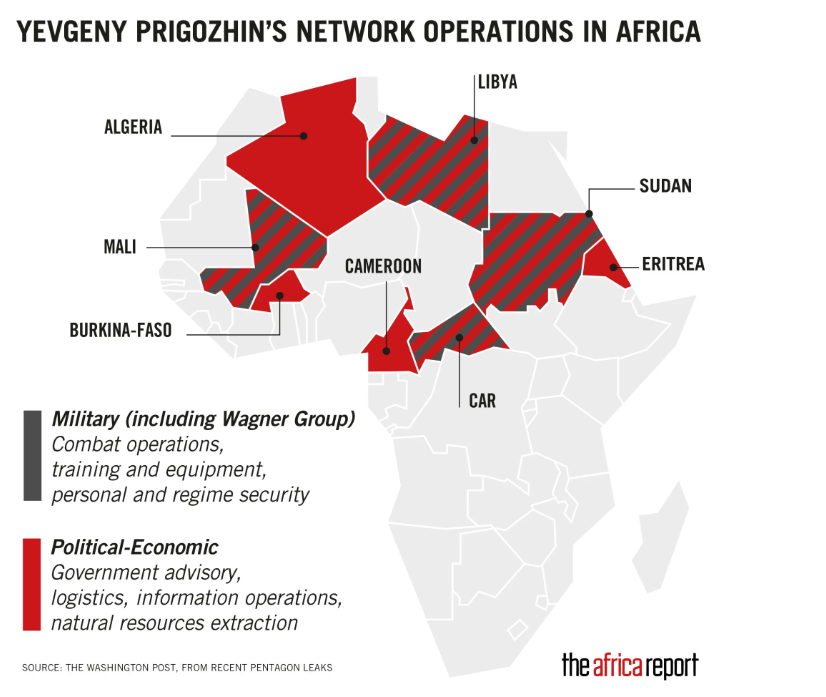
Likewise, before the Belt and Road Initiative, African states had no alternative but to go to the IMF and World Bank and impose austerity, even though it trapped their people in debt and misery. Now there may be better deals to be found. Or at least, that thing capitalists supposedly love – a fair competition. Take a look at the visual capitalist from EIGHT years ago:
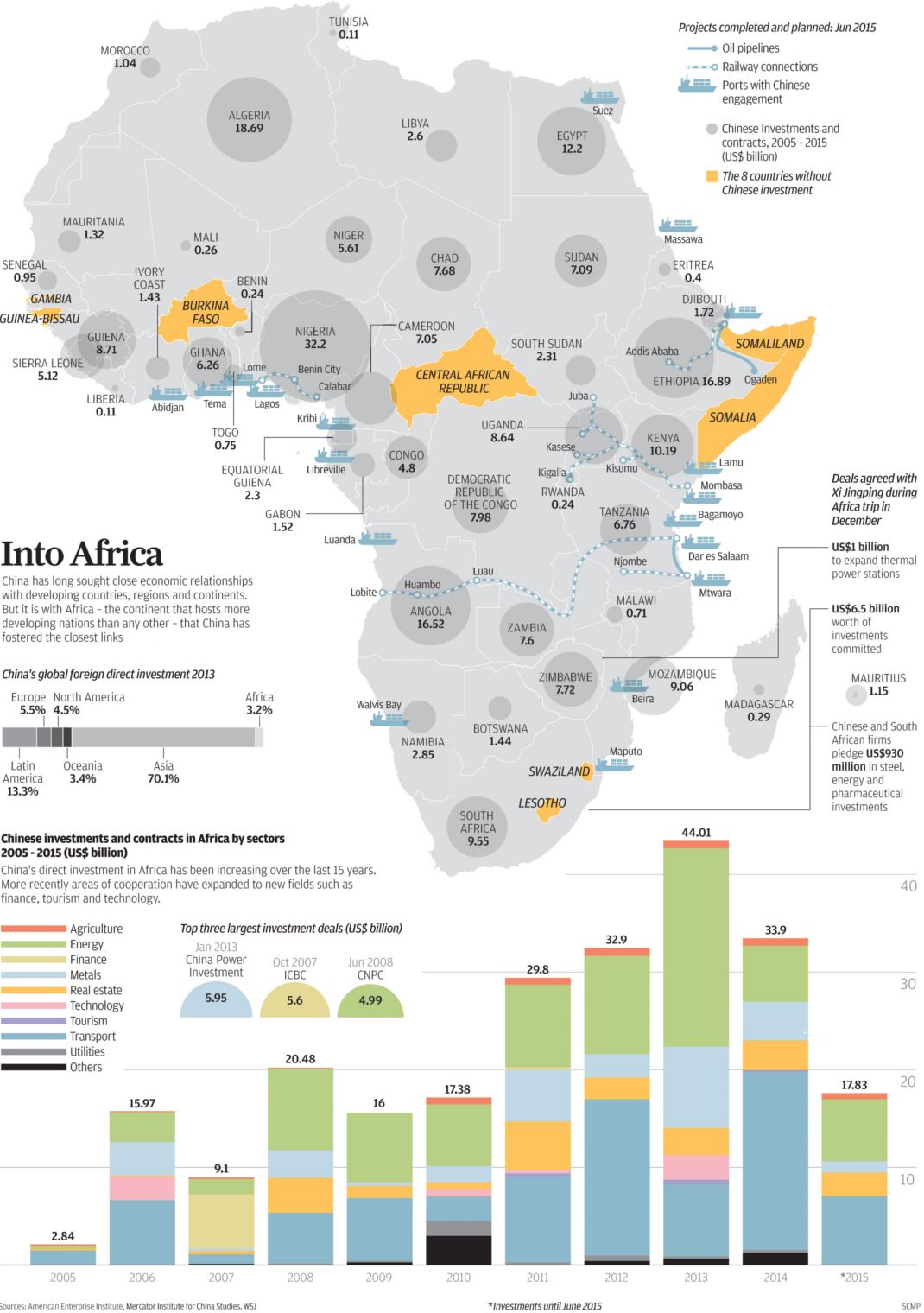
So, there are big stakes, and a wider conflict over the future of Africa, at work in this coup.
In Real Time 13: Do we need states to solve climate change?
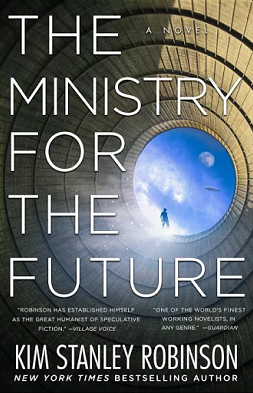
Stan Cox and I talk about Kim Stanley Robinson (KSR)’s 2020 book, The Ministry for the Future, which is a hugely important book because it pictures how we could get from our current situation to a world where CO2 emissions were actually trending downwards, saving human civilization from catastrophe. We talk about the climate events in the book, the geoengineering technologies proposed, the international policies proposed, and then I have a long critique of KSR’s geopolitics, which I argue gives undue praise to India, has an undue dislike of China and Russia, and gives too short a shrift to the imperial mechanisms of plunder that underpin the global economy and its currency regime, which leads to problems with the proposed carbon coin. But for all my critiques, this is the book we’ve got and so we have to use it as a starting point for how to get there from here.
Strategies to reverse climate change
Kim Stanley Robinson’s 2020 sci-fi / cli-fi book The Ministry for the Future as a starting point for discussion
2023 is, as the cartoon goes, the hottest year we’ve ever experienced and maybe the coldest we will experience. Heat waves in more places than ever, record wildfires, the Greenland ice sheet disappearing as predicted. An appropriate time for trying to work out how, if we were to seriously try, we might go about reversing this situation.
Historically, utopian fiction has been used to criticize existing social institutions or to envision how things might be different. Centuries ago, Thomas More’s Utopia used Europe’s limited understanding of Indigenous societies in the Americas to envision a society that had contempt for gold and for greed. Edward Bellamy’s 1888 book Looking Backward imagined a socialist society; Ernest Callenbach’s 1975 Ecotopia imagined the technology of a sustainable separatist West Coast (guaranteed by a nuclear deterrent); Ursula K. LeGuin’s 1974 The Dispossessed imagined an anarchist society in a context of scarcity. These days, there are probably 10 dystopias produced for every 1 utopia, and as Kim Stanley Robinson (henceforth KSR) once said in an interview, anyone can write a dystopia by scanning the headlines — certainly a climate dystopia could easily be produced using that method in 2023.
The visionary utopian fictions I mentioned are, at this juncture, less important than another type of utopian fiction, which is strategic utopian fiction. The hardest thinking that needs doing right now isn’t about what a better world would look like, but about how we could get from here to there. And that is the value of KSR’s 2020 book The Ministry for the Future, focused intensely on the question of how the “international community” (led by the West, and specifically by an Irish diplomat working for the United Nations) could lead the planet out of the climate crisis. The definition of being “out of crisis” is that emissions, temperatures, and carbon dioxide parts per million (ppm) are all trending down, towards stable, pre-industrial levels. This is the situation achieved by the end of the book. The book is about how it was done.
To set up the strategic utopia, KSR starts with – and introduces at all major milestones – dystopian climate events. The book starts with a heat wave in Uttar Pradesh, India, that kills millions. There are further heat waves later on in the book in Iran and Pakistan, and another one in the southern US. By the later half of the book, there are more than 100 million climate refugees on the move, and their plight is explored in detail. There is a flood that pretty much destroys Los Angeles. These events all add urgency to the project of the characters and of the titular Ministry.
To fight this, KSR’s characters adopt a portfolio approach. Two decades ago, scientists Pacala and Socolow described such an approach as a series of “stabilization wedges”. No new technology was needed, they argued, to meet the world’s energy needs with technologies current even at that time. The portfolio adopted in the Ministry includes:
-
The spraying of aerosols into the sky to reduce the amount of solar energy reaching the earth – this is unilaterally done by India’s Air Force after the heat wave at the start of the book. [And it’s probably not a good idea].
-
Pumping water from the ocean surface to the top of the antarctic glacier to forestall sea level rise by re-freezing the glacier.
-
Converting petroleum corporations’ pumping infrastructure to infrastructure that pumps frozen carbon back into the ground.
-
Using high-tech sail power to do the world’s shipping (sails, but also electric and solar sails).
-
Habitat conservation, restoration ecology, regenerative agriculture (all good ideas).
The individual technological and geoengineering pieces are there to be critiqued, and KSR does a good job of referring to projects and ideas by their searchable names. For a fiction book, this is pretty good citation practice.
Beyond the speculations about climate events and technologies, Ministry also has its own geopolitical world view, its own – to use a favorite KSR phrase – structure of feeling about the world order and the powers that contend within it. This structure of feeling is where I have some divergences from KSR and where I would counter-propose some alternative analyses and strategic thoughts.
In Ministry’s geopolitics, India is central and Kerala in particular is central to India. As a huge democracy, India throws off BJP (and Congress) rule and points the way for a democratic and decentralized transition to a carbon-neutral economy for all. The US is so omni-present that it is invisible: US officials don’t sabotage the Ministry, the US military and police don’t green themselves or abolish themselves – it’s as if they never really existed in the first place. China is disliked – described by one of the point-of-view characters as “debt-laden, opaque, oligarchic, authoritarian.” Russia is largely irrelevant, a country of mafias, poisoning, assassination, and some high-tech weaponry that they make available for terrorists (including climate terrorists). Europe has some sort of occupy movement that doesn’t come to much; Europe’s struggles with taking on Global South climate refugees, and its functioning headquarters of the Ministry in Zurich, anchor the story – Europe is mostly benevolent and mostly functional, trying to help the world as much as possible.
So much of what happens in Ministry is based on these geopolitics that the events in the book couldn’t work, the strategies wouldn’t apply, if the world didn’t work the way KSR describes. Which is unfortunate, because the world doesn’t work this way: The geopolitics of Ministry are inadequate.
Ministry gets a state for Kurdistan, carved out of Turkey, Iran, Iraq and Syria; but the Palestinians are unaddressed. The US and UN sanctions against Cuba, Venezuela, Iran, Russia, the other 1/3 or so of humanity under sanction – unaddressed. US wars, coups and occupations of Iraq, Afghanistan, Syria, Libya, Haiti, Guantanamo, Puerto Rico, Hawaii — unaddressed. A student debt revolt leads to the nationalization of US banks – but there is no specific struggle by Black America nor do Indigenous struggles for Land Back play a role. Ministry is socialist, but shows a dislike for existing socialist countries (China especially, but also Cuba, Vietnam, DPRK). Ultimately Ministry puts its faith in liberal international institutions, elections, non-governmental organizations, and decentralization of power. It is unfavorable towards centralized states, central planning, and organized armed struggle.
The point about armed struggle is an important one because in Ministry, the international agreements and economic pacts are guaranteed by decentralized terrorism by a group based in India called the Children of Kali. These children crash all commercial airlines with drones on a day called Crash Day, killing 7,000 civilians; they assassinate all major corporate executives, again using drones; they kidnap all the dignitaries at the World Economic Forum at Davos for a week (and show them video lectures to try to deprogram them, without success); and they use swarming missiles to blow up container ships. This level of violence cannot be organized by decentralized terrorism, but only by organized states which would lead quickly to world war. Thus, the Children of Kali are a geopolitical hand-wave, a type of magic that achieves a global monopoly of violence without state power.
The other major hand-wave is that in Ministry, economic planning is substituted with “carbon quantitative easing”, whereby the Central Banks of China, Europe, and the US agree to spend “carbon coins” into the global economy for any projects that reduce the amount of carbon in the atmosphere (or prevent it from going into the atmosphere). There are other economic tools in Ministry besides the carbon coin, including carbon taxes, incentives for specific projects, etc., but the mainstay is the carbon coin. In practice, the carbon coin would mean de-dollarization, which in our world is being led by China and Russia, who appear to be signing up much of the Global South for the plan. Whether this is going to lead to world war remains an open question. But in Ministry, neither Europe nor the US fight hard to maintain a global system where they get trillions in value each year drained from the Global South (see, as I always find myself saying, Zak Cope, Utsa and Prabhat Patnaik, or Jason Hickel for more about this drain). In our world, they are fighting hard to maintain this global system and it is this fight – of neocolonialism imposed on the global south – that will determine what happens with the climate and therefore with human civilization.
To take the strategy presented in Ministry forward, we will sadly have to revise its attitude towards India (which shows no sign of throwing off fascism any time soon), China (which unlike the West is making non-apocalyptic plans on the basis that civilization will indeed continue to exist for centuries to come), the US and indeed the whole West (which isn’t neutral but a formidable and actively hostile opponent of climate action) centralization, states, and planning.
References:
Cory Doctorow has one and another excellent threads about this book.
I presented most of this critique in a podcast recording I made with Stan Cox for our In Real Time series.
A couple of years ago I wrote a piece about why Five Year Plans were a better model for resolving the climate crisis than Green New Deals were.
Why did they overthrow Gaddafi?
The same reason they overthrew everyone else
This post is inspired by The East is a Podcast’s latest episodes on Libya, featuring Matteo Capasso, discussing the rise and fall of Gaddafi’s revolution from 1969-2011. Sina’s episodes coincided with my own research, with my Civilizations co-host Dave Power, into Italy’s initial invasion of Libya in 1911-12. We did our own episode about that invasion, which culminated in Italy committing genocide in Libya after WWI – and we’ll be returning to the long war there and the genocide in our show.
But what I wanted to do in this post is use the occasion of Sina’s episode to talk about a book that profoundly changed the way I viewed Gaddafi and Libya. That book is the 2012 Slouching Towards Sirte: NATO’s War on Libya and Africa, by Maximilien Forte. When there is a US war and propaganda campaign against a targeted country, I instinctively look for books from different perspectives, including if possible the strongest possible case for the other side. I don’t need anti-war books to be fair and balanced: we’re subjected to non-stop pro-war, biased propaganda. I don’t mind reading biased anti-war propaganda. I can do the balancing myself.
I had read a couple of other books about Libya or touching on it. I’d read a bit about the Chadian civil war in pro-US sources like Burr & Collins’s 1999 Africa’s Thirty Years War: Chad-Libya-the Sudan, 1963-1993. I knew about Gaddafi’s Green Book and his Isratine proposal. So, like any consumer of Western media, I got the impression of a snazzy-dressing, mentally unstable, adventurist dictator. Not so different than impressions of Saddam Hussein provided in South Park: The Movie, or of Kim Jong-Un that you would get from Kim Jong-Un’s Little Book of Calm.
Most of the anti-war material I read didn’t really dislodge this view.
But Forte’s book did.
Whenever any US-based regime change is successful, it is cheap and easy to make the argument that the ousted leader was a strategic failure. I have personally heard such arguments about:
-
the Afghan communists, overthrown in 1992;
-
Aristide in Haiti, overthrown in 1991 and again in 2004;
-
Chavez in Venezuela when he was overthrown for a couple of days in 2002;
-
Saddam Hussein in Iraq in 1990 and 2003;
-
Assad in Syria from 2011 on;
-
Hizbullah in Lebanon (for supporting Assad);
-
Milosevic in Yugoslavia;
-
Lula and Dilma in Brazil;
-
Zelaya in Honduras.
These are just the ones I have personally heard in my own life. I know that such arguments have been constructed about every single leader that’s been regime-changed at least since the early phase of the Scramble for Africa in the 1830s when France grabbed Algeria, and probably before.
Now, the fact that they’re formulaic and repeated in every single case doesn’t necessarily make them false. Nor does it make ousted leaders angels or martyrs. It does, however, impose an extremely heavy burden of proof, so much so that it might behoove readers to reverse the default assumption. Maybe if the regime-changers were lying the last 100 times, they’re lying this time.
For Aristide, the argument went that he shouldn’t have accepted the US intervention to put him back into power in 1995; he should have conducted more repression against those who were trying to overthrow him from 2001 on; he should have conducted less repression against same; he should have been more/less conciliatory; he shouldn’t have asked for the indemnity money France stole from Haiti…
And what about Gaddafi? He shouldn’t have antagonized the imperialists with his bombastic style; he shouldn’t have antagonized them by supporting Palestinian armed organizations, the IRA, the ANC; he should have avoided intervening in the Chad war and the fight with that France-backed government; he shouldn’t have made a deal to try to normalize relations with the imperialists, since they overthrew him anyway…
The implication in all these cases is that there was some set of perfect strategic choices that could have kept the nationalist regime in power and kept the revolution moving forward. Maybe there was. But is this a fruitful use of energy, criticizing the failings of third world leaders facing impossible odds? Our efforts might be more profitably deployed in activities other than criticizing the strategic errors of such leaders.
(That’s not to say there aren’t a few good principles that Third World leaders have learned from hard experience. The Patnaiks distilled a few economic ones at the end of their book, Capital and Imperialism: impose capital controls, survive the CIA coup attempt, impose import controls, stimulate the domestic market, raise agircultural productivity, redistribute land, provide rights to employment, food, healthcare, education, pension/disability for 10% of GDP, don’t apologize for economic nationalism. I might eventually do a post just on these points, but not right now).
Anyway, there are several general retorts to the “X was bad and deserved to be overthrown by the imperialists”.
-
Is the country better of now than it was under X? (Almost always the answer is disastrously no – Libya is an extreme case, though Iraq, Haiti, and Afghanistan are right up there).
-
If X was so bad, why did the imperialists overthrow him at all?
The answers to #2 can be found in Maximilien Forte’s book. Here are a few:
-
Under Gaddafi’s regime Libya’s life expectancy grew from 51 years to 74. Literacy grew to 95% for men and 78% for women, and per capita income increased to $16,300. It was the only continental African nation to rank “high” in the Human Development Index.
-
Gaddafi supported the anti-apartheid struggle in South Africa. Mandela told Gaddafi: “your readiness to provide us with the facilities of forming an army of liberation indicated your commitment to the fight for peace and human rights in the world.”
-
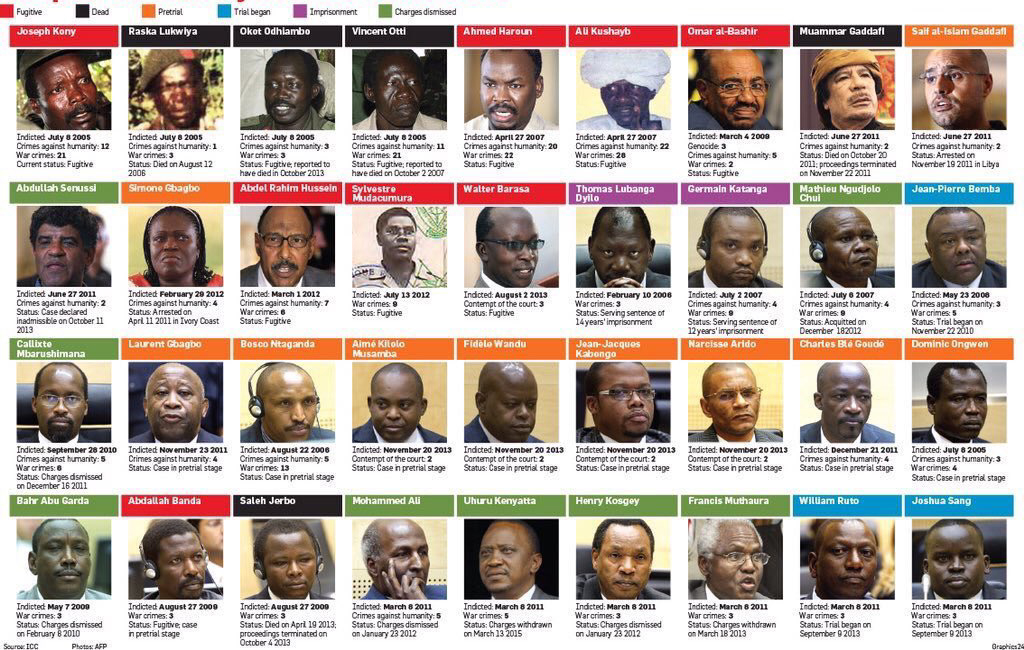
Under Gaddafi, Libya was a major financial backer of the African Union and an advocate for independent, AU institutions including sovereignty over resources, an African Monetary Fund to replace the IMF, and independence from the International Criminal Court which, until it added a couple of Russians to its indictment list, has only ever prosecuted Africans.
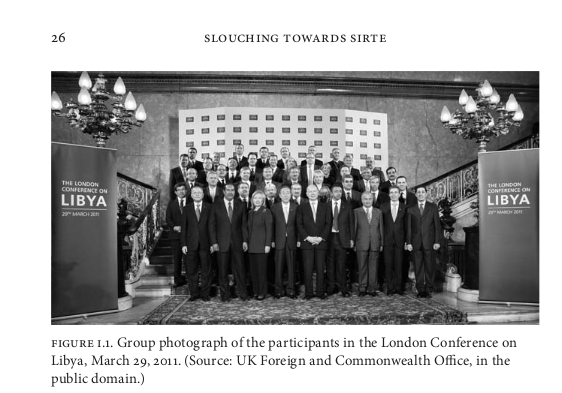
Contrast this with the photo of those gathered to overthrow Gaddafi in 2011, above. Notice anything?
-
Libya under Gaddafi invested around $150 billion in infrastructure and agriculture projects in Africa.
-
A minor point: Gaddafi treated African leaders and diplomats with dignity (as China does) in contrast with the West which continues to engage in calculated humiliation and indignities of the same leaders.
-
Gaddafi was a fierce adversary of the US African Command (AFRICOM). After his overthrow in 2011, the US announced deployment to four more African countries: Central African Republic, Uganda, South Sudan, and the DR Congo, and 14 joint military exercises in 2012.
Forte suggests that Gaddafi’s “turn toward Africa” was “arguably a turn away from the Arab world’“. While Gaddafi had worked in many Arab unity initiatives, he gave up around 1999. It was Gaddafi’s Africa policy that got him overthrown.
As always, there’s more. Forte’s book is devastatingly argued, has rich footnotes, and a 30-page reference list. I wasn’t able to emerge from my reading of it with the same stereotyped idea of Gaddafi as an erratic and silly person. Indeed, I don’t even think that the US players that overthrew him saw him that way. That’s a myth for mass consumption, an expression of hatred.
(Another aside, I realized watching pro-war propaganda that while we think of hate speech in terms of screaming, clawing, and gnashing teeth, a lot of hate is expressed through mockery and ridicule. Certainly the caricatures of Gaddafi are hateful.)
When she heard Gaddafi was murdered, Hillary Clinton was being interviewed when the note came in on her phone. Her spontaneous reaction was to say: “We came, we saw, he died.” And to burst into what appears to be a truly satisfied laugh, a rare unscripted moment of celebration for a politician renowned for extraordinary self-control.
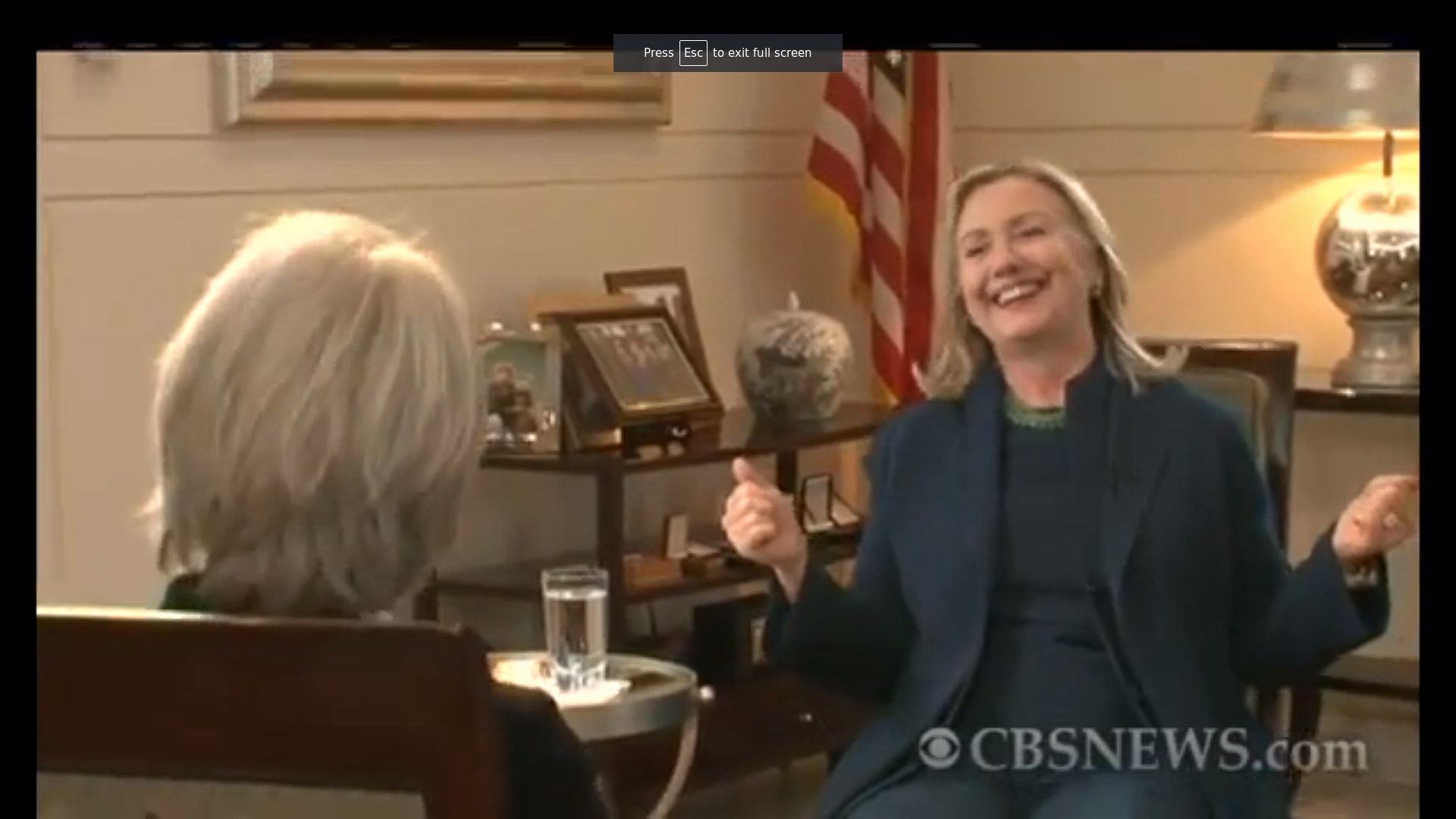
There’s nothing to celebrate.
World War Civ 20: Italy invades Libya, 1911-12
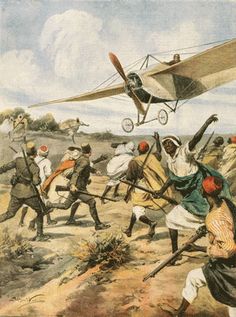
After losing to Ethiopia, Italy tries to restore its reputation as a colonizer by invading Libya, following directly from France’s invasion of Morocco and leading directly to the Balkan War. The dominoes keep falling as the European colonizers keep grabbing. Libya becomes a battlefront for decades – one we will return to in future episodes.