The myth of the belly of the beast

Why it’s hard to ‘go make a revolution’

The myth always starts the same. It’s a quote attributed to Che Guevara, by American antiwar activist Jerry Rubin. He visited Cuba and wrote about it in his book Do It! Scenarios of Revolution. Page 20:

“Che stood before us in the Ministry of Labor auditorium… We were 84 Amerikan students visiting Cuba illegally in 1964… As Che rapped on for four hours, we fantasized taking up rifles. Growing beards… Joining Che to create revolutions throughout Latin America. None of us looked forward to returning home to the political bullshit in the United States. Then Che jolted us out of our dream of the Sierra Madre. He said to us: “You North Amerikans are very lucky. You live in the middle of the beast. You are fighting the most important fight of all, in the center of the battle. If I had my wish, I would go back with you to North America to fight there. I envy you.”

Some questions arise.

  1. Did this happen? Jerry Rubin is the sole source, and his reliability is questionable. He abandoned activism in 1972 to become a businessman, selling wellness and supplements and producing quotes like “wealth creation is the real American revolution”, and books like The War Between the Sheets: What’s Happening with Men in Bed.

  1. Was Che being diplomatic? This was a diplomatic visit, after all. Che could have said this for any number of reasons – including wanting to send these Americans back home so they wouldn’t stay.

  1. Is this quote a sufficient basis to build a sense of where on the globe the most strategic location for a political “fight” would be?

I’m inclined to think that Che probably said something like this, to be diplomatic, and that it has been taken much more seriously than it should be. After all, after this Che Guevara went first to Congo, and then to Bolivia, not to the US. His revealed preferences show what sites he thought were strategic and which not.
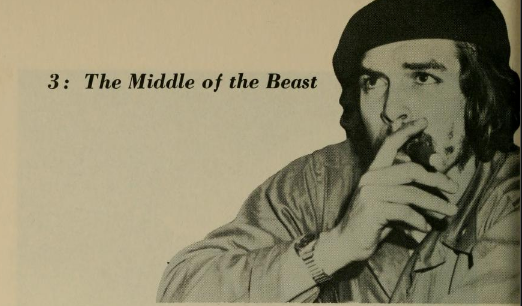
Did this man envy Jerry Rubin?

A few years after Rubin’s 1964 visit to Cuba, another Jewish American antiwar activist, in the course of setting out tasks for the American peace movement, argued in 1969 that the peace movement had not yet amounted to very much or had much influence on America’s consciousness. The more important variable, Chomsky argued, was the Vietnamese resistance. In American Power and the New Mandarins, he wrote: “Nevertheless, those who have devoted themselves to working for peace in Vietnam can only be saddened by the realization that they have failed to create the consciousness in this country that we have no right to win a military victory. It is the miraculous heroism of the Vietnamese resistance that has forced these tentative moves towards peace in Vietnam.

On the one hand, Rubin invoked Che Guevara to argue that the US revolution was the most strategic revolution; on the other, Chomsky recognized that the US movement had no meaningful effect on the situation, that only the Vietnamese resistance had changed the equation.


In 2012, Norman Finkelstein wrote a book called Knowing Too Much: Why the American Romance with Israel is Coming to an End. In April 2026, the Jewish Electorate Institute published a poll finding that, after 3 full years of openly committing genocide, rape, and torture before the world, Israel was understood by 87% of American Jews as having the “right to exist as a Jewish homeland.” 83% of American Jews believed that criticism of Israel was antisemitic.

In his 1980 book A People’s History of the United States, writer and nonviolence advocate Howard Zinn described the American system’s genius like this:

“The American system is the most ingenious system of control in world history. With a country so rich in natural resources, talent, and labor power the system can afford to distribute just enough wealth to just enough people to limit discontent to a troublesome minority. It is a country so powerful, so big, so pleasing to so many of its citizens that it can afford to give freedom of dissent to the small number who are not pleased.”

Zinn’s conclusion is right, but one premise is wrong. America is not “a very wealthy country” because it is “rich in natural resources, talent, and labor power.” America is a very wealthy country because it is a parasitic apparatus draining the wealth and resources of the entire Global South to it. Political economists like Jason Hickel, analyzing value transfer, unequal exchange, and drain, explain the dynamics. Everything from the dollar as reserve currency and dollar recycling mechanisms, monopolies of intellectual property and patents, the (low) pricing of raw materials from poor countries and (high) pricing of services from rich ones, to US control over international institutions (including financial ones), gives the US trillions of free, drained value from Asia, Africa, and Latin America.

America didn’t get into this parasitic position through “talent”, either. It nudged its predecessor, England, off the throne and into a gentle second-hand parasitic place. That America had the resources to nudge England off came from a prior theft: the theft of the North American continent (through genocide) and the theft of millions of African people whose labor and freedom was stolen (through slavery).

He goes on to explain why America hasn’t had a revolution:

“One percent of the nation owns a third of the wealth. The rest of the wealth is distributed in such a way as to turn those in the 99 percent against one another: small property owners against the propertyless, black against white, native-born against foreign-born, intellectuals and professionals against the uneducated and unskilled. These groups have resented one another and warred against one another with such vehemence and violence as to obscure their common position as sharers of leftovers in a very wealthy country.”

Zinn adds an ideological reason to his material argument: “The idea of saviors has been built into the entire culture, beyond politics. We have learned to look to stars, leaders, experts in every field, thus surrendering our own strength, demeaning our own ability, obliterating our own selves.” Fifty years later, every TV show, cartoon, and Hollywood blockbuster is some variant of superhero, “chosen one” narrative: things have gotten far more extreme than Zinn described.

He hoped that Americans could one day unite and “succeed in doing what the system itself has never done-bring about great change with little violence.” The tactics he believed would work were nonviolent ones: “demonstrations, marches, civil disobedience; strikes and boycotts and general strikes; direct action to redistribute wealth, to reconstruct institutions, to revamp relationships; creating-in music, literature, drama, all the arts, and all the areas of work and play in everyday life-a new culture of sharing, of respect, a new joy in the collaboration of people to help themselves and one another.” Such a nonviolent movement, Zinn said, “would be a new kind of revolution, the only kind that could happen, I believe, in a country like the United States.”

Zinn believed that the US had divided its population into prisoners and guards. The title of this rousing concluding chapter to his book? The Coming Revolt of the Guards.

To these Jewish American activist-writers of the 20th century, a major, nonviolent, but nonetheless revolutionary change in the American status quo was coming, at some point in the future. 14 years after Finkelstein’s prediction of the romance coming to an end, Jewish American support for genocidal Israel is basically total. Meanwhile, 46 years after Zinn’s prediction, is it safe to say the “Revolt of the Guards” is probably not coming? And if not, could the promise that it will appear around the corner itself not some kind of pacification, release valve?


Looking at the record since, say, 1917, there have been revolutions, near-revolutions, and successfully rolled-back revolutions in many countries, but nothing close to one in the US. It could well be that a revolution in the US, forcing elites into exile in places like England and Israel to plot their return, would be the most strategic thing that could happen. But that enthusiasm has to be curbed by the record, and the record would suggest that it is much harder to have a revolution in the US (or another Western country) than in the rest of the world. It could be that the conditions in the core are the least conducive to revolution and that revolution would only occur there after a lot of revolutions in the periphery.

If it were easier, or as easy, it would have happened already.

Because we’re trying to figure out the reason for the absence of something, the truth is it’s impossible to know. A few have ventured to name the reasons over the decades.

Material Bribery. Zinn’s hypothesis, that US elites give enough wealth to enough people that they identify with elites instead of the people, is an explanation that has been offered in many different forms from Lenin (“labor aristocracy”) to Sakai (“the mythology of the white proletariat”) and many times in between.

Psychological / status bribery. Beyond bribery, the idea from Du Bois that racism gives the privileged a “public and psychological wage”, suggests that elites have more than just cash and toys to distribute, but also psychological privileges and pleasures in a racist system. Watching Israeli society and its supporters publicly enjoying the razing of cities, agriculture, infrastructure, and the torture, rape, and killing of children shows that there is some kind of “psychological wage” at work in participation in genocide.

Propaganda. One of the major industries of the West is propaganda. Propaganda for the Global South is manufactured in the north. News media, social media, high culture, pop culture, the academy – all are manufactured at massive scale and weaponized from the core outwards. The principal targets and most brainwashed by propaganda are its Western producers. Those minds would be among the hardest to free.

Co-optation. America is also the epicentre of the production of ideologies specifically to capture and redirect dissent and revolutionary energy: the ideology of democracy and electoralism (in which parties all work for the same goals), the ideology of human rights and the rule of law (for some), the belief that free speech and awareness alone can make revolution, the idea that nonviolence can be a substitute for armed struggle, all work to ensure every movement fizzles. Co-optable movement leaders are promoted into electoral and non-governmental organization (NGO) machinery.

Murder and Prison. But the emphasis on, to put it crudely, the bribery of a privileged minority (Zinn’s argument), even when added to the world’s most comprehensive and sophisticated propaganda apparatus (Chomsky’s argument), and co-optation engine (through electoralism, nonviolence and free speech ideologies, etc.) can take emphasis away from a major factor that has been openly on display especially in the past three years: violent repression.

Chomsky used to claim that violent repression was something that happened in the Global South, but in the Global North the consequences of dissent were less severe because of past struggles and won freedoms. But that isn’t true. When the co-optation engine fails, George Jackson wrote (in Blood in My Eye, quoted in an MROnline article by Colin Jenkins): “Take protest too far, however, and they will show their other face. Doors will be kicked down in the night and machine-gun fire and buckshot will become the medium of exchange.”

Movement leaders in the US are assassinated before they can amass a large following (as occurred as recently as BLM in the 2020s). The US doesn’t just have a big middle class, it also has the world’s biggest prison population in a system of prison camps, surveillance, house arrest, parole, and custody. US police train in Israel and kill thousands of Americans every year. American tech companies, the foundation of the economy, have surveillance as their core business. Student encampments were crushed through force. Police raid, entrap, and infiltrate activist spaces as one of their core functions. Polls might show majorities want health care or are against a war – but majorities don’t get what they want. In the words of George Jackson: “The ultimate expression of law is not order–it’s prison.”


When leftists from the global north and the global south argue online, Westerners might end up getting shut down with something like: “Shut up and go make a revolution where you are.” Fine. Shut up, Westerner. It’s as good a way as any to end a pointless argument.

But those who would take that advice ought to know that while the global north is unequivocally more materially comfortable because of all the stolen wealth, it is not an easier location to “go and make a revolution”. Based on the lack of one in history, we can conclude it’s harder.

If Che Guevara wasn’t merely being diplomatic, if he really did envy Rubin, his envy was misplaced.
Resisting Sanctions and Economic Warfare

Resisting economic warfare is possible. The main challenge for anti-imperial governments is military.

According to a paper published in the Lancet Global Health journal, economic sanctions imposed by the US on other countries have killed about 38 million people since 1970. A key feature of that economic warfare is the deliberate undermining of the currencies of countries singled out for punishment. In February, Trump’s Treasury Secretary boasted about how he brought about a collapse in the value of Iran’s currency. But it is not only sanctioned governments that must manage their currencies under the boot of the U.S. Empire. We’ll review the strategies governments have used to manage their exchange rates and conclude with a note on how economic warfare is inseparable from the real thing.

Basics of monetary policy under U.S. tyranny

Money is the inevitable result of goods and services being exchanged in a modern economy. If too little money circulates in an economy, the exchange of goods and services is restricted and unemployment can rise to excruciating levels. That often happens because central banks try to keep inflation very low by restricting the money supply (often done by raising the central bank interest rate on government bonds, making borrowing more expensive and disincentivizing it, thereby reducing the amount of money banks put into circulation through these loans). Too little money in circulation can cause deflation- a fall in the weighted average of all prices. But too much money printing can result if too much money chases after too few goods and services. It can cause the opposite of deflation, which is inflation. At excessively high levels inflation will prevent most people’s wages from keeping up with rising prices. When people lose purchasing power, they are impoverished. A state’s money policy should align with the real resources – labor, skills, natural resources including energy, infrastructures of various kinds – available in the economy. (Social classes within a country can have very different ideas about what a desirable money policy is).

A huge additional concern is foreign exchange. Unless a country is rich and powerful enough to have its central bank print a “reserve currency” like the U.S. dollar, then it also needs to worry about the international value of its currency. It is a global economy: all countries need imports, and they need foreign currency to pay for them. Today, about 57% of global central bank reserves are in U.S. dollars. The percentage was over 70% in 2000.

Using its dollar reserves to buy or sell its own currency is one way a central bank can impact the value of its currency (the exchange rate), selling dollars they have saved to buy back their own (eg., rials) in order to keep their own currency from depreciating too much, or buying dollars to build reserves when their own currency gets so strong that local industry is harmed by cheap and abundant imports. An alternative tool for protecting local industry, as someone taught Trump half a lesson about this term, is tariffs – but that’s a story for another newsletter.

If the value of a country’s currency drops too low relative to the US dollar, the cost of all imported goods people try to buy inside the country soar, which in turn can drive up all other prices, leading to an inflationary spiral. An overvalued currency, on the other hand, can stifle the development of domestic industry: when no other country can afford to acquire your expensive currency to buy what you’re selling, costumers will look for those goods somewhere cheaper. If you’re in the UK or the USA, you can go shopping on the world market with your strong currency and buy what you like, with no incentive to buy local, depriving your local businesses of the opportunity to sell to the local market. If you can’t sell in the local market the chances of succeeding globally are low. Deindustrialization results. Not a terrible outcome in the metropole, whose role in the global economy is to consume, not produce (even the flagship military industry is basically consumptive: its products are made to be blown up).

Ideally, the value of a country’s currency is stable and at a level that’s compatible with its economic development: not too high or too low relative to the U.S. dollar. (Again, social classes within a country can have very different ideas about what a desirable exchange rate is)

International trade also requires payment systems (ie., SWIFT). Because the U.S. dollar is still the world’s top reserve currency, the U.S. financial system remains the heart of the international payment system. As Andres Arauz, former head of Ecuador’s central bank, explained, when two countries in Latin America trade with each other – seemingly not involving the US at all – money still flows briefly through U.S. banks as part of the transaction. The U.S. Treasury then can claim jurisdiction over businesses in other countries, arresting foreign executives like France’s Robert Pierucci in what he called The American Trap. This is sometimes called “long-arm jurisdiction”, and it is one of many ways the U.S. exerts control over every economy in the world. The U.S. has tremendous coercive economic power that is ultimately backed by its military might.

There are various strategies governments have used to try to manage their currencies.[1]

Floats and pegs: options for the unsanctioned

A 1:1 Peg to the U.S. dollar (Argentina)

From 1991 until 2001, Argentina, under U.S.-backed rightwing governments, pegged its currency to the U.S. dollar. The government guaranteed that it would buy and sell Argentine pesos as if they were equal in value to dollars.

This strategy has been called a close cousin to dollarization. Dollarization is dispensing with your own currency entirely and using the U.S. dollar. What low inflation-obsessed economists like about a dollar peg and dollarization is that they greatly limit and eliminate, respectively, a central bank’s ability to print money.

In Argentina’s case, the dollar peg was credited with ending high inflation. But poverty and unemployment spiked after adopting the dollar peg. Then, in 1998, Argentina entered into the worst recession in its history. It continued for four years. Throughout the crisis IMF economists insisted that the dollar peg was not the problem – that Argentina simply needed to reduce wages and government spending (destroying health, education, human infrastructure, the social safety net…).

Taking IMF orders (and loans) during the crisis led to deflation, but it didn’t end the crisis. It made it worse. The crisis ended shortly after Argentina took three measures: 1. abandoned the peg, 2. let the peso devalue down to 25 cents, and 3. defaulted on $100 billion of government debt.

Argentina’s economy recovered quickly and living conditions improved steadily for over a decade. The key reason: Argentina began stimulating the economy rather than strangling it with austerity to try to save the dollar peg.

Sadly, because of imperial “long-arm jurisdiction”, the default led to Argentina being targeted by vulture funds: A U.S. businessman and funder of Philos Israel and other pro-Israel projects, Paul Singer, purchased Argentina’s debt and years after the default, sued Argentina in a U.S. court and was awarded $832 million of Argentina’s money by that court.

A managed float of the currency (Argentina)

Shortly after default and devaluation of 2001 Argentina imposed foreign exchange controls. High income exporters were forced to turn over dollar earnings to the central bank in exchange for pesos at the greatly devalued rate. That helped Argentina’s central bank build up dollar reserves so that it could implement a managed float of the peso.

If a central bank does nothing to impact where international supply and demand for its currency sets the exchange rate then it is said to allow the currency to “float”. With a managed float, the central bank does intervene to try to keep the exchange rate stable, but does not try to keep the exchange rate very far from where the international market would set it. A fixed exchange rate regime (a peg) is characterized by much more intervention by the state and a greater distance between the fixed exchange rate and the rate that would exist if the currency were allowed to float.

Argentina’s recovery happened mainly under the leftwing governments of Nestor Kirchner and later his wife Cristina Fernandez de Kirchner. The “Kirchner period” lasted from 2003-2015.

Thanks to Western democracy, Argentinian voters in 2023 were able to return economic madness and extreme Zionism to the presidency in the form of Javier Milei, who talks to his dogs that he named after right-wing economists like Milton Friedman and Murray Rothbard, bringing Argentina down to historic economic disaster, eating donkey meat and tree bark.

A reasonable peg to the dollar (Bolivia)

Under the leftwing Evo Morales government in Bolivia (2006 – 2019) the country greatly improved living conditions while maintaining a very stable exchange rate and low inflation.The poverty rate was cut in half, and extreme poverty by 60%. Bolivia’s currency (Boliviano) traded at about 6.8 for one U.S. dollar (about 15 cents) throughout this period The central bank intervened in the market to keep it remarkably stable.

To achieve that stability Bolivia built up massive central bank reserves that reached 48% of GDP by 2013, one of the highest in the world. The key to building huge reserves while also paying for public investment and social programs was a sevenfold increase in the government’s hydrocarbons export revenues. Morales ended loan agreements with the IMF whose economists had always opposed the nationalization of hydrocarbons.

Bolivia probably got carried away building reserves and should have plowed even more money into reducing poverty. A small reduction (say 10%) in its reserves would have gone a long way towards additional poverty reduction without sacrificing a stable currency. Could that have translated into additional public support – perhaps enough to have prevented the 2019 US-backed coup that ousted Morales? Possibly. Regardless, Bolivia’s approach to maintaining a stable and appropriately valued currency, while successful overall, was still very expensive both politically and economically. It illustrates the difficulty of operating within the US imperial system even when not subjected to crushing U.S. sanctions.

Dollarize your economy (Ecuador)

Decades of closely following IMF orders led Ecuador to disaster that drove unprecedented mass migration during the 1990s. Throughout the 1990s the central bank tried to keep the value of the sucre stable at a reasonable rate relative to the dollar but failed miserably. Constant devaluations were a feature of the catastrophic 1990s. In 1999 the banking system collapsed and in 2000 the government decided to adopt the U.S. dollar as its official currency.

President Jamil Mahuad, who made the decision to dollarize, remains despised in Ecuador, but dollarization is popular. More precisely, there is widespread fear that abandoning dollarization would mean a return to 1990s chaos and financial collapse.

Under the leftwing government of Rafael Correa in Ecuador (2007’-2017) it was shown that dollarization isn’t the policy straitjacket that both proponents and detractors assumed it was. Correa’s government defaulted on government bonds owed to foreigners then repurchased them at greatly discounted rates. It took advantage of the benefits dollarization can bring (low inflation, low interest rates, a minimal need to hold dollar reserves) to help pay for public investment and social spending. It used banking regulations and tariffs to work around the limitations dollarization imposes. The government actually created a very significant amount of money during its last years in office – not by printing US dollars of course- but through the banking system.

All that said, dollarization was, overall, a burden that the Correa government had to bear. Assessing Correa’s achievements it must be stressed that Ecuador was not under U.S. sanctions while he was in office. The U.S. was focused on undermining Venezuela. In a post-Gaza genocide world, it is impossible to believe Correa’s government would have gone un-sanctioned.

Use a gold standard (USA, UK, Zimbabwe)

A gold standard has been fiercely advocated by right wing extremists like Ayn Rand, Ron Paul and Alan Greenspan. If a currency must be backed by gold, then the government cannot print what gold standard advocates call “fiat money”. But note (as discussed above regarding Ecuador) that even if the government cannot print money (even if it used gold coins as its currency) it could still create money through the banking system. That’s why goldsmiths ended up becoming powerful bankers in seventeenth century England. Also, a gold standard exists by a government fiat (decree) just like money that’s printed when there is no gold standard.

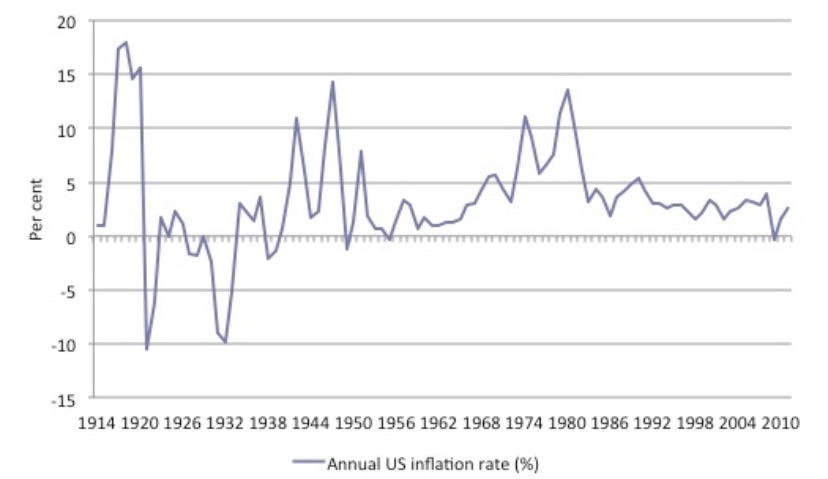
Contradictions aside, there is no doubt that a gold standard imposes extremely tight restrictions on the government’s monetary policy. As economist Bill Mitchell has explained, the gold standard was used in the United States from 1873 to 1933. It made the Great Depression much worse than it would otherwise have been, and even its narrow record on keeping inflation low and prices stable was not good. Price stability improved in the U.S. after the gold standard was abandoned.

When there is hyperinflation (an inflation rate of over 50% per month), it is the main problem hurting an economy, so resorting to a gold-backed currency – to trigger deflation – may appear justified- as in Zimbabwe recently. But the government must eventually find ways to increase the money supply as Ecuador did under the constraints of dollarization. It has been about a century since the leading capitalist states subjected themselves to a pure gold standard – 55 years if you count the Bretton Woods system, a modified gold standard for international trade after WWII that the U.S. dismantled in 1971. That alone speaks volumes about the problems with a gold standard.

Cuba resists sanctions through multiple modes

Reserve currency rationing, multiple fixed exchange rates and barter (Cuba)

Almost immediately after taking power in 1959, Cuba’s government was subjected to economic warfare and other acts of war perpetrated by Washington. While Che Guevara ran the central bank (1959-61), all Cuban pesos were replaced with new ones printed in Czechoslovakia. The new pesos arrived in Cuba disguised as arms shipments. The old pesos, held in large quantities by the revolutionary government’s enemies in the U.S., were suddenly made worthless by Che’s surprise maneuver. Additionally, anticipating the US blockade, Che quickly ordered Cuba’s gold reserves moved out of the US.[2]

During the Cold War, Cuba’s socialist government used a fixed exchange rate relative to the Soviet ruble and the US dollar, but also tightly controlled foreign currency to ensure that its use was compatible with the government’s economic plan. By 1979 possession of US dollars was legal only for the government and tourists. The Cuban government set pesos equal to US dollars for the purposes of setting some prices. That was very different from the 1:1 peg to the dollar in Argentina which had a freely convertible currency and consumer prices set by markets.

Another huge difference was Cuba’s barter-type trade with the USSR which was deliberately set up to be favourable to Cuba. This offset not only the harm done by U.S. sanctions but also the harm US imperialism did (and still does) to unsanctioned countries through normal trade. In fact, passively accepting unequal exchange is the requirement for remaining un-sanctioned.

One of the most valuable products Cuba received from the USSR in exchange for Cuban exports, largely sugar, was oil. By the mid 1980s, Cuba’s re-export of Soviet oil became its largest source of foreign currency.

Post Soviet sellout: two currencies, one pegged 1:1 with the dollar (Cuba)

The USSR was formally dissolved in 1991. Cuba was cast into the infamous “special period”. Smelling blood, the U.S. intensified its sanctions.

Cuba quickly turned to tourism to get foreign currency it could no longer get through its trade with the defunct USSR. It legalized the circulation of the U.S. dollar in Cuba in 1993, but still carefully regulated and taxed its use. Legalization reduced the size of the black market for dollars which had grown as Cubans living in the U.S. sent increasingly large amounts of dollars to family members in Cuba.

In 1994 Cuba introduced the CUC, a peso that Cubans and tourists could exchange at par with the dollar. The CUC reduced the need to have as many dollars circulating in Cuba. The CUC circulated alongside the dollar in Cuba until 2004. Cuba’s regular peso, known as the CUP, exchanged for dollars at a very different fixed rate. In 1996 the rate was 1 dollar for 18 CUP.

Cuba also defaulted on foreign debt which was also key to it surviving the special period. By 1994 Cuba had not only survived the special period, in defiance of IMF predictions, but also returned to growth.

Beginning in 2000 barter-type trade with Venezuela helped reduce the pressure on Cuba to get dollars. Cuba doctors and other professionals worked in Venezuela in exchange for Venezuelan oil.

In 2004, the government concluded that the influx of dollars in a decentralized manner was not doing enough to alleviate Cuba’s dollar shortage. Cuba again centralized its control of U.S. dollars and other foreign currency. With rare exceptions, only the CUC and CUP were allowed to circulate in Cuba.

The CUC exchanged at 1 CUC to 24 CUP for Cuban consumers and 1 CUC to 1 CUP for state enterprises.

Slow transition towards currency and exchange rate unification (Cuba)

Cuba’s post-1993 reforms allowed rapid growth of the tourist industry which by the early 2000s became Cuba’s major source of foreign of currency. But it also caused problems and resentment. It created a two tier system where workers in industries like tourism who had ready access to CUCs had much higher incomes than those without. The system incentivized highly educated professionals to abandon their professions to work in the tourism industry if they could.

To some extent that problem was offset by the health care sector. The medical services provided by Cuban doctors working abroad became a very important source of foreign currency.

Beginning in 2013, the government stopped allowing some state enterprises to exchange CUC and CUP at a rate of 1:1. The 1:1 rate meant the enterprise was treating revenues and costs as the same whether in pesos or dollars – a massive cost to the government that often discouraged efficiency. So in 2013 some state enterprises were required to exchange at a rate of 1 CUC for 10 CUP.

As former Minister of the Economy, José Luis Rodríguez, explained, the goal was to gradually shift to one currency whose exchange rate was set through a managed float (discussed above).[3] Helen Yaffe, in her book “We are Cuba” described the extensive public consultations and debates that are always ongoing about public policy in Cuba. Cuban leaders were extremely careful to prepare the public for currency and exchange rate unification. The CUC was eliminated in 2021, eight years after the process was initiated, but multiple fixed exchange rates are still used for the CUP.

The long economic war on Venezuela

After suffering two U.S.-backed coup attempts in 2002-2003 Venezuela abandoned a floating exchange rate system in favor of foreign currency controls and a fixed exchange rate. By 2010 it began using multiple official exchange rates. It worked well enough until 2013 when it suddenly ran into problems with an inflation-devaluation spiral that was driven by a black market for dollars. This problem became vastly worse after the U.S. and its proxies deliberately crashed oil prices in 2014 to hurt Venezuela, Iran and Russia. The U.S began imposing broad economic sanctions in 2015, under Obama, which were intensified repeatedly through Trump’s first term.

Starting in 2019, Venezuela began to significantly relax foreign currency controls – to give Venezuelans many more legal ways to get dollars. In 2020, Venezuela also shifted away from indiscriminate fuel subsidies to a system that was far more targeted – and that recycled dollars back to the government. The economy has been growing since 2021 despite crushing US sanctions.

Contrary to western media lies about political repression, necessary economic reforms in Venezuela were delayed by the government’s remarkable tolerance for U.S.-backed subversives as we argued in our book “Extraordinary Threat”.

If a country has a market economy – which is the case for all the cases we reviewed except for Cuba – then it would appear that a managed float and single exchange rate appears to be best – if it is a realistic option politically. (It wasn’t realistic in Ecuador during Correa’s decade in office as we explained). However, even Cuba, which has a socialist planned economy, has a managed float and a single exchange rate as a long term goal. But extreme U.S. malevolence has obstructed Cuba’s efforts. That said, a one-size-fits-all conclusion about the best exchange rate system for all countries in all circumstances would be unwise.

China’s inimitable methods

Currency options are not a menu that a government can choose from, but historical choices arising from contingency and improvisation. Cuba has survived through so many crises because of its revolutionary trajectory and its ability to mobilize its people. China, on the other hand, was the largest economy in the world for most of history, passed through a century of humiliation, and is returning to its historical role. China has also had a revolution and shares with Cuba the ability to mobilize people for major undertakings. Its size and resources mean that it has passed from defending itself from US sanctions, to working around them, and is now reaching the point of challenging them directly.

Under U.S. economic sanction from 1949-1979, China used barter trade within the socialist bloc as well as with the capitalist bloc. The terms of the barter trade with the Soviet Union were a source of resentment and one of the causes of the Sino-Soviet split (documented in Shu Guang Zhang, Economic Cold War). For a long time, Hong Kong served as a bridge between China and the capitalist bloc. As China builds out the Belt and Road Initiative, they made specific deals, including infrastructure-for-resources deals, avoiding the U.S. dollar and its long-arm jurisdiction.

China’s socialist economy has successfully used a fixed exchange rate system – and China is far less vulnerable than Cuba to U.S. aggression. Even the IMF has conceded that China’s control over foreign currency flows allowed it to grow during the Asian financial crisis of the late 1990s when other Asian economies were devastated. In fact, China did well because it did the exact opposite of what the IMF coerced other Asian countries to do. After the Asian financial crisis, many countries built up massive dollar reserves to avoid ever having to go to the IMF for help. Standard capitalist economics textbooks don’t tell developing countries to build up reserves to defend against the kind of predators who teach economics at Harvard.

Since 2005 China’s exchange rate has gradually become more flexible – similar to a managed float.

In 2018, Canada under PM Trudeau was convinced to arrest the CFO of the flagship Chinese tech company Huawei, Meng Wanzhou, on behalf of the US, who wanted to prosecute her, alleging that Huawei was not complying with US sanctions on Iran. The analogy to Pierucci and the American Trap, which ended with the US-based General Electric acquiring the cutting edge part of the French giant Alstom, was obvious. But China did not hand Huawei over to the Americans. Instead, Canada ended up handing Mme. Meng back to China. This was one turning point in China’s history of being sanctioned.

Next, in 2022, the US and Europe scolded China for providing an economic lifeline to Russia, whose economy was supposed to collapse when the West stopped supplying it with Western goods. China expanded its trade with Russia, unfazed.

In 2026, with the Strait of Hormuz closed to the US and its allies in aggression and genocide, the US demanded that China stop trading with Iran lest its refineries face secondary sanctions. China employed a 2021 law called the “blocking mechanism”, declaring that any company complying with US sanctions would face severe legal consequences in China. This is another turning point in China’s history as it constitutes the most direct challenge yet to the US sanctions weapon.

Iran, Russia, and the other inimitable method: war

In 2026 Iran has discovered a unique and probably unrepeatable option for defeating a U.S. sanctions regime. When the U.S. and Israel initiated a unilateral war of aggression by assassinating Iran’s supreme leader and killing 180 schoolchildren in Minab, Iran responded by closing the Strait of Hormuz, charging a toll for ships passing through, and conducting both tolls and trade for its own oil in currencies other than the dollar. As a result of these war conditions, Iran has broken out of the sanctions regime that had been destroying its economy and is now selling more oil at higher prices than before the war, as well as exerting control over a significant portion of the economy of its enemies. Oil in West Asia was referred to in 1944 by the US State department as a “stupendous source of strategic power” and “the greatest material prize in world history”. Deployed since 1979 against Iran by the US, that stupendous power is now in Iran’s hands.

This option cannot be generalized because no other country has the capacity and the confidence to go to direct war against the U.S. To do so, a country would need a vast underground military-industrial complex, a huge, dispersed, and motivated leadership class that can recover from the assassinations of key figures, deterrent-level air defense, the ability to threaten to destroy a large amount of the world economy, physical control over one of a handful of key global logistical chokepoints, and the ability to fight a standoff war with the U.S. air force, navy, and all of its allies.

Or some similarly potent set of attributes – like Russia has.

Russia was supposed to collapse under the weight of sanctions in 2022. Biden boasted that the ruble was goint to turn into rubble. Instead, Russia has defeated the sanctions and used them to develop local industries including their own military-industrial complex. As with Iran, Russia’s success in defeating the sanctions was inseparable from their success on the battlefield. Russia chose a slow, casualty-averse attrition strategy knowing that NATO and the US could continue adding resources to match Russia, but knowing also that Russia’s military industrial production was a match for the West in a long war of attrition. Russia also had its own “stupendous source of strategic power” as a major oil and gas producer. When the US cut Russian gas out of European markets, Russia found markets for their energy in the east (as did Iran). With resources to sell, markets to sell them to, and currencies other than the dollar to trade in, there was no way the ruble was going to turn into rubble.

We conclude this newsletter with real war because economic warfare is inseparable from kinetic war and cannot be conducted without its threat. This year, the Trump dictatorship has bombed Venezuela, imposed a sadistic fuel blockade on Cuba, and launched a disastrous war on Iran. Trump has also threatened that Cuba will be invaded next. Economic wars on Russia and Iran were followed by the real thing; the US makes clear every day that it intends the same for China. Eventually, targeted countries (which eventually, will be everyone) will have to defend their economies on the battlefield.

NOTES

[1] The overview we provide for Argentina, Bolivia and Ecuador comes primarily from Mark Weisbrot’s 2015 book “Failed: What the “experts” got wrong about the global economy”

[2] Our sources on Cuba were two of the books Helen Yaffe wrote about Cuba: “We are Cuba” and “Che Guevara: The Economics of Revolution”. This article of Yaffe’s was also very informative.

[3] See page 42 of Cuban Economists on the Cuban Economy

Did the war disrupt weather modification on Iran?

Speculations about post-war rainfall

In November 2025, Iran’s president Pezeshkian announced that Tehran could no longer remain the capital of Iran: drought would soon make the city of 10 million people unlivable. Scientific American diagnosed Tehran’s plight as “a perfect storm of climate change and corruption”, citing Michael Rubin of the American Enterprise Institute.

Six months later, Tehran was experiencing record rainfall and snow, and dams were overflowing in other parts of the country. The Iranian Embassy in Bulgaria posted a video of one such dam, at Paveh.

You can’t predict the weather. But “climate change and corruption” presumably didn’t change in six months. If the rain keeps up, what did change?

This note reviews some of the scientific literature on weather modification, with specific reference to well-funded weather modification programs based in the United Arab Emirates, which were damaged in Iran’s retaliatory strikes during the Ramadan war. The notion that the US military induced drought over Iran and/or Iraq is speculative; the notion that the US and UAE are engaged in active weather modification in Iran’s environs is established fact.

  1. Cloud seeding

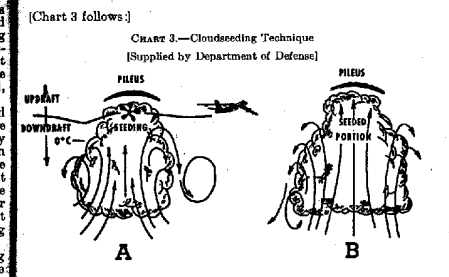
The focus of the UAE weather modification program is cloud seeding. Simply explained, cloud seeding involves aircraft spraying materials (usually silver or potassium iodide) into clouds around which water vapor will condense, growing clouds and inducing precipitation. The US military weaponized cloud seeding over Vietnam between 1967 and 1972, which they called Operation Popeye, to try to disrupt North Vietnamese logistics by extending the monsoon. Another US military weather modification project was called STORMFURY (not Epic Fury or Epstein Fury), and involved the manipulation of hurricanes (Willoughby et al. 1985).

From Department of Defense 1974, SEASIA Rainmaking. Retrieved from the soon-to-be-defunct Wayback Machine: https://web.archive.org/web/20090612231729/http://www.sunshine-project.org/enmod/popeye

The UAE program is not limited to chemical interventions. In 2021, they tried what the BBC called “cloud-busting drones”. The drones delivered electric charge to clouds to attempt to aid condensation.

Evaluations of the UAE’s extensive cloud seeding program indicate success in enhancing rainfall (Hosari et al. 2021, Wehbe et al. 2023), and the physics of cloud seeding continues to advance, including in and around the UAE. Saudi Arabia reported a successful cloud seeding in 2025 (Alzahrani and Abdelbaki 2025).

  1. Ground-based weather modification

German scientists have experimented with using lasers to create clouds – in lab conditions, but lasers aren’t the only option for ground-based weather modification. A 2009 paper by Beare et al., “Accounting for spatiotemporal variation of rainfall measurements when evaluating ground-based methods of weather modification” described a study in Australia of a system called Atlant, a ground-based ionization technology for affecting rainfall. The system’s functioning is described as follows:

“1. Initially, negative ions are generated from a high-voltage corona discharge wire array; the ions become attached to particles in the atmosphere which later act as cloud condensation nuclei; the ions are conveyed to the higher atmosphere by wind; the electric charges on these particles are transferred to cloud droplets; and the electrostatic forces on droplet interaction aid the coalescence of the cloud droplets, resulting in enhanced raindrop growth rate and ultimately increasing rainfall downwind from the Atlant ion emitter.”

Ground-based manipulation of the ionosphere through the emission of radiated power is the science of the US military’s HAARP (High Frequency Active Auroral Research Program). Emitters can add considerable energy to targeted areas of atmosphere. Ground-based ion emitters were used for cloud seeding in Oman in 2013 and 2014 in a trial reported in the Arabian Journal of Geosciences (Chambers et al. 2016).

  1. Iran’s complaints

Iraqi scholar Salam Abdulqadir Abdulrahman (2024) described cloud seeding as “problematic” because of the transnational nature of clouds and disputes over water:

“Similar to water basins, there are cloud basins or cloud lines, shared by states.

“A cloud basin starts from where the clouds form and begin their journey and all the areas they travel over to where they disperse completely. For example, the northern areas of the Middle East, except for the northern part of Turkey, share a basin. Their clouds are largely formed over the Mediterranean Sea and move eastward. They travel over Israel and Lebanon, Syria, Iraq, south of Turkey, northern Iran and some other areas. It is believed that seeding clouds in one state, the upwind, reduces the amount of rain in another state, the one downwind; i.e. part of the rain of a downwind state is seized by an upwind state. The shift of rain causes security concerns for downwind states.”

Iran thus complained in 2018: “Brigadier General Gholam Reza Jalali, head of Iran’s Civil Defence Organisation, accused Israel in a press conference in 2018 of manipulating weather and making the clouds unable to rain over Iran. He alleged that Israel had stolen Iran’s snow.”

  1. Rainfall in 2026

Two mechanisms are suggested for how a drought over Iran could be engineered through UAE-based weather modification.

  1. First, cloud seeding over UAE could indeed have deprived Iran of rainfall in proportion to the extra rainfall received by UAE.

  2. Second, if ground-based ionization can be used to encourage condensation, a similar process could be used to discourage condensation and prevent the formation of clouds.

One Iranian poster (@AcEpic69, April 15/26) speculated that THAAD radar arrays could be used to disrupt the formation of clouds over Iran. Another poster (@raminrnp, April 22/26) believes that weaponized weather modification against Iran will continue from other bases (Qatar, Bahrain), drones, HAARP emitters in the northern hemisphere, and more.

In this fourth section we have left the scientific literature and headed on to twitter. The evidentiary standard is lowered. Correlation is not causation. But the radars are destroyed, the UAE’s cloud seeding program is disrupted, and it’s raining in Iran again.

The academic racists behind Iranian monarchism

Aryan race theory is a made-in-Europe import

The war began with the US assassinating Iran’s Supreme Leader and murdering 168 schoolgirls in class.

Assassinations and attacks on schoolchildren are now a normal part of the way the US and Israel act in the world. Still, it was jarring to see online that in places like Toronto and Beverly Hills, people celebrated these murders. Even in North America, which is full of diasporas who call for the overthrow of the countries from which they came, seeing – from non-Israelis – celebrations of genocidal bombing is rare, surprising – even baffling. After all, when Israeli Jews celebrate deaths, they’re celebrating the deaths of Palestinians, Lebanese, and Iranians – never other Jewish people.

What explains these dancing monarchists? Why no solidarity for their fellow people back home?

Hasan expresses bafflement at people dancing while Iran is being bombed

There is only one answer: those dancing see themselves as racially distinct from the people being bombed. They have no more solidarity with the bombing victims in Iran than Israeli Jews have for Palestinians. How is that accomplished? The same as it is with Zionists: over generations, through school textbooks and media saturation. It turns out these dance moves have their roots in an unexpected place: dusty academic texts from a century and a half ago.

As one racist president of the Eugenics Society, JM Keynes, put it memorably a century ago: “Madmen in authority, who hear voices in the air, are distilling their frenzy from some academic scribbler of a few years back.”

To whose academic tune are these monarchists dancing? The melody of Aryan race theory, of course. Orientalist Sir William Jones, founder of the Asiatic Society in Calcutta in 1784, first coined the Aryan term. Around 1786, Jones wrote about these Aryans (1).

“… we Europeans, together with the Persians and the Hindoos, however wide may be the apparent and superficial differences between us, are, nevertheless, members of a close and common brotherhood in the great families of nations. First westward and northward, afterwards east- ward and southward, the Aryans extended…”

Jones’s contemporary, Freidrich von Schlegel in Germany, took this up, putting Germany and the Indo-Iranians together in the Aryan race in 1819: “everything, absolutely everything, is of Indian origin”, he said. To Schlegel, who coined the word ‘Aryan’ from Greek and Sanskrit words, it was the Aryan race who brought civilization to India, Egypt, and Europe (2).

From the beginning, these European racial anthropologists were as anti-Arab as they were pro-Aryan. French orientalist Ernest Renan (3) wrote in 1852:

“Imprisoned as all Semitic people are in the narrow circle of lyricism and prophetism, the inhabitants of the Arabian peninsula never had the slightest idea of what can be called science or rationalism. It is when the Persian spirit, represented by the Abbasid dynasty, vanquished the Arab spirit, that Greek philosophy penetrated Islam. Although subjugated by a Semitic religion, Persia always maintained its rights as an Indo-European nation.”

Renan believed that Arabs and Aryans were “perfectly distinct… two different species having nothing in common in the manner of thinking and feeling.”

Racism is an academic theory with many filthy contributors but one of its main founding fathers must be Arthur de Gobineau. The author of the 1855 Essay on the Inequality of Human Races taught that race was the motor of history, that all good things came from the pure white race, and that purity of race and blood were the key to everything. Gobineau wrote that Aryans were pure and unadulterated, that Jews were the chosen race and superior to all others, and that Arabs, Africans, and Asians were degenerate races. (4) As Iranian-Canadian academic Alireza Asgharzadeh describes Gobineau (5):

“Seeing racial crossbreeding as central to the decay of civilizations, Gobineau argued that civilizations mixing with peoples incapable of civilizing will be ruined eventually. In his view, “the blood” was the source of all human ability, power, intelligence, creativity, imagination, and resourcefulness. These qualities were passed on through blood from one individual to the next, and from one racial generation to another. If a race’s blood was contaminated, then the entire race and its civilization would be contaminated. Gobineau insisted that different races were innately unequal in talent, worth, and ability, and only the “white Aryan races” were capable of creating culture and civilization. The non-Aryans and “darker races” could not produce higher forms of culture and civilization; they could only borrow from the white races.”

In Gobineau’s own blood-quantum words (6):

“The white race originally possessed the monopoly of beauty, intelligence, and strength. By its union with other varieties, hybrids were created, which were beautiful without strength, strong without intelligence, or if intelligent, both weak and ugly. Further, when the quality of white blood was increased to an indefinite amount by successive infusions, and not by a single admixture, it no longer carried with it its natural advantages, and often merely increased the confusion already existing in the racial elements.”

Gobineau’s 1855 book arrived in time to inspire a Persian-flavored version of Aryan race theory from playwright Fath’ali Akhundzadeh (7). In his 1860 book, the Maktubat, Akhundzadeh argued that the Arabs are to blame for everything. He quotes a medieval-era play, Ferdowsi’s Shahnameh: “From drinking camel milk and eating lizard / The Arab’s fortune has reached the point / That he wishes for the Persian crown.”

Akhundzadeh mocked the Islamic tradition of charity, arguing that Persians should not “bear expenses of 100 or 200 tomans to go to Hajj and feed hungry Arabs.”

He mocked the foundational Shia story of martyrdom, summarizing it as: “a thousand and two hundred and something years before, ten or fifteen Arabs killed ten or fifteen other Arabs in the Kufa desert [allusion to the yearly Shi‘ite commemoration of the martyrdom of Imam Hussein ibn Ali, who was murdered in Karbala and not Kufa].”

Akhundzadeh’s most virulent hatred was always for Arabs: “The Arab tribe is unique among the tribes of the world in its capacity to weave lies and create tales, and the people of Iran are unmatched in their propensity to believe lies and tales.”

Akhundzadeh’s protege, Mirza Aqa Khan Kermani (d. 1896) built on that rotten foundation, with two books written in the 1890s, Seh makhtub and Sad khatabeh. Kermani “calls Arabs “bare-arse, savage, hungry, vagabonds.” He goes on:

“I spit on them . . . naked bandits, homeless rat-eaters . . . vilest humans, most vicious beasts . . . camel-riding thieves, black and yellow scrawny lot, animal-like and even worse than animals.”

Kermani also “affirms that “the philosophers of Europe write that we have never seen two nations more antagonistic and opposed to each other in character than [Aryan] Iranians and [Semitic] Arabs.”

His dehumanization of Arabs is so excessive that he even implies that they may deserve no less than extermination.

“If it was not for the ruthless ulama of Iran,” he warns, and their relentless praising of the Arabs, Iranians would have taken revenge over their ancestors’ blood, and they would not have spared “one single tribe of the barbarian Arabs on the face of the earth.””

Everything was fine for Aryan race theory until the 20th century, when British and German racists realized they didn’t actually want to be in the same race as Indians and Persians. So the British changed their theory, and the poor Indo-Iranian racists were left behind. As Asgharzadeh puts it (pg. 92): “This was a major blow, particularly to the overexcited Aryanist elements in places such as Iran and India who were preparing their own versions of Nazism, based on the presupposition that they were biologically related to the same “superior race” as Hitler’s Aryan race.”

In Asgharzadeh’s summary (pg. 102):

“All this discursive/ideological confusion, disharmony, and Aryanist mumbo jumbo means that notions such as the Aryan myth, the superior Aryan race, pure blood, and superior civilization were nothing more than powerful ideological/discursive tools to facilitate the desire and aspirations of certain groups for power and domination.”

Academics need infrastructure – ideally state power – to get their ideas across, from journals to university students and teachers, to textbooks and children’s education (and now, Western-sponsored Persian language satellite television, Western-run Persian language social media…) The ideas found an eager patron in Reza Shah Pahlavi, a Cossack officer who’d come to power in a coup in 1921, and the German Nazis (8) sponsored a number of journals in the 1930s to disseminate Aryan race theory. Iran-e Bastan, Iranshahr, Mehr-e Iran, Partow e-Iran, Anahita, Takht-e Jamshid, were the top journals in Iran’s literary scene. Asgharzadeh (pg. 111):

“The Nazi propaganda machine advocated the (supposedly) common Aryan ancestry of “the two Nations.” In order to further cultivate racist tendencies, in 1936, the Reich Cabinet issued a special decree exempting Iranians from the restrictions of the Nuremberg Racial Laws on the grounds that they were “pure-blooded Aryans” (Lenczowski, 1944, p. 160). In 1939, the Nazis provided Persians with what they called a German Scientific Library. The library contained over 7,500 books carefully selected “to convince Iranian readers . . . of the kinship between the National Socialist Reich and the ‘Aryan culture’ of Iran” (Lenczowski, 1944, p. 161). In various pro-Nazi publications, lectures, speeches, and ceremonies, parallels were drawn among Reza Shah, Hitler, and Mussolini to emphasize the charismatic resemblances among these leaders (Rezun, 1982, p. 29).”

Without reviewing what’s happened in the literature from the 1950s-1979, you get the idea (see my two sources, Asgharzadeh and Ebrahimi, for that history). Suffice it to say that the monarchists are the intellectual progeny of this body of work. As surely as Zionism flowed from the pens of Herzl and Jabotinsky, the Iranian monarchists Aryanism flows from the pens of Gobineau, Akhundzadeh, and Kermani. The interlocutors, the explainers, the informants for the US/Israel adventure currently upending the world order, are readers of this work and its derivatives. They see the world divided into races, they see themselves as Aryans, and they see the Iranians in Iran as impure, adulterated by Arabs.

Iran meanwhile has moved on, with a state and society that are the product of a revolution that occurred in 1979, sending their children to win medals in things like math olympiads and wrestling. The 1979 revolution affirmed everything despised by the Aryan race intellectuals: Shia Islam, justice for oppressed Arabs in Palestine, confrontation with the European masters.

Steeped in these readings and ideas, the monarchists dancing to celebrate the deaths of 168 schoolgirls and an 86-year old religious leader see themselves as purer, superior beings to those killed.

But there are no chosen peoples or superior races. Just like their Zionist masters, it turns out the people who believe they are Aryans are mere mortals like the rest of us.

Notes

  1. Alireza Ashgharzadeh. Iran and the Challenge of Diversity: Islamic Fundamentalism, Aryanist Racism, and Democratic Struggles. Pg. 85. Cites Farrar 1878 (Farrar, 1878, pp. 306–307) citing William Jones.

  2. Asgharzadeh: “In a book titled Essay on the Language and Wisdom of the Indians (1808/1849), Schlegel asserted that the Sanskrit-speaking Aryan race had brought civilization to India, Egypt, and Europe from their Himalaya homeland. In 1819, Schlegel used the term Aryan to identify this discursively emerging Indo-European race who had presumably brought culture and civilization to the world. The term Aryan had been derived from Herodotus’s Arioi and Sanskrit’s Ariya. He associated the root Ari with Ehre, the German word for honor and gave a new dimension to the rising importance of language by connecting it to racial and national issues.”

  3. Renan, quoted in Reza Zia Ebrahimi’s 2016 book, The Emergence of Iranian Nationalism: Race and the Politics of Dislocation.

  4. Quoted in Ebrahimi pg. 114.

  5. Asgharzadeh pg. 69

  6. Gobineau, 1915/1967, pp. 209–210 quoted in Asgharzadeh

  7. Akhundzadeh and Kermani are the main subjects of Ebrahimi’s book. All quotes from these two over the next paragraphs are from Ebrahimi.

  8. Asgharzadeh: “As early as 1933, the Nazis began to publish a racist journal titled Iran-e Bastan [The Ancient Iran]. The journal was financed by Siemens-Schuk-kert, and Major von Viban of the Political Department of the NADFA in Berlin handled the editorial issues. A pro-Nazi Iranian intellectual named Sheikh Abdul-Rahman Seif worked as coeditor of the journal (Blucher, 1949, p. 137)… “Iran-e Bastan played a very important role in advocating Persian racism among the Iranian elite and intellectuals. It provided a starting point for Persian nationalists to launch their chauvinistic attack on whoever they did not see as Aryan. Following the Nazi journal, all kinds of chauvinistic magazines, journals, and newspapers such as Iranshahr, Mehr-e Iran [The Love of Iran], Partow-e Iran [The Light of Iran], Anahita, Takht-e Jamshid [The Seat of Jamshid, imaginary Ancient Persian King] dominated the Persian literary scene. All these publications highlighted the past and the pre-Islamic glories of the Persian nation and blamed the supposedly “savage Arabs and Turks” for the backwardness of Iran.” (pg. 11).

After Noam

A program of reeducation

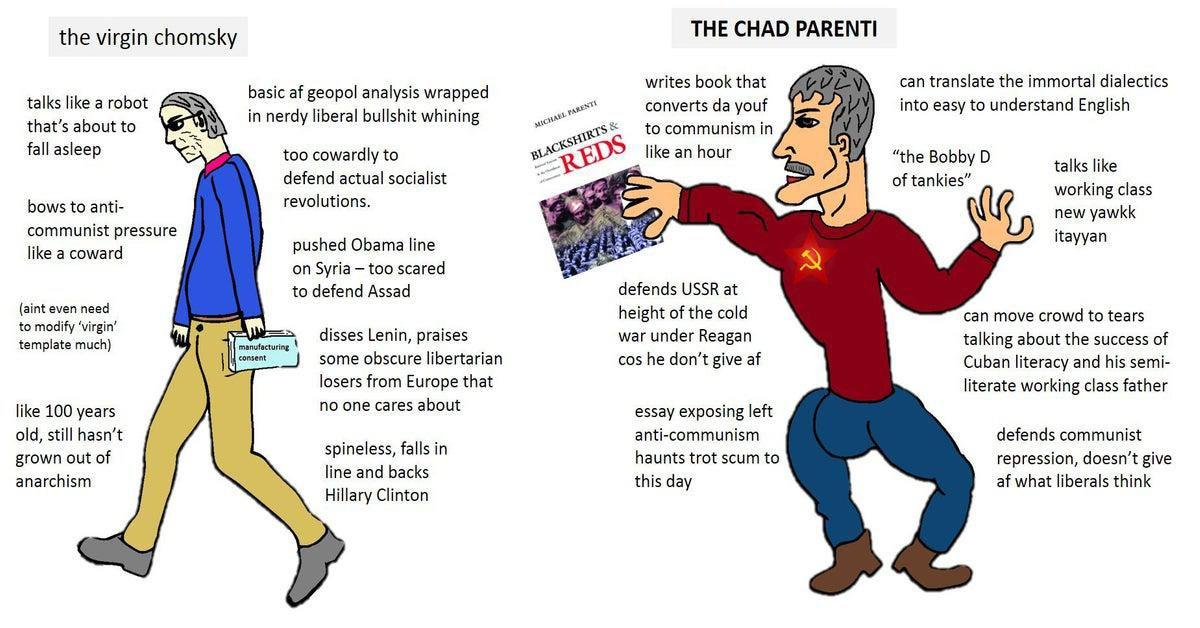
During the first few rounds of Chomsky Epstein revelations – indeed even before – I’d been seeing, from leftists on social media, various versions of the meme that Parenti was the real leftist and Chomsky, mere controlled opposition.

As the revelations rolled out, many said that they knew it all along, that they had long resented Chomsky’s anarchist / libertarian politics, the things that he said against the Bolshevik Revolution and the USSR, against “conspiracy theories”, against BDS and the right of return, in favor of the “two-state” dead end.

But Parenti wasn’t my pathway to activism. Chomsky was. I didn’t know it all along.

Discovering Chomsky

I grew up reading the Canadian daily newspaper my dad subscribed to, The Globe and Mail, every morning, for as long as I can remember, in disgust without knowing why. As a teenager, I stumbled on Eduardo Galeano’s Memory of Fire in my public library; Gandhi’s Hind Swaraj in a shopping mall bookstore. I wrote a high school history essay about Mao Zedong. I read about the life and death struggles of the revolutionaries of the past. But these people were literally leading warriors into battle. I couldn’t see a way to emulate them in my own life. About a year later I found Chomsky’s Deterring Democracy in a university library. Even after reading about revolutionaries, there was something new in that experience. It felt like the mainstream media that had been playing in the background my whole life had encased my mind in glass and Chomsky’s writing shattered the glass. I didn’t know it was possible to write like that, in that style, without the reverence and deference for American power that was an invisible part of every word and image on cable TV and newspapers at the time. I tracked down all the books I could find by Chomsky: Turning the Tide, Year 501, Culture of Terrorism, World Orders, Old and New, Towards a New Cold War, American Power and the New Mandarins. I got into Fateful Triangle and co-authored books like Manufacturing Consent and The Political Economy of Human Rights, later.

It’s only recently that I’ve been hearing people who say that Chomsky never said or did anything special. This is not my experience. To me, there was a lot he did that was special, and I’ll try to get specific about that below. But it wasn’t just what he said and how he went about the writing, but the fact that I could actually imagine trying to do what he did – not leading a guerrilla movement or a satyagraha, but working in science and then trying to make a political contribution through writing. I saw it, and I did it: I’d always liked science and been interested in history and politics and writing, and seeing that Chomsky had done it, I thought I could try to do both.

Searching for Chomsky’s name, I found ZNet on the 1990s internet. I joined their online forum community, volunteered for their website, started my political writing journey there, attended their summer school, taught at their summer school, and became friends with people who were also major political and intellectual influences on me. This became my main political engagement for more than a decade and a half. It’s hard for me to express how proud I was to be associated with Z and with Chomsky specifically. It’s difficult to put into words how much of Noam’s ideas, methods of working, teaching style, and even interpersonal and activist approaches I consciously tried to absorb. If there was such a thing as a “Chomskyite”, I was one. Maybe I still am.

An elite defector

I never had the delusion I would reach either the scientific heights or political influence that Noam did. Everyone’s capacities are different, we were from different eras, and we started in different places. These are realities of class society. In my life I’ve met people who started with fewer privileges than I have had who couldn’t get a break: getting a ride somewhere or transit fare, fixing a broken computer or getting a form printed became huge challenges. I’ve also known people for whom everything works out, who could easily do things that would never occur to me as being possible or feasible.

This is a fundamental thing I don’t think people understand about Chomsky: He’s a member of the elite who became a dissident. He was always going to have a high academic and public profile. He published his writing in elite journals. When he talks about even the most genocidal US policies with total disgust, he uses the first person “we” to describe the US – “we bombed”, “we overthrew”, “we slaughtered”. Back in 1967, when he was a decade younger than I am now, he was on a panel with Hannah Arendt and Susan Sontag – on the stage with the most prominent intellectuals of the time. Coming from where he comes from, there is something of the magician that betrays his illusionist profession to reveal how the tricks work backstage. He focuses his criticism on US imperial intellectuals, because he knows (and hates) how they think. Not, again, something that others who are not of his background could emulate.

Chomsky has argued – I took his word for it then and I disagree with him now – that US elite culture didn’t really support Israel until after the 1967 war. In his words, he was “driven out of the mainstream” over the Palestine Question around 1970, after – according to his analysis – the post-1967 consolidation of Zionism in the US. By then he was already so prominent that his being “driven out of the mainstream” helped to generate an alternative media ecosystem, with Z Magazine’s growth in the 1990s being due in significant part to the fact that they were publishing Chomsky. And not only Z.

Chomsky’s enormous standing in the US intellectual class and in the Jewish community meant that when he took up opposition to Israel, it had the effect of giving the rest of us some kind of permission to do the same. Thanks to decades of struggle by Palestinian activists, the Palestine movement has reached the maturity to follow Palestinian voices. But in the early 2000s, those of us “Palestine people” who were neither Palestinian nor Jewish, found ourselves looking to Jewish voices like Chomsky, the late Tanya Reinhart, and others, to quote [1]. When I went to occupied Palestine in 2002 with the International Solidarity Movement, it was after reading an article by Chomsky’s student Tanya Reinhart called, simply, “Stop Israel!” Thankfully, the movement is finally moving beyond the need for this and recognizing this as an issue for all humanity – for all of us Basel al Araj called “Palestinian in the broad sense” [2]. But in those years, Chomsky had a role in creating that space, at least around here. His punishment for breaking this taboo was being “driven out of the mainstream”.

The US establishment may have regretted driving Noam from the mainstream. Many decades later, they absorbed him back in.

Demystification

No one can decide where they come from nor the talents they’re born with. There’s nothing wrong with being from an elite family, especially if you become a dissident. Or a revolutionary – wasn’t Castro from a big family? Nor is that something that can be learned, or emulated. What then, are the elements of the “Chomskyism” that I am lamenting?

Reading Chomsky’s books, you’ll come across phrases like, “as any six year old would know”, “a three year old could understand”. These kinds of statements are popular in the natural sciences, when trying to distinguish between easier and harder concepts. Chomsky’s agenda was to demystify social and political affairs. He didn’t want ordinary people to be intimidated by academics or elites who claimed to rule because they were so much smarter. No, Chomsky always argued, these were things anybody could learn and do, and you didn’t need complex social theories. His scientific ideas, which I know only a little bit about, were also along these lines – that human capacities like language were the endowment of everyone.

First Principles

Another famous phrase of Chomsky’s is the “elementary moral truism”, which was that “we should judge ourselves” (“we” meaning the US) “by the same standards we judge our official enemies.” Chomsky also repeatedly referred to the “elementary moral principle” that it’s only moral to focus on things one can affect – hence, people of the US ought to focus on US crimes, which they are supposed to have responsibility for, and not the crimes of enemies, which, however awful they may be, are not your responsibility any more than lamenting the crimes of Genghis Khan is your responsibility. In 2026, it is pretty clear that ordinary people in the US have much less ability to affect foreign policy than is implied in this principle and that the crimes committed by the genocidal, pedophilic Epstein class might as well be being committed by foreign occupiers or aliens since ordinary people have zero ability to influence them. Nonetheless, Lenin also held something like this idea [3] in the lead up to WWI, arguing that instead of joining their respective ruling classes in going to war against other workers, socialists ought to take the battle to their own national ruling classes.

Like building a mathematical system, Chomsky wanted to present a small number of “elementary moral truisms” which reveal the injustice and immorality of US foreign policy. Demystifying elites is a good thing to do. Teaching that understanding politics is within the grasp of anyone is also a good thing to do. It’s possible to overdo it – if you tell a student that something they are struggling with is actually simple, it might be empowering, but it might also be disempowering. Chomsky also overreached when he claimed that Marx’s political economy was overcomplicated by a class of Marxist intellectuals. As Chomsky knew, some elements of political economy are complicated and take long and difficult study to understand. It isn’t always mystification.

Using their sources

Another “Chomskyism” is to use establishment sources to refute establishment propaganda. The most devastating critiques are delivered by quoting US and Israeli officials themselves. This was a powerful technique worth using, but it can be overused and devalue local sources and people on the ground.

The Analogical Method

In his tribute to Noam for his 95th birthday, Z Magazine publisher, 1960s antiwar activist, and former MIT student of Noam’s Michael Albert described what he thought admirable and remarkable about Noam. In terms of his work and teaching style, Chomsky was remarkable for giving time to everyone who approached him with a sincere question, answering emails all day, every day. He especially supported activists and activist groups. Michael also talks about how, in addition to reading fast and a lot and remembering a large amount of what he reads (qualities that others have, if perhaps to a lesser extent), Chomsky has a skill with employing analogies:

“He would switch from talking about the U.S. in Vietnam (then obscured by emotional preconceptions and prejudices that the U.S. could do no wrong) to the role of Russia in Eastern Europe (where an American could see invasion and imperialism more clearly). He would switch from discussing the possibility of a U.S. invasion of Afghanistan (which deeply-held axiomatic U.S. beliefs biased against recognizing since the U.S.was never the bad invader) to the possibility of Iran invading Afghanistan (easier to conceive for someone from the U.S.). He would switch from assessing the criminality of the U.S. punishing Afghanistan’s whole population for their country housing terrorists who attacked the U.S. (confused, after all, how could we be criminal) to Britain (if it had done so) punishing the U.S. for housing and financing IRA acts in Britain (easy to analyze since of course anyone else can be criminal). Or he would compare the media emphasizing 9/11 as terrorism but not seeing the U.S. embargo of Iraq as chemical and biological warfare waged on civilians. He would move from discussing U.S. media dynamics to discussing old Soviet media dynamics, or from discussing U.S. foreign policy to discussing the behavior of Mafia dons, and so on. The analogies would bypass confounding biases to reveal core features and then he would switch back to see them in more difficult to accept circumstances like scientists with thought experiments more generally.”

This, one of the trademark “Chomskyisms”, was certainly useful for breaking through propagandized thinking. Chomsky would use American hatred for Russia or Iran to stump audiences as to why they don’t have that same energy when the US is committing crimes. He compared the silence on the US-sponsored Indonesian massacres in East Timor with the wall-to-wall coverage of Khmer Rouge massacres in Cambodia. For people who didn’t like him, these analogies were the ammunition to insinuate he was an apologist for the Khmer Rouge, or for tankies, to say he hated the USSR. I believe he did sincerely oppose the USSR and in his reading of history, the Bolsheviks prevented a libertarian socialist or anarchist revolution from happening (a reading of history I don’t share, and for which Parenti’s reading in Blackshirts and Reds etc. is much better) but the point of these analogies was much more tactical and pedagogical: it was always to show that if, as you’ve been taught, you hate these actions by official enemies, you should hate these actions by the US (which he would say, “crimes that we are committing”) that much more.

Even though my first exposure to this analogical method was Chomsky, I learned later that Marx used it a century before when critiquing the British Empire’s second opium war. The British used as a pretext that the Chinese attacked their fleet as it headed to the capital where the British Ambassador wished to set up. In an 1857 article in the New York Daily, Marx asked: “Does the right of the French Embassador to reside at London, involve the right of forcing the river Thames at the head of an armed French expedition?”

The Chronological Method

Another key element of Chomsky’s method was the fact that he read the New York Times every day for many decades and was able to hold details, quotes, and historical events. He also freely read primary sources, classic texts, and archives, without any intermediation. Simply by holding on to the chronology, Chomsky was able to debate propagandized people even when they claimed to have life experience. The link is dead now, but one of the most memorable moments for me was a lecture he gave at MIT that I watched on video in 2000 (“The Current Crises in the Middle East: What Can We Do?” MIT. December 14, 2000). An angry Israeli settler in the audience told him she’d suffered under shelling from Lebanon during certain years in the 1970s. Chomsky told her there was no shelling in the relevant years and she’d been raised to believe something that wasn’t true – directly refuting someone’s claimed “lived experience”. When some new round of Israeli atrocities would happen in Palestine and Israel would claim they were retaliating, Chomsky would always show up with a chronology of the many Israeli atrocities that had preceded the current one. The lesson for me was that there is tremendous value in simply knowing what happened when.

It turns out, again, that this power was also exercised a hundred years before by Marx. During the so-called “Indian Mutiny”, Marx wrote extremely detailed military reports for newspapers and refuted British propagandists by showing they were nowhere near the atrocities they claimed to have witnessed.

Limitations

Because Chomsky did indeed read a great deal and write at least a bit about every place where the US committed crimes (which means everywhere in the world), it’s easy to miss the fact that he did, actually, specialize in a few places and times: The later stages of the Vietnam war. The Central American wars of the 1970s-1980s. Iraq from the first Gulf War onward. Israel/Palestine especially from the 1970s to the late 2000s. Even when talking about other situations, these would be the main examples he would reach for. His book Year 501, published in 1993, spends most pages on the second half of the 20th century. For the most part, when Chomsky uses history, it starts in WW2. People who liked Chomsky or disliked him may not have realized these limitations.

With Israel/Palestine in particular, not really looking at the early Zionist movement, the Balfour Declaration, the so-called Arab Revolt, and the Nakba, but starting history in 1967, leads to massive distortions. The limited window misses how the Zionists, mostly from Germany and Russia, worked with the British Empire before they went over to the US. Chomsky argued firmly that the US was in charge and Israel subordinate, and the Israel Lobby irrelevant. It’s probably time to revisit all of these views.

Too many interviews

Another limitation: Famous for answering every email, accepting every invitation, and taking every interview, Chomsky probably took too many interviews (we could call Chomsky of the interviews, Chomsky-I). Most of the “gotchas” people have about Chomsky, most of the “I knew it all alongs”, are things Chomsky said in interviews. No matter how good you are in interviews, a claim in a piece of writing that you sat and composed and edited will be of a higher standard (this includes lectures you wrote up beforehand). One writer I met because of Chomsky and Z once said something like “we’re never any better than what we write”.

Chomsky did start slowing down in the late 2000s. I think the last single-authored book that Chomsky wrote – as opposed to collections of articles or interviews – was Failed States, in 2006. I had often written to him – mostly through the Z boards but sometimes through email. I mostly stopped writing to ask him questions, not wanting to add to the burdens of someone in their 80s, whose wife had died in 2008. I can’t understand or relate to people who tried to co-author books with him when he was in his 80s and 90s.

After all, I’d read his books. I should be able to figure out what he would think of a new situation without asking – and I should definitely be able to figure out what I think.

As I became more of a “tankie”, I thought, if Noam were younger, and in these times, he’d probably be one too.

The Consent of the Governed

Chomsky’s theory of politics, explicitly stated throughout his writing, is that all elites, even the most violent, must depend to some extent on the consent of the governed. This theory is why Chomsky’s political work was so focused on attacking propaganda – for it is through propaganda, not solely force, that consent is won.

Gandhi said something similar in his time. How could hundreds of thousands of British rule hundreds of millions of Indians, he asked? Only with the cooperation of Indians themselves. Hence, for Gandhi, and for Chomsky, social struggle was about organizing the withdrawal of consent. When Chomsky himself participated in militancy, it fit this theory – organizing tax resistance against the Vietnam War. Whether seeking reform or revolution, the role of the activist was to threaten or actualize the withdrawal of consent until elites gave up what the people wanted.

It’s a compelling theory and I truly thought it was how the world worked. Chomsky counterposed (again more or less explicitly) the theory of withdrawal of the consent of the governed against what he called “Leninism”, the organization of the working class to overthrow the capitalist (bourgeoisie) through unions, the Party, and ultimately armed struggle. The theory of withdrawal of consent was also counterposed against the idea of national states using armed force to defend their sovereignty (which I think Chomsky understood to be a necessary evil).

In this sense, even if he is on record saying he was not a strict pacifist, the author of an essay praising “The Revolutionary Pacifism of AJ Muste” could be understood to be a proponent of nonviolence theory.

For my part, I have come to the conclusion that most nonviolence theory and ideology is ultimately aimed at the Palestine question and specifically at the delegitimation of Palestinian armed resistance to genocide. I have also come to the conclusion that the Palestinian experience, and specifically the 2018 Great March of Return, are as close to a controlled experiment as exists in human affairs, proving scientifically that nonviolence theory is false.

Through the genocide, the response to the encampments, and the Epstein revelations, Western elites have been open that they don’t give a shit about the consent of the governed. We are cattle to them.

I don’t want to convince or wring reforms from these genocidal pedophiles through the threat of non cooperation. I want them gone. I will be discarding this tenet of “Chomskyism”.

Chomsky-B and Chomsky-E

The Chomsky of the books (let’s call him Chomsky-B) was gone before Chomsky befriended Epstein (let’s call the post-Epstein version Chomsky-E).

From Chomsky-B, I will keep the first principles, demystification of intellectuals, the use of establishment sources for critique, the scientific outlook, the analogical method, and the chronological method. I will discard the theory of the consent of the governed and the nonviolence theory.

Chomsky-E is someone I don’t recognize, someone I never knew.

At the end of Robert Barsky’s 1997 biography, Noam Chomsky: A life of dissent, the biographer describes Chomsky in 1990 at a bar in Scotland after giving a talk to activists and unionists. There were 330 who attended the talk, and Chomsky wrote about them that many were “unemployed working class, activists of one or another sort, those considered to be ‘riff raff’, the kind of people that I like and take seriously.”

What a contrast to flying the private jet with Epstein, the photo with Epstein’s butler in Paris, the Manhattan hotel, the “lovely apartment” in New York, “fantasizing” about the Caribbean island, chatting with Ehud Barak, dinner with Woody Allen, “a great artist”. Michael Albert described Chomsky as honest to a fault, which was also my sense of Chomsky-B. What a contrast with telling journalists that his association with Epstein was “None of your business. Or anyone’s.”

Even with a sharp mind, Chomsky needed to retire, and he did. He should have retired sooner. He retired back into the elite from which he emerged, and that elite turned out to be even more vile than any of us believed.

Notes

1- One evening around 2006 or 2007 a Palestinian academic and I were giving a talk in a small room at an Ontario university. During Q/A, a member of the mostly Arab audience asked us why we hadn’t also included a Jewish speaker on our panel. This wasn’t unusual.

2- Even though the Palestine movement has plenty of quarrels with Chomsky, over BDS, the one-state solution, and the right of return, the fact that Israel/Palestine was a central focus of Chomsky’s meant that most of us found ourselves relating to and reacting to Noam more than Parenti – whose politics on the issue were good, as far as I know, but for whom it was simply not as much of a focus.

3 – With important differences since for Lenin, “we” was always socialists, whereas for Chomsky “we” was the US itself.

The Iran Insurgency

A review of the available evidence

Iran, the Sanctioned Economy

Before a military analysis of the demonstrations of January 1-15, let’s look at Iran’s economic problem and the origin of the December 28 demonstrations.

Iran faces a unique set of problems. Surrounded by US military bases, facing both the US and Israel that have stated that they want not solely its surrender but its destruction and partition, its scientists and military personnel facing assassination wherever they go in the world, its economy under one of the most severe sanctions regimes in the world with its oil and ships periodically stolen on the high seas. All the same, the people still need jobs and incomes and development.

Some Iran watchers fantasize that if Iran could convince Israel and the US of its peaceful intentions, that the West would lift the sanctions and Iran could have a normal economic life. Iranian American Virginia Tech professor Djavad Salehi-Isfahani expressed such a fantasy in a January 9 article, “The Economic Roots of Iran’s Protests”. The economist concludes: “Iran’s government cannot credibly promise to stabilize exchange rates or tame inflation any time soon. The one move that could offer relatively quick economic relief – and to which the government could credibly commit – is a cessation of hostilities with Israel and the US.” Leaving aside the moral bankruptcy of normalizing with genocidal Israel as a means of sanctions relief, the absurdity of thinking that a unilateral cessation of hostilities from the Iranian side would be met with anything but increased violence from the US and Israel should be apparent to anyone that has been awake for any amount of time in the past several decades (never mind since 2023). Salehi-Isfahani’s prescriptions – predictably for a mainstream US-based economist – are for “free-market” remedies: basically, letting the Iranian currency float. Like all neoliberal cures, this remedy would be fatal for the patient (which could be why the US prescribes it to its enemies). Netherlands-based economist Kayhan Valadbaygi argues that Iran has built a “welfare-warfare state”, but the problem is that it has done so “without a firm economic basis to maintain it.”

Many Iranian policy makers were educated in these US schools of economics and believe that if they can play by Western rules they can get sanctions lifted and enter a free market utopia. But as Nahid Poresa told Max Blumenthal of the Grayzone in an interview on January 22, a more realistic approach would be to accept the sanctions as a permanent fact of life instead of having false hope that they would be lifted, and commit fully to a “look east” economic policy with Russian and Chinese (also sanctioned) partners. To, instead of accepting the de facto dollarization of the Iranian economy, use the local currency to run the national economy and limit foreign exchange through capital controls. Iran already does many of these things: its multiple-exchange rate system is an evolution based on the sanctions situation. Industries have built a certain resilience in spite of – or perhaps because of – the sanctions regime which effectively shielded local industries from exposure to competitors. There is a barter trade with neighbours. There are subsidies for gasoline and bread. The Pezeshkian government’s challenge to these latter policies and the threat to cut some of these subsidies and to unify the exchange rate system – these are what led to the collapse of the currency and to the December 28th protests. Western-based economists looking at Iran argue the exact opposite: that the neoliberal reforms are the one good thing the Iranian government wants to do, and that the heterodox adaptations that have enabled people to survive the sanctions are deviations from orthodoxy that need to be removed. Like Israel and the US, these economists are trying to kill Iran.

Why would Iranian economic and political leaders go along with this? Financialization is the fashion and Iran’s banking system is growing more complex with a greater role for private banking and therefore opportunities for truly magical profits, as one Tasnim article from November argues (I read an auto-translation). A harsher assessment is provided by sociologist Yousef Abazari, who laments the naivete of Iran’s economic policy makers who don’t understand that economics isn’t science, that there are very different schools of thought in the field, and that the economics “experts” at the helm of Iran’s economy have the same fatal prescriptions that the Americans want – austerity, misery and oligarchy. Abazari asks sardonically, what’s the point of resisting America if Iran implements the same economic policies on its people? Iran has been attacked by many Western weapons, but among the worst weapons seems to be giving a Western economics education to many of Iran’s leaders.

Still, the most orthodox free-marketeers will turn to things like rationing, planning, barter, and capital controls as a matter of survival. Iran’s policies of solidarity with others in similar situations like Venezuela expose people to a diversity of methods for dealing with economic warfare. What most free-market oriented Iranian officials and Western Iran watchers agree on is that neoliberal austerity is the right direction, which is why it doesn’t come up as a subject of debate. It is the wrong direction.

Iran also needs a tech stack like China has to replace Instagram, WhatsApp, etc. so that people aren’t using US tech companies obsessed with their overthrow and assassination to communicate with one another. Iran has several allies that aren’t bent on its destruction and is full of educated scientists and engineers who make things work and can take the reins away from the Chicago boys. Iran could get out of this one yet.

The economic and university protests

On December 28, facing the end of the multiple exchange-rate system that immediately tanked the value of the local currency, economically motivated protests began against the loss of their purchasing power and a proposed austerity budget. There were more protests the following day and on December 30th, including at universities, where students also protested for their right to protest.

The Iranian president and other officials stated that they would change some of the proposed policies and look at better solutions to the economic problems.

That is the end of the economics discussion and of the economics protest. Beginning January 1, the nature of the protests changed.

January 1-15: A review of NYT and WaPo coverage

I reviewed the main news articles in the New York Times and the Washington Post on the protests from December 30 through to January 15. I was looking in particular at events described and the sourcing of the claims. NYT and WaPo are outlets that are against the Iranian government and in favor of US and Israeli policy towards Iran (regime change, destruction of the state, partition, etc.) I also reviewed all of the videos and comments posted by the pro-Iran aggregator @AryJeay on twitter, “Fotros Resistance” on telegram. I took screenshots of each important video and saved important text from the articles as a slight hedge against the impermanence of the internet.

There is little different between NYT and WaPo coverage in terms of politics, depth, or sourcing. None seem to have reporters present in Iran and bylines are from Beirut, Istanbul, or Jerusalem. Sourcing is often to “according to videos posted on social media”, which is a cheap way of covering world events. Both NYT and WaPo also quoted (if somewhat mockingly) Iranian news outlets such as Tasnim and Fars. There are also interviews with pseudonymous people who tell their ordinary stories of what they’ve seen, with last names not provided. Finally, for the all-important casualty numbers, US- and German-based human rights organizations are cited. The most frequently cited is HRANA, the Human Rights Activists News Agency. Alan MacLeod of MintPress news reported that the Fairfax, Virginia based organization received $900,000 in funding from the United States’s National Endowment for Democracy in 2024 alone. Also frequently cited is the Abdorrahman Boroumand Center for Human Rights in Iran (ABCHRI), also funded by NED, and the Center for Human Rights in Iran, also funded by NED.

On January 1, the NYT cited “footage circulating on social media” to describe protesters pulling a gate open in Fasa, chanting “death to the dictator” in Hamedan, closing their stores in Tehran chanting “don’t be afraid, we’re all together”. NYT supplemented their “videos showed” with an interview with “Yaser”, who saw protesting shopkeepers first hand at a bazaar in Tehran. On January 2, NYT stated that a 21-year old Basij militia member had been killed – the first casualty, on the government side, which the NYT sourced to Iranian government news agency Tasnim. On January 3, the NYT led with Trump’s Truth Social post: “If Iran violently kills peaceful protesters, which is their custom, the United States of America will come to their rescue. We are locked and loaded and ready to go.” NYT also cited Israel’s minister of innovation, Gila Gamliel, who posted to X, “Israel is with you, and we support you in every way possible.”

On January 4-5, coverage was dominated by the US raid on Venezuela and kidnapping of its president and first lady.

On January 6, the NYT reported that things had calmed down, and was reproducing Iranian news outlets describing the organization and violence of the protests of the previous day, mentioning “videos on social media” showing protesters firing assault rifles into the air while chanting “Death to Khamenei”. “But in Tehran, with the exception of the bazaar downtown, the university campus, and a few working-class neighborhoods, the city seemed normal, residents said in interviews and videos on social media suggested. Ski resorts north of Tehran were packed with affluent day trippers.”

But Reza Pahlavi made a call and an op-ed on January 6, calling people to overthrow the regime and calling on the US to intervene.

The peak days of the campaign were January 8 and 9, covered in the NYT on the 9th and 10th. On the 9th, the NYT was estimating 27-36 had been killed up to the 8th; also, citing NetBlocks, NYT noted that the internet in Iran had been shut down on the 8th. Notably, NYT cites no organization, no manifesto, no political demands, no slogans, no placards. Here is their description of the protests on the January 8th:

In telephone interviews, more than a dozen witnesses said that they saw large crowds forming on Thursday night in neighborhoods across Tehran, the capital, and in cities around Iran, including Mashhad, Bushehr, Shiraz and Isfahan. They said the crowds were diverse, with men and women, young and old. The people interviewed inside Iran asked that their names not be published out of fear of retribution.

One resident of Tehran said that the crowds were chanting, ‘’Death to Khamenei,’‘ referring to Iran’s supreme leader, Ayatollah Ali Khamenei, and ‘’freedom, freedom.’‘ The chants could be heard from several blocks away in the affluent neighborhood of Shahrak Gharb in Tehran, which had until now sat out the protests.

Videos filmed on Thursday night showed government buildings on fire across the country, including in Tehran, as protests grew. While the protests were mostly peaceful early in the evening, violence broke out later in the night in Tehran, with demonstrators setting fire to cars, buildings and items in the street. A video verified by The New York Times shows fires in the streets of Kaj Square in the capital, with thousands of protesters flooding the area.

In Karaj, a suburb west of Tehran, a video verified by The Times showed protesters fleeing after gunshots were fired, though it is unclear from the videos whether it was security forces firing.

On January 10, citing HRANA and others, NYT said deaths were in the “dozens” (up to January 9th).

After January 11, NYT depends increasingly on “Videos shared” as their primary source. On the 11th, notably, the highest estimate printed for numbers killed was 65 protesters. The Washington Post ran an op-ed by Reza Pahlavi stating that he was ready for a transition.

As the protests died down, the casualty numbers leapt. On January 12, WaPo cited a HRANA figure of 490 protesters killed. They backed this up with “A senior Western official who was briefed on the matter”, who “said hundreds were killed”. The official “spoke on the condition of anonymity because he was not authorized to brief the media” (!) On January 14, WaPo came back with a HRANA figure of 2,000 killed, an anonymous source speaking from the suburbs calling it a “full-on war” but who couldn’t see properly because she “didn’t have my glasses or contact lenses”. On January 15, WaPo came back citing Bari Weiss’s CBS in an editorial by Marc Thiessen, “There is no US downside to striking the Iranian regime”, with new casualty figures of 12,000 and potentially as many as 20,000. Diminutive German-Iranian lobbyist for Reza Pahlavi, Amir Parasta, gave a figure of 30,304. Parasta also tweeted offering Iran’s assets to Turkey, and of course praising Reza Pahlavi.

January 1-15: A review of the videos

In order to fill out their pseudonymous interviews, NYT and WaPo freely cited Iranian news agencies. In the same period, pseudonymous pro-Iran social media account AryJeay / Fotros Resistance aggregated a comprehensive set of videos from Iranian news, cellphones, and CCTV footage. One aggregator, IntelonIran, estimated a peak of 11,000 demonstrators on the streets on the night of January 8, before the internet was shut down. According to this source, 11,000 was the highest number of people on the streets. The economic protests were long ended and the violent riots had been ongoing for a week, so it is safe to assume all 11,000 of these were people working for regime change.

The five ways of attack

Rather than repeat a chronology, I will compile the five different kinds of attacks that appear in these videos. I made a rough map of the locations of the attacks as well.

  1. The Jump. A crowd jumps a single bystander or security, beats him and/or burns his vehicle

January 1, location unspecified, rioters throw rocks at the home and burn the car.

Hamedan, January 1, rioters jump a security guard and beat him down (CCTV).

January 2, location unspecified. Shop owner, Ali Azizi, killed by 6 rioters.

January 2, Qom. Rioter sets a shop on fire.

January 4. Hamedan. Rioters jump a police officer and beat him.

January 5, Isfahan. 2 rioters jump a police officer and beat him with an iron bar. Cellphone footage.

January 7. Colonel Shahin Dehghan, Malard County near Tehran, stabbed to death.

January 7, Kermahshah. Rioters kick a man on the ground with his pants pulled down: this is a standard procedure, pull their pants down and then beat and kick them on the ground.

January 8, location unspecified, rioters jump a man and kick and beat him.

January 8, Ahvaz City. CCTV footage of a group of rioters overpowering an elderly man, beating him, and burning his car.

January 8, Noorabad County, Lorestan. Cellphone footage of rioters destroying a car.

January 9, Gohardasht, Karaj. Group of rioters jump a man and beat him. Cellphone footage.

January 9, Tehran. CCTV footage of armed rioters attacking a police officer.

  1. The attack on first responders. Rioters attack ambulances, fire, buses or emergency response vehicles

January 2, Tehran. Rioters attack an ambulance.

Between January 6-9, rioters burned several Red Crescent centers throughout Iran.

January 9, Mashhad. An Iranian firefighter burned to death.

January 9, Mobarakeh, Isfahan. Photo of a torched fire truck.

January 9: authorities report 15 buses burned on January 8-9, 600 signs and railings, and the Metro stormed in Mashhad.

January 9: authorities report 50 fire trucks nationwide – a fire station in Mashhad, 15 vehicle in Isfahan, 5 in Ahvaz, a fire station in Shiraz, and the Red Crescent Building in Izeh, all attacked over Jan 8-9.

January 10, rioters attack and burn a bus in Isfahan. CCTV footage.

January 10. Rioters burn several buses in Mashhad.

  1. Gun battles. A street gun battle between rioters and law enforcement

Kudasht, December 31. 13 officers injured, 20 armed rioters arrested, 1 police officer burned, one Basiji (22 years old Amir Hesam Khodayari-Fard) killed.

January 3, location unspecified. Cell phone footage of a rioter using a flamethrower against a police motorcycle convoy.

January 5. Yasuj. Armed rioter shoots at bypassers and security.

January 5. Koushk. Armed rioters attack a pro-government march.

January 6. Tehran. Clash between police and rioters in front of Sina hospital. Both sides claim the other threw tear gas on the street.

January 7, Charmahal, Bakhtiari. Close up footage of a masked rioter with a keffiyah covering his face and baseball cap shouting Marg Bar Khamenei and shooting off-frame with a shotgun.

January 8, location unspecified. Shooters ambush a police motorcycle convoy, shooting them as they drive by.

January 8, Kermanshah. Nightvision camera / CCTV captures shooters shooting (but not what they’re shooting).

January 8, Hamedan. Rioters kill a police major, Mohammed Javed Bakshian and 6 civilians. A news item on the aftermath shows destroyed buildings and some CCTV footage of the riots.

January 9, Tabarsi Boulevard, Mashhad. Rioting leads to deaths, including security forces’ Mostafa Abufazeli.

January 9, 8:50pm. Shushtar videos of rifle man and shotgun man, and of a female rioter with a machete.

January 10. Police claim to have killed 1 rioter in a firefight in Mashhad.

January 10. Police claim to have killed 1 and arrested 6 rioters in Ilam.

  1. Attacks on buildings or on people. Rioters shoot or throw Molotov Cocktails at public or private buildings or at security personnel or other people

Arak, December 31 night time, cellphone video.

January 3, Zahedan. Masked rioters loot a grocery store. CCTV footage.

January 6. Abdanan. Protesters loot a supermarket, Ofogh Kourosh, dump all the rice in the street, and take selfies (does this remind you of anything?)

January 7. Location unspecified. Rioters burn down a religious bookstore.

January 8, burning of a Basij seminary. Location unspecified.

January 8, Alireza, 17, shot and killed.

January 8, 2-year old Bahareh, shot in Shahid Beheshti street in Nishapur, died January 15.

January 8, 3-year old Melina in Kermanshah, going to a pharmacy with her parents shot by armed rioters.

January 8, location unspecified. CCTV footage of rioters vandalizing a bank.

January 8, rioters burn the shrine of Sabzeqaba, CCTV footage from various cameras.

January 8, rioters burn the Shahid Montazeri mosque in Shushtar.

January 8, 15th Khordad Square in Shushtar, rioters attack a passerby on a truck.

January 8, Ardebil. Phone video of armed masked rioters attacking a grocery store and a Sepah bank.

January 8, Ilam Province, village of Lumar. Rioters attack the Keshavarzi bank. Cellphone footage.

January 9, Mahdieh Mosque in Karaj. Rioters burn the mosque and Qurans in the mosque. Whose operating procedure is that?

January 9, Sabzevar, Khorasan. CCTV footage shows a Molotov attack on a civilian house.

January 9, Mobarakeh, Isfahan. Torched a grocery store, totally burned.

January 9, Sabzevar, Khorasan. CCTV of children running from a Molotov attack.

January 9, Gorgan, Golestan. Several shops and other areas torched.

January 9, location unspecified. Rioter throwing a Molotov at a civilian home.

  1. Attacks on state symbols. Rioters attack a governor’s office or police station.

Fasa City governor’s office December 31. Cellphone video.

Azna, Lorestan, January 1. Several police vehicles set on fire, 3 killed, 7 injured.

January 1, 9am. Lordegan Governor’s office. Masked rioters throw stones and shoot at police.

January 2, Police Station 11 Marvdasht (Fars Province), rioters try to seize the station and are scattered when police fire into the air.

January 3, Tabriz. Rioter uses Molotovs to try to set the Tabriz Chamber of Builds building on fire. Cellphone footage.

January 4. Malekshahi, Ilam Province. Rioters attempt to storm a Basij outpost and are scattered when police fire into the air.

January 8, 200 rioters with molotov cocktails attack the residence of Salam al-Zawawi, the Palestinian Ambassador. Who would want to attack the Palestinian Ambassador in particular?

January 8, attack on police station 126, Tehranpars. Police and Basij were killed.

No politics, organized on the internet

AryJeay commented: “In this year’s riots, we see no prior statements, organized gatherings, formal protests, or specific pre-announced locations. Suddenly, a group pours into the streets and riots in specific locations that are close to sensitive, infrastructural, vital, and security-military sites. They then steer the riot toward these locations in order to gain access to firearms and ammunition.”

Rioters always dressed in black and were masked. They moved around at night with confidence and fluidly knew how to burn motorcycles, take the rods off of street signs, wield machetes and swords, and use shotguns and rifles.

In confessions shown on Iranian TV, arrested rioters say they were recruited based on their online behavior and what kinds of posts they “liked”, then messaged and organized and trained via Telegram and WhatsApp, paid specific rates based on what kinds of attacks they could prove they did (using video evidence), and some were ultimately told they were of no value and shot by their handlers. “They had precise intelligence of coordination with separatists and terrorists on the part of US and Israel. “They even planned for each separated region to draft its own constitution, and they directed arms smuggling, as well as financial & logistical support.” The rates are around $6000 for killing people, $2375 for burning each vehicle, $850 for burning police stations, $175 for any other disruption.”

Other arrested rioters told news agencies that they felt they had been set up to die in fires, sent up into buildings to set fires only to find their planned exit blocked. Iranian authorities called this “project killings”, in which riot organizers killed other rioters with the intent of blaming the state for the deaths.

One arrested rioter said: “The same person who called for the unrest attacked me, and after some time passed, he shot me and said, ‘You’re no longer of any use.’” Team leaders pursued manufacturing deaths and provoking public emotions by killing their own operatives and rioters with close-range shots to the head.”

By January 10, likely due to the internet shutdown on the 8-9, the tide had turned and on January 12, there were massive demonstrations in support of the government (there had been these all along, including mass funerals, but this was the largest culmination).

Iran also jammed the Starlink network and reported arrests and unraveling of networks, safe houses, and seizure of massive numbers of weapons over the following days, before finally restoring internet connectivity more than a week later.

The Iranian medical authorities gave the following summary of all damage: 184 ambulances attacked and damaged. 6 completely destroyed and burned. Directly hit with bullets in Teheran. Molotov cocktail attack on an ambulance in Rafsanjan while on active mission. 54 injured. 4 hospitals attacked.

AryJeay gave the following roundup of property damage: 250 mosques damaged. 20 religious centers. Imamanieh mosque in Golestan province. Hundreds of vehicles burned in Teheran. 364 large stores. 419 small stores. Damage reported across 30 provinces. $5.3 million in fire department vehicles. $14 million in bank damages. 317 bank branches destroyed. 4700 bank branches damaged. 1400 ATMs damaged. 250 ATMs permanently out of service. $6.6 million in damages to electricity sector. 265 schools damaged. 3 libraries set on fire. 8 cultural heritage sites damaged. 4 cinemas (Tehran, Nishapur, Boruejd, Shahin Shahr).

Ayatollah Khamenei explained in a speech the state’s theory of how the riots had unfolded: ‘one group of individuals carefully selected, identified, and trained abroad. Others, malicious elements and criminals. And others, naive teenagers: “These are the foot soldiers. Their mission is to go and attack a place, like a police station, a house, an office, a bank, an industrial center, an electricity facility. That is their mission. The ringleaders gather in groups of 10, 20, or 50 people each, guide them, and tell them: You must go here, do this, and commit crimes, and they do.”’

The final Iranian government tally of those killed in the insurgency was over 3,000. AryJeay estimates ⅔ of these were pro-government security forces and civilians, and ⅓ were rioters. This is higher than the 1,000+ Iranians killed in the 12-day war with Israel and the US in 2025.

What was this? A military analysis

The US and Israel were open about Mossad’s support for the rioters and for their goal, the destruction of the Iranian state. Mike Pompeo tweeted “happy new year to the protesters and to Mossad walking beside them.” Mossad told protesters “we are with you, in the field.” Trump posted to protesters that help was on the way, and as the riots unfolded – attacking groceries, emergency responders, government buildings, mosques, and random people on the street to sow insecurity and terror – a US armada approached Iran. As that armada approached, the US-backed regime in Syria made a final push in the Northeast to reach the Iraq border, releasing thousands of Islamic State prisoners.

The riots may have been envisioned to have achieved more than they did – and they might have done, had the state not shut down the internet and starlink – causing the state to approach collapse just in time for a US invasion to finish Iran off.

The state didn’t collapse, but the war may be coming regardless.

Migration from Venezuela

Did 7+ million really leave the country to flee socialism?

Daniel Coronel, a journalist with the US-based television network Univision, recently interviewed Colombian president Gustavo Petro. At about the 55 minute point of the interview, Coronel said to Petro that “the misery and repression that Venezuela has suffered at the hands of Maduro’s dictatorship has caused millions to flee.”

This little quip, this off-hand remark, is actually one of the major remaining regime change talking points about Venezuela.

We’ve addressed most of the others – the elections, the constitution, the notion that Venezuela is an “extraordinary threat” to the US – in our book. In a recent substack, we addressed the newest lie: that Venezuela is a meaningful source of drugs to the US.

In this one we address the idea that Venezuela should be destroyed because supposedly seven million Venezuelans have fled socialism.

We believe that anti-Maduro sources have 1. grossly exaggerated the scale of migration from Venezuela since 2015, 2. ignored that US sanctions have caused such migration as did occur, and 3. also ignored mass migration from U.S. client states like Ecuador.

Is this true though?

Pre-2015 lies about the scale and causes of Venezuelan migration

By the time Chavez died in 2013, Venezuela’s GDP per capita was close to achieving the historical peak it reached in 1977, After reaching that peak in 1977, Venezuela went through decades of ruinous decline. By 1992, the New York Times reported that “only 57% of Venezuelans are able to afford more than one meal a day.” But migration from Venezuela, compared to other Latin American countries, was never very significant despite this disaster. Despite outlandish claims in anti-Chavez media, emigration was still not significant while Chavez was in office, enacting policies to enable Venezuela’s recovery from the post-1977 decline.

In 2011, the Venezuelan newspaper El Universal erroneously reported a World Bank figure for the total number of Venezuelan-born people living anywhere else in the world as of 2010 (521,000) – a figure that included people who had left Venezuela in any year – as the total number of Venezuelans who left in 2010 alone.

In 2015, Reuters uncritically cited an anti-Chavez academic (Tomas Paez) who claimed that 1.5 million Venezuelans had left Venezuela since Chavez took office in 1999 – in other words that about 100,000 Venezuelans per year had left between 1999 – 2015. World bank figures at the time suggested about 25,000 Venezuelans per year left Venezuela during most of that period, about one quarter the number Reuters had uncritically accepted from Paez, and one twentieth the number El Universal had reported in 2011. [1]

TABLE 1

2015 – 2017 migration from Venezuela begins to take off for real

As a result of US sanctions and an oil price collapse, migration from Venezuela did, indeed, begin to explode in 2015.

A few months before Hugo Chavez died of cancer in 2013, he urged his supporters to vote for Nicolas Maduro as his successor. They did. Maduro won the snap election that was held in April 2013. But Maduro was immediately hit with violent US-backed protests that year – and then again in 2014 and 2017. Adding to Maduro’s difficulties, in the last quarter of 2014, the high oil prices on which Venezuela’s economy depended collapsed by half, and remained very low for years.

Early in 2015, Obama added to the pressure by imposing broad economic sanctions on Venezuela. Obama’s apologists deny the significance of the sanctions by saying they merely outlawed dealing with seven Venezuelan government officials that the US accused of human rights abuses. But this ignores the problem of “over compliance” with US sanctions, built into their design: scaring investors away from dealing with Venezuela at all. In addition to the sanctions, Obama officials successfully pressured banks not to make low risk loans to Venezuela’s government.

The combined impact of collapsed oil prices and Obama’s malevolence did indeed cause a sharp increase in migration. One way to confirm that migration from Venezuela did indeed begin to take off is to look at the number of Venezuelans arriving only in the US. If the U.S. had some powerful political incentive to do so, it would certainly exaggerate the number of Venezuelan migrants in the United States, but it has no need to do that. Even with the very low numbers of Venezuelan migrants – receiving only 7% of the migration that has been claimed since 2015 – it has treated them in an astoundingly cruel and lawless manner. According to Pew Research, as of 2024, Venezuelans were still only the ninth largest Latino group living in the United States despite the rapid growth in its population in recent years.

According to Pew Research, Venezuelan migration to the USA averaged 7,000 people per year between 2000 to 2013. It increased to 28,000 per year by 2015; then to about 44,000 per year in the 2015-2020 period. [2] Trump caused migration to accelerate when he dramatically intensified US sanctions on Venezuela in August of 2017, and then again in 2018, 2019 and 2020.[3]

TABLE 2:

A suspiciously low level of Venezuelan migration to the US

Today, UN Population Division data claims that 7.6 million people have left Venezuela since 2015. If that were accurate then one should expect to see a vastly higher number of Venezuelan migrants in the US. As of 2021, the UN Population Division claimed that over 5 million had left Venezuela since 2015. But as of 2021 (see below) the number of Venezuelan migrants in the US remained lower than from other Latin American countries that have much smaller populations than Venezuela: El Salvador, Guatemala, Dominican Republic, and Honduras.

In the case of Ecuador, which has roughly half Venezuela’s population, its migrant population in the US was very close to Venezuela’s in 2021. During the 1990s and early 2000s, migration from Ecuador to the US skyrocketed. As shown in Table 3, between 2013 – 2021 migration slowed tremendously., But as of 2024, Ecuador, which has been under disastrous pro-US rightwing rule since 2017 (as it was during the 1990s and early 2000s) provides the second largest growing Latino migrant community in the US after Venezuela according to Pew Research.[4]

Table 3

Reliable data collection and collaboration with the Lima Group don’t mix

As of 2020, the UN Population Division had been reporting that just under 2 million Venezuelans had migrated from 2015 – 2019, about half the figure other UN agencies were reporting. The much higher figures were the ones widely amplified by western media. But the UN Population Division dramatically revised its numbers upward around the time of a conference that took place in Ottawa on June 17, 2021. The conference was held to raise money for Venezuelan migrants and refugees. It was hosted by the Canadian government “in collaboration with” the UNHCR, the UN Refugee Agency, and the International Organization for Migration” .

In 2017, the Canadian government spearheaded the formation of the “Lima Group”. Canada recruited rightwing Latin American governments into this group which had the explicit aim of overthrowing Maduro – “reporting democracy in Venezuela” as they put it. After 2019, the Lima Group recognized the US-appointed Juan Guaido as the interim president of Venezuela. The Lima Group was joined by Bolivia in 2020 while the country was run by the US-backed fascist dictator, Jeanine Áñez.

We should not have to explain how damning it is that various UN agencies that provide data on migration from Venezuela were openly collaborating with the Lima Group. Moreover, as Venezuelan researchers with SURES have pointed out, increased estimates of Venezuelan migrants leads to increased budgets for UN agencies and NGOs who work with them. As one of us (Emersberger) observed, other UN agencies, including UNICEF, have made extremely dubious revisions to historical data that appear motivated by a desire to bolster US propaganda.

Ignored Estimates, and trends that would have emptied Venezuela by now

The surveys done by anti-Maduro Venezuelan academics (ENCOVI surveys) suggest about 2.3 million people left Venezuela between 2015 to 2019. (Data in Table 4 below is taken from ENCOVI surveys here and here.) [5] That’s very similar to what the UN Population Division estimated before it drastically revised its data upwards.

Table 4: ENCOVI Estimates

In a February 2019 interview with the BBC, President Maduro gave an estimate of “no more than” 800,000 Venezuelans who had migrated in the previous two years (2017 and 2018).[6] That’s not far off what ENCOVI estimated.

Anti-Maduro Venezuelan economist Francisco Rodriguez noted in a 2024 paper that Venezuela’s economy has been in recovery since 2020 posting four straight years of positive economic growth despite U.S. sanctions. Rodriguez observed that UN agencies have documented a big reduction in the rate of migration from Venezuela since 2020. But their estimates were so high from the 2015-2018 period that they had to come way down regardless of any economic recovery. At the rate the UN Population Division claims Venezuelan migration was accelerating between 2015 to 2018, Venezuela would have been completely empty by 2023 had the trend continued.[7] Despite this, all accounts confirm that there are indeed Venezuelans still in Venezuela.

Despite this, all accounts confirm that there are indeed Venezuelans still in Venezuela.

A Venezuelan researcher explained to us the various problems with double counting that can occur, setting aside deliberate manipulation of the data (which we believe occurred). She told us that a large number of Venezuelans returned during the COVID pandemic – often through uncontrolled points (trochas). People often returned then migrated again creating one possibility for double counting. It is not clear how many people work in border areas near Colombia but actually continue to reside in Venezuela, or get counted as residing in Colombia despite having moved to another country.

We do not deny that there has been a massive and unprecedented amount of migration from Venezuela since 2015, but we do not believe the numbers cited in western media. No one should blindly accept claims made by UN agencies and NGOs that have a track record of serving US imperialism – especially when Washington ramps up the pressure on an official enemy.

NOTES:

[1] The data in Table 1 can be found here, here, here and here.

[2] The data in Table 2 can be found here, here and here

[3] Table 1 of this paper by Venezuelan economist Francisco Rodriguez provides a timeline of US sanctions on Venezuela.

[4] 2021 is the most recent year for which we could find data for Latino groups in the US broken down into “US born” and “foreign born” (migrants).

[5] The 2017 Ecovi study found 815,000 emigrated between 2012 to 2017 of which 11.5%, 38.5% and 40.3% emigrated in 2015, 2016 and 2017 respectively. The figures were then updated to 2019.

[6] See the 3 minute mark of the video

[7] Rodriguez provides annual UN Population Division migration data in his paper. Using this curve fit website, we fit a second order polynomial through the data points for 2016, 2017 and 2018 to establish a trend line. We then projected that trend into future years. By 2023, 29 million Venezuelans would have migrated. The World Bank estimates Venezuela current population as 28.4 million

India 1919 and Gaza 2023

Uncanny colonial patterns

I’ve been doing research for the historical podcast and we’ve reached a moment that I’ve always wanted to know more about, when the British massacred a thousand trapped people in a walled garden over 10 minutes of continuous shooting into an unarmed crowd of tens of thousands of people on April 13, 1919 in Jallianwalla Bagh, Amritsar. There’s a really good 2019 book about it by scholar Anita Anand, called The Patient Assassin: A True Tale of Massacre, Revenge, and the Raj.

Anand includes a lot of details about the massacre itself, about the British genociders who conducted it and the stories they told about their racial superiority and the need to teach the natives a lesson. Even though I’m always reading these colonial histories, I often forget how directly the Israeli genocide playbook is a copy of the Anglo-American genocide playbook.

All these quotes are from Anand’s book.

Psychological disorder: obsession with the colonized

Here’s a silk merchant, Thomas Cope, talking about a British-induced famine in India that killed a million people in 1840:

‘I certainly pity the East Indian labourer, but at the same time I have a greater feeling for my family than for the East Indian labourer’s family. I think it is wrong to sacrifice the comforts of my family for the sake of the East Indian labourer because his condition happens to be worse than mine.’

Indian revolutionaries worked underground in different parts of the world under the obsessive surveillance and control of the British. The psychology of the British – their simultaneous obsession with Indians and their insistence of their own superiority – was striking. Their obsessive pursuit of the Indian revolutionaries and their constant denigration of Indian people, combined with insistence that they keep India forever and that they were making it better, seems uniquely pathological and unhinged – until you notice the Israelis have the exact same mentality today. Look at Michael O’Dwyer, the lieutenant governor who ordered the massacre and who was shot dead 21 years later by an Indian revolutionary named Udham Singh, just after finishing a public lecture justifying the slaughter, exhibiting all these obsessions in a single paragraph op-ed in the Times:

“The British Empire in India is the greatest achievement of our race. It has been built up by the blood, the brains and the energy of our ancestors. During 150 years it has given peace, security, increasing well-being and honest administration of a medley of hostile races, conflicting creeds and jarring casts who had never, but for a few brief periods, known those conditions before. WHAT IS INDIA? Not a Country but a Continent. Not a Nation, but a Noah’s ark of races religions and tongues. INDIA NEVER HAD – Unity, security, peace, justice, communications, public health – until the British came.”

Atrocity propaganda to teach a lesson

The genocidal British commander Rex Dyer didn’t stop at the massacre. He ordered public floggings of children and aerial massacres of villagers. A story circulated that after the massacre, mobs in Amritsar had assaulted a white woman named “Miss Sherwood”. Dyer said he “visited Miss Sherwood” and then decided to commit these additional atrocities, including the “crawling order”, where any Indian who lived on the street where “Sherwood” had been assaulted, would have to crawl on their bellies the entire way to their house, being kicked and brutalized by white soldiers the whole way.

remind you of anything?

Beastly behavior supposedly justified by the need to punish assaults against white women. The same playbook that the Israelis have used to rationalize the ongoing genocide.

“In Amritsar, Rex Dyer and his men remained busy. They erected large wooden triangles around the city – ‘flogging triangles’, which struck fear into the heart of the civilian population. Though only six people were flogged in public (twenty others were whipped in camera), the incidents were so horrifying that entire neighbourhoods were left traumatised.

“Wrists tied to the apex, legs splayed and fastened to the base, the six young men suspected of taking part in the brutal attack on Miss Sherwood were given summary punishments of thirty lashes. According to one resident of Kucha Kaurianwala, some were no more than boys.”

One woman, Ishwar Kaur, eyewitnessed the floggings:

“Sometimes, I stood up to see the flogging; sometimes I sat down, not being able to bear the sight. The first Sikh boy was whipped with his clothes on, and then his clothes were taken off, and he was flogged naked. Then all the boys were whipped naked. The third boy became senseless three times. Each time, he was unbound, laid flat in the street, and water was poured down his throat. [The flogging resumed when the boy regained consciousness.]”

White Brit publicly flogging an Indian man

British Lt.Col Frank Johnson approved: ‘I would sooner have been deprived of the services of 1,000 rifles than the power of inflicting corporal punishment.’

Rex Dyer was enthusiastic about it: ‘Shooting was, in my opinion, far too mild a punishment and it was for me to show that women must be looked upon as sacred.’

Dyer died in 1927 on a crowdfunded dairy farm – white British people raised thousands of pounds for him to purchase it in gratitude for his commission of the massacre – before any Indian Revolutionary assassins could reach him.

Does this aerial massacre remind you of anything?

“In one incident, 150 peasants, making their way home after a long day in the fields, suddenly felt the shadow of a plane flying low over their heads. One of the planes despatched by Sir Michael made a pass and then wheeled back. Without warning, the pilot opened fire with machine guns. The screaming of the civilians was drowned out by the engines of the plane. Those who could ran for their lives, the others fell onto the road where bullets strafed them in the back. One woman, a child and two men were cut to pieces by automatic fire there on the dirt road… The lucky ones fled into their village, but to their horror found themselves pursued by Major Carberry in his First World War BEX bi-plane. He turned his machine guns on them again, shooting many in the back. Even the ones who managed to reach their homes found no sanctuary. Carberry continued to fire through their roofs and walls, with no idea who was inside.” Carberry also unloaded his bomb bay, dropping 8 twenty-pound bombs on the village.

While most of the press praised these massacres, some journalists at the Bombay Chronicle wrote angrily about it. The English one was deported and Indian ones were sentenced to hard labor, the paper shut down.

The long run loss of the colony after an atrocity

Some of the British imperialist elite didn’t like the 1919 massacre and said so in a parliamentary debate. Churchill, despite loving a good Indian genocide himself, called the massacre “un-British” (in fact it’s hard to imagine anything more British). But it’s Montagu – the Jewish-British secretary of state for India, who had argued against the Balfour Declaration and Zionism a couple of years before because he didn’t think Jewish was an ethnicity – whose intervention was most striking. Montagu argued that these atrocities were, in the long-run, going to lead to the loss of the Indian colony:

“Once you are entitled to have regard neither to the intentions nor to the conduct of a particular gathering, and to shoot and to go on shooting, with all the horrors that were here involved, in order to teach somebody else a lesson, you are embarking upon terrorism, to which there is no end. I say, further, that when you pass an order that all Indians, whoever they may be, must crawl past a particular place, when you pass an order to say that all Indians, whoever they may be, must forcibly or voluntarily salaam any officer of His Majesty the King, you are enforcing racial humiliation. I say, thirdly, that when you take selected schoolboys from a school, guilty or innocent, and whip them publicly, when you put up a triangle, where an outrage which we all deplore and which all India deplores has taken place, and whip people who have not been convicted, when you flog a wedding party, you are indulging in frightfulness, and there is no other adequate word which could describe it.”

Montagu warned of the result of these atrocities:

“The great objection to terrorism, the great objection to the rule of force, is that you pursue it without regard to the people who suffer from it, and that having once tried it you must go on. Every time an incident happens you are confronted with the increasing animosity of the people who suffer, and there is no end to it until the people in whose name we are governing India, the people of this country, and the national pride and sentiment of the Indian people rise together in protest and terminate your rule in India as being impossible on modern ideas of what an Empire means.”

The Indian people did indeed rise together in protest and terminate British rule in India – but it took another 27 years, and another world war, more famines, millions more deaths, after the 1919 atrocity.

The battle is over collaboration

Why did it take so much longer? Why didn’t Montagu’s prediction come about sooner? It has to do with another pattern: collaboration. A certain percentage of collaborators will never be shaken from the practice, no matter how vile the colonizer’s acts.

How did the British continue to have so many Indians killing other Indians for them, taking their bribes, taking their subsidies while the country’s wealth was drained away, maintaining a posture of loyal opposition despite open British race hatred and contempt for them, despite the savagery of British expressed intention and action?

The Butcher of Amritsar himself was presented with a shawl to honor him by one of the British-appointed Sikh religious authorities. How could a leader – even a British-appointed one – with any amount of accountability to his own community, honor a proud genocider?

In 1931, the British killed a number of very important Indian revolutionary leaders: Bhagat Singh, Shivaram Rajguru, Sukhdev Thapar, Chandrasekhar Azad. How could the struggle recover from the loss of these leaders (and many others assassinated or executed by the British)?

Meanwhile Gandhi, whose followers had called the 1919 meeting at Jallianwallah Bagh that had ended with the massacre, called off the campaign at the critical moment. This Independence leader who had recruited Indian soldiers to fight for their British colonizers in WWI advocated strict nonviolence against the genociders. During a five month long peasant rebellion in Malabar in South India (see the short edited book by Narayanan and Prashad The 1921 Uprising in Malabar), Gandhi publicly claimed that the peasant revolt against landlords and the British was actually Muslim violence against Hindus, that Muslims must disavow and Hindus must try to forgive. Gandhian leaders went to the peasants and encouraged them to stand down and surrender to the British. Some who did, were immediately hanged. How could leaders think of collaborating with their colonizers, fall into the colonizer’s narrative traps, sow despair and preach surrender?

It’s hard to believe. And yet all of these patterns are present today.

Conclusion

I have long believed the world worked as Montagu described: that counterinsurgency based on atrocity was ultimately futile because it made the fundamental requirement of colonization – the recruitment of collaborators – impossible. The brazen way the Israelis have behaved, the confident way they have flouted what I thought was an obvious truth about colonialism – that hiding its brutality lengthened its tenure and embracing brutality shortened it – has shaken my belief. Maybe I missed something? Maybe brutality actually works? Maybe we can all be cowed into submission rather than enraged into action.

Probably not. Montagu was probably right, still is right. But reading the history of Indian Independence it’s striking to see how long the process took. From the 1857 genocide (which Western history diminuitively calls a “mutiny”) to Independence took 90 years. From the 1919 atrocity, it took 27 years for matters to unfold as Montagu had predicted they would. Decades of massacres, of collaborators, of co-optation and loyal opposition.

I don’t know where we are in the process of Palestine’s liberation – whether we are closer to 1857, 1919, or 1942-46 when Quit India was declared, the Indian National Army formed, and the sailors mutinied.

Everything moves faster now. But the patterns are striking and point in the long run to the same result.

Science refutes Zionism

Zionism is a mix of corrupted biology and mythic stories

As a holdover of 19th-century colonialism, Zionism is infused with that era’s mix of scientific formulae and classical mythology. Science has moved on from these outdated formulae; history has moved on from the literal interpretation of myth.

The outdated scientific argument underlying Zionism is that today’s Jewish Israeli colonists are the descendants of the ancient kingdoms of Judah and Israel described in biblical texts.

The notion that such descent could confer upon these colonists a right to steal others’ land today is a preposterous notion, but it has nothing to do with science, so science isn’t required to refute it – logic and ethical reasoning are sufficient.

To the scientific question: are today’s Jewish Israeli colonizers the descendents of the ancient kingdoms of Judah and Israel described in biblical texts? Does their claim to the land go back 3000 years?

Look at this claim in the light of combinatoric mathematics (specifically, powers-of-2).

undefined
Powers of 2. By Cmglee – Own work, CC BY-SA 4.0, https://commons.wikimedia.org/w/index.php?curid=86587380

Consider a Jewish colonizer living in a West Bank settlement. Can you visualize him assaulting his Palestinian neighbours, burning houses, stealing belongings, etc., as they do with impunity? This settler has two parents, four grandparents, eight great-grandparents, with the numbers of ancestors growing exponentially with each generation.

Going back 12 generations (less than 300 years ago), there were some 4096 people walking around (mostly) Europe, Africa, the Americas, perhaps even the Ottoman Empire, who each contributed 1/4096 (0.002%) to this man’s DNA.

Try it. Going back by powers of two, you fairly quickly reach a number of ancestors that exceeds the total population of planet earth at that time.

Going back 1000 years, we reach – for Europe – what’s called the genetic isopoint: the point when all people alive in that part of the world are related to all people alive from that region in the world today, contributing a tiny portion to each contemporary person from Europe’s DNA. Because today’s Israelis are basically Europeans, they fall into this genetic isopoint.

But suppose you disagree that Israelis are basically Europeans, even though they’re in Eurovision and claim to be a bastion of Western civilization. Suppose you instead believe the contradictory claim that their ancestry in Palestine goes back 3000 years. The global genetic isopoint was around 3400 years ago: if you look at the people today and the people 3400 years ago, every one of us is related to every one of them, with each of them contributing a tiny fraction of each of our DNA.

Leave aside the illogic of a claim that descent should confer a right to steal someone else’s land or commit genocide. The ancient Hebrews were no more related to today’s genocidal Israelis than they were to anyone else on planet earth.

This wasn’t easy for me to understand the first time I read it, so allow me to let Jonathan Marks, author of the book Is Science Racist?, explain it again:

“Let us say, for the sake of argument, that you claimed to be a direct descendant of George Washington, say ten generations ago. The biological question is, “How much of your DNA did you inherit from him?” That question can be answered by knowing how many other lineal ancestors you have ten generations ago. One generation ago, you had two parents, each of whom had two parents, and so on. Ten generations ago, you had 210 ancestors, or more than 1,000 lineal progenitors. While that number is an upper limit, assuming you are perfectly outbred, it nevertheless indicates that whatever DNA you may have inherited from George Washington is at best a minuscule proportion of your genome. Moreover, it is also a miniscule proportion of George Washington’s genome, and consequently the chance that what you happened to inherit actually represents George Washington’s best DNA is quite small. Clearly, then, being George Washington’s lineal descendant is biologically meaningless.”

Marks addresses Zionist claims to ancient rights to the Holy Land fairly explicitly, though he does so by discussing the Da Vinci Code (my emphases added):

“Consider the premise of The Da Vinci Code, that there might be people alive today who are descendants of Jesus. But biologically speaking, how many other people would they also be the descendants of? If we assume 25 years per generation, Jesus would have lived about 80 generations ago. And 280 ancestors in 30 ad works out to about a septillion (a number with 24 zeroes behind it) ancestors in that generation along with Jesus.

But what a strange calculation – that anyone would have more ancestors than people alive at the time – in this case, by many orders of magnitude. This paradox is known as pedigree collapse, and it reveals the bio-cultural aspect of ancestry, retaining symbolic meaning in the face of effectively infinite genetic dilution, much as devotees of homeopathic medicines believe about their elixirs.

“Of course, you could have received a tiny chunk of DNA from that first-century ancestor, because that is what ancestry is, biologically – the transmission of DNA. But here is the kicker: any ancestor in your bloodline that far back is probably also in mine. Think about it. There are a septillion slots to fill in your first-century pedigree, and perhaps a few tens of millions of people alive back then to fill them. Anyone alive back then, who has anything represented in today’s human gene pool, is as likely to be among my septillion ancestors as to be among your septillion ancestors. There may be quantitative variation in our pedigrees – he may recur more times in my pedigree than in yours – but there isn’t mathematical room for there to be qualitative variation.”

What Marks is saying about pedigrees means that not even huge amounts of inbreeding can defeat this exponential growth. Even if you believe that Jewish Europeans are extremely inbred (they’re not), pedigree collapse still happens after a surprisingly small number of generations:

“There simply weren’t enough people alive, and everybody’s got to have two parents. We are all biological relatives, we are all inbred, and the farther back we go, the less meaning biological differences have, because for every generation that we retreat, the number of our ancestors doubles, yet the size of the human species diminishes. Each of us has a septillion ancestors being drawn from a much smaller pool of people who lived 80 generations ago.”

The biological claims collapse easily.

The archaeological claims are even worse.

Biblical archeology is basically a centuries-long project of Zionists to dig below the lands they occupy to find (or make) evidence to verify the mythic stories of their religious texts. Any dig that took place after the Balfour Declaration of 1917, when the British Empire awarded Palestine to the world Zionist movement, can be assumed to have been corrupted and to have found what imperialist and Zionist scholars were looking for to justify their conquests. A 2001 book like The Bible Unearthed doesn’t even begin to fulfill its promise of “setting apart facts and legend”. For the past century biblical archaeologists have gone and dug around in Occupied Palestine looking for proof of conclusions they had already decided based on their religious texts and their colonial plans. There’s nothing more to this field than the brandishing of ancient objects to fulfill insidious agendas.

With biology and archeology refuted, what’s left is trying to make a claim based on the texts themselves. The logic there is both simple and repugnant: ancient myths state that today’s colonists had ancestors who committed genocide to take that land from its inhabitants thousands of years ago, and today’s Israelis have to re-enact those genocides today. That’s not history, and it’s not science. It’s an evil to be stopped.

Recognize Hamas

Today’s symbolic actions make no difference, but there are symbolic actions that could.

Meaningless gestures

Israel’s most genocidal Western supporters are planning to “recognize” a “Palestinian state”. France, Britain, maybe even Canada if the Palestinian state meets the Canadian Prime Minister’s novel criterion (the Canadian PM said he thinks there needs to be a “Zionist Palestinian State”).

This “Palestinian State” will be run by the “Palestinian Authority” and will derive its authority not from its arms or the electoral legitimacy of its people, but from an agreement with Israel signed in Oslo in 1993 under American auspices, one that binds the Palestinian Authority but not Israel. For this agreement, the Palestinian Authority imprisons, tortures, and kills Palestinians, while the Israelis enthusiastically break every obligation and provision that is supposed to compel their side.

The UN General Assembly adopts a resolution endorsing the New York Declaration on the Peaceful Settlement of the Question of Palestine and the Implementation of the Two-State Solution, September 12, 2025 (UN)

Meanwhile, some United Nations committee, following some group of something called “genocide scholars”, has decided two years and hundreds of thousands of deaths later, that Israel is, indeed, committing genocide in Gaza.

Genocidal politicians like Bernie Sanders followed – they too, discovered that there’s a genocide in Gaza.

Do not find hope in these gestures.

That’s not because they are symbolic. The US / Israel and Western allies are more dependent on propaganda than any other tool. Symbolism is extremely important to them. If they were deprived of their symbols, they would have a far harder time committing this genocide.

But these gestures do not do that. These gestures are meaningless.

The Heated Exchange

What is a sort of symbolic gesture that would have an effect on the genocide?

There’s a clue to be found in the viral video of a Chinese academic confronting an Israeli official. The Chinese academic states a figure (probably one tenth of the actual death toll) of 70,000 killed, and says that Israel lost legitimacy when they killed so many women and children. The Israeli official says that is not factual. Prof. Xuetong rejoins that Israel does not get to determine what is factual and what isn’t.

Prof. Xuetong gets right to the heart of Israel’s symbolic power: it is to determine what is factual and what isn’t.

But the truth is that even Prof. Xuetong accepts much, far too much, of Israel’s “facts”.

Through its disciplined spokesman, Israel tells the professor that “the terror organisation Hamas is still holding our hostages”.

Prof. Xuetong replies: “Your military people should [have shot] the terrorists. Not the children! Not the women! When [you] shot the women and the children, you lost the legitimacy to carry out any actions [for] that reason.”

You agree they’re genociding. Why do you still believe them?

But if it’s the case that Israel is committing genocide, why is the “international community” that decides the facts accepting Israel’s claim that Palestine is full of terrorists that are to be killed?

Why is the “international community” accepting Israel’s claim that Hamas is a terrorist organization at all?

Why is the “international community” accepting Israel’s lies about what happened on October 7, 2023?

It’s been two years. Official bodies now accept that Israel’s committing genocide. Now how about some skepticism about the claims Israel made to justify that genocide?

Reject both Israeli facts and Israeli logic

The international community to which Prof. Xuetong refers has some serious rethinking to do. It is not solely the acceptance of Israeli facts, but the acceptance of Israeli logic that must stop.

If the international community accepts that terrorists are simply to be eliminated, there is a lot more genocide in our future. What is the definition of terrorism? Israelis and their followers would say, “a terrorist is whoever we say it is”, but to try to apply any non-racist logic, the only viable definition of terrorism is something like the “killing of noncombatants for political objectives”. Israeli logic is that everyone involved in the entire chain is a terrorist: those who fire the weapons, those who make the weapons, those who transport them, those who manufacture them, those who finance them, and those who justify their use. And furthermore, Israelis state that eliminating terrorists is so important that it’s acceptable to kill 2-10 others per terrorist if they are “human shields”. This is the declared, accepted doctrine (Israeli practice, which includes rape, torture, and infrastructure destruction, is much worse) which Israeli lawyers defend in public and under which they are committing this genocide.

Imagine if the “international community” applied this logic about eliminating terrorists consistently. The Israelis are, after all, killing people all over the world, and especially Palestinians, for political objectives – terrorism. There are hundreds of thousands of people in their army, navy and air force firing these weapons. Between Israel, Europe, the US and beyond, there are millions of people involved in the production and distribution of these weapons and in the ideological and media terrorist apparatus of rationalization and justification.

If the “international community” wishes to apply Israel’s logic about terrorism, it has three choices:

  1. Accept racism. Accept that the US / Israel has a right to label terrorists, commit genocide, and the rest of the world can just hope not to be on the list.

  2. Commit a counter-genocide. Start drawing up their own list of millions of people in the US, Israel, and Europe, who, by way of their participation in the production, distribution, and justification of bombing and famine in Gaza, meet the Israeli definition of terrorists, to be eliminated.

The third choice is to discard this logic altogether, get out of the genocidal Israeli mentality, and focus on what will stop genocide, not proliferate it.

Symbolic gestures

Symbolic gestures should attack Israel’s symbolic powers:

  • Israel’s lies about October 7th.

  • Israel’s ability to label the Palestinian people – and the people of the whole world, increasingly – as “terrorists” or “human shields”, who Israel has the right to kill.

  • Israel’s ability to label anyone resisting them as illegitimate, as outside of politics, and as people who Israel is allowed to kill. Yesterday it was the PLO. Today it’s Hamas. Symbolic demons, symbolic targets when the real target is the entire Palestinian people and especially their children.

If the Israelis succeed in their genocide and “wipe out Amalek”, tomorrow there will be a new Amalek – and the Israelis will be there to extract the world’s condemnations of Amalek one way or another. Israel conjures up enemies to continue its supremacist and colonialist aims.

A Meaningful Gesture: Recognize Hamas

Imagine if the “international community”, instead of “you should have killed the terrorists and spared the children,” were to say “We don’t give a damn if you call them terrorists, you have no right to kill anybody anywhere.

Imagine if the “international community” were to say, “we have investigated your claims and we don’t believe your lies about October 7th.

Imagine if the “international community” were to say, “the military actions taken by Palestinian armed organizations against the Israeli army are legitimate, but the genocidal actions taken by Israel, including mass Hannibal actions killing hundreds of Israelis on October 7, are not. We recognize the Palestinian resistance, but Israel has lost its right to be recognized.”

Imagine if the “international community” were to say, “none of the things Israel has said about them can disqualify the Palestinian resistance, but Israel’s genocidal actions and statements have disqualified Israel.”

Imagine if the “international community” were to say, “after your long record of atrocities, the only sensible conclusion is not that the future Palestinian state must be disarmed, but that Israel must be disarmed.

Imagine if the “international community,” instead of making a fantastical distinction between “offensive” weapons and “defensive” weapons, were to say, “with no sign of a halt to the genocide on the horizon, we are going to work towards ensuring parity of weapons between the Palestinians and the Israelis, so there is meaningful deterrence from genocide now and in the future.”

Yes, today’s symbolic gestures are meaningless. But symbolic gestures are not inherently meaningless.

If the “international community” wants to take meaningful, purely symbolic action, the thing to do isn’t to recognize a disarmed, Zionist, Palestinian statelet. It isn’t to attend to Israel’s chosen collaborators. It’s to begin negotiating the future of the region directly with the people that Israel wants to kill. It’s to recognize that resistance to genocide is legitimate by recognizing the people resisting. It’s to say, yes, people resisting now will indeed have a say in the future of Palestine, while the people committing genocide now will not.

It’s to recognize Hamas.