[Shorter post today – just some thoughts to help make sense of the strategies at play and our room for maneuver after the protests this weekend.] A month into the process we have a clearer sense of the strategy of Israel/US (and accessories) and the Palestinian Resistance (and al
[Shorter post today – just some thoughts to help make sense of the strategies at play and our room for maneuver after the protests this weekend.]
A month into the process we have a clearer sense of the strategy of Israel/US (and accessories) and the Palestinian Resistance (and allies).
Israel/US follow the colonial template. In colonial wars there is always some confrontation with the Indigenous fighters on the battlefield, but from the very first days of the United States, described in John Grenier’s book The First Way of War, through to the Israelis attacking Gaza today, the template is not the von Clauswitz’s “politics by other means” envisioned by political scientists and realists – of powers clashing on the battlefield to obtain a better settlement than they could without a war.
The colonial template is the destruction of the Indigenous peoples’ means of survival: destruction of their food supplies, of farmers’ fields, of fruit trees, of fishing boats, of shelters. It is not the destruction of the opposing army in the field but the massacre of noncombatants, especially children. Colonial warfare is genocidal. And by attempting to short-circuit the military struggle by directly attacking noncombatants and total war on society to try to compel the armed Indigenous forces to surrender, colonial warfare is terrorism.
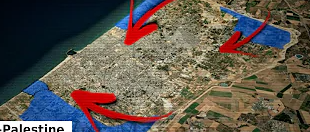
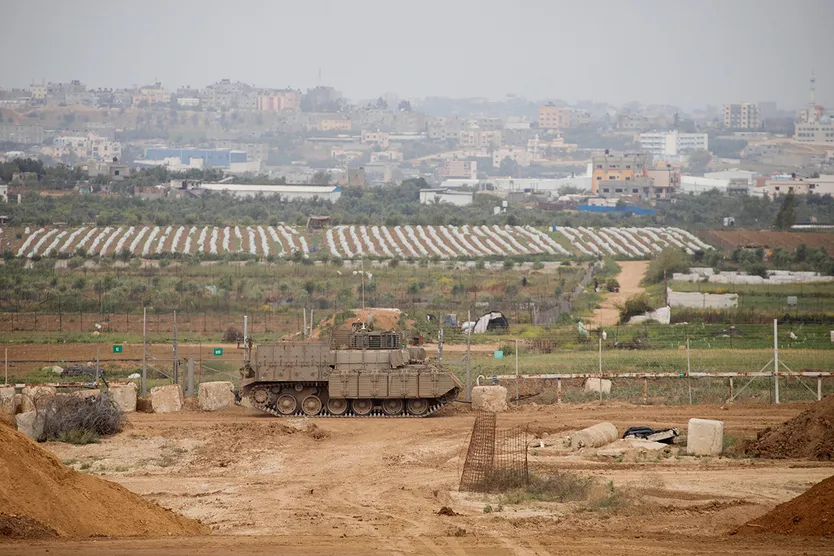
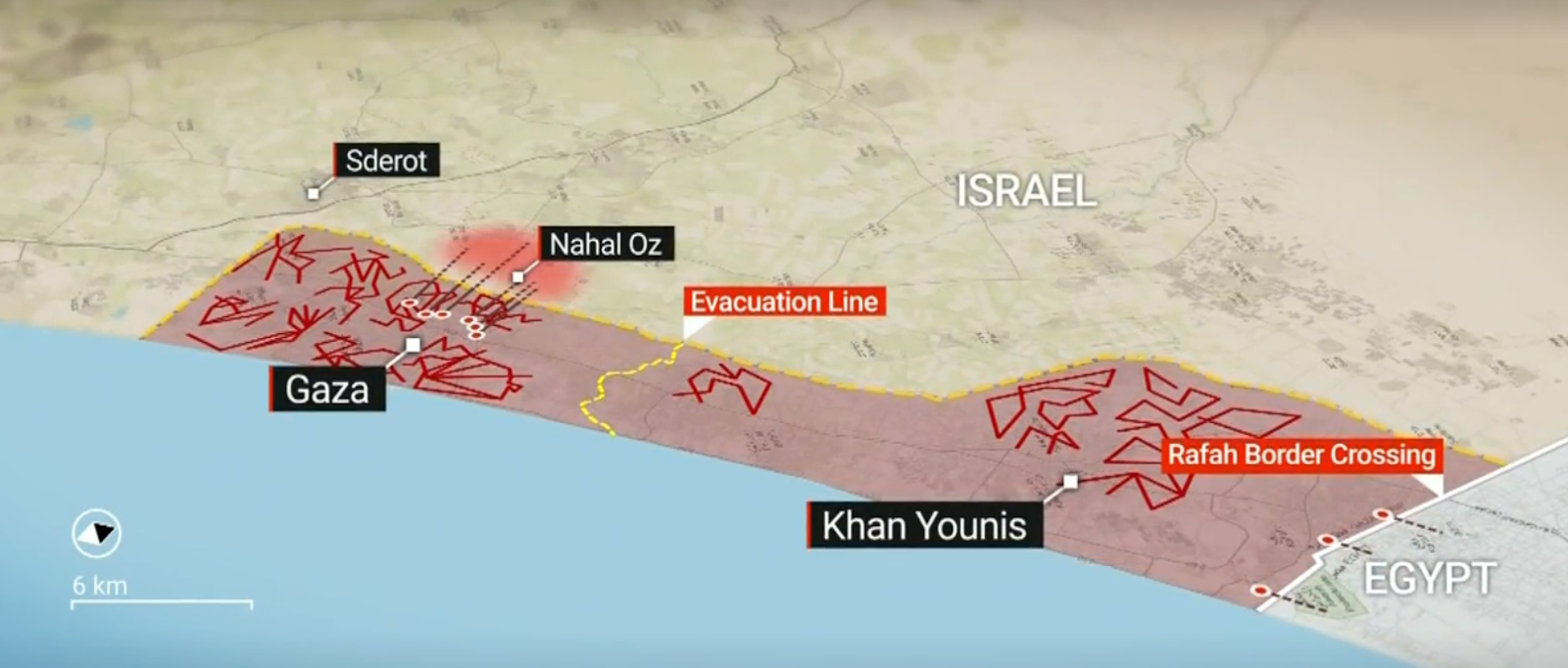
The Palestinian Resistance (referred to as “Hamas”) is following the guerrilla war template. The guerrilla knows that the imperialist enemy has better equipment and greater firepower, that many more Indigenous people will die than the colonial power’s soldiers, but that imperialists, in their racism, value their lives much more than many multiples of Indigenous people and that colonial armies are therefore casualty-averse. That means that analysis of how, e.g., Israel has “cut the Strip in half”, “surrounded Gaza”, or showing maps – cannot tell the whole story of a guerrilla war. From the guerrilla perspective, these are the inevitable opening moves in the people’s war.
The beginning, not the end, of a guerrilla war looks like this
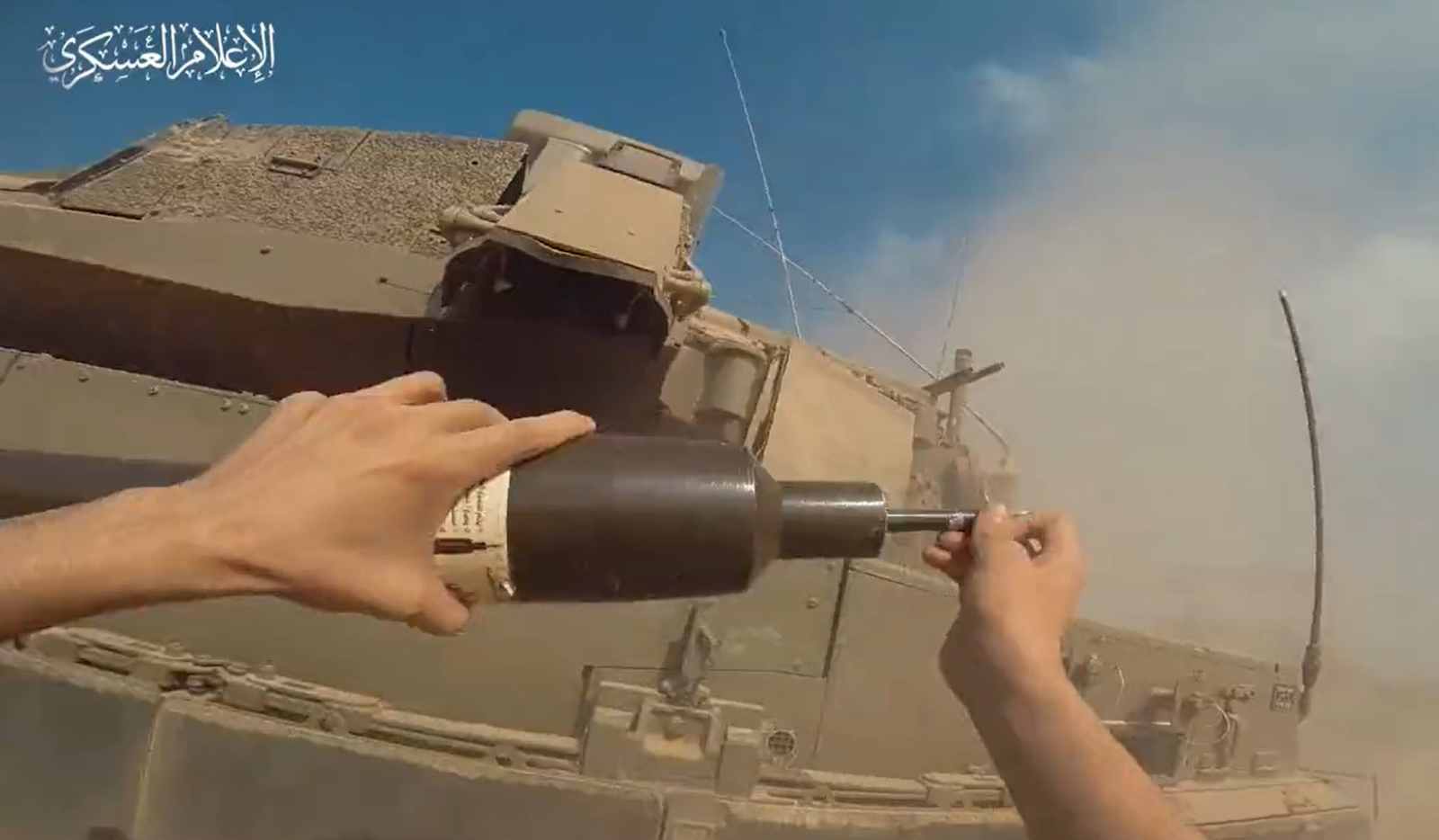
There is no way for the guerrillas to get into contact with the Israeli military unless the Israelis make such moves first. As for what these contacts have looked like, there are videos of Palestinian guerrillas attacking tanks from point-blank range.
Palestinian guerrilla fighter hand-places an explosive on a tank during a battle
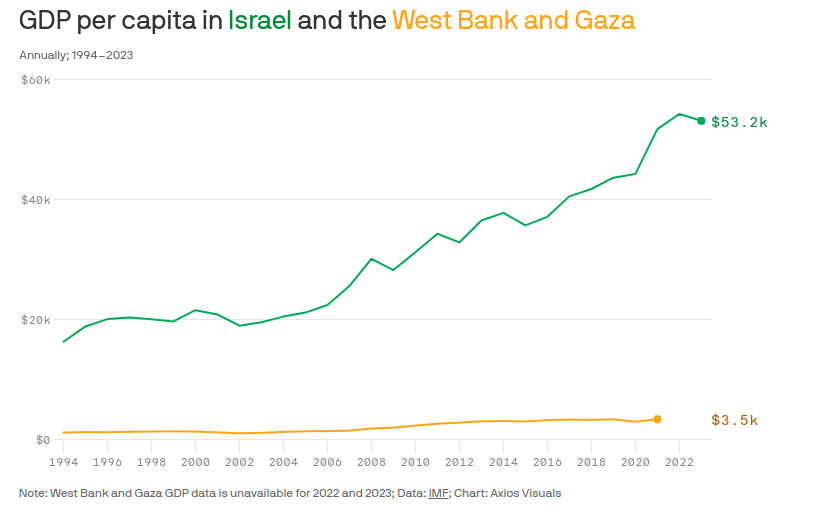
So the Resistance depends on fighting on the ground to raise the cost of aggression beyond what is bearable for Israel’s comparatively privileged society (per capita income $53K, compared to Gaza’s pre-war $3K).
Israel depends on vaporizing non-combatants through direct bombing killing disproportionately children, specific attacks on agriculture, fishing, water, and electricity infrastructure to try to induce mass starvation and dehydration in the hope that the Resistance it is so broken by terror that it cannot continue.
For those of us who are anti-genocide, the race against time is on. We have nothing to do with the military struggle but the unarmed around the world have to do our best for the unarmed in Palestine.
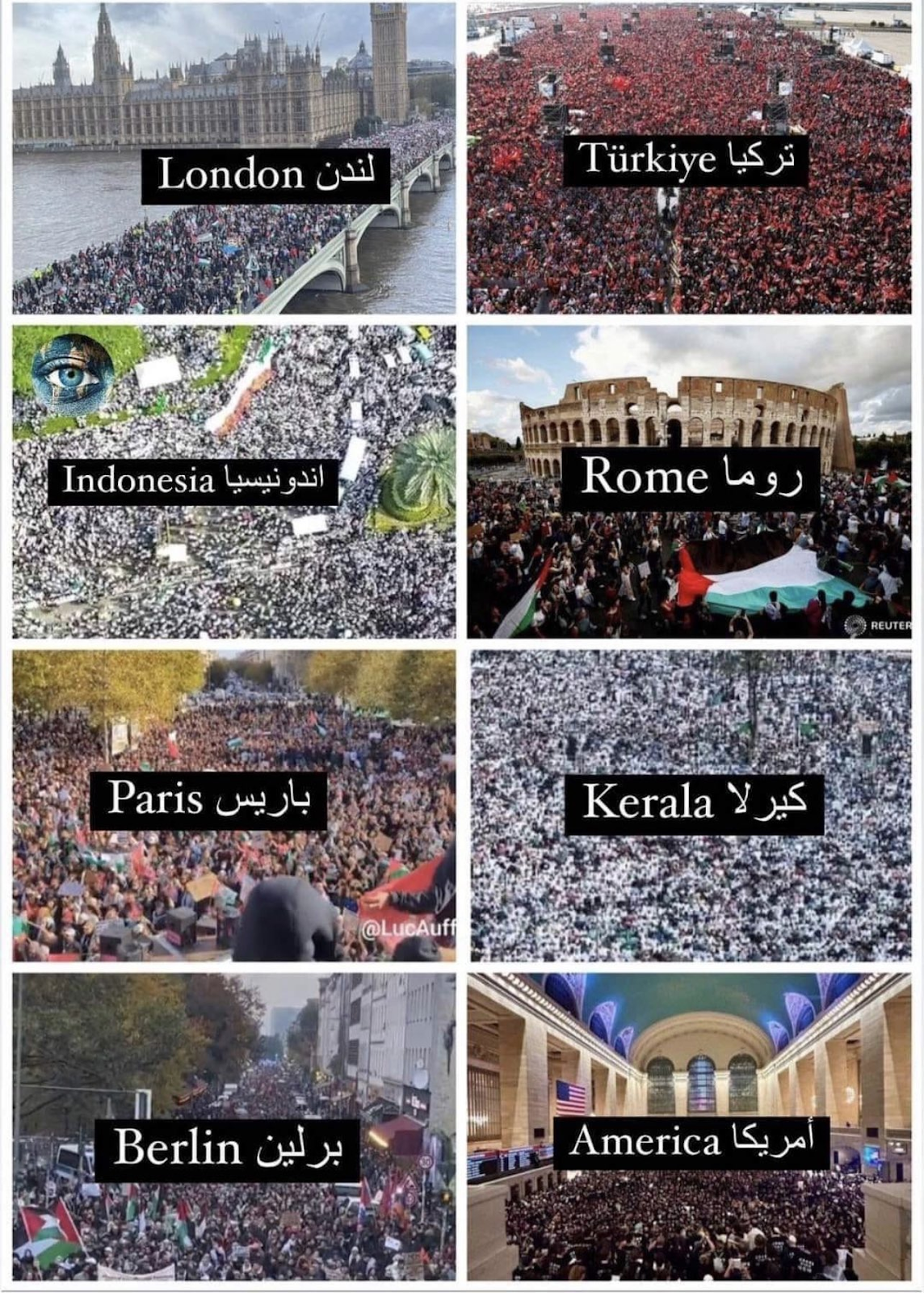
The protests on November 4 showed that the anti-genocide bloc is the majority even in Western countries, despite all the smears and racist attempts to intimidate everyone – these coming from the leadership of all political parties and major media, and intensifying after the demonstrations of the scale of anti-genocide sentiment. “When,” comedian Amanda Seales wrote, “have you seen so many people in the streets for some wrong shit?”
If majority opinion alone could do the job, the ceasefire would have happened and the siege would be broken already. But whether they call themselves “democracies” or not, our political systems are designed specifically to deny the will of the majority.
Nonetheless, as the majorities, we still retain some ability to communicate with one another and we can still exert some influence over how this goes. Whatever we can do to stop the genocide, we have to do. On that, more soon.
Resource to follow the war – Updates on Electronic Intifada
The genocide proceeds. In Jabaliya, Israel dropped six tons of bombs on a refugee camp a week after bombing a number of hospitals. Westerners are being conditioned gradually to accept higher and higher numbers of daily Palestinian deaths in more and more obviously genocidal ways – gathering sites, hospitals, schools, churches, mosques, refugee camps.
The US has placed naval assets where it safely could in the region and is deploying antimissile systems on the ground all to try to deter the military intervention of regional powers to stop Israel’s genocide. There is daily contact and exchanges of missiles and other fire on the Lebanon-Israel border, missile and drone attacks on US bases in Iraq and Syria, Yemen has declared war formally and fired missiles, and of course continuing fighting across the fence and now within Gaza.
Pointing out the criminality of what Israel is doing can have no effect when the enforcers of the law are the imperialists themselves. International law will play no role in stopping this genocide. So, this presentation of the facts is not done in the hope that facts can change the West’s position on this genocide or to lay the foundation for the war crimes trials of the future. Still, since the events of October 7 are the pretext for the ongoing genocide, they must be examined.
The feelings of October 7
Most of the discussion in Western media of what happened on October 7 is based on feelings, not facts, evidence, or the relevant laws of war that would apply, if Israel or the US were subject to such laws (they are not). Based on such feelings, progressive pro-Israel writers could assure their readers that it was a massacre; or that “animals isn’t even an appropriate term for the crimes committed by the Hamas invaders” oof October 7. Squeamish feelings indeed, the preciousness of life emphasized, and the barbarism of those who would kill the innocent.
For tough talk about the harsh realities of war, you need to look to the way Americans like John Kirby talk about Palestinian deaths – present at, at the time of his speech, future as well. “I wish that that wasn’t going to happen. But it is. It is going to happen. And that doesn’t make it right… But that’s that’s unfortunately the nature of conflict.” As one commentator noted about Kirby’s speech: “this is the kind of statement people in Serbia and Rwanda got played back at them while they were sitting in a glass box in the Netherlands.”
In the end, the West doesn’t really need the facts of what Hamas’s armed wing did on October 7. What the West needs for its genocide propaganda is to generate a feeling around what happened. That it was uniquely savage, uniquely atrocious. Armed with this feeling, there can be no minimizing these Israeli civilian deaths as “collateral damage” incidental to the objectives of the Palestinian Resistance (“Hamas”) operation, the way there would be if Israel had done it to the Palestinians.
In the West, what the Palestinian Resistance did on October 7 was not a crime – but worse than a crime. Pure evil. Counterproductive to the Palestinian cause. Bad enough that Palestine’s leadership is tarnished forever, forever illegitimate.
Bad enough that any antiwar movement that wants the genocide to stop is also illegitimate, for by their failure to condemn these uniquely savage crimes, they have turbocharged Israel, lost credibility.
Bad enough to justify everything Israel did since 1948.
Bad enough to justify genocide.
Through lurid descriptions of the events of October 7, the Palestinian Resistance is defined outside of humanity. Anyone who expresses support or solidarity is defined as a supporter of inhumanity, a committer of a criminal speech act, unprotected from libel and whatever penalties can be applied from there.
Genocide is justified, solidarity is criminalized, through such feelings. It is hard to imagine that Western countries could be moved away from this structure of feeling.
What happened on October 7?
Still. Even if the West will not use the facts in any future legal proceeding, even if the West ignores them, even if the West is morally and politically incapable of calling the genocide off, as fact-mongers, we still have for some reason to try to find out what actually happened. An anonymous group of Israelis have made the demand for an investigation of what happened – published on Mondoweiss. What are the facts? What can we put together about what happened on October 7?
In doing this we have a finite number of sources. The Haaretz list. The guided tour of Kfar Aza. Several eyewitness accounts. On the other side, we have Hamas’s statements. We have to analyze these carefully. Each piece has to be assessed according to the source, its previous record, its interest in releasing the information, and its biases.
US spokesman John Kirby assesses the Palestinian Ministry of Health as a source in this way: “The Gaza Ministry of Health is just a front for Hamas … a terrorist organization … We can’t take anything coming out of Hamas, including the so-called ‘Ministry of Health,’ at face value.”
The same could be said, from the reverse perspective, of all mainstream Western and Israeli sources, which are “just a front for [the Israeli military]”, which is currently committing genocide and whose utterances cannot be taken at face value.
But such are the sources we have. If we cannot depend on any of the given sources to tell the whole truth, we can perhaps depend on the Western sources to present Palestinians in the worst possible light, and on Hamas’s accounts of what happened to present themselves in the best possible light, and use the sources while keeping these biases in mind.
Quantitative Analysis of the October 7 attack: The Ha’aretz List
For a quantitative sense of the scale of deaths on October 7, we rely on the Israeli newspaper, Ha’aretz, where the death count is currently being updated and which has published 902 names as of October 26, 2023. The Ha’aretz list includes both civilians and military personnel and includes those killed after October 7 – the number rises as Israelis killed in the Gaza invasion are added to the same list. An earlier list with 308 names of Israelis killed was analyzed by one commentator, who counted 171 Israeli military personnel among them.
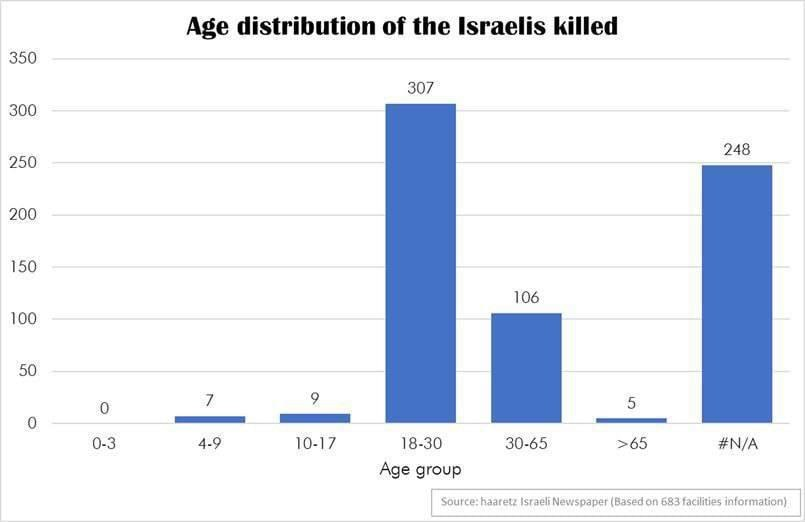
An article in The Cradle with a similar goal as the current one – of determining what is known about what happened October 7 – published an age distribution of those killed and concluded that 16 of the 683 on the list to that date were children, the rest adults; and around half of the 683 on the list were combatants.
The Cradle contrasts this with the 5,790 Palestinian civilians killed in Gaza by Israel since October 7, 2,360 of whom were children (at the time Cradle published; we are now over 9,000 Palestinians killed and around half children, with several huge massacres like the dropping of 6 1-ton bombs on Jabaliya camp on October 31). But the Cradle doesn’t understand that Israel and the West expect a far higher standard of Hamas than they do of themselves. It is impossible to imagine what a commentator like Gideon Levy would call Palestinians, what Guardian columnists would say to the antiwar left, if Palestinians were to kill 10,000 people and 4,000 children in indiscriminate bombing.
On October 26, the Ha’aretz list had 902 names (515 of whom had photos) and categorized 556 of these as civilians, 59 as police, 14 as rescue, and 273 as soldiers (10 Nepali students and 14 Thai workers are included as well).
For 635/902 of these, no detail is provided about where the deaths happened. The largest single death toll in this list is the Re’im music festival, where 195 Israelis were killed according to this list.
The proportion of adults killed was 498/540 of the dead who have an age indicated. The October 26 list includes 20 children in total: 8 children ages 4-9 and 12 children aged 11-16. Five of these children were killed in in Be’eri, 4 in Nir Oz, 4 in Kukhleh (last names Alkra’an and Abu Sabaakh), 2 in Dimona, 1 in Arara (last name Abu Jama). Four were 17 years old, and the other 498 were between 18-65 years old. Eighteen of the dead with age indicated were senior citizens over 65.
The Battle of Nir Am: The Economist
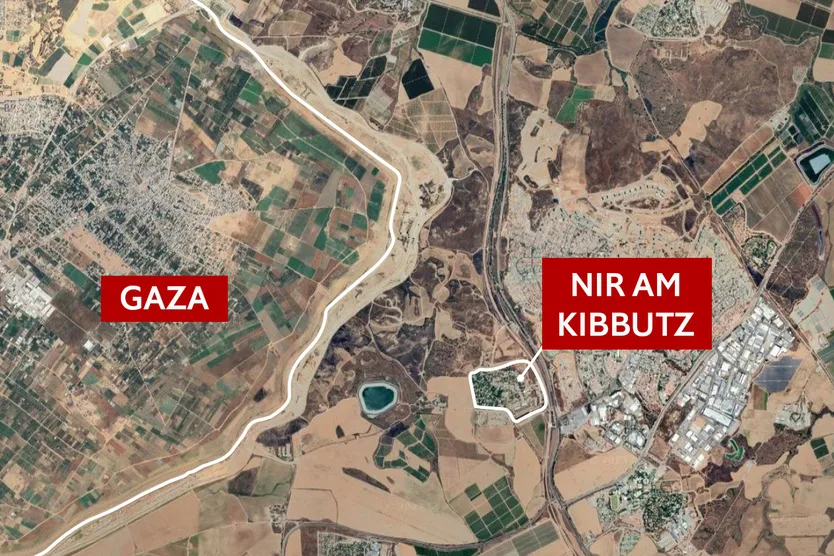
An episode of the Economist’s podcast, the Intelligence, called “The Day Hamas Came”, describes what a battle with the Qassam fighters looked like from the point of view of Adam, a dual-pistol wielding Kibbutz dweller from Nir Am who “knew how to fight”.
The same story was written up here for the magazine. In the story, Adam describes his kibbutz, Nir Am, as a militarized fortress with a gate strong enough that a truck could not be driven through it if closed.
The kibbutz has its own militia, the KK, and its own armory. When the attack started, Adam went to the KKK commander and then to the armory, and organized the defense of the kibbutz. He personally shot one of the Palestinian fighters three times in the body and delivered the coup de grace with a shot to the head. Some of the kibbutz’s agricultural laborers, Palestinians from Gaza, were killed in the crossfire. The kibbutz’s defenders held off the Palestinian fighters until the Israeli police and army arrived. According to Adam, while the kibbutz lost people, virtually all of the attackers were killed.
In summary: this account from a survivor describes an attack on a fortified community, a two-way battle between armed groups, concluding with the death of all the attackers.
The Battle on Kibbutz Be’eri, described in the NYT Daily
The New York Times’s podcast, the Daily, featured another kibbutz survivor of the October attack, this time from Kibbutz Be’eri. 44 year old Golan Abitbol who describes his community as one of 1,000 people. Like his dual-pistol wielding compatriot Adam, Mr. Abitbol heard the alarm in the morning and immediately got his 9mm pistol, locked his family in the shelter, took a firing position in the front of his home. Soon he was exchanging gunfire with a group of Palestinian fighters. “You don’t think,” Mr. Abitbol said. “You act like a warrior.” The enemy moved on to the next house, and Mr. Abitbol saw them a house on fire. As in kibbutz Nir Am, the Israeli military eventually came to the rescue with some heavy armor. When Mr. Abitbol came out of his house, he saw a tank parked on the street. “They told us to close the eyes of the young kids so they won’t see the dead bodies of the terrorists lying outside,” he said. His fortress, kibbutz Be’eri, had been burned he estimated that one hundred people had been killed: “I don’t know how many. I couldn’t count… 1 out of 10 is dead,” he said, in his community of 1,000.
Mr. Abitbol provided his assessment of what happened and of the attackers – they were “not human beings”, he said, but “vicious killers”, “evil”, “animals”, and the attack was a “second Holocaust”. What he described, however, was not a death camp but a battle between armed attackers and armed defenders during which civilians were killed and other civilians taken captive.
Friendly fire, crossfire in Israeli media
Mondoweiss published on October 22 a review of evidence available at that time of possible “friendly fire” deaths in which Israelis died as a result of Israeli military action. One major piece of evidence reviewed was an Israeli interview, republished by the Electronic Intifada, with Yasmin Porat, another survivor from Kibbutz Be’eri, who witnessed the Israeli retaking of the kibbutz. She said the Israeli army “eliminated everyone, including the hostages. There was very, very heavy crossfire.” Another article cited is from the Guardian by a journalist who went on an Israeli-Army guided tour of kibbutz Be’eri on October 11, who described the destruction: “Building after building has been destroyed, whether in the Hamas assault or in the fighting that followed, nearby trees splintered and walls reduced to concrete rubble from where Israeli tanks blasted the Hamas militants where they were hiding. Floors collapsed on floors. Roof beams were tangled and exposed like rib cages.” A military commander told Ha’aretz that his unit “fought inside the kibbutz, from house to house, with the tanks.” “We had no choice.”
Mondoweiss cites an October 20th Ha’aretz article going into more detail about the Israeli counterattack: “…only on Monday night and only after the commanders in the field made difficult decisions — including shelling houses with all their occupants inside in order to eliminate the terrorists along with the hostages — did the IDF complete the takeover of the kibbutz. The price was terrible: at least 112 Be’eri people were killed. Others were kidnapped. Yesterday, 11 days after the massacre, the bodies of a mother and her son were discovered in one of the destroyed houses. It is believed that more bodies are still lying in the rubble.”
A survivor’s account from the kibbutz of Nir Oz describes fighting, Palestinian attackers burning houses, followed by looting, and finally an attack by an Israeli attack helicopter when one woman died – possibly from Israeli fire. Some snippets of a WhatsApp group chat from residents of Nir Oz were published in an Israeli newspaper and and show residents chatting with one another awaiting the Israeli military, describing terrorists walking around outside speaking Arabic. Another video shows what appear to be crossfire incidents at the Re’im music festival.
Another inquiry into the deaths on October 7 was published by Max Blumenthal in the Grayzone. In addition to the damage at kibbutz Be’eri characteristic of high explosives fired from tanks, Max also shows how footage of charred remains of victims at the music festival were characteristic of Hellfire missiles fired by Israeli helicopters.
Military analyst Scott Ritter believes (discussed at 1:06 of this video) that most deaths were friendly fire:
“Israel’s lying to itself and the world because Israel doesn’t want the truth to come out about October 7, the absolute failure – political failure, military failure. And they definitely don’t want to talk about October 8. That’s the day they really don’t want to talk about. Because that’s the day that this undisciplined mob of Israeli Defense Force poured back into the settlements and slaughtered the settlers that were there… if they release the autopsies of all the bodies they picked up, you’ll find that the majority of them, more than the majority, were killed by 5.56mm rounds fired by Israel. There’s enough eyewitness testimony that supports this. And Israel doesn’t want to talk about this.”
Urban warfare and civilian casualties
For a comparison of the methods used by armed organizations and civilian casualties, the Palestinian attack on October 7 could be compared to the battle of Shuja’iya in 2014, described by Israeli participants in the battle in the report by Breaking the Silence, This is How We Fought in Gaza.
Scott Ritter, on the program DD Geopolitics, described how the various decisions by Hamas’s armed wing could have been made. He compares October 7, 2023 with the World War 2 Normandy campaign and the battle for Caen. The British and Canadians had hoped to seize the city in a day, but the Germans moved three divisions into the city and it was a “bad battle” in which tens of thousands of French civilians lost their lives. The British and Canadians, Ritter said, would “go in, throw a hand grenade, oops, family of six, sorry, too bad so sad, wrong place wrong time, keep going. Because if you pause and cry, you get killed.” Like the allies in Caen, the Palestinian fighters were “being actively resisted – Israeli forces were surging into the area, they were making contact with Hamas, they met Hamas in the kibbutzim. It’s an active war zone. A lot of people died. And a lot of them were civilians caught in the crossfire.”
On the question of the civilians captured by Hamas, Ritter elaborated. “Why did they remove the women and children?” Ritter described a mission, Operation Eagle Claw, when Delta Force attempted to rescue hostages held in Iran. As they were setting up, “a busload of religious pilgrims drove through the site after we had landed. We captured the bus. We couldn’t let them go. So we put them all on a C-130… we took them hostage for operational security reasons. Do you think it’s possible Hamas had these women and children and thought if we keep them alive they’re going to make a phone call, we’ve got to get them out with us. Do you think that could have happened? I don’t know… I’m not saying Hamas didn’t commit any atrocities. I’m not in a position to know. The Israelis have a lot of footage of Hamas fighters turning corners and shooting people. Is that terrorism? Is that terrorism or are they assaulting a military position, from their standpoint?”
Reports of atrocities all source back to the Israeli military
Reports of atrocities all trace back to the Israeli military and are rejected by Hamas categorically. The worst reports – of sexual violence, decapitated babies, burned babies – are all sourced back to the Israeli military and reported by the corps of pro-genocide Western reporters. These include a report in the Daily Mail based on testimony from a pseudonymous morgue worker named Shari who said it was “worse than the holocaust”, a visit by a journalist to a forensic pathology center showing photos of hands, plastic bags, and unidentifiable burned remains, a screening of Go Pro footage to 100 pro-genocide reporters, and the like. In all of these, specifics are removed, ostensibly out of either respect or simply because the horror is too great – the result is to maintain the mystique of acts that are beyond human comprehension. Acts that also, according to these sources, took place during active battles with the Israeli military.
As far as footage that does not trace back to the Israeli military: There is video footage – from cellphones, security cameras, etc. – of Palestinians looting and even engaging in undisciplined attacks on civilians. The men in these videos do not appear uniformed or equipped as Hamas’s armed wing or any of the other factions. There were men who left Gaza through the fence once it was destroyed and were caught on video engaging in crimes. It is possible that these individuals were responsible for the crimes that occurred, and not Hamas’s armed wing who were engaging with the Israeli army and police.
Conclusion: What is known about October 7
Gathering these Western and Israeli sources: there were a series of attacks on October 7 by Hamas’s armed wing on military bases and fortified kibbutzes that resulted in gun battles in which many armed personnel and many civilians died. Many Israeli military personnel and civilians were taken captive. Hamas has said the civilians will be released unconditionally (and some have been) and the military personnel will be traded for Palestinian political prisoners in a prisoner exchange.
The Israeli army also claims that Hamas’s armed wing committed atrocities, claims which Hamas rejects. There is footage from sources other than the Israeli military suggesting both that many Israelis died in crossfire and friendly fire incidents and that Palestinians who escaped from Gaza once the fence was breached committed looting and other crimes.
Meanwhile the Kirbys and Bidens deny Palestinian casualty numbers.
We are approaching complete polarization: soon no claims made by Palestinians will be believed by the pro-genocide Western bloc and no claims sourced to the Israeli military will be credible to the anti-genocide bloc. There will be no reason to talk to one another and no desire on either side to do so.
It is too obvious to say, but this bodes ill for solutions based on dialogue or negotiation.
The Israeli military’s claims of extraordinary and unfathomable atrocities on October 7 have become the principal justification for the current genocide, which is no exception to the historical rule that genocides are not built on facts, but on lies.
A horrible event shocks the world. The affected power, enraged, threatens war and gives an ultimatum. Looking around for allies, it’s given a “blank cheque” by its powerful patron – one of the great powers of the world. With that patron’s guarantee, the march to war starts. But the smaller power, about to be invaded, also has powerful allies, who mobilize their forces in turn. Once the mobilization and counter-mobilization begins, the march to war seems irreversible. Then, the power who wrote the blank cheque decides to strike first – pre-emptively, to try to take out one of its enemies before facing the others. We’re talking about 1914, and how WW1 started.
Joined by Jon Elmer and Nora Barrows-Friedman from The Brief / Electronic Intifada to talk about the War on Gaza, including the preparation for ground invasion, the siege, and the attack of October 7.
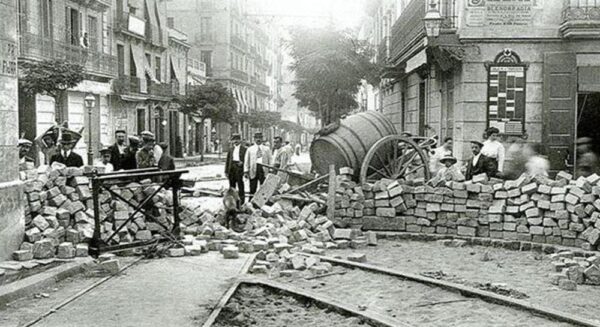
The near-revolution in Spain in 1909 turns out to be more of a cause of World War 2 than a cause of World War 1 but it includes anarchism, conspiracy, revolution, and ends in a show trial. Our final pause before we roll into the immediate causes of WW1.
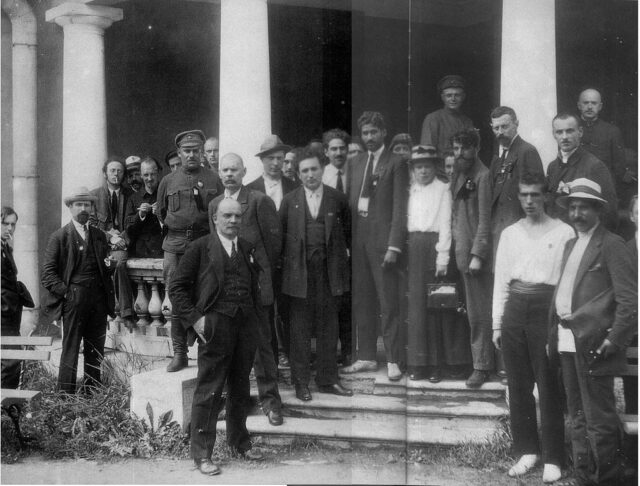
Leading up to 1914 socialist movements all over Europe, notably in France and Germany, had become so strong that they were in the very halls of power. But when faced with the onset of the Great War, the established socialists blinked, unwilling to risk their heard-earned position and possibly be arrested and have their parties driven underground again. This is precisely what they should have done, argued Lenin in 1915. We discuss this possible missed opportunity – why the socialists failed to stop the war before it started.
Let us start where we must: I do not support violence.
Let us start where we must: I do not support violence. I am not here to support or condemn anything, certainly not anything violent. Commentators, especially Western ones, are far too generous with their supports and condemnations. Analysis is difficult enough without peppering it with pompous gestures. And you didn’t come here to read a list of what I support or condemn. I know why you came here, it’s the same reason you always come here, it’s to find out what the hell happened. Let’s go.
[One other note – if the below analysis works for you, it is also the basis for the 2019 book I wrote, Siegebreakers, which, while fictional, is based on research of the military and humanitarian situation in Gaza. Some of you have asked how you could support my work – buying that book and good reviews would be the best way.]
The maps
You know that at the Anti-Empire Project we’re all about the long arc of history. But for the story of the colonization of Palestine going back to the Zionist Congress, the Balfour Declaration, the Arab Revolt, the UN Partition Plan etc., you’ll have to listen to it unfold in World War Civ, probably over the next few years of listening time (as a start you can listen to the story of the Uganda Proposal, when leaders of the Zionist Movement at the beginning of the 20th century were thinking of joining the Scramble for Africa). Instead, here I start with a geopolitical approach and see if we can illuminate a few military issues that are under-emphasized.
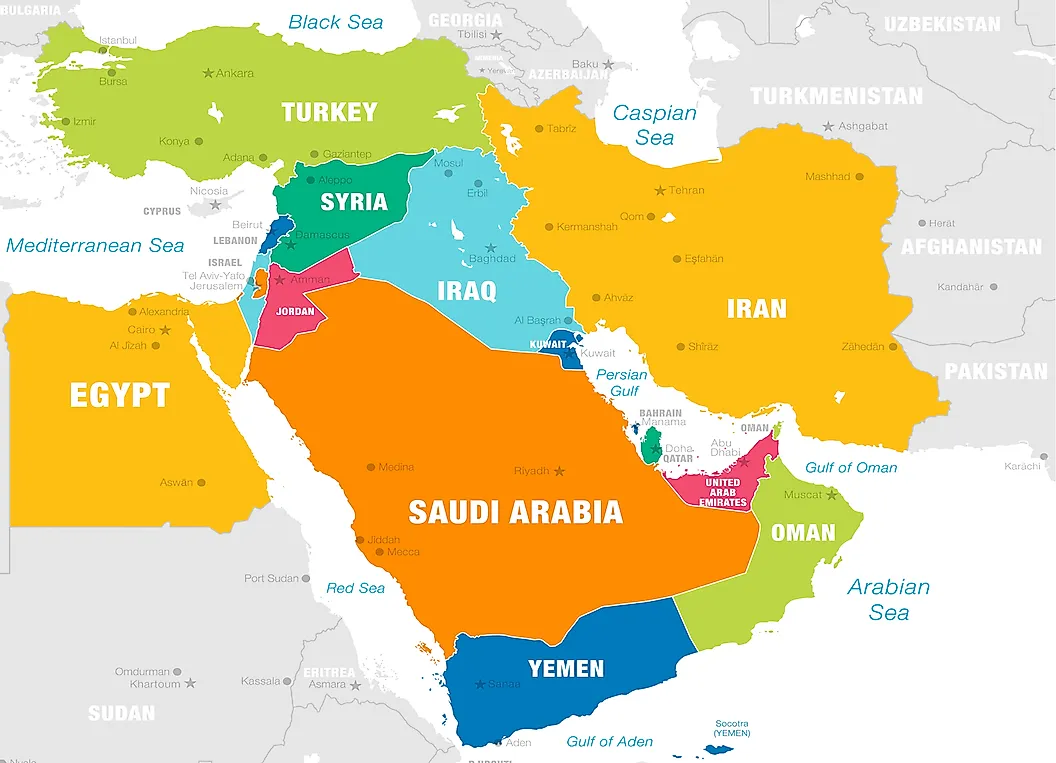
The region is mapped nicely by World Atlas. (Map 1)
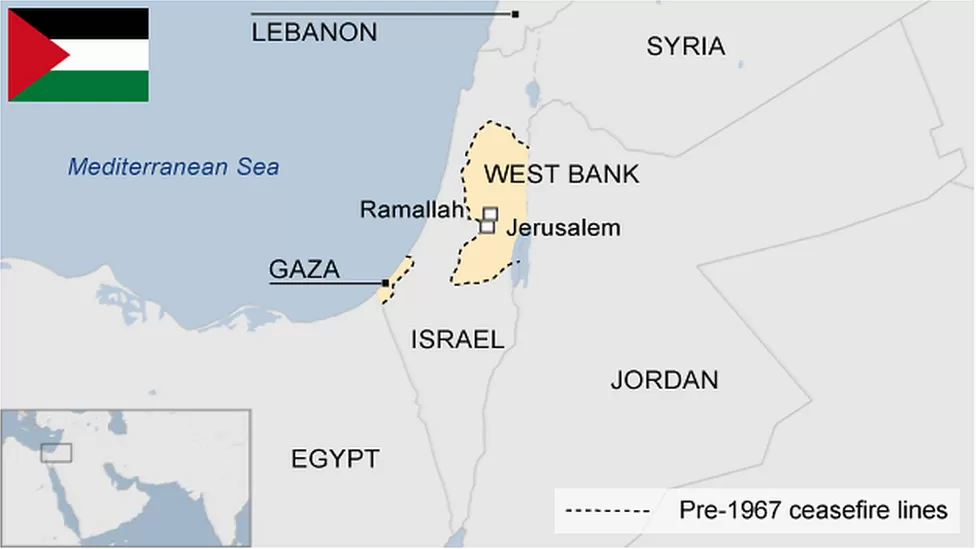
We can zoom in a bit and get a look at Israel/Palestine, the West Bank, Gaza and surroundings courtesy of the BBC (Map 2):
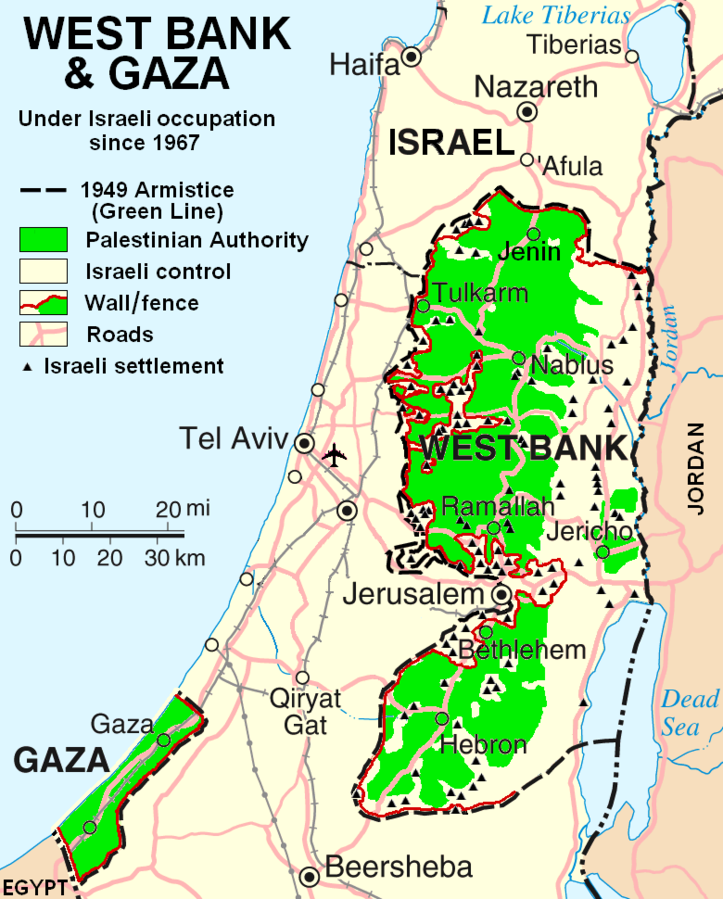
And then, through Wikimedia commons, we can see in Map 3 below the status quo with the apartheid wall and the additional land thefts through 2007 (Israel has stolen more West Bank land since 2007).
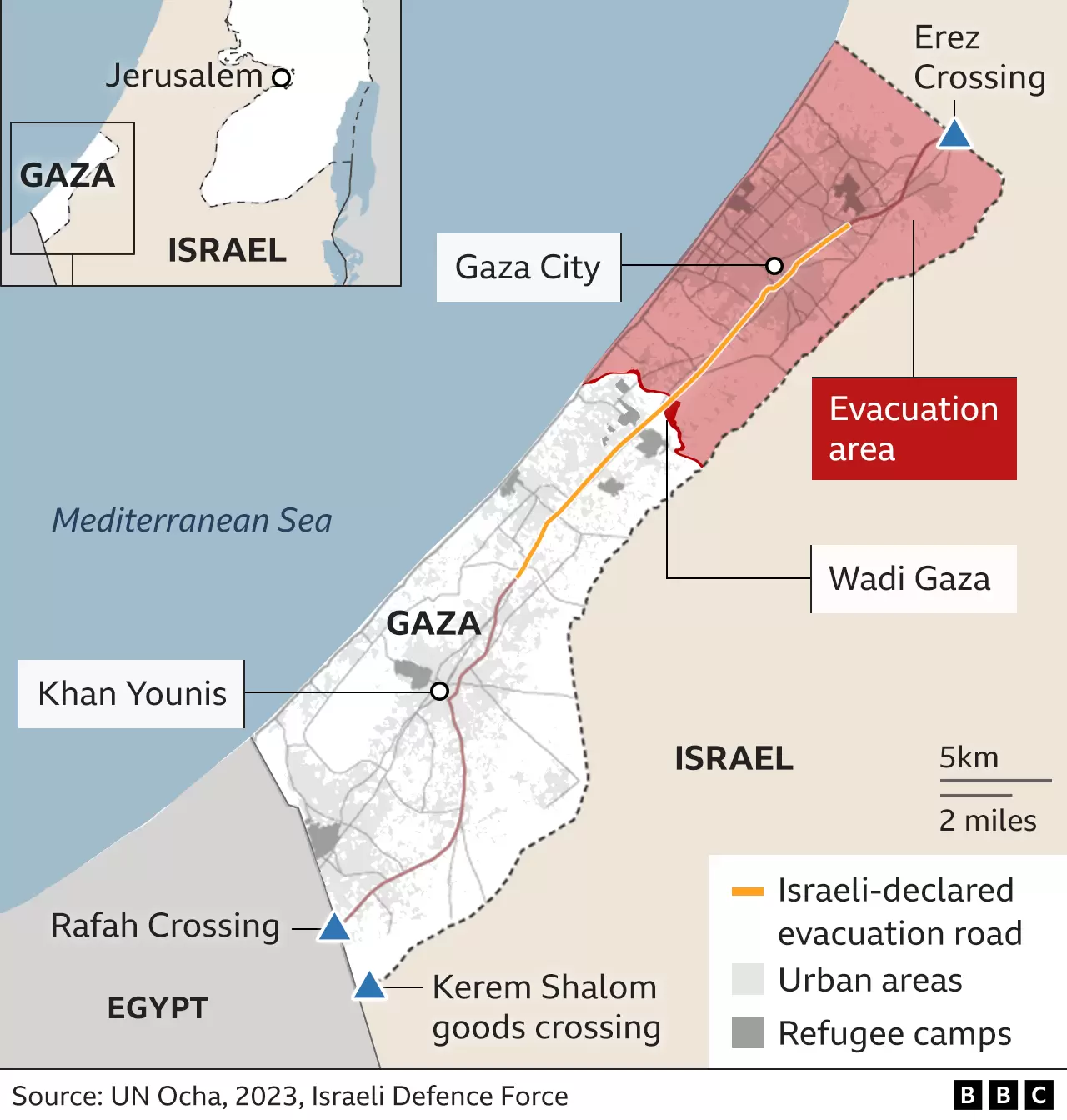
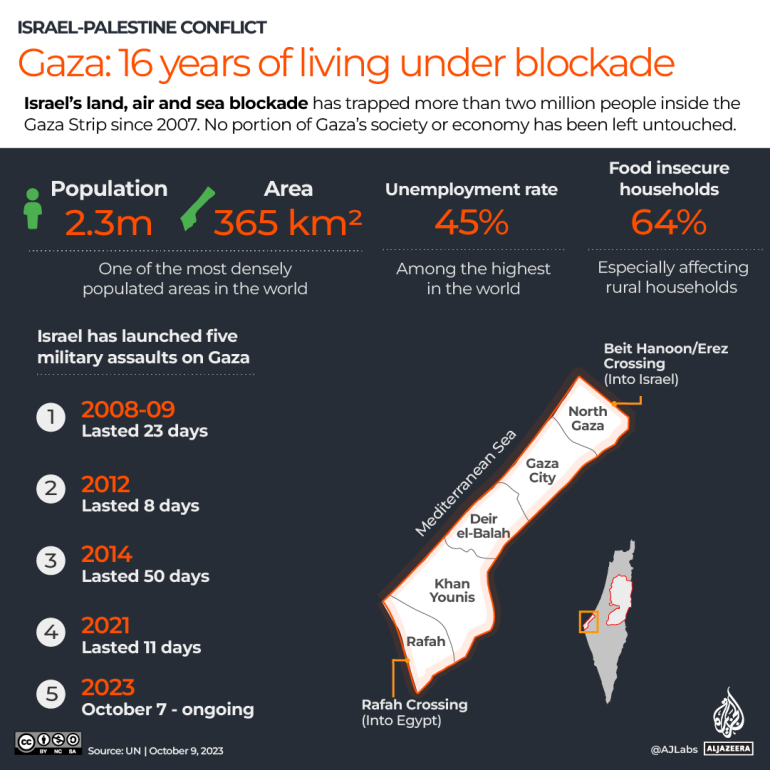
Let’s zoom in one more time, and take a look at Gaza and the surroundings. Both BBC and Al Jazeera have produced “Gaza in Maps” documents recently, from which some important visualizations can be extracted. The BBC version (Map 4) has produced a map of the “evacuation area” that Israel is trying to displace 1 million people from:
Al Jazeera published a helpful map (Map 5) summarizing attacks and the siege by Israel.
Let us start at the zoom level of maps 4-5 and talk about military affairs on this scale, before zooming back out all the way to the possibility of maybe a world war. We revert to our usual chronological method.
The Chronology
The current, multi-phase conflict began when Israel was created in 1948 and a hundreds of thousands of refugees were displaced by Israel’s military and paramilitary forces into refugee camps in Gaza (and the West Bank, as well as Jordan, Lebanon, Syria, and beyond).
The dynamics changed when Israel occupied the entire Gaza Strip (as well as the West Bank, and the Sinai, since returned to Egypt, and the Golan Heights from Syria, still Israeli-occupied) after the 1967 war, in which Israel defeated Egypt, Syria, and Jordan.
The Palestinian guerrilla struggle was briefly based in Jordan, until the leadership was purged in 1970, when the base moved to Lebanon.
In 1973, Israel fought another war with Egypt and Syria and agreed to give Egypt’s land back in return for a permanent annual bribe from the US. Getting the deal with Egypt, Israel’s giant neighbour, has been key to the US strategy to secure Israel.
Israel attacked Lebanon in 1982 and forced the Palestinian guerrilla movement leaders to leave again (after committing some notable massacres in Sabra and Shatila). The US sent the Marines to separate the warring sides (and de facto support Israel) but the US left after a big bombing by what would become Hezbollah. Syria also intervened in Lebanon in this period. Hezbollah was created out of this 1982 Israeli invasion, and drove the Israeli Army out of Lebanon (almost) entirely in 2000.
Then in 1987-1990 came the First Intifada, a multi-year popular struggle using many of the tools of non-violence including strikes and demonstrations, brave people facing tear gas, beatings, jail terms, and even training and advice from Gene Sharp. Israel responded with a campaign to break the bones of the Palestinians, fill Israeli jails with Palestinian prisoners, and continue the program of illegal settlements.
Several things changed around 1990, marking yet a new phase. The USSR collapsed, and a huge number of Soviet Jews moved to Israel (even though many were pressed to move to Israel and had wanted to go to the US or Germany). The US invaded and destroyed Iraq, disarming it and instituting a devastating sanctions regime. The First Intifada forced Israel to try to negotiate with the Palestinians for the first time. The negotiations succeeded in relieving the pressure on Israel from the Palestinian Intifada.
Brokered by the US, then posing successfully as an honest broker, culminated in the 1993 Oslo Accords, through which the Palestinian Liberation Organization turned into the Palestinian Authority and became a subcontractor of Israel’s occupation of the West Bank, Gaza, and Jerusalem. As Israel continued to expand settlements into occupied territories and encroach on the Al-Aqsa mosque, it became clear that Oslo had been a trap and not the generous offer for lasting peace presented by the honest American broker.
In 2000, the Israeli prime minister invaded al Aqsa with a security escort of 1500 men, sparking the Second Intifada. If in the First Intifada Israel had a policy of breaking bones, the Second Intifada was a military re-invasion of the West Bank and Gaza with snipers, attack helicopters, tanks, and armored personnel carriers. Military checkpoints were set up to cut every Palestinian community off from the others: the Israeli Army used all of the machinery of a modern Western military to suppress a civilian population. When, in 2001, the US declared a War on Terror and invaded first Afghanistan, then Iraq, Israel eagerly joined up, selling its repressive technologies as tested anti-terror weapons in the global arms bazaar as documented in the Israeli film, The Lab (2013).
Until 2005, the West Bank and Gaza shared similar fates: occupied by the Israeli Army, experimented upon for weapons manufacturing and policing/military ideas, their land gradually being stolen by expanding Israeli settlements, an apartheid system of checkpoints and passes.
In 2005, however, Israel withdrew the settlers from Gaza. On the one hand, the departure of an occupying army and colonists is a cause for celebration. On the other hand, Israel had bombed the only airport, controlled the sea, and walled off all the exits. Gaza was a prison. The people who lived there lived under Israel’s control in every aspect. But now that Israel no longer had an interest in settling the land, its military campaigns against the civilian population became ever more unrestrained. Scholar James Ron argued that violence on frontiers was more genocidal than violence in ghettoes. When the Israeli settlers left, Israel was free to unleash frontier-style violence on the imprisoned population.
Under the Oslo Accords there was provision for a Palestinian Legislative Council and the election for that body happened in 2006. There is a lot that could be said about it but for our purposes, let’s summarize it by saying: Hamas won, and they weren’t supposed to. The US and Israel had expected the incumbents (Fatah, whose leaders negotiated Oslo and run the Palestinian Authority as a subcontractor for Israel) to win. When they lost, the US/Israel refused to recognize the winner. Hamas was effectively swept out of the West Bank, which came under Palestinian Authority control. PA forces tried to do the same to Hamas in Gaza, but after a brief armed conflict Hamas ended up on top there.
Hamas was not rewarded for thwarting a coup against it in Gaza: Israel, continuing its relationship with the PA in the West Bank, simply refused to recognize Hamas as the government in Gaza. Instead, Israel besieged Gaza and launched a war in 2006, another in 2008, 2012, 2014, 2018, 2021, and now 2023.
The nature of the Israel-Gaza wars
With our political chronology in hand we are ready to talk about the characteristics of the war between Israel and Gaza – really, I will argue, the conflict between the whole combined West (US, Canada, Europe) and the hitherto stateless Palestinians – but there are some unique elements to the Israel-Gaza part of this bigger war. Who are the combatants, what are their goals, how do they use force to try to attain their objectives in war?
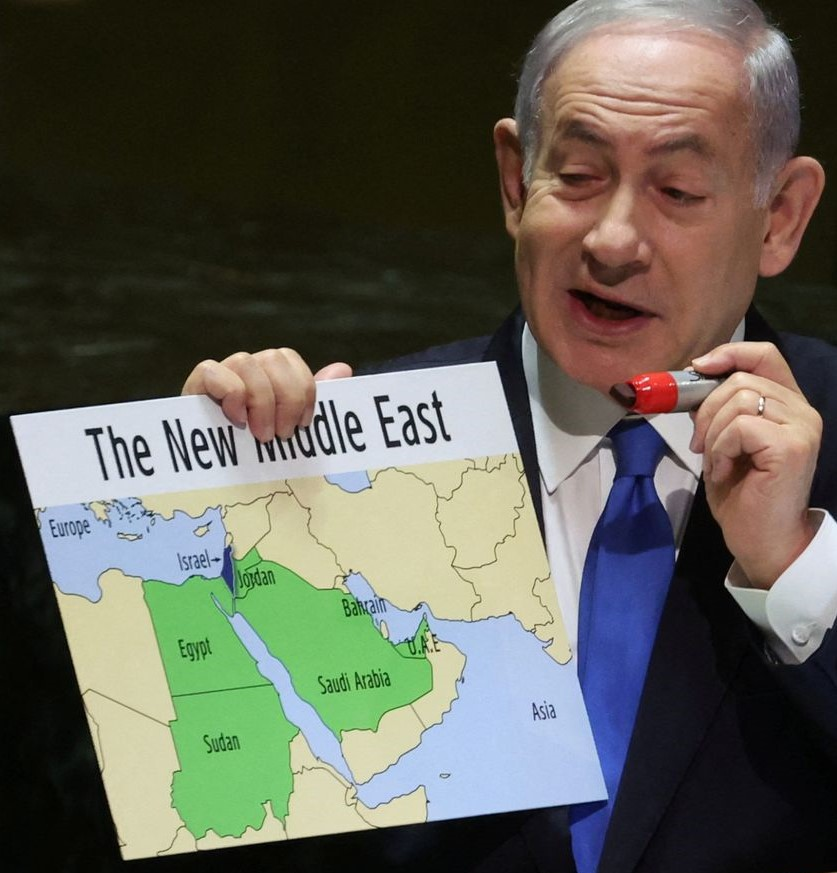
Israel’s objectives. Let us start with Israel, whose leadership has always been transparent about goals and intentions. When these appear unpalatable, they are simply effaced by the West – it is pretended that the utterances were never made. Any historian of the conflict could provide a century of quotes from figures like Chaim Weizmann, David Ben Gurion, Menachem Begin, Golda Meir, Ariel Sharon… but there is no need. The goal was also summarized neatly enough by the current prime minister of Israel when he held up a map of the “New Middle East” at the United Nations in September.
The “New Middle East” has no Palestine and no Palestinians. That is the simple and genocidal objective, announced openly and repeatedly to the world at every turn, most recently in September in this map by the multiply-elected leader of Israel.
[Sure, Netanyahu is unpopular. Many in the leadership think he is corrupt, undermining Israel’s institutions, overreaching, or underreaching. His goal for the “New Middle East” is not unpopular, however.]
Israel’s strategy. The grand strategy of Israel has been, like other settler-colonial states, incrementalism. Constant pressure on the Indigenous population. Constant encroachment. The use of the law to seize land. The assassination of leaders. The imprisonment of leaders. The suppression of cultural expression. Taking control of the means of survival and using that control. As Canada used the famines of the 1880s to force Indigenous peoples in the West onto reserves, at gunpoint and on pain of starvation, Israel uses aid to refugees whose access to land, water, electricity and food have been taken away (when Palestinians build infrastructure Israel bombs it) as a means of control. Periodically, there are crises – wars, uprisings – for Israel these crises are opportunities to increase the quotient of violence and get closer to the exterminist goal.
For Israel’s strategy to succeed there are a number of things that have to go well for them, and these things appear to have been going well for Israel since 1948. These are:
An unshakeable alliance with the dominant world power, the US (or rather, the US, UK, Europe, Canada, etc.). If US support were to wane for any reason, Israel might be forced to make concessions away from Netanyahu’s map.
Opponents must be divided with some of them working on Israel’s behalf (the Gulf monarchies, the Islamic State, Egypt, Jordan, the Palestinian Authority) and others mired in internal wars or invaded by the US (Iraq, Syria). Netanyahu’s map can only be made reality if Israel’s neighbours are disunited.
A “qualitative military advantage” over any of their possible rivals (in the past Jordan, Egypt and Iraq, notably Syria, in recent decades Hizbollah and Iran, and of course the Palestinians). Without military superiority, Netanyahu’s map remains a colonizer’s dream.
Addressing each of these in turn. 1. About Israel’s ability to maintain Western support regardless of what its actions are, Netanyahu is a particularly confident leader. He has been recorded bragging about having the US leadership in his pocket, the recordings made public, etc. Despite now decades-old predictions that US youth would abandon Israel (e.g. Norman Finkelstein’s 2012 book, Knowing Too Much, that focused on idea that the US Jewish community would grow disillusioned with Israel) the solidarity of the elite of all Western countries with Israel is complete. Rooted as it is in racism and colonialism, Western elite solidarity with Israel will not be dislodged. As Israel drops 1000 bombs a day, cuts water, food and electricity to Gaza, calls the people “human animals”, etc., the solidarity remains unbroken – Western politicians focus on gestures of support for Israel and persecution of pro-Palestine sentiment in the West. Nor can that solidarity be cracked by a Palestinian nonviolent movement, as some fantasized it might be. In 2018, hundreds of Palestinians were shot to death like fish in a barrel by Israeli snipers as they engaged in a massive nonviolent struggle. Western hearts were not melted. The West was unmoved. Western solidarity with Israel is solidarity unto genocide, at least at the elite level. More on this question, below.
2. Egypt’s military regime continues to co-operate with Israel no matter what Israel does to Gaza. Despite its vast size (population 112 million) and its near-victory in the 1973 war, since the 1970s Egypt is in a position where the US and Israel exert immense influence over it (with debts to the IMF, a lack of food sovereignty, etc.). The Palestinian Authority, whose leader once described their security agreement with Israel as “sacred”, continues to seem impossible to dislodge, despite its unpopularity, even as it works to keep the West Bank divided and caged. More geographically distant states like Turkey have expressed disapproval, but such disapproval seems toothless at the moment. Turkey sent thousands of tons of tomatoes to Israel to help replace the tomatoes lost in the warfare around Gaza.
3. The question of Israel’s “qualitative military advantage” remains the great unknown. The two opponents that Israel has fought wars with in recent decades are Hizbollah in Lebanon and the Resistance in Gaza (it’s not correct to call it “Hamas”, because Hamas is a political party with an armed wing called the Izaddin al-Qassam Brigades, but there are other armed groups affiliated with other political parties and there is always an alliance of military resistance factions from different political parties arrayed against Israel).
Taking Lebanon first: Israel invaded Lebanon in 2006 and bombarded the country from the air, claiming to have the objective of destroying Hizbollah, who responded by launching missiles of their own into Israel and repelling the ground attack. Lebanon was devastated, but Hizbollah was not destroyed and continued to build their military capacities. Presumably, both sides have studied and tried to learn lessons from the 2006 war, so no one knows how the next war between these belligerents would go. Since 2006, Hizbollah has sent forces to support the Syrian state in the civil war, which presumably involved both taking mass casualties and also gaining experience and developing new abilities. Israel, since 2006, has fought all of its wars with Gaza.
As mentioned above, Israel has fought nearly annual wars against Gaza: 2006, 2008, 2012, 2014, 2018, 2021, and now 2023. There were ground invasions in 2008, 2012, 2014, and 2018, but the ground invasion of 2014 was also a frightening experience for the Israeli military, which has focused since on using the air force to bomb civilian targets.
Because Gaza is sealed, the Gaza Resistance launches rockets into Israel to answer the Israeli air force’s bombings. Israel’s bombs have much bigger payloads of explosives than the Gaza Resistance’s rockets, and Israel has progressively destroyed more and more of Gaza’s civilian infrastructure. Having destroyed more of the infrastructure, Israel tightens the siege (and in the current conflict, the siege is total, no water, electricity, or food allowed, and as mentioned before an ongoing negotiation to use food and water to force Palestinians in Gaza to accept displacement from their homes – per Netanyahu’s map). Israeli’s long-running goal is to push the people of Gaza into the Sinai desert and annex the Gaza Strip. Having failed to do so by invasion, Israel is now trying to do it through a combination of imposed famine and aerial bombardment.
[What? Surely if Israel has humanitarian concern for the Palestinian population, if the real problem is Hamas, then Israel ought to take in those Palestinian refugees within its own borders? Rhetorical question, obviously.]
The scale of genocide goes beyond those directly killed. Joe Emersberger recently did a calculation of how many Palestinian children would have lived had Israel – the occupying power – maintained the same child mortality rate in the territories they occupy as they do within the 1948 borders. Based on this calculation, he estimated 115,000 extra Palestinian child deaths.
Can the Gaza Resistance break this pattern? Let us turn to that side.
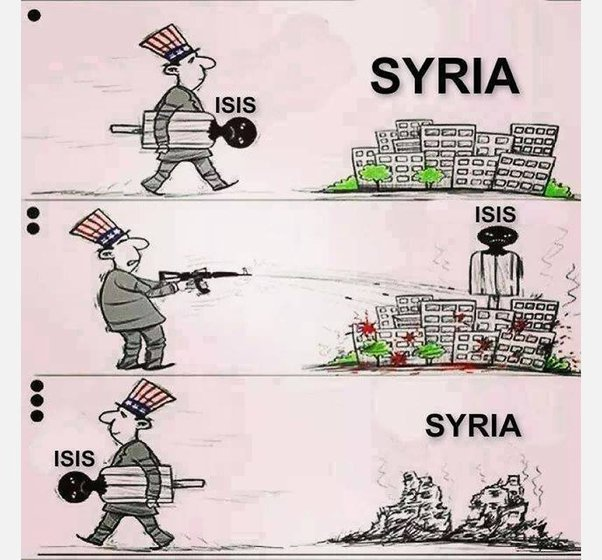
Palestinian Resistance objectives: Settler states are “negationist” toward Indigenous people and Israel’s position toward any resistance leadership Palestinians have is that those leaders must be killed or jailed before Israel is willing to talk. This was the case with the Palestinian Liberation Organization from the 1960s, and it is the case with the Palestinian Resistance today, which is today summarized with the word “Hamas”, and then conflated with the actions of the Islamic State in Syria, widely believed to be a US proxy whose goal (shared with the US and Israel) was to overthrow the government of that country. When an errant ISIS shell landed in Israel, the Islamic State apologized. On the other side, Israel assisted ISIS fighters during their war on the Syrian state. So when pro-Israel people say Hamas needs to be treated like ISIS, they don’t mean treated the way Israel treated ISIS, which was to assist their fighters and try to keep them going. Likewise, the notion that “Hamas” just wants to “kill Jews” is racist nonsense – part of the genocidal campaign against Palestinians and of colonial negation of Indigenous leaders.
No, Palestinian Resistance is not a nihilistic US proxy like ISIS. Its objectives are much simpler: to stop the theft of their lands and the genocide of their people, to secure their rights, including to return to the homes they were displaced from, and to secure their holy places (especially the al-Aqsa mosque in Jerusalem) against Israel’s plan to destroy it (like India destroyed the Babri mosque in 1992).
Palestinian Resistance Strategies. From the beginning of the Second Intifada in 2000 to the completion of the Apartheid Wall in 2005, the Palestinian Resistance used many civil resistance strategies throughout Gaza and the West Bank, including nonviolent protests and strikes. These were unsuccessful in the face of the increasingly heavy weapons brought to bear: as I mentioned above, Israel used tanks, attack helicopters, snipers, and aerial bombardment against civilians and assassination, imprisonment, and torture as responses to Palestinian political struggle.
Some Palestinian factions used “terrorist” methods, including bombings on buses (an interesting and dispassionate analysis, to the extent such a thing is possible, of “suicide terrorism” can be found in Robert Pape’s book, Dying to Win). Once the settlers left Gaza and especially once Hamas became the government there, the Resistance basically abandoned suicide bombing as a tactic. Instead, the Palestinian Resistance followed a similar evolution by Hizbollah from its inception in the 1980s and early “terrorist” methods. Like Hizbollah did gradually from the 1980s and facing the same opponent, the Palestinian Resistance from 2005 on focused on the slow construction of a conventional, professional military force to fight the Israeli military. To answer Israel’s aerial bombardment of Gaza, the Resistance worked on developing rockets, gradually improving their range and explosive power. In early conflicts they carried very small payloads and did very little damage, but their capacities have grown with each conflict. As Jon Elmer reported in 2012:
[Qassam] “was Gaza’s smaller-scale answer to Hezbollah, led by Qassam Brigades commander, Ahmed Jabari. Under Jabari, Hamas’ armed wing transformed into a more structured and professionalised force. “This isn’t a terror organisation anymore,” said Minister for Home Front Defence Avi Dichter, two days before Jabari’s assassination, “it’s a bona fide army.”
On the other hand, to protect against an Israeli re-invasion of Gaza and the re-introduction of Israeli settlers and colonies, the Palestinian Resistance developed a ground force specializing in urban warfare, with a tunnel network that the Resistance could use in the event of such an invasion.
Resistance ground forces defeated Israeli troops in several major ambushes during Israel’s 2014 invasion of Gaza, as documented in Max Blumenthal’s book The 51-Day War; in the face of these ambushes, Israeli troops would withdraw and engage their air force to destroy the entire neighbourhood where the ambush occurred.
On the character of the October 7 attack. Much of what happened on the ground in the October 7 attack by the Palestinian Resistance in the so-called “Gaza Envelope” will remain unknown until both sides release the full details from their perspectives to be compared. Some of what is known is that Palestinian Resistance forces attacked settlements outside Gaza, including military bases and posts, captured military personnel, and returned inside the fence. The fighting continued for days in some places.
The military objective as outlined in the communications by Resistance spokespeople was to break out of Gaza and to take prisoners of war who could be exchanged for the thousands of Palestinian political prisoners held in Israeli prisons. Israel’s countermove appears to be to unleash a genocidal aerial campaign and starvation to try to push the entire population of Gaza south, ideally into tent cities in Egypt. Military objectives were attacked, military equipment was destroyed and military personnel were taken prisoner. Hamas official spokesperson has said that all civilians, beginning with those who were not Israeli, would be returned unconditionally, while Israeli military prisoners would be exchanged for the thousands of Palestinians held in Israeli prisons.
Israeli sources reported that many civilians were killed and captured during the attack, in addition to hundreds of Israeli military personnel. According to a pre-recorded Hamas press conference, Resistance forces were given strict orders to engage military and police and not to attack civilians. They attribute the violence against Israeli civilians to people outside the professionalized Palestinian Resistance forces who escaped from Gaza once the fence was breached and the Israeli forces keeping the Palestinians encaged were occupied in gun battles with the Resistance. There were also civilians who were killed when caught between the Resistance and Israeli forces as they engaged one another in combat. Atrocities have been reported by the Israeli military and picked up by the Western media.
An accepted account of the extent of these atrocities, their perpetrators, and all the details that both sides agree upon will eventually come out. At the moment, stories of terrible atrocities committed by the Palestinian Resistance (“Hamas”) on October 7 are the principal rhetorical weapon wielded by Israel’s supporters in justifying every Israeli act, from imposing dehydration and soon, famine, to bombing sites like churches and hospitals where refugees have gathered in large numbers after their houses have been reduced to rubble by previous bombings. Given the function of these atrocity stories in the current moment of genocide, and the systematic lying by the Israeli military and by Western sources about the conflict, claims sourced from the Israeli military have to be treated with extreme skepticism.
In any case, a military impasse has persisted since 2014, and appears to persist even now, as Israeli troops threaten a ground invasion but in practice continue to kill civilians from the air, bombing thousands of civilian targets a day including increasingly outright civilian and refugee gathering places in a genocidal pattern, rather than engage Palestinian Resistance forces on the ground where they might take even higher military casualties.
The genocide-in-motion will force the region to react.
It’s time to zoom out all the way to Map 1.
The regional war context
During the Syrian Civil War, perhaps before, the concept of the “Resistance Axis” was coined. The Resistance axis includes Iran, Hizbollah, Syria, Ansarallah in Yemen (the so-called Houthis), and armed groups in Iraq as well. The Palestinian Resistance, including Hamas, are considered part of the Resistance axis today (this was not always the case, for reasons I won’t get into here but may have occasion to discuss in future).
Israel’s genocidal campaign in Gaza is enraging the Resistance axis, as are Israel’s ongoing encroachments and planned partition (and destruction) of the al-Aqsa mosque. Conflict between Israel and Hizbollah on the Lebanese border has been slowly ticking up. There are reports that on October 19, the day after Israel bombed the Ahli hospital and killed 500+ people in a single attack, Ansarallah launched a missile from Yemen that was intercepted by the US Navy and an Iraqi resistance group launched a drone attack on a US base in Iraq. Iran’s Foreign Minister has stated that Iran will intervene if the attack continues.
If Hizbollah joins the war, Israel’s air force will try to destroy Lebanon’s cities once again, but Hizbollah has more powerful missiles than it did in 2006 and it has the combat experience of Syria behind it. Presumably Israel has also prepared for a new war with Hizbollah and the US may join as well.
If Iran joins the war, the US would join as well, and we will be in fairly new situation in terms of the scale of the war, the weapons available to the combatants, and the effects on the global economy starting with the global energy system. I would rather not talk about it or even think about it until I have to, so let’s leave it there for now.
Extreme Western solidarity – and its possible cost
The Western response to Israel’s genocidal campaign has been a change from the past. In all previous Israeli campaigns against Gaza (and Lebanon) since 2005, different Western countries offered slightly different variations of support for Israel combined with calls for peace or for a ceasefire. This round, however, all Western countries spoke with one voice to repeat the mantra that Israel had the right to do whatever it wanted, it needed to explain nothing to anyone, and all that was required of Palestinians was to renounce terror and die. Supporters of Palestine in the West were subject to aggressive libels (this will need its own newsletter or series, stay tuned). France’s top court banned pro-Palestine protests (people came out in huge numbers anyway). Berlin banned pro-Palestine protests (including by a Jewish group). A UK official said waving the Palestinian flag might be a criminal offense.
Why the extreme Western solidarity with Israel this time? Why the extra virulence of anti-Palestinian racism? Western officials explain it in terms of the heinousness of the attack into the ‘Gaza Envelope’ by the Resistance, but Israel’s atrocities have already topped even the maximalist death tolls that Israel gave for October 7th.
Western officials can commit, and tolerate, the deaths of millions (they did in the War on Terror in Iraq, Afghanistan, Yemen and elsewhere) without batting an eye. Sincere moral indignation cannot explain it, since Western elites don’t possess it.
Instead, the West is showing loyalty and demanding loyalty to Israel in proportion to the monstrosity of Israel’s crimes. To support genocide – that is the biggest test of loyalty imaginable.
The price for Western leaders of taking this stance, still to be determined, will be paid in the repulsion of people of the global south, sometimes quantified as “soft power” or “global prestige”. No Western country can pretend to be an “honest broker” again, no Western country can be taken seriously when talking about human rights, international law, or nonviolence. The price is already being paid. When Blinken went to the Middle East, Jordan didn’t receive him, the head of the Palestinian Authority cancelled their meeting after the hospital bombing, the Saudi monarch made him wait multiple hours before postponing. The US ambassador to the UN Human Rights Council found people getting up and turning their backs during her speech. Canada’s prime minister was booed when trying to get a photo op at a Toronto mosque.
If Westerners were so ready to abandon it, how valuable was this liberal order? How valuable was this soft power? Can it be restored after the UK prime minister, the EU Minister, and the US president all fell over themselves to visit Israel during the genocide? Perhaps it will. Perhaps the West is as indispensable as these leaders believe and these frayed relations can be patched up once this round ends, as they have been in all the previous rounds. This particular issue will take time to settle.
How this round ends
How then, will this particular round of conflict end? There are a limited set of possibilities.
1- Total victory for Israel; Genocide; Rolls into regional, maybe world war. Even if, as one Israeli official projected, Israel kills 600,000 Palestinians this round, this problem will persist. Even if Israel and the West successfully use famine to sweep the people of Gaza into the Sinai desert, it will not be secure in its new border and the new rubble-covered buffer zone it has created.
There are two reasons for this: the first, because all of Israel’s neighbours understand that they are next, and the regional war will keep ramping up as the genocide continues. Israel wants to do it, and the West would allow it, but the Resistance Axis would not, so even a genocide isn’t the end of the story.
The second, because one of the pathologies of settler-colonies is that they are obsessed with Indigenous people. Israel could no more leave 2 million Palestinians in Sinai alone than they could leave the Palestinians in Gaza, the West Bank, or Jerusalem alone. The idea that settlers want land and want to get rid of Indigenous people is only partly true: settler-colonialism is a constant process of displacement, confinement, humiliation, cultural appropriation and ultimately, identity formation. Only decolonization can heal this pathology whereby the settler defines his identity against the Indigenous person.
2- Ceasefire. Awaits the next round. Could this round end as previous rounds have, with a unilateral ceasefire declared by Israel? A protracted negotiation and prisoner exchange? Israel remaining in control of water, food, and electricity, inspecting food items that come in through Rafah? Gaza that much more devastated, thousands or tens of thousands more killed? It could. That status quo would hold until the next big operation by the Resistance, at which point the cycle would repeat. With the scale of what Israel is doing now, this doesn’t look like the most likely possibility, but it has certainly happened before and could happen again.
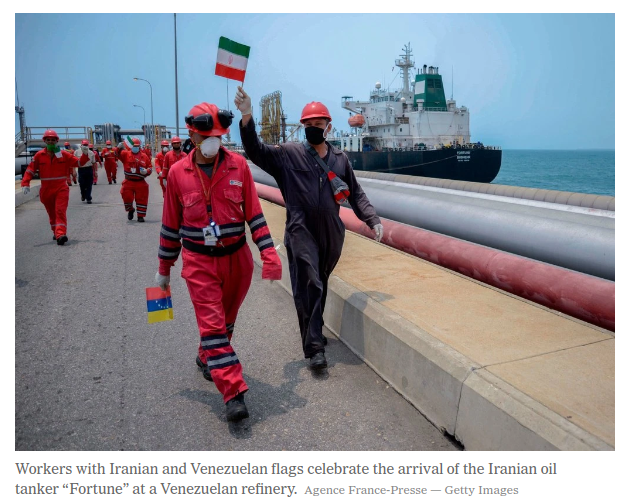
3 – Resistance victory. Gaza siege broken. Three years ago, Iran, under US sanction, sent an oil tanker to Venezuela, also under US sanction. People from both countries (and many others) watched the progress of the tanker on the web and wondered whether the US was going to start a naval battle and a war. The tanker got through, and it was the first of many.
When the siege on Gaza is finally broken, it will probably be by an Iranian cargo ship sailing in. At the moment, that particular path to ending the siege is blocked by three US aircraft carrier groups.
There may be others I have missed. But likely it will be some combination of these three that plays out over the medium term.
Rebuilding after genocide
We cannot know how far the genocide will go and we have a very small room to maneuver to try to work toward stopping it. I told you at the beginning I’m not here to support or condemn but I am anti-genocide, it remains a durable political commitment of mine.
In the long term, Palestine will recover as others have. Vietnam, where the US killed 2-5 million people, is thriving today. More recently, the genocidal war on Yemen led by Saudi Arabia and with full US and UK (and Canadian etc.) participation, started in 2015, is now basically over, in what looks like a permanent ceasefire mode. There, too, there was a famine created by a blockade, uncounted dead, tens of thousands of whom were children. The people of Yemen suffered immensely, and for a long time it seemed hopeless – the idea that Yemen could answer the far greater weaponry and resources of fully Western-backed Saudi Arabia seemed far-fetched. Today the pro-Palestine demonstrations in Yemen are some of the biggest in the world (they always were).
Was the collapse of the international gold standard – established in 1873 – in 1914, a sure sign that war was coming? Was gold a “peaceful metal”, as Michael Hudson has argued? Does the history of finance and money, tied up with states and war, provide a theory of everything? We go way back to Greek and Roman times and forward all the way to 1914, drawing insights from modern monetary theory (MMT), Indian Political Economy (IPE), advocates of debt-free money creation (notably Stephen Zarlenga), to follow the rise and fall of the gold standard and of bimetallism. It’s a weird world mostly ignored by mainstream economics. But not by Civilizations!
In the August 2023 edition of In Real Time with Stan Cox (yes I know it’s September) we talk about his dispatch, “The Hubris of Plutocrats”, and the escape fantasies (and condos) of the super-rich. Stan argues they can’t escape the heat that’s coming, but at least some of our troubles stem from the fact that they think they can.
The cornucopia of antimaterialist ideologies in North America are just flavors of right-wing magical thinking
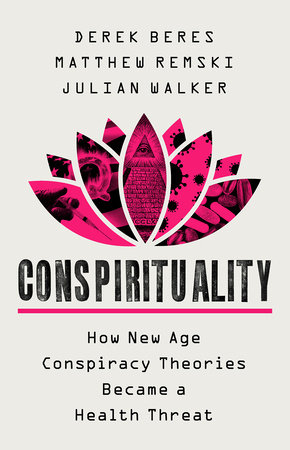
Review of: Conspirituality by Julian Walker, Matthew Remski, and Derek Beres. Penguin Random House. June 2023.
“Conspirituality” refers to a mix of spirituality, New Age thinking, yoga and wellness (I would add martial arts), and political conspiracy theorizing. The book has a focus on anti-vaccination campaigns during the COVID-19 pandemic, but it goes beyond health and explains something important about how politics have evolved in both Canada and the US in recent years.
The book is a valuable resource to explain to people how their families and social groups have divided during COVID-19. Despite politics being a generally taboo topic in mainstream North American society, during long crises, like wars, big political changes, or the pandemic, political conversations are inevitable. People discover the politics of their friends and loved ones. Friendships break up, family ties are strained, and you begin a search for answers about how your friends went down these rabbit holes.
As you try forensically to find out what happened, know that your friend’s rants are not really about them believing ever more esoteric beliefs. Other people’s beliefs always appear exotic, after all, especially when they’re unverified or unverifiable, as spiritual and religious beliefs are. Your friend’s rants are the rhetorical gestures of someone who is leaving one group, one social ecosystem (yours), for another. Conspirituality beliefs, like Kevin Simler wrote about advertising, are about social signaling more than they are about brainwashing.
The politics of conspirituality run deep
I mentioned that in North America, political conversations are mostly taboo and that could be because people figure it’s better not to know, the better to get along. Avoidance usually is politely accomplished by saying something like, “I’m not really a political person.” But conspiritualists are not merely beyond politics: they claim to be beyond earthly concerns altogether.
Don’t believe it. Conspirituality is hyper-political and the politics of conspirituality, as the authors use the term, run far deeper than they appear. The movement against vaccine mandates didn’t stand down after the mandates were repealed – that movement is bigger now than it was when there were vaccine mandates. It is a movement that has a special hatred for public health measures, yes, but it also has:
its own philosophy of knowledge
Its own media network
A political economy including a durable source of revenue and livelihood for its leaders
Politicians and business leaders in high places
Social groups and organizations meeting in person and on the web day in, day out, 365 days a year.
It is a major social and political phenomenon, with deep roots: at least a movement, it is perhaps better understood as a religion whose many adherents are willing to make major sacrifices – to their social, financial, and health lives – in the name of what they believe. In the name of their own freedom, they are also willing to impose the consequences of their beliefs on others.
It’s necessary to understand these core beliefs, beyond the wide array of details. Its leaders use a well-established right-wing trick of using language co-opted from the left, emptied of its original content, then redeployed. From the women’s movement for abortion rights, they call for “bodily autonomy” and “the right to choose”. But though they claim to despise liberals, they assert above all the liberal politics of individual property asserted against state control and of individual rights asserted against the collective.
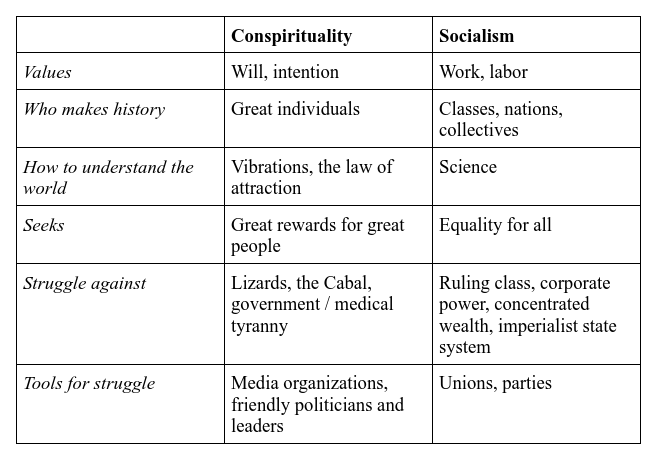
What makes their movement distinctive and gives it a religious character is that it goes beyond individual rights and assigns non-materialist, super-powers to the individual will – to heal, to acquire wealth, to change the course of history. In the same breath, the movement assigns non-materialist blame to the individual – for being poor, sick, or powerless. In their world, everybody gets what they deserve. It’s allocated by the universe. All that states, collectives, or public action can do is engage in immoral redistribution – from the undeserving to the deserving.
Reading the description above, listeners of the Civilizations Series (e.g. our episode about Nietzsche) will start to discern patterns in today’s conspirituality movement that look a lot like the belief systems circulating in England, its colony, India, its former colony, the US, and its greatest admirer, Germany, at the end of the 19th century. The triumph of the will. Contempt for the collective. Fear and loathing of state action. The belief that the majority are sheep, natural slaves. The belief that there is a non-material power to the individual will. That the unfairness we see around us is actually fair, indeed optimal. You can call it many things. A hundred years ago it would have been Nietzschean or Theosophical. Today, as the book documents, it’s conspirituality and QAnon. Another word that sums it up? Anticommunist.
Because what is communism? A system that values not individual will and intention for individual reward, but collective work for social benefit. A system that is willing to seize private wealth to allocate resources to public goods (yes, including health care and education). A system where there are no masters and slaves, natural or otherwise. A belief system that is materialist and scientific, that seeks to understand the relationship between human volition and the historical and physical realities in which we make our choices.
After WWII, the US violently took up the leadership of the struggle against communism in all its forms (even modest social democratic reforms in remote parts of the world and pre-1917 forms of Indigenous, “primitive communism”). But before WWII, the great anticommunists were Nazis and Fascists, and before them, the great anticommunists were various kinds of Nietzscheans.
Understanding conspirituality as a flavor of anticommunism makes possible some quick sorting. Suddenly the dense jumble of talking points changes from an incomprehensible muddle to simply one of a few possible variations on a few key themes.
The actual book
The authors of Conspirituality, Derek Beres, Matthew Remski, and Julian Walker, were members (victims? survivors?) participants in yoga-based or other similar cult-like conspirituality organizations, have researched cults, and currently run a podcast talking to people who have been in and out of these kinds of organizations. The book includes both journalistic and historical investigation, and skillfully weaves the experiences of the authors and their guests through the narrative. Through their critique of the right-wing and their defense of science and of public health care specifically, the authors identify themselves as being on the left: to me they read like social democrats with interests in both electoral work and grassroots activism.
I worried as I read the beginning of the book: when liberals write about conspirituality and related movements, they often end up defending the indefensible. In the liberal world view, deportations, assassinations, police worship and corporate giveaways are bad when Trump does them but fine when Obama/Biden does; liberals have an imperialist focus on the crimes of official enemies, etc. But there was very little of that in this book.
There are real conspiracies
I was perhaps even a bit defensive in Chapter 2 when the authors outlined “three pillars of conspiratorial thinking, as laid out by the political scientist Michael Barkun.” These pillars are: “Nothing happens by accident. Nothing is as it seems. Everything is connected.”
Reading this critique of conspiracism I remembered Michael Parenti’s lecture on “Conspiracy and Class Power”, Lance deHaven Smith’s book, Conspiracy Theory in America, or comedian Ron Funches, who asks: “You don’t believe in any conspiracy theories? I understand not all of them, not most of them, but you don’t believe in any conspiracy theories? You think the government’s just batting a thousand and telling us the whole truth? That’s a strong stance to take.”
Because there are conspiracies, and dismissing all conspiracy theorizing is a gift to imperialists, who, after all, spend enormous amounts of money and resources on covert operations. But the authors of Conspirituality acknowledge that there are real conspiracies: “real conspiracies”, they write, “are discovered through evidence”. From Chapter 1 they note that there are real-world conspiracies – and that conspiritualists actually blur the lines between real conspiracies (like Epstein’s sex-trafficking ring) and spurious ones (which they discuss and refute in their book).
Their analysis is brutally honest, going well beyond a simplistic defense of the liberal establishment. In Chapter 6, “Conspiritualists Are Not Wrong”, they discuss the vacuum created by privatized health care, into which the alternative health & wellness community seeps in. Conspiritualists, they write, “are attuned to systemic problems. They have felt their existential angst insulted by lifestyle marketing, and their humanity reduced to consumer data. They have felt the cold neglect of the state, the vacant stare of the medical gaze, and the brutal rise of rents…”
They continue: “Conspirituality does not create its followers’ nausea at the state, modernity, or the poisoned chalice of techno-capitalism. It does not create real-world disasters such as the Jeffrey Epstein sex trafficking network (a reality that makes QAnon reasonable on a symbolic, if not factual, level). It does not create histories of genocide, nor does it create histories of governmental cover-up.”
No indeed, these are all real things that the conspiritualists take political advantage of.
The political economy of wellness and conspiracy
In Canada, the public system is under attack and has been brought to the point of collapse, with privatization being incrementally brought in as a “solution” to the engineered crisis. In the US, which has no public system, getting sick means facing bankruptcy. Even Americans who thought they had good private insurance find themselves with surprise, ruinous bills after routine procedures or emergencies. At every stage people who need care are faced with actors who have incentives to stop them from getting that care. What is available through the privatized (or semi-privatized) health system is expensive, bureaucratized, frightening, and humiliating. For anyone who can promise an alternative path to good health that does not lead through this system, there are opportunities.
Because scientific and evidence-based medicine is only accessible through financialized insurers and plans, the alternative paths work on everything else. Many of these are good practices: exercise, breathing, going outside, eating healthy, and of course, nutritional supplements. Some, like yoga, include exercise and breathing but also get people together for social activity, another healthful practice in itself. Some are big business, multi-level-marketing schemes and corporate behemoths in their own right.
The capture of US health care by private insurers is one side of the political economy of conspirituality; the business of selling online and in-person yoga, lifestyle, spirituality and train-the-trainer courses and nutritional supplements is the other side.
The number of actors in the conspirituality space that sell supplements came as a shock to me. Alex Jones sells supplements. Jordan Peterson’s daughter sells supplements. The book exposes many other figures – people who have sexually abused their yoga students, ran cults, defrauded clients, and enriched themselves while making unscientific claims. And all of them sell supplements! I remember reading some Big Tech executive lamenting that “we’ve made the world a dystopia so that we could get people to click ads.” If you read Conspirituality, you’ll be horrified at what’s been done to sell nutritional supplements.
Combine the drive to sell supplements and online courses with the marketing of these products in an attention economy where more extreme claims outcompete less extreme ones and you get an incentive structure for ever-more outrageous theories. These are outlined in gory detail in the book.
By diving into the history of yoga, the authors also pull out links to eugenics. Yoga is less an ancient practice of wisdom and more an amalgam of 19th-century physical culture. Europeans certainly got much of their culture, including physical culture, from Asia (I am convinced that catch wrestling, for example, developed in Lancashire around the same time as British colonialism in India’s most rapid advance, and from which other wrestling traditions followed, was a cross-pollination of local wrestling tradition with Indo-Persian pehlwani / kusti) but the borrowing went the other way too. Yoga was an outgrowth of a Swedish gymnastics movement and heavily influenced by a genocidal German eugenicist bodybuilder who changed his first name to Eugen to reflect his interest in human perfection.
This guy called himself Eugen Sandow, but he was born Freidrich Wilhelm Muller. His birth name didn’t have enough eugenics in it for his taste.
Purity of breath, purity of movement, purity of exercise, and purity of diet: these were all eugenicist beliefs that are also woven inevitably into the fabric of today’s multi-billion dollar wellness industry / movement. In the gospel of prosperity, in the law of attraction, everyone gets what they deserve. In the eugenics movement, that includes genocide for the racially inferior or impure. As India goes fascist, yoga is its standard bearer in North America.
The authors map every major star in the conspiritual constellation: Joe Rogan, while he doesn’t get his own chapter, is described as
“the Walmart Supercenter that opens up on the access road to a midsized town. It’s enormous. It’s open late. It dries up the mom-and-pop shops in town. Parking is easy. You can buy anything there in a low-cost, frictionless consumer experience. But usually, you can’t tell where the product comes from, and you won’t know its quality until you get it home and use it.”
Robert F. Kennedy Jr’s anti-vax campaigns get their own chapter, as they describe how RFK pivoted from a “big-picture environmentalist fluent in geopolitical intrigue and corporate malfeasance” whose anti-vax moves collapse the big picture into
“a single medical-sized issue. His expertise on the imperiled global environment shoehorns down to an obsession with the individual body—especially the child’s body—as its symbolic victim.”
For a leftist, such figures really are always the same. They are pushed onto our screens by the algorithm with some kind of reputation for speaking hard truths and being uncontrollable mavericks. We investigate. Before long, every single one of these mavericks kiss the ring of the pro-Israel lobby and reveal that their loyalty is first to colonialism and only secondarily to any other maverick cause they might have or hard truth they might want to speak.
[And before you tell me, yes I know that Rogan’s had Abby Martin on to talk Palestine. I also find him likeable, ok? As the authors write, Rogan’s “sheer volume of content resists any final word on Rogan’s personal political values or worldview on reality”. But over time, the authors continue, “his guest list has trended… into parroting right-wing talking points about quarantine, Biden, guns, and culture war moral panics. He emphasized his values shift in an interview about moving his business from California to Austin. “I moved to Texas because I want fucking freedom.”]
The simple “triumph of the will” pattern beneath the bewildering details
The authors lampoon conspiracy theorists for believing everything is connected. But their very book provides a framework for simplifying the bewildering details that present as an incredible diversity of beliefs and systems: life coaching, yoga, the law of attraction, aliens, lizards, crystals, vegan diets, buddhism, theosophy, QAnon, antivax. The authors very effectively point out the connections between these.
And I can add that these are all just different flavors of Nietzscheanism, of anticommunism. They are belief systems that can find ample financial and political support on a continent where health care and science have been almost fully subordinated to profit and corporate power. They are ideologies and organizations appropriate to struggle against the main demands of socialists: health and education for all. Didn’t the Nazis, the most extreme anti-communists, build out a science of racial hygeine to “cleanse” science of socialist baggage? Didn’t they build out their own Nazi version of environmentalism, to keep the earth unpolluted of inferior chemicals and inferior races, even as they poisoned and destroyed everything in their path?
Liberal and right-wing politics are complementary anti-socialist strategies. Liberal anti-socialists show up with professional charts and hyper-educated agents of austerity to explain why such demands are infeasible. When socialism is shown to be feasible, there are movements of the right who are willing to fight, kill and even die, out of the belief that science-based measures are the real killers.
As I mentioned in my last post, before I learned (from Losurdo, Horne, and some others) what liberalism really was, I used to believe that there was some kind of possibility of reconciliation between liberalism and leftism. I’ve come to the conclusion that the core beliefs of liberalism in private property, constraints on state powers of redistribution and public action, and in-group democracy were designed as ideologies of colonialism and imperialism. They’re not compatible with anti-imperialism.
Conspirituality and me
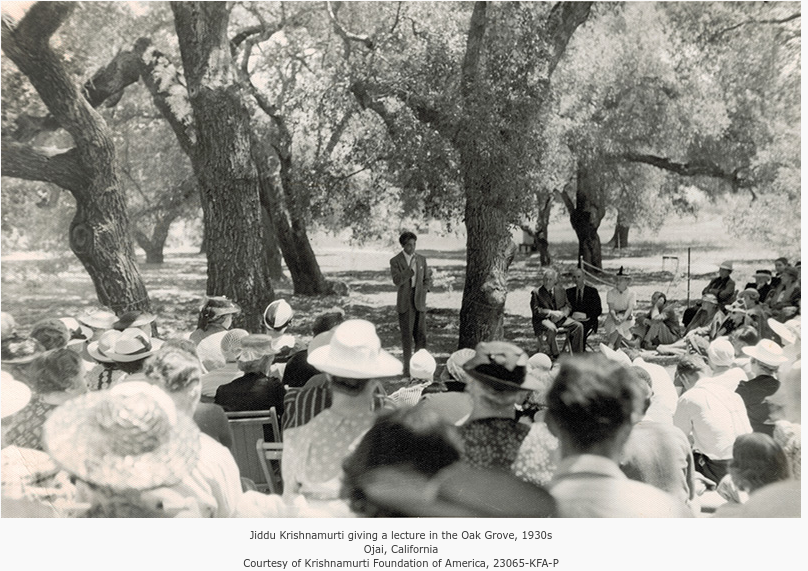
What about spiritual beliefs? Can they be reconciled with leftist aspirations? As a teenager, I actually had my own fascination with spirituality. On a page of Bruce Lee’s Tao of Jeet Kune Do, I found the name “J Krishnamurti” on a list under the heading “Mental Training”. I became an avid reader of Krishnamurti’s books, dialogues, and lectures. His dialogues with (rogue) physicist David Bohm influenced my decision to make one of my majors physics (the other was history, as listeners know).
Krishnamurti lecturing. Who wouldn’t want to listen to an enlightening lecture under the trees?
Krishnamurti counsels detachment of the ego, of not projecting one’s own ideas on to other people or situations, of experiencing the moment fully, of not carrying baggage from the past or expectations for the future into the moment. As I started to read more political writing (starting with Gandhi, who met Krishnamurti and they didn’t get along), I wondered if this kind of “mental training” could help in political work. I don’t think it can. Indeed, Krishnamurti’s notebook of dialogues with visitors to one of his retreats contains a dialogue with a communist that goes nowhere – there is an unbridgeable gulf between them as they talk past one another.
Many years later, I read a book about Krishnamurti by the daughter of his business partner (also the daughter of the woman with whom Krishnamurti had a lifelong affair, known to her husband the business partner – and yes I read the Krishnamurti foundation’s reply to the book too). Learning a bit about how Krishnamurti actually lived, I realized how poorly these lessons translate for anyone who has to actually live in the world, even someone who’s life was deliberately sheltered the way Krishnamurti’s was. Krishnamurti, who was waited on by people who believed in his saintly status, could not live the life he preached. How could his preaching help someone who has to figure out a livelihood, relationships, how to work ethically and try to contribute to making the world a better place?
As tools for specific situations, focusing on the present and letting go of the ego are useful. As an approach to living? Much less so. Detachment from daily life and from the material world isn’t desirable or possible. Disconnection from the future and past ends up meaning you can’t understand what happened or plan what to do next. With apologies to Bruce Lee, this is the opposite of “mental training”.
And this is true when you look at the sayings of Krishnamurti, who is among the most benign of these figures. As with liberalism, so with conspirituality: there’s no reconciling it with a leftist world view.
Indeed, while I think I understand North America a bit better after reading it, the book has given me new worries. It seems there is a grassroots insurgent movement with deep roots, plenty of resources, friends in high places and in the police, that is opposed to public health and to science. In the unlikely scenario that a government comes to power in North America that wants to improve those things, it will have to contend with that movement.
I’m still going to exercise, pay attention to nutrition, go outside, breathe, and be an environmentalist, and so should you. If Lenin could learn weightlifting, so can I, dammit.
Leftists can’t afford to concede wellness to the right. We can’t concede conspiracy theorizing to the right either.