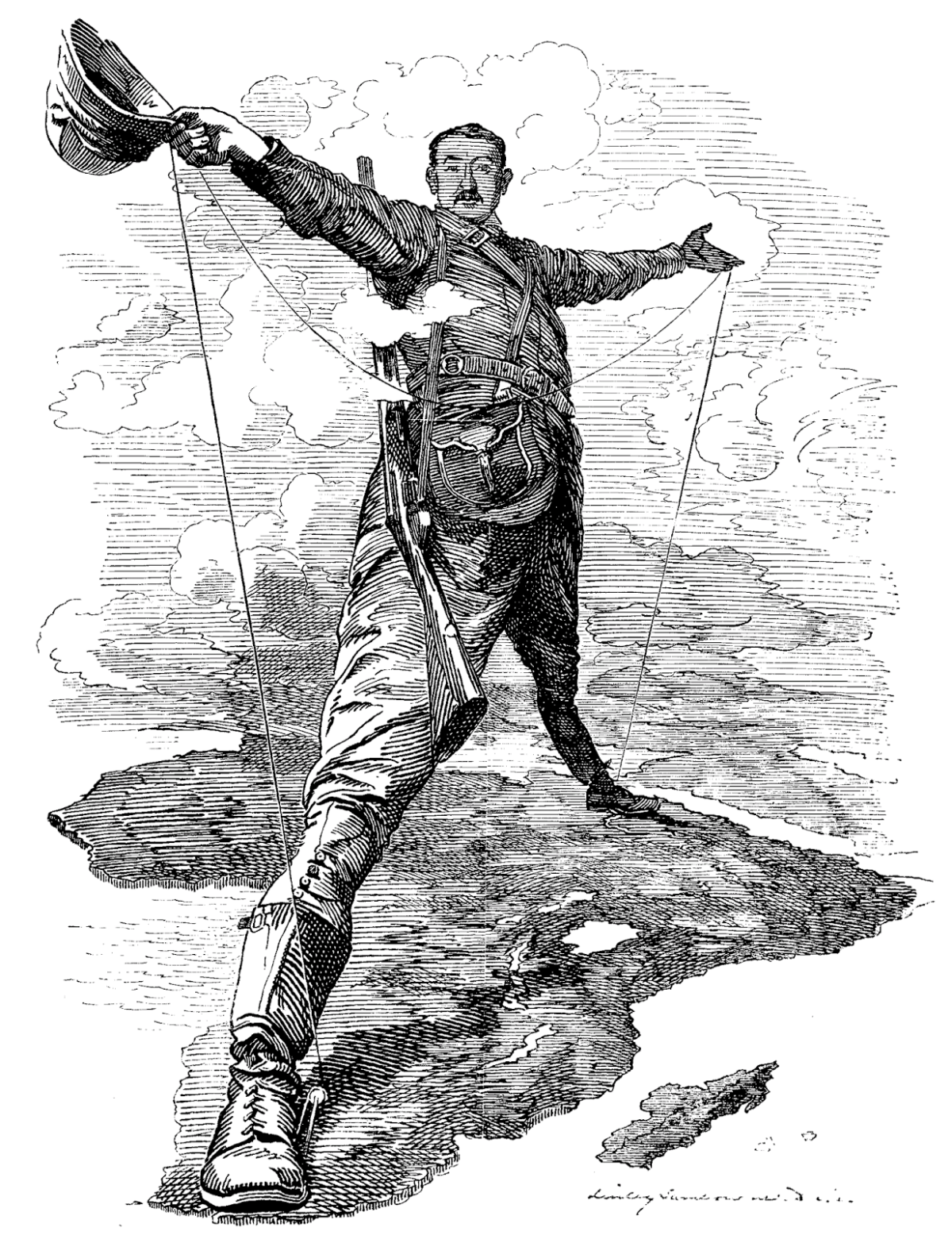
The Scramble for Africa cannot be encapsulated in the career of any single imperialist, but if it could, that imperialist would be Cecil Rhodes. From the Rhodes Scholarship to the falling statues, Rhodes’s impact is still ubiquitous today. We look at the words and deeds of the exemplar of the Scramble, from his beginnings to the Jameson Raid which made the Boer War inevitable.
Scramble for Africa 9c: South Africa pt3 – The Boers before the War
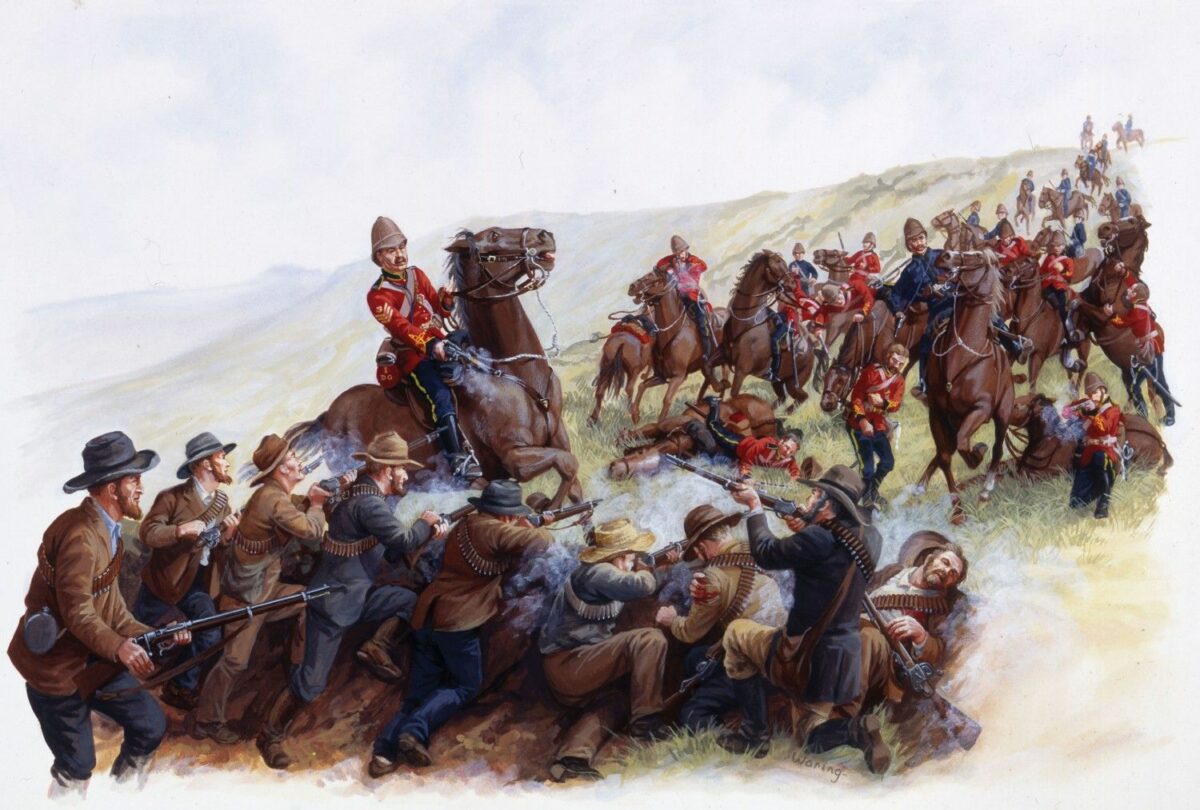
Continuing the history of the Scramble for South Africa, we talk about the Boers, the Dutch settlers and their attacks on the Africans and then on the British conflicts with them, up to the discovery of diamonds at Kimberley that might just be the event that set off the entire scramble. South Africa’s unbelievable mineral wealth and what it did to British imperial minds; who’s responsible for apartheid; and more, in this episode.
Scramble for Africa 9b: South Africa pt2 – The Zulus from Shaka to Cetshwayo
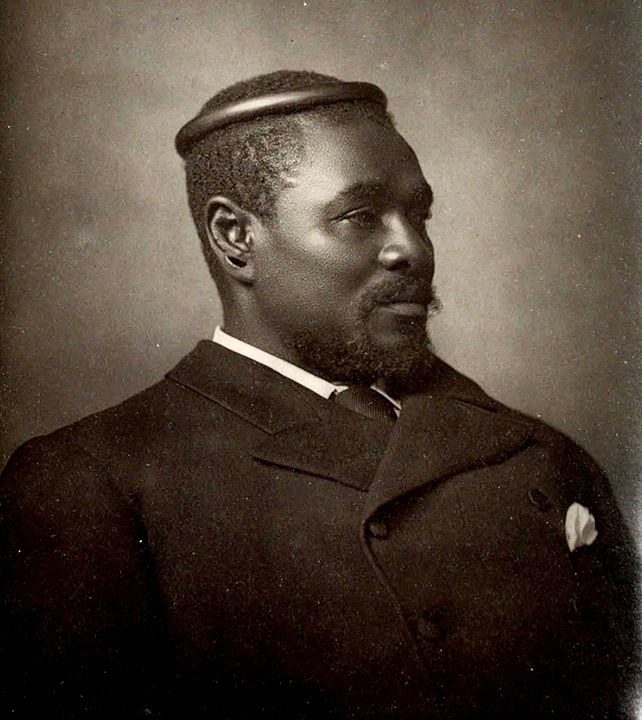
Part 2 of our series on the Scramble in South Africa takes us back to the Zulu modernizer, Shaka, in the early 19th century, all the way to the end of the Anglo-Zulu War between the British imperialists and the Zulus ruled by Cetshwayo. The land theft and swindling you’ve come to expect from the Scramble for Africa combine here with some sharpening of white supremacist ideology, a lot of which it turns out was developed specifically to find a theory of how and why the British Empire should settle and rule South Africa.
Why you should subscribe to Dan Freeman-Maloy’s anti-racist substack
View this email in your browser
The holidays are approaching
With the holidays approaching, I suspect you must be thinking, “what encyclopedically researched anti-racist newsletters are there that I could subscribe to?” Well, you are in luck. Dan Freeman-Maloy’s substack, Check the Liner Notes, has come out with another newsletter and will be writing regularly. Support his work by subscribing. Maybe gift a subscription to a loved one (who loves to read long, well researched newsletters).
In other news, Dave Power and I are continuing our Scramble for Africa series, please check that out as we’re 10 episodes in with much more to come. And on Africa, I had an 8,000 word article about Rwanda (reviewing a new book about Rwanda) in Covert Action Magazine (in case your appetite for long-reads hasn’t been sated by Dan’s newsletter).
But here’s a sample from Dan’s latest: https://freemanmaloy.substack.com/p/what-does-the-white-mans-burden-mean
What does “the White Man’s Burden” Mean? by Dan Freeman-Maloy
December 1, 2021
The phrase “the White Man’s Burden” is, syllable for syllable, probably the most iconic thing ever written in the English-language history of racism. But what does it mean?
In short, it means gaslighting. The concept of gaslighting has moved into discussions of empire and racial myth from the field of relationship psychology. Fittingly, the term is adapted from a play, Gas Light, set in late Victorian England. The British Empire in the late decades of Queen Victoria’s reign (1837–1901) was a powerhouse of gaslighting the likes of which the world has rarely seen. One of its gifts to the world was the slogan, “White Man’s Burden.”
In 1955, in his inimitable Discourse on Colonialism, Aimé Césaire warned against getting too caught up in changes in imperial surface language, in his time or in ours. “Don’t let the subtleties of vocabulary, the new terminology, frighten you,” he said; “be reassured! At the start of the journey it may seem a bit difficult, but once you get there, you’ll see, you will find all your baggage again. Nothing will be missing, not even the famous white man’s burden” (p. 60).
Guidance of that sort seems to me too invaluable for us to forget.
For now, I reproduce the below as a follow-up to my last research note, “On Swastikas & Research Method.” In coming posts, I will dig deeper into the racially coded imperial myths that German wordsmiths tried to keep “unbewusst” (unconcious), that English wordsmiths tried to keep “inductive” (see my last note), and which Kipling boldly celebrated as “the lies I tell.”
Taking up the “White Man’s Burden” in Dixie
We can start with the Ku Klux Klan.
The single most accomplished Klan publicist of all time, Thomas Dixon, was a big Kipling fan. Dixon spent the early years of the twentieth century promoting Klan hatreds in a series of popular books. He entitled the first of these books in a double homage to Kipling, The Leopard’s Spots: A Romance of the White Man’s Burden (1902). While Dixon’s subtitle declared the selflessness of white-power politics, his title echoed one of Kipling’s tales of anti-Black racism.
These lies carried power and prestige. After the abolition of slavery in the United States, the terror squads of the Klan did not work in isolation. Their violence was the cutting edge of the white backlash. But it had wider support. The horror of lynchings, then, was inseparable from the wider U.S. assault on Black people after emancipation. This assault on Black life now stands exposed as “one of the most stupendous efforts the world ever saw to discredit human beings, an effort involving universities, history, science, social life and religion” (p. 55). Dixon helped to push it forward, doing his utmost to boost the worst white supremacists’ morale and reputation.
Dixon’s title, The Leopard’s Spots, took its cue from one of Kipling’s children’s stories, “How the Leopard got its spots” (1901). For twelve decades, this story has served as a tool of racist acculturation for any teachers or parents willing to resort to it.
The moral of the story is that dark skin is an irremediable, even a contagious, human fault. Kipling seized upon a phrase that was translated as follows in the King James Bible: “Can the Ethiopian change his skin, or the leopard change his spots? then may ye also do good, that are accustomed to do evil.” Kipling used this imagery to instill a hateful sense of anti-Blackness in the minds of all children who could be made to read along or listen.
Once upon a time, Kipling begins, “everybody started fair.” We will return to this word, fair. Then came darkness. Kipling taught (teaches?) children that darkness came to the leopard when “the Ethiopian put five fingers together . . . and pressed them all over the Leopard, and wherever the five fingers touched they left little black marks.” This is from Kipling’s Just So Stories. My copy, reprinted in 2000 by Penguin, features a leopard’s tail dangling provocatively across the cover.
You can see above how our cultural mainstream continues to gaslight. And in Klan terms, you can see why Dixon appreciated Kipling. The bogeyman of “race-mixing” or “miscegenation” was a favourite lynchers’ theme. Kipling’s story played it up.
Once again, however, the full title of Dixon’s book was The Leopard’s Spots: A Romance of the White Man’s Burden. And where Kipling really excelled was in the transition from the theme of the title of Dixon’s book to the theme of its subtitle, that is, from anti-Blackness to romantic white innocence.
This brings us back to the word “fair.” Modern English investors owed an enormous proportion of their wealth to the exploitation of Africans.1 English dictionary-writers were thus eager to make the virtues of whiteness a matter of definition. Little wonder that in standard imperial English, “fair” was a moral as well as a physical description. “Light as opposed to dark,” the Oxford English Dictionary explained, was one of the word’s meanings. But for the OED, to be fair was not only to be free of physical spots – “Clean, unsoiled, unstained” – but also to be clean in “character, conduct, reputation: Free from moral stain, spotless, unblemished.”2 This story was told by generations of well-financed experts in barrels of Oxbridge and Ivy League ink.
Now, Kipling celebrated the English racialist as a “Puzzler” in tribute to this history of deception. But here we encounter a mild contradiction. On the one hand, Kipling celebrated racial mastery as the property of Englishmen above all others. He never tired of this theme: “the English – ah, the English! – they are quite a race apart.” On the other hand, Kipling layered Englishness into a wider white supremacy. Racism is always a pack of lies – but its contradictions are not random.
Kipling’s supreme lie was that white-power politics are a generous service to non-Europeans targeted by empire. This is the key point. The equation of whiteness with selflessness, and of imperialism with charity, was the central theme of Kipling’s gaslighting. But for a moment, let us pick apart the more basic theme, “whiteness” . . .
. . . or not. In his classic bit about the “Romanian cracker” (timestamp 45:11), Chris Rock expressed a hilarious dismissal of the niceties internal to whiteness; “we don’t got time to dice white people up into little groups.” The point is as fair as it is funny, and I ask those impatient with the dicing to please skip the next section.
Details on Kipling’s supreme lie – white-power-as-charity – can be found below, under the heading “Don’t run. We are your friends.” But for those with the patience, let us first look for a moment at the specifically English or Anglo-Saxonist racism around which white nationalism really did develop.
White nationalism and the “Anglo-Saxon’s burden”
Paul Martin, Jr., featured in the photo above, modelled the “White Man’s Burden” with a sense of heritage. It was autumn 2004, and this Canadian prime minister was visiting Haiti to confirm Canada’s support for the overthrow of Haiti’s elected government and the repression of Haiti’s main mass-based political party. Enter the Globe and Mail, the principal newspaper of central Canadian capital.
Kipling could not have written it better. The Globe did not mention the name of the girl featured in its photo, whom it identified only as “a resident of the Timkatec orphanage in Port-au-Prince, Haiti.” But it found a way to present Martin’s cynical power politics as charity. Proud, prime ministerial fingers are shown directing a Haitian forearm to wave a Canadian flag for the camera.
With Martin, all ambiguity is removed. This is not Johnny-come-lately whiteness but the thing itself, in all of its vintage prestige. But let us step back for a moment. Just who and what is “white”?
In earlier centuries, some claimed that Englishmen possessed this title almost alone. “The number of purely white people in the world is proportionably very small,” Benjamin Franklin wrote from Pennsylvania, in the days when it still fell under British rule. Franklin continued:
All Africa is black or tawny; Asia chiefly tawny; America (exclusive of the newcomers) wholly so. And in Europe, the Spaniards, Italians, French, Russians, and Swedes are generally of what we call a swarthy complexion; as are the Germans also, the Saxons only excepted, who, with the English, make the principal body of white people on the face of the earth. I could wish their numbers were increased.3
So for this racial storyteller, some of the Germans – the “Saxons,” i.e., those from Saxony – made the cut, as did the English, who according to modern racial lore were “Anglo-Saxons.” But that was about it.
The question of whether any very poor person could be considered fully white lingered for centuries. By the late nineteenth century, a leading French racialist, Gustave Le Bon, could also crudely gender his standard racist tropes. Le Bon wrote that even among the “superior races” of his imagination, “as among the Parisians, there are a large number of women whose brains are closer in size to those of gorillas than to the most developed male brains.” It was old wine in new bottles.
That is the basic story of racism: the recasting of old oppressive hierarchies in new naturalized forms. “The vulgar, primitive, over-simple racism,” observed Frantz Fanon, “purported to find in biology – the Scriptures having proved insufficient – the material basis of the doctrine.”4 Ergo, European Christendom was the best, and its rich better than its poor, and its men better than its women, etc., etc. Own enough universities and such self-serving prattle can be made to sound pretty. Plus ça change.
Meanwhile, the U.S. led the way toward white nationalism. Toward the end of Benjamin Franklin’s life, the U.S. break with Britain meant that British nationality was no longer in play. Congress invited all “free white persons” to become U.S. nationals. A whiteness including various European nationalities emerged, defined against an Indigenous and Black foil. Generations of racialist experts argued that to include more white people was to broaden the basis for white racial power over others. John Van Evrie, a Canadian-born white supremacist, was especially enthusiastic about this point.
After abolition, Van Evrie cheered on Klan violence from New York. He summarized his argument in an 1870 book entitled, White Supremacy and Negro Subordination: Or, Negroes a Subordinate Race, and (So-Called) Slavery its Normal Condition. What Orwell never really taught us was that slavery = freedom is above all a white lie, even if English patriots prefer to call it a red one.
For Van Evrie, “can’t we all just get along” was a battle cry for white-power hatreds. He wrote: “The Englishman believes that the English are alone truly Christian and civilized; the Frenchman honestly believes that La Belle France is at the head of modern civilization; even the advanced and liberal American Democrat thinks, and perhaps correctly, that the Americans alone are truly civilized.”5 Van Evrie’s message was that all white-on-white rivalry or violence was wasted energy, better poured into the unified violence of anti-Black and imperial politics.
So anti-Black and imperial violence defined the “White Man’s Burden.” But whiteness needed first to be made in order to be used as a weapon. In Kipling’s work, readers will thus find a dual commitment to white power and to Anglo-Saxon power. This logic was explicit. It was spelled out in Kipling’s day by the most influential U.S. racial theorist of the period, William Z. Ripley.
Visiting Britain in 1908, Ripley told his hosts that Kipling’s “burden” should really be split into two, especially in North America. Yes, Ripley insisted, it was great for the British to plunder India, for the Klan to gallop across Dixie, and for the U.S. army to devastate the Philippines. But white nationalism needed special attention. Ripley said:
You have your ‘white man’s burden’ to bear in India; we have ours to bear with the American negro and the Filipinos. But an even greater responsibility with us and with your Canadian fellow-citizens is that of the ‘Anglo-Saxon’s burden’ – to so nourish, uplift and inspire all these immigrant peoples of Europe, that in due course of time . . . the torch of Anglo-Saxon civilization and ideals, born by our fathers from England to America, shall yet burn as bright and clear in the New World, as your fires have continued to illuminate the old.6
Like all white supremacist theory, this was nonsense, but it was nonsense with a logic. Ripley was spelling out a program that combined the primacy of British conservative social norms – and the English language – with the pan-European demographic and striking force sought by Van Evrie.
Those who do not care about Canada should now really skip to the next section. But strictly speaking, while Ripley bracketed Canada together with the U.S., the situation here was a little different. In this case, there was no break with the British Empire: a specifically British dominance endured. Until the 1940s, there was not even a specifically Canadian citizenship. Canadians were officially classed as British imperial subjects. Relatedly, in celebration of this imperial connection, British Protestant sectarian groups like the Orange Order (do sample some Fenian-blood–lust) retained power at the expense of white nationalism as such. Not until after World War II was Canada’s British imperial connection painted over.
This brings us to Paul Martin, Sr., father to the twenty-first century Canadian prime minister. In 1946, it was Martin, Sr. who introduced the Citizenship Act for Canada. Thenceforth, Martin declared with white ecumenism, Canadians would be more than British nationals. Martin said: “No matter where we come from or what our origins, French, English, Scandinavian, Scottish, Ukrainian, Irish or whatever else, one thing at least we can all be, and that is Canadians.”7 In this telling, the story of British or dual British–French nationality gave way to a story of composite Canadian whiteness.
In a master stroke of hypocrisy, this record was then removed from the field of popular education and debate. Organized confusion is the upshot. “The truth,” one candid historian wrote as early as 1981, “is that we are a very confused people. We have invented for ourselves a false national identity to conform with the historical myth of Canadian nationalism which we have created from very little hard evidence.”8
Granted, layers of multiculturalist paint have since been applied to the old Canadian social structure. But specialists agree that the appearance is altogether misleading. It now falls to a few academics to joke at the expense of those of us who were kept in the dark about Canada’s imperial foundations. One quips: “To paraphrase Kipling, ‘What should they know of Canada who only Canada know?’”
It will take work to free these quips from specialists and develop a popular anti-racist discussion grounded in the historical record – as distinct from amnesiac national branding. What is meanwhile plain is that the strongest local traditions of gaslighting could not have developed in a few decades, or even in a few generations. They are as vintage as a Rosedale wine cellar. As C.L.R. James warned: “That calm confidence in its capacity to deceive is a mark of the mature ruling class.”
“Don’t run. We are your friends”
Finally, we return to Rudyard Kipling. So long as his mockery remains obscure, the roots of contemporary racist gaslighting are likewise hidden.
Hollywood put Kipling’s politics to film in its 1996 spoof, Mars Attacks! The film features a Martian invasion of earth. The invaders claim with a poker face that they come in peace. It is the plainest lie. But the confusion it causes on the part of earthlings is too convenient for the Martians to abandon. So even as the invaders raid and kill, they stick to the script. In one scene, satirized Martian shock troops storm a US street, firing their weapons while professing their innocence: “Don’t run. We are your friends.”
Eight decades before the spoof, Kipling’s take on this story was played out in India. It was then, in 1919, that the British Brigadier-General Reginald Dyer fired 1,650 rounds of live ammunition – by his own estimate – at Indian demonstrators who had dared to gather in public in their own country against British wishes. To think that British rule in India was ending, Dyer explained, was to be guilty, and the sentence against the crowd was open massacre. “I fired and continued to fire,” he boasted. “If more troops had been at hand the casualties would have been greater in proportion.”
Crucially, Dyer maintained that this massacre was an act of friendship to India – as British rule always was – and that Indians “ought to be thankful to me for doing it.” Kipling could only nod at his pupil’s wisdom: “He did his duty as he saw it.”9 The tradition of Kipling and Dyer was a tradition in which first-person compassion was asserted as an article of faith, all facts be damned.
What was empire, so the story went, if not a gift to those it conquered? Kipling joked about this ruse in an early poem entitled “Et Dona Ferentes,” from the proverb, “Beware Greeks bearing gifts.” Kipling made it clear to his readers that even the fiercest exploitation and hate should be made to sound kind, or at least kept quiet. In the idealized racist of Kipling’s poetry, “the hard, pent rage ate inward,” before striking out with sharp violence and then disappearing without a harsh word. Such was the mastery of the imperial figure whom Kipling idealized as the Puzzler: “When his lips are schooled to meekness, when his back is bowed to blows – / Well the keen aas-vogels know it – well the waiting jackal knows.”
In sum, Kipling’s “The White Man’s Burden” was an ode to the waiting jackal.
Kipling was a product of the British imperial community that ruled India, which had been wrapping the gift of empire in Dyer’s manner for generations. Empowered by its Atlantic exploits, Britain first broke through resistance to its advance in India in the eighteenth century. What followed was the plainest plunder. In the words of one English historian, “No eighteenth-century nabob, as the plunderers of India were called, pretended that he laboured for the benefit of the Indians. He laboured in order to become a millionaire.”10 Over time, the means became more subtle, but the profits continued to flow. By 1932, a British author could forget Kipling’s script and spell it out in dollars and cents. “It has been computed,” he wrote, “that every fifth man in Great Britain is dependent, either directly or indirectly, on our Indian connection for his livelihood.”
The Big Lie that British rule was a gift to India was a fateful and world-destructive joke. Never has wealth flowed from one country to another as wealth flowed from India to Britain during the colonial period. The scope of what happened is suggested by statistics published by the Organization for Economic Cooperation and Development (OECD). In 1700, on the eve of British expansion, India contributed nearly a quarter of the world’s Gross Domestic Product (GDP) against three percent for Britain. By 1870 India’s share had been cut in half while Britain’s had tripled. By late Victorian times, Indians were dying of famine while British wealth poured into universities that celebrated white fairness as an article of faith.
Kipling argued that the lessons of British India generalized: white power the world over should be wrapped as a gift from Europe to the rest of the world. This was the meaning of his poem, “The White Man’s Burden.” Kipling coached his readers to stick to the script, à la Mars Attacks! Proclaim white-power selflessness, Kipling told his readers; whatever the facts, say it again and again: “By open speech and simple, / An Hundred times made plain, / To seek another’s profit, / And work another’s gain.”
In the Canadian North-West as in India, colonized people were reeling from famines that the British authorities had ruthlessly exploited. Pretend, Kipling mocked, that empire comes to the colonized with no attacks and no malice, just bundles of food and medicine: “Take up the White Man’s burden – / The savage wars of peace – / Fill full the mouth of famine / And bid the sickness cease.”
Kipling aimed to define colonial oppression out of existence – white power equals charity equals white power – and in this way to make anti-colonial resistance to oppression a logical impossibility. One can resist oppression. But one cannot resist charity. To resist charity is not resistance at all: it is ingratitude, insolence. In anti-colonial resistance, Kipling therefore coached, racists should refuse to see anything but “The blame of those ye better, / The hate of these ye guard.”
But why would the bearers of empire’s gifts be blamed in the first place? Why would racists receive anything but thanks for, say, the friendship they would show in Jallianwala Bagh, or in Canadian residential schools? Kipling answered with six syllables of carefully crafted hate. He declared that colonized people were “Half-devil and half-child.” The phrase is sharpened to purpose like a knife’s edge. On the one hand, it restates the case for imperial tutelage: if colonized people are racially immature, so the story goes, then they must, in empire’s manner, be taught a lesson. On the other hand, the charge of demonic immaturity makes room for righteous hate even within empire’s educational mission. The result is a self-righteousness fitted to a cruelty both pious and profitable.
By the early twentieth century, Britain’s Lord Cromer could only smile. Cromer sat on an enormous family fortune from the trade in enslaved Africans. Then, without returning a dime, he helped to lead the Scramble for Africa. And after all of this, he felt confident demanding not only the continued European exploitation of Africans, but also their thanks. “Even the Central African savage,” Cromer quipped, “may eventually learn to chant a hymn in honour of Astraea Redux, as represented by the British official who denies him gin but gives him justice.” The mockery is astounding.
After Dyer, pushing Anglo-Indian friendship to its classical conclusions; after Cromer, marketing false humanitarianism as profitable (see the link immediately above); and after Kipling, with his pride in the “waiting jackal” – after all of this, the politeness of the powerful has lost all benefit of the doubt. Hateful words can be terrible. But silence can say just as much. All this time later, there is every reason to make Kipling’s warning the baseline for decent thought and action: “oh, beware my country, when my country grows polite!”
Canada in Haiti: A retraction
I conclude with a retraction.
Some time ago, I wrote that Canadian policy in Haiti combined professed good intentions with oppressive policies. I began one article, now a decade old: “Over the course of the past decade, Canada’s leading officials and most prestigious commentators have learned how to approach Haiti in the spirit of cynical power politics and racist condescension (or worse) while maintaining a posture of national self-flattery.”
At the time, I did not know the precedents. But the claim that this dates to the first decade of this century is wrong. It is much older. In fact, empire’s twenty-first century arguments on Haiti were anticipated even by that distant imperial icon, Henry Dundas, whose legacy has loomed so large in the public architecture of Toronto.
Notwithstanding the error, that brief article does unpack the context for the ghastly Haiti photo featured above. You can refer to the article here.
The exploitation of Africans and their overseas descendants was a fulcrum of English and then British economic development throughout the modern period. The details are poorly publicized but well documented. Eric Williams, who went on to serve as the first prime minister of Trinidad and Tobago, established this point as early as 1944 in a landmark study available here <https://archive.org/details/capitalismslaver0000unse>. A fuller review of the record can now be found in Joseph E. Inikori, Africans and the Industrial Revolution in England: A Study in International Trade and Economic Development (Cambridge: Cambridge University Press, 2002).
Henry Bradley, A New English Dictionary on Historical Principles, Vol. IV, edited by James A.H. Murray (Oxford: Clarendon Press, 1901), 26.
As quoted in Matthew Frye Jacobson, Whiteness of a Different Color: European Immigrants and the Alchemy of Race (Harvard, Ma.: Harvard University Press, 1998), 40.
Frantz Fanon, “Racism and culture,” in Toward the African Revolution, translated by Haakon Chevalier (New York: Grove Press, 1967), 36.
J.H. Van Evrie, White Supremacy and Negro Subordination: Or, Negroes a Subordinate Race and (So-Called) Slavery its Normal Condition (New York: Van Evrie, Horton & Co., 1870), 67.
William Z. Ripley, “The European population of the United States,” Journal of the Royal Anthropological Institute of Great Britain and Ireland (38 (1908), 240.
As quoted in Sunera Thobani, Exalted Subjects: Studies in the Making of Race and Nation in Canada (Toronto: University of Toronto Press, 2007), 89.
John E. Flint, “Reflexions on British Imperial and Canadian History,” Canadian Journal of African Studies 15, no. 1 (1981), 53.
As quoted in Derek Sayer, “British reaction to the Amritsar massacre, 1919–1920,” Past & Present 131 (1991), 146 & 158.
A.J.P. Taylor, “Conquerors and profiteers,” in Essays in English History (Harmondsworth: Penguin, 1976), 30.
AEP 100: Debriefing the Indian Farmers’ Victory with Navyug Gill
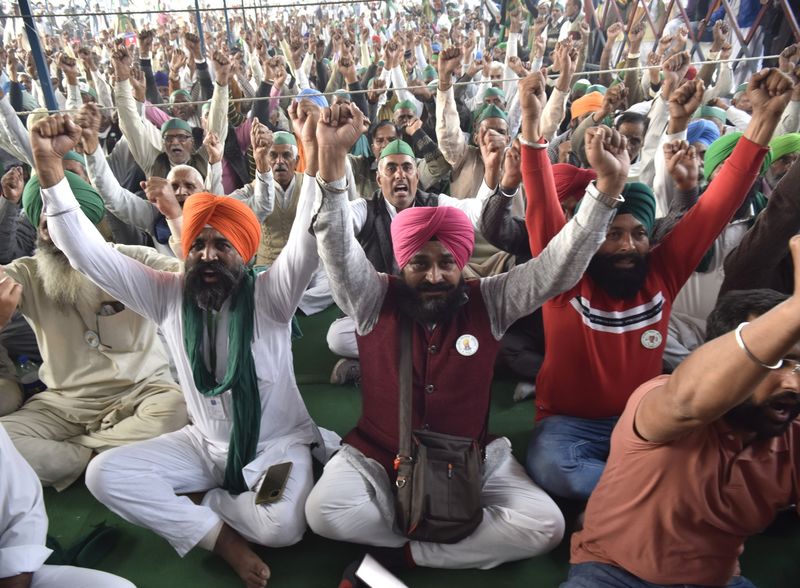
I’m joined by Navyug Gill from William Paterson University to talk about the historic victory of the Indian Farmers who, after demonstrating for a whole year at the cost of 750 lives, succeeded in forcing the repeal of three laws that would have immiserated agriculture in India, done away with the government procurement system, and subjected the entire agricultural system to new levels of instability and volatility. Instead, the farmers stopped the seemingly unstoppable Modi juggernaut. We talk about how they did it and what might come next.
Scramble for Africa 9a: South Africa pt1 – Frontier Wars and Settler-Colonialism
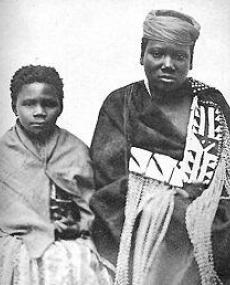
The wealthiest and most powerful state in Africa is South Africa, and its fate has been pivotal to the whole continent. This was no less true during the Scramble for Africa, which is why this series will have multiple episodes on South Africa. In this one, the so called “frontier wars” between the Europeans and the Xhosa; the Cattle Killing Movement; how the Cape Colony fell into British hands, the Boers and the British Empire, the Dutch East India Company, Canada and other analogies…
The New Deal, Racism, and War
View this email in your browser
Why do they call it a Green New Deal? What was the New Deal?
[Last year I was lucky enough to be invited by Harpreet Kaur Paul and Dalia Gebrial to submit a discussion on the international dimensions of the Green New Deal, and I thought I’d use it as a way to discuss the original New Deal, and its historical (imperialist) context. My punch line was we might do better to think in terms of Green Five Year Plans than Green New Deals. In any case, The Ecologist Magazine republished the essay, which had originally appeared in an edited collection published by the Rosa Luxemburg Stiftung. In case you missed it, here’s the essay — Justin]
https://theecologist.org/2021/oct/04/new-deal-racism-and-war
The original New Deal, and its champion, Franklin D. Roosevelt, are credited with saving the US economy from the Great Depression – and perhaps preventing the country from adopting ‘socialism’.
The New Deal is the inspiration behind the contemporary call for a Green New Deal. But its history is remains contested. The story is told in Stan Cox’s recent book The Green New Deal and Beyond.
Planning
In 1932, US unemployment was at 24 percent. The New Deal started by designating $3.3 billion for public works, an amount larger than the entire federal budget just three years before.
Roosevelt created new agencies to try to steer private industry into a gentle, voluntary form of economic planning.
In 1935, the Supreme Court struck down one of these initiatives – the National Recovery Act. But that same year, the New Dealers started a Works Progress Administration (WPA) that hired eight million unemployed Americans to build public infrastructure.
The New Deal also took place in a time of unremitting white terror towards black people in the US south. The New Deal programmes helped cement racial inequalities. Federal relief agencies paid locally prevailing wages, allowing lower wages in the US south.
Black sharecroppers’ government benefits were kept by their white landlords. White plantation owners would receive federal compensation for cotton extracted from land, and then turn around and evict the black tenants that worked the land anyway.
Social Security did not cover farm workers or domestic workers – the occupations that employed two thirds of black workers.
Spending
The Federal Housing Administration (FHA) required banks to perpetuate segregation: “If a neighbourhood is to retain stability, it is necessary that properties shall continue to be occupied by the same social and racial classes,” the FHA underwriting manual instructed.
Despite this, the New Deal faced elite opposition, and so Roosevelt reduced stimulus funds by 25 percent between 1936-8. Unemployment went back up to 19 percent.
In the end, the New Deal was not the answer to the Depression. That answer came in the form of a war: first supplying Europe, then sending the US military to world war two (WWII).
According to Patrick Renshaw the US spent $321 billion on WWII, more than its total spending from 1790-1940. Unemployment fell to 1.2 percent.
Imperialism
The New Deal took place in the age of imperialism. India, Africa and much of southeast Asia were colonies. The Philippines and Cuba were US possessions. Other lands that the US had taken – Puerto Rico and Hawaii – still are.
In the Arab world, the British sponsored the House of Saud, dismantled and subordinated the economies of the Levant and Egypt.
By the time of the New Deal, the US empire was pushing the British empire out of the fossil fuel-rich Middle East.
In 1945, Roosevelt met the Saudi king at Great Bitter Lake in the Suez canal, moving Saudi Arabia into the US’ system.
What economists Jonathan Nitzan and Shimshon Bichler call the “weapondollar-petrodollar” global economy was established.
Stimulus
The Saudi dictatorship would ensure that the price of oil would favour the US, which would get back what it paid for the oil in weapons sales.
The hundreds of billions of dollars of sales of military hardware would be conducted in US dollars, the reserve currency of all the world, which enabled the US to print money and accumulate wealth at the expense of every other country.
While ending fascism was necessary, it paved the way for a US economy built on conflict. It is an empire based on endless war and fossil fuels. Climate change is just one of its life-destroying consequences.
Underpinning this system is a regime of permanent US warfare that has killed millions in the decades since the New Deal, including the dropping of nuclear bombs on Japan, the high-tech destruction and aerial bombardment of Korea, Vietnam, Grenada, Panama, Iraq, Yugoslavia, Afghanistan, Palestine, Lebanon, Libya, Syria, Yemen and other countries, covert operations in every country in the world, and the imminent threat of nuclear catastrophe.
In making the US the wealthiest society in human history, the stimulus of the New Deal played a much smaller role than the stimulus of WWII.
Protection
The long-term wealth of the US was guaranteed not by either stimulus, but by the consolidation of a global empire with the US at its centre.
Given this context, can the New Deal be divested of its racist and imperialist baggage and reinvented to save the world from climate catastrophe?
At the end of The Green New Deal and Beyond, Cox suggests a series of ways that a Green New Deal could include justice for the financially and energy-impoverished peoples of the world.
This starts not with greening the US military, as Elizabeth Warren suggested on the US campaign trail, but with disarming and dismantling it, as well as the militarized police in the US, both of which are disastrous fossil fuel consumers while also being implicated in persistent human rights abuses.
Protecting and expanding Indigenous land bases, as discussed in documents like Red Nation’s Red Deal or the work of the late Arthur Manuel, will not only redress some of the horrors of colonialism, but also reduce carbon emissions from land use.
Constraints
In some places – like Haiti or the Democratic Republic of Congo – the use of energy will actually have to increase for there to be any economic justice.
If we are going to have to discard baggage one way or another, internationalists might find more interesting experiences and tools from a study of the Five Year Plans of communist China and the Soviet Union and of India when it was socialist, some of whose experiences have been discussed in Salvatore Engel di Mauro’s new book, Socialist States and the Environment.
These countries’ economies and polities have had many flaws, and their planning processes have had many errors, all of which have been amplified by Western propaganda as efficiently as the West’s colonial genocides and massacres have been minimised by the same.
But it may be productive to study how vast, poor countries devastated by imperialism tried to plan for development within severe constraints – including the hostile US empire.
Lin3r Notes 1: On the racist who wrote “Lest We Forget”
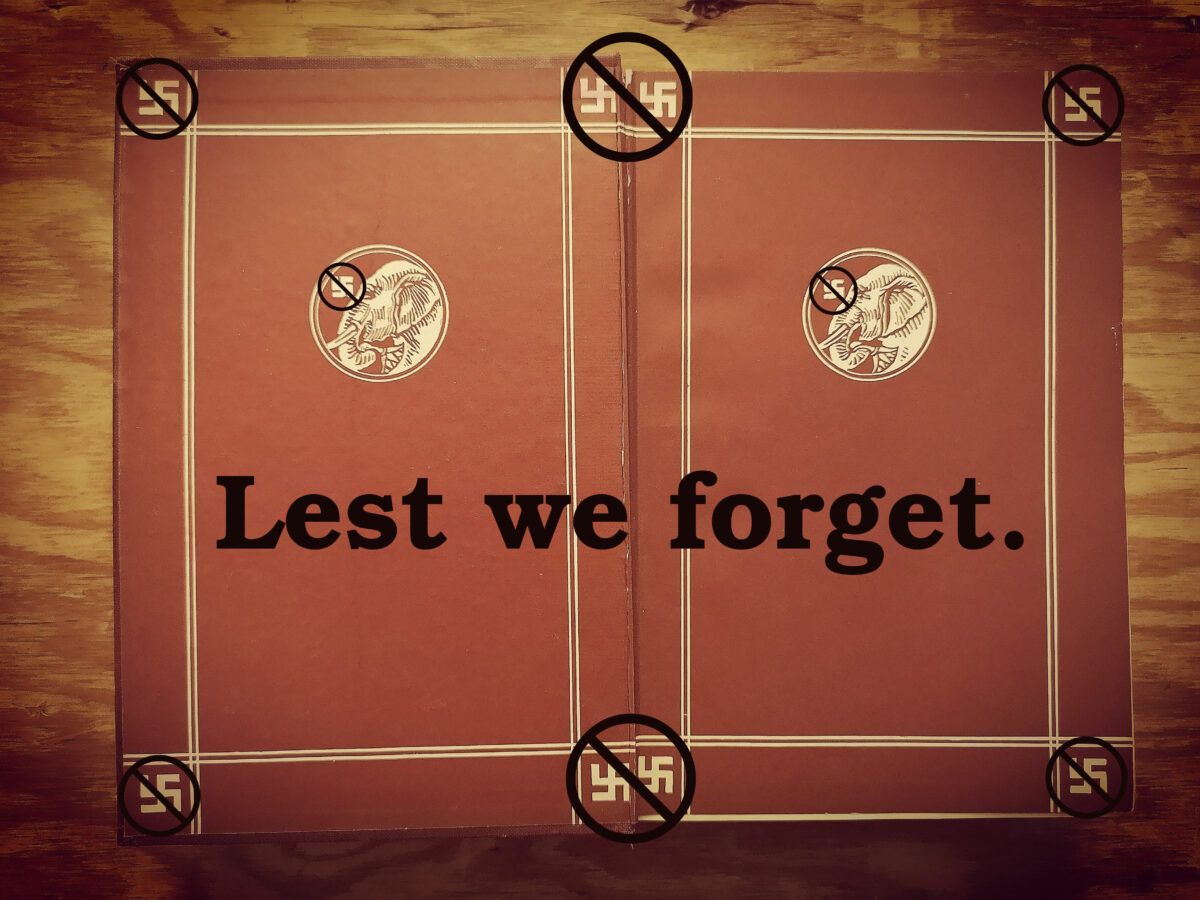
Episode 1 of Dan Freeman Maloy’s series Lin3r Notes. Frequent guest and collaborator Dan Freeman-Maloy (@lin3rnotes on twitter) has a new substack, “Check the Liner Notes” (https://freemanmaloy.substack.com/), and will be podcasting on related topics here on AEP. This episode is about the Canadian / British imperial WWI commemoration, Remembrance Day, and some of the literary objects around it: the poem, In Flanders Fields, the various versions of O Canada, and of course the phrase Lest We Forget, penned by the racist writer Rudyard Kipling. Dan’s newsletter and podcasts will be unraveling how British imperial racists used language – from deception disguised as “plain-speaking”, to co-optation of compassion towards in-group morality, and everything else – to fulfill their objective of, well, world domination. Having taught racism for so long, is a redirection against racism possible for our education system?
Scramble for Africa 8: Belgium Steals Congo
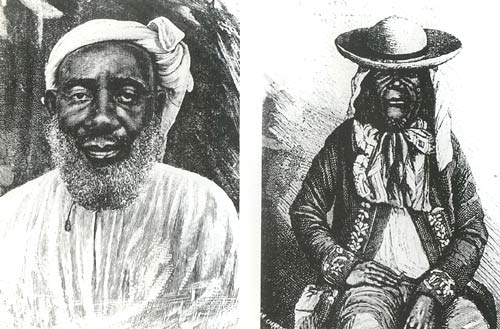

This one is about the precolonial African powers in the Congo – Zanzibar’s representative Tippu Tip, Msiri of Katanga, and a few others (but mainly these two). We talk about their rise in the context of growing European power, and their eventual fall to Belgium – although as you’ll see it wasn’t exactly Belgium, but Leopold II and his British and German allies that made the theft of Congo possible. Another key piece – the centre of the board – falls in the Scramble for Africa.
Article: sanctions as a weapon targeting development
View this email in your browser
Sanctions as a weapon targeting development
[What follows is a short article which I wrote for a US sociology of development newsletter – specifically, SECTORS: Newsletter of the American Sociological Assocation’s Sociology of Development section. I was asked to write it by Jeb Sprague, whose writing many of you probably know. This article appeared in the Fall 2020 edition and it occurred to me that it might be of interest to some on this mailing list as well.]
The United Nations is currently sanctioning groups in Somalia, the Democratic Republic of Congo, Sudan, Libya, Guinea-Bissau, the Central African Republic, South Sudan, Mali. Sanctions in Non-African countries include Iraq, Yemen, the Islamic State and al-Qaeda, the Taliban, Lebanon, and North Korea. The Security Council states that “since 1966, the Security Council has established 30 sanctions regimes, in Southern Rhodesia, South Africa, the former Yugoslavia (2), Haiti, Iraq (2), Angola, Rwanda, Sierra Leone, Somalia and Eritrea, Eritrea and Ethiopia, Liberia (3), DRC, Côte d’Ivoire, Sudan, Lebanon, DPRK, Iran, Libya (2), Guinea-Bissau, CAR, Yemen, South Sudan and Mali, as well as against ISIL (Da’esh) and Al-Qaida and the Taliban.” None of the sanctioned countries are developed countries to begin with – sanctions devastate their capacities for future development.
The UN says that “sanctions measures, under Article 41, encompass a broad range of enforcement options that do not involve the use of armed force.” The deadliness of UN sanctions, however, cannot be disputed. The sanctions regime imposed on Iraq after the US bombing of the country in 1990/1 was acknowledged to have killed 500,000 children by 1996, when Madeline Albright famously told 60 Minutes that she thought the price was worth it. Guttman et al. (2019) found that a UN sanctions episode lowered a country’s average life expectancy by 1.2-1.4 years, reduced the targeted countries GDP by 25%, increasing poverty and income inequality. The main mechanisms for this reduction: child mortality, cholera deaths, and decreased resources for public health spending. These aggregate statistics disguise some very grim specifics.
The list of countries under unilateral sanction by the US (or the US plus any coalition it can build for the purpose of punishing a regime) is much longer than the UN list – which countries the US sanctions as well. In addition, the US Treasury site lists financial sanctions details for the Balkans, Belarus, Burundi, the Chinese military, Cuba, Nicaragua, Syria, and Zimbabwe. Up until 2012, when Guttman et al. (2019) study period ended, unilateral US sanctions were less deadly than UN sanctions (shortening life expectancy in the targeted country by an average of 0.4-0.5). The deadlier sanctions are UN sanctions.
It is one of many paradoxes of today’s world order that the United Nations, the body responsible (through its Security Council) for the deadliest sanctions also produces the most eloquent reports (through its Office of the High Commissioner for Human Rights) on the ill effects of proliferating unilateral sanctions. The Special Rapporteur on Unilateral Economic Measures, Idriss Jazairy, has produced five reports on the matter to date. The latest (a report to the General Assembly presented July 5, 2019) specifies violations of human rights stemming from these sanctions regimes:
-
US sanctions against Iran violate UN Security Council resolutions, deprive Iranians of relief, have been complied with “unduly” by the European Union such trade has virtually collapsed between Europe and Iran. Sanctions have devastated Iran’s food security (Hejazi and Emamgholipur 2020), its health system and ability to deal with the COVID-19 pandemic (Takian et al. 2020), even its long-term scientific capacity (Butler 2019).
-
US sanctions against Cuba have “shattered” the normalizing relations that began in 2017, violate agreements between the US and Europe, and “exert a massive toll on the Cuban economy.”
-
US sanctions against Venezuela have played, in the colorful UN prose, “a non-negligible role in crippling the economy.” The rapporteur cites Weisbrot and Sachs (2019), who showed that tens of thousands of Venezuelans have died as a result of these sanctions, and millions have been displaced.
-
US sanctions against Russia, the rapporteur complains, “have unintended effects, including boosting the domestic (indigenous) capabilities of Russian industries and the agricultural sector to the detriment of Europe.” And also, sanctions have caused price increases that hurt workers.
-
Israel’s blockade against Gaza “constitutes collective punishment of the people of Gaza, contrary to article 33 of the Geneva Convention.”
-
The US and EU sanctions against Syria, openly proclaimed as being part of a strategy of “isolating the Assad regime”, “is a crude admission of disregard for the principles of the Charter of the United Nations, human rights and humanitarian law.” They have a “catastrophic impact on the Syrian economy and population.”
-
The US-UK-Saudi blockade on Yemen has the rapporteur noting “with concern that the flow of essential foodstuffs and other commodities into Yemen continues to be restricted de facto, even though the naval blockade was lifted after the UN Verification and Inspection Mechanism for Yemen was set up.” This is a particularly euphemistic, given the genocidal nature of the assault on Yemen (e.g. Bachman 2019).
Sanctions against Russia and China are part of a broader US strategy: with these sanctions, the US hopes to isolate targeted countries from potential sources of military aid (e.g., Russia’s aid to Syria) or investment (e.g., China’s investments in Cuba, Venezuela, Iran, or various targeted African countries). These sorts of US strategies can never be isolated from questions of international development. Sanctions regimes represent the most profound weaponization of development: targeted economic isolation to punish populations by inflicting mass mortality through starvation and preventable disease, all the while destroying future economic prospects.
References
Bachman, J. S. (2019). A ‘synchronised attack’ on life: The Saudi-led coalition’s ‘hidden and holistic’ genocide in Yemen and the shared responsibility of the US and UK. Third World Quarterly, 40(2), 298–316. https://doi.org/10.1080/01436597.2018.1539910
Butler, D. (2019). How US sanctions are crippling science in Iran. Nature, 574(7776), 13–15.
Gutmann, J., Neuenkirch, M., & Neumeier, F. (2020). Sanctioned to Death? The Impact of Economic Sanctions on Life Expectancy and its Gender Gap. The Journal of Development Studies, 0(0), 1–24. https://doi.org/10.1080/00220388.2020.1746277
Hejazi, J., & Emamgholipour, S. (2020). The Effects of the Re-imposition of US Sanctions on Food Security in Iran. International Journal of Health Policy and Management, 0. https://doi.org/10.34172/ijhpm.2020.207
OHCHR | Reports. (n.d.-a). Retrieved November 18, 2020, from https://www.ohchr.org/EN/Issues/UCM/Pages/Reports.aspx
Takian, A., Raoofi, A., & Kazempour-Ardebili, S. (2020). COVID-19 battle during the toughest sanctions against Iran. Lancet (London, England), 395(10229), 1035–1036. https://doi.org/10.1016/S0140-6736(20)30668-1
Weisbrot, M., & Sachs, J. (2019). Punishing Civilians: U.S. Sanctions on Venezuela. Challenge, 62(5), 299–321. https://doi.org/10.1080/05775132.2019.1638094