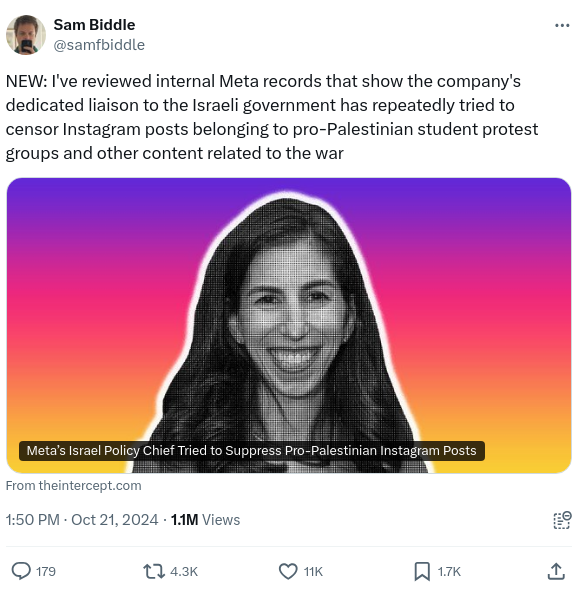
Reading about Meta’s Israel Policy chief the other day reminded me that there are real human racist decisions without which “algorithmic suppression” cannot happen. We are deceived by the idea that our screens are controlled by “algorithms”. Actually, they’re controlled by racists.
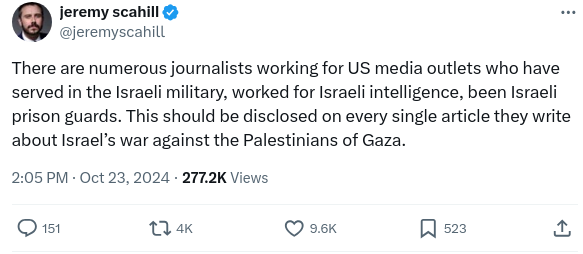
Tech executives working with genocidal governments decide which news items we can see on our screens: news editors decide what those items contain. CBC policy, BBC policy, and a revolving door between the Israeli military and American journalism, as Jeremy Scahill mentioned.
That’s why I never saw the point of the supposedly groundbreaking stories about Lavender AI or the Where’s Daddy algorithm for killing people in Gaza. Really? Is an algorithm driving the bulldozer over hundreds of people? Is an algorithm dressing up in dead women’s underwear, playing with dead children’s toys, and taking photos for dating sites?
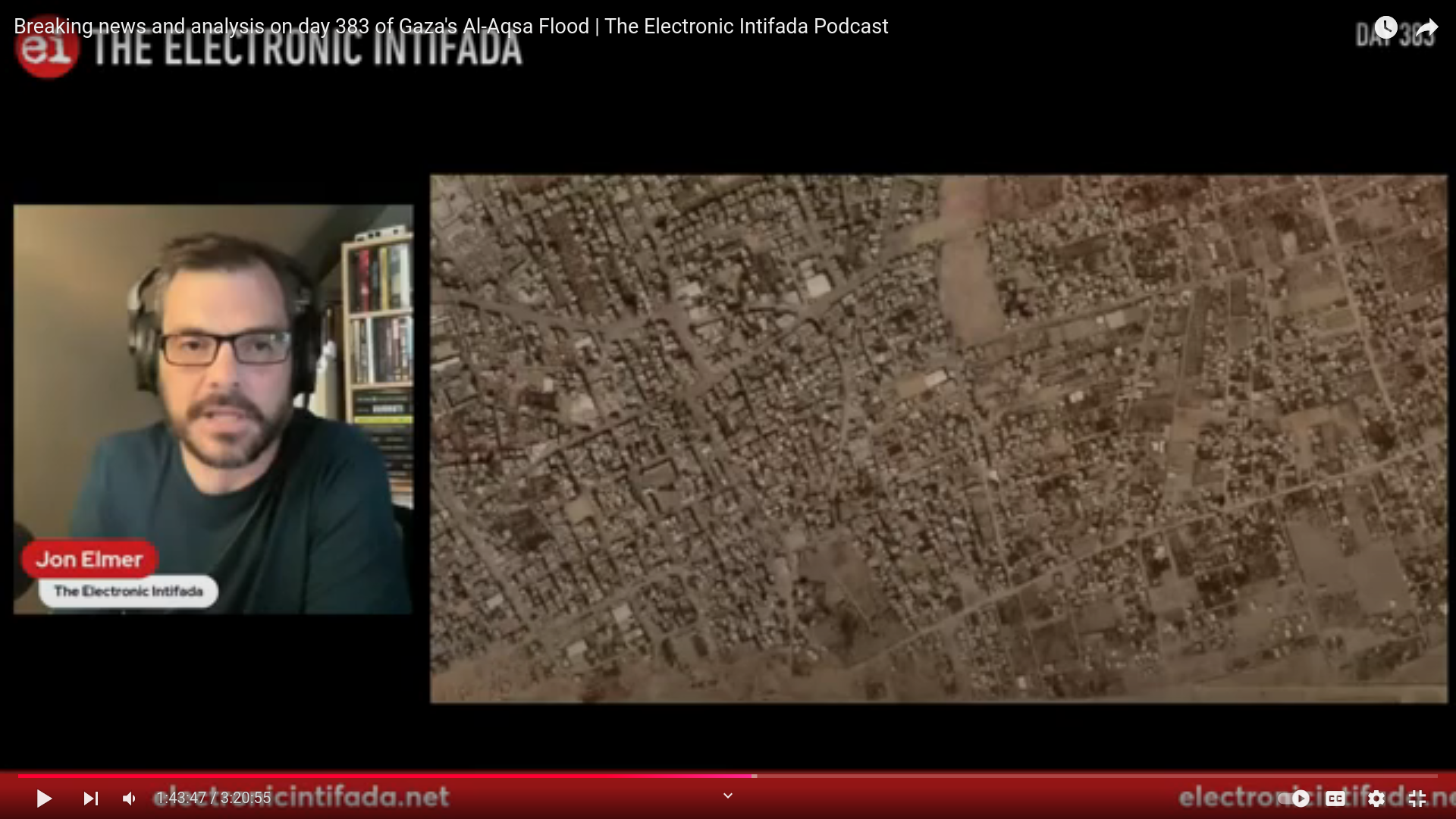
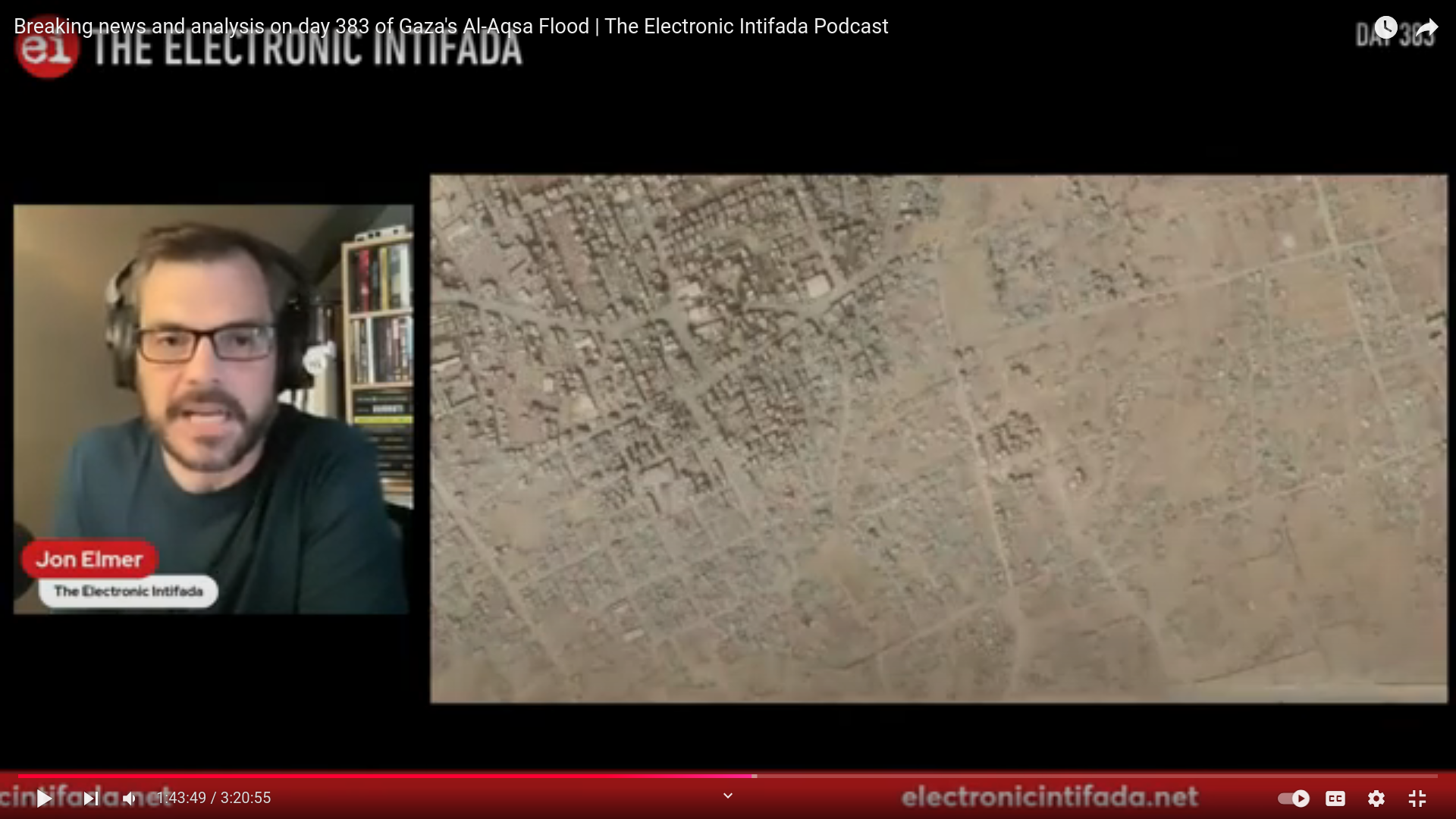
On today’s EI Livestream, Jon showed some aerial imagery from Rafah of before and after.
It’s not serious to think that any intelligence, artificial or otherwise, was applied in doing “targeting” that led to this destruction. We are talking about how many multiples of the Hiroshima nuclear holocaust’s worth of ordinance have been dropped on Gaza at this point (I think it’s around 4x now and counting). There’s no intelligent algorithm needed, only the sheer depravity to take the decision, the American bombs to drop, and the American planes to deliver them.
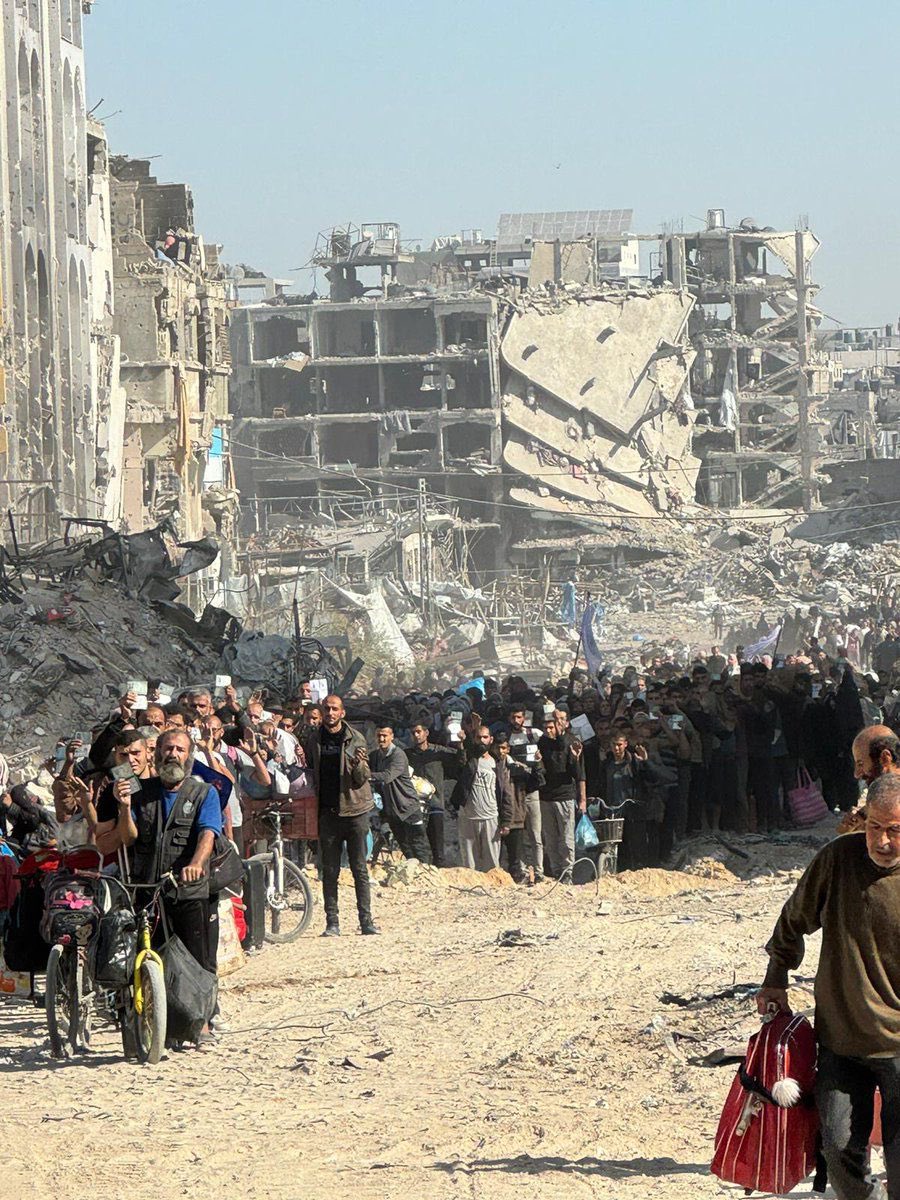
Well, that’s not all that’s needed. Because in north Gaza right now it’s a very intimate, hands on holocaust. In the Sde Teiman torture / death camp, it’s a hands on holocaust.
And according to a CNN story and an Israeli media story this past week (the latter written up in the Cradle), doing the genocide is driving the perpetrators crazy – so crazy that they can’t even talk about what they did in direct language, even in the expose. Instead of talking about the trauma of what they did, they talk about what they saw. Instead of talking about what they’ve become, they talk about being depressed and unmotivated. Their army psychologist tries to help them “normalize” the atrocities, but the subject of the CNN story killed himself. Can human compartmentalization be so total that you can commit mass murder and then retain the sense of the preciousness of life that you need to have relationships? Can racial supremacy really get you that far? It might not.
It’s a word I heard my whole life but I only bothered looking it up a few years ago: shibboleth, meaning a word that distinguishes one group from another. Speak for a few seconds and I’ll know from just a few words whether you’re pro- or anti-genocide.
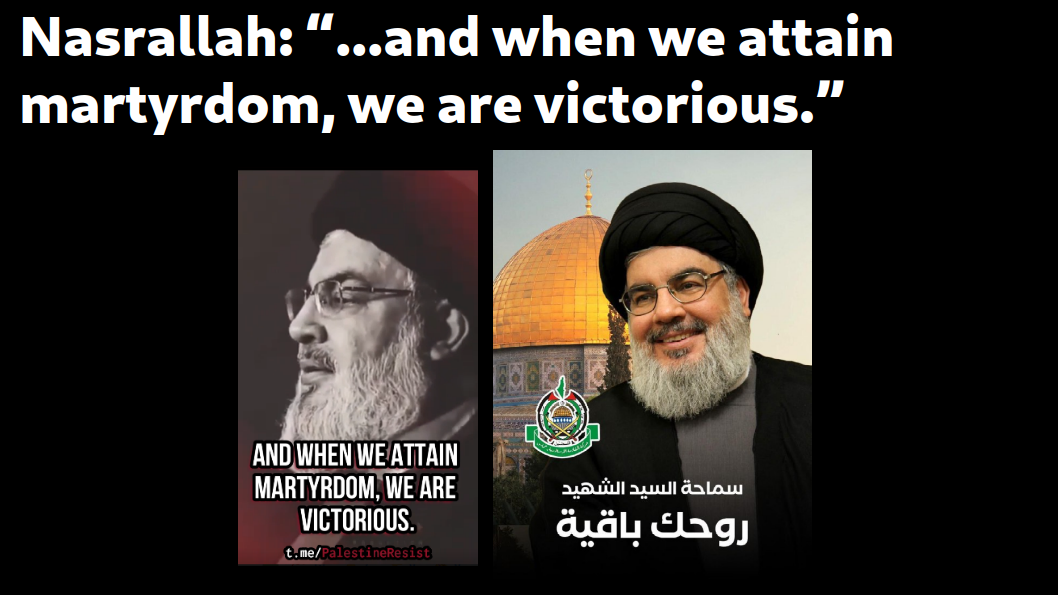
Anti-genocide shibboleths include using the word “genocide” to describe what Israel is doing; using the word “resistance” to describe the people fighting Israel; using the word “martyr” to describe someone Israel has killed.
Pro-genocide shibboleths include calling the victims “terrorists”, phrases like “Hamas embeds in civilian areas”, “Hamas uses human shields”, and repeating the lies about October 7th.
I wrote last year that as far as the pro-genocide and anti-genocide sides go, that as they reject our (facts) and we reject their (lies), that soon “there will be no reason to talk to one another and no desire on either side to do so.” We’re pretty nearly there – not sure about you but I get less and less from watching anti-genocide people go on debate platforms to have it out with the genocidals (usually with a genocidal or fake friend of the anti-genocide movement hosting).
It’s good to keep track of these shibboleths. Knowing them can help: on the anti-genocide side we need to learn to find each other quickly and recognize who’s a waste of time. There isn’t any time to waste. Every day that our efforts fail carries an intolerable cost.
On the messages sent between occupier and Resistance
Over the past year I have tried to focus on the military question in the expanding war / genocide the US / Israel has been waging on the Palestinians, Syrians, Lebanese, Yemenis, and Iranians. As figures from the Resistance have said and reiterated, the issue will be decided on the battlefield. And although struggle in all these areas has a role to play, the issue also won’t be decided in the feelings of the oppressor communities nor even in Western genocidal media, campuses or streets. Military affairs require extensive study, encompassing the particulars of weapons systems to topography and maps, to supply chains and logistics, to propaganda and morale. History is always the principal tool, but used with caution: the future is different from the past and the present is maximally dynamic.
The quintessential Western military theorist, von Clausewitz, the subject of a previous post of mine, described war as an extension of politics. Politics involves communication between enemies, and so does war.
Israel, and following it the whole West, has transformed itself over the course of the year. It presents itself as a new and different kind of opponent. All year I have wondered about the long-term consequences of such a voluntary self-transformation. Let us now focus on the image Israel is trying to project, how it communicates that new image, and how this will ultimately compel the Resistance to transform as well.
If you’ve followed the utterances of genocidal Western elites or of Israelis, you’ll hear a lot of pedagogical language. “The Yemenis are about to learn why we don’t have free healthcare”, said one memorable tweet. “We will teach them a harsh lesson,” a repeated theme. But what exactly is the lesson? If you were to ask an Israel advocate, they would say probably that the lesson is “don’t mess with Israel”, as Israeli bots like to add under anti-genocide posts on social media. But the strategic lesson Israel seeks to teach its victims is a bit longer. If it could be spelled out, it would be more like: We can do whatever we like to you, and if you resist we will make it even worse for you. That there are unimaginable punishments in store for those who resist is the most important lesson the oppressor, the abuser, wants to teach.
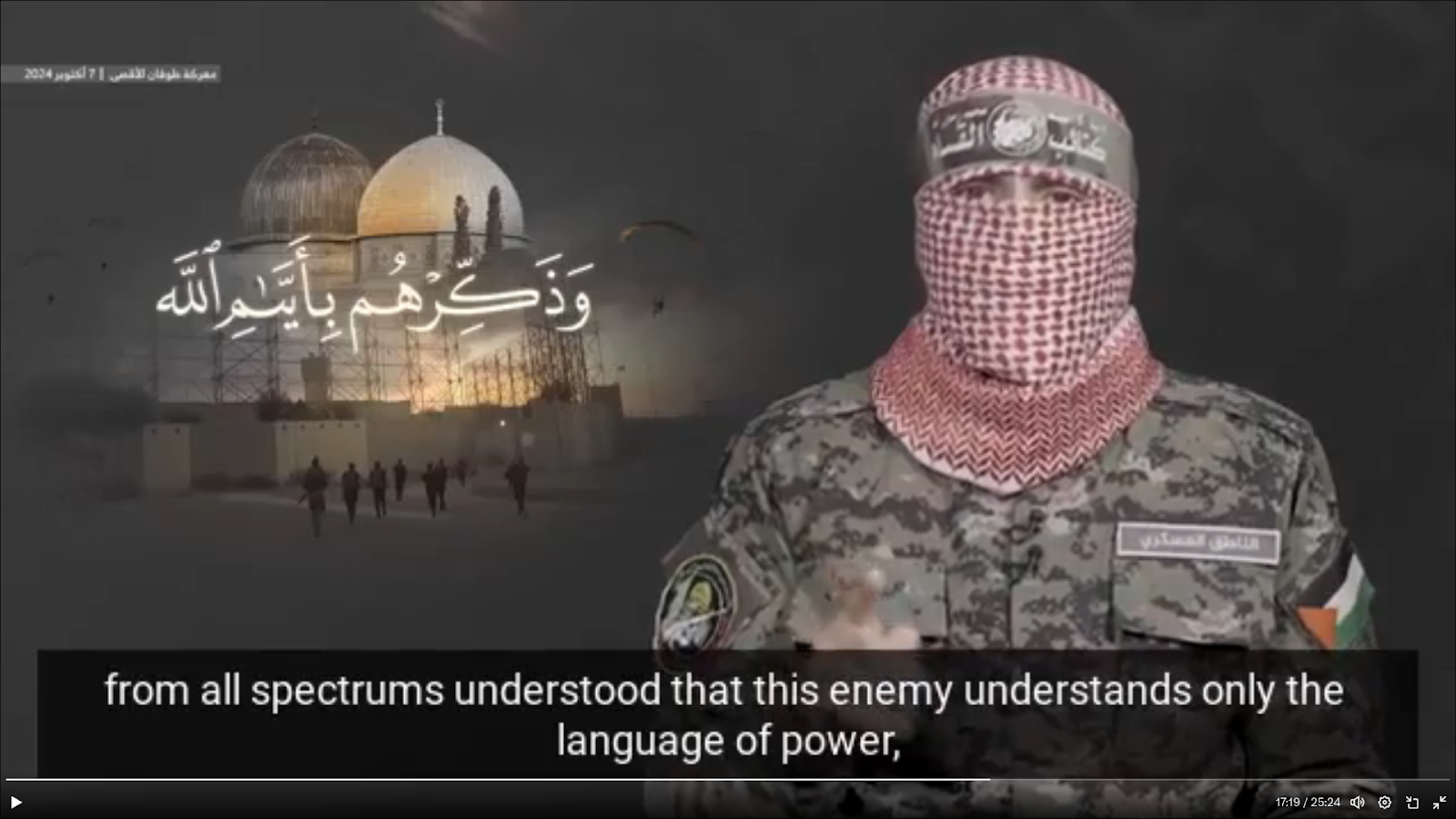
In his speech on the anniversary of al-Aqsa flood, the spokesman for Hamas’s armed wing, the Qassam brigades, Abu Obeida, intimated that the operation of Oct 7/23 was a pre-emption against an Israeli plan against the al-Aqsa mosque, a pre-emption of an Israeli plan to advance the ethnic cleansing of the Palestinians. The arrival to power in Israel of the Kahanist settler movement would give credence to this line of thinking.
Abu Obeida’s speech declared an understanding of Israel to “only understand the language of power”.
If the Oct 7/23 raid was indeed a pre-emption, it explains why the Israelis were so ready for October 7/23 in every way but defense. While they didn’t repel the raid, they managed to deploy their helicopters and ground forces to kill hundreds of Israelis to prevent them from becoming captives that might then be tradeable for thousands of Palestinian prisoners, in a “mass Hannibal” event. Israel was prepared to destroy houses full of Israelis in the kibbutzes. This is one of the messages: Israelis would die so that Palestinians could remain imprisoned, Israelis would die so that Palestinians could be killed. Israelis are willing to die for the sake of imprisoning and killing Palestinians.
Israel and its advocates were ready with a package of lies about atrocity crimes, lies that people who knew the dynamics of the conflict and its antagonists instantly recognized as such and fairly quickly proved their case – not that it mattered for Western media and politicians who repeat the same lies a year later. The specific lies about atrocities against children and lies about sexual violence are more than just standard colonial tropes. The point of the lies is a deep one. Morale is the key to the anti-colonial struggle. The preparation and propagation of lies about atrocity crimes were designed to make supporters of the struggle ashamed. To make the operation of October 7th a shameful operation. To sap the elation of courageous fighters entering their homelands for the first time and successfully taking the fight to their invader, and instead force supporters to defend against accusations of the worst crimes. Israel has conducted several successful genocidal operations over the year, but the atrocity propaganda operation is one of its most successful. And here is another message Israel sends its victims: We can turn your victories into shame, because we control how the world sees you. The goal is both demoralization and isolation of the Resistance’s cause from friends and allies who are silenced by the viciousness of the lies.
After massacring Israelis and preparing the full package of atrocity propaganda, Israel quickly moved into genocide mode, announcing intent in advance and then proceeding to impose food, water, and power blockades, methodically destroy Gaza’s health care system, hospital by hospital, while targeting children and boasting about it to the world. The lies they told to justify these massacres – of human shields, of command centers under hospitals and schools, etc. – were never meant to be believed. Their target was the oppressed: We can lie about you and we will be believed, not you.
Israel was so ready with the whole genocide package that some came to believe that the Israelis knew about the Oct 7/23 attack and allowed it to happen. I’m not among them: I think Israel was ready with an accelerated genocide plan because Israel has always been ready with an accelerated genocide plan. Israel came into existence in 1948 through an accelerated genocide plan, and everything it has done since has been to add more and more American technology to the unfolding of that original plan.
Israeli strategy is open-ended and opportunistic: grab what is possible. If limits are hit, wait for the next opportunity – or force one. Israel made a plan to force the people of Gaza into Egypt’s Sinai (and then occupy it, of course) and discarded it when Egypt demurred. Israel has enumerated many plans for the post-war occupation of Gaza that assume they’ve won the war and defeated Hamas. More can be grabbed when the oppressed are demoralized than when they are hopeful. This explains the message sent by the revelling in atrocity – dressing up in dead women’s underwear and playing with dead children’s toys, demolishing universities and mosques, etc. You have suffered so much because you resisted. This destruction is your fault.
This last message, the abuser’s look what you made me do, is Israel’s most important one for the subjugation of the Palestinians (and now Lebanese, Syrians, Yemenis, Iranians…). The total destruction is spun as the victim’s fault for the logic of subjugation, analogous to the way Resistance successes are spun as atrocity crimes to try to achieve the isolation of the Resistance. Destruction and lies, subjugation and isolation. These are the messages sent by the colonial power to those who would resist.
Adapting to the colonizer’s classroom
Long term, subjugation is a pipe dream. One of the most spectacular projects of colonization (which the early Zionists tried to participate in) was the Scramble for Africa, when all the Great Powers of the 19th century – far more powerful in relative terms than they are now – got together to colonize the immense continent of Africa. They had a formal meeting, the Berlin Conference, in 1884 and had rolled up most of the continent within a couple of decades, killing millions of Africans in the process and during the colonialism that followed. Africans threw most of them out by the early 1960s. Africa expelled the invaders even though their leaders were murdered; even though their people were displaced and genocided, imprisoned and tortured; even though they lost most of the battles they fought with their technologically overpowered colonizers. Faced with the look what you made me do carnage, decolonizers put their heads down and kept fighting. Faced with the 19th century version of atrocity lies, the claims that they were savages, not ready for self-government, two-legged beasts, racial inferiors etc., decolonizers once again put their heads down and kept fighting.
In the current war, the anticolonial resistance has actually challenged Western media and narrative control of the colonial power – something the 20th century decolonizers hardly even tried to do. The armed resistance has also gone beyond trying to survive (win or lose) until the colonizer has to leave. Instead it has tried to impose a different “equation” on Israel. The Resistance always talks about “the equation.” Besides the escalation ladder, the equation is the most pervasive metaphor used to describe the battle with Israel.
Trying to take Israeli prisoners to exchange for Palestinian prisoners was an attempt at creating an equation, one that had freed many Palestinian prisoners in the past, and one that could equal freeing all Palestinian prisoners if the calculation was correct. This is the equation Israel was trying to cancel through the formalization of the Hannibal doctrine: the willingness to kill Israelis before, during, and after capture, to make sure Palestinian prisoners remained captive and hopeless.
Creating armies and Indigenous arms industries that could challenge and defeat Israeli ground forces was an attempt at creating an equation, one that the Resistance hoped could deter Israel. Once the message was firmly sent that Resistance ground forces could not be defeated by the Israeli army, there could be talk of a long-term ceasefire that was not on the basis of subjugation. Israel is trying to cancel this equation in two ways: by showing willingness to send the Israeli army in again and again and use media strategy to claim victory even if there wasn’t any on the ground; and use their superior air force to commit genocide from the air, returning to the message of look what you made me do.
Open equations
Several equations remain open.
In 2012, Nasrallah promised a yet new equation: if Israel again destroyed Beirut from the air the way they had done in 2006, Hezbollah had missile capabilities to do the same to Israeli cities. In 2024 Israel has set out to test whether this is the case, by assassinating Nasrallah and bombing Beirut exactly as Nasrallah promised would bring the destruction of Haifa. Haifa still stands, but the war is just starting.
In 2023, Ansarallah in Yemen announced that they would be blockading Israel and attacking any ships that tried to go to Israel for any reason, until Israel ends the genocide and the blockade on Gaza. The US sent their Navy to try to get Yemen to back down, which they did not. The US, UK, and Israel have bombed Yemen many times over the year. Each time Yemen emerged to resume their blockade and their attacks on Israeli shipping and the US navy. Israel has announced that it wants to assassinate Yemen’s leaders; Yemen announced that they have implemented new security measures… and resumed launching missiles and drones, including on Tel Aviv.
In April 2023, Iran attacked Israel with a series of drones and missiles after Israel attacked the Iranian consulate in Syria. In October 2024, Iran attacked Israel again, after Israel assassinated Hamas leader Ismail Haniyeh and Hizbollah leader Hassan Nasrallah. Israel has promised that it will attack Iran, and Iran has promised it will attack Israel again if that happens. If there’s an equation here, no one knows the variables yet.
In addition to the above three open equations, to repeat the other communications so far:
Israel tries to tell the Palestinians that resistance is futile. The Palestinians do October 7/23. Israelis claims the story of October 7th and paints the event as an atrocity crime to isolate Palestinians from allies and demoralize them through a demonstration of media domination and Western message discipline.
Israel commits aerial genocide to show Palestinians and now Lebanese that they should submit to Israel’s will. Resistance ground forces fight to show that they can keep fighting as long as it takes.
Israel takes thousands of Palestinians prisoner and tortures them to try to demoralize and subjugate the nation. Palestinians take Israeli prisoners to try to get an exchange. Israel responds by showing a willingness to kill Israeli prisoners rather than let an exchange happen.
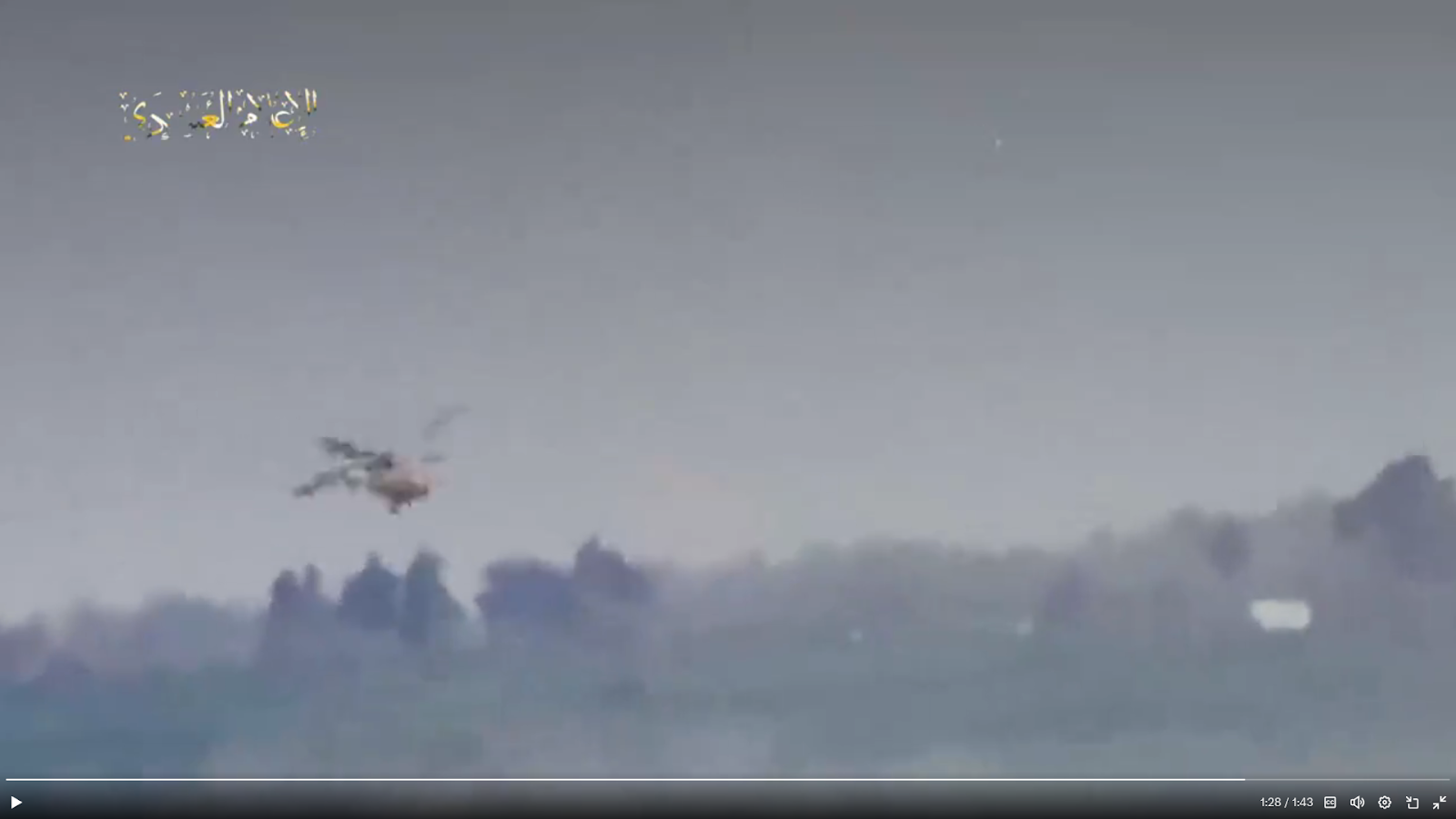
Another Resistance message that would confound Westerners if they knew (which they don’t) is their adherence to the rules of war as they understand them. Hizbollah and Iran both conducted missile strikes which they said were revenge for assassinations and massacres, revenge that inflicted almost no casualties. While Qassam in Gaza has fired on attack helicopters with shoulder-launched missiles, they have not fired on medical evacuation helicopters, content to watch and film them. Despite the most daring campaign of lies about October 7th, returned Israeli hostages have reported that the Resistance did not abuse them and repeatedly told them “we are Muslims, no harm will come to you” – the same phrase that Ansarallah told the crew of the Israeli ship (Galaxy Leader) when they took it over and sailed it to Yemen last year.
Westerners assume Resistance captives are abused like Israeli prisoners are.
This message seems to be: No matter how low you sink, we will not abandon our (Islamic) principles of fighting honorably. Perhaps Israel will succeed in eliminating the honorable warriors and Westernizing the next generation, one day to face an opponent more like themselves. From the Resistance perspective, there are probably two reasons they stick to their beliefs: first, because they draw their strength from the same place that these beliefs come from; and second, perhaps, because they view themselves as the future government of all of Palestine, and are fighting the war on the same principles with which they wish to rule.
An Israeli medevac helicopter, coolly observed from the camera of a Resistance fighter.
What happens in Year 2?
As the Resistance has tried to drill the lesson that aerial destruction will not defeat us on the ground, Israel has tried to drill the same lesson from a different perspective: repeatedly defeating Israel on the ground will not protect Palestinian and Lebanese civilians from aerial genocide. Nasrallah’s 2012 deterrence formula, that the destruction of Lebanon’s cities will lead to the destruction of Israel’s cities, has been taken as a challenge by Israel, which is forcing Nasrallah’s successors to either follow through on the threat or accept that nothing can stop Israel from committing genocide safely from afar.
As Israel drills the lesson that we will not be deterred regardless of military casualties, it is arguing that it will not make concessions, not negotiate, and will continue war while it has the ability to do so. The Resistance took prisoners and established military forces towards a long-term ceasefire with a prisoner exchange. Israel’s reply: while Israel exists and while the US is based there, there will be genocide against the peoples of the region. The Resistance did not believe in Year 1 that conditions were right for bringing matters to a decision like this – the most statements by the Ayatollah and by Abu Obeida suggest that the Resistance has come to realize that the US/Israelis believe they can genocide to victory.
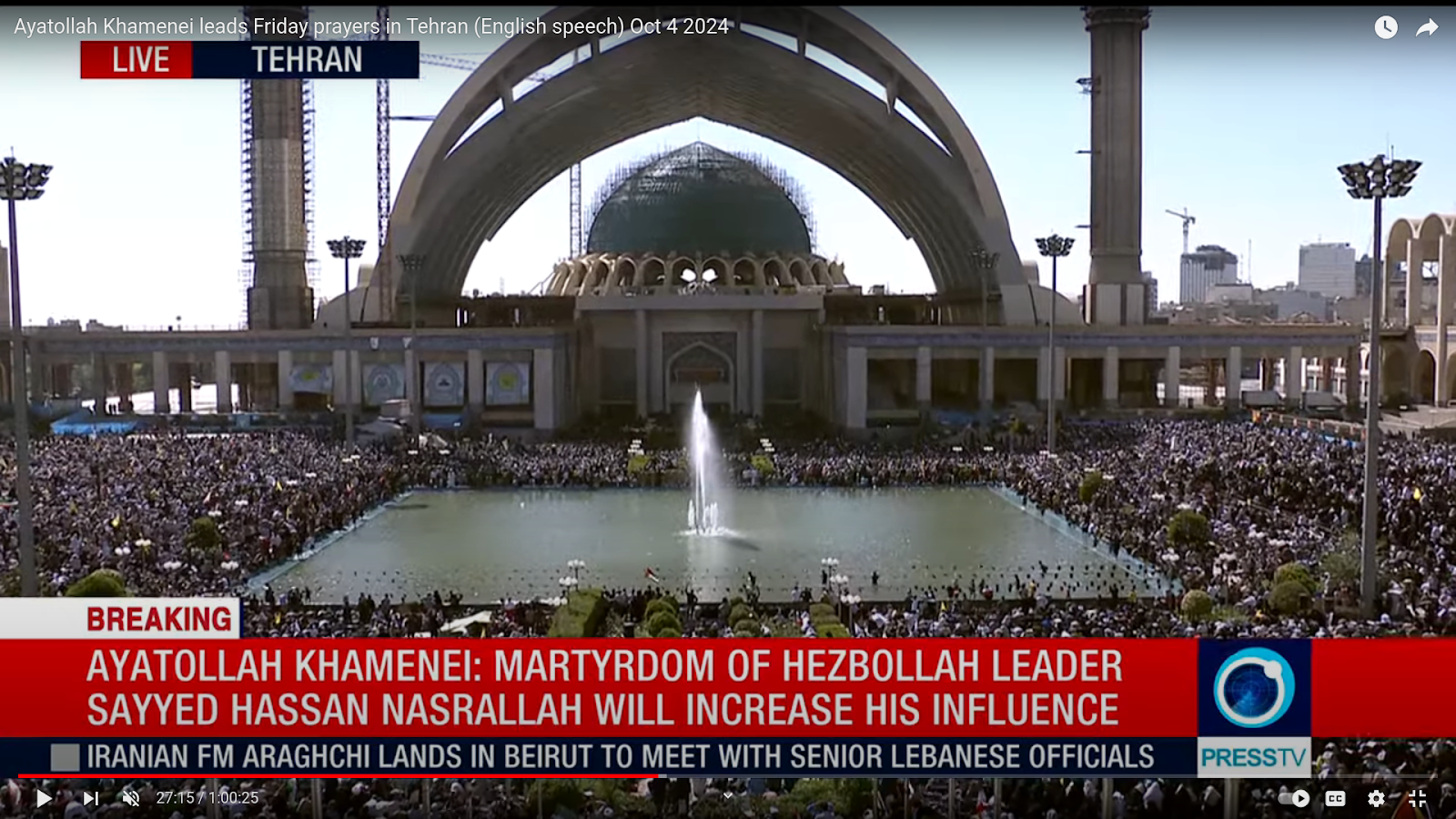
The Ayatollah said “when they finish with one country, they move on to the next.”
As Israel has drilled the lesson that we would rather kill our own people than let them be exchanged for Palestinian prisoners, the only way of freeing the Palestinian prisoners without an exchange is the Khiam model (when Hizbollah drove the Israeli occupation out of southern Lebanon in 2000 and liberated the prisoners by liberating the prison).
As Israel has drilled the message that we have the narrative mastery to tell your story including whatever lies we wish, the Resistance has made strong efforts on the war propaganda front through videos that depict their continuing capability and ability to inflict losses on the ground, as the unarmed resistance challenges the lies using whatever media are available through censors and monopoly control. This, too, is an open equation. The truth doesn’t always prevail, and we don’t know whether it will prevail here. All we can do is tell it.
Israel is still planning to attack Iran and dramatic events are certain to occur in the coming days. Can the Resistance win? Nasrallah said that war is like this – one day for the enemy, one day for you. The US and Israel could assassinate even more people, Israel’s army could collapse and be backfilled by the Americans directly. Maybe they’ll blow up the world.
Let’s suppose they don’t, since there’s not much point in continuing this post if they do.
Suppose they don’t and that they win the war, somehow destroying Hizbollah in the mountains of Lebanon, completing the genocide and starving the fighters of Hamas to death, cleansing the Palestinians of the West Bank to Jordan, destroying Iran’s missile abilities, crushing Iraq, perhaps miring Yemen and Syria in fratricidal wars? Then Israel will have bought itself a decade or two of tranquility to dance again in the ashes. And in a generation, a new war, in a totally different geopolitical and technological world than today’s, with foes that make it long for the enemies of today, who were foolish enough to think they could force a Western enemy committed to genocide and racism to fight with reason and honor.
When Russia withdrew from the war, Britain and France were in the lurch, but America saved the day. Why? Successful war propaganda, propinquity, or making good on investments and seizing a chance for world domination?
Nora joins and we go over our memories of following Seyed Hassan Nasrallah’s speeches over the decades. He led the resistance for 32 years and freed Lebanon from occupation once. His successors will operate under a new set of rules of engagement.
The scientific principles of war propaganda that we’re all suffering from today were laid down by Anglo-American writers amazed by their own performance in World War 1. What are these principles? Why did Anglo-American propaganda work better than German?
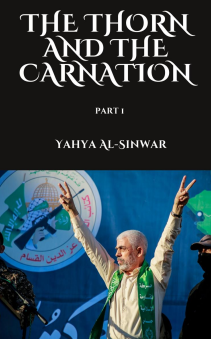
A review of Yahya Sinwar’s novel, The Thorn and the Carnation
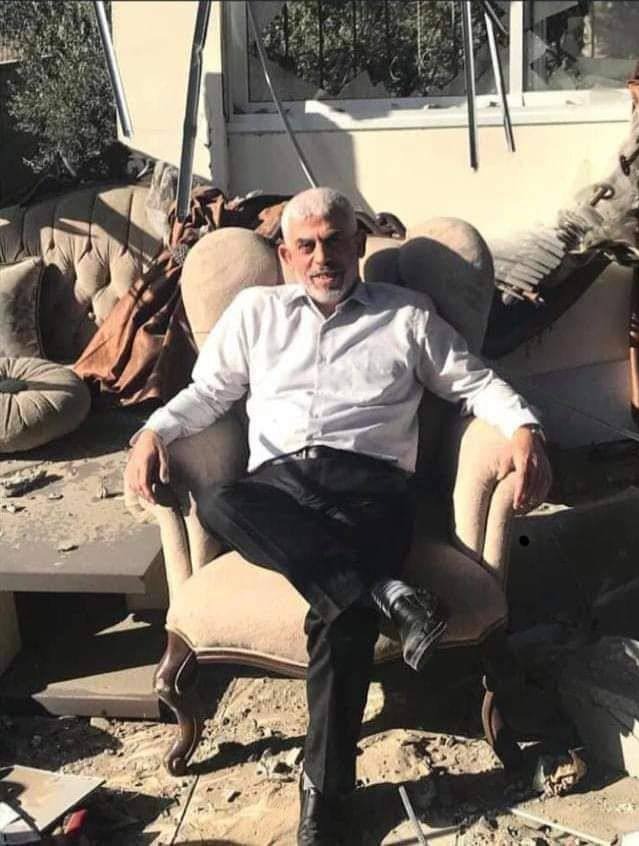
At the end of the 2021 war, a Hamas leader gave a speech among the carnage of Gaza. He told the press and public that he would walk home, that the Israelis knew where he was, and if they wanted to make him a martyr that would be their chance. Instead, he ended up going home and sitting on an intact piece of upholstery amid the rubble of his house.
Yahya Sinwar in his destroyed home in 2021
Today that leader – until 2011 a prisoner of Israel’s, now the head of Hamas’s political bureau – is in the tunnels of Gaza, directing the war effort against Israel’s genocidal army.
Two decades ago, Yahya Sinwar wrote a novel. It should be required reading for friends and enemies of Palestinians alike, but it was banned from Amazon and circulates instead on the back channels of the web. The Thorn and the Carnation was written inside Israeli prison, copied by hand and smuggled out: Sinwar’s words escaped Israel’s dungeons years before the author got out in a prisoner exchange. The novel is a document of Palestinian life under occupation from the 1960s to the early 2000s and reveals the perspectives and priorities of one of the main Resistance leaders of our time.
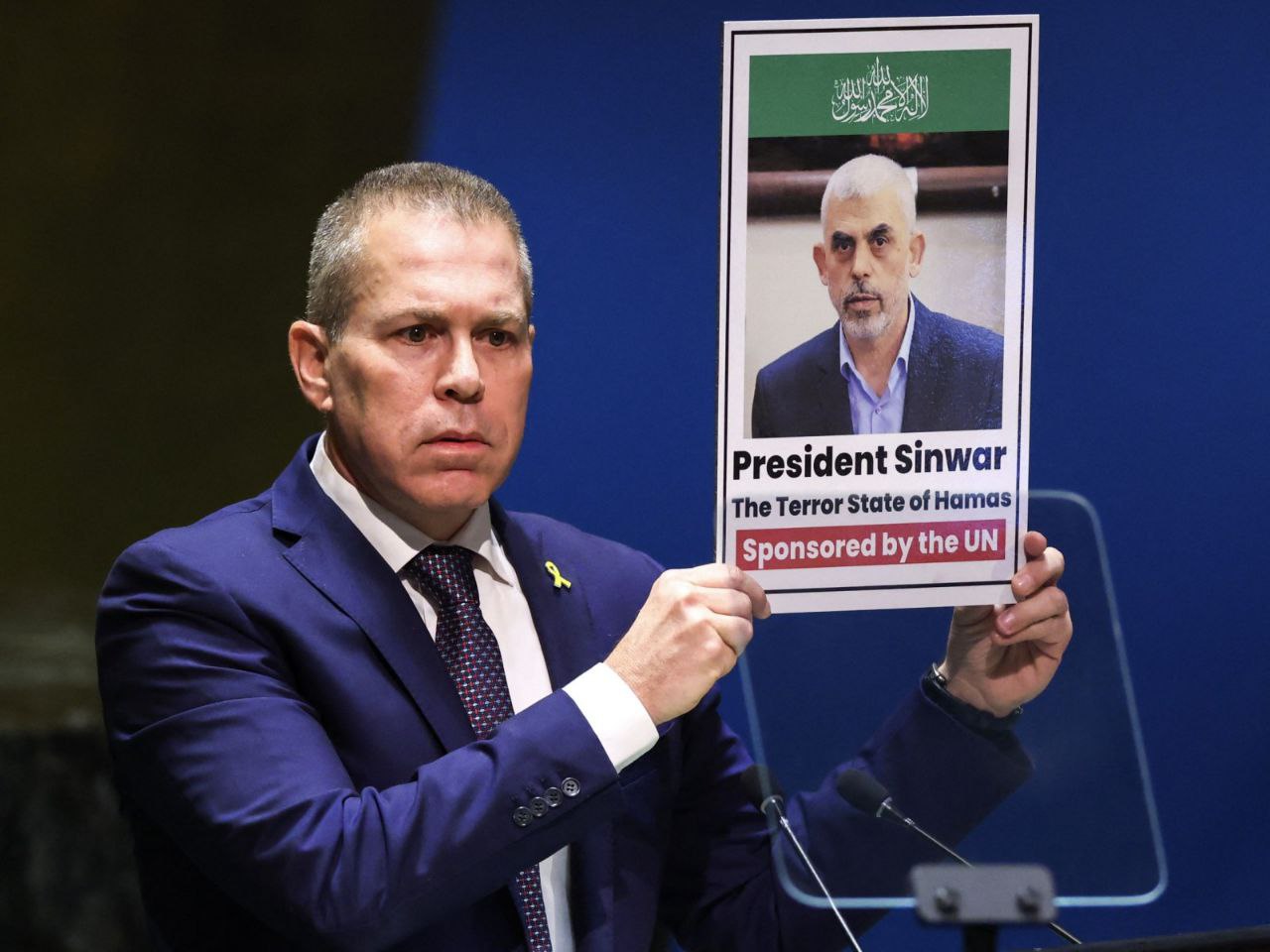
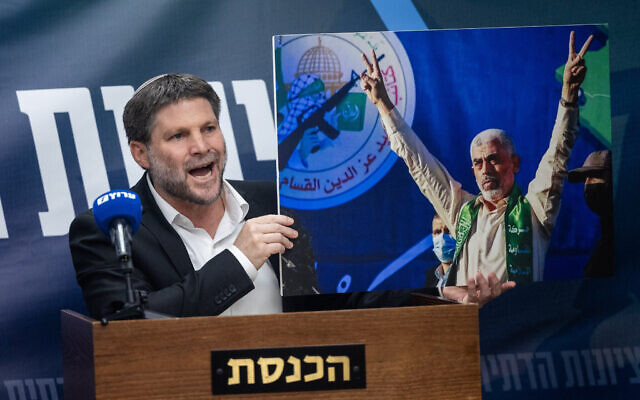
Colonizers are always obsessed with the leaders among the oppressed, and Sinwar obsesses the Israelis like no one else at the moment.
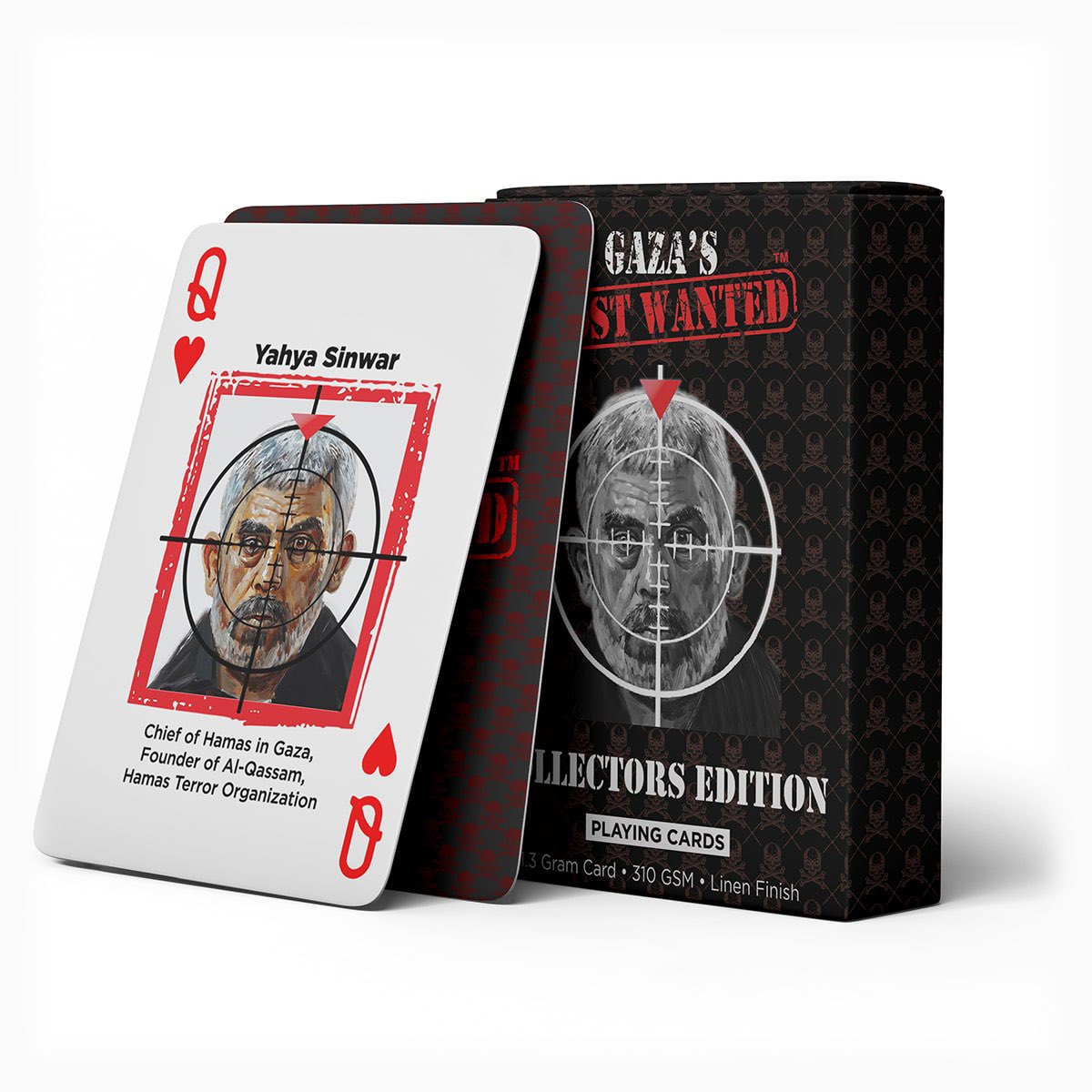
Israel’s UN ambassador holding up a photo of SinwarIsrael’s Finance Minister holds up a photo of SinwarIsraeli made terrorist playing card of Sinwar
In the preface of the book, Sinwar says that all the events in the book are real but have only been transformed into fiction to “to fulfill the form and requirements of a novelistic work.” As a graduate of the Arabic Literature program of the (now destroyed, along with every other university building in Gaza) Islamic University of Gaza, Sinwar would know. Imprisoned not long after his student years (he was born in 1962 and imprisoned in 1988, sentenced to life), Sinwar wrote a book where most action takes place in the three sites central to an occupied people obsessed with education: the camps, the campuses, and the prisons. There are no corporate boardrooms, glitzy hotels, yachts, or even weapons laboratories. Readers of the Thorn and the Carnation witness the construction of the Resistance in seemingly impossible conditions, humble locations, under the ever-watchful eye of the occupier.
Morally and practically prescriptive, the novel is not written from an ironic distance, but from the point of view of a youth growing up and learning of the world. Corrupted characters and villains – the occupation and collaborators – play their roles across from upright Resistance characters and heroes. The protagonists’ family hold fully-drawn out debates between communist (Popular Front for the Liberation of Palestine), Islamist (Hamas), and nationalist (Fatah) members. All positions are reasonably portrayed, but the Hamsawis get the last word.
A review of the book by Haneen Odetallah in Mondoweiss draws the philosophy of Sinwar out of the text, showing how the protagonist’s cousin (more like a brother), Ibrahim, represents the values of a Resistance fighter: Self-sacrifice, asceticism, and security awareness.
Certain military concepts can also be drawn out by reading Thorn and Carnation. In it, a frank and undramatic narration of Israeli atrocities coexist alongside an ever-evolving assessment of Resistance possibilities.
Long before the current genocide, Israel’s actions could have formed the basis of a horror novel, but the Thorn and the Carnation is a novel of action. While occupation persists, resistance never stops, and never will. Its forms change, but through all the harms inflicted upon the people, it grows. Even if Sinwar himself were killed in the current war, the Resistance would go on.
The book describes a Gaza Strip in the 1960s constantly under patrol by the Israeli army, in which guerrilla fighters would move in silence and come out of hiding for an ambush. “The resistance men would dominate the camp at night, making it impossible for the occupation patrols to enter its alleys. They stayed on the main streets, and with the break of dawn, the resistance men would disappear.”
The actions and the deaths of martyrs are reported in a straightforward style:
“A significant event that year was the martyrdom of our neighbor Abu Yousuf. He, along with two other young men, had set out to execute a mission against the occupation patrols. Their strategy involved one of the fighters throwing a grenade at the patrol that regularly passed through the main street at a specific time, then retreating in a way that made him visible to the soldiers. Abu Yousuf and another fighter, armed with Carl Gustav rifles and grenades, lay in wait for the reinforcements that would pursue the first attacker. Unfortunately, they were ambushed unexpectedly from behind, and both Abu Yousuf and his comrade Ibrahim were martyred on the spot.”
As a child, the protagonist, Ahmed, witnesses the public execution of a collaborator, followed by an Israeli mass arrest operation; imprisonment and torture of random men from the community. Characters are introduced to show how Resistance is organized: recruiting, building networks, acquiring weapons. Resistance members, like everyone else, get swept up in the Israeli dragnet, and the novel reveals how they conduct the struggle even while being interrogated:
“As is usual in resistance work, one of the cells encountered an operational failure, leading to the arrest of its members. Under severe interrogation, some began confessing, leading to more arrests, eventually reaching Abu Ali. He was captured and subjected to intense interrogation in the dungeons of Hebron prison. Abu Ali showed great resilience and refused to confess even the simplest things that some of the young men, deceived during the interrogation, had admitted.” His partner had confessed, but the uncle didn’t: “Abdul Fattah was taken to Hebron prison and subjected to severe interrogation and torture, as they questioned him about his relationship with Abu Ali and tried to convince him that Abu Ali had confessed everything. However, Abdul Fattah continued to deny the allegations. Consequently, he was sentenced to six months of administrative detention without any charges, while Abu Ali received a five-year sentence based on the confessions obtained from some of the young men who weren’t resilient enough to withstand the interrogation ordeal.”
The ones who don’t confess to anything end up free sooner, while confessions lead to worse sentences for everyone. The message is clear.
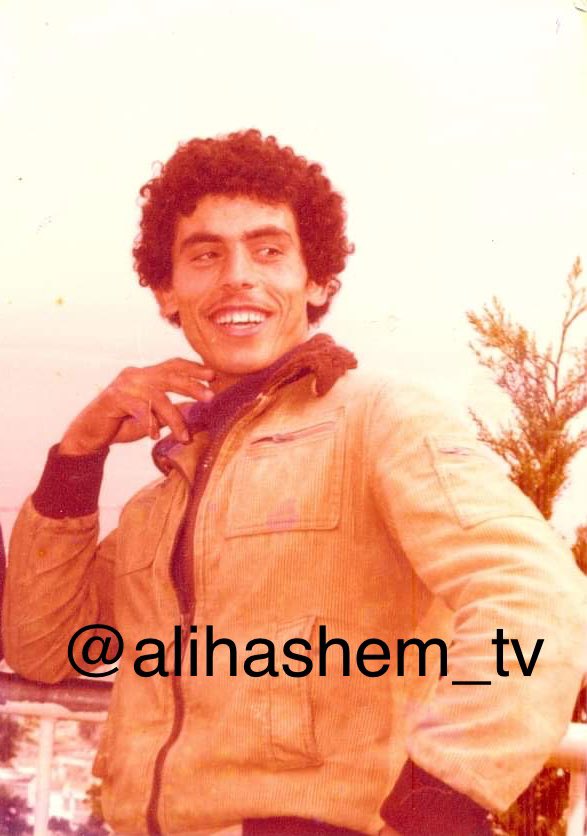
Sinwar as a young man
The chapters covering the 1970s dive deeply into prison life – the counts, loudspeakers, food, bathroom shifts, beatings, being made to sit on a blanket non stop, one five minute shower per week, one bar of soap for dozens of people… then the military court / kangaroo court. A young reader of the novel would know what to expect when the Israelis nabbed him and sent him to prison. This part of the novel conveys the centrality of the prisoners’ struggle to Palestine, and the importance of liberating the prisoners to the Resistance. After the prisoners adopt the hunger strike, the Israelis make conditions a bit better and the prison becomes a Resistance school in its own right:
“In the following period, cultural, religious, and educational gatherings in prison became very common. In one room, there was a session discussing Palestinian history; in another, a political session about the latest developments; in a third, a session about the principles, slogans, and objectives of the Fatah movement; and in a fourth, a session on socialist thought and Marxist philosophy. The prison transformed into an advanced school where learners taught others, and those inexperienced in debate and political thought were trained.”
As the chronology moves into the 1980s, the protagonist’s older cousin, Ibrahim, the model Resistance fighter, comes into his own. He studies and prepares, builds a family life and a business while getting an education and working underground in the Resistance.
Before the First Intifada (1987-1989) the Resistance is at a low point and Israeli intelligence looks unbeatable:
“The occupation’s intelligence had begun to infiltrate the camp gradually, systematically, and deliberately. Anyone opposing or objecting would find the intelligence officer responsible for the area sending dozens of summonses to young men and men to his office. They would sit in the waiting room for hours, then be called in one by one, to be beaten, threatened, warned, bargained with, consoled, and efforts made to recruit them.”
How did the Israelis recruit? Through blackmail, bribery, corruption, and, from the Islamic perspective, through immorality as well:
“It became clear that through its agents, the occupation’s intelligence started promoting the trade and use of hashish, drugs, and alcohol. They considered this a means to destroy the nation and kill any spirit of resistance, while the agents saw it as a quick way to make money with their appearance protected. The agents began to promote corruption and immorality by spreading obscene pictures, magazines, and sexual videotapes among boys and girls.”
A reader of the book would be forewarned against these Israeli methods:
“It was clear that the occupation’s intelligence, using its agents, systematically practiced spreading organized corruption to destroy the people and end any hope of a future for liberation or resistance. Every day, their methods in this field evolved, to the extent that one of the well-known agents’ offices would announce registration for a tourist trip to areas inside the Green Line. During these trips, with dozens of naive young men, several prostitutes known for their collaboration with the occupation’s intelligence were taken along.”
But despite all the infiltration and Israeli intelligence success, resistance persists. The Intifada indeed begins. In the Thorn and the Carnation, there is no separation between the armed struggle, the intelligence war, and the popular struggles on campuses or in the streets. The Israelis do not differentiate between these and neither does the Resistance. In the latter half of the novel, there is a switch to third-person narration as details of how organization proceeds and what methods are employed by both occupation and Resistance, e.g.:
“…the territories were completely devoid of weapons; the occupation had methodically worked over nearly two and a half decades of its occupation of Gaza and the West Bank to empty the regions of weapons and ammunition and to seal all avenues through which they might be brought, imposing severe penalties on anyone involved in this trade. People didn’t even know how to use weapons if they found them. Therefore, activists resorted to using bladed weapons like knives, daggers, machetes, and swords, in addition to batons, and it was very rare to see an old Carlo Gustav rifle or a pistol.“
On organizing the Intifada:
“They are planning and organizing the escalation of the Intifada and confrontations in the city and surrounding towns and villages. They agree to work on two fronts: first, to activate the events and incidents wing of the Intifada, and second, to start establishing armed groups and cells and to gather weapons for them.
“One of the attendees departs to meet three young men to announce the formation of the core of the armed effort. They are instructed to start searching for weapons, prepare hideouts and shelters, and nominate candidates ready to engage in this field. Meanwhile, dozens of activists move in various directions to mobilize individuals and supporters to distribute pamphlets, write slogans on walls, and set up barricades on roads to hinder the movement of occupation forces and settlers, drawing them into suitable locations for stone-throwing, thus facilitating the youths’ camouflage, withdrawal, and maneuvering.”
When the Intifada winds down and Fatah signs the Oslo Accords with Israel, the debate between Hamas and Fatah on the peace process takes place in the protagonists’ family home, between Ahmed’s brother, Mahmoud, who is with Fatah, and his cousin Ibrahim, with Hamas. When Mahmoud says that the Palestinians needed an agreement to establish the beginnings of a state in the West Bank and Gaza, Ibrahim replies:
“It’s clear that continuing resistance and military activities, which cause human losses to the occupation, along with a popular uprising that inflicts political and media damage, will force them to withdraw from the Gaza Strip and the West Bank. Then we can establish a state on any piece of land from which the enemy withdraws… If they leave by an agreement, it means that we Palestinians must adhere to certain obligations, the least of which is recognizing their right to our remaining land. However, if they leave without an agreement under the pressure of resistance, it means that we have committed to nothing and the door remains open for us to continue immediately or later… when we find it appropriate.”
As the Intifada dissolves into the Oslo Accords, Ibrahim he gives a speech in prison, to his fellow prisoners, about how the Resistance would start over and over again, as many times as necessary:
“…All sacrifices of the first Intifada have been wasted, and now, with the politicians and negotiators, we’ve reached a deadlock. What’s stopping us from starting anew?”
“Hundreds, if not thousands, of martyrs will fall, and tens of thousands will be wounded. You’ll find someone to propose going to a new Oslo, or whatever you want to call it. After every round of our people’s struggle and sacrifice, the politicians come to reap the fruits; because they rush to harvest the fruit before its time, they are punished by being deprived of it. Neither does the fruit stay on the tree to ripen, nor is it useful when harvested because it’s not yet ripe. This was the solution with our people’s first Intifada, and now we must start again until someone imagines that the fruit has ripened and its time has come, only to destroy everything our people have sacrificed for.”
In Ibrahim’s view, the pressure of Resistance alone is what led to the partial withdrawal of Israel from the occupied territories, and the easing of that pressure that led to the reoccupation.
The novel goes through the 1990s in a whirlwind of Israeli repression and Resistance operations. In the end, Israel is at a crossroads, unable to decide how to proceed, as Resistance continues to grow.
In Mahmoud’s (Fatah) view, continuing Resistance after the agreement was endangering the Palestinians, who had no way of defeating Israel. Ibrahim addresses this defeatism directly, as Mahmoud says the Israelis could easily crush the Palestinians.
“Then why haven’t they crushed us? The components of the equation are not merely about pure military strength, Mahmoud. Israel knows it faces an Arab and Islamic nation behind us, fragmented yes, but if it used excessive force against us, the balances of the universe would turn. Israel is unable to crush us because it is governed by many equations, and breaking any one of them means it could be crushed as well.”
Ibrahim’s journey ends in martyrdom, from a helicopter-launched missile striking his car. That, too, is symbolic of the way, in the world view of the Thorn and Carnation, a model Resistance fighter’s life should end while occupation persists.
In the end, the great characters in the Thorn and the Carnation exhibit persistence – through pain, grief, prison, and torture. They don’t reveal themselves to the enemy. They are not fooled by the enemy’s deception and are not intimidated by the enemy’s violence. They study and learn and prepare, even as they fight. They will fight on regardless of setbacks and even through genocide.
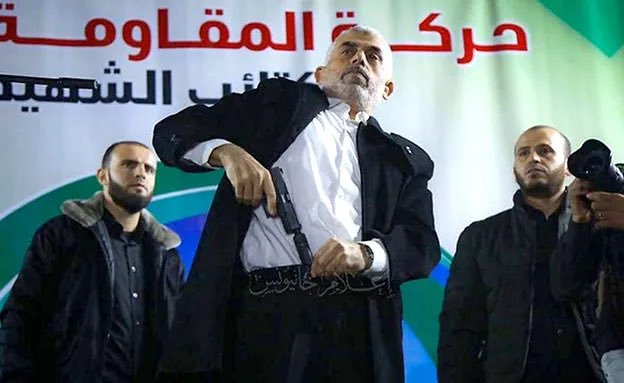
At a public event Sinwar is presented with a sidearm captured from an Israeli soldier.
The narrative of the novel ends in 2004. Two decades later, Israel is one year into a genocide against the Palestinians, with the full support of all Western countries, led by the US. The leader of the genocidal campaign is Benjamin Netanyahu. The leader of the principal Palestinian Resistance organization is Yahya Sinwar.
At the moment, Israel, governed as Ibrahim says “by many equations”, is trying to break them, all to try to crush the Resistance. Increasingly it seems that by the end of this war, the Resistance will either have to “start anew”, or Israel will, as Ibrahim calculated, be crushed by the equations it has tried to ignore.
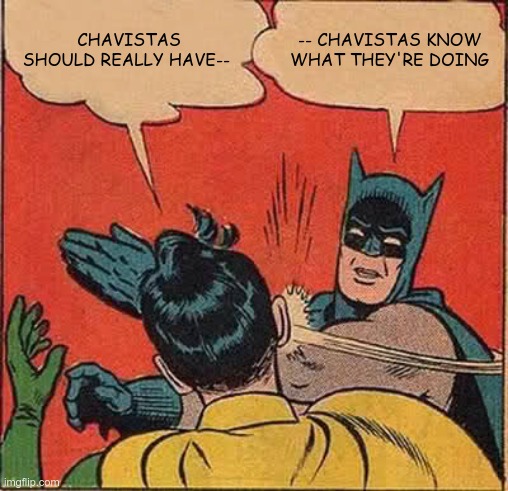
With Joe Emersberger. The co-authors of the Monthly Review Press book Extraordinary Threat: The US Empire, the Media, and Twenty Years of Coup Attempts in Venezuela, discuss the seventh coup attempt on Chavismo which is in the process of being defeated.
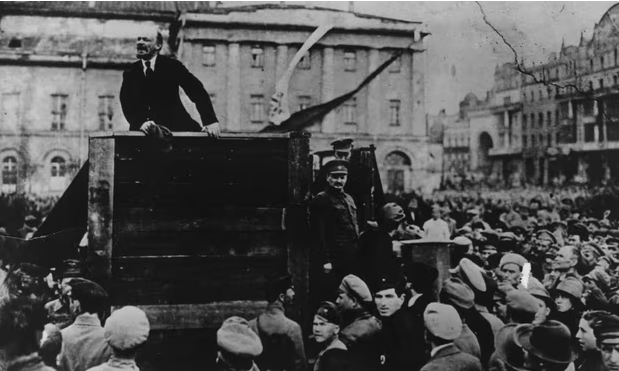
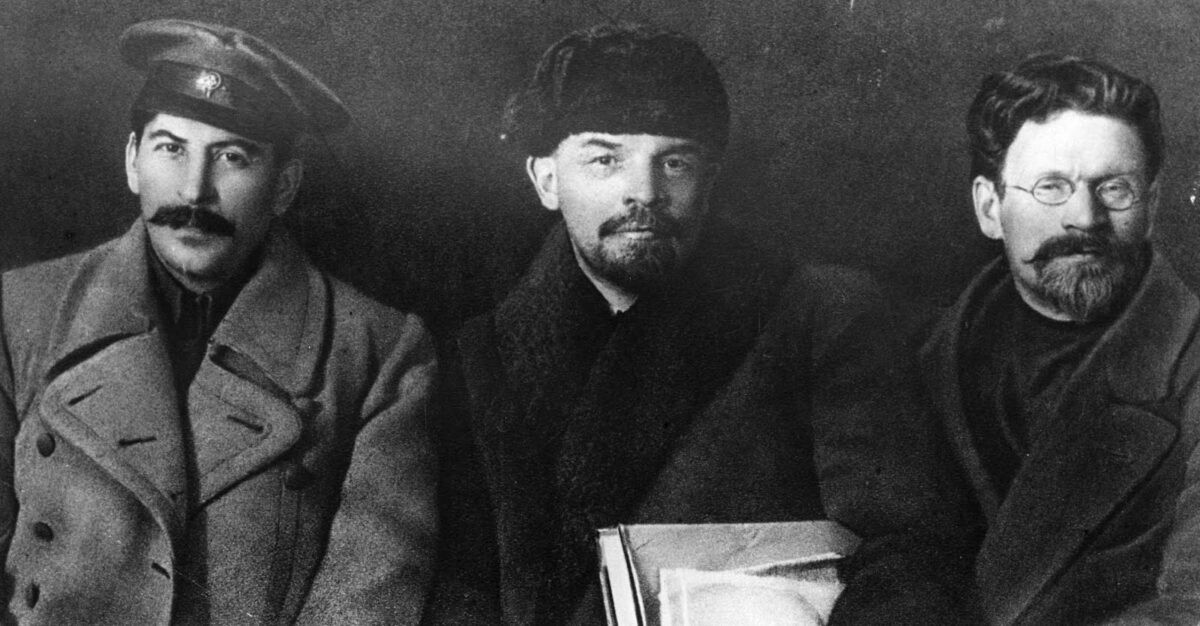
Way back in World War Civ 6,7, and 8, we covered the Russian Revolution of 1905 including future main characters Lenin, Trotsky, and Stalin. Now as the 1917 Revolution unfolds we revisit these protagonists and study their actions and writings in the years leading to October 1917. Perhaps history is grand movements of masses, but if there are individuals who can make a difference in world history, these were some of them.
A scholar who grew up in a Christian Zionist tradition, Jamin Hubner joins to talk about how the ideology is unrolled to kids and how he found his way out of it.