IPE and MMT: a theoretical quibble

For both the podcast and a recent article on de-dollarization, I’ve been getting into some heavy duty political economy.

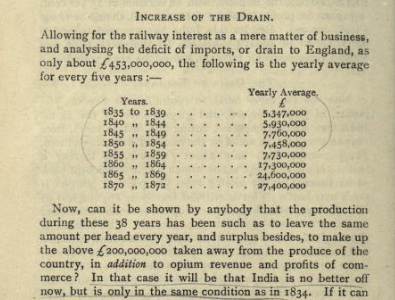
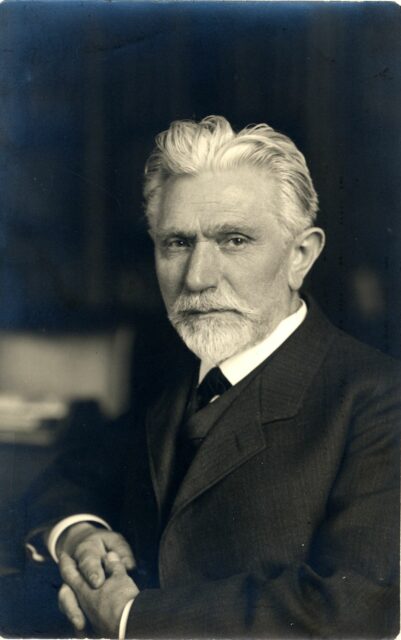
For both the podcast and a recent article on de-dollarization, I’ve been getting into some heavy duty political economy. One very valuable thread I’ve followed is sometimes called Indian Political Economy, or IPE. The tradition begins with Dadabhai Naoroji, who studied the way that the British Empire “drained” India. Naoroji’s best known book was the 1901 Poverty and un-British Rule in India, which is funny because in retrospect nothing is less un-British than draining India of all of its wealth (in several ways the book is a painful read, full of Naoroji trying to appeal to the better natures of the imperialists, but important as the beginning of a tradition!).

Today’s leading practitioners of IPE (unclear whether they’d identify as IPE since they’re really just P.E.s who happen to be from I and know a lot about I) include Utsa and Prabhat Patnaik, authors of such works as Capital and Imperialism and A Theory of Imperialism, both of which I used in the de-dollarization article. Utsa Patnaik’s research is where the figure of $45 trillion drained from India by Britain comes from. In Zak Cope’s book The Wealth of Some Nations, as well as research by Jason Hickel and his co-authors, you can read about the various mechanisms by which “drain” continues, to the tune of some $2 trillion per year, drained from the poor countries to the rich ones, year after year.

In the de-dollarization article there was a point that I wanted to make, that follows from IPE, which is the maintenance of the imperial currencies underlying the global economy – the gold standard in the British Empire and the dollar today – is based on the constant flow of free labor and commodities, of “drain” from the colonies (now neocolonies). If the Global South countries are able to carve out the ability to trade with one another without needing the dollar, as seems to be happening; and if the dollar isn’t replaced by another imperial currency regime, which it might not be… well, then the drain might also be coming to an end, which could be very good for the no-longer-drained countries who could then use those resources for some sensible combination of development and environmental protection.

None of which is really why I’m writing this post today. It’s instead to make a record of something I encountered in my research that didn’t fit into the article and doesn’t really fit anywhere, but is worth a short post of its own. Because in addition to using IPE, anyone trying to make sense of how money works in the economy will also encounter Modern Monetary Theory, or MMT. There is a very clearly written book by Stephanie Kelton called the Deficit Myth, but I was using a textbook called Modern Monetary Theory by Randall Wray. The point that MMTheorists make is that currencies are given force by taxes and are ultimately backed by states. This means governments don’t tax and spend, they create money and people accept and use the money because they know they can always use the money to pay their taxes.

Several consequences follow from this, the main one being that governments don’t need taxes or debt to create money. States are limited only by real resource and labor power constraints – the constraints of the real world. Debt ceiling debates, deficit scares, are all propaganda used for austerity politics. Inflation and deflation could both be managed by making sure the amount of currency issued matches the actual resources available in the economy.

This is all fine and a more realistic way of looking at money than the proponents of austerity. But Wray’s discussion of the history of money and of, for example, the gold standard, I don’t think holds up. Wray starts with a good point that accounting money preceds commodity (gold) money, meaning the earliest forms of money were actually debt marks in temple and palace records, and that gold came later. But then he asks, “what were coins and why did they contain precious metal? To be sure, we do not know.” Because coins and gold have been very important, Wray suggests that they became important for Athenian democrats who mocked the wealthy and powerful by using gold for something so sullied as coinage (pp. 156-157). I don’t think this is right, and I think the commitment to the point MMTheorists are making about the importance of state power in creating currency causes Wray to dismiss the whole role of gold in the imperial economy – as well as its historic role in imposing deflation and “drain”. Wray dismisses this all as a “monetary mess”: “The sovereign was always short of gold and silver,” which was “needed to conduct the foreign wars”, which made for a “nice vicious circle”. This “monetary mess”, Wray writes, “was resolved only very gradually with the rise of the modern nation state, a clear adoption of nominalism in coinage, and with abandonment of the long practiced phenomenon of including precious metal in coins.”

You all know I have many opinions about the British Empire. One opinion I do not hold is that it was full of idiots who created a “monetary mess”. They weren’t having a fit of absence of mind then and they aren’t doing so now. The gold standard then, and debt- and deficit-based global finance now, are shining examples of methods to drain wealth from the global south. The MMTheorists want to cut through the propaganda, which is fine. But to understand how the mechanisms work historically, why gold was – and remains – more than a “mess”, how the currency regime underlying the global economy is a tool for plundering the poor countries – for that, you’ll need IPE more than MMT.

Are We Living Through a De-Dollarization?

De-dollarization is apparently here, “like it or not,” as a May 2023 video by the Quincy Institute for Responsible Statecraft, a peace-oriented think tank based in Washington, D.C., states. Quincy is not alone in discussing de-dollarization: political economists Radhika Desai and Michael Hudson outlined its mechanics across four shows between February and April 2023 in their fortnightly YouTube program, “Geopolitical Economy Hour.” Economist Richard Wolff provided a nine-minute explanation on this topic on the Democracy at Work channel. On the other side, media outlets like Business Insider have assured readers that dollar dominance isn’t going anywhere. Journalist Ben Norton reported on a two-hour, bipartisan Congressional hearing that took place on June 7—“Dollar Dominance: Preserving the U.S. Dollar’s Status as the Global Reserve Currency”—about defending the U.S. currency from de-dollarization. During the hearing, Congress members expressed both optimism and anxiety about the future of the dollar’s supreme role. But what has prompted this debate?

Until recently, the global economy accepted the U.S. dollar as the world’s reserve currency and the currency of international transactions. The central banks of Europe and Asia had an insatiable appetite for dollar-denominated U.S. Treasury securities, which in turn bestowed on Washington the ability to spend money and finance its debt at will. Should any country step out of line politically or militarily, Washington could sanction it, excluding it from the rest of the world’s dollar-denominated system of global trade.

But for how long? After a summit meeting in March between Russia’s President Vladimir Putin and China’s President Xi Jinping, Putin stated, “We are in favor of using the Chinese yuan for settlements between Russia and the countries of Asia, Africa, and Latin America.” Putting that statement in perspective, CNN’s Fareed Zakaria said, “The world’s second-largest economy and its largest energy exporter are together actively trying to dent the dollar’s dominance as the anchor of the international financial system.” Already, Zakaria noted, Russia and China are holding less of their central bank reserves in dollars and settling most of their trade in yuan, while other countries sanctioned by the United States are turning to “barter trade” to avoid dependence on the dollar.

A new global monetary system, or at least one in which there is no near-universal reserve currency, would amount to a reshuffling of political, economic, and military power: a geopolitical reordering not seen since the end of the Cold War or even World War II. But as a look at its origins and evolution makes clear, the notion of a standard global system of exchange is relatively recent and no hard-and-fast rules dictate how one is to be organized. Let’s take a brief tour through the tumultuous monetary history of global trade and then consider the factors that could trigger another stage in its evolution.

Imperial Commodity Money

Before the dollarization of the world economy took place, the international system had a gold standard anchored by the naval supremacy of the British Empire. But a currency system backed by gold, a mined commodity, had an inherent flaw: deflation. As long as metal mining could keep up with the pace of economic growth, the gold standard could work. But, as Karl Polanyi noted in his 1944 book, The Great Transformation, “the amount of gold available may [only] be increased by a few percent over a year… not by as many dozen within a few weeks, as might be required to carry a sudden expansion of transactions. In the absence of token money, business would have to be either curtailed or carried on at very much lower prices, thus inducing a slump and creating unemployment.”

This deflationary spiral, borne by everyone in the economy, was what former U.S. presidential candidate William Jennings Bryan described in his famous 1896 Democratic Party convention speech, in which he declared, “You shall not crucify mankind upon a cross of gold.” For the truly wealthy, of course, the gold standard was a good thing, since it protected their assets from inflation.

The alternative to the “cross of gold” was for governments to ensure that sufficient currency circulated to keep business going. For this purpose, they could produce, instead of commodity money of gold or silver, token or “fiat” money: paper currency issued at will by the state treasury. The trouble with token money, however, was that it could not circulate on foreign soil. How, then, in a global economy, would it be possible to conduct foreign trade in commodity money and domestic business in token money?

The Spanish and Portuguese empires had one solution to keep the flow of metals going: to commit genocide against the civilizations of the Americas, steal their gold and silver, and force the Indigenous peoples to work themselves to death in the mines. The Dutch and then British empires got their hands on the same gold using a number of mechanisms, including the monopolization of the slave trade through the Assiento of 1713 and the theft of Indigenous lands in the United States and Canada. Stolen silver was used to purchase valuable trade goods in China. Britain stole that silver back from China after the Opium Wars, which China had to pay immense indemnities (in silver) for losing.

Once established as the global imperial manager, the British Empire insisted on the gold standard while putting India on a silver standard. In his 2022 PhD thesis, political economist Jayanth Jose Tharappel called this scheme “bimetallic apartheid”: Britain used the silver standard to acquire Indian commodities and the gold standard to trade with European countries. India was then used as a money pump for British control of the global economy, squeezed as needed: India ran a trade surplus with the rest of the world but was meanwhile in a trade deficit with Britain, which charged its colony “Home Charges” for the privilege of being looted. Britain also collected taxes and customs revenues in its colonies and semi-colonies, simply seizing commodity money and goods, which it resold at a profit, often to the point of famine and beyond—leading to tens of millions of deaths. The system of Council Bills was another clever scheme: paper money was sold by the British Crown to merchants for gold and silver. Those merchants used the Council Bills to purchase Indian goods for resale. The Indians who ended up with the Council Bills would cash them in and get rupees (their own tax revenues) back. The upshot of all this activity was that the Britain drained $45 trillion from India between 1765 and 1938, according to research by economist Utsa Patnaik.

From Gold to Gold-Backed Currency to the Floating Dollar

As the 19th century wore on, an indirect result of Britain’s highly profitable management of its colonies—and particularly its too-easy dumping of its exports into their markets—was that it fell behind in advanced manufacturing and technology to Germany and the United States: countries into which it had poured investment wealth drained from India and China. Germany’s superior industrial prowess and Russia’s departure from Britain’s side after the Bolshevik Revolution left the British facing a possible loss to Germany in World War I, despite Britain drawing more than 1 million people from the Indian subcontinent to serve (more than 2 million Indians would serve Britain in WWII) during the war. American financiers loaned Britain so much money that if it had lost WWI, U.S. banks would have realized an immense loss. When the war was over, to Britain’s surprise, the United States insisted on being paid back. Britain squeezed Germany for reparations to repay the U.S. loans, and the world financial system broke down into “competitive devaluations, tariff wars, and international autarchy,” as Michael Hudson relates in his 1972 book, Super imperialism, setting the stage for World War II.

After that war, Washington insisted on an end to the sterling zone; the United States would no longer allow Britain to use India as its own private money pump. But John Maynard Keynes, who had written Indian Currency and Finance (1913), The Economic Consequences of the Peace (1919), and the General Theory of Employment, Interest, and Money (1936), believed he had found a new and better way to supply the commodity money needed for foreign trade and the token money required for domestic business, without crucifying anyone on a cross of gold.

At the international economic conference in 1944 at Bretton Woods, New Hampshire, Keynes proposed an international bank with a new reserve currency, the bancor, that would be used to settle trade imbalances between countries. If Mexico needed to sell oil and purchase automobiles from Germany, for instance, the two countries could carry out trade in bancors. If Mexico found itself owing more bancors than it held, or Germany had a growing surplus of them, an International Clearing Union would apply pressure to both sides: currency depreciation for debtors, but also currency appreciation and punitive interest payments for creditors. Meanwhile, the central banks of both debtor and creditor nations could follow Keynes’s domestic advice and use their powers of money creation to stimulate the domestic economy as needed, within the limits of domestically available resources and labor power.

Keynes made his proposal, but the United States had a different plan. Instead of the bancor, the dollar, backed by gold held at Fort Knox, would be the new reserve currency and the medium of world trade. Having emerged from the war with its economy intact and most of the world’s gold, the United States led the Western war on communism in all its forms using weapons ranging from coups and assassinations to development aid and finance. On the economic side, U.S. tools included reconstruction lending to Europe, development loans to the Global South, and balance of payments loans to countries in trouble (the infamous International Monetary Fund (IMF) “rescue packages”). Unlike Keynes’s proposed International Clearing Union, the IMF imposed all the penalties on the debtors and gave all the rewards to the creditors.

The dollar’s unique position gave the United States what a French minister of finance called an “exorbitant privilege.” While every other country needed to export something to obtain dollars to purchase imports, the United States could simply issue currency and proceed to go shopping for the world’s assets. Gold backing remained, but the cost of world domination became considerable even for Washington during the Vietnam War. Starting in 1965, France, followed by others, began to hold the United States at its word and exchanged U.S. dollars for U.S. gold, persisting until Washington canceled gold backing and the dollar began to float free in 1971.

The Floating Dollar and the Petrodollar

The cancellation of gold backing for the currency of international trade was possible because of the United States’ exceptional position in the world as the supreme military power: it possessed full spectrum dominance and had hundreds of military bases everywhere in the world. The U.S. was also a magnet for the world’s immigrants, a holder of the soft power of Hollywood and the American lifestyle, and the leader in technology, science, and manufacturing.

The dollar also had a more tangible backing, even after the gold tether was broken. The most important commodity on the planet was petroleum, and the United States controlled the spigot through its special relationship with the oil superpower, Saudi Arabia; a meeting in 1945 between King Abdulaziz Al Saud and then-President Franklin Delano Roosevelt on an American cruiser, the USS Quincy, on Great Bitter Lake in Egypt sealed the deal. When the oil-producing countries formed an effective cartel, the Organization of Petroleum Exporting Countries (OPEC), and began raising the price of oil, the oil-deficient countries of the Global South suffered, while the oil exporters exchanged their resources for vast amounts of dollars (“petrodollars”).

The United States forbade these dollar holders from acquiring strategic U.S. assets or industries but allowed them to plow their dollars back into the United States by purchasing U.S. weapons or U.S. Treasury securities: simply holding dollars in another form. Economists Jonathan Nitzan and Shimshon Bichler called this the “weapondollar-petrodollar” nexus in their 2002 book, The Global Political Economy of Israel. As documented in Michael Hudson’s 1977 book, Global Fracture (a sequel to Super Imperialism), the OPEC countries hoped to use their dollars to industrialize and catch up with the West, but U.S. coups and counterrevolutions maintained the global fracture and pushed the global economy into the era of neoliberalism.

The Saudi-U.S. relationship was the key to containing OPEC’s power as Saudi Arabia followed U.S. interests, increasing oil production at key moments to keep prices low. At least one author—James R. Norman, in his 2008 book, The Oil Card: Global Economic Warfare in the 21st Century—has argued that the relationship was key to other U.S. geopolitical priorities as well, including its effort to hasten the collapse of the Soviet Union in the 1980s. A 1983 U.S. Treasury study calculated that, since each $1 drop in the per barrel oil price would reduce Russia’s hard currency revenues by up to $1 billion, a drop of $20 per barrel would put it in crisis, according to Peter Schweizer’s book, Victory.

In 1985, Norman recounted in his book that Saudi Arabia “[opened] the floodgates, [slashed] its pricing, and [pumped] more oil into the market.” While other factors contributed to the collapse of the oil price as well, “Russian academic Yegor Gaidar, acting prime minister of Russia from 1991 to 1994 and a former minister of economy, has described [the drop in oil prices] as clearly the mortal blow that wrecked the teetering Soviet Union.”

From Petrodollar to De-Dollarization

When the USSR collapsed, the United States declared a new world order and launched a series of new wars, including against Iraq. The currency of the new world order was the petrodollar-weapondollar. An initial bombing and partial occupation of Iraq in 1990 was followed by more than a decade of applying a sadistic economic weapon to a much more devastating effect than it ever had on the USSR (or other targets like Cuba): comprehensive sanctions. Forget price manipulations; Iraq was not allowed to sell its oil at all, nor to purchase needed medicines or technology. Hundreds of thousands of children died as a result. Several authors, including India’s Research Unit for Political Economy in the 2003 book Behind the Invasion of Iraq and U.S. author William Clark in a 2005 book, Petrodollar Warfare, have argued that Saddam Hussein’s final overthrow was triggered by a threat to begin trading oil in euros instead of dollars. Iraq has been under U.S. occupation since.

It seems, however, that the petro-weapondollar era is now coming to an end, and at a “‘stunning’ pace.” After the Putin-Xi summit in March 2023, CNN’s Fareed Zakaria worried publicly about the status of the dollar in the face of China’s and Russia’s efforts to de-dollarize. The dollar’s problems have only grown since. All of the pillars upholding the petrodollar-weapondollar are unstable:

But what will replace the dollar?

“A globalized economy needs a single currency,” Zakaria said on CNN after the Xi-Putin summit. “The dollar is stable. You can buy and sell at any time and it’s governed largely by the market and not the whims of a government. That’s why China’s efforts to expand the yuan’s role internationally have not worked.” But the governance of the U.S. dollar by the “whims of a government”—namely, the United States—is precisely why countries are looking for alternatives.

Zakaria took comfort in the fact that the dollar’s replacement will not be the yuan. “Ironically, if Xi Jinping wanted to cause the greatest pain to America, he would liberalize his financial sector and make the yuan a true competitor to the dollar. But that would take him in the direction of markets and openness that is the opposite of his current domestic goals.” Zakaria is wrong. China need not liberalize to internationalize the yuan. When the dollar was supreme, the United States simply excluded foreign dollar-holders from purchasing U.S. companies or assets and restricted them to holding U.S. Treasury securities instead.

But as Chinese economist Yuanzheng Cao, former chief economist of the Bank of China, argued in his 2018 book, Strategies for Internationalizing the Renminbi (the official name of the currency whose unit is the yuan), Beijing can internationalize the yuan without attempting to replace the dollar and incurring the widespread resentment that would follow. It only needs to secure the yuan’s use strategically as one of several currencies and in a wider variety of transactions, such as currency swaps.

Elsewhere, Keynes’s postwar idea for a global reserve currency is being revived on a more limited basis. A regional version of the bancor, the sur, was proposed by Brazil’s President Luis Inácio (“Lula”) da Silva. Ecuadorian economist and former presidential candidate Andrés Arauz described the sur as follows in a February interview: “The idea is not to replace each country’s national, sovereign currency, but rather to have an additional currency, a complementary currency, a supranational currency for trade among countries in the region, starting with Brazil and Argentina, which are the sort of two powerhouses in the Southern Cone, and that could then amplify to the rest of the region.” Lula followed up the sur idea with an idea of a BRICS currency; Russian economist Sergey Glazyev proposes a kind of bancor backed by a basket of commodities.

Currency systems reflect power relations in the world: they don’t change them. The Anglo gold standard and the American dollar standard reflected imperial monopoly power for centuries. In a multipolar world, however, we should expect more diverse arrangements.

This article was produced by Globetrotter.
Is China socialist?

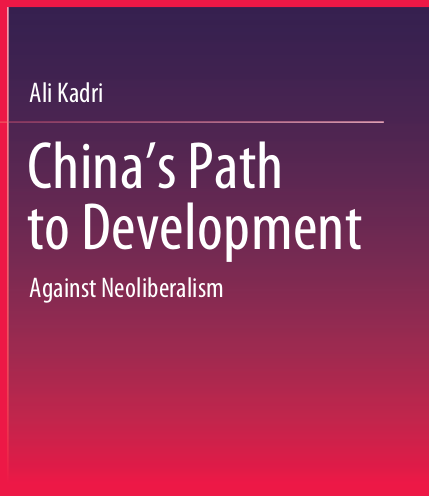
Reading Ali Kadri’s 2021 book China’s Path to Development

In 2021, when China’s Path to Development: Against Neoliberalism was published, Ali Kadri was teaching at the National University of Singapore, which seems to me an interesting vantage point in East Asia from which to study world events. I had read Kadri’s 2019 book, Imperialism with Reference to Syria, which deserves (and might get) a newsletter on its own. I was very interested to see what a writer focused on US imperialism in the Middle East would have to say about China. With these two books, Kadri has made definitive statements on two of the burning questions of imperialism. In recent years, Syria and China have both preoccupied my mind and forced me to change some of my own views.

Let’s stick to the China book though, which tackles an important and divisive question for leftists: is the apparent US-China rivalry really a rivalry between two different systems? Or is it an essentially fake rivalry where Chinese elites, integrated into the capitalist system, are trying to get a slightly better share for themselves under US hegemony? The more I learned about China’s history with the imperialists, from the Opium Wars, the suppression of the Boxer Rebellion, to the 1911 revolution and beyond, the more the question was settled for me.

The question is settled for Kadri too, who is not one for halfway declarations or mealy-mouthed conclusions: China is socialist, and it is because of its socialist policies that it has had the developmental achievements that it has.

Neoliberalism as waste accumulation

For Kadri, the socialist approach is one where a state “holds ultimate control of production and property relations” and can make “autonomous” macroeconomic policies, regulating “macro-prices and its trade and capital accounts in ways that recirculate much of the social surplus for the benefit of society”. The alternative in this world is neoliberalism, which Kadri emphasizes is fundamentally about turning life — the living earth, human lives, other species, nature – to waste. The most devastating passages in Kadri’s books are about this ruthless, cold, calculating waste. “The destruction of the labourer along with the labour power he houses in his very being becomes itself an industry of destruction or waste.” Kadri’s descriptions of how capitalists operate are not for the faint of heart: “In the new factory of the world, living labour produces dead labourers with dead labour.” The death is ivsited upon the developing world by the imperialists, and it is subject to a simple, brutal equation, in inverse proportion to the “power that the aggressed masses exercise in self-defence.”

Kadri’s critique of eurocentric analysis

Kadri unleashes a harsh critique not only on the imperialist system but also on those intellectuals who justify it. “The western left,” Kadri writes, “was the cultural manifestation of the imperialist right and its weapons.” This western left “fought capital’s battles by inculpating the regimentation that the developing world deploys to fend off imperialism as ‘state capitalist’ practice. While contributing to imperialism’s… ideological edifice, it magnified the partial errors in the practice of Southern socialism to discredit it.” By doing so, “the western left turned Marxism into a white supremacist ideology.” According to Kadri, this means misrepresenting Marx himself, who “has been transformed into a liberal obsessed with the western machine and its voting system.” His conclusion: “the ideas propagated by western universities and other ideological apparatuses do more harm in a single day than all the peoples of the developing world pulling rank to keep imperialism at bay do in a century.” To Kadri, the bias towards critiquing global south states’ attempts at self-defence is at the root of much of the western left’s animus towards China especially.

China after the Nixon rapprochement

The debate on the western left about whether China is socialist or not is based on analysis of what happened after China and the US reconciled in 1971 (including joint foreign policy projects like supporting the mujahadeen in Afghanistan 1978-1991), when Deng Xiaoping opened an era of market reforms after 1978, and when China joined the WTO in 2005. Do these changes not indicate that China has embraced capitalism, and neoliberalism? No, Kadri says, because the Chinese state continues to not only grow the economy but also to redistribute wealth. Kadri sees no discontinuity between the planning-driven economic growth of the Mao era (6% until 1977) and the market-reform era post-1980. The growth in the latter period “had roots in the social and productive infrastructure built under Mao.”

What are the actual policies that China uses, and could these be adopted by other countries? Kadri cites investment policy, including state ownership and management of the “inter-industrial input-output relations at social prices, which respect the value of direct producers while guaranteeing growth in industrial investment”; the use of “state-owned development banks” to “create the credit space into which the economy grows”, “entrapping the moneyed value chain within the national economy” through regulation. On the employment side, China includes “planning schemes correlating employment with existing spare capacity”. In agriculture, China engaged in a land reform which “enabled the working class to own wealth”, and slowed rural-urban migration through “government transfers from an industrial sphere benefiting from agricultural surplus and labour” to “re-capitalise” rural areas. China exerted control over agricultural prices, pumped new technology into the rural sector, and equalized wages.

It is these policies, and China’s ability to enact them, that make China socialist. By merely existing in this form, China causes panic to imperialists. “China hinders two operations of imperialism, the concentration and centralisation of capital.” For this reason, “US-led imperialism intensifies its offensive against China.” That ever-intensifying offensive means China has to always think about self-defence. “If China is to survive, it has to finance the national front as well as working classes far afield. It must fight back, and it is better to fight with a working class free of want as well as supersonic missiles.”

As I said at the top, Kadri’s ideas have applicability well beyond analyzing China. The idea that imperialism’s main product is waste has implications for environmental analysis, for example. Without Kadri, you might conclude that there are certain errors in the way we make things that could be changed with better or different technologies. With Kadri, you see that every techological choice in our system is designed to produce waste, and death. To whatever degree China has been able to win some policy freedom from this system, and help others do so, space is provided for policies that produce something other than death.

The last time the US tried to destroy China’s economy

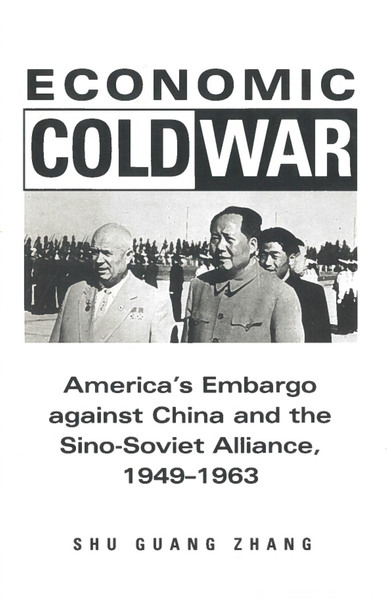
Reading Shu Guang Zhang (2001). Economic Cold War: America’s Embargo against China and the Sino-Soviet Alliance 1949-1963.

Shu Guang Zhang is a US-based academic of Chinese origin – when he wrote the book, a specialist in US history at the University of Maryland. The book is from 2001, when US-China relations looked pretty different than they do now (and different from how they looked during the period he’s writing about). For those reasons it deserves special attention, because you can see how much of what is happening now with the ever-expanding (and perhaps ever-less-effective) US sanctions regime already happened before.

From 1839 until the Chinese revolution succeeded in 1949, China was colonized and partitioned. At that time, the US policy towards China was called the “Open Door”: whatever other imperialists forced China to accept, the US also wanted. There would be no favored imperialist in China.

In the Chinese civil war that pit the Guomindang (Nationalists) against the Communist Party of China, the US bet on the Guomindang against the Communists until the very end.

But when the Communists won the US didn’t see a viable military option against China. Instead, they would have to wield the “economic weapon”, which they hoped would work just as well. In the State Department’s 1948 Policy Planning Staff assessment, China would be “plagued” by an “implacable population pressure” dragging their standard of living downward. Even if they got Russian help, Russia would see them as “a vast poor house, responsibility for which is to be avoided.” They would be desperate for trade and therefore vulnerable to the economic weapon. China was headed rapidly for economic disaster, and would soon come begging to the US. And when they did, the US would say no. Lewis Clark from the US embassy to China wrote to Secretary of State Dean Acheson in 1949: “How fatal for us to permit ourselves to be enticed into assisting the Communists in their desperate need only to discover too late that they wanted our help solely during the interim and until they could get along without us.”

The US had already set up a system of export controls against the Soviet Union: since 1947, the goal was to use export control to deprive the USSR of advanced technology. The US created List 1A of goods with military potential and List 1B of goods with indirect military potential. Anyone trying to send these goods to Russia would need licenses from the Department of Commerce – and the US worked closely with its Western to make sure this embargo held.

Wouldn’t that just drive China and the USSR together? That didn’t worry the US all that much in 1949. Edmund Clubb, US consul-general in Beijing, said if China went to Russia they would quickly “learn how profitless was dealing with the USSR.” Sanctions would force the Chinese to “learn the hard way that they cannot get along without the West.” The US consul-general in Shanghai figured it would “suit our purposes” if the “catastrophic economic situation here would prove a costly drain on Soviet economy, and Chinese Nationalism should make it a thankless task.” Meanwhile the US could “sit with dignity on the sidelines, not necessarily needling Communists, but denying them many things they want badly.”

When China intervened in the US war on Korea in 1950, US officials felt they couldn’t trade with enemies lest the materials they sent be used to “kill our boys.” “The massive Chinese aggression”, they told the British, “confirmed our anxieties and removed our hopes.” In December the US put all trade under control: “we license no goods whatever for export to Communist China, we prohibit our ships and planes from calling at its ports… and we have frozen Communist Chinese assets within the United States.” Truman also set out to “enlist the cooperation and support of other nations” in taking “such measures as are feasible to prevent the flow to countries supporting Communist imperialist aggression of those materials, goods, funds and services which would serve materially to aid their ability to carry on such aggression.”

The CIA suggested a naval blockade and “a campaign of aerial and naval bombardment against selected ports, industrial capacity and storage bases” to “create unemployment and unrest, hinder industrial production and development, and create serious administrative problems”. These ideas were dismissed as infeasible. The US also realized it couldn’t impose a total embargo against China because it would put too much pressure on its allies. Negotiating the multilateral embargo against China proved difficult, with Britain – doing business through its Hong Kong colony (which only became part of China in 1997) – finding itself unable to leave so much money on the table. Worse, Britain feared, too much of this and China might take Hong Kong back even earlier! The result was a Hong Kong compromise, which rendered the whole sanctions regime rather leaky. What a predicament: sanctions needed to pressure China clashed with Britain’s need to make money through its Hong Kong colony and risked an early decolonization.

On the Chinese side, Mao and the Communists realized they would need to rely on Soviet help “for the interim” as they tried to build their own industrial base. The Soviets of course had immense worries of their own, and the result was a tense relationship in which resentments built over time. The story of these resentments and how they grew into the deadly Sino-Soviet split is told in Economic Cold War, as are the economic planning measures that China took in this period. To focus on the sanctions, I won’t summarize either of those right now, as interesting as both are.

Back to the sanctions: China had to develop trade routes and networks with the Soviet Bloc and any other countries that refused to join the US sanctions regime. China also had to try to recover the assets and trade goods that the US stole: imports China had already paid for in hard currency that weren’t going to come, goods China had already sent away for which the payments would never come. Because the dollar was already the currency of international transactions, China also had to resort to trade in barter. This, too, caused resentment since China didn’t feel the USSR was giving them good terms on barter deals. It did, however, start China’s long experience in how to do substantial trade with third countries without using the US dollar.

By 1953, the US made a special assessment that concluded that China had made “rapid progress in economic reconstruction” and that the sanctions “have not appreciably affected the Chinese Communist regime’s ability to consolidate its political position.” Worse, China was exploiting sanctions “in domestic propaganda as an additional indication of the implacable hostility of the West.” How dare they! US allies, including even UK, France, Canada, etc., were increasingly less keen on a total embargo. But in the face of this assessment, Secretary of State Dulles made the perverse strategic calculation that “the best way to get a separation between the Soviet Union and Communist China is to keep pressure on Communist China and make its way difficult so long as it is in partnership with Soviet Russia.” The logic is flawed: pressuring two countries is far more likely to drive them together than apart, which is what happened repeatedly in the course of US-China-Russia relations.

When the Sino-Soviet split finally did happen at the end of the 1950s, the US of course didn’t help, but the agency for the split can only be located in China and Russia – this wasn’t a split engineered or masterminded by the US, but an accumulation of difficult issues between the two countries. A momentous event, but I don’t think an inevitable one or one that the US can count on to repeat itself. The US was eventually able to take advantage of the split, much to the benefit if its imperialist plans! These years too are a story for another time, and not this newsletter. Instead, let’s draw some lessons.

Studying this last episode of US-led economic warfare on China, what can we learn about what’s happening now? A few notes suggest themselves.

  • The US evaluated military and economic options and decided on the economic weapon because the military options seemed infeasible against China.

  • The US had difficulties cajoling its allies into taking economic and financial losses for the sake of punishing China.

  • China was able to develop and progress relying on its internal resources and on using trade methods that the US couldn’t reach (barter, trade with the Soviet Bloc, and the use of Hong Kong).

  • The Russia-China relationship fell apart on its own steam, and has dynamics independent of US desires or actions.

Which of these seem to still hold today? Which of these are subtly (or not subtly) different today? Here are some differences between that time and this one:

  • The US does not have the technological or economic advantages it had then.

  • The US doesn’t appear to have a viable military option but it might do it anyway (it might be an illusion but US Cold War planners seemed to have a slightly higher sense of self-preservation? Is that an illusion on my part?)

  • Russia and China seem to be getting along well – better perhaps even than they did in the early 1950s before the Sino-Soviet split!

That is it for now. I’ll be coming back to this book to talk about the split, the famine of 1958, and other things raised by it. Have a good weekend.

AER 126: Multipolarity? Schmultipolarity! A debate with Sam Gindin

Sam Gindin and Justin Podur, moderated with fairness and balance by Nora Barrows-Friedman, debate the proposition that the world is becoming multipolar as US hegemony declines. We clash over capitalism, colonialism, and the history of the past few centuries; as well as over the meaning of the Russia/Ukraine war and the relative power of Chinese billionaires. If you listen through to the end, leave a review on the podcast app saying who won.

Subimperialism and multipolarity

Brazil’s dilemma

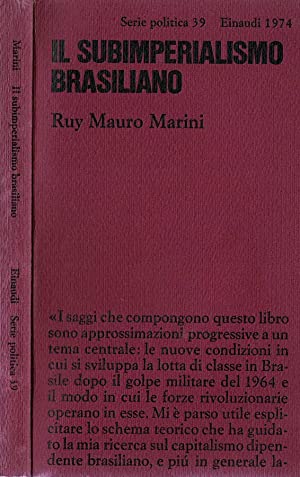
[NOTE: This article was produced by Globetrotter and is published in many of the usual places, but was mainly intended to have a permanent home at the Independent Media Institute’s Observatory, a place for articles that aren’t tied to the news cycle where readers can get into concepts (like, for example, subimperialism!) At my blog, I hosted an article by a colleague, Mandisi Majavu, where he blasted the concept’s analytical value back in 2005 in the South Africa context. I had always intended to come back to it and 18 years later I finally have, after seeing the term pop up in my re-reading of Galeano last year. I found the concept to have been developed through thinking about Brazil, and I wanted to mention the main theorist of the idea that I was able to find, Ruy Mauro Marini… and it helped me think about where Brazil might be headed today…]

A look at sub-imperialism and multipolarity in Brazil historically and into the future.

In the Open Veins of Latin America Eduardo Galeano described an 1870 genocidal war of regime change waged on Paraguay by a Triple Alliance of its neighbors, Argentina, Uruguay, and Brazil, on behalf of British imperialism. The target, nationalist president Solano Lopez, died in battle. The country lost 56,000 square miles of territory. Paraguay’s population was reduced by 83.3 percent.

By the end, Galeano wrote: “Brazil had performed the role the British had assigned it.” Before the intervention, “Paraguay had telegraphs, a railroad, and numerous factories manufacturing construction materials, textiles, linens, ponchos, paper and ink, crockery, and gunpowder… the Ibycui foundry made guns, mortars, and ammunition of all calibers… the steel industry… belonged to the state. The country had a merchant fleet… the state virtually monopolized foreign trade; it supplied yerba mate and tobacco to the southern part of the continent and exported valuable woods to Europe… With a strong and stable currency, Paraguay was wealthy enough to carry out great public works without recourse to foreign capital… Irrigation works, dams and canals, and new bridges and roads substantially helped to raise agricultural production. The native tradition of two crops a year, abandoned by the conquistadors, was revived.”

After the war: “it was not only the population and great chunks of territory that disappeared, but customs tariffs, foundries, rivers closed to free trade, and economic independence… Everything was looted and everything was sold: lands and forests, mines, yerba mate farms, school buildings.”

Summarizing all this, Galeano wrote: “Paraguay has the double burden of imperialism and subimperialism.”

“Subimperialism,” Galeano continued, “has a thousand faces.” Paraguayan soldiers joined an intervention against the Dominican Republic in 1965, under the command of a Brazilian general, Panasco Alvim. Paraguay “gave Brazil an oil concession on its territory, but the fuel distribution and petrochemical business [was] in U.S. hands.” The U.S. also controlled the university, the army, and the black market as well, of which Galeano wrote: “Through open contraband channels, Brazilian industrial products invade the Paraguayan market, but the Sao Paulo factories that produce them have belonged to U.S. corporations since the denationalizing avalanche of recent years.”

Elaborating on Brazil’s sub-imperial function since 1964, Galeano wrote: “A very influential military clique pictures the country as the great administrator of U.S. interests in the region, and calls on Brazil to become the same sort of boss over the south as the [U.S.] is over Brazil itself.”

Ruy Mauro Marini Analyzes the Phenomenon

It is perhaps no coincidence that the leading scholarly authority on sub-imperialism is the Brazilian scholar Ruy Mauro Marini. Mauro’s 1977 article was published shortly after Galeano’s book. To understand “global capitalist accumulation and subimperialism” some background on the theory of imperialism set out by Lenin is in order, and more recent books like Zak Cope’s The Wealth of Some Nations and Patnaik and Patnaik’s A Theory of Imperialism teach the theory eloquently.

The key concepts are unequal exchange and value transfer, magical processes through which the wealthy countries exchange smaller amounts of labor for larger amounts of labor from the poor countries. The mechanisms are many: patent regimes, Western corporate control of Global South resources, denomination of oil and other commodities in U.S. dollars, IMF and Western-bank loan terms and draconian rescue packages, Western arms sales and military training programs—all backed up by the threat of sanctions, coups, invasions, and “color revolutions,” which happen frequently enough to remind Global South governments to stay in line.

In Imperialism, Lenin described the pressure on wealthy countries to “go imperialist:” winners in the Western domestic market invariably consolidate and tend towards monopoly; these winners are invariably coordinated increasingly through banks and financial interests; throwing new investments in to a mature market brings lower returns than they can get in newly opened ones, so the financiers seek colonies to get high returns on their growing piles of capital; the colonies also address their interests in labor and raw materials that are cheap (or ideally, free, through theft).

Mauro shows how this dynamic can lead to sub-imperialism if the context is right. Sub-imperialism, he writes, is “the form assumed by the dependent economy when it reaches the stage of monopoly and finance capital,” and it has two basic components.

The first is a “relatively autonomous” expansionist policy that functions under the overall umbrella of U.S. hegemony.

The second is what Mauro calls a “medium” organic composition of capital. To explain this concept an example comparison will suffice: an economy with a high organic composition of capital is one where workers use advanced, costly machinery that itself required a lot of labor to produce (the word “composition” refers to how much so-called “dead labor” went into the machines on which the “living labor” is now laboring). These are the workers in the vacuum labs making nanometre-precise computing chips. An economy with a low organic composition of capital is one where workers labor with their hands or simple tools, cutting sugar cane with machetes as day laborers. Their work is called “unskilled” and their wages are proportionately lower.

In 1977, Mauro argued that in Latin America, only Brazil had both the medium organic composition and the relatively autonomous expansionist policy. But what about today? And what about in other regions?

Generalizing the Concept

Are there sub-imperialists in South Asia? Pakistan exercises its ambitions in Afghanistan under U.S. hegemony. Imran Khan was overthrown in a coup for withdrawing support for the U.S. occupation of Afghanistan; his successors have worked hard to prove their subordination to the hegemon. India meddles in the affairs of its small neighbors like Bhutanand does so under U.S. hegemony; Western corporations certainly have an immense footprint in both India and Pakistan.

In the Middle East, Saudi Arabia and Turkey qualify as sub-imperialists though both showcase how each sub-imperialist is a special case. In Africa, South Africa has been analyzed as a sub-imperialist and tiny Rwanda could well qualify as a Central African version.

Who doesn’t fit? None of the U.S. Five Eyes partners (Australia, New Zealand, Canada, or UK) nor Japan, nor Israel, since all are high-income countries with higher than “medium” organic composition of capital.

Nor do China, Russia, or Iran fit the sub-imperialist mold. They may exercise hegemony—or contest it—in their regions, but they do not do so under the umbrella of U.S. hegemony.

This brings us back to Brazil and to the changes in the world since the writings of Mauro and Galeano on sub-imperialism.

Sub-Imperialism and Multipolarity

Until very recently, unilateral U.S. hegemony was the basic fact of world affairs.

No one could contest the U.S. invasions of Grenada, Panama, Iraq, or Haiti or its destruction of Yugoslavia and Libya. But Russia and Iran did contest the U.S. plan to dismantle Syria in 2015.

When Yemen voted against the U.S. invasion of Iraq in 1990, they were told that it was “the most expensive vote they ever cast” and punished economically. But by 2022 many countries remained neutral in the Russia-Ukraine War despite Western demands that they support Ukraine. India and China ignored Western demands that they refuse to buy Russian energy, expanding a series of options for trading commodities in currencies other than the U.S. dollar. African countries need not beg Western commercial banks for development finance: they can examine Western offers side-by-side with the Chinese Belt and Road Initiative. In 2023, China brokered a peace deal that restored relations between Saudi Arabia and Iran.

These developments reveal a historical change from a unipolar to a multipolar world order. The world has been under unipolar Anglo-American hegemony since the 1750s. There were world empires prior to that (notably the Spanish and Portuguese) but China and India each had around 25 percent of the world economy even at that time; a few centuries earlier, before the devastation of the Americas, the world was even more multipolar, if much less globalized.

If we are indeed moving away from the unipolar historical pattern, current sub-imperialists have some re-thinking to do: the U.S. umbrella is not what it once was.

Sub-Imperialism or Multipolarity? Which Way for Brazil?

With Lula (Luiz Inácio Lula da Silva) back in the president’s office in Brazil as of 2023, the country faced this precise dilemma. In his previous tenure, Lula acted as both a multipolarist and a sub-imperialist. An early proponent of multipolarity (before the moment had even arrived) through his advocacy of BRICS (Brazil, Russia, India, China, and South Africa) and of Latin American integration, Lula’s Brazil played the sub-imperial role as well, leading the morally compromised and disastrous UN mission to take over the U.S. occupation of Haiti. Some of the military officers who led the Haiti occupation helped overthrow Lula’s party in the coup that led to his jailing and eventually to Bolsonaro’s destructive presidency.

Bolsonaro was certainly, symbolically sub-imperialist: he saluted the U.S. flag and marched under the Israeli one. But most of his time in office was characterized by a disastrous COVID-19 response, genocidal policies against Indigenous peoples, and a general incoherence on foreign policy. Bolsonaro participated in a regime change stunt in Venezuela but tried to stay out of the Russia-Ukraine war.

Lula returned to office in a context of weaker domestic left-wing movements but a stronger multipolar context. Lula’s Brazil voted with the West in the condemnation of Russia’s invasion of Ukraine but Brazil was told by Russian diplomats that Russia understood the vote.

There are economic considerations beyond the organic composition of capital that can drive Global South leaders back into the criminal arms of the U.S.—dependence on natural resource exports and foodgrain imports are tendencies that are difficult to reverse, especially in democracies like Brazil that are vulnerable to coups or regression when the right-wing returns to power.

Perhaps Brazil will be the vanguard of multipolarity in the Americas, or the sub-imperialist agent undermining BRICS from the inside. The changing world includes possibilities never contemplated by Galeano, Mauro, or Lenin.

Justin Podur is a Toronto-based writer and a writing fellow at Globetrotter. You can find him on his website at podur.org and on Twitter @justinpodur. He teaches at York University in the Faculty of Environmental and Urban Change.

This article was produced by Globetrotter.
Subimperialism and multipolarity: Brazil’s dilemma

A look at sub-imperialism and multipolarity in Brazil historically and into the future.

In the Open Veins of Latin America Eduardo Galeano described an 1870 genocidal war of regime change waged on Paraguay by a Triple Alliance of its neighbors, Argentina, Uruguay, and Brazil, on behalf of British imperialism. The target, nationalist president Solano Lopez, died in battle. The country lost 56,000 square miles of territory. Paraguay’s population was reduced by 83.3 percent.

By the end, Galeano wrote: “Brazil had performed the role the British had assigned it.” Before the intervention, “Paraguay had telegraphs, a railroad, and numerous factories manufacturing construction materials, textiles, linens, ponchos, paper and ink, crockery, and gunpowder… the Ibycui foundry made guns, mortars, and ammunition of all calibers… the steel industry… belonged to the state. The country had a merchant fleet… the state virtually monopolized foreign trade; it supplied yerba mate and tobacco to the southern part of the continent and exported valuable woods to Europe… With a strong and stable currency, Paraguay was wealthy enough to carry out great public works without recourse to foreign capital… Irrigation works, dams and canals, and new bridges and roads substantially helped to raise agricultural production. The native tradition of two crops a year, abandoned by the conquistadors, was revived.”

After the war: “it was not only the population and great chunks of territory that disappeared, but customs tariffs, foundries, rivers closed to free trade, and economic independence… Everything was looted and everything was sold: lands and forests, mines, yerba mate farms, school buildings.”

Summarizing all this, Galeano wrote: “Paraguay has the double burden of imperialism and subimperialism.”

“Subimperialism,” Galeano continued, “has a thousand faces.” Paraguayan soldiers joined an intervention against the Dominican Republic in 1965, under the command of a Brazilian general, Panasco Alvim. Paraguay “gave Brazil an oil concession on its territory, but the fuel distribution and petrochemical business [was] in U.S. hands.” The U.S. also controlled the university, the army, and the black market as well, of which Galeano wrote: “Through open contraband channels, Brazilian industrial products invade the Paraguayan market, but the Sao Paulo factories that produce them have belonged to U.S. corporations since the denationalizing avalanche of recent years.”

Elaborating on Brazil’s sub-imperial function since 1964, Galeano wrote: “A very influential military clique pictures the country as the great administrator of U.S. interests in the region, and calls on Brazil to become the same sort of boss over the south as the [U.S.] is over Brazil itself.”

Ruy Mauro Marini Analyzes the Phenomenon

It is perhaps no coincidence that the leading scholarly authority on sub-imperialism is the Brazilian scholar Ruy Mauro Marini. Mauro’s 1977 article was published shortly after Galeano’s book. To understand “global capitalist accumulation and subimperialism” some background on the theory of imperialism set out by Lenin is in order, and more recent books like Zak Cope’s The Wealth of Some Nations and Patnaik and Patnaik’s A Theory of Imperialism teach the theory eloquently.

The key concepts are unequal exchange and value transfer, magical processes through which the wealthy countries exchange smaller amounts of labor for larger amounts of labor from the poor countries. The mechanisms are many: patent regimes, Western corporate control of Global South resources, denomination of oil and other commodities in U.S. dollars, IMF and Western-bank loan terms and draconian rescue packages, Western arms sales and military training programs—all backed up by the threat of sanctions, coups, invasions, and “color revolutions,” which happen frequently enough to remind Global South governments to stay in line.

In Imperialism, Lenin described the pressure on wealthy countries to “go imperialist:” winners in the Western domestic market invariably consolidate and tend towards monopoly; these winners are invariably coordinated increasingly through banks and financial interests; throwing new investments in to a mature market brings lower returns than they can get in newly opened ones, so the financiers seek colonies to get high returns on their growing piles of capital; the colonies also address their interests in labor and raw materials that are cheap (or ideally, free, through theft).

Mauro shows how this dynamic can lead to sub-imperialism if the context is right. Sub-imperialism, he writes, is “the form assumed by the dependent economy when it reaches the stage of monopoly and finance capital,” and it has two basic components.

The first is a “relatively autonomous” expansionist policy that functions under the overall umbrella of U.S. hegemony.

The second is what Mauro calls a “medium” organic composition of capital. To explain this concept an example comparison will suffice: an economy with a high organic composition of capital is one where workers use advanced, costly machinery that itself required a lot of labor to produce (the word “composition” refers to how much so-called “dead labor” went into the machines on which the “living labor” is now laboring). These are the workers in the vacuum labs making nanometre-precise computing chips. An economy with a low organic composition of capital is one where workers labor with their hands or simple tools, cutting sugar cane with machetes as day laborers. Their work is called “unskilled” and their wages are proportionately lower.

In 1977, Mauro argued that in Latin America, only Brazil had both the medium organic composition and the relatively autonomous expansionist policy. But what about today? And what about in other regions?

Generalizing the Concept

Are there sub-imperialists in South Asia? Pakistan exercises its ambitions in Afghanistan under U.S. hegemony. Imran Khan was overthrown in a coup for withdrawing support for the U.S. occupation of Afghanistan; his successors have worked hard to prove their subordination to the hegemon. India meddles in the affairs of its small neighbors like Bhutanand does so under U.S. hegemony; Western corporations certainly have an immense footprint in both India and Pakistan.

In the Middle East, Saudi Arabia and Turkey qualify as sub-imperialists though both showcase how each sub-imperialist is a special case. In Africa, South Africa has been analyzed as a sub-imperialist and tiny Rwanda could well qualify as a Central African version.

Who doesn’t fit? None of the U.S. Five Eyes partners (Australia, New Zealand, Canada, or UK) nor Japan, nor Israel, since all are high-income countries with higher than “medium” organic composition of capital.

Nor do China, Russia, or Iran fit the sub-imperialist mold. They may exercise hegemony—or contest it—in their regions, but they do not do so under the umbrella of U.S. hegemony.

This brings us back to Brazil and to the changes in the world since the writings of Mauro and Galeano on sub-imperialism.

Sub-Imperialism and Multipolarity

Until very recently, unilateral U.S. hegemony was the basic fact of world affairs.

No one could contest the U.S. invasions of Grenada, Panama, Iraq, or Haiti or its destruction of Yugoslavia and Libya. But Russia and Iran did contest the U.S. plan to dismantle Syria in 2015.

When Yemen voted against the U.S. invasion of Iraq in 1990, they were told that it was “the most expensive vote they ever cast” and punished economically. But by 2022 many countries remained neutral in the Russia-Ukraine War despite Western demands that they support Ukraine. India and China ignored Western demands that they refuse to buy Russian energy, expanding a series of options for trading commodities in currencies other than the U.S. dollar. African countries need not beg Western commercial banks for development finance: they can examine Western offers side-by-side with the Chinese Belt and Road Initiative. In 2023, China brokered a peace deal that restored relations between Saudi Arabia and Iran.

These developments reveal a historical change from a unipolar to a multipolar world order. The world has been under unipolar Anglo-American hegemony since the 1750s. There were world empires prior to that (notably the Spanish and Portuguese) but China and India each had around 25 percent of the world economy even at that time; a few centuries earlier, before the devastation of the Americas, the world was even more multipolar, if much less globalized.

If we are indeed moving away from the unipolar historical pattern, current sub-imperialists have some re-thinking to do: the U.S. umbrella is not what it once was.

Sub-Imperialism or Multipolarity? Which Way for Brazil?

With Lula (Luiz Inácio Lula da Silva) back in the president’s office in Brazil as of 2023, the country faced this precise dilemma. In his previous tenure, Lula acted as both a multipolarist and a sub-imperialist. An early proponent of multipolarity (before the moment had even arrived) through his advocacy of BRICS (Brazil, Russia, India, China, and South Africa) and of Latin American integration, Lula’s Brazil played the sub-imperial role as well, leading the morally compromised and disastrous UN mission to take over the U.S. occupation of Haiti. Some of the military officers who led the Haiti occupation helped overthrow Lula’s party in the coup that led to his jailing and eventually to Bolsonaro’s destructive presidency.

Bolsonaro was certainly, symbolically sub-imperialist: he saluted the U.S. flag and marched under the Israeli one. But most of his time in office was characterized by a disastrous COVID-19 response, genocidal policies against Indigenous peoples, and a general incoherence on foreign policy. Bolsonaro participated in a regime change stunt in Venezuela but tried to stay out of the Russia-Ukraine war.

Lula returned to office in a context of weaker domestic left-wing movements but a stronger multipolar context. Lula’s Brazil voted with the West in the condemnation of Russia’s invasion of Ukraine but Brazil was told by Russian diplomats that Russia understood the vote.

There are economic considerations beyond the organic composition of capital that can drive Global South leaders back into the criminal arms of the U.S.—dependence on natural resource exports and foodgrain imports are tendencies that are difficult to reverse, especially in democracies like Brazil that are vulnerable to coups or regression when the right-wing returns to power.

Perhaps Brazil will be the vanguard of multipolarity in the Americas, or the sub-imperialist agent undermining BRICS from the inside. The changing world includes possibilities never contemplated by Galeano, Mauro, or Lenin.

Justin Podur is a Toronto-based writer and a writing fellow at Globetrotter. You can find him on his website at podur.org and on Twitter @justinpodur. He teaches at York University in the Faculty of Environmental and Urban Change.

This article was produced by Globetrotter.
Asking the Oppressed to Be Nonviolent Is an Impossible Standard That Ignores History

In January 2023, after five police officers killed Tyre Nichols, President Joe Biden quickly issued a statement calling on protesters to stay nonviolent. “As Americans grieve, the Department of Justice conducts its investigation, and state authorities continue their work, I join Tyre’s family in calling for peaceful protest,” said Biden. “Outrage is understandable, but violence is never acceptable. Violence is destructive and against the law. It has no place in peaceful protests seeking justice.”

In June 2022, when the Supreme Court overturned Roe v. Wade, Biden made the same call to protesters. “I call on everyone, no matter how deeply they care about this decision, to keep all protests peaceful. Peaceful, peaceful, peaceful,” Biden said. “No intimidation. Violence is never acceptable. Threats and intimidation are not speech. We must stand against violence in any form, regardless of your rationale.”

It is a curious spectacle to have the head of a state, with all the levers of power, not using that power to solve a problem, but instead offering advice to the powerless about how to protest against him and the broken government system. Biden, however, showed no such reluctance to use those levers of power against protesters. During the Black Lives Matter protests of 2020 after the murder of George Floyd, when Biden was a presidential candidate, he made clear what he wanted to happen to those who didn’t heed the call to nonviolence: “We should never let what’s done in a march for equal rights overcome what the reason for the march is. And that’s what these folks are doing. And they should be arrested—found, arrested, and tried.”

In the face of murderous police action, Biden called on protesters to be “peaceful, peaceful, peaceful.” In the face of non-nonviolent protesters, Biden called on police to make sure the protesters were “found, arrested, and tried.”

Are protesters in the United States (and perhaps other countries where U.S. protest culture is particularly strong, like Canada) being held to an impossible standard? In fact, other Western countries don’t seem to make these demands of their protesters—consider Christophe Dettinger, the boxer who punched a group of armored, shielded, and helmeted French riot police until they backed off from beating other protesters during the yellow vest protests in 2019. Dettinger went to jail but became a national hero to some. What would his fate have been in the United States? Most likely, he would have been manhandled on the spot, as graphic footage of U.S. police behavior toward people much smaller and weaker than Dettinger during the 2020 protests would suggest. If he survived the encounter with U.S. police, Dettinger would have faced criticism from within the movement for not using peaceful methods.

There is a paradox here. The United States, the country with nearly 800 military bases across the world, the country that dropped the nuclear bomb on civilian cities, and the country that outspends all its military rivals combined, expects its citizens to adhere to more stringent standards during protests compared to any other country. Staughton and Alice Lynd in the second edition of their book Nonviolence in America, which was released in 1995, wrote that “America has more often been the teacher than the student of the nonviolent ideal.” The Lynds are quoted disapprovingly by anarchist writer Peter Gelderloos in his book How Nonviolence Protects the State, an appeal to nonviolent protesters in the early 2000s who found themselves on the streets with anarchists who didn’t share their commitment to nonviolence. Gelderloos asked for solidarity from the nonviolent activists, begging them not to allow the state to divide the movement into “good protesters” and “bad protesters.” That so-called “antiglobalization” movement faded away in the face of the post-2001 war on terror, so the debate was never really resolved.

For the U.S., the UK, and many of their allies, the debate over political violence goes back perhaps as far as the white pacifists who assured their white brethren, terrified by the Haitian Revolution, which ended in 1804, that abolitionism did not mean encouraging enslaved people to rebel or fight back. While they dreamed of a future without slavery, 19th-century abolitionist pacifists understood, like their countrymen who were the enslavers, that the role of enslaved people was to suffer like good Christians and wait for God’s deliverance rather than to rebel. Although he gradually changed his mind, 19th-century abolitionist and pacifist William Lloyd Garrison initially insisted on nonviolence toward enslavers. Here Garrison is quoted in the late Italian communist Domenico Losurdo’s book Nonviolence: A History Beyond the Myth: “Much as I detest the oppression exercised by the Southern slaveholder, he is a man, sacred before me. He is a man, not to be harmed by my hand nor with my consent.” Besides, he added, “I do not believe that the weapons of liberty ever have been, or ever can be, the weapons of despotism.” As the crisis deepened with the Fugitive Slave Law, Losurdo argued, pacifists like Garrison found it increasingly difficult to call upon enslaved people to turn themselves back to their enslavers without resistance. By 1859, Garrison even found himself unable to condemn abolitionist John Brown’s raid on Harpers Ferry.

The moral complexities involved in nonviolence in the antiwar movement were acknowledged by linguist, philosopher, and political activist Noam Chomsky in a 1967 debate with political philosopher Hannah Arendt and others. Chomsky, though an advocate for nonviolence himself in the debate, concluded that nonviolence was ultimately a matter of faith:

“The easiest reaction is to say that all violence is abhorrent, that both sides are guilty, and to stand apart retaining one’s moral purity and condemn them both. This is the easiest response and in this case I think it’s also justified. But, for reasons that are pretty complex, there are real arguments also in favor of the Viet Cong terror, arguments that can’t be lightly dismissed, although I don’t think they’re correct. One argument is that this selective terror—killing certain officials and frightening others—tended to save the population from a much more extreme government terror, the continuing terror that exists when a corrupt official can do things that are within his power in the province that he controls.”

“Then there’s also the second type of argument… which I think can’t be abandoned very lightly. It’s a factual question of whether such an act of violence frees the native from his inferiority complex and permits him to enter into political life. I myself would like to believe that it’s not so. Or at the least, I’d like to believe that nonviolent reaction could achieve the same result. But it’s not very easy to present evidence for this; one can only argue for accepting this view on grounds of faith.”

Several writings have sounded the warning that nonviolence doctrine has caused harm to the oppressed. These include Pacifism as Pathology by Ward Churchill, How Nonviolence Protects the State and The Failure of Nonviolence by Peter Gelderloos, Nonviolence: A History Beyond the Myth by Domenico Losurdo, and the two-part series “Change Agent: Gene Sharp’s Neoliberal Nonviolence” by Marcie Smith.

Even the historic victories of nonviolent struggles had a behind-the-scenes armed element. Recent scholarly work has revisited the history of nonviolence in the U.S. civil rights struggle. Key texts include Lance Hill’s The Deacons for Defense, Akinyele Omowale Umoja’s We Will Shoot Back, and Charles E. Cobb Jr.’s This Nonviolent Stuff’ll Get You Killed. These histories reveal continuous resistance, including armed self-defense, by Black people in the United States.

Even before these recent histories, we have Robert Williams’s remarkable and brief autobiography written in exile, Negroes With Guns. Williams was expelled from the NAACP for saying in 1959: “We must be willing to kill if necessary. We cannot take these people who do us injustice to the court. … In the future we are going to have to try and convict these people on the spot.” He bitterly noted that while “Nonviolent workshops are springing up throughout Black communities [, n]ot a single one has been established in racist white communities to curb the violence of the Ku Klux Klan.”

As they moved around the rural South for their desegregation campaigns, the nonviolent activists of the civil rights movement often found they had—without their asking—armed protection against overzealous police and racist vigilantes: grannies who sat watch on porches at night with rifles on their laps while the nonviolent activists slept; Deacons for Defense who threatened police with a gun battle if they dared turn water hoses on nonviolent students trying to desegregate a swimming pool. Meanwhile, legislative gains made by the nonviolent movement often included the threat or reality of violent riots. In May 1963 in Birmingham, Alabama, for example, after a nonviolent march was crushed, a riot of 3,000 people followed. Eventually a desegregation pact was won on May 10, 1963. One observer argued that “every day of the riots was worth a year of civil rights demonstrations.”

As Lance Hill argues in The Deacons for Defense:

“In the end, segregation yielded to force as much as it did to moral suasion. Violence in the form of street riots and armed self-defense played a fundamental role in uprooting segregation and economic and political discrimination from 1963 to 1965. Only after the threat of black violence emerged did civil rights legislation move to the forefront of the national agenda.”

Biden’s constant calls for nonviolence by protesters while condoning violence by police are asking for the impossible and the ahistorical. In the crucial moments of U.S. history, nonviolence has always yielded to violence.

This article was produced by Globetrotter. Justin Podur is a Toronto-based writer and a writing fellow at Globetrotter. You can find him on his website at podur.org and on Twitter @justinpodur. He teaches at York University in the Faculty of Environmental and Urban Change.
WWCiv 9: Imperial Resentment, Industrial Power, Inevitable Socialism: Germany before WW1

Germany’s contested rise and WW1

Of all the mysteries of the World Wars, Germany’s is perhaps the most mysterious. We discuss this country with the fastest growing industrial power, the largest and most powerful socialist movement, and (perhaps) the most arrogant imperialist at the helm. We conclude with some notes on some interesting (but not especially well liked by us) sources on German-British rivalry.

AER 114: Why Democracy (TM) Fails the Global South

Does democracy deliver development?

Democracy means “the people rule”. But do the people rule in the “democratic” systems that form governments all over the world? Are these democratic governments less repressive or authoritarian than those without the democratic certification? And does the democratic system of frequent multiparty elections deliver the developmental goods?

Talking to Vik Sohonie, former journalist who runs the grammy-award nominated Ostinato Records, about why Democracy (TM) fails the Global South.