By a slave owner’s reading of history, Abraham Lincoln butchered 260,000 to 400,000 of his “own people” in the South to keep the Confederate States from seceding from the USA. [1] Lincoln was actually a perpetrator of genocide against the indigenous peoples of North America like the all the US presidents who established the USA. He also wanted to expel the Black population to Haiti after the Civil War. But taken in isolation, his military victory over the Confederate States – even if you know that the plight of slaves was not actually Lincoln’s priority – cannot be used by any reasonable person to depict him as a monster. There is no “freedom” to establish a giant confederation of slave owners that anyone should respect. Waging a civil war to prevent it was fully justified. That does not mean that Lincoln’s side never acted immorally in the way it fought the war. But an honest assessment of Lincoln’s human rights record must take into account that he was on the right side of the US Civil War.
Waging war to defend against the world’s greatest evil is justified
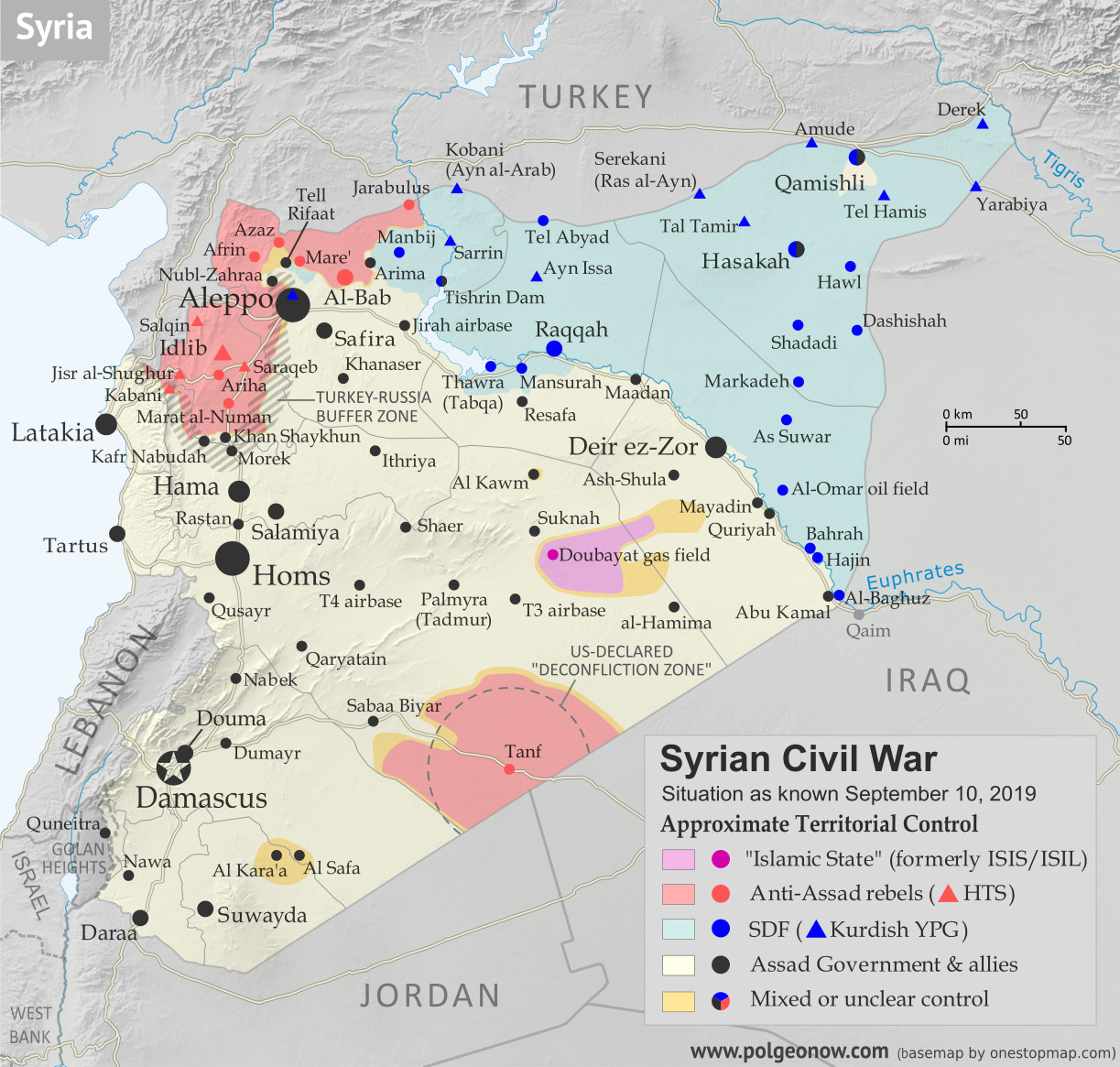
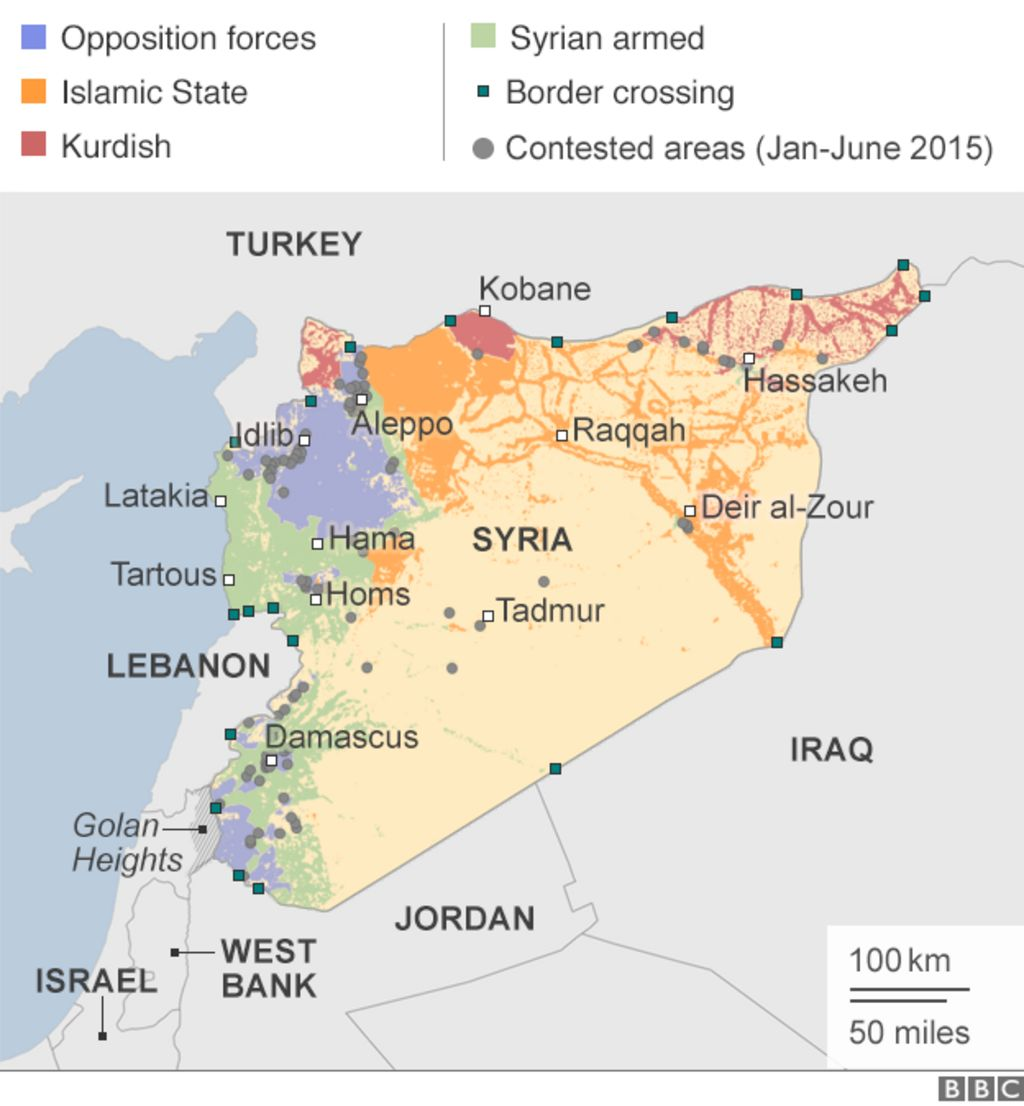
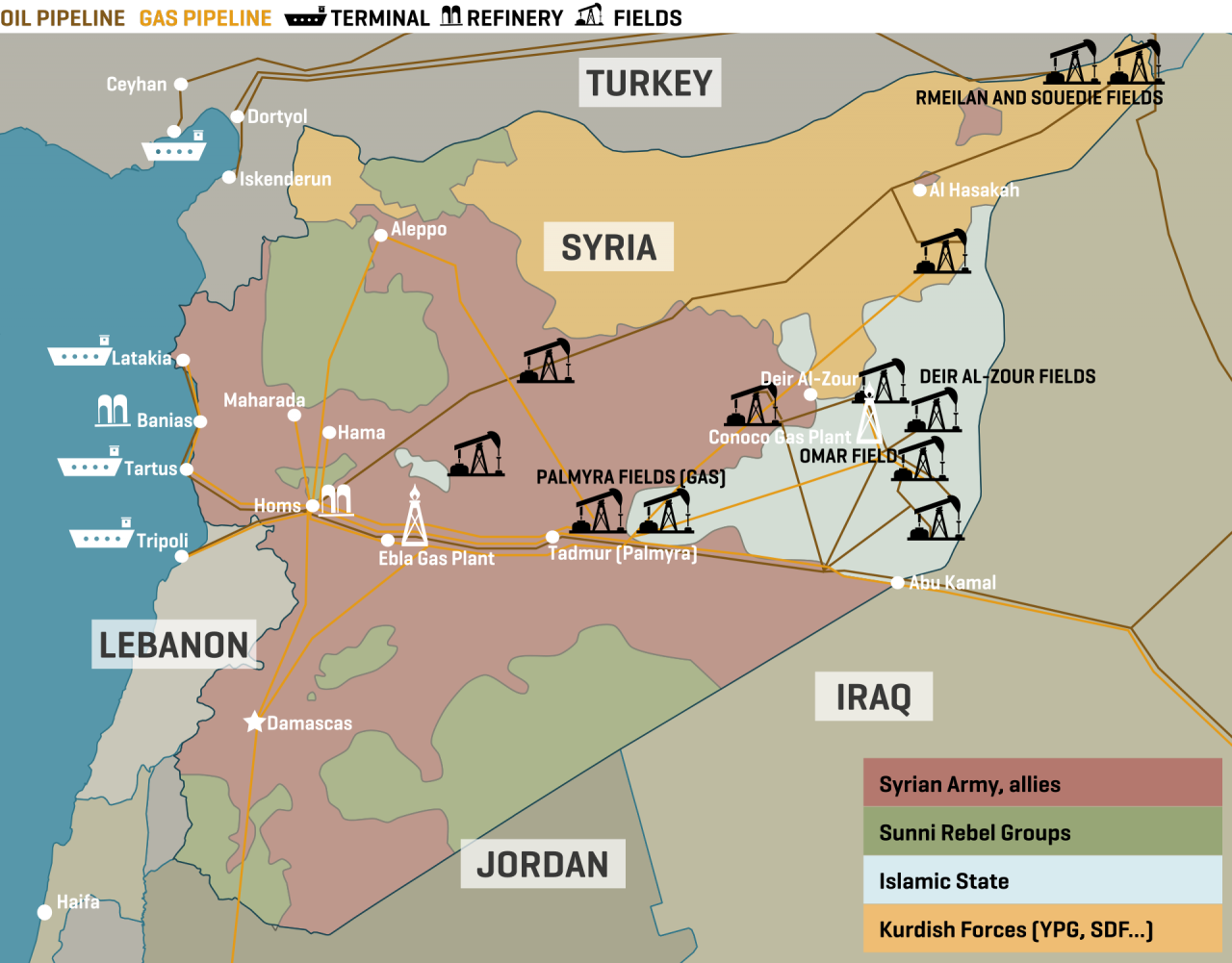
President Bashar al-Assad of Syria also fought, but in his case ultimately lost, a civil war that he was fully justified in waging. Since 2011 until his ouster weeks ago, Assad fought to prevent his country from being conquered and partitioned by the greatest evil in the world today: the US Empire. Assad fought armed rebels backed by the US and its top clients in the region: Turkey, Israel and Saudi Arabia. The case for depicting Assad as a monster is based on the premise that Assad had no right to defend his country against the US and its allies. Sometimes Assad’s detractors denied the significance of the US role in the war. Always absurd, their denial became downright farcical once the US occupied part of Syria in 2014.
With the help of Russia and other allies (Iran and Hezbollah), Assad was able to achieve a stalemate in the war for years. But it was a stalemate that allowed the US and its proxies to occupy resource-rich areas of the country. The US occupation magnified the impact of sanctions that Washington used to ruthlessly bleed Syria economically. Neither Assad nor his foreign allies were willing to take the enormous risks required to kick the US out of Syria, or to stop Israel’s constant bombing of Syria. The economic bleeding eventually paid off dramatically for the US-backed rebels. Assad was overthrown mere days after rebels launched an offensive to break the 2020 stalemate that had been negotiated by Russia and Iran with Turkey.
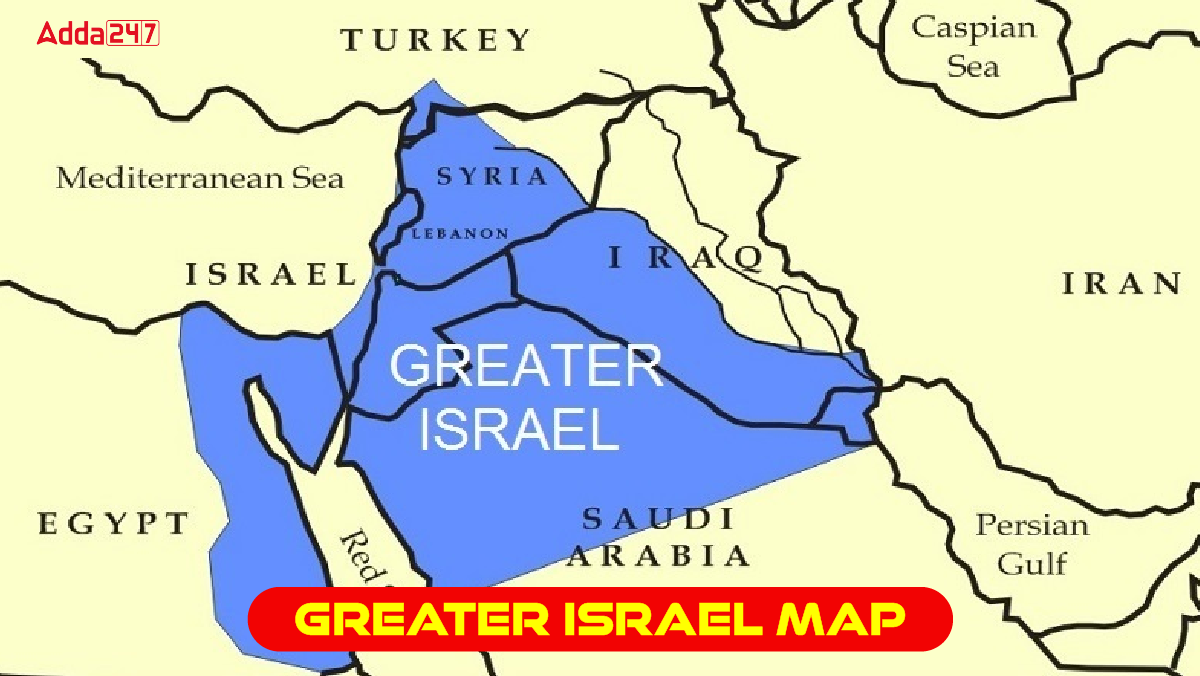
The civil war to oust Assad was a US project executed for the benefit of Israel. The genocidal Zionst state has already bombed hundreds of sites in Syria to destroy any military capacity for the new government. At the same time Israel has done this, Syria’s new government has clearly signalled its submissiveness towards Israel, but expressed hatred for Israeli enemies: Iran and Hezbollah. Israel is occupying Syrian villages, issuing deportation orders to Syrian citizens, and bringing in Jewish settlers. Israel now has better military options for attacking Lebanon and for cutting off armed support to Hezbollah. So those hailing Assad’s ouster on “human rights” grounds must ignore that his ouster has provided the Israelis state with greater power and impunity to crush the human rights of Syrians, Palestinians and Lebanese.
When we declare the US Empire to be the world’s greatest evil, our case is overwhelming. Before October 7, 2023 one could point to countless military coups the US has sponsored in the Americas; its slaughter of millions in Indochina during the 1960s and 70s; the millions of deaths it caused in Iraq since 1990; economic policies that consigned hundreds of millions to misery and premature death; its sponsorship of Israeli atrocities for several decades. The case was already irrefutable, but today it is even more stunningly so.
The US government has sponsored a Holocaust in Gaza since October 7, 2023. Its horrors have been live-streamed around the world so continuously that even outfits with proven track record of subservience to the US have been forced into damage control. In November, the ICC issued arrest warrants for Netanyahu and his former defense minister Yoav Gallant. Days ago, Amnesty International belatedly concluded that Israel is guilty of genocide in Gaza. But both the ICC and Amnesty international, still insisted on parroting the genocidal Israeli (and US) take on the Palestinian armed resistance of October 7. [2]
Imperialists have always posed as a “human rights” crusaders
The character assassination of targeted leaders for their “human rights” records was conceived by Western imperialists, avant la lettre, in the 19th century to justify the destruction of states and the colonization of the post-destruction territories. When the Scramble for Africa was happening at full speed in 1884, the Times of London carried campaigns about every single individual African leader and how they each “must go”: Tippu Tip of Eastern Congo had to go, Msiri of Katanga had to go, Cetshwayo of the Zulus had to go, Mwanga of Buganda, Kabarega of Bunyoro, Arap Samoei, Bai Bureh, Yaa Asentewaa, Abd el Kader of Algeria had to go, Sadok Bey of Tunis had to go, Sultan Ahmadou, Samori Toure, King Benanzin – had to go, of course Queen Ranavalona had to go, she was a Mad Queen, Mkwawa of the Hehe, Samuel Maherero, Hendrik Witbooi – had to go, Queen Liliuokalani of Hawaii had to go. This is not an exhaustive list. Every single one of these leaders had the equivalent of their human rights record pilloried in the Western press, notably the Times. The Belgians claimed that they colonized Congo to protect the Congolese from slavery. Then they killed 10 million of them over about 20 years, chopping off their hands for trophy photographs if they didn’t collect rubber fast enough.
The imperialist game of targeted leaders that “must go” is older than the specific doctrine of human rights and democracy. But that doctrine also was conceived and built as an engine of imperialism. When Africa was decolonizing itself in the 1960s, Africans looked naturally to the communist countries as models. Economic equality and economic development – tangibles like caloric intake, health and education, and infrastructure – these were the kinds of things that were rapidly improving in postcolonial communist nations. In the kind of neocolonial relationships that the US was trying to impose on the newly decolonized countries – in which the West would continue to control investment, finance, intellectual property, and elite education – Third World nations tilting to the West would not be getting economic equality or development. They would instead be getting unequal exchange and impoverishment while enriching the West.
What the West could offer, especially to communist, nationalist, or developmentalist states that were trying to protect themselves from Western economic penetration, was “human rights and democracy”, a methodology for measuring “authoritarianism” and even a framework for overthrowing these developmentalist regimes – the “color revolution”. Another benefit of campaigning for human rights and democracy is that the open (to foreign penetration) multiparty electoral political and media systems that the US promotes render developmentalist states unprotected from US campaigns against them. US agents can freely use local media (and now social media) to generate political influence inside almost any country in the world. Any state that constrains US media, tech, or political agents like NED, IRI, and NDI gets labelled as authoritarian.
This is all outlined in, among other works, Nicholas Guilhot’s The Democracy Makers, Jessica Whyte’s The Morals of the Market, and James Peck’s Ideal Illusions. Our own book, Extraordinary Threat, shows the working of this (so far failed) methodology on Venezuela and previous books by one of us, Haiti’s New Dictatorship, and America’s Wars on Democracy in Rwanda and the DR Congo shows the working of this (successful) methodology to Haiti, Rwanda, and the DR Congo. Yugoslavia is another well-documented case.
Closer to Syria, in the Arab world, the “human rights and democracy” campaign was run to overthrow Saddam Hussein in Iraq and Muammar Gaddafi in Libya, leaving generational destruction in their wake and countries that show no sign of regaining the sovereignty or developmental level they had under dictators they were told “must go’. As already noted, Bashar al-Assad in Syria was targeted with incredible ferocity and held out for a long time, but ultimately left in 2024. Syria’s development prospects had already been destroyed by Israeli bombing, US sanctions, and US and Turkish occupation and outright asset stripping before the overthrow.
How bad was Assad’s human rights record?
But what if we put all these important considerations aside? Put aside Assad’s right to defend his government from being overthrown by the US Empire. Put aside western imperialism’s long track record of lying about enemies and pretending to be human rights crusaders as they murder and plunder. Let’s simply try to assess how bad Assad’s government was.
He first took office in 2000. There are two questions:
-
How badly did he violate human rights between 2000-2011, before the civil war began?
-
How badly did he violate human rights in the way he fought the civil war from 2011-2024?
“How badly” can only be answered comparatively.
So, we review what is known about Assad’s human rights and democracy record, compared to two states: Saudi Arabia and the USA. These two comparators have prisons, the death penalty, and torture. They commit genocide (the US all over the world and notably Gaza right now, Saudi Arabia in Yemen from 2014 on), but face no threat, nor even any rhetoric, of being overthrown by anyone.
The main index of human rights violations / authoritarianism / tyranny would be numbers killed and imprisoned. The main index of dictatorship / democracy is elections.
How does Syria under Bashar al-Assad, from 2000-2011 compare?
Prisons. Consider the prison population data shown below which is taken from the Institute for Crime & Justice Policy Research (ICPR), a research outfit funded in part by the UK government.

During the 2000s both the USA and Saudi Arabia had vastly larger prison populations than Syria. Adjusted for population, Syria’s imprisoned about half as many people as Saudi Arabia, and only one tenth as many as the USA.

Elections. Saudi Arabia doesn’t even bother holding sham elections at the national level.
In the USA, the Republican and Democratic parties can be considered two factions of the same party that serves US elites, not the general public. Some have branded them the Uniparty. There are certainly significant differences between Democrat and Republican voters. African Americans are far more likely to vote Democrat than Republican for example (80 percent voted for Harris in 2024, and 90 percent for Biden in 2020). Majorities of Democrat voters and independents said last year that the US should stop arming Israel. Democrat voters ( as well as independents) are twice as likely as Republican voters to say that the US should stop weapons sales to Israel. However, we know for certain neither party would ever cut off weapons sales to Israel simply because most voters want that. In fact, the Democratic party’s willingness to defy their voting base (and disregard trying to appeal to independents) by arming Israel probably cost them the presidential election in November. But what does “losing” really mean when Uniparty always wins?
Alternatives to the Uniparty are very effectively marginalized: everything from the winner-take-all allocation of electoral votes, to the lawsuits to deny alternative ballot access, to the exorbitant cost of media access, to the dependence on private donors all work to ensure that the Uniparty consistently gets over 96 percent of the vote.
In fact, as shown below, the Uniparty in the USA, has sometimes been more dominant in elections than Assad had been in Syria.
ELECTION RESULTS
Saudi Arabia – no national level elections
USA percentage of vote won by the Uniparty [3]
2000…96.3%
2004…99.0%
2008…98.6%
SYRIA percentage of vote won by Assad [4]
2000…97.0%
2007…97.0%
2014…88.7%
2021…95.1%
Services. A broader view of human rights in Syria before the civil war would look at access to basic services like health care and food. One way to capture that is through child mortality data. As of 2011, UNICEF’s data for 2009 (the most recent available at the time) showed Syria had a very low child mortality rate compared to many nearby countries. It was significantly lower than Saudi Arabia’s and Jordan’s in 2009 according to UNICEF’s 2011 data.
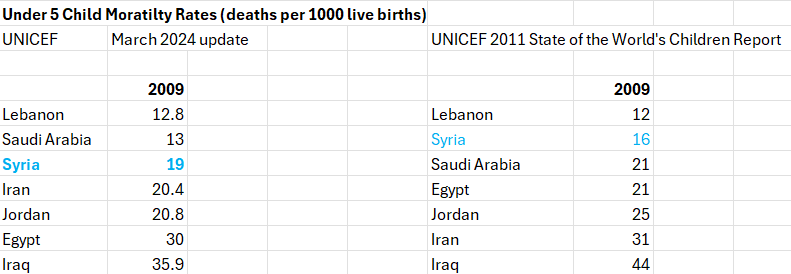
But UNICEF often revises its data retroactively. As with other UN agencies, these revisions often look like they have been driven by pressure from powerful western donors. UNICEF revised by 2009 so that as of 2024 it is claiming that Saudi Arabia’s child mortality rate was actually much better than Syria’s in 2009. Regardless, in neither data set does Syria stand out as a country with a poor child mortality rate compared to its neighbors, many of them dictatorships that were not hit with US-orchestrated destabilization campaigns.
We can’t really use human rights data from 2011-2024 to compare Syria to the USA and Saudi Arabia since neither of those two countries were fighting a civil war. But we do have a long-running war in the neighbourhood that we can use for comparison. Let’s compare Assad’s conduct of the Syria war to the way Israel (with the unconditional and essential backing of the US) has waged war since October of 2023.
Comparing Syria’s civil war to the Holocaust in Gaza
Deaths. According to the New York Times, fourteen years of civil war in Syria caused as many as 620,000 deaths in a country whose population in 2011 was 22 million. These deaths were inflicted by both the Syrian government and the armed opposition. The NYT cited various counts of war-related deaths, not cluster sampling methods that have been used to estimate the death rates before and after a war. Cluster sampling captures deaths from the war that might not otherwise be reported as war-related: the deaths caused by damaged health and sanitation systems for example. In Iraq, cluster sampling methods produced vastly higher estimates of the death toll from the US invasion of Iraq in 2003 (and the subsequent occupation) than did direct counts produced by sources such as Iraq Body Count.
So to compare the NYT’s count for Syria civil war we will use similar direct counts available from Gaza’s health ministry. In Gaza, with a population of only 2.2 million people before the Israeli rampage since October 7, there were 43,000 deaths tallied by Gaza’s health ministry in 13 months – Ralph Nader and others have argued this is a drastic underestimate. Unlike the NYT’s figure for Syria where the government and rebels share responsibility for the deaths, all of the victims of the war on Gaza were killed by Israel.
So the share of Gaza’s population killed by Israel in only 13 months is 1.95 percent. In 14 years of civil war in Syria, all sides together killed 2.8 percent of the population (about 0.2 percent per year on average). According to the lowest estimates of Israeli killing (which could be off by a factor of 5) Israel is therefore killing Gaza’s population at a rate about nine times faster than all actors in the war in Syria killed Syrians.
The Syria numbers used in the comparison above include deaths on all sides, combatants as well as civilians. The anti-Assad Syrian Observatory for Human Rights, seems to claim that Assad is responsible for 219,223 civilian deaths by March of 2024. [5] Given that the death toll in Gaza has overwhelmingly been of Palestinian civilians, a better comparison with the Gaza health ministry data would be the number of civilians Assad has been accused of killing since 2011. In that comparison Israel has been killing Gaza’s population at a rate about 16 times faster than Assad did to Syrians. [6]
Displacement. By 2014, three years of Syria’s Civil War had displaced 9.5 million people, 43% of the pre-war population of 22 million. By 2024, 14 million were displaced, 63.6% of the population. The responsibility for displacement is shared by both sides of the war. In Gaza, 90 percent of the population had been displaced after a year of war, entirely by Israel.
Hospital Destruction. In 2021, nine years into Syria’s civil war Aljazeera reported that “in northwest Syria, [not all of Syria] for example, the UN has said that 50 percent of health facilities are no longer functioning.” In Gaza, after only a year of war, less than half of its hospitals were functional, and those that were “only partly so” according to Doctors with Borders.
In conclusion:
-
Syria under Assad incarcerated a fraction of the numbers the US incarcerates.
-
Its record on women’s rights is a century ahead of Saudi Arabia’s.
-
Its conduct during the 2011-2024 civil war destroyed a fraction of the buildings and infrastructure Israel destroyed in Gaza and Lebanon.
-
Assad’s government did not target children and medical facilities with anything like the intensity Israel did, nor did it impose starvation and siege conditions.
-
There were disputes about the fairness of Syria’s elections, but unlike Saudi Arabia, it held some. If Republicans and Democrats are counted together, as they should be, the duopoly achieves vote tallies that would make any authoritarian or dictator blush.
-
The 2011 protests in Syria were suppressed with violence, as were protests in Saudi Arabia. When Palestinians in Gaza protested against Israel in 2018, Israeli snipers killed hundreds of them and injured thousands. American police also kill protesters. Several of the leaders of the Ferguson and George Floyd uprisings in the US were killed by police after the fact. And of course US police kill around 1000 Americans a year, every year.
According to any measure of human rights or democracy, the ousted Syrian regime had more legitimacy than the completely secure genocidal governments of the US, Israel, and Saudi Arabia. Trotskyists believe in permanent revolution and anarchists believe that all tyrannies must fall. For Westerners who belong to those political tendencies, it is necessary to prioritize. On the basis of human rights and democracy, among these four governments (US, Saudi Arabia, Israel, and Syria), overthrowing Syria ought to have been the fourth priority.
So why was there such an intense campaign to overthrow Syria?
Syria was overthrown because the US is devoted to neutralizing and destroying independent countries; it was prioritized by the US and Israel for overthrow because Arab states are prioritized for destruction. We’ve written about this in the past and will write more. For our purposes here, we will conclude by talking about the role the Western campaign to overthrow Syria played in Western politics.
2011 was the year of the Arab Spring: grassroots movements arose in Tunisia, Egypt, Bahrain, Libya, Syria – but not in Saudi Arabia, UAE, or Qatar. The demands of protesters varied from economic and developmentalist demands to demands for multiparty elections. In Egypt and Bahrain the spring was crushed. In Tunisia the president left the country and reforms did follow. With Libya and Syria, the US got involved quickly (some have argued that they sprung the spring in the first place) and turned springs into civil wars. Libya was an immediate success for the US, the government overthrown, Gaddafi publicly murdered. But Syria turned into a 13-year war.
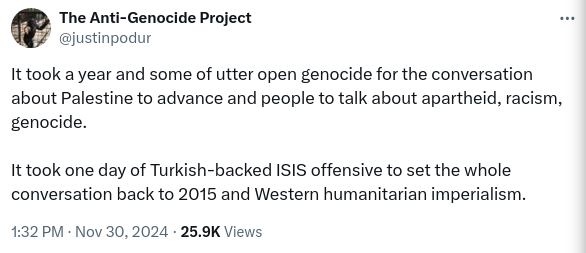
As the Syria war went on, campaigners for the overthrow of Syria targeted the Palestine solidarity movement in the West for destruction. Sectarianism played a role. But their main rhetorical tool was “human rights and democracy.”
That movement was always fighting an extremely uphill battle. All mainstream Western political parties and mainstream media outlets are pro-Israel and racist against Palestinians. Even in this weak movement, 2011 was not a particularly strong year. The year before, Israel had murdered activists trying to get into Gaza by sea in the Freedom Flotilla, waylaying the boats and sending the message that the siege would never be broken nonviolently. Antiwar mobilizations during Israel’s Gaza wars (2006, 2008/9), as well as attempts to get into Gaza, were ongoing. Campus movements were updating the models of struggle developed for solidarity with anti-apartheid activists in the 1980s. Social media was becoming important – for better and worse.
Those of us who knew about US-backed regime change operations and opposed agitation in the West for the overthrow of other countries, found ourselves to be a minority in the Palestine movement. For the most part, we were simply shouted down by the “human rights and democracy” wielding regime changers. We tried both holding debates and holding our tongues but the split left the antiwar coalition degraded even relative to its weak pre-2011 state.
When Israel and the West opted for genocide in Gaza after October 2023, many of the same people on both sides of the decade-old split found themselves mobilizing to try to stop the genocide alongside younger activists unfamiliar with the old debate. The focus on the genocide led us to naively believe that the fracture over Syria had been transcended. It hadn’t. Once again, “human rights and democracy” is being wielded not against the genociders, but against the now-ousted Syrian government. Even now, with Assad gone, regime changers are primarily focused on blaming the current chaos on Assad.
Antiwar, Palestine solidarity efforts have not thus far been a powerful force in the West. We will never influence events if we can be divided at will by regime changers wielding the fraudulent weapon of human rights.
NOTES
[1] Britannica gives a low value for the death toll in the South of 260,000 (and 620,000 combined for North and South) but notes that other researchers have estimated a combined North-South death toll of 752,000 to 851,000.
[2] Amnesty said in its report that “On 7 October 2023 Hamas and other armed groups indiscriminately fired rockets into southern Israel and carried out deliberate mass killings and hostage-taking there, killing 1,200 people, including over 800 civilians, and abducted 223 civilians and captured 27 soldiers”. This is false. Palestinians overran at least eight military bases on that day according to a UN report. The Electronic Intifada showed that Israeli forces likely killed hundreds of its own people in its response to the raids, in fact, likely killing many in an effort to prevent more hostages from being taken.
And the ICC issued an arrest warrant for Hamas leader Ibrahim Al-Masri at the same time it issued warrants for Netanyahu and Gallant. The resistance to Israel’s genocide was considered as bad as genocide itself. And the ICC neglected to issue warrants for Israel’s full partners in genocide, several western governments, most especially its benefactors in Washington.
[3] US presidential elections results downloaded from the Federal Election Commission website
[4] Syria’s presidential election results taken from Straightstimes (2000 and 2021), from Washington Post (2007), and Gulf News (2014)
[5] A March 2024 SOHR article listed 164,223 civilian deaths overwhelmingly caused by Assad or his allies. The article later added “These statistics, documented by the Syrian Observatory for Human Rights, do not include the following:
Over 55,000 civilians who were killed under torture in the detention centers and prisons of Bashar al-Assad’s regime…”
[6] Assuming the Gaza Health ministry numbers for 13 months are 70% civilian deaths then 1.33% of the population had been killed. According to SOHR, over a 13 year period the civilians Assad killed equaled 1% of the pre-war population of 22 million (an average of 0.077 percent of the population per year). If Nader is correct, Israel is killing Palestinians at a rate more like 80x the rate that the Syrian government’s enemies claim Assad killed Syrians.