The last time the US tried to destroy China’s economy

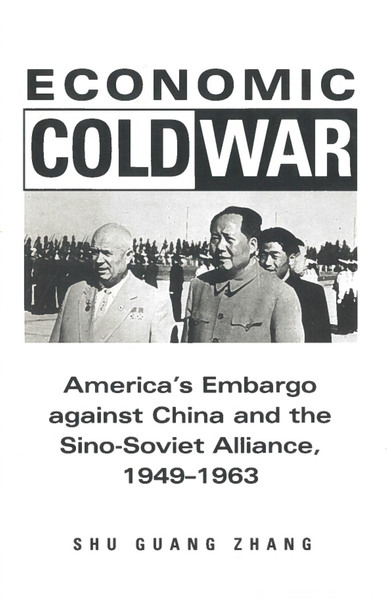
Reading Shu Guang Zhang (2001). Economic Cold War: America’s Embargo against China and the Sino-Soviet Alliance 1949-1963.

Shu Guang Zhang is a US-based academic of Chinese origin – when he wrote the book, a specialist in US history at the University of Maryland. The book is from 2001, when US-China relations looked pretty different than they do now (and different from how they looked during the period he’s writing about). For those reasons it deserves special attention, because you can see how much of what is happening now with the ever-expanding (and perhaps ever-less-effective) US sanctions regime already happened before.

From 1839 until the Chinese revolution succeeded in 1949, China was colonized and partitioned. At that time, the US policy towards China was called the “Open Door”: whatever other imperialists forced China to accept, the US also wanted. There would be no favored imperialist in China.

In the Chinese civil war that pit the Guomindang (Nationalists) against the Communist Party of China, the US bet on the Guomindang against the Communists until the very end.

But when the Communists won the US didn’t see a viable military option against China. Instead, they would have to wield the “economic weapon”, which they hoped would work just as well. In the State Department’s 1948 Policy Planning Staff assessment, China would be “plagued” by an “implacable population pressure” dragging their standard of living downward. Even if they got Russian help, Russia would see them as “a vast poor house, responsibility for which is to be avoided.” They would be desperate for trade and therefore vulnerable to the economic weapon. China was headed rapidly for economic disaster, and would soon come begging to the US. And when they did, the US would say no. Lewis Clark from the US embassy to China wrote to Secretary of State Dean Acheson in 1949: “How fatal for us to permit ourselves to be enticed into assisting the Communists in their desperate need only to discover too late that they wanted our help solely during the interim and until they could get along without us.”

The US had already set up a system of export controls against the Soviet Union: since 1947, the goal was to use export control to deprive the USSR of advanced technology. The US created List 1A of goods with military potential and List 1B of goods with indirect military potential. Anyone trying to send these goods to Russia would need licenses from the Department of Commerce – and the US worked closely with its Western to make sure this embargo held.

Wouldn’t that just drive China and the USSR together? That didn’t worry the US all that much in 1949. Edmund Clubb, US consul-general in Beijing, said if China went to Russia they would quickly “learn how profitless was dealing with the USSR.” Sanctions would force the Chinese to “learn the hard way that they cannot get along without the West.” The US consul-general in Shanghai figured it would “suit our purposes” if the “catastrophic economic situation here would prove a costly drain on Soviet economy, and Chinese Nationalism should make it a thankless task.” Meanwhile the US could “sit with dignity on the sidelines, not necessarily needling Communists, but denying them many things they want badly.”

When China intervened in the US war on Korea in 1950, US officials felt they couldn’t trade with enemies lest the materials they sent be used to “kill our boys.” “The massive Chinese aggression”, they told the British, “confirmed our anxieties and removed our hopes.” In December the US put all trade under control: “we license no goods whatever for export to Communist China, we prohibit our ships and planes from calling at its ports… and we have frozen Communist Chinese assets within the United States.” Truman also set out to “enlist the cooperation and support of other nations” in taking “such measures as are feasible to prevent the flow to countries supporting Communist imperialist aggression of those materials, goods, funds and services which would serve materially to aid their ability to carry on such aggression.”

The CIA suggested a naval blockade and “a campaign of aerial and naval bombardment against selected ports, industrial capacity and storage bases” to “create unemployment and unrest, hinder industrial production and development, and create serious administrative problems”. These ideas were dismissed as infeasible. The US also realized it couldn’t impose a total embargo against China because it would put too much pressure on its allies. Negotiating the multilateral embargo against China proved difficult, with Britain – doing business through its Hong Kong colony (which only became part of China in 1997) – finding itself unable to leave so much money on the table. Worse, Britain feared, too much of this and China might take Hong Kong back even earlier! The result was a Hong Kong compromise, which rendered the whole sanctions regime rather leaky. What a predicament: sanctions needed to pressure China clashed with Britain’s need to make money through its Hong Kong colony and risked an early decolonization.

On the Chinese side, Mao and the Communists realized they would need to rely on Soviet help “for the interim” as they tried to build their own industrial base. The Soviets of course had immense worries of their own, and the result was a tense relationship in which resentments built over time. The story of these resentments and how they grew into the deadly Sino-Soviet split is told in Economic Cold War, as are the economic planning measures that China took in this period. To focus on the sanctions, I won’t summarize either of those right now, as interesting as both are.

Back to the sanctions: China had to develop trade routes and networks with the Soviet Bloc and any other countries that refused to join the US sanctions regime. China also had to try to recover the assets and trade goods that the US stole: imports China had already paid for in hard currency that weren’t going to come, goods China had already sent away for which the payments would never come. Because the dollar was already the currency of international transactions, China also had to resort to trade in barter. This, too, caused resentment since China didn’t feel the USSR was giving them good terms on barter deals. It did, however, start China’s long experience in how to do substantial trade with third countries without using the US dollar.

By 1953, the US made a special assessment that concluded that China had made “rapid progress in economic reconstruction” and that the sanctions “have not appreciably affected the Chinese Communist regime’s ability to consolidate its political position.” Worse, China was exploiting sanctions “in domestic propaganda as an additional indication of the implacable hostility of the West.” How dare they! US allies, including even UK, France, Canada, etc., were increasingly less keen on a total embargo. But in the face of this assessment, Secretary of State Dulles made the perverse strategic calculation that “the best way to get a separation between the Soviet Union and Communist China is to keep pressure on Communist China and make its way difficult so long as it is in partnership with Soviet Russia.” The logic is flawed: pressuring two countries is far more likely to drive them together than apart, which is what happened repeatedly in the course of US-China-Russia relations.

When the Sino-Soviet split finally did happen at the end of the 1950s, the US of course didn’t help, but the agency for the split can only be located in China and Russia – this wasn’t a split engineered or masterminded by the US, but an accumulation of difficult issues between the two countries. A momentous event, but I don’t think an inevitable one or one that the US can count on to repeat itself. The US was eventually able to take advantage of the split, much to the benefit if its imperialist plans! These years too are a story for another time, and not this newsletter. Instead, let’s draw some lessons.

Studying this last episode of US-led economic warfare on China, what can we learn about what’s happening now? A few notes suggest themselves.

  • The US evaluated military and economic options and decided on the economic weapon because the military options seemed infeasible against China.

  • The US had difficulties cajoling its allies into taking economic and financial losses for the sake of punishing China.

  • China was able to develop and progress relying on its internal resources and on using trade methods that the US couldn’t reach (barter, trade with the Soviet Bloc, and the use of Hong Kong).

  • The Russia-China relationship fell apart on its own steam, and has dynamics independent of US desires or actions.

Which of these seem to still hold today? Which of these are subtly (or not subtly) different today? Here are some differences between that time and this one:

  • The US does not have the technological or economic advantages it had then.

  • The US doesn’t appear to have a viable military option but it might do it anyway (it might be an illusion but US Cold War planners seemed to have a slightly higher sense of self-preservation? Is that an illusion on my part?)

  • Russia and China seem to be getting along well – better perhaps even than they did in the early 1950s before the Sino-Soviet split!

That is it for now. I’ll be coming back to this book to talk about the split, the famine of 1958, and other things raised by it. Have a good weekend.

Strunk and White is a bunch of humbug and so is George Orwell

Anglo-Saxon words aren’t better than Latin ones, shorter isn’t better than longer, monosyllables aren’t better than polysyllables…

Despite spending most of my life writing, I have never won any awards or accolades for writing and have no reason to think that I am an especially good writer.

I say this not because I’m fishing for you all to tell me that I am actually not a bad writer etc., but to tell you that despite writing being an obsession of mine in which I read many how-to write guides, produce the occasional one or two myself as well as try to deconstruct writing I consider good (or bad) to reverse-engineer results, reaching the exalted heights of the greatest writers… hasn’t happened for me yet.

Worse than that, though, is the fact that not all writing advice that is out there is good.

Which brings me to today’s topic.

In the past, I have been bamboozled by a mainstream of writing advice that has been propagating through these how-to-write guides for decades. So bamboozled that I even recommended two of the best-known ones to students. I regret those recommendations, because I have discovered there is a hidden racist thread in that writing advice that does not stand up to scientific scrutiny.

Some decades ago, I found out that apparently everyone interested in improving their English writing should read two things: a short book called The Elements of Style by Strunk and White, and an essay called “Politics and the English Language” by George Orwell. I did so. I passed the references on to my students. I edited work that writers trusted to me with Orwell and Strunk & White in my mind. And I edited my own work that way. The result? Wasted years during which my writing suffered, especially when I wrote for academic audiences who have no interest in Strunk, White, or Orwell. I wasn’t getting rejections because I was a bad student of writing, but because I was too good a student of Strunk & White and of Orwell.

Strunk and White, Orwell, and their predecessors produce writing advice in short, simple rules – modeling, of course, the advice they give writers. You may have seen them. Here are a few from E.B. White (of Strunk & White): Use active voice instead of passive. Use the positive form instead of the negative. Omit needless words.

Orwell will tell you to avoid dying metaphors, operators like “militate against”, pretentious diction (science words, adjectives, old words, foreign words). He says:

“(i) Never use a metaphor, simile or other figure of speech which you are used to seeing in print. (ii) Never use a long word where a short one will do. (iii) If it is possible to cut a word out, always cut it out. (iv) Never use the passive where you can use the active. (v) Never use a foreign phrase, a scientific word or a jargon word if you can think of an everyday English equivalent. (vi) Break any of these rules sooner than say anything barbarous.”

If you are a sincere student who reads these essays and tries to implement them as I did, your writing will suffer. So will your readers. Because these pieces of advice, presented as universal truths about the english language, are audience dependent at best, and useless at worst. They aren’t even guidelines that are good in most situations but bad in others. They are just White preferences (and Orwell preferences). What they like to see. The style they like to write in.

Telling writers to write short simple sentences with monosyllabic words is older than Orwell or White, who probably got their material from American businessman Robert Gunning’s 1944 book, The Technique of Clear Writing. He has 10 principles: 1. Keep sentences short. 2. Prefer the simple to the complex. 3. Prefer the familiar word. 4. Avoid unnecessary words. 5. Put action in your verbs. 6. Write like you talk. 7. Use terms your reader can picture. 8. Tie in with your reader’s experience. 9. Make full use of variety. 10. Write to express not impress.

Gunning provides a list of 3000 words writers should stick to and includes a quantitative set of “readability yardsticks” for writers to use. He recommends writing to what he calls a “sixth-grade level” and recommends a “fog index”, a formula that combines sentence length and percentage of polysyllabic words (similar to the Flesch Readability Score and other such indices). Charles Kay Ogden, author of a book called Uncontrolled Breeding, or Fecundity versus Civilization (1916), provided a list of 850 “Basic English” words to stick to for readability.

Gunning also cites Herbert Spencer’s book The Philosophy of Style, which explained that “a reader brings to your writing limited mental power.” Spencer spread philosophies beyond those of writing style: he was big on measuring skulls to determine intelligence and wrote pieces of English prose like this one: “The forces which are working out the great scheme of perfect happiness, taking no account of incidental suffering, exterminate such sections of mankind as stand in their way. … Be he human or be he brute – the hindrance must be got rid of.”

Since we’re talking about Herbert Spencer, it’s time to return to what I mentioned earlier: a racist strain running through too much of this English prose advice. It has to do with a 19th century obsession with the idea that pure Anglo-Saxon England was conquered by the Normans in medieval times and in addition to corrupting the pure vigorous Anglo-Saxon blood, the Normans corrupted the vigorous Anglo-Saxon language. This idea of getting back Anglo-Saxon racial purity through the use of short sentences filled with single-syllable words is explicit in the likes of Herbert Spencer and reproduced by White and Orwell etc., without acknowledging where the racialist passion for monosyllables comes from.

University of Chicago academic John Williams, in the 1995 writing book Style: Towards Clarity and Grace, talks about the Norman conquest and its effects on English – thankfully, without the racial nostalgia. Williams’s analysis is that because medieval English lacked words for translating and doing business and government, these words were imported from Latin and French. 16th century Renaissance scholars brought in Greek and Latin for classical texts. The result is that 80% of daily words come from Anglo-Saxon, while in more technical fields, there are more French- and Latin-origin words. The result: Depending on what you’re writing about, it could simply be impossible to choose the single-syllable Anglo-Saxon word, which might not exist. As Williams quotes “there ys many wordes in Latyn that we have no propre Englysh accordynge thereto”.

In addition to racialist nostalgia, these style guides bring to the writer the advice given to every sales force: pander. But pandering ignores one of the main reasons that readers read: to learn new things, including new words! When I read, I look for writing that has as much new (to me) material in it as I can handle without getting overwhelmed. New words, new ideas, new combinations. I don’t pick up a book looking to read the same 850 words in the shortest possible sentences.

Anyway you can do propaganda in small words and short sentences just as well as you can in big words and long sentences (maybe better). Orwell inverts this reality in his “Politics and the English Language”, arguing that “plain english” is inherently less deceptive. “Bad writers… are nearly always haunted by the notion that Latin or Greek words are grander than Saxon ones,” he says. But this isn’t true. It took Trump’s mastery of plain english for liberals to take notice, but they eventually did.

If you’re not pandering and you’re not trying to recapture teutonic vigor the better to help your superior race rule the whole world, then all of the White-Orwell rules go out the window. Short words aren’t better than long ones. Short sentences aren’t better than long ones. Anglo-Saxon words aren’t better than Latin ones. Language is an infinitely creative system endowed to us by miraculous accidents of evolution over millions of years. How degrading to confine ourselves to 850 short words!

No, writing is a relationship between people. A social relation. To be meaningful, advice about writing is advice about this relation. You can be cynical about it and follow University of Chicago writing centre director Larry McEnerney, who tells graduate students

that the writer’s job is to solve a problem for the people with power in their field. You can follow Virginia Tufte and reverse-engineer hundreds of sentences to see what makes them good. The way I think about writing now is as a research phase where you find the resources you need, a first draft phase where, as McEnerney advises, you actually use the writing of the first draft to figure out what you think, and a revision phase where you rewrite the whole thing with your reader in mind.

Instead of thinking of writers as pretentious Latins who don’t use enough simple vigorous Anglo-Saxon words, think about writers as working to reach specific readers with their language. Then you will understand more about how propaganda works than Orwell wanted you to. When the New York Times says that a missile “finds” cafe patrons watching soccer, that’s not because they’re too stupid to use the active voice: it’s because they are connecting with NYT readers, who want to know what is happening in Israel/Palestine in a way that is palatable to their pro-apartheid commitments. Thinking of this as bad writing by stupid writers leads to feelings of smug superiority. That’s fine where Orwell lives but it’s a luxury we (ie., the anti-apartheid side in this case) cannot afford. Time to dump Strunk, White, and Orwell.

Subimperialism and multipolarity

Brazil’s dilemma

[NOTE: This article was produced by Globetrotter and is published in many of the usual places, but was mainly intended to have a permanent home at the Independent Media Institute’s Observatory, a place for articles that aren’t tied to the news cycle where readers can get into concepts (like, for example, subimperialism!) At my blog, I hosted an article by a colleague, Mandisi Majavu, where he blasted the concept’s analytical value back in 2005 in the South Africa context. I had always intended to come back to it and 18 years later I finally have, after seeing the term pop up in my re-reading of Galeano last year. I found the concept to have been developed through thinking about Brazil, and I wanted to mention the main theorist of the idea that I was able to find, Ruy Mauro Marini… and it helped me think about where Brazil might be headed today…]

A look at sub-imperialism and multipolarity in Brazil historically and into the future.

In the Open Veins of Latin America Eduardo Galeano described an 1870 genocidal war of regime change waged on Paraguay by a Triple Alliance of its neighbors, Argentina, Uruguay, and Brazil, on behalf of British imperialism. The target, nationalist president Solano Lopez, died in battle. The country lost 56,000 square miles of territory. Paraguay’s population was reduced by 83.3 percent.

By the end, Galeano wrote: “Brazil had performed the role the British had assigned it.” Before the intervention, “Paraguay had telegraphs, a railroad, and numerous factories manufacturing construction materials, textiles, linens, ponchos, paper and ink, crockery, and gunpowder… the Ibycui foundry made guns, mortars, and ammunition of all calibers… the steel industry… belonged to the state. The country had a merchant fleet… the state virtually monopolized foreign trade; it supplied yerba mate and tobacco to the southern part of the continent and exported valuable woods to Europe… With a strong and stable currency, Paraguay was wealthy enough to carry out great public works without recourse to foreign capital… Irrigation works, dams and canals, and new bridges and roads substantially helped to raise agricultural production. The native tradition of two crops a year, abandoned by the conquistadors, was revived.”

After the war: “it was not only the population and great chunks of territory that disappeared, but customs tariffs, foundries, rivers closed to free trade, and economic independence… Everything was looted and everything was sold: lands and forests, mines, yerba mate farms, school buildings.”

Summarizing all this, Galeano wrote: “Paraguay has the double burden of imperialism and subimperialism.”

“Subimperialism,” Galeano continued, “has a thousand faces.” Paraguayan soldiers joined an intervention against the Dominican Republic in 1965, under the command of a Brazilian general, Panasco Alvim. Paraguay “gave Brazil an oil concession on its territory, but the fuel distribution and petrochemical business [was] in U.S. hands.” The U.S. also controlled the university, the army, and the black market as well, of which Galeano wrote: “Through open contraband channels, Brazilian industrial products invade the Paraguayan market, but the Sao Paulo factories that produce them have belonged to U.S. corporations since the denationalizing avalanche of recent years.”

Elaborating on Brazil’s sub-imperial function since 1964, Galeano wrote: “A very influential military clique pictures the country as the great administrator of U.S. interests in the region, and calls on Brazil to become the same sort of boss over the south as the [U.S.] is over Brazil itself.”

Ruy Mauro Marini Analyzes the Phenomenon

It is perhaps no coincidence that the leading scholarly authority on sub-imperialism is the Brazilian scholar Ruy Mauro Marini. Mauro’s 1977 article was published shortly after Galeano’s book. To understand “global capitalist accumulation and subimperialism” some background on the theory of imperialism set out by Lenin is in order, and more recent books like Zak Cope’s The Wealth of Some Nations and Patnaik and Patnaik’s A Theory of Imperialism teach the theory eloquently.

The key concepts are unequal exchange and value transfer, magical processes through which the wealthy countries exchange smaller amounts of labor for larger amounts of labor from the poor countries. The mechanisms are many: patent regimes, Western corporate control of Global South resources, denomination of oil and other commodities in U.S. dollars, IMF and Western-bank loan terms and draconian rescue packages, Western arms sales and military training programs—all backed up by the threat of sanctions, coups, invasions, and “color revolutions,” which happen frequently enough to remind Global South governments to stay in line.

In Imperialism, Lenin described the pressure on wealthy countries to “go imperialist:” winners in the Western domestic market invariably consolidate and tend towards monopoly; these winners are invariably coordinated increasingly through banks and financial interests; throwing new investments in to a mature market brings lower returns than they can get in newly opened ones, so the financiers seek colonies to get high returns on their growing piles of capital; the colonies also address their interests in labor and raw materials that are cheap (or ideally, free, through theft).

Mauro shows how this dynamic can lead to sub-imperialism if the context is right. Sub-imperialism, he writes, is “the form assumed by the dependent economy when it reaches the stage of monopoly and finance capital,” and it has two basic components.

The first is a “relatively autonomous” expansionist policy that functions under the overall umbrella of U.S. hegemony.

The second is what Mauro calls a “medium” organic composition of capital. To explain this concept an example comparison will suffice: an economy with a high organic composition of capital is one where workers use advanced, costly machinery that itself required a lot of labor to produce (the word “composition” refers to how much so-called “dead labor” went into the machines on which the “living labor” is now laboring). These are the workers in the vacuum labs making nanometre-precise computing chips. An economy with a low organic composition of capital is one where workers labor with their hands or simple tools, cutting sugar cane with machetes as day laborers. Their work is called “unskilled” and their wages are proportionately lower.

In 1977, Mauro argued that in Latin America, only Brazil had both the medium organic composition and the relatively autonomous expansionist policy. But what about today? And what about in other regions?

Generalizing the Concept

Are there sub-imperialists in South Asia? Pakistan exercises its ambitions in Afghanistan under U.S. hegemony. Imran Khan was overthrown in a coup for withdrawing support for the U.S. occupation of Afghanistan; his successors have worked hard to prove their subordination to the hegemon. India meddles in the affairs of its small neighbors like Bhutanand does so under U.S. hegemony; Western corporations certainly have an immense footprint in both India and Pakistan.

In the Middle East, Saudi Arabia and Turkey qualify as sub-imperialists though both showcase how each sub-imperialist is a special case. In Africa, South Africa has been analyzed as a sub-imperialist and tiny Rwanda could well qualify as a Central African version.

Who doesn’t fit? None of the U.S. Five Eyes partners (Australia, New Zealand, Canada, or UK) nor Japan, nor Israel, since all are high-income countries with higher than “medium” organic composition of capital.

Nor do China, Russia, or Iran fit the sub-imperialist mold. They may exercise hegemony—or contest it—in their regions, but they do not do so under the umbrella of U.S. hegemony.

This brings us back to Brazil and to the changes in the world since the writings of Mauro and Galeano on sub-imperialism.

Sub-Imperialism and Multipolarity

Until very recently, unilateral U.S. hegemony was the basic fact of world affairs.

No one could contest the U.S. invasions of Grenada, Panama, Iraq, or Haiti or its destruction of Yugoslavia and Libya. But Russia and Iran did contest the U.S. plan to dismantle Syria in 2015.

When Yemen voted against the U.S. invasion of Iraq in 1990, they were told that it was “the most expensive vote they ever cast” and punished economically. But by 2022 many countries remained neutral in the Russia-Ukraine War despite Western demands that they support Ukraine. India and China ignored Western demands that they refuse to buy Russian energy, expanding a series of options for trading commodities in currencies other than the U.S. dollar. African countries need not beg Western commercial banks for development finance: they can examine Western offers side-by-side with the Chinese Belt and Road Initiative. In 2023, China brokered a peace deal that restored relations between Saudi Arabia and Iran.

These developments reveal a historical change from a unipolar to a multipolar world order. The world has been under unipolar Anglo-American hegemony since the 1750s. There were world empires prior to that (notably the Spanish and Portuguese) but China and India each had around 25 percent of the world economy even at that time; a few centuries earlier, before the devastation of the Americas, the world was even more multipolar, if much less globalized.

If we are indeed moving away from the unipolar historical pattern, current sub-imperialists have some re-thinking to do: the U.S. umbrella is not what it once was.

Sub-Imperialism or Multipolarity? Which Way for Brazil?

With Lula (Luiz Inácio Lula da Silva) back in the president’s office in Brazil as of 2023, the country faced this precise dilemma. In his previous tenure, Lula acted as both a multipolarist and a sub-imperialist. An early proponent of multipolarity (before the moment had even arrived) through his advocacy of BRICS (Brazil, Russia, India, China, and South Africa) and of Latin American integration, Lula’s Brazil played the sub-imperial role as well, leading the morally compromised and disastrous UN mission to take over the U.S. occupation of Haiti. Some of the military officers who led the Haiti occupation helped overthrow Lula’s party in the coup that led to his jailing and eventually to Bolsonaro’s destructive presidency.

Bolsonaro was certainly, symbolically sub-imperialist: he saluted the U.S. flag and marched under the Israeli one. But most of his time in office was characterized by a disastrous COVID-19 response, genocidal policies against Indigenous peoples, and a general incoherence on foreign policy. Bolsonaro participated in a regime change stunt in Venezuela but tried to stay out of the Russia-Ukraine war.

Lula returned to office in a context of weaker domestic left-wing movements but a stronger multipolar context. Lula’s Brazil voted with the West in the condemnation of Russia’s invasion of Ukraine but Brazil was told by Russian diplomats that Russia understood the vote.

There are economic considerations beyond the organic composition of capital that can drive Global South leaders back into the criminal arms of the U.S.—dependence on natural resource exports and foodgrain imports are tendencies that are difficult to reverse, especially in democracies like Brazil that are vulnerable to coups or regression when the right-wing returns to power.

Perhaps Brazil will be the vanguard of multipolarity in the Americas, or the sub-imperialist agent undermining BRICS from the inside. The changing world includes possibilities never contemplated by Galeano, Mauro, or Lenin.

Justin Podur is a Toronto-based writer and a writing fellow at Globetrotter. You can find him on his website at podur.org and on Twitter @justinpodur. He teaches at York University in the Faculty of Environmental and Urban Change.

This article was produced by Globetrotter.

Some basics of journalism to evaluate these CSIS stories

Have professional guidelines been followed here?

Since the Canadian media engulfed itself in a Sinophobic panic fueled by some probably racist CSIS leaker and credulous reporters (that I have referred to previously as CSIS-GM) a small number of people in independent media have tried to create some kind of response. While we have at least a couple of good pieces in e.g. The Canada Files and in Passage, we are definitely talking about, if not voices in the wilderness, honourable exceptions to a dishonourable unanimity. There is no debate going on here, at least not yet. 

On the other hand, there is nothing that upsets a monopolist more than the slightest sign of a crack in their racist wall of anti-China coverage. And so it is that we are treated not only to the unfolding defamation campaign against Chinese-Canadians, but also to several of the most fervent of the campaigners sniveling – because of the lack of credulity in these little pockets of twitter about what CSIS-GM is selling – about how the public doesn’t understand the complexity of journalism. 

Like the ungrateful public that refuses to understand how what looks like food prices being driven up by monopoly is actually much more complex, the ungrateful public refuses to understand how what looks like fiction from a racist spy agency is actually the apogee of professional journalism. If they only knew. 

Shall we take up the challenge? Shall we pick up the gauntlet thrown down by the Canadian media? Perhaps we can take a look at some foundational resources for journalists, from the place you know all Canadian journalists look for foundational resources – the US.

How does the CSIS-GM reporting of the past few months stack up against, for example, the Society of Professional Journalists’ Code of Ethics? Here are some principles from the code for you to compare with the behavior of the Canadian media in recent weeks. They include:

  • Verify information before releasing it.

  • Consider sources’ motives before promising anonymity. 

  • Diligently seek subjects of news coverage to allow them to respond to criticism or allegations of wrongdoing.

  • Provide access to source material when it is relevant and appropriate.

In recent years there have been real journalists and sources who have suffered real persecution by the US and its allies for reporting within the above code of ethics. Wikileaks, after a painstaking process of harm reduction to ensure no danger would come to US spies and military personnel, published whole troves of source documents – the Iraq War Diary, the Afghan War Diary, Cablegate – so that the public, journalists, researchers could do their own analysis and their own verification on the documents directly. The source, Chelsea Manning, was punished severely and the publisher, Julian Assange, is in jail, his life in danger. Edward Snowden, after getting himself to safety, came out in his own name and defended his decision to become a source on the NSA’s universal surveillance program. 

Meanwhile the CSIS leaker was given space in the Globe and Mail to defend his honor as well – to defend, that is, his decision to engage in political manipulation and defamation behind a cloak of anonymity. He will continue to be defended by the journalists who published his narratives and by the spy agency that employs him, even as Assange languishes in prison.

Let’s go over now to the Comittee of Concerned Journalists. There we find similar ideas about sources and verification, which is “a consistent method of testing information — a transparent approach to evidence — precisely so that personal and cultural biases would not undermine the accuracy of their work.” How is that working out in Canada? Also in the CCJ principles you will find the idea of publishing in the public interest: “journalists must continually ask what information has most value to citizens and in what form.” The more the CSIS-GM leak material that seems by perfect coincidence to vindicate their approach and assumptions, the more it’s revealed that the goal is narrow political and personal agendas and not what “has most value to citizens”. 

A third resource. While I wouldn’t want to imply that Associated Press follows its own ethics, it too has guidelines that are being mocked by the CSIS-GM operation. 

“ Under AP’s rules, material from anonymous sources may be used only if: 1. The material is information and not opinion or speculation, and is vital to the report. 2. The information is not available except under the conditions of anonymity imposed by the source. 3. The source is reliable, and in a position to have direct knowledge of the information.”

If the CSIS-GM information has passed these tests, there is no way to know it from the story. It doesn’t look like information (#1 failed) and the source says things that make absolutely no sense (#3 failed). With #1 and #3 failed there’s no way to even think about #2, since some of the leaks sound like pure inventions. 

Like any other important endeavour, journalism involves both skill and insight that develop over time and practice. Verification, for example, is a complex method. Seeing with your own eyes is better than hearing from a witness; two witnesses are better than one, but not all that much better if they coordinate their stories before talking to you. Documents are good but can be faked. How much trust you can put into, e.g., a Wikileaks cablegate cable depends on how much you know about what was going on at the time, how well the information fits with what else you know, the nature of the official denial, the motivation of the leaker and of the publisher. How to make a judgment about what is in the public interest and how to balance that with how well you were able to verify and how timely it all is (why now?). Infinite possibilities to do good work emerge from a fairly simple set of principles. 

Violating the principles leads to bad work – which is what has happened here. The social damage, as I’ve said before, is just beginning.

Multiculturalism is over in Canada – it’s back to Sinophobia

How a rogue spy and two reporters are breaking the fragile system for integrating immigrants

Breaking Canada-China science connections as prologue

The death throes of Canadian multiculturalism began on February 2023 over China-Canada science connections. Canada’s Innovation Minister said Canadian universities shouldn’t do research with China’s military, as 50 of them have since 2005. “I am not happy and it’s unacceptable,” Minister Francois-Philippe Champagne said, quoted in a February 2 Globe and Mail article “Ottawa vows to curb research with Chinese military scientists”. Champagne reminded Canadians that there are new national-security reviews for scientists since 2021 – also designed for China. Michael Chong, the foreign affairs critic with the Conservative party, called for a ban to all research collaboration with China’s military. 

One Canadian research fellow said that “Everyone recognizes the importance of academic freedom but Canadian researchers should be thinking within their souls, not partnering with Chinese researchers who maybe are helping to develop military equipment.” What will these Canadians find in their souls? 

It didn’t take long for Champagne to give these souls a nudge, announcing the ban Michael Chong had asked for on February 14. “Grant applications that involve conducting research in a sensitive research area will not be funded if any of the researchers working on the project are affiliated with a university, research institute or laboratory connected to military, national defence or state security entities of foreign state actors that pose a risk to our national security.” In case you were wondering, the shifty category of “foreign state actors that pose a risk to our national security” does not include the US, UK, or Israel – military research with these partners continues, of course. 

Indeed to try to substitute “the US” or “Israel” for China anywhere in this story would render it incomprehensible. When a group of Palestinian students started a lecture series asserting that Israel was an apartheid state, it was denounced by every mainstream Canadian politician including Trudeau himself and official parliamentary motions. As this very story unfolds a disabled, Black NDP candidate, Sarah Jama, is under attack for criticizing Israel when she was a student activist. Israel, apparently, might be a “foreign state actor”, but no one thinks it “poses a risk to our national security” – on the contrary, Canadian politicians must be vetted and disqualified if they are critical of Israel. 

Chinese Canadians must prove they are loyal to Canada and not China; Canadian politicians must prove that they are with Israel and not the Palestinians.

The Globe and Mail  didn’t stop with mere government declarations. They got quotes from CSIS, Canada’s spy agency, and also a report from a “US strategic intelligence company Strider Technologies Inc” that stated that “Researchers at 50 Canadian universities… have conducted and published joint scientific papers from 2005 to 2022 with scientists connected to” China. 

No questions asked about why a US strategic intelligence company is studying Canada-China research connections for these guardians of Canadian sovereignty.  

Fife, Chase, and their CSIS source break the 2021 election story

On February 13, Robert Fife and Steven Chase published a story in the Globe and Mail “CSIS warned Trudeau about politician’s alleged ties to China.” In this story, the reporters cite “two national security sources” making accusations against a Canadian Liberal Party politician Michael Chan, saying that CSIS “has a dossier on Mr. Chan that contains information in the 2019 and 2021 federal election campaigns and meetings with suspected Chinese intelligence operatives.” This dossier made by the intelligence agency has now been entered into the public record. Chan fired back hard: “Your own statement to me about a recent briefing by CSIS to Prime Minister Trudeau, serves only to ignite xenophobia and cause continued, unwarranted and irreparable damage to my reputation and the safety of my family,” he said.

He added: “CSIS has never interviewed me regarding their false and unsubstantiated allegations. However, I am aware that they have conducted intimidating interviews with my friends and acquaintances and then instructed them to keep their mouths shut.”

That might have been the end of it, but the story has legs. What follows in Fife & Chase’s report – and in the growing scandal in Canada – is a narrative where every sentence begins or ends with the phrase, “CSIS believes”. Michael Chan met with Chinese diplomats, who CSIS believes are “suspected intelligence actors”; “security sources” told Fife & Chase that they had told the prime minister’s office that Chan should be “on your radar”. They briefed the prime minister on “foreign interference, tactics and Chinese tradecraft.” 

Reporter Robert Fisk said, in the run-up to the US invasion of Iraq in 2003, that all newspapers should change their name to “US officials said”, since their reporting relied solely on unnamed US officials using their newspapers to generate support for the war. Perhaps the Globe & Mail should change its name to “CSIS believes.” 

Fife & Chase repeat a set of sinister phrases, all citing back to their source in CSIS who is leaking them “top secret” information – a cachet that adds undeserved weight to their assertions: “CSIS has repeatedly warned that China has been conducting foreign interference operations in Canada, including efforts to influence the political process.” They quote CSIS director-general of intelligence Adam Fisher:  “They are not necessarily relying on trained agents. They use cutouts. They use proxies. They use community groups. They use diaspora organizations and community leaders,” he said. They quote Cherie Henderson CSIS assistant director of requirements “They will use whatever avenue they can to achieve their objectives”. The story’s sourcing is principally their unnamed CSIS leaker, backed up by official statements… also by CSIS officials. The total impression given by this set of quotes is that an informed Chinese Canadian who effectively pushes back against Canada’s belligerence towards China will automatically become a prime suspect for Chinese collusion. 

Michael Chan protested to Fife & Chase that he is a “loyal Canadian” – a phrase with historical resonance for anti-racists. Chinese Canadians must prove their loyalty – ideally, by publicly denouncing the Chinese state. 

Then, the bombshell on February 17, 2023. Fife and Chase again, in a report titled “CSIS documents reveal Chinese strategy to influence 2021 election.” This breathless story reports as if established fact that China was working for the Liberals and against “Conservative politicians considered to be unfriendly to Beijing”. The basis of Fife & Chase’s story is the usual: “The full extent of the Chinese interference operation is laid bare in both secret and top-secret Canadian Security Intelligence Service documents viewed by The Globe and Mail.” 

Fife & Chase call it “an orchestrated machine” run by the “Chinese Communist Party leadership in Beijing” to use Canadian organizations “while obfuscating links to the People’s Republic of China.” 

From February on, the Globe and Mail with its reporting duo of Fife & Chase, its TV network, and its CSIS source, have worked to create a national media scandal. Let’s call this network CSIS-GM. 

As with the 2014 Trojan Horse Affair in Britain or the Dreyfus Affair 100+ years ago in France, the flimsy basis of the accusations isn’t questioned. The Trojan Horse Affair and Dreyfus Affair were based on outright fake documents. In contrast, Fife & Chase and their paper, the Globe and Mail, are working with a secret faction inside CSIS in ways that will incite racist attacks on Chinese Canadians and they do not appear to care. If they cared, their standards for evidence would be much higher. 

Since the CSIS leaker is anonymous, we don’t know his goal. Here’s a guess for what this CSIS-GM operation could accomplish: better Canadian state control and monitoring of contact between Canadians, especially Chinese Canadians, and Chinese people. The unelected and unaccountable CSIS retains its personnel and infrastructure regardless of who is in the Canadian parliament. With centralized control over Canada-China contacts, CSIS will make a better asset for its real master, the US, in the latter’s ever more aggressive and dangerous confrontation with China. 

Interlude 1: A reminder of the major problem with Canadian elections

For Canadians worried about whether electoral outcomes reflect the popular will, there are some real questions. Why is health care being privatized when no Canadians want or voted for that? Why did the Green Party – a minor party nowhere near power – seem to self-destruct when a pro-Palestine candidate made a good showing in the leadership race? 

Canada’s wealthy donors and corporate lobbies certainly have their say through electoral financing, though they have to work creatively around spending limits. More powerful, though, is the revolving door of corporate boards and the chance to own privatized businesses, with former Ontario premier Mike Harris in the Long-Term Care business, a Toronto public school board leader being part owner of a private school, former Toronto police chief Julian Fantino cashing in on legalized marijuana, etc. 

The parties’ processes of vetting candidates also helps ensure a unanimity of ideology. When, for example, candidates with a pro-Palestine past (something that usually only happens on the left, ie., in the NDP, like the aforementioned Sarah Jama) become controversial, they are purged by the party apparatus. This has been going on for years and perhaps decades – I wrote about it in 2015

Perhaps even more important is the intense concentration of Canadian media. The Canadian Media Concentration Research Project reported in 2021 that “The top six Canadian companies—Bell, TELUS, Rogers, Shaw, Quebecor and the CBC— accounted for 69% of network media economy revenue last year; in contrast, the “big six” US-based Internet giants’ combined revenue in Canada of $14.5 billion gave them a 15.3% market share.” What Canadians see and read come from six Canadian and six US corporations, all of which share the same view of the world and of the place of various peoples in it. Good thing we’ve banned Chinese-owned TikTok, right?

Can a concentrated media, careful ideological vetting, and a wealthy class that can offer the riches of Croesus to retired politicians who have done them good service have any influence on elections? Should Canadians worry about that? Never mind! Focus on Chinese interference, says CSIS-GM. 

CSIS-GM accusations grow

Back to our story. By February 20th Fife & Chase, with the same CSIS sourcing – remember the phrase: “secret and top-secret Canadian Security Intelligence Service documents viewed by The Globe and Mail “, were describing an ever-more terrifying system of “ Chinese government espionage that employs blackmail, bribery and sexual seduction, with the country even enlisting the Bank of China in its foreign-influence activities.” What they called an “orchestrated machine”, three days later was a “a broad Chinese strategy to interfere in Canada’s democracy and gain influence over politicians, corporate executives, academics and vulnerable Chinese Canadians.” A national security expert, Akshay Singh, sounded a frightful alarm: “It’s about different levels of government. It is about academia. It is about civil society and it is about private enterprise.” The Chinese, it seems, were everywhere.

On February 21st, Fife & Chase’s reporting had won results. Their report that day, “Committee to probe Chinese interference in 2021 election”, described how a parliamentary committee would convene on Chinese interference. Opposition parliamentarians demanded the committee investigate the 2021 election based on Fife & Chase’s “shocking revelations.” 

The same day the Globe and Mail’s editorial board began to drive the political line for the scandal. “Stand up to China, Mr. Trudeau.” The editors asserted that Canadians didn’t care about the spy agency leaking “top secret” information, but about the Chinese undermining democracy. Apparently the Globe and Mail editors thought Canadians valued precisely what the Globe and Mail had given them and Canadians weren’t suspicious at all of the CSIS leaker or the corporate media pushing the story. The paper collaborating with the spy agency to generate suspicion of all Chinese Canadians cast itself as the victim in the editorial because Trudeau had said the CSIS reports, whose “top secret” status was hyped up by the Globe and Mail to add energy to their story, shouldn’t have been leaked. 

CSIS-GM counter Trudeau’s threat to investigate the leaker – with another leak

Fife & Chase stepped up the game again on February 28 breaking another story, again from their CSIS source: 

“The source said the Canadian Security Intelligence Service captured a conversation in 2014 between an unnamed commercial attaché at one of China’s consulates in Canada and billionaire Zhang Bin, a political adviser to the government in Beijing and a senior official in China’s network of state promoters around the world.

“They discussed the federal election that was expected to take place in 2015, and the possibility that the Liberals would defeat Stephen Harper’s Conservatives and form the next government. The source said the diplomat instructed Mr. Zhang to donate $1-million to the Trudeau Foundation, and told him the Chinese government would reimburse him for the entire amount.”

The Trudeau foundation provides scholarships and has nothing to do with elections. It is named for the current prime minister’s father, who was also prime minister of Canada decades ago. The foundation returned the donation days after the story broke. 

Interlude 2: A review of the difference between evidence and intelligence

Perhaps we should review the different standards of evidence. To meet the standards of a court of law, evidence has to be very good, since someone could go to jail based on it. To meet the standard of publication, evidence also should be good, since lives and reputations could be ruined. Intelligence agencies, meanwhile, are allowed to give their briefings in secret because they can then assess threats and probability freely without worrying about destroyed reputations or innocent people going to jail. They can produce reports that would be libelous (false and defamatory) if published but might be useful for a government scanning the horizon for threats to sovereignty. What they should not be allowed to do is hide behind anonymity to spread secret evidence, inciting racism against a whole group of people who, according to multicultural theory, are as Canadian as Fife & Chase or their CSIS leakers.

Some Canadian intelligence officials have tried to sound some warnings about the difference between evidence and intelligence, but the scandal keeps growing. 

At any given moment, if the political climate is right for it, the publication of intelligence materials as established fact will be enough to cause a public scandal. 

In the case of this CSIS-GM operation, this is bigger than an intelligence agency leaking their threat assessments to a corporate media monopolist to challenge an election outcome. 

The end of Canadian multiculturalism

There’s more at stake because Canada has a history of Chinese Exclusion, of anti-Chinese racism, and a recent history of multiculturalism which is now coming to an end.

Beginning in the 1970s (with the current prime minister’s father) multiculturalism was the framework for integrating immigrants into Canada and has always carried both an anti-racist and a sinister element. It is based on the belief that people from any country of origin could become as “Canadian” as the British colonists who seized it in the name of the English Crown. The resulting Canada would be a “mosaic of cultures”, not a melting pot that pressures people to sever ties with the old country and assimilate as happens in the United States. 

On the sinister side, the multicultural idea is used to try to lower the special status of First Nations down to the level of any other part of the mosaic and hide the fact that they retain sovereignty over the land. If Canada is to be a mosaic, immigrants would have to be invited by First Nations on their terms, not by the state that stole their land. 

Canadian multiculturalism is also used to weaponize diasporas for campaigns against their home countries, wherever those home countries are in the crosshairs of the US. These diaspora communities of the mosaic are assumed to have homogeneous politics as regards foreign policy: their visible leaders and their community media are of course vocally against the Chinese government, but also pro-US sanctions and wars, anti-Communist, against Palestinian sovereignty, etc. 

Multiculturalism was strained by the War on Terror decades as Canadian police and informants infiltrated Muslim communities and entrapped them in terror plots the same way the FBI did in the US, but Canada didn’t go as far as the UK did with its Trojan Horse Affair. Sinophobia in Canada has a much deeper tradition, with race riots in British Columbia and the Chinese Exclusion Act. 

CSIS-GM are working towards an open parliamentary inquiry on Chinese interference. This would be like the McCarthy inquiry for Canada. And as James Bradley noted in his book The China Mirage, McCarthyism in the US did indeed begin as an anti-China initiative. So we’re back full circle. A simple protectionist measure has been debated: expelling Chinese diplomats. The problem with that, Canada’s foreign affairs minister said, was that China would then expel Canada’s diplomats, which would “harm Canada’s ability to have ‘eyes and ears’ on the ground in China.” (that’s from a March 10th report by… Fife & Chase). What a colonial dilemma for poor Canada, who needs to maintain its “eyes and ears” to spy and interfere in China and cannot risk losing this access even to protect Canadians from alleged Chinese spies and interference!

After last weekend’s removal of the Toronto MPP Vincent Ke from the caucus of the Ontario Tories – under the pressure of unnamed intelligence sources pushing against all in Canada who were born in China, or have Chinese connections, through the instrument of willing media operatives – a respected reporter on party politics, Chantal Hébert, could not help but call this what it is. Canada’s latest yellow-peril purge was becoming a “witch-hunt,” she told CBC (as it operates in Quebec), “and not just a political witch-hunt but a witch-hunt to which the media is contributing.”

“At what point,” she joined a usually servile media corps in asking, “does one stop being an investigative journalist and start being the secretary of a source that dictates to us things that we don’t verify . . . ?” In other words, even journalists who accept as given the need for a new Cold War patriotism against China are starting to feel some palpable unease. “Think on it well,” Hébert warned her colleagues: “we know where it starts, but do you know where it ends?”  

If the Globe and Mail and CSIS get the national scandal they are working to generate, it will be the end of multiculturalism in both its positive and negative aspects. Minorities, starting with Chinese-Canadians, will be made to understand just how conditional the multicultural embrace really is. As both living standards and educational institutions in China continue to improve (ending Canada’s joint research will have absolutely no negative effect on China’s progress), Chinese people will increasingly avoid Canada. Chinese firms will be kicked out of the Canadian surveillance capitalism market so that work can be done by American and Israeli firms. Maybe that, and not some narrow partisan advantage gained by questioning the government’s electoral legitimacy, is the desired endgame of this campaign. 

Whatever the real CSIS-Globe and Mail game is, it is a dangerous one that is already out of control. Chinese Canadians are the target – but the whole thing will not end well for Canada.

A writer’s manifesto

The business model for writing is designed to make you feel bad about yourself.

Before Fernwood published Siegebreakers, I was so desperate to “get published” as a fiction writer that I followed every piece of advice I found in books and online, even advice that was self-contradictory. 

One piece of advice, for example, about twenty years ago, was to never submit manuscripts to publishers directly. You had to find a reputable literary agent, and most publishers only looked at work from agents. So, I looked at more online resources, bought various Writer’s Market publications, and started a process of desperation and supplication to get the attention of a literary agent. 

It worked well: Instead of racking up rejections from publishers, I was racking up rejections from agents, which led to ever weirder experiences. One agent said he liked my submission, scheduled a phone call for months later, and ghosted me after the phone call (I guess there was something he didn’t like). It seemed agents liked to be polite, so they would rather find ways to politely ghost you than to write the kind of rejection letters academics are used to getting from journals (“a rather pedestrian study”, was the favorite rejection comment I got for one of my early scientific papers). 

But one rejection was maximally revealing about the state of the world for writers. One agency rejected me after the standard 12 weeks, then put me on a mailing list for one of the courses they run for writers on how to get published! There are literary agencies out there that make money off of courses teaching writers how to increase their chances of getting published. What’s even worse: years later, I took one of their courses! In the course, a group of writers communicated with each other, and gave one another feedback on writing, and at the very end, one of the agents gave one or two sentences of summary feedback to each writer. Finally, I think one writer was selected to pitch their manuscript to the agents. We writers paid a literary agency (handsomely), whose job it is to find publishers for writers and take a fee, so that we could give one another feedback on our writing. 

How did it come to this? Because money flows in this industry not from readers, not to writers, but from writers and to those who give them the false promise of “publication”. 

But it has been decades since the time when a writer, in order to be read, needed a publisher to work on a printing press with ink and paper to be read. It has been decades since the time when those publishers, who wanted to make sure they made profits off of selling those paper-and-ink products, had to be careful gatekeepers, rejecting most manuscripts and assigning editors the work of improving the lucky few that were chosen. 

That isn’t how it works any more, writers. Today you join the other billions with an internet connection and put your words up somewhere – probably in some space owned by one of the tech giants. What, then, is this mystique of “getting published” that writers are being sold? It is nothing other than any other promise of fame and fortune. 

It turns out the less meaningful the service offered (“publication” of words you can put out in any of a hundred places on the web within seconds of logging on?) the more intensely the service is marketed to writers – who should be the sellers, not the buyers. 

Writing isn’t the only thing that has gone this way. Money is made by teaching people how to become yoga teachers, not by teaching yoga. Money is made by teaching people how to become life coaches, not by coaching people how to live their lives. The best though is of course the online courses that teach you how to make money making online courses! Such courses do exist. 

And yet, I have to admit that the most valuable advice I found about how to understand our current publishing landscape came from an author of a how-to book about how to make money creating how-to books. This author, John T. Reed, has self-published a novel called The Unelected President about what happens when “Mike Medlock, a libertarian, non-politician accidentally becomes president of the United States while serving out a dead senator’s term.” I’m the author of the Anti-Empire Project. I don’t see eye to eye politically with John T. Reed, whose novel blurb ends: “ There’s a new sheriff in town, and the North Koreans, Iranian Revolutionary Guard Corps, Chinese, and Russians are very unhappy about that.”  I would, no doubt, also be unhappy about Mike Medlock being the new sheriff in town. 

Nevertheless, I have always believed that insights can come from anywhere and anyone and what anti-imperialist doesn’t have at least one uncle with John T. Reed’s politics? At any rate, Reed sold me his How to Write, Publish, and Sell Your Own How-To Book. I sent him the payment. He had the book printed and bound. And his family operation had it shipped to me (at my expense). And my favorite line in the book was (from memory, because I loaned the book to a friend): “There are two kinds of publishing: vanity publishing and self-publishing.”

For as long as there’s been a publishing industry, self-publishing was disparaged as “vanity publishing”, because writers, unable or unwilling to risk rejection by a “real” publisher, did it only to see their book in print. But John T. Reed argues that today it’s those who seek a publisher that are the real “vanity publishers”, since all they want is to see their name on a book as the author. That those who want to make money selling books have to undertake the editing, printing, and distribution tasks themselves. And, John T. Reed warns, don’t use Amazon, which is the worst of both worlds! 

I found John T. Reed’s ideas so compelling that I’ve decided to try them out. More on that later. 

First, let’s finish unraveling the propaganda mechanisms upon which the business model of marketing to writers depends. For them to work, writers must be completely psychologically broken, convinced that we have to beg readers for attention and beg social media companies for access to the chance to beg those readers for attention. So broken that we forget the reason we started writing. So broken we forget how much, and how eagerly, people love to read. 

Capitalist propaganda would never try to sell writers on a pitch like: “learn how to research and write to provide use-value for others and earn a good living in the process!” Instead, it’s the promise of being one of the superstars and, importantly, of not being one of the rejected losers! 

(Probably worth mentioning that it isn’t just propaganda, but legal and monopoly mechanisms that the propaganda serves. Cory Doctorow and Rebecca Giblin call it Chokepoint Capitalism.)

But in fact, the market for writing is a long-tailed one. Sure, there are the superstars. But you don’t need to be one of them to find your readers, even – gasp – readers who are able to pay for your writing. 

No matter how much they try to make you feel otherwise, there are three facts that endure: 1. Readers like to read 2.Despite all the hype about how people don’t read any more, you know people love reading and they do it all day. 3. It’s about you and readers and everything else is people coming in between trying to make some money off of both. The social media giants have made you feel like, in the attention economy, readers are doing you a favor by reading your stuff and above all, these platforming profiteers are doing you a favor by putting your stuff in front of readers. 

Not true. All readers want is to find out something they didn’t know before through a written conversation with another person. They don’t need stars or superstar authors, the precise 28 beats of storytelling to be followed, “plain english” excised of all Latin words, or Joseph Campbell Heroes Journeys for every character. 

Maybe everything becomes a superstar system in our world, including the substack over which I write you today (having left mailchimp because they lowered the size of their free tier mailing list to better focus on their paying customers – which didn’t include me). But let’s have the conversations we can have in the meantime. 

Don’t let them break your spirit, writers! We are all on here to write to each other, and we all love to read. Allow me to qualify my earlier words that only writers and readers matter and nuance it this way: Let use-value be your filter. Editors are here to help. Publishers do valuable work including assigning good editors and artists and making your writing into a nice book. 

[Sidebar: There are exceptions, including big ones. I have loved working with Monthly Review and with Fernwood as a writer – and it’s probably no coincidence that I love reading their books as a reader. Monthly Review and Fernwood are mission-driven publishers that serve their community of readers. You don’t work with them for vanity or for money, but for the mission. And the mission doesn’t have to be as exalted   – in my opinion – as MR or Fernwood’s: academic publishing generally is supposed to be mission-driven too.]

But you don’t need gatekeepers between you and readers and you definitely don’t need gatekeepers who make you feel bad about yourself. Your writing is an offering and I’m grateful for it. So, writers: thank you.

And whether you:

  • make tactical use of a blogging platform like substack or wordpress;

  • follow the advice of John T. Reed laying out, printing, and mailing your own books;

  • or even find a publisher that shares your values and doesn’t treat you like a nuisance;

Stop letting the platform giants (and those who have internalized their propaganda) bully you!

And readers – if you’re interested – do consider buying my books. You see, I’ve started this whole self-publishing thing… and I’ll make a substack post announcing just that in a few days. 

Newsletter: Reading Galeano in Costa Rica

View this email in your browser

Reading Galeano in Costa Rica

I recently had occasion to re-read Eduardo Galeano’s book, the Open Veins of Latin America, and to do it while traveling in Costa Rica.

Open Veins was written in 1970, and remains relevant a half-century later (and it would have been current and relevant to debates half a century before, had it been written in 1920). There are some heart-rending moments, where Galeano talks full of hope about Salvador Allende’s plans in Chile (Allende was overthrown in 1973). But there is also vindication – he talks about how much progress the Cuban Revolution has made in a decade (by 1970) and half a century later, Cuba is sending its doctors to save lives all over the world. In the decades after Galeano’s book, Cuba also helped overthrow South African apartheid, which must have seemed an intractable reality when Galeano wrote Open Veins, and survived the collapse of its ally, the USSR, by inventing agroecology.

I wanted to write this newsletter about an experience that maybe you have had: you read a book, then decades later you re-read it and it is a completely different experience. There is so much on this second read that my eyes glossed over when I first read it without knowledge of the surrounding history. I’m also perpetually amazed by how much people seemed to know in the 1970s – about imperialism, about environmental issues, and even about history – that was since forgotten and is only being picked up again now. Has there been a review of imperialism in the Americas that surpasses Open Veins? Has there been a review of imperialism in Africa that surpasses How Europe Underdeveloped Africa by Walter Rodney? Let me know if you think there is one that I missed.

Let me share with you some of the stories that struck me this time around, in this book that I now think of as one of the best economics textbooks out there.

No accomplices here

In telling the story of Tupac Amaru’s revolt against the Spanish in Peru, Galeano has a dialogue between an Inquisitor who talks to Tupac Amaru after his capture. “The Examiner Areche entered his cell to demand, in exchange for promises, the names of his rebel accomplices. Tupac Amaru replied scornfully: ‘There are no accomplices here otehr than you and I. You as oppressor, I as liberator, deserve to die.’” [Listeners to the Civilizations Series know that I scour history for quotes like these by invincible anti-colonial heroes…]

1703 Methuen Treaty, 1713 Assiento Contract and the rise of England

Galeano talks about the importance of the 1703 Methuen Treaty between Portugal and England, which basically enabled England to take over Portugal’s economy – including all the resources of the Americas (notably Brazilian gold) that Portugal had stolen in the previous two centuries. Portugal and England were the two countries Ricardo built his “Theory of Comparative Advantage” on – the England-serving theory that said that England should specialize in building manufacturing power while Portugal supplied it with wine (even though what Portugal was actually supplying wasn’t wine, but Brazilian gold). Between the Methuen Treaty and the Assiento Treaty with Spain of 1713 which granted England a monopoly over the slave trade to the Americas, we see the basis of England’s rise. The Portuguese prime minister, the Marquis de Pombal, in 1755 said that “the English had conquered Portugal without the trouble of a conquest.”

The commodity doesn’t bring wealth

Story after story in Open Veins is of the discovery of some immense new source of wealth (sugar, gold, silver, nitrates…) which creates a boom, after which the area of the boom is abandoned to squalor. There are two points here. First, commodities don’t make a town or a nation wealthy – they provide wealth to be siphoned to the metropole of the time. And second, that the particular commodity doesn’t seem to matter – the commodities are depleted but the relationship of subordination (and of Open Veins) remains constant. Venezuela was a cacao monopoly before it was an oil monopoly; Chile was the go-to place for guano before copper; Bolivia was about silver before tin and gas…

Slave revolts and the Black Kingdom of Palmares, 1693

There are slave revolts described by Galeano that I wish I’d covered in Civilizations! One in 1522 in Santo Domingo by the slaves of Diego Columbus (the son of *that* Columbus). A huge revolt in Guiana; in Brazil they built a Black Kingdom of Palmares, which “throughout the eighteenth century had successfully resisted dozens of military expeditions sent to suppress them… assaults by thousands of soldiers were fruitless against the guerrilla tactics which, until 1693, made the refuge invulnerable.” The Black Kingdom had positive human *and* positive ecological consequences: “Palmares was the one corner of Brazil where agriculture was being diversified. Guided by their own experience or that of their ancestors… the [Africans] raised corn, sweet potatoes, beans, manioc, bananas, and other foods” where only sugar was growing elsewhere in Brazil. Finally the Portuguese sent the biggest army seen in Brazilian history to invade.

19th Century British-sponsored regime changes

The names Sandino, Zapata, Arbenz, and Cardenas probably ring bells for you but names like Ubico, Artigas, and Balmaceda were less familiar. Jose Artigas of Argentina/Uruguay, a leader from 1811-1820 and contemporary of Simon Bolivar, is one that Galeano feels has been wronged by history “the victim of impassioned vilification by official historians”, “he fought against Spanish and Portuguese, and his forces were finally crushed by a pincer movement from Rio de Janeiro and Buenos Aires – instruments of the British Empire.” He levied tariffs, enacted land reforms, passed an agrarian code in 1815 – but when he was defeated, his enemies undid most of what he’d made.

There’s also Juan Manuel de Rosas of Argentina in the 1840s, who Galeano also thinks has been done wrong by history (and his Wikipedia page would certainly indicate as much). De Rosas introduced a tariff banning “iron and tinplate manufactures, riding equipment, ponchos, belts, wool or cotton waistbands, coarse woolen cloth, farm products, carriage wheels, tallow candles and combs, and levied heavy duties on coaches, shoes, cordage, clothing, saddles, dried fruits, and alcoholic beverages.” Industry flourished for about 10 years, until “the guns of British and French warships smashed the chains across the Rio Parana to open up the interior waterways that Rosas had kept firmly closed.” The intervention was asked for by a petition from “1500 bankers, traders, and industrialists” who asked the British government to intervene. De Rosas was limited, Galeano argues, because he “always remained true to his class” and so could never undertake a “dynamic, sustained, industrial policy.”

1886-1890, Chile had a President Jose Manuel Balmaceda, who “undertook the most ambitious development plan in its history.” The program was wide-ranging, from nationalizing industry to modernizing education. The British press called him a “butcher” and a “dictator of the worst stripe”, supporting a rebellion and a civil war in which London “generously financed the rebels” while “British warships blockaded the Chilean coast.” It was Balmaceda-must-go. When he was defeated, the British Ambassador wrote home: “The British community makes no secret of its satisfaction over the fall of Balmaceda, whose victory, it is thought, would have ipmlied serious harm to British commercial interests.”

But the most shocking story for me was that there was basically a genocide against Paraguay, sponsored by the British and conducted by Paraguay’s neighbours, in 1870. Somehow, Galeano argues, Paraguay had escaped imperialist absorption until then “the only country that foreign capital had not deformed”. Early 19th century dictators maintained a developmentalist outlook: “When the invaders appeared on the horizon in 1865, Paraguay had telegraphs, a railroad, and numerous factories manufacturing construction materials, textiles, linens, ponchos, paper and ink, crockery and gunpowder.” There was a military industry, a steel industry, a merchant fleet, a stable currency and a balance of payments surplus. “It did not owe one penny abroad, yet was able to maintain the best army in South America.” So, British commerce decided it had to be destroyed. Edward Thornton, the British minister in Buenos Aires, was a key plotter – it was an invasion by a Triple Alliance of Argentina, Uruguay, and Brazil. Paraguay’s president Solano Lopez was presented as “the Attila of America”, etc. The war lasted five years. “Men and women, young and old, fought like lions… when bullets and spears finally finished off the Paraguayan president… he managed to say, ‘I die with my country’ – and it was true. Paraguay died with him.” When the war began, Galeano says, Paraguay’s population was around the same as Argentina’s. By the end, it was 250,000. It destroyed the invaders as well as the invaded. “The financial bankruptcy of the three countries deepened their dependency on Britain. The Paraguay massacre left its mark on them forever.” So an early, unsung, British-sponsored, genocidal regime change in the Americas around the same time as the crushing of the Morant Bay Uprising in Jamaica.

Concluding notes: protectionism, and culture

Galeano’s analysis of US protectionism is also of interest. He argues that the rise of the US occurred precisely because the US didn’t make Britain rich the way the Caribbean made Britain rich and the way Latin America made Britain rich. He calls it “the importance of not being important”, which combined with racial indulgence towards its settler colonies to give them space to grow to industrial power. Ulysses Grant is quoted: “For centuries England has relied on protection, has carried it to extremes, and has obtained satisfactory results from it. After two centuries, England has found it convenient to adopt free trade… Very well then… within two hundred years, when America has gotten out of protection all that it can offer, it too will adopt free trade.” It’s pithy but it isn’t quite right either – since England never abandoned protectionism where it matters and neither has the US. Free trade isn’t a phase: it’s always for others, never for the metropole.

There’s so much more in this book that I’ve only written up half my notes here. But I’ll leave you with this quote which has been on my mind ever since, about the importance of culture and of education.

“Latin American universities turn out mathematicians, engineers, and programmers who can only find work in exile: we give ourselves the luxury of providing the US with our best technicians and ablest scientists, who are urged to emigrate by the high salaries and broad research possibilities available in the north. At the same time, whenever a Latin American university or center of higher learning tries to stimulate the basic sciences, to lay the foundations for a technology that is not copied from foreign patterns and interests, a timely coup d’etat destroys the experiment on the pretext that it is an incubator of subversion. The University of Brasilia, crushed in 1964, was an example of this. And the truth is that the armor-plated archangels who guard the established order are not mistaken: an autonomous cultural policy, when it is genuine, requires and promotes deep changes in all existing structures.

If you’ve read (or re-read) this book lately, what jumped out for you?

-Justin

An interview on Balochistan

View this email in your browser

The war in Balochistan has gone on too long

Friends, welcome back for the March newsletter. Early this month I wrote an article for Globetrotter trying to imagine a development-first path to peace in Balochistan. The article was based on three interesting interviews – with Andrew Korybko, Shah Jahan Baloch, and Pervez Hoodbhoy. What was remarkable about the interview with Pervez was that I sent him a series of questions over email, and he replied with basically a highly polished Q/A. I quoted from it for the article but in my opinion it was too good to not put on the web somewhere. So, I’m sending it to you as a reward for being on this list. If not all of you know Hoodbhoy’s work, now would be a good time to find it – he’s required and prolific reading, on things Pakistan and well beyond. A good place to start would be the Eqbal Ahmad Centre for Public Education.

And now the interview. Have a good April and I’ll be back with something at the end of that month.

Justin Podur (JP): How would you characterize the demands of Balochistan’s movements at the moment? After many conflicts over the decades (four rounds, I believe based on my background reading), are there different tendencies with different demands, some for autonomy, a greater share of resources, and some for outright separatism?

Pervez Hoodbhoy (PH): In political terms, Balochistan has been in revolt since the birth of Pakistan in 1947. It remains so today as well. The nationalists speak of Punjabi occupation, the revival of Baloch independence (referring to the Kalat State) and the reunification of the historical Baloch territory now spread between three states and among numerous provinces within them. The 1973-1976 war was Marxist-led and followed a long train of abuses by the center, including the undue extraction of Balochistan’s mineral wealth. Bhutto’s order to uproot that insurgency in 1973 was a godsend for an army despondent after its surrender to Indian forces in 1971. The final cost of suppressing this insurgency stood at 3000-3500 soldiers, over 5000 Baloch fighters, and many thousand civilians.

JP: How are Baloch movements treated by the state? Is there some dialogue, some attempts to improve representation, along with the repression and human rights violations that we hear about?

PH: The army establishment uses all kinds of ploys but there’s no real softening. It sees Baloch nationalism as a threat to its hegemony and does all it can to crush it. This has become particularly important after the China Pakistan Economic Corridor (CPEC) which the Baloch resent. Like the dreaded generals of Latin America, Pakistan’s generals too have learned how to quell insurgencies. Over the years dead bodies have appeared on the roadsides with marks of torture and many thousand young Baloch men have gone missing, some forever. The Supreme Court of Pakistan expressed helplessness in face of numerous petitions. The establishment has willfully used extremist militant religious organizations like Sipah-e-Sahaba as an antidote to Baloch nationalism. It has worked up to a point – what was once a Marxist inspired insurgency as in the 1973 uprising – is now more ethnically oriented.

JP: Is there any joint struggle between Balochistan’s movements and other activists in Pakistan? Anything at the level of official politics? How is the situation in Balochistan seen in the rest of Pakistan?

PH: For much of Pakistan, Balochistan is far off distant land about which is little is known. The mainstream media may not comment upon Baloch matters. No journalist who reports accurately on events from Balochistan can expect to live too long. Balochistan is such a sensitive issue for the ruling establishment that Pakistan’s universities may not hold seminars or meetings and Baloch students in Punjab and Sind are closely watched by the so-called “agencies”. In January 2022, Baloch students were rounded up in Lahore, which is many hundred miles away, after a terrorist attack likely carried out by the Taliban.

JP: Is the Pakistani establishment feeling more confident now that the US has left Afghanistan? Does this have any impact on the Balochistan situation?

PH: In principle it should be but it is not. The US exit from Afghanistan and the rule of the Taliban has not lessened the anxiety of Pakistan’s Punjab-centered civil and military establishment. It is bent upon resource extraction and upon making Balochistan safe for the Chinese. It wasn’t ever that the generals feared the US. Rather it was India’s tit-for-tat in Balochistan that they were afraid of. Everyone knows that for decades Pakistan had helped fuel the insurgency in Indian-held Kashmir and now it was getting paid back in the same coin.

JP: It seems to me that US and Pakistan relations are at a low point, including the financial sanctions of FATF and other impacts. Does this have any impact on the Balochistan situation – in terms of US covert operations in Balochistan (and/or Afghanistan pre- and post-2021…)

PH: Pakistan’s generals are rather miffed that, now that their boys have won in Afghanistan, the US does not seem to care much about them – or for Pakistan – any more. After all they had made a killing for decades from the Coalition Support Funds driven by NATO’s need to truck supplies into land-locked Afghanistan. The loss of geopolitical importance after last August means that the gravy train has stopped. China has not taken up the slack – it has put in $62 billion into Pakistan but these are all loans and investments, almost no aid. Our generals would like to give the US bases for use in Afghanistan on the sly, but the US has pretty much burnt its boats there – it does not seem to have any large scale military ambitions in Afghanistan presently. Instead it would rather ally with India against China; allying with both India and Pakistan is very difficult.

JP: Is Balochistan one area where Pakistan’s relationship to India isn’t really relevant? Or is it still relevant?

PH: Well, on every occasion when the security forces or Chinese nationals have been attacked in Balochistan, the Pakistani establishment has blamed India. The capture of Kulbhushan Yadhav in 2017, an Indian national with a faked passport, was held as one solid proof of Indian involvement in seeking to subvert CPEC. Could this allegation be correct? Possibly so. As a general rule, whenever a population is angry with those who it sees as an occupying power, it is not hard for enemies of that power to find domestic allies. This is exactly why Pakistan was able to successfully recruit Kashmiris on the Indian side of the LOC. And this is also why Balochistan is now an arrow in India’s quiver against Pakistan.

JP: Another question is how Pakistan seems to have lost influence in Kashmir, and whether that is a temporary situation or not.

PH: India has so thoroughly fenced off the Line of Control in Kashmir that Pakistan based jihadis are finding it near impossible to breach it. But even more, the jihad infrastructure has had to down-sized because international monetary sanctions, in particular FATF (Financial Action Task Force), has arm twisted Pakistan into dropping support for cross-border activities. However, India has not been able to translate Pakistan’s loss into its gain. The Hindu nationalism of India’s ruling party is unacceptable to the majority of Muslims in the Kashmir valley. So there is a lull, but neither India nor Pakistan seem to learn from history.

JP: Why has Islamabad gone to such extreme lengths to protect China’s interests in Balochistan? Why are Baloch insurgents targeting Chinese projects?

PH: Islamabad’s czars have made sure that the Balochistan assembly and various chief ministers have almost no say in matters related to the $62 billion dollar China Pakistan Economic Corridor (CPEC) project of which Gwadar is the linchpin. The port of Gwadar, which was historically a fishing village, is China’s future base in the Persian Gulf. China is therefore viewed as an accomplice of Islamabad and Chinese businessmen, engineers, and technicians are seen as fair game for assassination and kidnapping. The 2018 attack on the Chinese consulate in Karachi, and on the Pearl Continental Hotel in Gwadar in 2019, were claimed by the Baloch Liberation Army and sent shockwaves down the CPEC corridor.

In December 2021, protests in Gwadar became so visible and loud that it became impossible for the establishment to hide or suppress the fact. These drew tens of thousands of people, including women and children, day after day for three weeks from nearby areas of Gwadar including Turbat, Pishkan, Zamran, Buleda, Ormara and Pasni. They were protesting against the treatment of locals, and particularly the paucity of drinking water and intrusions by Chinese fishing vessels. The sense of deprivation is felt far and wide in Balochistan. Baloch nationalists feel they have always been sold out by the center. For example in 1974, Zulfikar Ali Bhutto, who met with Nixon twice in the White House, had offered Gwadar to the US with the view that it could use it as a naval base. The US, however, rejected the proposal because the US already had ships in Chabahar under the Shah of Iran’s pro-American government!

JP: What possibilities and prospects exist for improving the situation?

PH: The diversity of its various peoples means that ethno-nationalism will always to be a challenge to the center. But this, by itself, is not a bad thing. India with far greater diversity could nevertheless succeed in evolving a stable political dispensation. The devastation of Pakistan in 1971 showed decisively the hollowness of its belief that religion can suffice to cement disparate peoples together. Nor will raw force work forever. The key to Pakistan’s stability does not lie in making the Army’s fist yet harder or peddling hard varieties of religion in an attempt to contain nationalist discontent. Instead it must be found in sharply limiting the power of the federation, sharing power between provinces, equitably distributing resources, and giving Pakistan’s various cultures and languages their due. In the long run, only a system where all have a stake can survive and prosper.

Pervez Hoodbhoy is a an Islamabad based physicist and social activist

AEP February newsletter: Peace is the priority

View this email in your browser

Dear friends,

I don’t have a February article to share (my China-Africa article came out in FAIR on Jan 31) but I have had inquiries about what someone who runs a site called the “Anti-Empire Project” has to say about the war in Ukraine.

I have been tweeting about it and today what I mainly had to say was expressing hope that the negotiations yield something. I’ve been told they’ve already broken off and amounted to nothing, but I can’t verify that and anyway that’s how negotiations go – they yield nothing until they yield something.

You can look back at the archives on my site and see that Russia and Ukraine aren’t areas that I cover extensively – though of course as an antiwar activist you’ll find a few items on it – like this interview from 2017 with academic Halyna Mokrushyna from the early days of the podcast (can’t say much about the audio quality, but Halyna was insightful if you’re looking for background). But it’s impossible to not pay attention to this so instead of claiming any instant expertise that I do not have, let me say a few things about my approach to these situations and then a few things that I’m reading.

Sources: You will have figured out that there is an “information war” happening as part of the actual war. When you see a claim about something that happened in the war, you have to apply the usual tests – what are the interests of the source? Does the information fit the source’s biases or run against them? What is the source’s past record – what were they working on and doing before this current conflict started? Not just what kinds of things, but how accurate were they? Do they have good academic practice (do they reveal their sources and research methods so that you can follow their trail)? Start with the CRAAP method (Currency, Relevance, Accuracy, Authority, Purpose) and go from there. Know that during wars there is 10x more disinformation than usual and there’s a lot in normal times.

Analysis: At the risk of having some of you new subscribers flee, you should know that my point of view is that there is only one empire in the world today. That’s why this site isn’t called the “Anti-EmpireS Project”. There are many relationships between states and there are big states that exert disproportionate influence on their smaller neighbours. But when you hear me talking about “the Empire”, I’m referring to a whole background of the events of the past 250 years or so, when first the British Empire and now the American Empire ruled (and a pretty smooth transition between these two). If you’re skeptical about this, I doubt I’ll be able to convince you in one paragraph of a newsletter but I am planning to do at least a podcast episode on this topic some time soon. The point here though is that I do understand the context of this to be NATO expansion and the US desire to prevent any rivals from presenting any challenge to its influence, and to try to ensure that the only power that can set red lines is the US.

The only other point of analysis that I’d suggest is that you reject any personal, psychological or pseudo-psychological, explanations of the situation (e.g. “Putin is a madman”). These are a substitute for hard thinking and information, and get you away from thinking about political and economic issues that are key to understanding the problem and its solution. The same goes for demonization, and though you know I am no fan of “both sides” type analysis, this is a case where demonization should be strictly avoided, on “both sides”. Nazi-type parties polled around 2% in the 2019 Ukraine election, despite their high visibility. Ukraine and Russia are neighbours and will have to live as neighbours when this is over. It would be unhelpful to that future to do demonizing if you lived there. To do demonizing from elsewhere is reprehensible.

Peace is the priority: If this is an anti-empire project, one premise is that war has a pro-empire bias and peace has an anti-empire bias. I know that you could read the whole history of wars of national liberation otherwise – but even wars of national liberation end with peace agreements and it’s my belief that the faster and less destructive the path to a peace agreement, the better. Another related point is that, as many have said, peace deals are made between enemies, not friends – the right people to talk are the people who are fighting and the right time for a peace agreement is yesterday if possible, but right now will do.

Alright. Some readings:

-Michael Hudson, America Defeats Germany for the Third Time – the author of Superimperialism explains some of the economics.

-Ivan Timofeev, Ukraine: Three Scenarios – a Russian writer outlines three scenarios a month ago, and we are in scenario 1.

-MA Bhadrakumar – an Indian ex-diplomat runs a well-informed blog, Indian Punchline, on world events with lots of information on Ukraine-Russia right now.

-I’d also recommend watching the US-based, well-connected John Meirsheimer’s lecture from 2015, “Why is Ukraine the West’s Fault?” and his updated talk from last week, given to a university audience in London over Zoom.

There is more, but I’ll leave it there. I’d be happy to hear from you what you’re reading and thinking about this, and whatever you think could help nudge the situation towards a peaceful resolution.

-Justin

Transcript: Talking to Vijay Prashad about “Modernization”

View this email in your browser

Let’s debate “modernization”

Dear Anti-Empire friends,

I’ve decided that I’m going to send you something on the 30th of every month. Instead of just sending articles as they come out, I am going to try for 2022 to send something – an article, a quick review, or in this case, a transcript, once a month, on the 30th.

For the first Anti-Empire 30th of 2022, here is a conversation I had on the now renamed Anti-Empire Radio (to distinguish it from the Civilizations Series historical podcasts) on January 13, 2022. I invited Vijay Prashad to join me after some twitter controversy about the word “modernization”. I hoped to settle the question in the conversation. The transcript is a bonus for you all (newsletter subscribers).

Hope you are doing well and following the Scramble for Africa series, which I have learned a hell of a lot researching and which we’re about half way through. Watch for the latest, the Zionists and the Scramble for Africa, which should be coming out any day now.

Now the transcript of Anti-Empire Radio Episode 101.

Interviewing Vijay Prashad about the question of “What Should the Left do About China?”

Transcript of the Anti-Empire Project’s Anti-Empire Radio Episode 101, recorded January 13, 2022.

Justin Podur: Well, Vijay Prashad, welcome. Here we are.

Vijay Prashad: Thanks. Great to be with you, Justin.

Justin Podur: For the listeners who don’t know, Vijay is the director of the Tri Continental Institute for Social Research, author of many, many books. The most recent would be Washington Bullets, which had a blurb from Evo Morales, which I know Vijay is proud of because you see the blurb everywhere.

For no particular reason, I just wanted to talk to you today on January 13th. I just thought I’d invite you out of the blue and, just for a chat, but I wanted to talk to you specifically about an idea that I’ve been having – just spontaneously – about modernization. What do you think of the idea? Because I think the idea of modernization — there’s a critique, I think, a very legitimate critique Indigenous movements. The indigenous movements that say, we don’t want your stupid modernization, we don’t want you to stick your your mines and your poisoned water and your dams all over our territory and call that modernization. We don’t want you to assimilate our children and impose, the English language or French language, your colonial languages on us. We don’t want that kind of modernization. On the other hand, you have China or Cuba, when they when they have like a universal literacy program or China’s attempt to lift — successful attempt to lift hundreds of millions of people out of poverty. They would use the term modernization for building infrastructure and building out education. So how do you think about this idea of modernization in different contexts?

Vijay Prashad: Well, it’s a tough discussion to enter into because the terms are easily misconstrued. I know there’s a critique to be made of what is known as modernization theory. Rostow and other American political scientists after World War Two in the height of the Cold War made the argument against communism, saying that societies need to be moved from tradition to modernity. That’s modernization theory. there are roots in the sociology of Talcott Parsons. There are roots in in in various forms of positivist sociology. Going back to 19th century Germany, where where the idea was, you move from Gemeinschaft or community to Gesellschaft, which is civil society and the journey between Gemeinschaft and Gesellschaft, tradition to modernity is something that has to happen to bring us into this contemporary world, which is alienating and as its own isolation and problems and so on. There’s a tradition in European social thought. There’s a tradition in political thinking in general about this great transition.

Justin Podur: And how about how about in communist theory? Do communists adopt that stage theory of like barbarism, or whatever, tribalism and then states and then advanced civilizations? Is that a debate? How would you define the debate within the communist literature?

Vijay Prashad: It actually doesn’t map onto this at all, because you see, this theory suggests that somehow modernity which becomes coterminous to capitalism is the big break from an older history, from the past. But in fact, many of the people who make the claim for modernity do it in a very constrained way. its modernity generally for Europeans where they are able to transcend their culture because that’s part of of the idea is that you have to be able to break out of your community, you have to become an individual as it were. And that has to do with capitalism, with market relations, with the way you enter the market, as an individual with your merit and so on. This is there very much in Max Weber and others. That’s one whole tradition of thinking.

But at the same time, they say that the so-called quote unquote barbarians, those who had been colonized, they don’t have the cultural wherewithal to break from their tradition and become modern. And there are many accounts in the 1950s of anthropologists and sociologists who travel to India, travel to Nigeria. They write books about the blockage of modernity because these cultures are an impediment. Now that’s interesting because in fact, they’re reproducing colonial thought. In the colonial times colonial leaders would come to these parts of the world – Asia, Africa, Latin America, into Eastern Europe even. And they would say things like, “Look, these people cannot be made into modern. The most we can do is we can sort of train them to live in the modern world. They can’t become modern, but they can live in the modern world. We’ll extract resources.”

Justin Podur: As it happens, they can live as our slaves more or less.

Vijay Prashad: Yeah, exactly. they have a different standard of living. In 1984, when the Union Carbide factory exploded in Bhopal, in India, an American executive said, “Look, Indians have a different idea of life. their their notion of human life is different. Three thousand Indians dying in an explosion, well, they think they’ll be born again and so on. We don’t need to worry about it so much.” But if one American dies, that’s horrendous. And by the way, this calculation is seen in wars that the United States conducts. If a US soldier is killed, that’s an abomination. If five hundred civilians are killed, well, we’re sorry you died, but you have a different attitude to life. So that colonial thinking is very much there. Modernization theory in this theory that capitalism can come to these parts of the world. But let’s face it, they don’t need to be paid too much in India. those workers, they can live in wretched conditions and caste hierarchies can be reproduced to help maintain capitalist structures. We’ll have these oppressed castes do that occupation and so on. This was mapped onto Indian reality. I’m giving you the Indian example because I know that best of all.

In the communist tradition, the idea was you have to break radically from the social hierarchies of the past. It’s not that you go from community to individualism, you go from social hierarchy to social equality. You don’t go to individualism, you go to a social world where people don’t are not tormented by the wretched hierarchies of the past. Hierarchies reinforced by religion, by race, by caste, by patriarchy and so on. So the communist transition period goes from social hierarchy, the wretchedness of those hierarchies to social equality. So actually, it’s quite different.

Now the thing is that maybe we suffer from a problem of language. What do we call that communist transition from social hierarchy to social equality? Well, we call it to some extent modernization. Why should we allow the capitalist groups to basically take over and monopolize the concept of modernity? We say it’s a form of modernization, socialist modernization. Why? Because part of the modernization is improving the basic conditions of people’s lives. You’ve got to improve things like literacy levels. You’ve got to improve things like access to running water so that because of the nature of patriarchy, women spend hours going to collect water. Their leisure time is reduced, their capacity to study is reduced. The capacity to engage other people is reduced. So all of that is part of socialist modernization and —

Justin Podur: — Literacy, right? In a lot of communist revolutions, there is a program to make sure that girls and women learn to read at the same rates as men, and there’s often a lot of resistance to that in rural areas. We’ve been talking about Afghanistan for a while and that that whole thing that came up, Anand Gopal wrote this article called the other Afghan Women (https://www.newyorker.com/magazine/2021/09/13/the-other-afghan-women), where he was talking about why women accepted the Taliban over the American constant bombing and and destruction of their villages. And they thought at least the Taliban could put an end to this. But he goes back to the 70s in this village and and in the village, he says, the communists sent these teachers and then the people slit all the teachers throats and then the communists got mad and arrested them all. And they were never seen again.

[Transcriber’s note: the exact quote in Gopal’s article is: “When the authorities began forcing girls to attend classes at gunpoint, a rebellion erupted, led by armed men calling themselves the mujahideen. In their first operation, they kidnapped all the schoolteachers in the valley, many of whom supported girls’ education, and slit their throats. The next day, the government arrested tribal elders and landlords on the suspicion that they were bankrolling the mujahideen. These community leaders were never seen again.”]

And it’s like: There was repression, but it wasn’t repression because we were trying to force you to send your kids to school. It was repression because you murdered the teachers. What’s the punishment for murder in any country?

Vijay Prashad: Well, also, that story is not it’s not accurate how it’s told. I spend a lot of time talking to Anahita Ratezbad who ran some of those literacy programs in Afghanistan. After the Saur Revolution in April 1978, one of the key features of the new revolutionary government was “we’ve got to educate the public.” Education levels were abysmally low, both for men and women. So fifteen thousand communists and sympathizers and teachers went out into rural areas extremely bravely because they had to confront the landlords. They had to confront conservative men, to confront conservative religious leaders, and eventually they had to confront the mujahideen funded by the Pakistanis, the Saudis and the United States who came across the border from Pakistan and attacked them. These were very brave people. Fifteen thousand of them and thousands of them either lost their lives or were kidnapped and never seen again. many were kidnapped and God knows what happened to them. Were they taken to Pakistan where they were forced to do whatever. I don’t know. We don’t know. These are brave people. What were they doing wrong? they were out there trying to bring literacy and education in the countryside, and they were confronted, not by the people. That’s why I said that the story is wrong. They were not confronted by the people. They were confronted by landlords, by religious clerics, by conservative figures who said, “We don’t want education for our serfs.”

Because let’s face it, in rural Afghanistan, in the nineteen sixties and seventies, land relations were appalling, and most of the landless workers had to work as serfs. They were indebted, born slaves and so on. And when the communists and the teachers and others came to the countryside to conduct literacy classes amongst the bond slaves and so on, landlords didn’t want that. This was a great threat to them, to what they saw as their property. So which side are you going to stand on there? Are you going to stand with the landlords and with the mullahs? With the conservatives or with these people who want education? I’m not saying stand with the teachers. I’m saying stand with the people who want education, the born slaves and so on. That’s why I I reject the characterization that “the people rejected the teachers.” Not true. There’s a class struggle in the countryside and the teachers came on the side of one class against another and they were killed because they did that. Now is this modernization to my mind? Yes, but it’s also the advance of society. Are you against that?

Justin Podur: I want to add two more examples. One is from Fanshen, which is this documentary of the Chinese revolution in a village. It’s a book. It’s a big book by William Hinton, and I gathered later that William Hinton’s daughter lived in China and speaks fluent Chinese and participated in the government — anyway, Hinton wrote this thing. It’s the way people pressed for land reform during the Chinese revolution, and he talks quite a bit about the conditions before the revolution, where as a peasant, you have to go to the bathroom on the the landlord’s toilet because he is not just entitled to your labor and your time, but he’s also entitled to your bowel movements because that becomes night soil, which is his right. If you’re working for him, that’s his right.

So landlords hate land reform. What do you call that? Do you call that changes in that condition modernization? That’s one.

Another example I wanted to add was the U.S. after the Civil War, the Reconstruction. That was when public education arrived in the U.S., especially in the South. But most of the public education in the U.S. starts after slavery is abolished after the Civil War, and again, people were dragged kicking and screaming to education because the elite, the southern elite and the racist elites despised it. And it was Black people who wanted education and demanded education.

And last, I just wanted to make an utter contrast – and I think you will agree – with what Canada does and did with Indigenous children. That has nothing to do with modernization. It has nothing to do with education. They were kidnapping these children and taking them to these places where they died in huge numbers and burying them in unmarked graves. And they were they were doing that with some kind of religious justification. But ultimately they said, we are doing this to “kill the Indian in the child.” We are doing this to get “a final solution to the Indian problem.” That’s fascism. That’s the opposite of socialist or communist modernity, like the opposite in the sense that like these people are fighting to the death all over the world, these two projects.

Vijay Prashad: I’m really glad you brought up Bill Hinton’s Fanshen. I recommend to people another book, Ten Mile Inn In by Isabel Crook and David Crook. In fact, I met Isabel in Beijing just a few years ago. There were a group of Americans like William Hinton and others. Many of them studied at the Putney School in Vermont as children. And they went to China. They were all socialists in one way or the other. Many of them worked in Chinese media. So did Isabel Crook. But Ten Mile Inn is as good a book as Fanshen. I met William Hinton toward the end of his life.

All of them were struck by the way in which the Chinese revolution, the people involved in the Chinese revolution, were angry with the cultural practices of the past, from foot binding to deference to landlords. You know when when the Chinese revolution succeeds and Mao is there at Tiananmen Square, the phrase he uses is captivating. He says China has stood up. the idea of standing up is important. When Thomas Sankara takes power in Upper Volta in a coup d’etat in 1983, one of the first things Sankara does is it changes the name of the country. He says Upper Volta, it’s a colonial name. We don’t live north of the Volta River. We are the land of upright people. Burkina Faso, the land of upright people.

And then Mao says, China stands up. It stood up because the idea of being hunched in front of a landlord, of compulsory hunching. When a landlord comes by, you have to bow down. You have to bow your head, your eyes have to be averted.

Your family is from Kerala. There were hideous cultural practices that the landlords and Brahmins enforced. People had to look down. Their shadow couldn’t touch a Brahmin. They couldn’t open an umbrella on the road. They couldn’t walk on the main road. That to walk on side roads. Women couldn’t wear a top. They had to have their breasts exposed and so on. This wretched kind of culture that we inherited.

In 10 Mile Inn, Isabel and David Crook, right, with great feeling of the anger of the peasantry as they come into some authority and they say, we’re not going to tolerate this anymore. We are going to transform our culture. Now, what do you call this? You call this the advance of a society. This is a people saying we are going to reject it and it’s a class struggle. It’s about a certain class that has been suffocated, saying, we want to breathe. That’s why I like that phrase a lot, land of upright people in Sankara’s thing, or Mao’s thing, stand up straight.

Justin Podur: I think that’s a great thing because historically speaking, because he didn’t just say, Chinese people have stood up. He said China has stood up and he’s referring to stood up after the so-called century of humiliation, the long century of humiliation that starts with the Opium War, opium wars, the destruction of the Summer Palace, basically sponsoring both sides of the of the Taiping Rebellion, the famines that they imposed.

Late Victorian Holocausts by Mike Davis has a little bit of this. We’re talking about tens of millions of Chinese people who died, just like Indian people who died from these famines at around the same time during this century, wars and destruction. And that is actually when Hong Kong became a colony of Britain.

What happened in Hong Kong a couple of years ago because of the security law that China was imposing, which is like pretty much the same type of law that many countries in the world have. The repression that went on when China was repressing the movement against that law, which again was far less than you’d see in the U.S. during the George Floyd rebellion. Or, normal (police) violence in the U.S., not even during an uprising.

With Hong Kong, there’s there’s a little bit too much colonial nostalgia for how great things were under the British that I see when people are talking about Hong Kong. I don’t know if you detect that kind of vibe.

Vijay Prashad: Well, the first thing I want to say because you’ve raised it in this way, Justin, is that in India, when India wins its independence and the partition takes place in India, is then created as a republic in in 1947. In 1950 we have a constitution and become a republic. Eleven years later, Prime Minister Jawaharlal Nehru tells the Indian military to get ready. They line up in western India and they march into three parts of India to militarily seize them back into Indian territory. And that’s the areas of Goa, Daman and Diu, which were Portuguese colonies. So the Indian government in 1961 walks into Goa and liberates Goa from Portuguese rule.

Justin Podur: Were there tanks?

Vijay Prashad: There might have been tanks. This is in 1961. This is two years after the People’s Liberation Army for the second time enter into the province of Tibet. The first time was in 1959. the Potala Palace is is now under civilian rule, no longer under the rule of the Lamas in 1959. But in India, this happens in 1961 and by the way, nobody talks about it. It’s interesting. The Chinese government in 1961, 62, 63 did not walk into Hong Kong. They waited till 1997 when effectively the lease ran out. I mean, the Chinese government actually followed the terms of the lease that had been there with the British government. They followed the terms of the lease.

The last governor general of Hong Kong, Chris Patten, who by the way, oversaw the colony without any democratic rights, is now a regular guest on the British Broadcasting Corporation, BBC, a regular guest complaining about the lack of democracy in Hong Kong. BBC is one of the lead journalistic houses, just as it reported appallingly on Zimbabwe. Lots of colonial nostalgia for what was previously Rhodesia. Lots of nostalgia in the same room.

Justin Podur: Who’s that named after, Rhodesia?

Vijay Prashad: Exactly. Who is that named after? There’s a question. Even the Wikipedia entry is not bad. Go check out who is Rhodesia named after. Well, in Hong Kong 1997, that’s when the so-called lease expires in Hong Kong comes back to territorial control of the Chinese government, which it had been before the lease.

Justin Podur: The lease was one of the unequal treaties. Again, something to look up for listeners look up the unequal treaties.

Vijay Prashad: But they still honored it.. The Indian government didn’t honor anything, just walked into Goa and took it back. And the people of Goa, there were people who were upset and moved to Portugal. So it’s not the case that in Goa people were all thrilled. It’s also the case when the lease expired in 1997, there were lots of people in Hong Kong who didn’t want to leave Britain. They wanted to be part of Britain. That happens in all colonies. When the colonial situation takes place, people collaborate with the colonial leaders, then they want to go with them. That happens all the time.

Justin Podur: It’s also the colonial education system, honestly, a system that’s designed not for modernisation, but to prepare people to be what the colony, what the colonizer needs them to be.

Vijay Prashad: I don’t disparage the people that say, OK, I’m going off to England now. You go, that’s fine. The issue is Britain wants to maintain Hong Kong as a permanent colony. That’s the real issue. One good thing you can say is that when the Portuguese dictatorship was confronted with the Indian takeover of Goa, they couldn’t react. They might have tried, but they couldn’t because a big country like India decided to come in. It’s so interesting. On the African continent on the other hand, at the same time, the Portuguese were brutal in Guinea-Bissau. when Amilcar Cabral and his comrades first began, they began as a nonviolent movement. They experienced massacres in Mozambique. This is all in the nineteen sixties, just after India walked into Goa. No European or US power came out there and put pressure on Lisbon not to behave like that. And the government, the Portuguese government treated Angola, Mozambique, they treated the people there as simply less than human. They animalized labour and I’m being very deliberate in my use of words, they did not treat people as human beings. And there was no criticism of the Portuguese colonial experience, which only ended because the people of Mozambique, Angola, Guinea-Bissau threw them out in 1974.

Justin Podur: Yeah. Nineteen seventy four. Angola was a colony until nineteen seventy four.

Vijay Prashad: And it’s because the people of Africa overthrew the colonial yoke in these countries that the people in Portugal overthrew their dictatorship. troops who went to fight in Angola, fight in Mozambique came back totally desolate, and they were part of the struggle to overthrow the Salazar dictatorship.

Justin Podur: So would you say, then, that Africa helped Portugal to modernize?

Vijay Prashad: I would say that it was the African national liberation movements that brought democracy to Portugal and the Portuguese should every day get on their knees and rather than thank Salazar and the dictatorship or even the first democratic government that came, they should thank the people of Mozambique, Angola, Guinea-Bissau and so on for in fact, giving Portugal democracy. They would never have had democracy, so easily as they did because of the struggles in this part of the world.

Justin Podur: A couple of other things I’d like to talk about. One is, you use the term, the hybrid war, the U.S. hybrid war on China. A hybrid war is not what you would think of the U.S. having done in Iraq. Like, they’re not just going to invade, but there’s proxies, there’s information war, there’s financial war. There’s lawfare, right? I covered a year of the kidnapping of the Chinese executive Meng Wanzhou from Huawei in Canada.

But Xinjiang, which borders Afghanistan. This northwestern part of China. The ethnicity is Uyghur, and they have a culture, it’s Muslim. Most of the Uyghur people are Muslim. There was a fairly strong separatist movement, a violent separatist movement. A lot of veterans of Syria, the attempt to overthrow Syria, there are still a lot of Uyghur, I militants in Syria now, but a lot of them coming back. They were and people who fought in Afghanistan as well veterans, of the Afghan so-called jihad in the eighties, coming back to Xinjiang and trying to establish kind of independent so-called East Turkestan on that model on like a Saudi model, with those kinds of practices and principles.

There’s a guy on Twitter that I follow, Maitreya Bhakal, and he says, compare the different approaches to a terrorist attack. Because there were fairly big and fairly brutal attacks by this East Turkestan Movement and the Chinese responded with this whole program where they arrested people and they put them in these re-education camps. It’s like that Maoist policy of like you, you sit people down and you criticize them and so on, like there’s a whole history of this in Chinese history. But his point was, maybe that re-education is bad. Not saying it’s good. But compare that policy to the U.S. policy, and it is clearly the least the lesser evil. Like if the U.S. is attacked by terrorists, they go and bomb the country, they bomb children, they bomb women, they bomb indiscriminately. They use cluster bombs, they leave bombs that are going to be there for generations. They destroyed Afghanistan. They occupied it for 20 years. They killed a million people in Iraq, supposedly all to fight terrorism. China has these re-education camps in Xinjiang where people learn job skills and and Mandarin language, and there’s a lot of monitoring, there’s a lot of surveillance. They watch what people do on the internet, the way, the FBI, other people watch what you do on the internet. If you watch too many jihadi videos, you will get a visit from the Secret Service in Canada or in the U.S.

So the thing in Xinjiang is I think it’s fair to say there’s a state, there’s repression, there’s things that they’ve done as a result of trying to repress this campaign of separatism and and some of these organized attacks.

My problem here is the the people in the the U.S. that have the take on it where we should boycott things that are produced there. We should boycott investment. And the ultimate goal of that is the U.S. strategy of creating economic hardship, unemployment and basically using trying to create a pool of resentful people with no opportunities that may then join this kind of separatist movement. So that’s also part of a hybrid war. That’s also part of the U.S. strategy ultimately to break up the countries that rival them, that’s their long term idea.

Vijay Prashad: Let’s go back a little bit. There were some serious problems in Xinjiang and in other provinces in China where there were large numbers of minority peoples. In 1978, when China had a reform era open up under Deng Xiaoping, there was an understanding that China had to grow the economy. It had to increase productivity. It had to increase its scientific and technological know-how and so on because there was impending stagnation. Because after a point, you can’t keep redistributing whatever surplus you have, you have to produce a surplus. That was in 1978. By the early to mid 1990s there was a recognition that a lot of disparities had crept in. One of the great disparities was the disparity in areas far from the Pacific coastal region. Not only Xinjiang, but Kunming and other provinces were not getting the kind of benefits that the Pacific provinces were getting. That was one problem. Secondly, there seemed to be an increase in poverty among minority peoples. That was an issue on the table and had been, to be fair, an issue on the table in the 1950s, when the Dalai Lama was the chairperson of the National Minorities Commission in Beijing. They had already discussed disparities of minorities and so on, but there was really no agenda to pick that up. This was not taken that seriously, in fact, until the early 2000s when, again, this came on the table. There was a suggestion. We’ve got to look west, we’ve got to develop western provinces and so on.

At that time, there were grievances in Xinjiang. No question about it. There were lots of grievances. And it turned out, unfortunately, that because of the war in Afghanistan, because of the really quite horrendous groups that had developed in Central Asia, including the Islamic Movement of Uzbekistan, a brutal group, many of these young, disgruntled, people from Xinjiang went off to Central Asia and then they went into the kind of jihad international, cutting their teeth in Libya. I mean, I met many of these people in Syria. Now the headquarters of their movement is in Idlib. It’s not in Xinjiang. It’s not even in in Central Asia, it’s not in Afghanistan, it’s in Idlib, Syria. That’s the headquarters. I met them on the border of the Turkey and Syria. They had been involved in various attacks. They’d been part of ISIS. Some of them had been in various al-Qaida groups, Jabhat al-Nusra in its earlier iteration. These men mainly came back to Central Asia. They got into Xinjiang. They conducted terror activities. But I also want to say that they were produced by a problem, which was this kind of neglect of the region, the kind of increasing levels of disparity. When Xi Jinping comes to office in 2013 he develops this theory of One Belt, One Road, and that eventually gets called the Belt and Road.

And they push hard on trying to eliminate as many disparities as possible and particularly to eliminate disparities that are faced by minority people. So the poverty, the abolition of extreme poverty, Xi Jinping and others are on record. China has lifted 800 million people out of poverty since 1949. The last hundred million were the hardest to to find the way out, largely because many of them were ethnic minorities where they had been neglected and face it, there are some problems. There are social hierarchies in China that had to be confronted. Mao wrote about this in the early years: we’ve got to stop Han chauvinism. This is a lot like Lenin’s writings against greater Russian chauvinism. You’ve got to confront the fact that there are these chauvinisms and so on. So Xi Jinping put a lot of emphasis on trying to get rid of disparities between the majority population and the minorities. And this is where Xinjiang becomes in a sense. ground zero, so does Kunming, so do other provinces. So what you see actually is a combination of various things. Poverty alleviation. Re-education of people who have been seduced into some of these terroristic kind of Islamic groups. It’s a combination of all these things happening in Xinjiang now.

Now what’s partly frustrating is that the the the the kind of communication that comes from Washington, D.C. and other places about what’s happening in Xinjiang is unwilling to entertain these complexities. It’s unwilling to entertain the issue of minorities who are fighting themselves to get out of poverty, fighting themselves to improve their conditions.

Justin Podur: It’s not just unwilling to entertain —

Vijay Prashad: — I mean, one of the interesting features, just just let me finish this one interesting feature of this, Justin, is the question of mechanization. There was a statement made about slave labor in southern Xinjiang in the cotton belt. I would like to see John Deere come out and make a public statement about the number of heavy machinery it has sold the government and private companies in southern Xinjiang. John Deere has made a lot of money selling heavy machinery in that part of the world. If you have heavy machinery in the cotton production, what slave labor? I talked to a professor in Urumqi on this issue. She has written a PhD on this. She says, look, there are great problems. For the laborers, there are lots of problems, just as there are problems for workers all across the world. But it doesn’t come to the level of slavery or anything like that. There are struggles that must be taken seriously, but it’s different than saying, it’s slavery, it’s genocide. These are very difficult words. And in fact, rather than elucidate, they shut off discussion.

Justin Podur: Yeah, and that’s what I was going to say. You were very euphemistic when you said there on the literature coming out of Washington is unwilling to confront the complexities. The literature coming out of Washington comes from one Christian Evangelical End Times guy named Adrian Zenz. And it’s not just unwilling to confront the complexities, it’s willing to make up stuff out of whole cloth, the information is so bad that it’s hard to — that’s that’s one of the biggest problems is like it’s really hard to believe any claim that the U.S. makes out about what’s what’s going on in any — I mean, that’s true for Iran, it’s true for Yemen, it’s true for Venezuela or Cuba. But it’s also very true for China.

Vijay Prashad: And well, the sad part of it is that, they manipulate the reality where there are bits and pieces of truth. There are bits and pieces of truth which are put under heavy concepts that make you feel like something horrible is transpiring. But the bits and pieces of truth: There have been neglect of minority people. Nobody’s denying that in Beijing. In fact, there are documents written about this that directed people in the poverty alleviation campaign to focus on the question of minority disparity. So they take that, little bits and pieces of the disparity literature, or they take bits and pieces of the fact that, the Chinese government is going after people who have been influenced by this ideology. The kind of jihadist ideology. This is the 20th anniversary of Guantanamo’s being set up. I’m not saying that there’s a perfect way to deal with the fact of some sort of ideology that is committed to mass murder or whatever. I don’t know if there’s a perfect way to do it.

But certainly this is not as bad as going in a wholesale bombing a country into extinction. Even what the Russians did in Chechnya. You’re not seeing that in Xinjiang. I mean, what the Americans did in Iraq, what the Russians did in Chechnya, what the British did during colonial times where they just said, we’re going to go and bomb the savages. You don’t see that happening in Xinjiang. Whatever you see, maybe it may trouble your appetite. It may be a problem. But it doesn’t rise to the level of the kind of terrible violence that we saw in Iraq. That I saw in Iraq. I saw how almost every family in Baghdad was marked by the killing marked by the trauma of that war, which I don’t even know if it’s over yet, Justin. That’s the thing or the kind of behavior of the dirty wars in Central America in the 1980s. None of this rises to that standard.

Justin Podur: And the cultural genocide accusations also don’t hold up, there’s language, there’s signage, there’s language education in Uyghur. The accusation seems to be that if you’re learning Mandarin as a second language, that’s cultural genocide. Meanwhile, again, in Canada, Indigenous Nations have been demanding education in their own languages for at least two generations. And it’s like, “Oh, we’re in the wealthiest country in the world, we can’t find the money for it.” But China, where the per capita income is far lower, they do. They find resources to keep the language not just alive, but to make sure that every kid has an education in their own language.

Vijay Prashad: I mean, the behavior of the Indian government in Kashmir is far worse than anything that I’ve seen in some of these provinces. And by the way, you use the phrase cultural genocide. In international law literature, there is no such phrase. There is a there is a convention against genocide. Genocide should not be minimized. That’s where you kill people. You know where you come in to do a genocide, genocide, that’s the killing of an entire people. There’s been a long debate in the UN about the term cultural genocide. It’s rejected. Article Two of the Convention on Genocide actually, it talks about how it’s it’s a crime to take children away from their families and put them somewhere else and educate them. That’s the experience of Canada.

Justin Podur: They said that because of Canada. It is not an abstract thing. They put that in there because of Canada.

Vijay Prashad: That’s Article two of the Genocide Convention. The term cultural genocide has been rejected over the years. In fact, closest it came into the various U.N. things was when there was a deliberation about the UN Declaration on the Rights of Indigenous people. There was a discussion about whether the term cultural genocide should be brought in. And this is in 1994. In Article Seven, I really I remember this as if it was yesterday this debate, because I have long had strong feelings about how people’s culture is taken away from them. The term was not adopted because again, lots of countries felt let’s not minimize the concept genocide. That means the killing of people. Taking away of your culture, this is now entering a complicated area because you see, you could then argue — the Indian government, a rightwing Indian government could argue anti Brahminism is cultural genocide. You can’t commit genocide against Brahmins. Brahmins should be allowed to exercise their culture. For God’s sake, I want to obliterate Brahmin culture.

Justin Podur: Brahmin culture is like, you can’t look this person in the eye and you can’t eat with them and you can’t.

Vijay Prashad: Yeah, why can’t somebody turn around and say patriarchy is my culture? No, patriarchy is not your culture. We are going to fight patriarchy and bring it out from the ground. Root out all the root of it. And so that’s the reason why there was hesitancy because people knew what will happen is and remember, this is 1994. This debate has been going from the 1948 convention on Genocide till the nineties, right through the period of the nineteen sixties, when new cultural forms were appearing, people were talking about women’s rights, gay rights, people talking about the rights of minorities and so on. All of that was on the table now. Why couldn’t the white supremacist government in South Africa, the apartheid government say, Oh my God, our culture is apartheid.

Justin Podur: They did! And the Peculiar Institution, in the U.S. South. That was one of their main arguments, right?

Vijay Prashad: So this is the reason why the term cultural genocide did not become law because there was great hesitancy, because you and I know, other people know, people who suffer from the other side of culture know that there are some things that we have to rip out root and branch. Root and branch. In Tibet, for instance, when the Lamas were in charge, the wretched feudal conditions for the serfs must be recognized and put on the table. Whatever you feel about the role of the Dalai Lama in the world, the wretched way in which the Lamas ran Tibet has to be put on the table now. I don’t believe that of all cultural artifacts or heritages of course. I was very upset when I saw the Bamiyan Buddhas get blown up by the Taliban. We don’t want to destroy museums. But the social relations of hierarchy, Justin, social relations of hierarchy. We are not zoo animals, OK? We don’t want to have that preserved, we want to destroy it. Call it modernization, call it whatever you want. But if you start calling that cultural genocide, you will drift immediately to the Right because you will then give an opening to Mr. Narendra Modi to say caste is our culture, and therefore any attempt to get rid of caste is the genocide of our culture. God forbid you take that position.

Justin Podur: The last thing is, again, something I’ve observed, it seems to be your turn. Because every few months it seems to me there’s an article about tankies or campists. And it’s in left publication. There’s a left publication, the most recent one was like, there’s this debate on the left wing of the Democratic Party, what to do about China? How do we formulate a policy about China within sort of like as an internal to the U.S. debate? What kind of position should the U.S. left take on China? Rhetorically, I suppose. And the problem is that there’s all these tankies and all these campists, and they keep trying to push this anti imperialism, and it’s divisive. It’s dividing the left wing of the Democratic Party. It’s dividing the Democratic Socialists of America. And this article concludes with this thing where they say, during the last Cold War, the U.S. monopolized freedom and and the USSR monopolized the discourse of peace. And, it seems like we can’t have both. And, I don’t know what we’re going to do about China.

And the other the other pattern that I notice is, they go after individuals, too. So I remember during the Syria, when Syria was big, they went after Rania Khalek in a big way and they were like, Rania Khalek is an Assadist. And it’s like never really about the individual. They target people, they hope, I think, that the tankies will disassociate from this because we don’t want to get criticized the way Rania is getting criticized, because that’s really nasty. And now it looks like it’s it’s your turn. So, congratulations, I guess.

Vijay Prashad: I suppose. I mean, the striking thing, Justin, is that in the one paragraph where I appear in this article, there are two different places where the journalist essentially puts words into my mouth. Once he says, this is sort of what he must be saying. And he says, Well, it may be somewhere around here. I mean, that to me, is outrageous. If you’re not clear… I spoke to the journalist. If the journalist is not clear about what I said to him, he had my phone number. He could have called me till the very last moment to say, Can you clarify?

Justin Podur: He could have literally said what he wrote. He could have said, Hey, it sounds like you’re saying that destruction of indigenous people’s cultures is good. Is that what you’re saying, Vijay? Because it doesn’t sound like something you would say.

Vijay Prashad: Thirty years plus of writing over 30 books, thousands of articles in which I’ve been very clear about my opinions on British rule in India, on the the the massacre of native people, genocide of native people in the Americas. Very clear in all the stuff that I’ve written to then suggest that my analogy, I was suggesting that I believed it was OK to conduct the genocide of native people. I find that not only to be disingenuous. That’s libel. And I’ve written a letter to the editors of The Nation. I hope they publish it. Unfortunately, in the United States, libel laws are very weak. They actually protect the person who makes the libelous statement. So there’s no point going on that road. But I have written to The Nation and I know this is libel. The the journalist has libeled me. And I have nothing to feel embarrassed about or ashamed of. I have strong opinions. I will not bow from those opinions. Honestly, I don’t care what your position is on China, but I do hope that people are against the war that is being built up against China because that’s extinction.

Justin Podur: But the facts also matter, right? Because they can make a claim that anybody is committing genocide. And then if you say, “Well, I don’t think the facts hold up that claim” you become a genocide denier, which is like a Holocaust denier, which is like the worst thing you can be, so…

Vijay Prashad: Some of this is a carryover from Syria. I mean, I find that many of the people —

Justin Podur: Still mad at you, they’re still —

Vijay Prashad: Angry with me for whatever reporting I did from inside Syria, including Qalamoun and from northern Syria, in the Turkish border and so on. They still hate me for my reporting in Syria. Some of them still hate me for my reporting in Libya. These are just people who have an axe to grind. And I get it. I’m sorry, you don’t like what I say, and I’m sorry that you’re upset that people read me. That’s what really is bothersome to people. I’m sorry about all that. Go and write your own stories, tell your own stories. Why are you so obsessed with me? Why do you constantly harass people who maybe refer to me or or tweet something that — these people are obsessive. Then I wonder, are they real? And that’s a serious question, given revelations about the troll farms in India.

Justin Podur: There’s also the — there’s right there in the congressional record, there’s like hundreds of millions of dollars for media who attack China and and, try to attack China’s favorable impression in the world. A law was passed for like $300 million a year for that. It’s just it’s a lot of money to leave on the table if you’re a media operation. It’s it’s the thing about these kind of Cold War literature fights, right? Like Louis Allday has said this. He’s like, we know now in the seventies that there were all kinds of shenanigans where the state was involved in funding these kinds of Cold War anti-communist programs. We’ll only know that the details of today’s programs 30 years from now. But he idea that they’ve stopped? The idea that this just ended in the seventies strikes me as kind of unlikely. So, keeping the U.S. left clean of tankies, trying to drive anti-imperialism out of U.S. politics at every turn, I think is a is a very important agenda item for them. And so anybody like you who who writes a lot and develops even a modest following, not to understate your following.

Vijay Prashad: All I would say to the U.S. government and its various acolytes and so on is good luck. I mean, good luck with what you’re trying to do. Basically, history is against you. Most people around the world looking at these matters understand that. The United States government comes at them with guns and with terrible deals on paper. The Cubans come with doctors. The Chinese come with doctors and with various kinds of aid and sometimes with bad deals as well, OK? Those are there, but they also come with other things. They don’t come and bomb them. Know when is the last time the Chinese government has bombed a country on the African continent? Or when is the last time the Cubans have gone and destabilized a government? Let’s grow up, guys. History is against you. History is against imperialism. You have to face it. And all these people who are basically hand wringing liberal imperialists, they need to get with the program. You think we’ve got to make a choice between — what was it, peace and and freedom? You’ve got to make a choice, but I don’t believe so. I believe in peace and freedom. You’re hand-wringing over what choice you’re going to make. I believe in peace and freedom, and we are going to win. And that’s it.

Justin Podur: Vijay Prashad, thank you for joining me today.

Vijay Prashad: Thanks a lot.