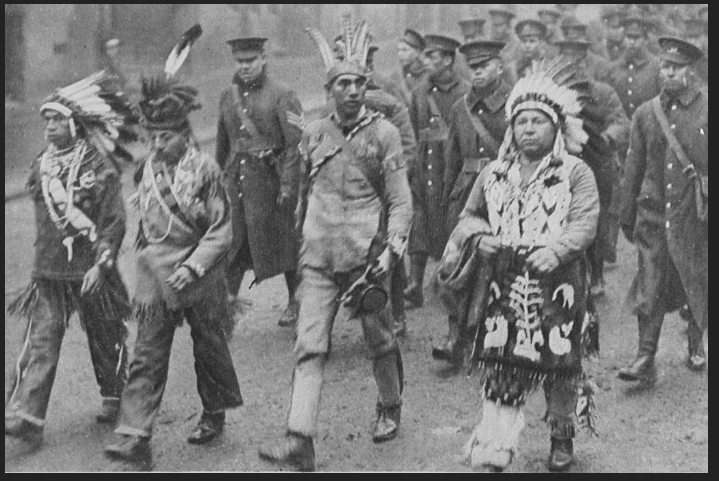
In desperation, the European empires turn to the people they’ve colonized and press them into sacrificing their lives for their imperial masters, setting off a chain of events that makes decolonization in a few decades inevitable.
Guest post: Driving Canadian Democracy to Oblivion: The Ideological State of the Canadian Establishment
A short letter to the editor from Anna Zalik
[Friends: You can catch up with what I’ve been doing for the past few weeks at Youtube, where I’ve been posting a series of sit reps on the war. Meanwhile, friend of the Anti-Empire Project, Anna Zalik, sent me this letter to the editor that the Globe and Mail declined, after publishing a long and embarrassing op-ed consisting of advice for the left, which is behind a paywall and only available to hardcore Globe and Mail readers. The op-ed is of what I call the “left’s best friend” genre, in which someone who despises you and your cause gives you advice about how you should be going about your work.]
Driving Canadian Democracy to Oblivion: The Ideological State of the Canadian Establishment
Anna Zalik, Toronto
In a poorly written OpEd published in the Globe and Mail on January 27th, embittered UofT humanities PhD Stephen Marche offers a “painfully clarifying reflection on the ideological state of the Canadian establishment.” In a conflation of facts, weakly organized examples, and cherry-picked polling data, Marche tries and convicts a group of people – various employed by universities- who allegedly postered an Indigo bookstore in downtown Toronto. Studiously avoiding reference to Israel’s genocidal attacks on Palestinians which the Canadian government and Reisman’s Heseg Foundation materially support, nor the destruction of all of Gaza’s universities, Marche’s piece could easily have been written by those in the Ontario government seeking to defund public post-secondary education. Precisely what ‘ideology’ Marche refers to is never clarified, but it is clear that his own is the same old elite populism that maintains the status quo – berating racialized and transgender activists, and defending police violence.
Particularly disturbing, Marche shields himself behind a non-sensical invocation of liberal multiculturalism that “leaves its shoes at the door”. Leaving one’s shoes at the door seems to consist of acquiescence to the new McCarthyism all around us. Indeed, despite a hat-tip to Netanyahu’s fascism, Marche’s piece never uses the words Palestine or Palestinians, nor does he acknowledge that various of his favoured targets, including Naomi Klein and Lesley Wood, are Jewish. If it’s best not to scratch the itch activists purportedly pose, why does Marche do so?
Ultimately, Marche does his part to drive Canadian democracy to oblivion.
AER 138: October 7 Hannibal
Israeli media recently published a minute-by-minute chronology of the morning of October 7th from the Israeli military perspective. Jon and I go over it as part of my youtube series of Gaza Sit Reps (for Day 104). Cross-posted over at The Brief, reposted here in case you missed it.
World War Civ 32: Britain’s plans for Arab lands – Sykes-Picot, 1916
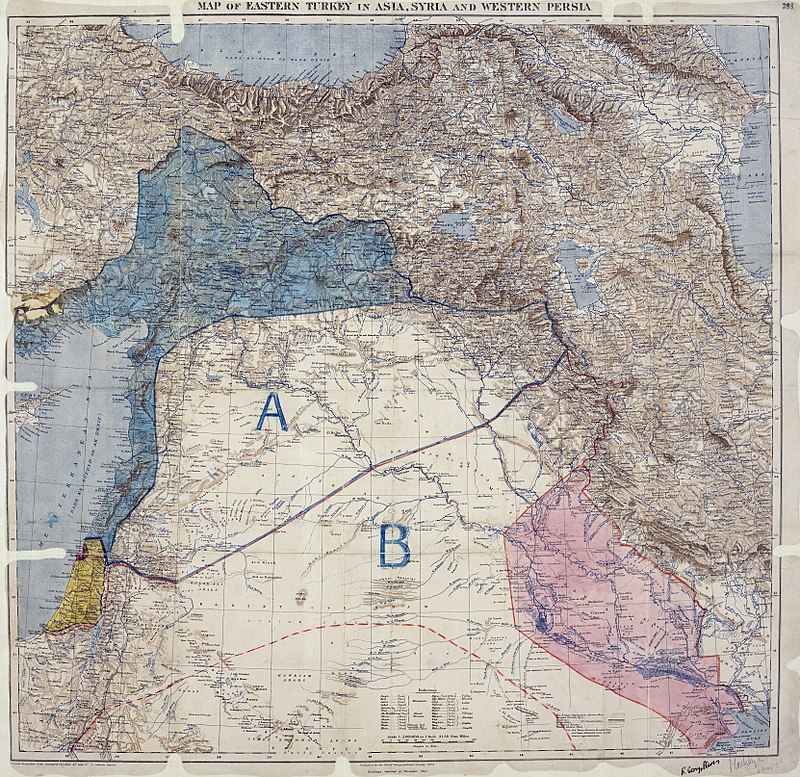
Early in the Great War Britain decided to dismantle the Turkish Empire and made promises to Arab leaders of independence if they would rebel against Britain’s Turkish enemy. While one British leader was making these promises, another, Mark Sykes, was making a deal with other imperialists for the division of Arab lands between them. Follow Mark Sykes on his world tour that culminates in the Sykes-Picot Agreement of 1916, an agreement we’re all still suffering from to this day.
The Land Back Party
If we’ll need one in twenty years, maybe we should start sooner than later
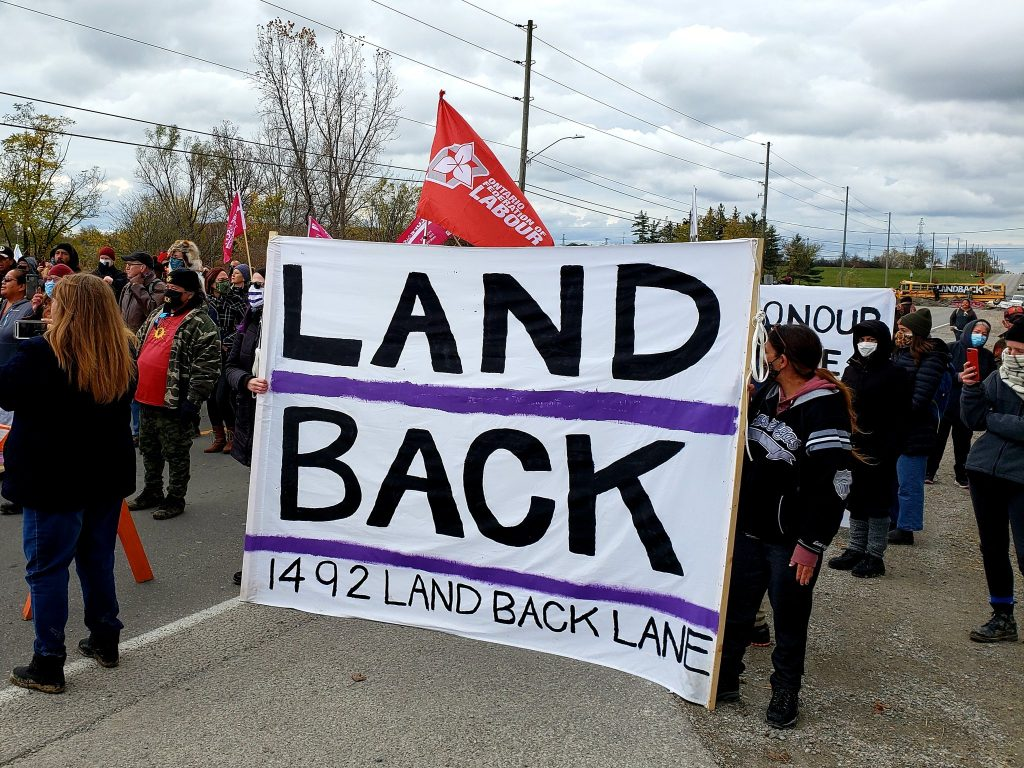
Canada’s political leaders are morally compromised. Months of genocidal bombing, 30,000 killed (15,000 children), 50,000 injured, the destruction of nearly every home, agricultural field, hospital, and school, the murder of journalists and medical personnel, field executions including children are before the International Court of Justice, where South Africa is seeking urgent preventive measures.
How has Canada responded? Most political activity on the matter still consists of each party trying to score points against the others by showing more unconditional support for Israel. South Africa’s case has been dismissed by media figures and ignored at the official level. Canadian media figures have screamed for the deportation of anti-genocide protesters, Ontario’s NDP has kicked out a lone voice (MPP Sarah Jama, now Independent) calling for a ceasefire, Toronto’s school board has agreements with an institution, CIJA, that openly lied about and targeted student protesters at a high school, anti-genocide doctors have been suspended from work. The rot is deep.
While did Canada anomalously vote at the UN General Assembly for a toothless ceasefire resolution, it followed up by joining a small pro-Israel minority asserting Israel’s colonial control over the West Bank.
Canada’s elite is totally morally compromised on the most basic moral issue of all: genocide.
In a context where the majority is pro-peace, if not necessarily pro-Palestine, this is a major disconnect between elite and population and, according to plural political theory, should provide a political opportunity for a party that is uncompromised.
It is necessary to understand why it does not provide such an opportunity in the current context. Why can’t any political party turn this moment of moral collapse to political advantage, by occupying the anti-genocide space?
There are two possible answers: 1. the strength of the pro-Israel lobby, or 2. what is called “settler solidarity”: the deep identification of the elite with Israel’s colonial project and the understanding that it would be hypocritical on some level to be a member of Canada’s political elite while espousing Indigenous rights in Palestine.
There is a strong pro-Israel lobby in Canada that is capable of punishing pro-Israel statement or action, especially by elites. The lobby is well-organized and can send floods of emails to institutions and mount social media campaigns to try to get people removed from elite posts. But the success of the lobby is precisely what needs to be explained, as an equivalent pro-Palestine lobby, equally well-organized, has not been found to have the same success. The success of the pro-Israel lobby is explained by “settler solidarity”. Canada’s elite identifies with Israel and with Israel’s project.
The only way for a party to fully occupy the political vacuum that is the anti-genocide political space in Canada would be for that party to be a party for the return of land to Indigenous Sovereignty. The empty political space in Canada can only be filled, in other words, by a Land Back Party. Canada’s elite cannot support Palestinian freedom because of its structural opposition to First Nations sovereignty; the movement inside Canada for Palestinian freedom has long understood the necessity for First Nations sovereignty.
Indigenous movements in Canada are currently experiencing what has been called a “resurgence”. The Land Back Party would support this unstoppable resurgence and work in constant coordination with it.
The Land Back Party’s program would be ambitious as it would have to achieve several difficult, perhaps unprecedented, and seemingly (though not actually) contradictory objectives:
-
Improve the living standards of everyone living in Canada, including health care, education, water, food, environment, and all other welfare measures
-
Without exploitation of the labor and resources of the Global South (ie., while achieving fair trade arrangements with Global South providers of resources);
-
-
While also transferring land and wealth from Canada to First Nations, expanding their land base and rights;
-
While also defending the land back project from the inevitable attempt to overthrow it.
While difficult, each of these objectives can be done.
Living Standards for all. The most succinct economic program for a left party upon reaching power was articulated by Utsa and Prabhat Patnaik with India in mind. In their book Capital and Imperialism, they imagine such a party introducing a set of
“universal, justifiable economic rights on par with the political rights typically enshrined in a democratic constitution. A minimal set of five such rights, namely the right to employment (or of wage payment if the state fails to provide employment); the right to food at affordable prices; the right to free, quality, public healthcare; the right to free, quality public education up to at least the university level; and the right to old-age pension and disability assistance of an adequate magnitude can be immediately implemented. And for this no more than an additional 10 percent or so of GDP will be required.”
Upon arrival in power, the government would immediately face capital flight and would have to incrementally introduce capital controls. Once those were introduced, trade controls would have to follow especially since, for Canada, a major portion of international trade is mining and military industry (both of which destroy Indigenous land within Canada’s borders and outside them). Were these controls to be introduced, big business in both Canada and the US would likely conduct an “investment strike” and try to shut down industry as part of a campaign of regime change. At that stage, a left government would also have to incrementally introduce nationalization of industries, turning them over to be run by their workers, and economic planning measures (for a Global North example, see the “window guidance” adopted in Japan prior to the Plaza Accord – described in the book and film The Princes of the Yen).
In The Wealth of Some Nations, Zak Cope describes the mechanisms by which trillions of dollars of value are transferred from the Global South to the Global North each year. The challenge for a left party in an imperialist country is improving living standards for all while moving towards a fair trade arrangement in the global economy. Moving Canada from a global exploiter to a country that is neither exploited nor exploiter. An analysis of the mechanisms through which neocolonial exploitation occurs can help understand how to unravel it without plunging the masses who live in Canada into misery. These mechanisms include especially the artificial lowering of prices of commodities and of labor from the Global South and the inflation of prices of services and labor from the Global North. The details of how to engage in fair trade in the global economy can be worked out if it is a priority.
Transfer of land and wealth to First Nations. In the book Unsettling Canada, Arthur Manuel and Ronald Derrickson show that Indigenous peoples control 0.2 percent of the land and settlers, 99.8%. The history of Canada is one of successive bad-faith attempts to “settle” these land claims – meaning, to extinguish them without changing the distribution of land. Rather than striking a committee or writing a new White Paper, the Land Back Party would come to power with a careful study of the history of land theft in Canada using maps like the set of maps at mappinglandtheft.ca, it would immediately stop fighting losing cases to prevent Indigenous people from getting their rights and lands, and begin immediately expanding the Indigenous landbase. Ultimately, it would learn about and adopt Indigenous ways of relating to the land – not the theft of Indigenous knowledge that characterizes the current colonial relation, but a transformation of the way society relates to the land in accordance with Indigenous principles.
Surviving all the overthrow attempts. As the landbase was expanded, strategies for holding the land against violent encroachment by aggrieved settlers and regime change campaigners would also be implemented. A Land Back Party would, on the road to power, have to win enough support to be able to resist even an armed coup attempt or an attempt to roll back gains that were made by First Nations. Returning the land to First Nations is, for its opponents, a most violence-inducing idea. A Land Back Party cannot afford to be naive about this, but with popular support, sovereignty can be defended.
The weakness of communist parties in Five Eyes countries has been a lack of understanding of countries like Canada as “prisons of nations” as Sakai described the US (following the Bolsheviks’ criticism of the Russian tsarist Empire). As organizations that work in colonial settler states that need to be transformed, left parties need to work for this transformation: not simply for a just distribution of the stolen spoils.
Other Land Back Party priorities would serve to permanently differentiate the party from unprincipled parties and serve as a bulwark against co-optation – the other early danger for such a party. These would include:
-
Freedom for Palestine, an end to the occupation, a Palestinian state with equal rights for all. Humanitarian and infrastructural aid to rebuild Palestine and no relations with Israel while occupation, apartheid and genocide continue. To those who ask, why is a foreign policy issue so important for this party? All other parties are pro-Israel and Palestine is evidently an issue of immense importance to Canada. Someone has to be the first anti-genocide party in North America. The party’s constitution will require support for Palestine.
-
Cancelling all governmental partnerships, guarantees, and subsidies for mining and military industries and co-operation with Five Eyes intelligence and US covert and overt military programs. Defense concepts will instead include partnerships with First Nations for defense of sovereign Indigenous land, solidarity and coordination with struggles of oppressed people inside the US, and communal and civil defense against coups and fascist violence.
-
Expansion of welfare state, health care, education including in Indigenous languages, water infrastructure to Indigenous communities. Transition to restorative justice based on First Nations models. Community control over police (see, e.g., The Black Agenda Report proposal). Food sovereignty and state support for agriculture. Economic planning. Unapologetic use of policy tools including taxation, nationalization, capital controls.
The initial activities of this organization will include:
-
Media work – social media and a media infrastructure that belongs to the party so that the party does not require social media to get its message out. Media work will be a high percentage of the work of the organization and will support all other work.
-
Media education and training – the idea of an introductory course for organization members that would be useful anyway – that would develop theoretical knowledge, writing skills, and other media skills so that the work required to join the party is rewarding in itself.
-
-
Movement defense. The party would work with lawyers but the organization will also defend anyone suffering repression for their Palestine- or Indigenous sovereignty- related work through public campaigns. This kind of movement defense casework will help the day to day building of the organization.
-
Support for organized labor in strike actions, political use of the general strike to exert pressure for policy change (ie., a ceasefire at this moment), again primarily through media and public work.
-
Work with school boards, media organizations etc., to get anti-Palestinian racism widely used as a concept. Longer term work would include education on the practicality of the immediate expansion of the First Nations land base.
There are also lessons from other parties – small, left-wing parties and mainstream parties – that the Land Back Party would learn from. These include having robust self correcting mechanisms within the party and organizational structures. The party charter would include democracy, transparency, equality, gender equity, diversity, anti sexual harassment policies, accountability mechanisms for all levels of the organization. Application to the organization would be open to all, but it would require completion of an educational program. The organization would be built with the expectation that it would grow and it would have committees and transparent procedures for handling everything from the aforementioned sexual harassment allegations to funds, budgets, and media infrastructure.
When the time is right, the party would fill out the forms, raise funds, find and prepare candidates, and run for office in elections at provincial and federal levels since it is only through state power that these economic, foreign policy, and land back agendas can be fulfilled. This, too, will require a careful analysis of what opportunities exist within the electoral system in Canada and the legal constraints on how political parties operate, with a view to preventing the Land Back Party from replicating the co-optation or (assisted) self-destruction of previous, similar efforts.
Such a party would have many difficulties getting started (all the problems left-wing people have in organizing at a small scale), greater difficulties achieving power (as repression would increase dramatically), and still greater difficulties governing (in the face of capital flight, coup attempts, and threats of invasion by the US). But all of these could be overcome in time and it would be better to start now than to look around as un-organized activists in twenty years of further rightward drift and wish we had done something like this now.
World War Civ 31: Towards Total War
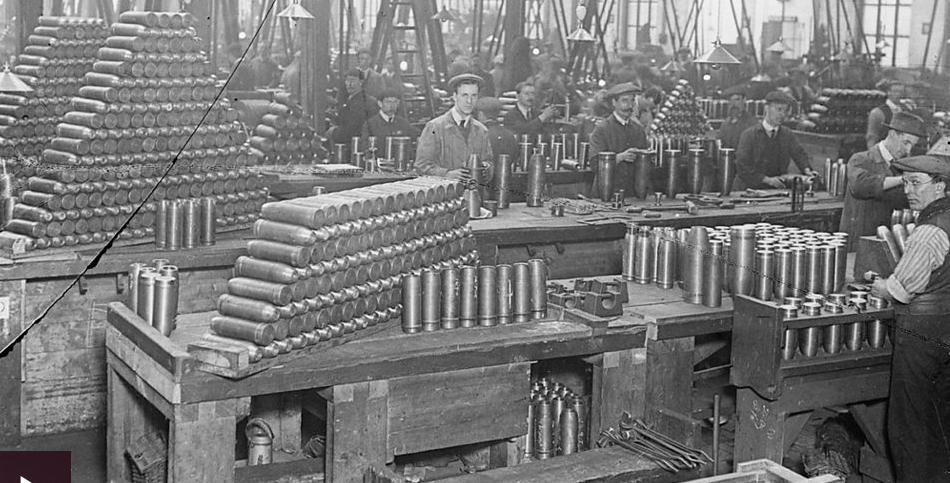
By the end the World War had mobilized 65 million troops, killed 20 million people and wounded 21 million more. The money was supposed to run out in a year, the armies were big but never that big. How did the war go on? Because the belligerents made immense and irreversible changes to their economies and societies to sustain it and begin the era of total, industrial war.
AER 137: Gaza War Sit Rep Day 91
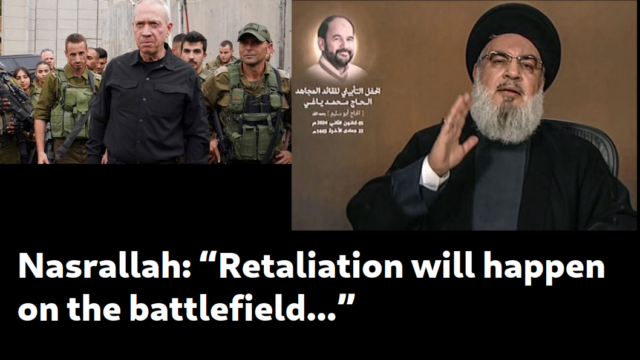
Solo episode discussing Nasrallah’s speech about the war on the Israel-Lebanon border and an analysis of the 2006 war based on a US military analyst’s paper titled, “We Were Caught Unprepared”.
World War Civ 30: Allied Disasters 1915
Germans use poison gas on the battlefield at Ypres, British lose 60,000 and Germans 40,000. French attack at Artois with casualties of 100,000 and German 75,000. Russians lose 2 million casualties fighting Germany on the Eastern front. British defeated at Loos, lose 50,000 and Germany 20,000. French offensive in Champagne results in 190,000 casualties and the German line unbroken. Britain makes a move against the Turks in Gallipoli / Dardanelles, and another disastrous move at Kut al-Amara in Iraq. A year of immense disasters with lasting consequences.
Zionists despise both religious and secular Jewish traditions
Part 8 of 8 on Zionism as an anti-Jewish, racist ideology
Until Western scientific racism became dominant in the 19th century, Jewish was a religion – what else could it have been? It was race science and race-science based, organized anti-Semitic organizations that racialized Jewish people. Though a debate continues about whether or not the Jewish identity ultimately must rest on a religious foundation, non-religious Jews are accepted and claimed widely as Jews in their own communities. Zionists are hostile to both religious and secular Jews.
Zionists are openly hostile to those religious Jews who understand and identify with Judaism through religion. Yakov Rabkin in A Threat From Within: A History of Jewish Opposition to Zionism (pg. 46-48) quotes historian Noah Efron: “Nowhere are Haredi Jews as feared and hated as in Israel. Israel is a bastion of a classic sort of anti-Semitism, aimed not against all Jews, but against the ultra-Orthodox, the overly Jewy Jews.” Quoting Efron at length, Rabkin argues that “Zionism’s promoters have simply refined the hateful image of the traditional Jew as painted by Voltaire and Fichte”
“One need not search hard to find denigrating images of the Altjtude traditional Jew] in Zionist rhetoric and pamphletry. Herzl had already noted in 1894 that Jews had “taken on a number of antisocial characteristics” in the ghettos of Europe, and that Jewish character was “damaged.” [The poet David] Frishman [1859-1922, of Russian origin] opined that “[traditional] Jewish life is a dog’s life that evokes disgust.” [Another Russian poet,] Joseph Haim Brenner, [1881-1921] likened Jews to “filthy dogs, inhuman, wounded dogs.” [Yehuda Leib] Gordon [1831-1892, an active opponent of Judaism, also of Russian origin] wrote that European Jews were parasites. [Micha Joseph] Berdyczewski [1865-1921, a poet and a philosopher bom in the Russian Empire] christened traditional Jews “spiritual slaves, men whose natural forces had dried up and whose relation to the world was no longer normal,” and elsewhere, “a non-people, a non-nation — non-men, indeed. (Efron 1991,88-89)”
Rabkin (pg. 49) quotes the well-known critic of Zionism, Yeshayahu Leibowitz, who argued that Zionists were “seeking a national identity that exists only in and for itself, for they no longer have any concrete, empirically observable ties with Judaism.”
Leibowitz feared that national identity would “be transformed into statism and will to power; into a national identity in the Mussolinian sense.”
Rabkin believes that Leibowitz’s analysis reveals “seeking a national identity that exists only in and for itself, for they no longer have any concrete, empirically observable ties with Judaism… the national consciousness of the Jews had only Judaism as a shared basis, and the state’s founders openly opposed it.”
But Leibowitz, opposing this, tried to remind his readers that “The state exists to serve men; men do not exist for their state.”
Rabkin quotes the Chief Rabbi of Britain, Jonathan Sacks, who criticized the disunity of the Jewish community: “we have fissured and fractured into different edot [congregations]: Orthodox and reform, religious and secular, and the many subdivisions that continue to atomize Jewish life into non-communicating sects and subcultures.”
Among all this, Rabkin reflects, it is Israel alone that provides the sense of belonging:
“For three decades, Zionist organizations have been inculcating belief in the centrality of Israel in most non-Haredi Jewish schools of the Diaspora. This vicarious “Israelism” replaces the traditional Jewish identity all the more easily because the new identity makes far fewer demands. Since Jewish identity is based on obedience to the Torah and to the commandments that it articulates, it affects both the most intimate of precincts (such as food and sex) and public behavior (such as the non-use of automobiles on the Sabbath or dressing modestly). Contrariwise, Israelism imposes no particular obligation, while at the same time transmitting a feeling of belonging. “I identify with Israel because it is the last refuge of the secular Jew,” a friend confided to me one day. While interested in Judaism he denies it any nor mative significance. “Without Israel I would be obliged either to observe the Torah commandments or to stop being a Jew.” When I passed on his remark to Rabbi Moshe Dov (Baer) Beck, perhaps the most prolific of the anti-Zionist thinkers, he replied, to my astonishment: “What’s wrong with being a non-Jew?” In other words, why would those who do not observe the Torah insist on remaining Jewish? A secular Jewish identity is obviously nonsensical for Rabbi Beck.”
In the religious view, being a Jew means no more or less than being a follower of the religion and fulfilling obligations of faith and conduct to that religion. If you don’t want to follow the religious rules, the Rabbi asks, “What’s wrong with being a non-Jew?” But to Nazis steeped in scientific racism, adherence to the religion or not is irrelevant – to Nazis, Jews are a racial group. Zionists also adopt a racial view of who is Jewish, and not a religious one.
The Zionist founders of Israel believed in colonial conquest and the nation’s will to power. Rabkin (pg. 56):
“According to the Israeli intellectual Boaz Evron, “Zionism is indeed the negation of Judaism” (Leibowitz, 133)… “Ben-Gurion saw Judaism as the historical misfortune of the Jewish people and an obstacle to its transformation into a normal nation” (Leibowitz, 144).”
Criticizing Hindu right-wing nationalism in the 2008 book 1857: War of Civilisations, Indian author Amaresh Mishra pointed out that all fascists are atheists, since they ultimately believe in earthly power and will. Religion is another tool to be used in the quest for power, whether to Zionists or the Indian ideologists of Hindutva like Golwalkar and Savarkar.
Holders of these ideologies are not capable of sincere religious belief.
In New York-based Rabbi Yaakov Shapiro’s 1382-page book The Empty Wagon: Zionism’s Journey from Identity Crisis to Identity Theft (2018), the author argues that early Zionists needed to “neutralize the Torah”, for “if the Torah would continue to be perceived as the defining principle of Jewish identity, Zionism would never get off the ground… The Zionists realized they would be unable to successfully deny the centrality of religion in the Jewish consciousness. Instead, they decided to enslave it and channel it for their own cynical agenda.” He quotes Ben Gurion: “I will never agree to the separation of religion from the State, because I want the state to hold religion in the palm of its hand.” In the Zionist integration of religion and state, it is religion that is subordinated. To religious authorities like Shapiro, this is blasphemy.
“I will never agree to the separation of religion from the State, because I want the state to hold religion in the palm of its hand.” – Ben Gurion
Can the army teach you how to be Jewish?
Shapiro describes the specific role of the Israeli military in undermining Jewish religion and subordinating it to political goals of Zionism. Reviewing the IDF officers’ training course, Shapiro finds lectures on:
-
What is Judaism?
-
The uniqueness of the Jewish people
-
The people and the land in a Jewish perspective
-
War and the army in a Jewish perspective
-
Is Judaism a religion, a way of life, or a constitution?
-
The identity of the Jewish people
“Suffice it to say,” Shapiro continues, “the IDF version of Judaism and Jewishness is not the same as the Torah’s… while the information disseminated is certainly destructive from the Torah perspective, the problem here is not just the content, but also the fact that these topics are being taught by a national army at all. The reality is that the IDF is the army of Israel, not the army of the Jewish people. But consistent with Zionism, the Israeli army is not portrayed as just the army of Israel, but of all the Jews.”
Zionist abuses of religious Jews from Yemen
Zionist abuses of religious Jews from Yemen are recorded by Yakov Rabkin in A Threat from Within (pg. 43). “The Yemeni Jews, well known for their devotion to the Torah and for their Judaic erudition, were subjected upon their arrival in Israel in the late 1940s to secular re-education campaigns, often in isolated camps. This measure was aimed primarily at the young, who, while not actually kidnapped, were nonetheless forced to endure ideological pressures designed to estrange them from tradition. Many sources concur: physical violence was employed, particularly when the young secular camp commanders forbade access to young religious Jews who wished to assist the internees.”
Rabkin quotes one Israeli parliamentarian saying in the Knesset:
“I cannot employ any other terms to describe the situation in these camps than those of spiritual constraint and inquisition against the Jewish religion. I see nothing in what is being done in these camps but the cultural and religious murder of the tribes of Israel.”
Rabkin continues: “Their Zionist educators apparently forced the young Yemeni Jews to harvest oranges on the Sabbath, to walk about bareheaded and to cut off the side-curls the Yemeni Jews had worn for centuries.” He quotes one Yemeni Jew describing this: “here, they treat us with contempt, and force our people to profane the Sabbath. They mock us; laugh at our traditional beliefs, our prayers and the religious observances of our Holy Torah.” In addition to religious abuse, these Yemeni Jews were also tested for “negro blood”, according to a June 16, 2017 report by the Times of Israel. The report was based on investigations for the “Knesset Special Committee on the Disappearance of Children from Yemen, the East and the Balkans”.
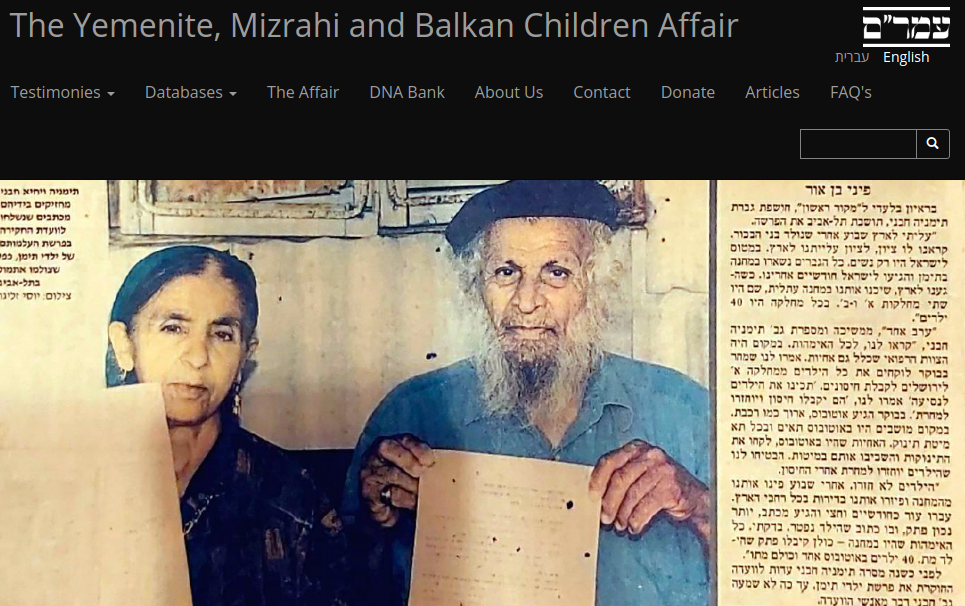
The kidnapping of thousands of Yemeni Jewish babies for forced re-education is now known as “The Yemenite Babies Affair”. Rabkin: “ The government apparently assured the parents that their children had died. It was not until many years later, when some of the parents received military call-up notices for their children, that they began to smell a rat.”
But the religion can’t be discarded; so it must be subordinated
For all of Zionists’ hatred of the Jewish religion, they are unable to discard it and adopt a purely “racial” definition of Jews, since no “race science” can produce a coherent “race” of any kind, let alone a “Jewish race”. Those Zionists who adhere most strongly to a “racial” definition of Jews are also the most inclined to discriminate against Jews of Arab, Asian, or African ancestry. In a video interview, Rabbi Yaakov Shapiro pointed out this contradiction in Israel’s Law of Return: while an atheist of Jewish origin could become an Israeli based on the Law of Return, a person of Jewish origin who converted to, e.g., Christianity, could not. Zionism is about subjugating religious Jews and using the religion as a cover, not sincere adherence to faith.
Zionism’s secular enemy: the Jewish left
Jewish culture goes beyond religion only, and there are non-religious participants in Jewish life. Zionism is inimical to these as well.
Describing her background in a 2021 video on her “journey away from Zionism”, Jewish-American activist Maya Edery said she had been “accidentally a Zionist” because she “didn’t know there was another way to be Jewish,” but her upbringing and understanding of “Judaism as a form of practicing social justice” made it impossible to reconcile her understanding of Judaism with the oppression of the Palestinians.
The late David Graeber described left-wing Jewish traditions in a video coming to the defence of Jeremy Corbyn against false accusations of anti-Semitism. Graeber argued that it was preposterous to argue that the left was anti-Semitic partly because “to some degree what we now think of as the left is a product of Jewish thought and the Jewish tradition.”
The right-wing in Europe is obsessed with the historical connections between Jewish culture and left-wing emancipatory politics. Right-wing ideologies, including Nazism and Fascism, arose as both anti-Left and anti-Jewish ideologies and remain so to this day. The list of Jewish left-wing historical figures hated by the right-wing (and revered by the left to this day – Marx, Luxembourg, Trotsky, Goldman, Chomsky…) is very long indeed.
Herzl, Jabotinsky, Weizmann, and other Zionist leaders offered a solution to the “Jewish problem” to anti-socialist, anti-Jewish racists. They accepted the right-wing premises that Jews are a degenerate, impure “race,” and that one of their flaws is apparently socialist agitation. Zionists interpret the participation of Jews in socialist struggles as a “racial flaw” to be remedied by their removal from Europe.
In 1948, the Jewish Labor Bund – a socialist labor organization that developed in parallel and in opposition to Zionism with a left-wing philosophy, argued in a pamphlet that while Jews could of course live in Palestine, that “the fight against anti-Semitism, for full equality, and for the full national and cultural development of the Jewish people must be waged – as it has been until now – side by side with the democratic and Socialist elements of the non-Jewish population in those countries.”
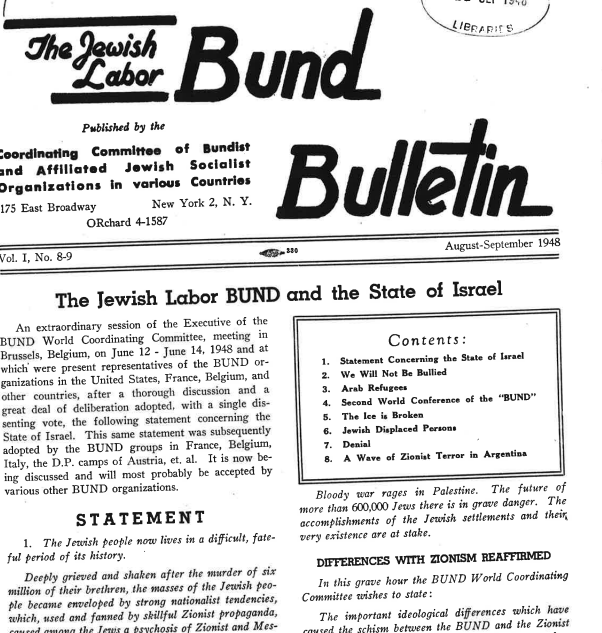
In a section of the same pamphlet titled “We Will Not be Bullied”, the pamphleteers described how “The entire Jewish press, dailies, weeklies, and scores of other publications, united in taking the Bund to task as a traitor to the Jewish cause. All shades of Jewish public opinion united in mobilizing the Jewish communities against us – simply because we dare criticize the wisdom of the establishment of a Jewish state in Palestine… Be this as it may, we wish to assure our political antagonists that we shall not allow them to terrorize us into silence.”
Zionists treat the Jewish left, whether in Palestine or in the Diaspora, as an enemy.
Zionists try to redefine Jewish identity
If neither religious worship nor secular left tradition are allowed by Zionists, what is left of Jewish identity after Zionism is done with it?
Rabkin (A Threat From Within, pg. 38) quotes Rabbi Blau, who believed that “Zionism had inflicted worse harm upon the Jews than upon the Arabs. The Arabs may have lost their land and their homes, but the Jews, by accepting Zionism, had lost their historical identity (Blau, A., 2-3).”
In a 2020 +972 mag article, journalist Etan Nechin explored the consequences of Israel’s Nation State Law, through which, Nechin argued, “Israel’s religious right is deciding who is a Jew.” Nechin cites the 1947 “status quo” letter from Ben Gurion to Orthodox Jewish leaders, which produced a lasting arrangement whereby “secular society would operate with limitations in areas such as transportation on the Sabbath, laws around marriage and death, and others. In return, religious communities would turn a blind eye to certain deviations from the rabbinate, Israel’s highest Jewish religious authority, such as the immigration of hundreds of thousands of Jews from the former Soviet Union who have not been recognized as Jewish by the rabbinate.”
The resulting definition of Jewish, Nechin argues, is a purely negative one:
“Passed by the most right-wing, nationalist-religious government in the country’s history, the law exposes the hypocrisy of the religious right in Israel: the only definition it can propose of being Jewish is “not an Arab.” Judaism is not defined as a vibrant religion with manifestations all around the world, but a state identity that guarantees superiority over people of different faiths under its rule, as well as over Jews living outside Israel. In other words, in Israel, Judaism is a synonym for power.”
In the 2013 book The Tragedy of a Generation: The Rise and Fall of Jewish Nationalism in Eastern Europe, Yeshiva University scholar Joshua Karlip traces movements for two roads not taken by Jewish Nationalists, roads that were ultimately folded into Zionism: Yiddishism and for Diaspora Nationalism. Karlip analyzes these roads through a study of three leading Russian-Jewish nationalist intellectuals – Elias Tcherikower, Yisroel Efroikin, and Zelig Kalmanovitch.
All of these leaders ultimately opted for Zionism because they feared assimilation above all, and felt especially strongly that the Soviet Union and socialism were guaranteed to end with assimilation. Their own anti-communism led them to a rejection of the Jewish left; their secularism meant they couldn’t accept a religious basis for their identity.
As one of these three intellectuals, Tcherikower, moved towards Zionism, he argued that Soviet Jewry was in the process of ‘“death by the kiss” of assimilation.’ Despite official support in the Soviet Union for Yiddish culture, Tcherikower came to see it as a dead end: “Why specifically Yiddish? If there is no national, historical or, dare we say, religious feeling of connection with the collective then why be a Jew in a country where you can freely partake of the general rich culture? Why send the children to a Yiddish school when the general ones prepare them much better for practical life?”
Another one of the trio, Kalmanovitch, concluded that Yiddish was “bankrupt. What kind of a movement can it be whose program is to read a Yiddish book and to go to the Yiddish theater once in a while?” Wherever they lived, Jewish people would “need to buy bread and repair their shoes and work; they need to do it in the language of the country in which they live… the only solution is for Jews to have their own country, where they can live a normal life.”
Describing the views of these three intellectuals on Nazism in the 1930s (before the Nazi genocide): “Tcherikower, Efroikin, and Kalmanovitch all viewed Nazism as a potential catalyst for the reconstitution of Jewish communal consciousness.” Karlip quotes one of these at length, stating that “Tcherikower even recognized a positive side to the rise of Nazism:”
“And who knows, perhaps the Jewries in the Fascist and half-Fascist lands would have been devoured internally if not for Jewish historical providence, which imparted to the contemporary Hamans the idea to build the anti-Semitic movement on principles not of religion but rather of race. And from this standpoint, it is perhaps true that “the Holy One Blessed Be He made a blessing for Israel” that this illogical [racial] theory has rendered apostasy purposeless. What would become of these Jews, if they would be able to save their lives and property through conversion?”
In this Jewish nationalist perspective, defining Jews racially instead of religiously had the benefit of providing a bulwark against assimilation.
The experience of the Anglo-American settler colonies (US, Canada, Australia, New Zealand) shows that a settler colonial state is no foundation on which to build a culture: such a state creates an identity based on theft and cultural appropriation.
Tcherikower mocked Yiddish culture, but whatever is not European in Israeli settler culture – from language to place names and food – is based on appropriation from Indigenous Palestinian culture. Having trampled on Jewish religious and secular traditions, Zionists have arrived at an empty, negative definition of Jewish identity as Nechin noted, someone who is “not an Arab”, while defining everyone who opposes them as an “anti-Semite”.
In this way, centuries of lively Jewish culture and tradition are effaced and replaced with this ideological dead end.
[This concludes the series. There will be an epilogue on the Hannibal Doctrine and how it, too, is anti-Jewish in effect.]
AER 136: Tankie Group Therapy #8 on Gaza War Day 78
Our usual group gets together to talk about the Gaza War but this time we’re joined by Lara, an actual therapist, who guides us through as we try to understand where things stand on Day 78 of the war.