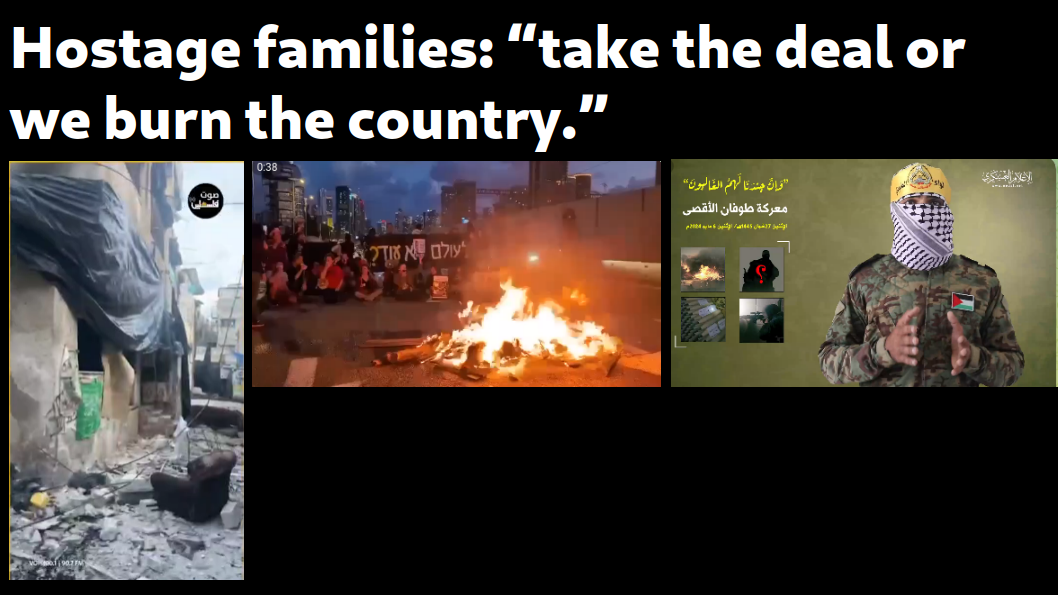
On the Anti-Empire Project Youtube Channel there are frequent situation reports or Sit Reps that are posted late at night. Not all of them are reposted here to this podcast, but we’re posting this one on the day of the Rafah invasion. A breakdown of the ceasefire negotatiations and an assessment of where the war is at. With Jon Elmer.
Category: Palestine
Palestine 2018 proved the futility of anticolonial nonviolence

There is no case of nonviolent anticolonial struggle
The US struggle for civil rights, remembered as the nonviolent movement of Martin Luther King, was also the movement of the Deacons for Defense in Louisiana, the movement of the Mississipi Regional Council of Negro Leadership which could “speedily mobilize substantial and deadly firepower” including E.W. Steptoe who had “guns all over the house, under pillows, under chairs”, of Robert Williams of Monroe, North Carolina’s NAACP who said in 1959 that “we must be willing to kill if necessary”, the movement of a night-long battle with police in Albany, Georgia in 1962 and in Birmingham, Georgia in 1963, when “every day of riots was worth a year of civil rights demonstrations”.
The Indian Freedom struggle, remembered as the nonviolent movement of MK Gandhi, was also the movement of the Hindustan Republican Army, of Chandrasekhar Azad and of Bhagat Singh, of the Telengana Uprising of 1946, of the Tamil Nadu anti-feudal struggle of 1943, of the underground guerrilla struggles after Quit India in Odisha, West Bengal, Bangalore and elsewhere, of the Toofan Sena in Maharashtra, of Indian National Army of Subhas Chandra Bose, and of the Naval Mutiny of 1946.
The two most iconic tales of the deployment of strategic nonviolence turn out, upon historical examination, to have been armed struggles, replete with violence.
Through an analysis of the work of Gene Sharp (“Gene Sharp’s Neoliberal Nonviolence” part 1 and part 2), writer and academic Marcie Smith has revealed the existence of a sort of “nonviolence industrial complex”, a network of institutions linked to the US foreign policy establishment, dedicated to two things: 1. steering opposition to US-backed states and projects in nonviolent directions, and 2. to using methods of nonviolent insurgency as a part of a set of tactics (including covert, violent action) to destabilize US targets.
The jewels in the narrative crown of this nonviolence network are the US civil rights movement and the Indian Freedom Struggle, which is why I devoted the two previous articles in this series to showing that these were in fact armed struggles.
The narrators of the nonviolence network have one other weapon: quantitative analysis. But this weapon too, turns out to be a plastic replica.
In their book Why Civil Resistance Works, Erica Chenoweth and Maria J. Stephan claim to have proven through statistical analysis that nonviolence is more effective than violence. Their analysis is worth detailed examination since it claims to have the authority of a huge dataset and logistic regression proving the chances of success are higher with nonviolence.
But what did they actually do? They made a list of several hundred revolutions from the 20th century (nearly all of which were in fact violent), coded some struggles as violent and others not, coded some struggles as successful and others not (in fact many of the successes delivered the countries and their economies directly over for imperialist plunder), and then after a quantitative assessment which amounts to counting the number of successful cases of each type, found that their “nonviolent” coded struggles had a higher chance of success. These nonviolent-coded struggles include:
- the South African struggle (including its armed wing, Umkhonto we Sizwe);
- and the many East European color revolutions.
- the Palestinian Intifada;
A quick skim of any of these histories show that these were all violent struggles. The data reveal the conclusion the authors believed at the outset and for which they coded their data. Why Civil Resistance Works is historical falsification covered with a quantitative mystique.
To determine the veracity of their analysis we need examine only those events coded as both nonviolent and successful. Nonviolent failures are of no interest, since they do not bolster the nonviolence narrative. Neither violent successes nor failures are of interest either, since to the nonviolence industry armed struggles are already failures.
The database published with the book contains 57 nonviolent successes. There are two types of movements analyzed in the database: movements for regime change and movements for secession. There are no nonviolent successes for secession movements: all 57 nonviolent successes are regime change successes. There are only 4 secession successes out of 46 attempts in the database (Croatia, Tigray, Bangladesh, and Aceh from Indonesia starting in 1976-2005). All of these were violent.
Philosophers of science know that there is a complicated set of human decisions that go into the translation of things occurring in nature into statistical data. Even such decisive phenomena as birth and death can only be entered in a spreadsheet as “0” and “1” by the declaration of a doctor. Of all the types of data to translate into “0”s and “1”s on a spreadsheet, historical data is the worst. Was the French Revolution a success, a failure, or is it too early to tell? In history, some failures are necessary prerequisites for future success; some processes simply cannot be classified as one or the other (Chenoweth and Stephan include a “limited success” category to try to capture these).
The relevant point here is that the coding of these 57 events as both “nonviolent” and “successful” ranges from deeply problematic to utterly preposterous.
Going through them:
In this database, the Palestinian liberation struggle apparently started in 1973, was violent, and a failure. The Intifada, 1987-1990, is considered a nonviolent partial success. The 1979 overthrow of the Shah of Iran, which I won’t dispute was successful, is coded as a nonviolent process – which would be a surprise to the guerrilla fighters and defectors who fought the Shah’s soldiers in the streets. The 2005 Cedar Revolution in Lebanon is coded as a success, but it did not change the regime and Lebanon’s political system continued as before.
The Cedar Revolution is not the only “color revolution” (short-hand for a US-backed regime change operation in a US enemy country led by US-trained political and media cadres) coded as a nonviolent success. Indeed a good part (14 of the 57) of the nonviolent successes are East Europe color revolutions: 1989 Germany, 1981 Poland, 1989 Hungary, 1989 Czech, 1989 Slovakia, 1989 Bulgaria, 1990 Russia, 1989 Estonia, 1989 Latvia, 1989 Lithuania, 2001 Ukraine, 2003 Georgia, 1989 Kyrgystan, 2005 Kyrgistan. In the background of all of these color revolutions was the threat of US-led NATO expansion and US nuclear war, as well as the fact of US violent covert operations. Three more of these East Europe nonviolent successes – 1999 Croatia, 2000 Yugoslavia, 1989 Slovenia – are from the incredibly violent US-led dismembering of Yugoslavia in a series of civil wars (described in, e.g., Michael Parenti’s book To Kill a Nation and Diana Johnstone’s book Fool’s Crusade).

In Africa, in addition to coding the South African anti-apartheid struggle as nonviolent (which would be news to umKhonto we Sizwe, the armed wing of the African National Congress), and the Ghanaian, Zambian, and Malawi Independence struggles as nonviolent (they were not), the majority of African nonviolent successes in the database were mass mobilizations to press for elections. These were: 1989 Mali, 2000 Ghana, 1993 Nigeria, 2001 Zambia, 1992 Malawi, 1991 Madagascar, 2002 Madagascar, 1985 Sudan (in active civil war at the time).
In East Asia, the 1960 April Revolution in Korea (in which 186 people were killed) is coded as a nonviolent success, as is the 1986 People Power Revolution in the Philippines (after decades of guerrilla struggle and notable defections from the military). East Timor, widely recognized to have suffered a genocide from the 1970s to the 1990s, is coded as having had a nonviolent success in 1988, despite Independence coming in 1999 after a long guerrilla war. A 1973 popular uprising in Thailand, that had bomb explosions and dozens of deaths in riots, is coded as a nonviolent success. So, too, in Thailand, a long-running political crisis in 2005 that culminated in a military coup in 2006, is coded as a nonviolent success.
In the Americas, the database includes as nonviolent successes a 1931 naval mutiny in Chile, a 1944 armed revolution in Guatemala, 1958 Venezuela (which featured attacks on security services headquarters and resulted in the awful Punto Fijo pact), a clear failure to overthrow the system in Mexico in 1987, and struggles against dictatorships in Argentina (1977 and 1986), Uruguay (1984), and Chile (1983), all of which had prominent guerrilla movements. The database cites 2002 in Venezuela as a nonviolent success, but there were two things that happened in April 2002 in Venezuela: a violent coup against Chavez and its reversal when the army refused to endorse the coup: the coup failed, the the successful reversal of the coup involved military moves.
In Europe, a 1974 military coup in Portugal is coded as a nonviolent success. Of the churning conflicts, revolutions, and civil wars in Germany in the 1920s that culminated in the rise of Nazism in the 1930s and the most violent events in human history so far, 1923 in Germany is coded as a nonviolent success.
There is, however, a specific type of conflict coded as a nonviolent success in the database that recurs in different parts of the world, in which a spent dictatorship gives way, in the face of a basically nonviolent popular movement, to an election. About eight of the 57 nonviolent successes belong to this pattern: 1963 and 1974 in Greece, 1977 in Bolivia, 1984 in Brazil, 1985 in Haiti (which led to a military coup and additional years of mobilization until Aristide was elected, then violently overthrown again…), 1990 Guyana, 2000 Peru, and 2001 in the Philippines. This particular set of eight cases (five of which took place in the Americas) could be used as evidence for the argument that, under the right circumstances, largely nonviolent popular mobilization can reverse a stolen election or force a weakened government to agree to elections. It does not prove at all that nonviolent movements have a better chance of success than violent ones. But even in these cases, the threat of violence existed.
There is value in analyzing and comparing movements of resistance in history. There may even be value in coding them and calculating probabilities. But there is no value to be had in building a model for probability of success based on violence and nonviolence by miscoding failures as successes and armed struggles as nonviolent.
We never needed a database to tell us that under some circumstances a social and political struggle can be kept on the nonviolent plane. The key factor is the investment elites have in maintaining the policy that is being challenged. Union struggles can often succeed in winning wage and working conditions improvements nonviolently. Every election where the loser congratulates the winner and there is a peaceful transfer of power is an example of a successful nonviolent struggle. But colonialism, struggles over land, in which oppressors have racial ideas of superiority over the oppressed? In these cases, whether it succeeds or fails, armed struggle alone has a chance. Only by wielding falsified histories and models can the nonviolence storytellers argue otherwise.
Palestine 2018: the final proof of the uselessness of nonviolence in anticolonial struggle
And so we turn to Palestine, a colonial struggle over land, in which the oppressors have racial ideas of superiority over the oppressed and are, since 2023, engaging in active genocide. Palestine has been an area of focus for the nonviolence industry for decades.
A February 2024 paper by the Center for Constitutional Rights has shown that US anti-terror legislation was “driven by anti-Palestinian agendas from the beginning.” The nonviolence industry has had a similar Palestine focus from the beginnings of Gene Sharp’s Albert Einstein Institute. The 1987-1989 Intifada was an object of fascination for Sharp and for the nonviolence industry. Sharp’s Journal of Palestine Studies article in 1989, “The Intifadah and Nonviolent Struggle”, identifies him as the author of the 1973 book The Politics of Nonviolent Action as well as the author of Almuqawama Bila Ounf (Nonviolent Resistance), published in Jerusalem by the Palestinian Center for the Study of Nonviolence in 1986. In the article, Sharp argues – quantitatively again – that 85% of the intifada has been nonviolent. He simply asserts that armed struggle and nonviolent struggle are “not easily mixed to advantage” – and so the Palestinians should go from 85% to 100% nonviolent. After the usual arguments absolving Israelis of responsibility for the violence they mete out on Palestinians and the normal nonviolence argument that the the colonial repression faced by the victims is their fault for provoking their oppressors, Sharp suggests Palestinians go on a 21-day hunger strike, followed by “whistling or wailing at night, especially in dark streets” and “having the youths standing peacefully, not fleeing, holding small Palestinian flags, their right hands outstretched in a gesture of friendship.” Sharp dangles recognition before well-behaved Palestinians: “The shift to fully nonviolent struggle would also make possible more active support for Palestinian independence in Western Europe and the United States.”
After months of genocide, starvation, and the gleeful mass murder of tens of thousands of children, all filmed and celebrated across Israeli society and by Israel’s supporters in the West, Sharp’s arguments are striking for their absurdity as well as their vulgarity.
But Sharp was not alone.
Pakistani activist and academic Eqbal Ahmed made the argument to Palestinians numerous times. He reported to journalist David Barsamian in 1996 (published in the 2000 book Confronting Empire) that he’d told a group of Arab students in the US after the 1967 war that “armed struggle was supremely unsuited to the Palestinian condition,” that “Israel’s fundamental contradiction was that it was founded as a symbol of the suffering of humanity at the expense of another people who were innocent of guilt,” and that “you don’t bring (the contradiction) out by armed struggle. In fact you suppress this contradiction by armed struggle.” He told them in 1968 that
“This is a moment to fit ships in Lebanon and say, ‘we’re not going to destroy Israel. That is not our intent. We just want to go home.’ Reverse the symbols of Exodus. See if the Israelis are in a mood to sink some ships. They probably will. Let them do so. Some of us will die. Let us die.” Eqbal Ahmed imagined if Arafat were to “take on the role of a Gandhi or a Martin Luther King and announce tomorrow, ‘I must stop these settlements. They violate the spirit of Oslo. We are committed to peace. You are making war. We do not want to use violence against you. Peacefully we will march against you. We will sit in. We will clog the roads, start a full-scale movement, and discipline the Palestinians not even to throw stones, intifada-style, because Israelis will use and justify bullets against stones. They will use soldiers against children. Don’t even give them that.’ Israel will divide. It will divide as a society the way America divided. I would keep it divided until it makes peace.”
But Eqbal Ahmed, despite being an insightful anti-colonial strategist, was wrong about the histories he cited (Gandhi and Martin Luther King) and wrong about what would happen in the face of Palestinian non-violence, which did not divide Israel but incited Israel to ever-more intense racism.
Norman Finkelstein wrote a whole book (What Gandhi Says) trying to assimilate lessons from Gandhi to the Palestinian struggle. His conclusions are ambivalent to say the least, since at times he writes things like “it might fairly be said that Gandhi fostered a death cult.” The book ends up being a presentation of the self-contradictory politics in Gandhi’s writing, not the practical manual of civil resistance Finkelstein may have hoped to create when he picked up Gandhi’s 100 volumes of writing as an aid for the US-based academic and activist “to think through a nonviolent strategy for ending the Israeli occupation of Palestinian lands.”
Palestinians took up these ideas in good faith for years – in better faith than the method deserves. Hundreds of Palestinians died trying to do nonviolent struggle. So too did a handful of friends of Palestine, including Rachel Corrie, Tom Hurndall, and others in the International Solidarity Movement.
Eqbal had suggested finding out “if the Israelis were in the mood to sink some ships.” They were – they already had been in 1967, if we count the USS Liberty – but in 2010 a nonviolent flotilla tried to go to Gaza*. Israel boarded the ships, killed some of the activists, and arrested, mistreated, and deported the rest.

But the culmination of the nonviolent vision, the maximum horizon of all nonviolence, the controlled scientific experiment of perfect nonviolence, occurred in the Great March of Return in Gaza in 2018. It proved that nonviolence does not work. From a scientific standpoint, the nonviolence debate ended in 2018.
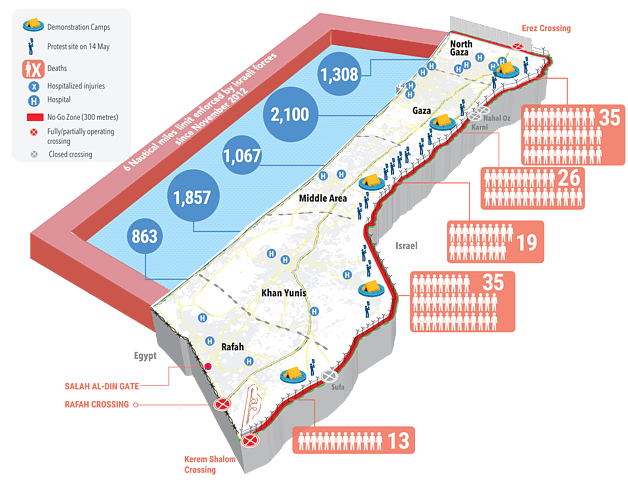
As Gene Sharp’s article on the First Intifada opened the debate on nonviolence in Palestine, Jehad Abusalim’s article, “The Great March of Return: An Organizer’s Perspective”, in the same journal, closed the debate on the topic.
The Great March of Return started, Abusalim reports, with a facebook post by Abu Artema on January 7, 2018. Abu Artema asked, “What could the occupation bristling with arms do to a mass of human beings advancing peacefully? Kill ten, twenty, or fifty of them? And then what? What could it do in the face of an unwavering mass peacefully marching?” Abu Artema and others worked to make it happen and organized for months, calling for a date in March:
“To the surprise of all concerned, an estimated 30,000–45,000 people showed up on the first day of the Great March of Return. And on that day, Israeli snipers shot dead 17 Palestinians and injured some 1,400 others.32 The mainstream international media instantaneously referred to the carnage as “rioting” and “clashes” but to those on the ground in Gaza, it was beyond shocking: how could nonviolent protests unleash such fury as to cause Israel to kill 17 peaceful protesters and maim or injure another 1,400? That is how, from the very first day, bloodshed came to define the protest.”
By the end of the protest, cold-blooded Israeli snipers had killed 226 Palestinians and methodically injured 30,000. For the Israelis, it was sport. The Western media fluidly and easily lied about the march, its nature, and the murderous Israeli response. Neither Israel nor its sponsors faced any crisis or internal division about what they were doing to the Palestinians. Neither Israel nor the West paid any cost for inflicting these tens of thousands of Palestinian casualties.
Abu Artema, the protest organizer interviewed by Abusalim in the article, seems bereft of ideas at the end – he feels that more international mobilization is needed, some tool that prevents Israel from “targeting Palestinians in such a horrific way” and to “prevent the occupation from using propaganda to prime the public for slaughtering us.” The nonviolence industry was unable to come up with any such tools: the slaughter of Palestinians at the Great March of Return was not the fault of the nonviolent protesters any more than the genocide in 2023-24 was the fault of the Palestinian armed groups. Israel is a genocidal state: then as now, it is doing what it is organized to do.
Six years later, Palestinians are waging an armed struggle against the Israeli military in Gaza and the West Bank. The Israeli military has chosen to accept military casualties and defeats on the battlefield (including the methodical destruction of its armored vehicles and groups of soldiers) to focus entirely on conducting a genocide against Palestinian civilians, with the central goal being the destruction of all of Gaza’s hospitals and educational institutions and the murder of patients and medical personnel, while blocking food and water from reaching people. Palestinians’ allies in Lebanon, Iran, Syria, Iraq, and Yemen are all engaging militarily with Israel and its Western sponsors. In the region, for the time being, the nonviolence case is closed.
Back in America though, in the solidarity movement, with the expansion of campus protests in April 2024, along with police repression all over the US, the nonviolence debate will rise again.

Anti-genocide students demand universities – which turned out, to the surprise of the students and faculty, to be investment banks that sometimes teach classes – divest from the military industry feeding the genocidal state. The pro-genocide establishment has called the police to crush the protests. What will be the outcome? Nonviolent or violent? Success or failure?
*As I write this, another nonviolent international flotilla is planning to leave from Turkey to Gaza.
Tankie Therapy on Day 163: Do we debate genocide?

We didn’t have quorum for a tankie therapy session but we got together anyway – Matteo and Alex joined for a discussion of several psychological warfare methods being used on us: normalizing crimes, treating the criminals like they are a natural phenomenon, and the abuser’s method of “look what you made me do”, absolving the criminals and blaming the victims for apparently bringing it on themselves. And another question: is this a topic to be debated? Courage and cowardice and challenges put to us by things we’ve been reading this week.
AER 140: The Gaza Siege
The siege on Gaza and the role of the Palestinian Authority are critical context for the Israel’s assault on Gaza. On this episode we take a look at the history of the blockade and how Israel has ghettoized the Palestinian population. Co-production with The Brief.
AER 138: October 7 Hannibal
Israeli media recently published a minute-by-minute chronology of the morning of October 7th from the Israeli military perspective. Jon and I go over it as part of my youtube series of Gaza Sit Reps (for Day 104). Cross-posted over at The Brief, reposted here in case you missed it.
AER 137: Gaza War Sit Rep Day 91
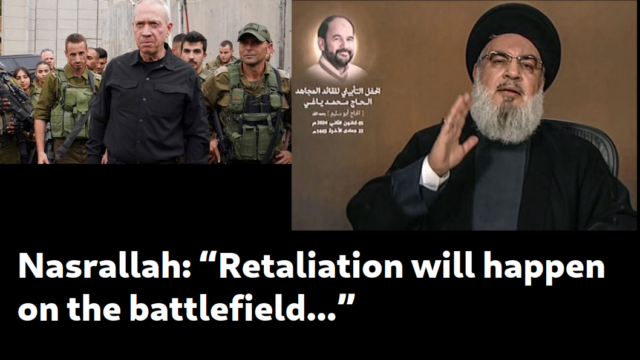
Solo episode discussing Nasrallah’s speech about the war on the Israel-Lebanon border and an analysis of the 2006 war based on a US military analyst’s paper titled, “We Were Caught Unprepared”.
Zionists despise both religious and secular Jewish traditions
Part 8 of 8 on Zionism as an anti-Jewish, racist ideology
Until Western scientific racism became dominant in the 19th century, Jewish was a religion – what else could it have been? It was race science and race-science based, organized anti-Semitic organizations that racialized Jewish people. Though a debate continues about whether or not the Jewish identity ultimately must rest on a religious foundation, non-religious Jews are accepted and claimed widely as Jews in their own communities. Zionists are hostile to both religious and secular Jews.
Zionists are openly hostile to those religious Jews who understand and identify with Judaism through religion. Yakov Rabkin in A Threat From Within: A History of Jewish Opposition to Zionism (pg. 46-48) quotes historian Noah Efron: “Nowhere are Haredi Jews as feared and hated as in Israel. Israel is a bastion of a classic sort of anti-Semitism, aimed not against all Jews, but against the ultra-Orthodox, the overly Jewy Jews.” Quoting Efron at length, Rabkin argues that “Zionism’s promoters have simply refined the hateful image of the traditional Jew as painted by Voltaire and Fichte”
“One need not search hard to find denigrating images of the Altjtude traditional Jew] in Zionist rhetoric and pamphletry. Herzl had already noted in 1894 that Jews had “taken on a number of antisocial characteristics” in the ghettos of Europe, and that Jewish character was “damaged.” [The poet David] Frishman [1859-1922, of Russian origin] opined that “[traditional] Jewish life is a dog’s life that evokes disgust.” [Another Russian poet,] Joseph Haim Brenner, [1881-1921] likened Jews to “filthy dogs, inhuman, wounded dogs.” [Yehuda Leib] Gordon [1831-1892, an active opponent of Judaism, also of Russian origin] wrote that European Jews were parasites. [Micha Joseph] Berdyczewski [1865-1921, a poet and a philosopher bom in the Russian Empire] christened traditional Jews “spiritual slaves, men whose natural forces had dried up and whose relation to the world was no longer normal,” and elsewhere, “a non-people, a non-nation — non-men, indeed. (Efron 1991,88-89)”
Rabkin (pg. 49) quotes the well-known critic of Zionism, Yeshayahu Leibowitz, who argued that Zionists were “seeking a national identity that exists only in and for itself, for they no longer have any concrete, empirically observable ties with Judaism.”
Leibowitz feared that national identity would “be transformed into statism and will to power; into a national identity in the Mussolinian sense.”
Rabkin believes that Leibowitz’s analysis reveals “seeking a national identity that exists only in and for itself, for they no longer have any concrete, empirically observable ties with Judaism… the national consciousness of the Jews had only Judaism as a shared basis, and the state’s founders openly opposed it.”
But Leibowitz, opposing this, tried to remind his readers that “The state exists to serve men; men do not exist for their state.”
Rabkin quotes the Chief Rabbi of Britain, Jonathan Sacks, who criticized the disunity of the Jewish community: “we have fissured and fractured into different edot [congregations]: Orthodox and reform, religious and secular, and the many subdivisions that continue to atomize Jewish life into non-communicating sects and subcultures.”
Among all this, Rabkin reflects, it is Israel alone that provides the sense of belonging:
“For three decades, Zionist organizations have been inculcating belief in the centrality of Israel in most non-Haredi Jewish schools of the Diaspora. This vicarious “Israelism” replaces the traditional Jewish identity all the more easily because the new identity makes far fewer demands. Since Jewish identity is based on obedience to the Torah and to the commandments that it articulates, it affects both the most intimate of precincts (such as food and sex) and public behavior (such as the non-use of automobiles on the Sabbath or dressing modestly). Contrariwise, Israelism imposes no particular obligation, while at the same time transmitting a feeling of belonging. “I identify with Israel because it is the last refuge of the secular Jew,” a friend confided to me one day. While interested in Judaism he denies it any nor mative significance. “Without Israel I would be obliged either to observe the Torah commandments or to stop being a Jew.” When I passed on his remark to Rabbi Moshe Dov (Baer) Beck, perhaps the most prolific of the anti-Zionist thinkers, he replied, to my astonishment: “What’s wrong with being a non-Jew?” In other words, why would those who do not observe the Torah insist on remaining Jewish? A secular Jewish identity is obviously nonsensical for Rabbi Beck.”
In the religious view, being a Jew means no more or less than being a follower of the religion and fulfilling obligations of faith and conduct to that religion. If you don’t want to follow the religious rules, the Rabbi asks, “What’s wrong with being a non-Jew?” But to Nazis steeped in scientific racism, adherence to the religion or not is irrelevant – to Nazis, Jews are a racial group. Zionists also adopt a racial view of who is Jewish, and not a religious one.
The Zionist founders of Israel believed in colonial conquest and the nation’s will to power. Rabkin (pg. 56):
“According to the Israeli intellectual Boaz Evron, “Zionism is indeed the negation of Judaism” (Leibowitz, 133)… “Ben-Gurion saw Judaism as the historical misfortune of the Jewish people and an obstacle to its transformation into a normal nation” (Leibowitz, 144).”
Criticizing Hindu right-wing nationalism in the 2008 book 1857: War of Civilisations, Indian author Amaresh Mishra pointed out that all fascists are atheists, since they ultimately believe in earthly power and will. Religion is another tool to be used in the quest for power, whether to Zionists or the Indian ideologists of Hindutva like Golwalkar and Savarkar.
Holders of these ideologies are not capable of sincere religious belief.
In New York-based Rabbi Yaakov Shapiro’s 1382-page book The Empty Wagon: Zionism’s Journey from Identity Crisis to Identity Theft (2018), the author argues that early Zionists needed to “neutralize the Torah”, for “if the Torah would continue to be perceived as the defining principle of Jewish identity, Zionism would never get off the ground… The Zionists realized they would be unable to successfully deny the centrality of religion in the Jewish consciousness. Instead, they decided to enslave it and channel it for their own cynical agenda.” He quotes Ben Gurion: “I will never agree to the separation of religion from the State, because I want the state to hold religion in the palm of its hand.” In the Zionist integration of religion and state, it is religion that is subordinated. To religious authorities like Shapiro, this is blasphemy.
“I will never agree to the separation of religion from the State, because I want the state to hold religion in the palm of its hand.” – Ben Gurion
Can the army teach you how to be Jewish?
Shapiro describes the specific role of the Israeli military in undermining Jewish religion and subordinating it to political goals of Zionism. Reviewing the IDF officers’ training course, Shapiro finds lectures on:
-
What is Judaism?
-
The uniqueness of the Jewish people
-
The people and the land in a Jewish perspective
-
War and the army in a Jewish perspective
-
Is Judaism a religion, a way of life, or a constitution?
-
The identity of the Jewish people
“Suffice it to say,” Shapiro continues, “the IDF version of Judaism and Jewishness is not the same as the Torah’s… while the information disseminated is certainly destructive from the Torah perspective, the problem here is not just the content, but also the fact that these topics are being taught by a national army at all. The reality is that the IDF is the army of Israel, not the army of the Jewish people. But consistent with Zionism, the Israeli army is not portrayed as just the army of Israel, but of all the Jews.”
Zionist abuses of religious Jews from Yemen
Zionist abuses of religious Jews from Yemen are recorded by Yakov Rabkin in A Threat from Within (pg. 43). “The Yemeni Jews, well known for their devotion to the Torah and for their Judaic erudition, were subjected upon their arrival in Israel in the late 1940s to secular re-education campaigns, often in isolated camps. This measure was aimed primarily at the young, who, while not actually kidnapped, were nonetheless forced to endure ideological pressures designed to estrange them from tradition. Many sources concur: physical violence was employed, particularly when the young secular camp commanders forbade access to young religious Jews who wished to assist the internees.”
Rabkin quotes one Israeli parliamentarian saying in the Knesset:
“I cannot employ any other terms to describe the situation in these camps than those of spiritual constraint and inquisition against the Jewish religion. I see nothing in what is being done in these camps but the cultural and religious murder of the tribes of Israel.”
Rabkin continues: “Their Zionist educators apparently forced the young Yemeni Jews to harvest oranges on the Sabbath, to walk about bareheaded and to cut off the side-curls the Yemeni Jews had worn for centuries.” He quotes one Yemeni Jew describing this: “here, they treat us with contempt, and force our people to profane the Sabbath. They mock us; laugh at our traditional beliefs, our prayers and the religious observances of our Holy Torah.” In addition to religious abuse, these Yemeni Jews were also tested for “negro blood”, according to a June 16, 2017 report by the Times of Israel. The report was based on investigations for the “Knesset Special Committee on the Disappearance of Children from Yemen, the East and the Balkans”.
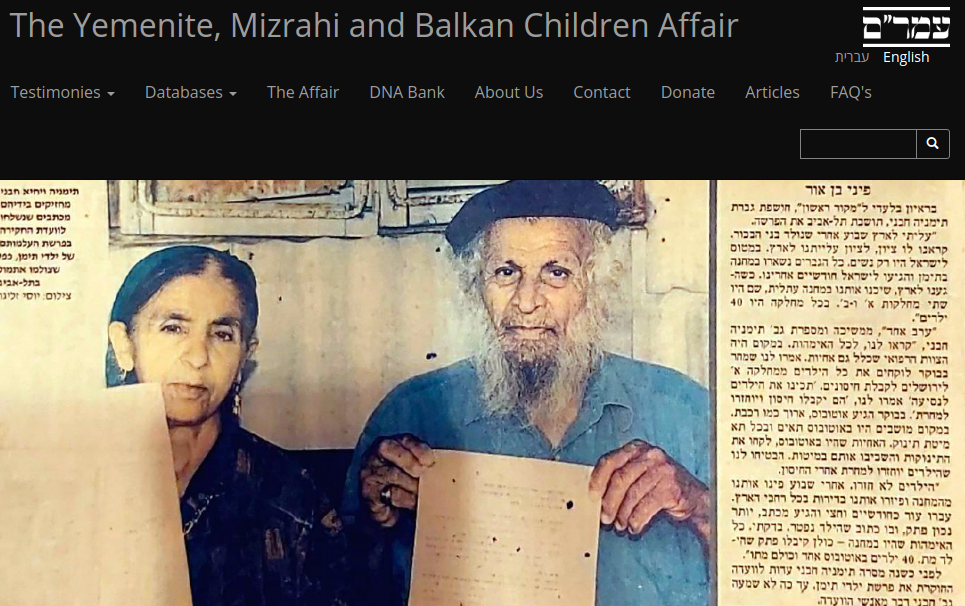
The kidnapping of thousands of Yemeni Jewish babies for forced re-education is now known as “The Yemenite Babies Affair”. Rabkin: “ The government apparently assured the parents that their children had died. It was not until many years later, when some of the parents received military call-up notices for their children, that they began to smell a rat.”
But the religion can’t be discarded; so it must be subordinated
For all of Zionists’ hatred of the Jewish religion, they are unable to discard it and adopt a purely “racial” definition of Jews, since no “race science” can produce a coherent “race” of any kind, let alone a “Jewish race”. Those Zionists who adhere most strongly to a “racial” definition of Jews are also the most inclined to discriminate against Jews of Arab, Asian, or African ancestry. In a video interview, Rabbi Yaakov Shapiro pointed out this contradiction in Israel’s Law of Return: while an atheist of Jewish origin could become an Israeli based on the Law of Return, a person of Jewish origin who converted to, e.g., Christianity, could not. Zionism is about subjugating religious Jews and using the religion as a cover, not sincere adherence to faith.
Zionism’s secular enemy: the Jewish left
Jewish culture goes beyond religion only, and there are non-religious participants in Jewish life. Zionism is inimical to these as well.
Describing her background in a 2021 video on her “journey away from Zionism”, Jewish-American activist Maya Edery said she had been “accidentally a Zionist” because she “didn’t know there was another way to be Jewish,” but her upbringing and understanding of “Judaism as a form of practicing social justice” made it impossible to reconcile her understanding of Judaism with the oppression of the Palestinians.
The late David Graeber described left-wing Jewish traditions in a video coming to the defence of Jeremy Corbyn against false accusations of anti-Semitism. Graeber argued that it was preposterous to argue that the left was anti-Semitic partly because “to some degree what we now think of as the left is a product of Jewish thought and the Jewish tradition.”
The right-wing in Europe is obsessed with the historical connections between Jewish culture and left-wing emancipatory politics. Right-wing ideologies, including Nazism and Fascism, arose as both anti-Left and anti-Jewish ideologies and remain so to this day. The list of Jewish left-wing historical figures hated by the right-wing (and revered by the left to this day – Marx, Luxembourg, Trotsky, Goldman, Chomsky…) is very long indeed.
Herzl, Jabotinsky, Weizmann, and other Zionist leaders offered a solution to the “Jewish problem” to anti-socialist, anti-Jewish racists. They accepted the right-wing premises that Jews are a degenerate, impure “race,” and that one of their flaws is apparently socialist agitation. Zionists interpret the participation of Jews in socialist struggles as a “racial flaw” to be remedied by their removal from Europe.
In 1948, the Jewish Labor Bund – a socialist labor organization that developed in parallel and in opposition to Zionism with a left-wing philosophy, argued in a pamphlet that while Jews could of course live in Palestine, that “the fight against anti-Semitism, for full equality, and for the full national and cultural development of the Jewish people must be waged – as it has been until now – side by side with the democratic and Socialist elements of the non-Jewish population in those countries.”
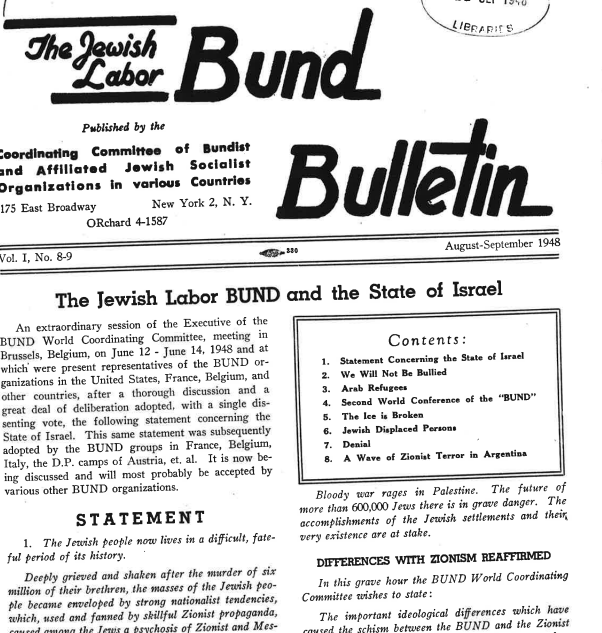
In a section of the same pamphlet titled “We Will Not be Bullied”, the pamphleteers described how “The entire Jewish press, dailies, weeklies, and scores of other publications, united in taking the Bund to task as a traitor to the Jewish cause. All shades of Jewish public opinion united in mobilizing the Jewish communities against us – simply because we dare criticize the wisdom of the establishment of a Jewish state in Palestine… Be this as it may, we wish to assure our political antagonists that we shall not allow them to terrorize us into silence.”
Zionists treat the Jewish left, whether in Palestine or in the Diaspora, as an enemy.
Zionists try to redefine Jewish identity
If neither religious worship nor secular left tradition are allowed by Zionists, what is left of Jewish identity after Zionism is done with it?
Rabkin (A Threat From Within, pg. 38) quotes Rabbi Blau, who believed that “Zionism had inflicted worse harm upon the Jews than upon the Arabs. The Arabs may have lost their land and their homes, but the Jews, by accepting Zionism, had lost their historical identity (Blau, A., 2-3).”
In a 2020 +972 mag article, journalist Etan Nechin explored the consequences of Israel’s Nation State Law, through which, Nechin argued, “Israel’s religious right is deciding who is a Jew.” Nechin cites the 1947 “status quo” letter from Ben Gurion to Orthodox Jewish leaders, which produced a lasting arrangement whereby “secular society would operate with limitations in areas such as transportation on the Sabbath, laws around marriage and death, and others. In return, religious communities would turn a blind eye to certain deviations from the rabbinate, Israel’s highest Jewish religious authority, such as the immigration of hundreds of thousands of Jews from the former Soviet Union who have not been recognized as Jewish by the rabbinate.”
The resulting definition of Jewish, Nechin argues, is a purely negative one:
“Passed by the most right-wing, nationalist-religious government in the country’s history, the law exposes the hypocrisy of the religious right in Israel: the only definition it can propose of being Jewish is “not an Arab.” Judaism is not defined as a vibrant religion with manifestations all around the world, but a state identity that guarantees superiority over people of different faiths under its rule, as well as over Jews living outside Israel. In other words, in Israel, Judaism is a synonym for power.”
In the 2013 book The Tragedy of a Generation: The Rise and Fall of Jewish Nationalism in Eastern Europe, Yeshiva University scholar Joshua Karlip traces movements for two roads not taken by Jewish Nationalists, roads that were ultimately folded into Zionism: Yiddishism and for Diaspora Nationalism. Karlip analyzes these roads through a study of three leading Russian-Jewish nationalist intellectuals – Elias Tcherikower, Yisroel Efroikin, and Zelig Kalmanovitch.
All of these leaders ultimately opted for Zionism because they feared assimilation above all, and felt especially strongly that the Soviet Union and socialism were guaranteed to end with assimilation. Their own anti-communism led them to a rejection of the Jewish left; their secularism meant they couldn’t accept a religious basis for their identity.
As one of these three intellectuals, Tcherikower, moved towards Zionism, he argued that Soviet Jewry was in the process of ‘“death by the kiss” of assimilation.’ Despite official support in the Soviet Union for Yiddish culture, Tcherikower came to see it as a dead end: “Why specifically Yiddish? If there is no national, historical or, dare we say, religious feeling of connection with the collective then why be a Jew in a country where you can freely partake of the general rich culture? Why send the children to a Yiddish school when the general ones prepare them much better for practical life?”
Another one of the trio, Kalmanovitch, concluded that Yiddish was “bankrupt. What kind of a movement can it be whose program is to read a Yiddish book and to go to the Yiddish theater once in a while?” Wherever they lived, Jewish people would “need to buy bread and repair their shoes and work; they need to do it in the language of the country in which they live… the only solution is for Jews to have their own country, where they can live a normal life.”
Describing the views of these three intellectuals on Nazism in the 1930s (before the Nazi genocide): “Tcherikower, Efroikin, and Kalmanovitch all viewed Nazism as a potential catalyst for the reconstitution of Jewish communal consciousness.” Karlip quotes one of these at length, stating that “Tcherikower even recognized a positive side to the rise of Nazism:”
“And who knows, perhaps the Jewries in the Fascist and half-Fascist lands would have been devoured internally if not for Jewish historical providence, which imparted to the contemporary Hamans the idea to build the anti-Semitic movement on principles not of religion but rather of race. And from this standpoint, it is perhaps true that “the Holy One Blessed Be He made a blessing for Israel” that this illogical [racial] theory has rendered apostasy purposeless. What would become of these Jews, if they would be able to save their lives and property through conversion?”
In this Jewish nationalist perspective, defining Jews racially instead of religiously had the benefit of providing a bulwark against assimilation.
The experience of the Anglo-American settler colonies (US, Canada, Australia, New Zealand) shows that a settler colonial state is no foundation on which to build a culture: such a state creates an identity based on theft and cultural appropriation.
Tcherikower mocked Yiddish culture, but whatever is not European in Israeli settler culture – from language to place names and food – is based on appropriation from Indigenous Palestinian culture. Having trampled on Jewish religious and secular traditions, Zionists have arrived at an empty, negative definition of Jewish identity as Nechin noted, someone who is “not an Arab”, while defining everyone who opposes them as an “anti-Semite”.
In this way, centuries of lively Jewish culture and tradition are effaced and replaced with this ideological dead end.
[This concludes the series. There will be an epilogue on the Hannibal Doctrine and how it, too, is anti-Jewish in effect.]
AER 136: Tankie Group Therapy #8 on Gaza War Day 78
Our usual group gets together to talk about the Gaza War but this time we’re joined by Lara, an actual therapist, who guides us through as we try to understand where things stand on Day 78 of the war.
Zionists resort to horrible anti-Jewish stereotypes and imagery at the drop of a hat
Part 7 on Zionism as an anti-Jewish ideology
This one is less a flowing argument and more of a short, extremely non-comprehensive litany of horrid anti-Jewish abuse from Zionists.
If it was upsetting that the Jerusalem Post would declare those Jews deemed anti-Israel to be “herem”, wait until you see the anti-Jewish stereotypes and imagery that Zionists go-to as a first resort when justifying an Israeli attack on Gaza.
(1)
On Henry Kissinger’s 100th birthday, the Jewish Daily Forward published the remarks of a man whose diplomatic efforts did more for Israel than many other US officials. Kissinger is reported to have said: “If it were not for the accident of my birth, I would be antisemitic… Any people who has been persecuted for two thousand years must be doing something wrong.”
“If it were not for the accident of my birth, I would be antisemitic… Any people who has been persecuted for two thousand years must be doing something wrong.” — Henry Kissinger
The Zionist worship of power, and contempt for Jewish people based on a stereotype of their weakness, is apparent in Kissinger’s remark.
(2)
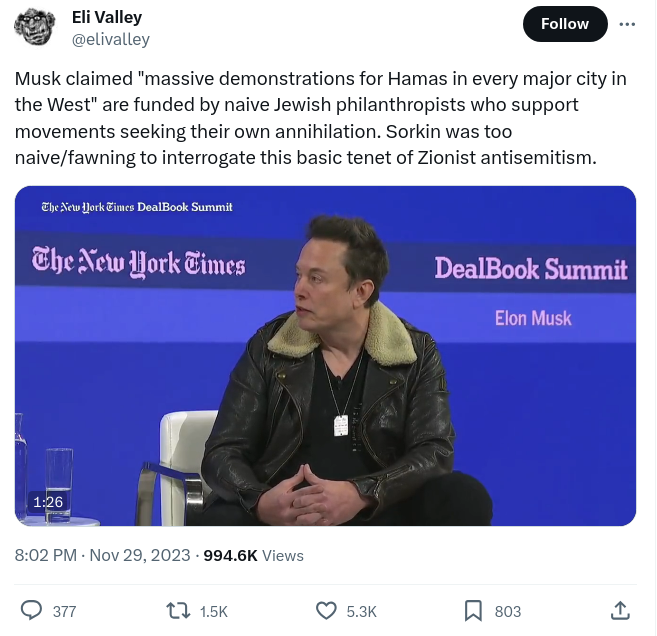
Cartoonist Eli Valley reported some comments by twitter owner Elon Musk who, after visiting PM Netanyahu in Israel said that “massive demonstrations for Hamas in every major city in the West” were ‘funded by naive Jewish philanthropists who support movements seeking their own annihilation.’ Valley called this a “basic tenet of Zionist antisemitism.”
(3)
Elsewhere, a group of Orthodox Jews holding a Palestinian flag on a sidewalk were approached by an elderly Zionist who told them “Hitler made one big mistake. You should have all been put in gas chambers.”

(4)
As they prepared for the ground invasion of Gaza in late October 2023, the Israeli Army took a photo of the Torah with a knife on it.
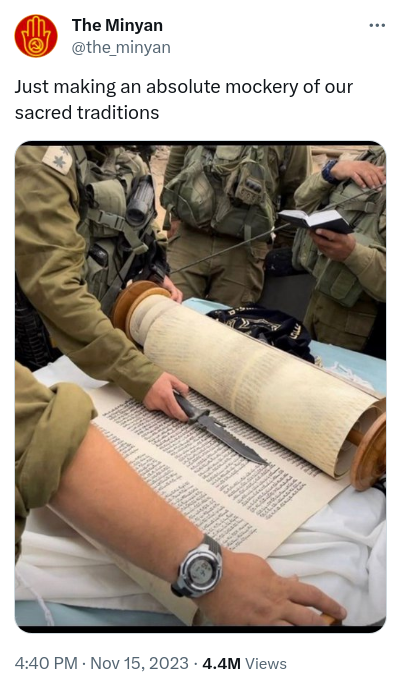
Commenting on this photo, US-based Jewish activist Morgan Artykukhina explained in a tweet: “A sefer Torah is so sacred that Jews treat it almost (but not quite) equivalent to a human life. Jews have died to save Torah scrolls from danger, Muslims literally called us “people of the book” b/c of our love for our Torah. Placing an instrument of death upon it is a threat.”
Elsewhere on twitter, Artykukhina argued that diaspora Jews don’t owe Zionism any loyalty since – as you have learned reading this series so far – Zionists hold them in contempt: “Israel doesn’t deserve the support it gets from the Jewish diaspora. Israeli Zionists hate us & haven’t hesitated to use the same old antisemitic tropes against us to cast themselves as “reborn” from being lowly & pathetic diaspora Jews.”
Artykukhina screenshotted an excerpt of “We are Not One”, which included quote from Zionists Joseph Chaim Brenner who called diaspora Jews “Gypsies and filthy dogs”, A.D. Gordon describing diaspora life as the “parasitism of a fundamentally useless people”, Jabotinsky calling them “ugly, sickly kids” and calling on Zionists to “eliminate the Diaspora or the Diaspora will eliminate you”. A.B. Yehoshua told American Jews they were “playing with Jewishness” ‘while Israelis lived it every day’.
(5)
A Zionist threat against pro-Palestine supporters serves as another example of Zionists using a horrid anti-Jewish stereotype. “If you keep saying ‘free Palestine’, us Jews are gonna take it, we love free stuff.”

(6)
When in 2016 the US ambassador to Israel, Dan Shapiro, said that Israel had different legal standards for Israelis and Palestinians in the West Bank, one of Netanyahu’s former aides called Shapiro a “little Jewboy”.
(7)
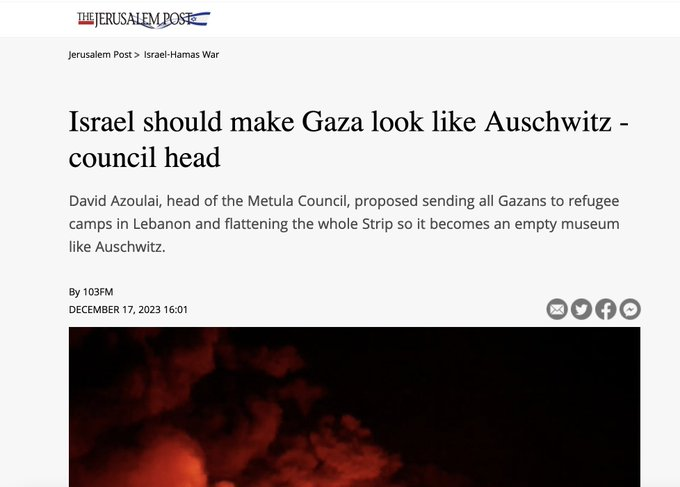
Demeaning the victims of the Nazi genocide, one Israeli politician in December called for Israel to make Gaza “look like Auschwitz”.
We conclude with the winner, the worst example so far:
(8)
In 2015, a settler group called the Samaria Council used Nazi imagery to criticize the Israeli left in a cartoon. They didn’t apologize afterwards.
Here are some images in case you skip watching the cartoon. The plot of the 2-minute cartoon is: one Mr. Sturmer is reading what is obviously the Ha’aretz newspaper, and asks “The Jew” (Israeli left-wing human rights groups) to provide him with evidence that can be used against Israel. He tosses “The Jew” a coin, and the cycle repeats until eventually he tells “The Jew” to “take care of himself”, at which point “The Jew” hangs himself as well.
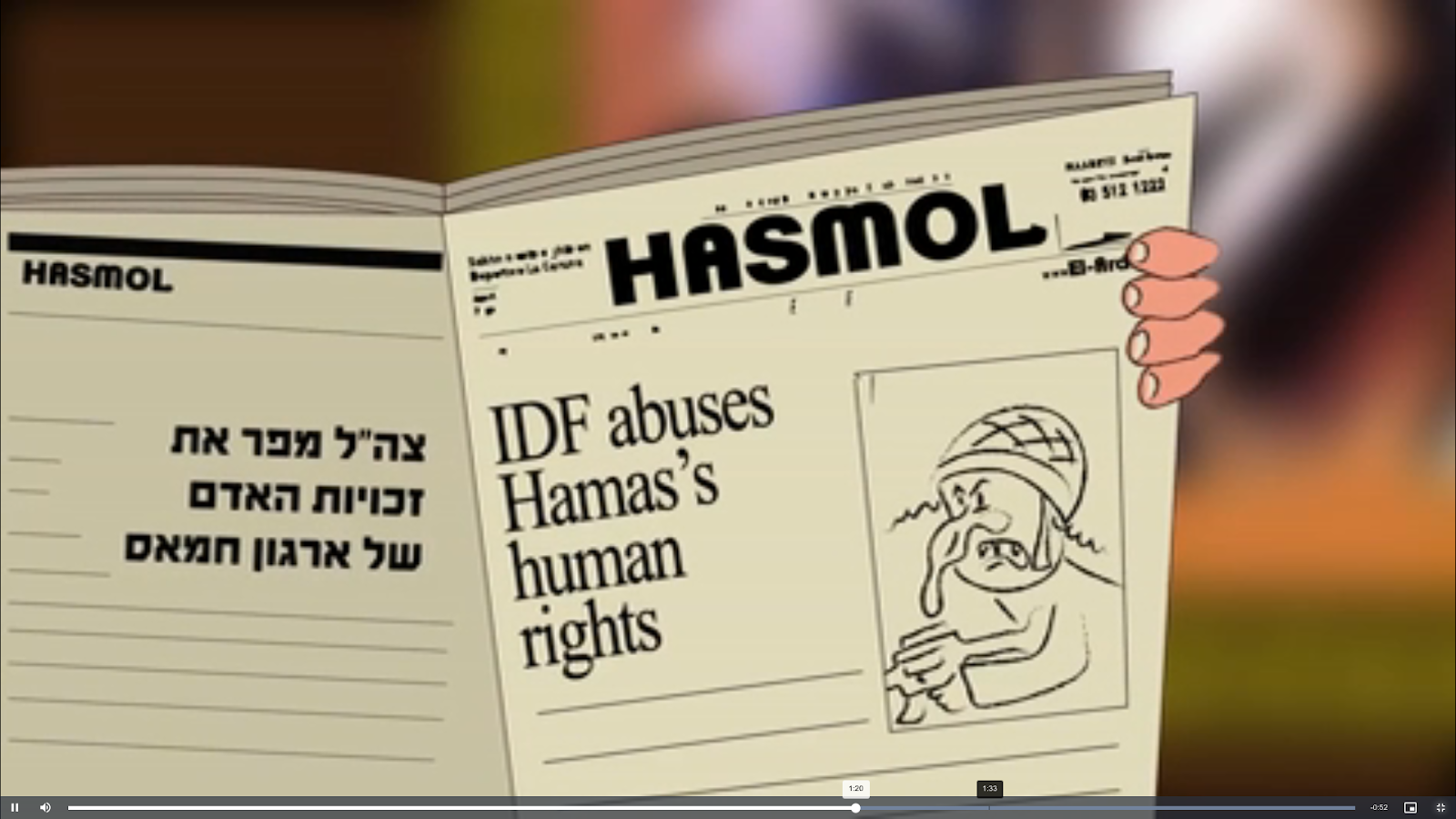




This is hate speech. It isn’t acceptable because it is phrased in first-person plural as “us Jews”. It is an indictment of the anti-Jewish ideology that produced it. That ideology is Zionism.
Zionists treat Jewish people as mere “human material”
Part 6 of a series on Zionism as an anti-Jewish, racist ideology
[A note before we begin here: since the last entry in this series a reader made me aware of a pamphlet by the UK Communist Party’s Harpal Brar, on the same subject matter as Part 5 of this series. People are apparently being arrested for distributing it, but it’s in the UK so no surprise there. Reading the pamphlet made me aware of Lenni Brenner’s work on the topic, the 1983 book Zionism in the Age of the Dictators, and the follow up 51 Documents. Both works are well documented and cover similar ground in case you want to continue studying this topic. OK, on we go.]
In Part 5 of this series I mentioned that the goal of the WW2-era Zionists was to get “human material” for their colony – the material being Jewish people. The acquisition of this “good human material” involved cruel measures by the early Zionists at several key moments in Jewish history, as the book by Yosef Grodzinsky of that title (renamed in the English version to In the Shadow of the Holocaust). One review of Grodzinsky’s work can be found here.
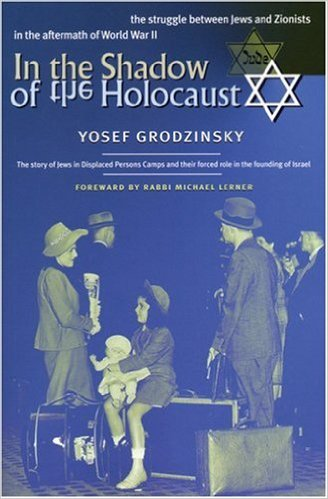
Grodzinsky describes a moment when Zionists resorted to cruel measures against Jews in order to acquire this “human material”.
It was the immediate aftermath of WW2, when the Nazi displaced persons (DP) camps were taken over by the Allies. Grodzinsky writes: “thousands of children were lingering in the DP camps, their suffering generating empathy and a desire to help. Perched on bunks amidst the filth like all survivors, their weak bodies were, more than the rest, suffering from malnutrition and disease.”
Organizations from the Allied countries made plans for the expedited rescue of orphans to France, England, and elsewhere. But Zionist leaders objected:
‘“The specter of Jewish children going to European countries seemed threatening to them, as it ran counter to their project—to bring all surviving children to Palestine, as part of Ben-Gurion’s vision “to populate Palestine with multitudes of Jews.”’
The British Jewish envoy, Shalom Adler-Rudel was sent to negotiate with the Zionist leadership – to try to get them to agree to let the children leave to Europe. The Zionists refused to let the children leave the camps until their transfer to Palestine was arranged: “I am a good Zionist,” he told them. But “your decision is not right.”
Another postwar moment Grodzinsky describes is when Zionists attempted to recruit Jewish survivors from the camps into the military to fight the Palestinians. One reporter from the camps, Moshe Ajzenbud, described the mood in a New York socialist magazine:
“Most Jewish refugees who had been through the hell of the ghetto, slavery and death camps under the Nazis, Soviet forced-labor camps, and other disasters, yearn for some quiet place. Regardless of their views on current events in Palestine, they feel physically drained, and have no desire to go into the fire again. They rightfully ask—even the Zionists among them—why do we, having been so pained and tortured, need to go back into the fire?”
When only 700 signed up, the Zionists imposed conscription. “Employees were fired, residents were evicted from their apartments, others were fined, or denied the supplementary food rations that the JDC was distributing to all camp Jews; others were simply beaten up.” Grodzinsky adds these recruitment methods were not anomalous, but systemic:
“Violent incidents were numerous: The archives are replete with hundreds of official documents describing brutal methods and actions carried out in an identical manner in a large number of camps in Germany and Austria, taking place mostly between March and August 1948. The archives also contain testimony and affidavits about “waves of Zionist harassment” in the camps,as well as vile descriptions, coming from various camps, of forced removal of Jews objecting to the draft from Camp Committees, arrests, and beatings. In a camp near Ulm, for example, “a father of Giyus evader Wecker was beaten up, as was the father of one who did not register; in another case an old father—Richter Aizik, was beaten because his son Moshe Richter did not register…”
The Zionists were more than willing to resort to violence against Jews to make sure the latter were available as “human material” for their colony.
Zionists suppressed diverse Jewish cultures inside Israel
Once they ended up in Israel, the culture Jews brought with them was negated and erased by the Zionists who had already settled there (referred to as Sabras in the quote that follows). American-Israeli blogger Matt Adler wrote in 2018 that “many Jews arrived (and indeed, arrive) to Israel, Sabras greeted them with hatred. Iraqi Jews were shamed for speaking Judeo-Arabic. Ashkenazi Holocaust survivors were not only attacked for speaking Yiddish, they were also called “sabonim” or “soap”…because of the rumor that Hitler made soap out of their families’ bodies.”
In The Seventh Million: The Israelis and the Holocaust, Israeli historian Tom Segev described the Zionist campaign of assimilation of the German Jews who went to Israel as refugees from Hitler (called yekkes). When German newspapers sprang up, Zionist activists suppressed them.
“The aim was “to get the German newspapers out of our lives.” Some of the participants said it meant war. One of them proposed demanding of advertisers that they refrain from buying space in the foreign-language press—and demanding of Hebrew newspapers that they not accept ads from those who advertised there. Coffeehouses, barbershops, and hotels should also be told not to offer foreign-language newspapers to their customers.’”
The campaign was ultimately successful, but not before some dramatic moments:
“The intolerance and fanaticism that characterized the campaign to promote Hebrew offended many, the German Immigrants’ Association warned in its newsletter, adopting a heroine for itself: a fourteen-year-old girl, a pupil at a Jerusalem school, to whom a classmate had said, “Go back to Hitler.” The brave and proud girl slapped her classmate on the cheek.”
Yemeni Jews got it even worse. Yakov Rabkin (A Threat From Within, pg. 43) describes their situation:
“The Yemeni Jews, well known for their devotion to the Torah and for their Judaic erudition, were subjected upon their arrival in Israel in the late 1940s to secular re-education campaigns, often in isolated camps. This measure was aimed primarily at the young, who, while not actually kidnapped, were nonetheless forced to endure ideological pressures designed to estrange them from tradition. Many sources concur: physical violence was employed, particularly when the young secular camp commanders forbade access to young religious Jews who wished to assist the internees… Their Zionist educators apparently forced the young Yemeni Jews to harvest oranges on the Sabbath, to walk about bareheaded and to cut off the side-curls the Yemeni Jews had worn for centuries.”
Zionists wanted to craft the “human material” of Jews into a specific type of colonist. The cultural diversity of Jewish life in the diaspora was disdained.
Zionists set out to destroy Jewish diaspora life in Iraq and Egypt
Zeev Sternhell in the 1998 book, The Founding Myths of Israel: Nationalism, Socialism, and the Making of the Jewish State, discusses Zionism’s negation of the diaspora:
“a hatred of the diaspora and a rejection of Jewish life were a kind of methodological necessity for Zionism… not only was Jewish history in exile deemed to be unimportant, but the value of living Jews, Jews of flesh and blood, depended entirely on their use as raw material for natural revival.”
The project of colonizing Palestine has required Zionists to destroy diasporic Jewish life. Zionists used terrorism to destroy the relationships between Jewish communities and the countries in which they lived.
Iraq terrorist bombings 1949-1952: John Cooley, in the 2005 book Alliance Against Babylon: the US, Israel, and Iraq, cited Naim Giladi, Rabbi Elmer Berger, and Mordecai Ben-Porat about a series of five terrorist bombings against the Jewish community in Baghdad between 1949-52 that helped spark the exodus of Iraq’s Jewish community to Israel.
-
One bomb on March 19, 1950, at the American Cultural Center and Library in Baghdad;
-
The next April 8, 1950, a grenade attack at the Dar-el-Beida cafe. “That night and the next day, leaflets scattered in Jewish neighbourhoods called on Jews to leave Iraq immediately.”
-
Another grenade attack followed on May 10, this time against a Jewish owned car dealership; another on June 3, 1950 in the wealthy Jewish neighbourhood of El-Batawin. “The Zionist emigration activists asked Tel Aviv to raise the quota for immigration from Iraq.”
-
Another bomb next to the Jewish-owned Stanley Shasghura building on June 5. “Most members of the Baghdad Jewish community believed that extremist Iraqis, probably all Muslims, wanted to kill them or drive them out, so as to seize their property and money.”
-
On January 14, 1951, a major grenade attack hit a synagogue full of Kurdish Jews, killing two children and one adult and injuring dozens. By March, “the tempo of flights increased to three or four a day.”
By the end of the exodus, just 5,000 Iraqi Jews remained of a community that had numbered 130,000. Once the damage was done, the Iraqi authorities caught a man named Yehudah Tajjar, who gave them the names of 15 conspirators. Israel’s emissary, Mordecai Ben-Porat, wrote a book, To Baghdad and Back, (cited by Cooley) that argued that Israel was innocent of wrongdoing. “A series of letters and affidavits, attached to the official Israeli findings, seem to show that the three Jews executed were innocent and framed, and that the attacks were the work of Iraqi officialdom.”
One of the Iraqi Jews who was part of the exodus to Israel after these bombings was Avi Shlaim, who would become one of the so-called Israeli ‘New Historians’. In his book, Three Worlds: Memoirs of an Arab Jew, he concludes that the Zionist underground was responsible for three of these bombings, but that two others were the work of other Iraqi factions. His evidence includes the initial Baghdad police report, which Shlaim believes “constitutes undeniable proof of Zionist involvement in the terrorist attacks that helped to terminate two and a half millennia of Jewish presence in Babylon.”
The Lavone Affair / Operation Susannah, Egypt 1954: The Iraq bombings were repeated in Egypt with a series of bombs in Cairo and Alexandria in 1954. In Shlaim’s description:
“A number of Egyptian Jews were arrested for planting bombs in public places and in the US Information Service offices in Cairo and Alexandria. This was an Israeli false flag operation designed to create bad blood between the revolutionary regime headed by Gamal Abdel Nasser and the Western powers. Israel’s military intelligence had recruited, trained and equipped the Jewish spy and sabotage ring. The arrest of one member led to the collapse of the whole ring, a well-publicised trial of its nine members, the execution of two of them and the capture of the Israeli officer in charge: Meir Max Binnet, the same Max Binnet who had directed the false flag operations in Baghdad a few years earlier. In 1954 he was a lieutenant-colonel in the military intelligence branch of the IDF. He committed suicide in the Cairo prison by cutting his veins with a razor blade after being tortured and hearing that the Iraqi authorities had requested his extradition.”
See also Shlaim’s fellow “New Historian” Joel Beinin’s 1998 book, The Dispersion of Egyptian Jewry: Culture, Politics, and the Formation of Modern Diaspora, Chapter 4.
Shlaim calls these operations “Cruel Zionism” and argues in his book that while the Palestinians were the “main victims of the Zionist project”, the “Jews of the Arab lands” were a “second category of the victims of the Zionist movement”. The conspiracy and terrorism against Jewish people in Iraq and Egypt is another example of the anti-Jewish nature of Zionism.
In their acquisition and shaping of “human material” for their colony, Zionists have shown no compunction about the ruthless destruction of Jewish lives, cultures, and traditions.