
The alliance between the East is a Podcast, the Brief, and the Anti-Empire Project continues as we discuss the Gaza War six weeks in (since October 7 2023). Structured as group therapy (the fourth in the series) we cover some of the news, the dynamic of aggression and resistance, military analysis of guerrilla war, the painful search for historical analogies to help us understand the moment, and more.
Author: Justin Podur
Author of Siegebreakers. Ecology. Environmental Science. Political Science. Anti-imperialism. Political fiction.
Anti Empire Radio 130: Palestine Action and the focus on Elbit Systems
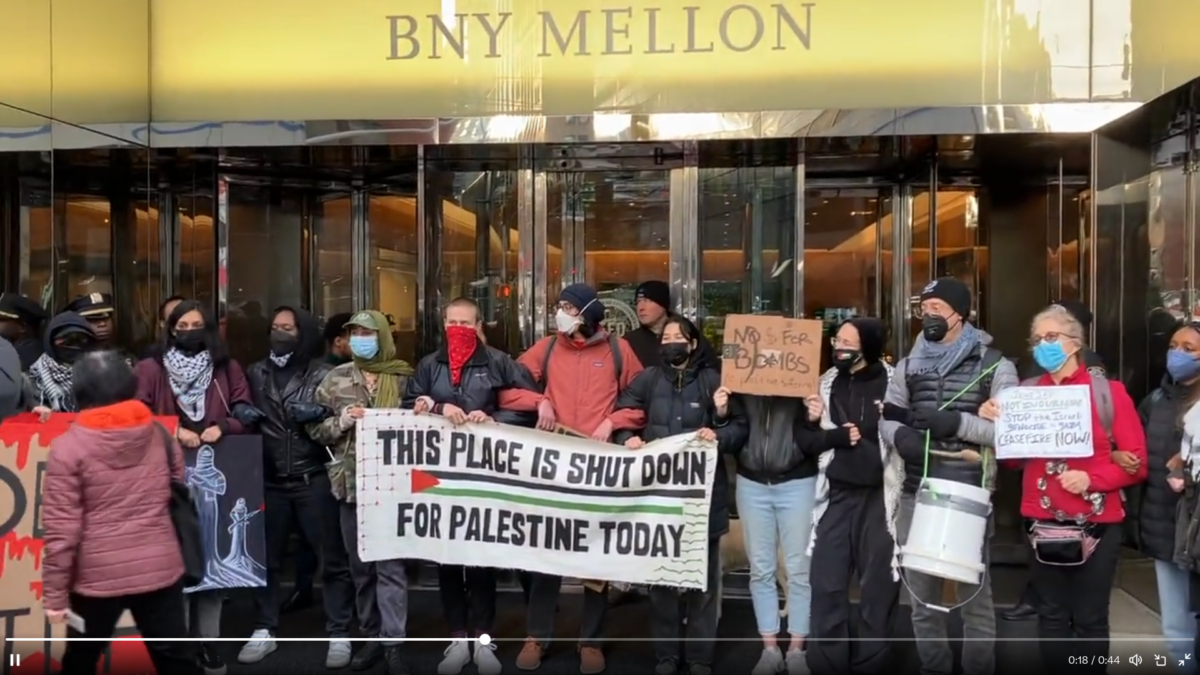
A discussion with Calla and Fergie from Palestine Action US about the theory of direct action and how activists have tried stop the flow of Western weapons that are being deployed against Palestinians in Gaza, instead of, e.g., moral suasion on Western politicians. The Palestine Action UK precedent and the reason for Palestine Action’s focus on Elbit Systems, the flagship corporation of Israel’s military industrial complex.
The intertwined western military-industrial complex
From mining the metal to using it to kill people, a logistical spiderweb
Who is winning the propaganda war? Billionaires are planning to pump some serious money into the narrative battle. Good luck to them, I guess, but perhaps the US – and satellites in UK, Canada, France & Germany – overemphasize narrative and information and underemphasize the material world. Vaclav Smil has pointed out that “recently fashionable claims about the dematerialization of modern economies dominated by services and miniaturized electronic devices” are misleading. The global food system and the entire industrial economy depends on fossil fuels. In his book How the World Really Works, Smil identifies the “four pillars of modern civilization”. They aren’t facebook, twitter, google, and amazon: they are ammonia, steel, concrete, and plastics.
This isn’t the main point of what I want to talk about tonight so I will give you this long quote about why these four pillars and move on:
“…only an impossibly complete recycling of all wastes voided by grazing animals could, together with near-perfect recycling of all other sources of organic nitrogen, provide the amount of nitrogen annually applied to crops in ammonia-based fertilizers. Meanwhile, there are no other materials that can rival the combination of malleability, durability, and light weight offered by many kinds of plastics. Similarly, even if we were able to produce identical masses of construction lumber or quarried stone, they could not equal the strength, versatility, and durability of reinforced concrete. We would be able to build pyramids and cathedrals but not elegant long spans of arched bridges, giant hydroelectric dams, multilane roads, or long airport runways. And steel has become so ubiquitous that its irreplaceable deployment determines our ability to extract energies, produce food, and shelter populations, as well as ensuring the extent and quality of all essential infrastructures: no metal could, even remotely, become its substitute.”
The material world also cannot be neglected in the question of war. States (or armed groups) go to war to try to change a status quo. They apply military pressure on their enemy to try to get that enemy to comply with something. I’ve talked about the different strategies at play in a previous post.
Israel has destroyed most of Gaza’s hospitals and is trying to close in and destroy the big hospital in Gaza City. They claim (a claim no one but diehard pro-Israel people believe) that the hospital is the “Hamas command center”. Since everybody knows the hospital isn’t a command center, we have to look for Israel’s real objective in applying so much military pressure to hospitals and gathering sites specifically, targeting the already wounded and children sheltering for safety. The idea is probably to try to show that Israel (and its western backers) have no limits (as Israelis have declared many times – see this compilation by Norman Finkelstein) in the hope that this will create enough terror to psychologically break the Palestinian Resistance (which Westerners call “Hamas”). If the Palestinians aren’t broken psychologically, the strategy fails.
This is a dynamic of warfare between settler states and Indigenous populations, guerrilla warfare, politics and strategy – topics we have covered before, including in the book Siegebreakers, and will cover again.
Tonight though I want to talk about another aspect of modern warfare, which is that it involves the production of composite objects of plastic and metal run on fossil fuels (missiles, shells, bullets) and then blasted into people from other machines (planes, artillery pieces, various kinds of guns) to kill them. The production of these objects is a global effort of Western states and corporations that involves exploiting and destroying Indigenous lands, employing workers from many countries, passing through many logistical bottlenecks.
Consider a metal, well below the four pillars in overall importance, but of central importance to warfare: aluminum. In their 2010 book Out of This Earth: East India Adivasis and the Aluminium Cartel, Felix Padel and Samarendra Das reveal the entire web of connections from the destruction of the means of Indigenous survival at the point of extraction to the physical destruction of Indigenous people when the bombs are dropped. They cite Dewey Anderson’s 1951 pamphlet Aluminum for Defence and Prosperity, published by the US Public Affairs Institute. Anderson wrote that “Aluminum has become the most important single bulk material of modern warfare. No fighting is possible, and no war can be carried to a successful conclusion today, without using and destroying vast quantities of aluminum.” Aluminum “makes fighter and transport planes possible”, it is “needed in atomic weapons”… “yet aluminum is a scarce metal… government steps in for prolonged periods of time, determines how much aluminum there should be, expands production at government expense, and decides what part of the supply will be available for civilians.”
Aluminum is an interesting metal because its production requires the raw material bauxite and copious amounts of electricity. Out of this Earth describes it in terms analogous to a mathematical equation: aluminum = bauxite + electricity. Bauxite is generally found in the Global South and on aboriginal lands: the biggest bauxite deposits in 2001 were 1 – Guinea, 2 -Australia, 3 – Brazil, 4 – India, 5 – Jamaica, 6 – China and in tonnage mined per year in 2007 the top 5 were Australia, China, Brazil, Guinea, India, and Jamaica.
But that’s bauxite – just one of the two inputs. When you look at production of aluminum, it’s a different story: the top 5 in 2008 were China, Russia, the US, Canada, and Australia. By 2022 it was China, India, Russia, Canada and the UAE (the US was 9th). Canadian production was once owned by Alcan, which was the Canadian subsidiary of the US Alcoa. Alcan was purchased by the British-Australian mining company Rio Tinto in 2007. Of course, the bauxite-producing countries get fleeced, with their bauxite selling at a fraction of the price of the finished aluminum – that’s the first increment of imperialist value transfer at work.
Why is Canada in the top 5 at all, if it doesn’t have bauxite? Canada found its way into this crucial network of the Western military-industrial complex because of its hydroelectric capacity (you guessed it – located on Indigenous land, “hydroelectric capacity” being another word for life-giving river ecosystems where First Nations civilizations thrived for centuries).
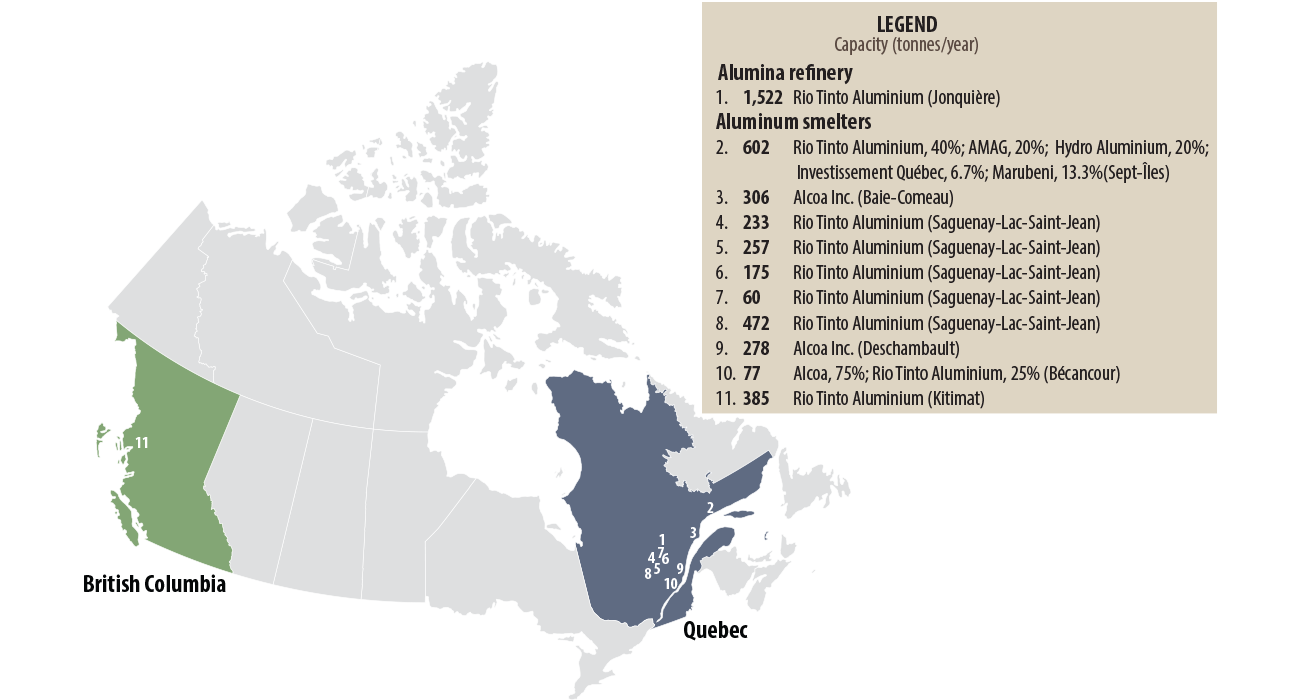
BC and Quebec’s hydroelectricity is supplied cheaply to Rio Tinto and to Alcoa, one of numerous subsidies to the mining and military industries that keeps them profitable and that enables them to beautify the environment like this:
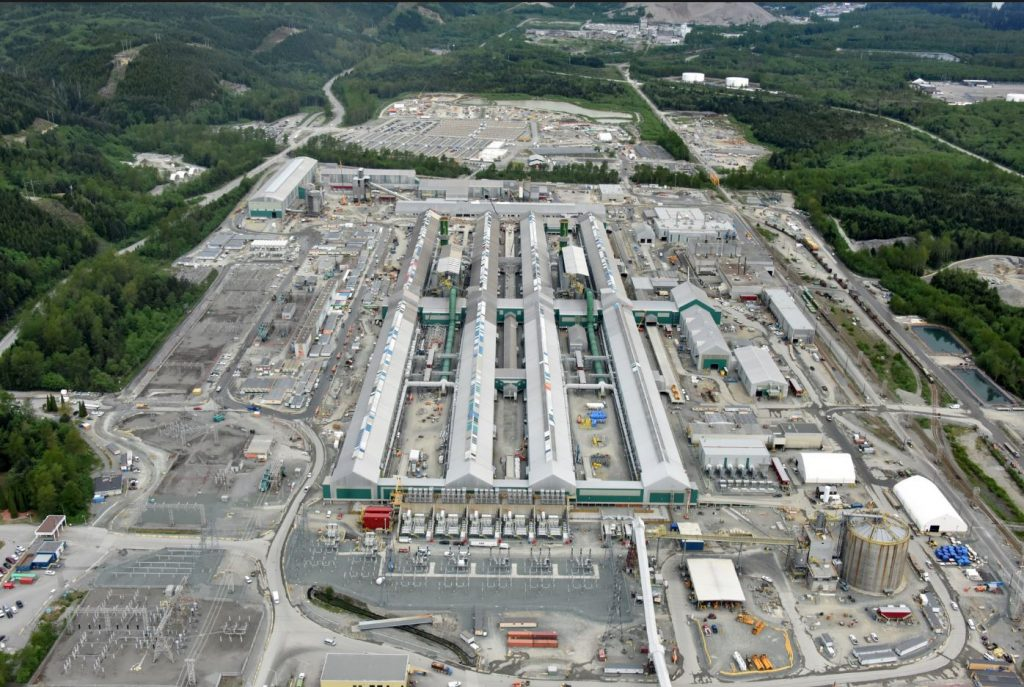
The electricity subsidy is another increment of value transfer, this time from Indigenous land to Global North corporations.
The final increment is when the shiny aluminum is used to make warplanes and missiles. At that final step, we see another huge increment in private profits and an equally complete integration between Canada and US military industries.
A 2016 article on Open Canada interviewing the peace institute Project Ploughshares described the “murky world of Canada’s arms manufacturing” and the Defence Production Sharing Agreement between Canada and the US, which “set up a special arrangement where military goods shipped between the U.S. and Canada are not required to go through the same system as everything else exported by the U.S. and do not require export permits by the Canadian government.” That’s why many of the top military producers in Canada on the Canadian Defence Review site are the same big US names: Lockheed Martin [Canada], Raytheon, General Dynamics [Canada], why you’ll see the same names on the Invest Ontario website.
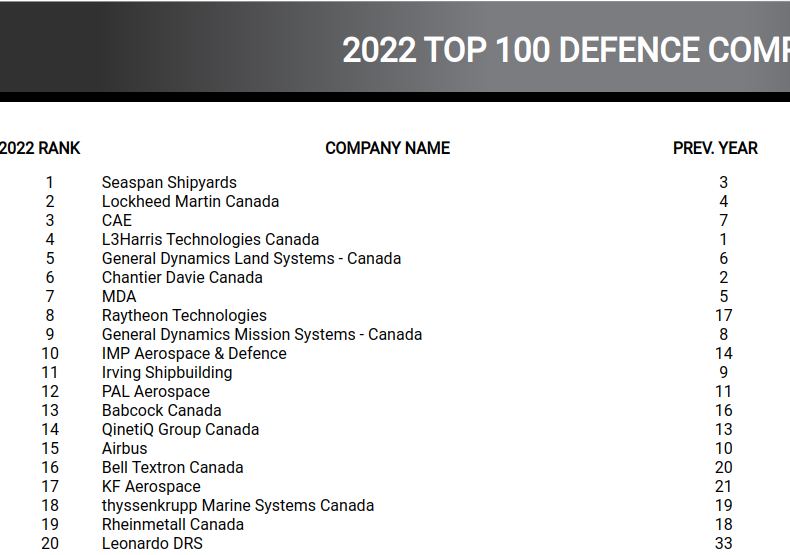
Industry Ontario:

In the past month, organized by groups like World Beyond War, activists have done direct actions at companies like INKAS and L3 Harris. The organization has created a map of companies and their locations.
Once the global logistical chains of these murderous objects are revealed, it becomes almost overwhelming to decide on where to campaign. The above analysis for aluminum could be repeated for other basic materials, like white phosphorus – a particularly nasty chemical Israel’s army uses to burn kids in Gaza. Some quick research suggests that most of the phosphate used by the US is mined in Florida:
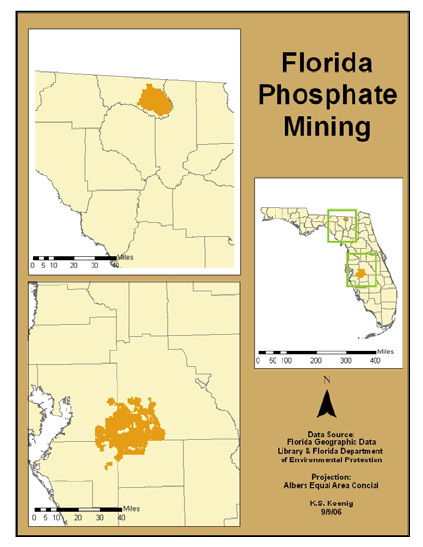
The environmental implications of phosphate mining are problematic, at least so the Washington Post found in 2021.
Mines, manufacturing facilities, and administrative offices are spread all over the West. The materials are trucked, railed, and shipped all over the place before they reach their final sites of death and destruction.
When majorities are organized, the whole murderous machinery could be halted by people simply putting their tools down in a general strike. Short of that, though, the leaders of direct actions in the West, Palestine Action, have argued for a sharp focus – theirs has been on Elbit Systems, Israel’s largest weapons supplier.
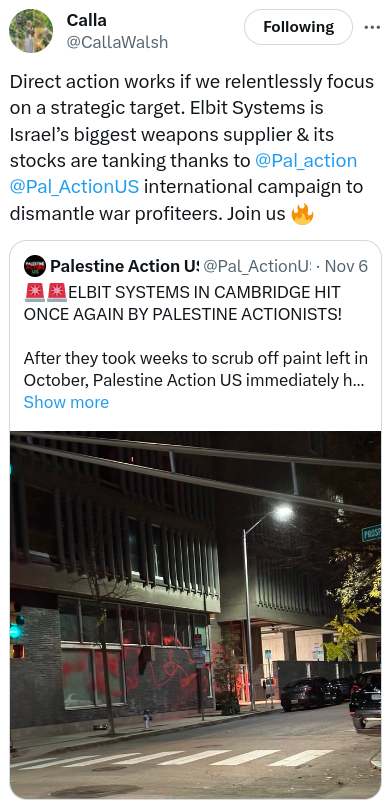
I’ll leave it there, but just with a little step back to the idea of building toward strike actions – let me quote Boots Riley, who apparently has a show called I’m a Virgo.
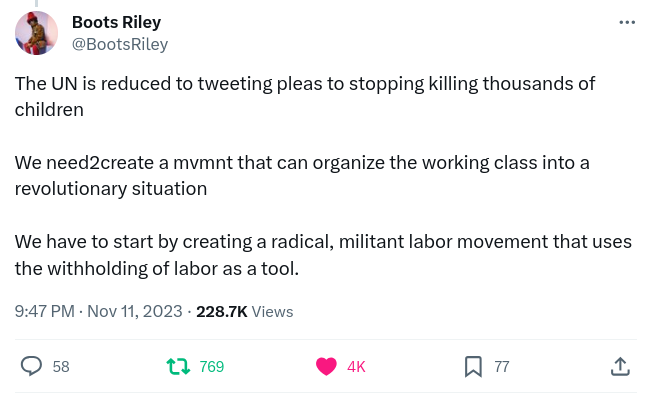
If stopping the genocide were entirely up to us, we would have to build up to this kind of people power. A movement that could take labor action and mass direct action to stop a genocide and then direct our labor to helping Palestinians rebuild every hospital, mosque, school, and house in Gaza more beautiful than before.
To stop a genocide it’s worth being a voice in the wilderness, but with large and growing numbers come greater opportunities.
Liberalism: what will be the cost of dropping the masks?
They’ll be terrible, but we don’t have time to let it play out
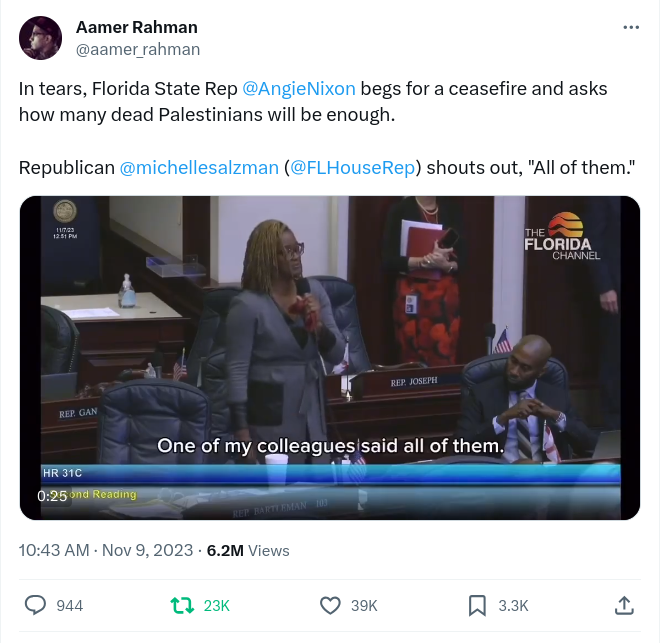
Israel’s genocide is fully supported by the US, Canada, UK, France, and Germany – all mainstream political parties and major media endorse it and have publicly stated there are no red lines, no numbers of dead children, no amount of starvation or dehydration that would stop them from supporting Israel.
Florida State Representative Angie Nixon asked in Congress how many dead children would be enough. Republican Congresswoman Michelle Salzman shouted, “all of them.”
The Jeff Bezos-owned Washington Post is publishing editorial cartoons like this:
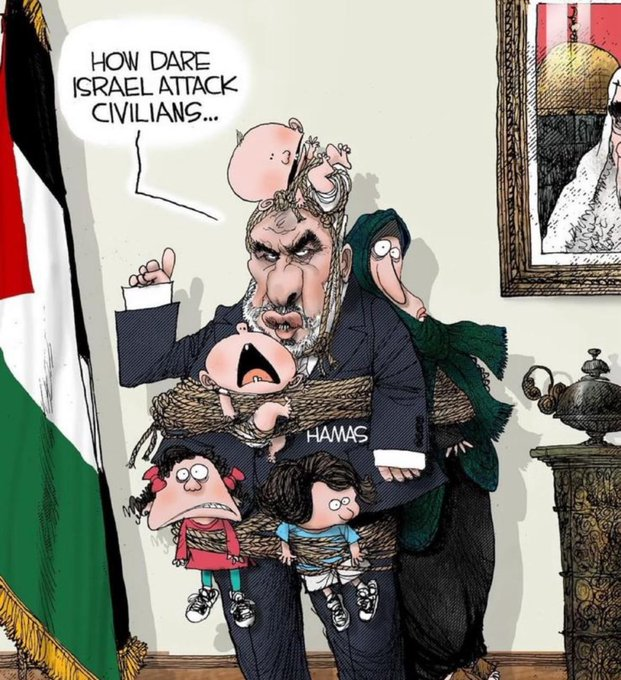
Combining racist caricature with genocidal incitement in an extraordinarily succinct piece of art. If there is a cartoon that summarizes the Western understanding of the world, this is it.
Tonight’s question is, what have these Western countries in the genocide bloc given up to support this open massacre?
For several centuries prior to the major decolonizations after WW2, the West offered one thing to the Global South: naked colonialism. The 2003 book Dark Vanishings: Discourse on the Extinction of Primitive Races 1800-1930 shows how Western elites filled their literature with solemn warnings, sometimes sad, sometimes exultant, that Indigenous peoples around the world were destined to go extinct to make way for their white racial superiors.
This was a period when:
-
White people would have picnics and watch lynchings in the US;
-
Canada was using starvation to push the First Nations of what would become the country’s Western provinces on to tiny fractions of their land;
-
Britain and France were conducting scorched-earth “punitive raids” all over Africa and the Middle East.
-
Germany drove the people of Namibia into the desert to die of thirst, got them to surrender by promising them food aid, then shipping them to death camps, a genocide openly declared ahead of time.
When it became clear that the colonized were nonetheless not going to go extinct, were going to win their independence, and likely go communist or socialist, the West revised their offer – from naked colonialism to neocolonialism. The new offer was this:
-
Economic aid and loans for “development”, to enmesh the new governments into economic dependency on the West while keeping their all-important commodities and the products of their labor flowing to the rich countries.
-
Weapons and training programs for the militaries (and police) of these newly independent countries, to ensure that the militaries would have direct, subordinate relationships with Western sponsors (and were not loyal to their own populations).
-
A package of international law, human rights, nongovernmental organizations, elections claimed to be free and fair, free speech, and support for nonviolent struggle.
Unlike the “authoritarian” communist bloc, the West promised peaceful avenues for change. Multiculturalism promised equality under the law regardless of where you were from or what you believed – you could leave your country and become Western, enjoying all the privileges of Westerners. Dissenters would be protected by law from state reprisal. Elections gave the people power over elites: the bastards could be voted out. If the bastards were particularly disrespectful of democracy (if they ignored elections and set up a dictatorship), they could be defeated through nonviolent struggle, with methods and manuals taught by US institutes and later, using US social media corporations to spread the word. There was always the United Nations to appeal to as well – to give succour to the refugees, to pass Security Council resolutions that were binding on all UN members, to “Unite for Peace” in the General Assembly if the Security Council failed.
If, as a leader of a Global South country, you didn’t like the new Western offer, you could get overthrown in a coup (see, e.g., William Blum’s Killing Hope, or the more scholarly version Lindsey A. O’Rourke’s Covert Regime Change).
As for the liberal package of law and rights – it was always an illusion, especially for Palestine But since Oct 7, 2023, the West has abandoned it wholly. Let’s look at each piece in turn.
International law? It may always have been a fantasy but Israel and the US are explicit that it doesn’t apply. Israelis who kill Palestinians are not charged with crimes. ICJ judgments are ignored; the ICC delays investigation – not that it would be respected if it made any judgments. The US has passed what is sometimes called the Hague Invasion Act, which states that the US would use military force against the court rather than allow its personnel to be judged for war crimes. Israel’s partners like Canada have pressured the International Court of Justice to drop the stances it has taken in the past. Israel had once signed the Rome statute, but then ‘unsigned’ it; the US has never been subject to it. Israel kills UN personnel and then trolls them, official account to official account, on twitter. The US vetoes resolutions at the UN Security Council and the General Assembly resolution is simply ignored.
Human rights? The mighty human rights organizations merely beg Israel to murder civilians in a way that respects human rights, and receive a contemptuous response for their trouble.
Elections? All Western political parties are disciplined in their support for Israel. In Ontario and in the US Congress (so far), parliaments have formally censured elected representatives (Sarah Jama in Ontario and Rashida Tlaib in the US) calling for ceasefire (or even short of ceasefire). For her trouble, Jama was also thrown out of her party, the left-wing NDP. Until there are anti-genocide political parties in the West, elections or the threat of elections are meaningless since there are no anti-genocide alternatives to vote for. There is no voting these bastards out. Not in the West.
Protected speech? On wonderful American social media platforms? Using the power of free expression and dissent to change genocidal policy? Besides direct censorship of Palestine and Palestine solidarity groups on the platforms, the pro-genocide bloc scours social media to try to get anti-genocide people fired from their jobs. They routinely lie and libel Palestine supporters, libel tens of thousands of protesters for peace at a time as “supporters of violence”, ignore Jewish pro-Palestine voices, and punish speech wherever they can.
Pro-genocide media figures have been advocating mass deportation (population transfer) as an answer to the large pro-Palestine rallies – calling for the deportation of hundreds of thousands of people for waving Palestine flags and chanting “from the river to the sea”. People in Canada have already been arrested for using the phrase. Germany, France, and the UK banned and criminalized the rallies before they happened; Canadian legislators called them “hate rallies”. More repression is planned, if they can get away with it.
You can say that these wonderful tenets of liberalism were always honored in the breach, applied with double standards, etc. But no matter how you argue it, we are in a major “mask off” moment and at least two questions follow from the dropping of these masks.
First, if it was so easy for them to drop these masks, what was the value of these masks in the first place? And second, what consequences are there, if any, to the dropping of these masks?
To the first question: the masks were very valuable and the cost of dropping them is still unknown – it will play out over years. The liberal package of ideas from free expression, to international law and the UN through to elections and nonviolent struggle as legitimate forms of popular struggle, was very important in several ways:
-
Winning a portion of the Global South and its elite to the Western agenda. Multiculturalism and equality under the law (getting rid of apartheid in the US and in South Africa, settlers leaving Kenya, etc.) were instrumental in the West being able to get people from the Global South to work for them (including in Western countries).
-
Dissipating rebellious energy. Appeals to international justice dissipate rebellious energies internationally just as appeals to electoralism dissipate them within the West.
Can the medical profession in a country work properly if doctors are petitioning for hospitals to be bombed? Can social media companies claim everyone’s attention if they are hunting grounds for libelers, doxxers, and people trying to get you fired? Can politicians displaying such public heartlessness expect the ear of those they wish to lead? Can schools and universities claim to educate students for the world if they punish them for speaking against genocide? Maybe this is just how the West works. The US seems to be able to run without a universal health care system and with frequent mass shootings, but other Western countries may not be so resilient. There may be lasting damage to the social order being done here.
Dropping these pretences could have major repercussions for the whole world order and for the functioning of these democracies.
But perhaps not. At the moment, Global South countries that are subordinate to the US are so far unyielding to the pressure of their own anti-genocide majorities. Some regimes have made rhetorical anti-genocide gestures while helping the US and Israel militarily. Egypt could unilaterally open Rafah crossing and end the humanitarian crisis in Gaza at any time, but does not. Jordan snubbed Blinken in a meeting but helps the occupation. Turkey accuses Israel of genocide but ships tomatoes and says interrupting business is infeasible. Saudi Arabia said they hold Israel responsible but shield Israel from Yemen’s missiles using US missile defense platforms operating from Arabian soil. India declared support for Netanyahu immediately and is apparently going to send 100,000 workers to replace the Palestinian labour force Israel had been exploiting (and is now murdering). The West is betting that this genocide won’t cause a crisis in the Global South.
And in the Global North? Western political parties have maintained solid pro-genocide discipline. Even if the rallies have shown that Western majorities are anti-genocide, they have nowhere, electorally speaking, to go. They mostly watch unreality and inverted reality on their screens, and are made to feel afraid of repression. Some tactical firings, suspensions of Muslim students, arrests of organizers, a bit of Islamophobic violence here and there – perhaps it need not reach crisis levels. The bet is that the genocide won’t cause a crisis in the Global North either.
Which raises the next question. If the Bidens and Trudeaus and von der Leyens are betting that everyone is going to go back to their normal lives after this genocide, was it really necessary to drop the masks? Why not let people demonstrate in London and Toronto and Berlin and Paris and ignore their demands like Western elites did in 2003, when the millions of demonstrators around the world were praised as a “second superpower” by the New York Times and then casually ignored by the US, who invaded Iraq anyway? Why label them as “hate rallies” and threaten mass deportation?
What is it about Palestine that moves them to such hatred to take bigger risks?
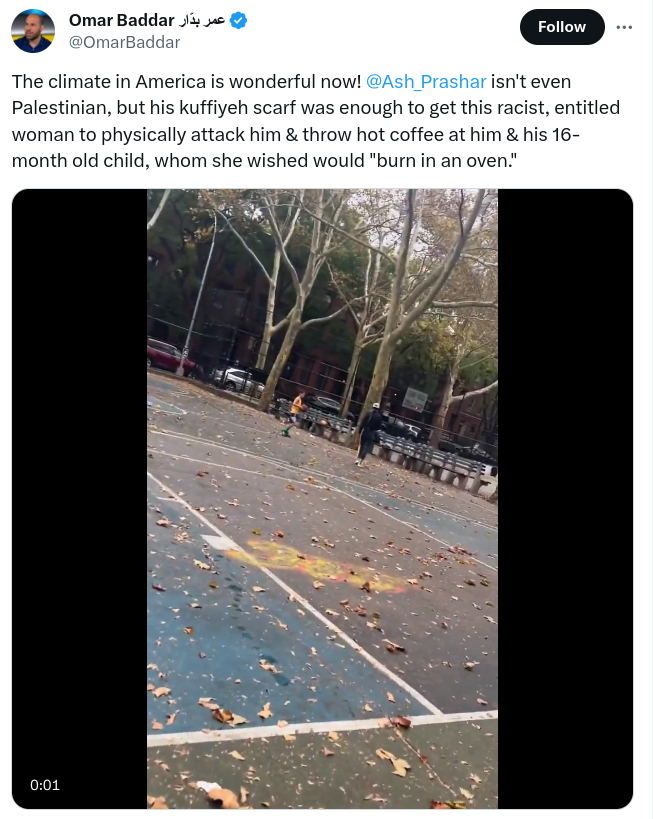
The simplest answer is that Israel is the West. It is Canada, it is the US, it is Australia and New Zealand. It is a settler colony. Western elites’ identification with it is total; for them to contemplate abandoning stolen lands to Indigenous people is inconceivable.
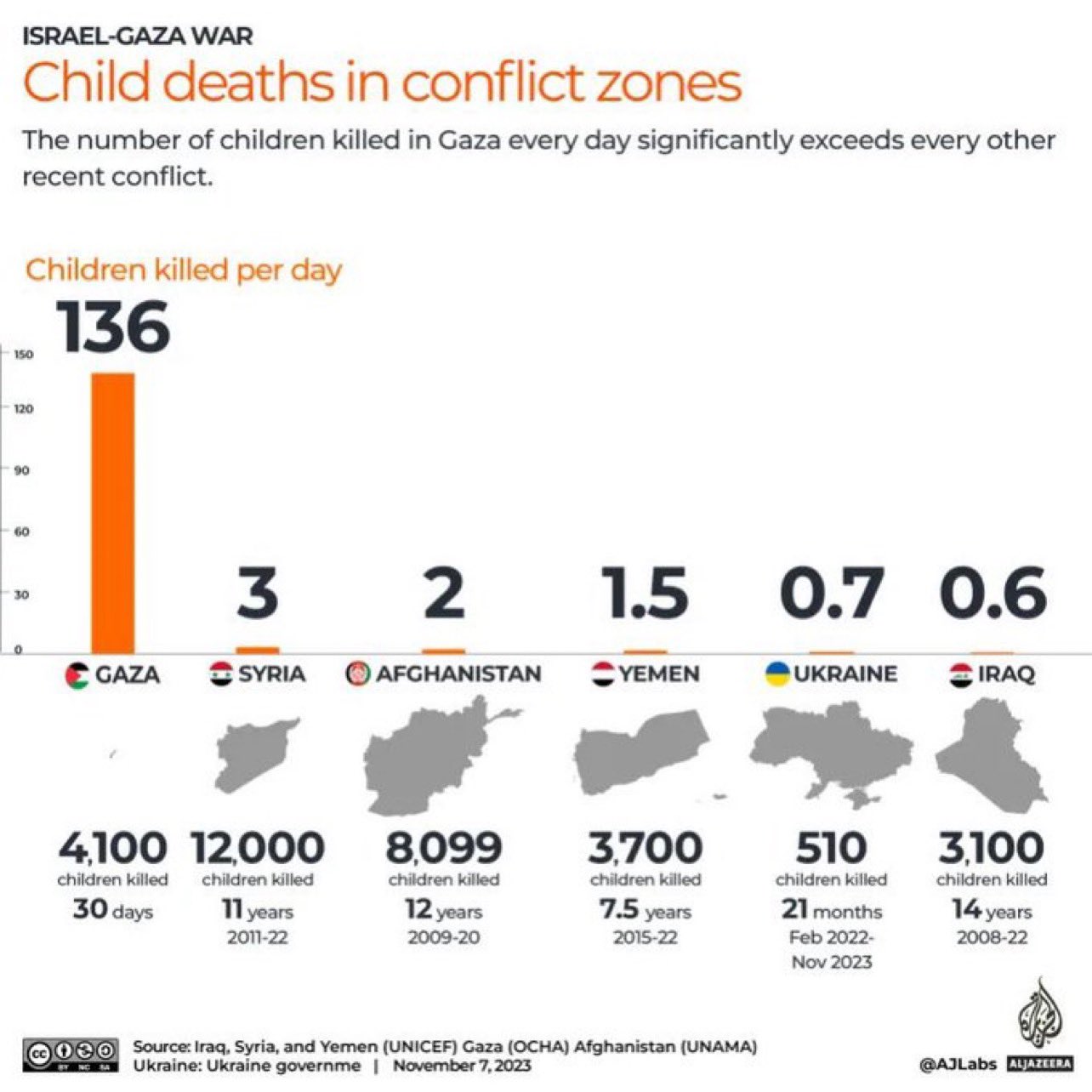
Aggressive wars like the ones in Vietnam, Iraq and Afghanistan have led to humiliating defeats – but for a settler colony to take even one step back is impossible to contemplate. A prisoner exchange, letting Gaza have an airport, letting people come and go from Gaza freely… and now even utterances about freedom or the colors of the Palestine flag have become intolerable to the Western mind. In Israel this brain freeze has led to the adoption of a pseudo-strategy of saturation bombing followed by an open-ended ground invasion with no achievable political goal besides genocide. Among Israel’s supporters, it has led to the maniacal repetition of phrases like “Israel has the right to defend itself” even as Israeli officials talk about dropping nuclear bombs on Gaza or exterminating them all, and are killing, now, 1500 people a day, 140 children a day, and climbing.
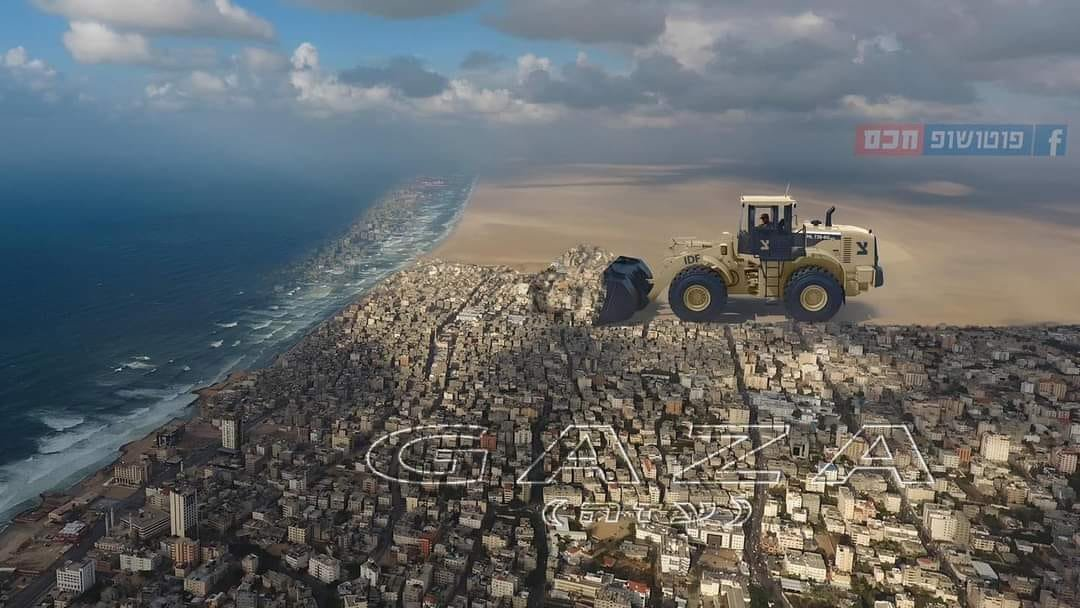
But, like I said in my last piece, we can’t affect what is happening on the ground in Gaza or the air above it and we can’t wait for the ripple effects of the abandonment of liberalism. There are, however, things that the anti-genocide majority can do even against such a committed elite consensus.
The most successful actions have been:
-
Direct Action against the intertwined Western military-industrial complex that is supplying the weapons for this genocide (see, e.g., Palestine Action – https://twitter.com/Pal_action).
-
The legal and political defense of those targeted for their anti-genocide activities and views (see, e.g., Palestine Legal https://twitter.com/pal_legal or Legal Profession Against Retaliation https://twitter.com/canlawforpal).
-
The huge and growing rallies organized by, e.g., the Palestinian Youth Movement (https://twitter.com/palyouthmvmt)
If these continue to grow, so will repression and violence in the West.
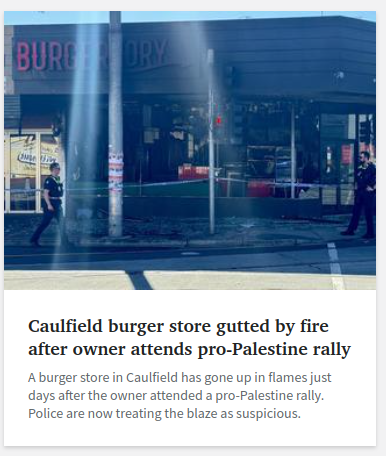
The next step would be preparing to survive that and grow in spite of it.
In 1915, when Lenin lamented the fragmentation of the socialist movement in the face of World War I, he argued that antiwar work had to be done in spite of the difficulties posed by what appeared to be the unstoppable march to war.
He said such work “is not easy, to be sure. It will demand arduous preparatory activities and heavy sacrifices. This is a new form of organisation and struggle that also has to be learnt, and knowledge is not acquired without errors and setbacks.” As examples of what had to be done, he suggested “setting up an international apparatus for the purpose of carrying on propaganda… organise the publication of illegal literature on the necessity of starting revolutionary activities, etc.”
He continued: “We cannot tell whether a powerful revolutionary movement will develop immediately after this war, or during it, etc., but at all events, it is only work in this direction that deserves the name of socialist work.”
So as to not end yet another piece with Lenin, I’ll mention Michael Albert’s book The Trajectory of Change. Michael was an antiwar student activist during the US war on Vietnam in the 1960s. The trajectory he describes in the title is one where demonstrations are not only building in numbers but also in commitment, radicalism, militancy. To roughly paraphrase him, a weekly rally with 250,000 people each week for a series of weeks is less likely to get elites to back off of a genocide than rallies that grow in number each week and where small but growing numbers are, instead of calling for, e.g., “ceasefire now”, are abandoning electoral lesser evilism altogether, calling for the end of apartheid, taking direct actions against the military industrial complex, etc.
Western elites have announced a willingness to transform their societies to make them more genocide-friendly. Dangerous times are ahead.
Colonial war, guerrilla war, and anti-war
[Shorter post today – just some thoughts to help make sense of the strategies at play and our room for maneuver after the protests this weekend.] A month into the process we have a clearer sense of the strategy of Israel/US (and accessories) and the Palestinian Resistance (and al
[Shorter post today – just some thoughts to help make sense of the strategies at play and our room for maneuver after the protests this weekend.]
A month into the process we have a clearer sense of the strategy of Israel/US (and accessories) and the Palestinian Resistance (and allies).
Israel/US follow the colonial template. In colonial wars there is always some confrontation with the Indigenous fighters on the battlefield, but from the very first days of the United States, described in John Grenier’s book The First Way of War, through to the Israelis attacking Gaza today, the template is not the von Clauswitz’s “politics by other means” envisioned by political scientists and realists – of powers clashing on the battlefield to obtain a better settlement than they could without a war.
The colonial template is the destruction of the Indigenous peoples’ means of survival: destruction of their food supplies, of farmers’ fields, of fruit trees, of fishing boats, of shelters. It is not the destruction of the opposing army in the field but the massacre of noncombatants, especially children. Colonial warfare is genocidal. And by attempting to short-circuit the military struggle by directly attacking noncombatants and total war on society to try to compel the armed Indigenous forces to surrender, colonial warfare is terrorism.
The Palestinian Resistance (referred to as “Hamas”) is following the guerrilla war template. The guerrilla knows that the imperialist enemy has better equipment and greater firepower, that many more Indigenous people will die than the colonial power’s soldiers, but that imperialists, in their racism, value their lives much more than many multiples of Indigenous people and that colonial armies are therefore casualty-averse. That means that analysis of how, e.g., Israel has “cut the Strip in half”, “surrounded Gaza”, or showing maps – cannot tell the whole story of a guerrilla war. From the guerrilla perspective, these are the inevitable opening moves in the people’s war.
There is no way for the guerrillas to get into contact with the Israeli military unless the Israelis make such moves first. As for what these contacts have looked like, there are videos of Palestinian guerrillas attacking tanks from point-blank range.
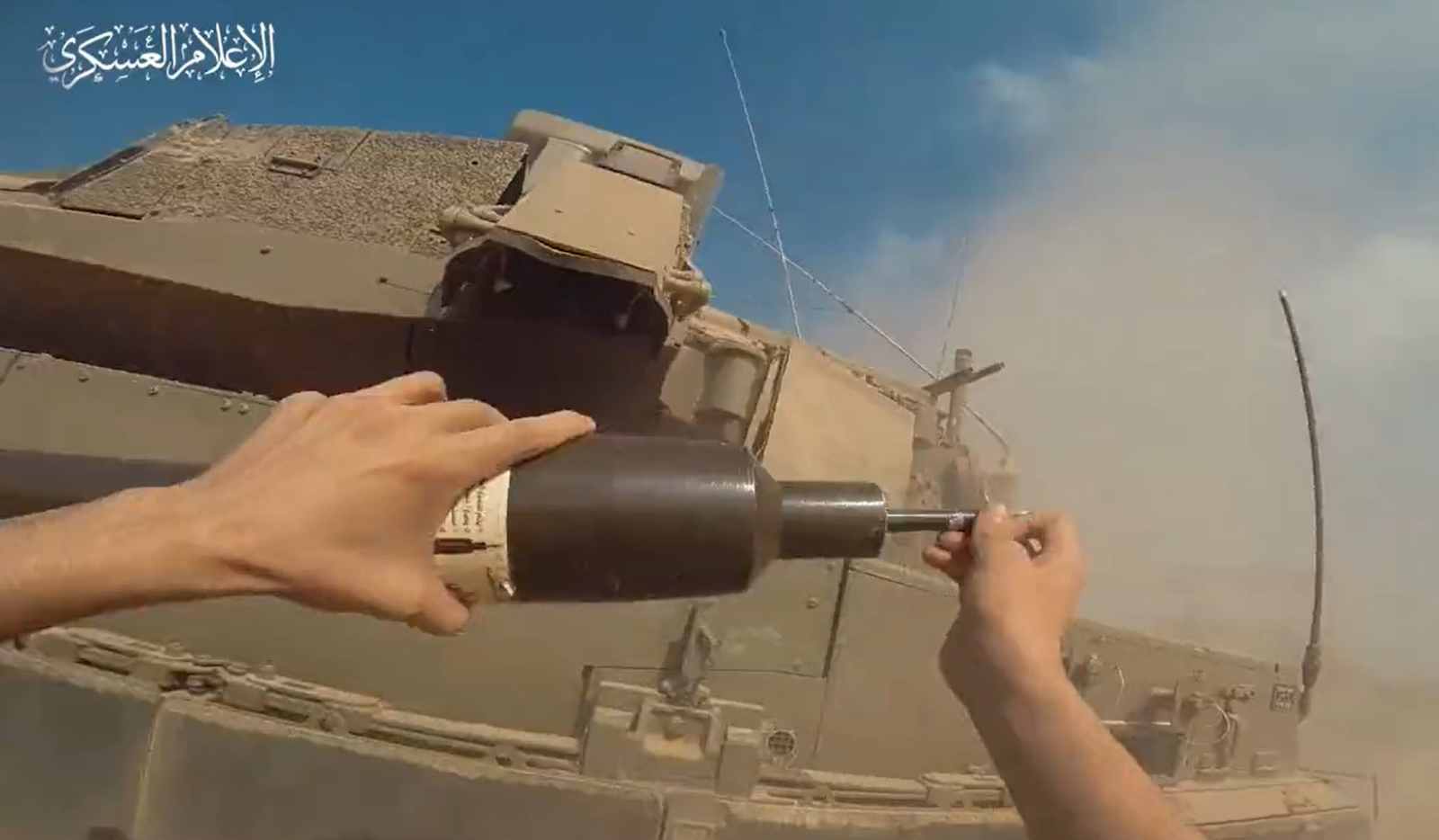
So the Resistance depends on fighting on the ground to raise the cost of aggression beyond what is bearable for Israel’s comparatively privileged society (per capita income $53K, compared to Gaza’s pre-war $3K).
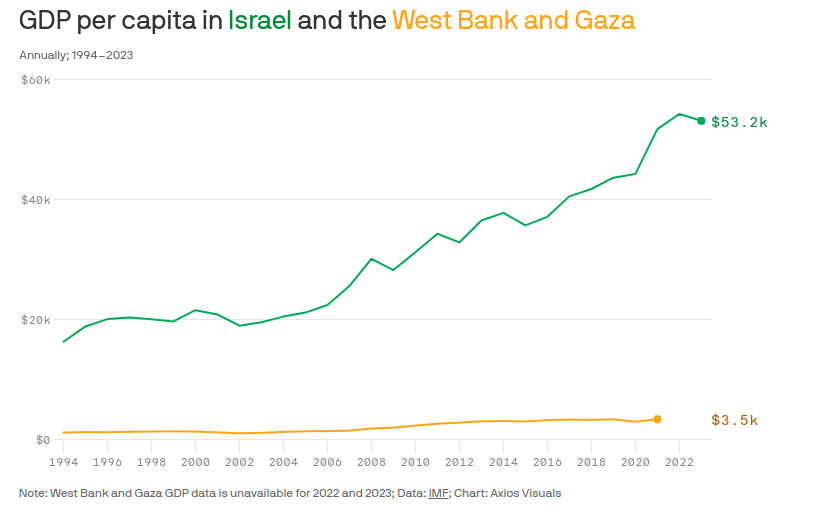
Israel depends on vaporizing non-combatants through direct bombing killing disproportionately children, specific attacks on agriculture, fishing, water, and electricity infrastructure to try to induce mass starvation and dehydration in the hope that the Resistance it is so broken by terror that it cannot continue.
For those of us who are anti-genocide, the race against time is on. We have nothing to do with the military struggle but the unarmed around the world have to do our best for the unarmed in Palestine.
The protests on November 4 showed that the anti-genocide bloc is the majority even in Western countries, despite all the smears and racist attempts to intimidate everyone – these coming from the leadership of all political parties and major media, and intensifying after the demonstrations of the scale of anti-genocide sentiment. “When,” comedian Amanda Seales wrote, “have you seen so many people in the streets for some wrong shit?”
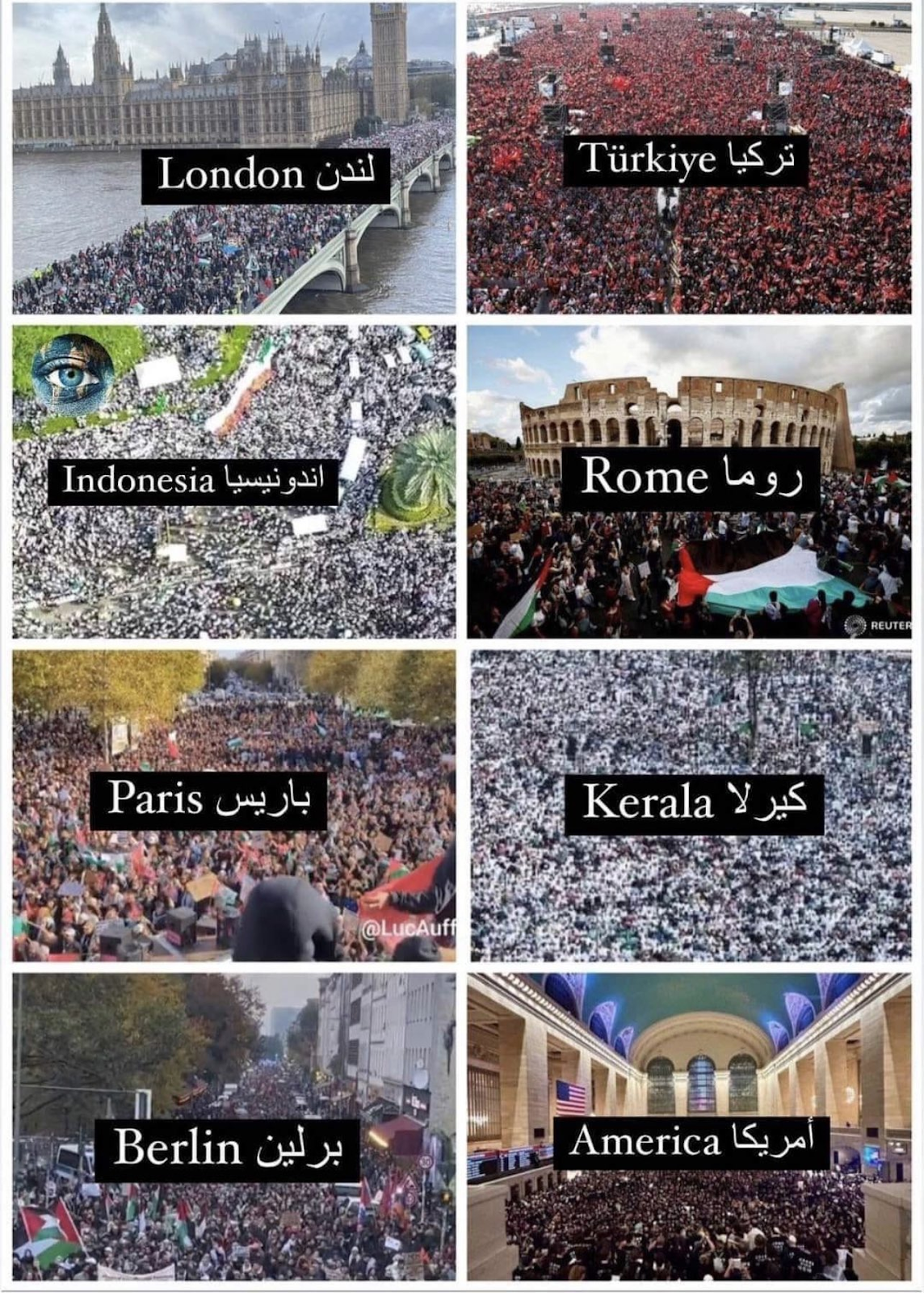
If majority opinion alone could do the job, the ceasefire would have happened and the siege would be broken already. But whether they call themselves “democracies” or not, our political systems are designed specifically to deny the will of the majority.
Nonetheless, as the majorities, we still retain some ability to communicate with one another and we can still exert some influence over how this goes. Whatever we can do to stop the genocide, we have to do. On that, more soon.
-
Resource to follow the war – Updates on Electronic Intifada
-
My book about Gaza is called Siegebreakers
What really happened on October 7th?
Assembling the sources, assembling the facts
The genocide proceeds. In Jabaliya, Israel dropped six tons of bombs on a refugee camp a week after bombing a number of hospitals. Westerners are being conditioned gradually to accept higher and higher numbers of daily Palestinian deaths in more and more obviously genocidal ways – gathering sites, hospitals, schools, churches, mosques, refugee camps.
The US has placed naval assets where it safely could in the region and is deploying antimissile systems on the ground all to try to deter the military intervention of regional powers to stop Israel’s genocide. There is daily contact and exchanges of missiles and other fire on the Lebanon-Israel border, missile and drone attacks on US bases in Iraq and Syria, Yemen has declared war formally and fired missiles, and of course continuing fighting across the fence and now within Gaza.
Pointing out the criminality of what Israel is doing can have no effect when the enforcers of the law are the imperialists themselves. International law will play no role in stopping this genocide. So, this presentation of the facts is not done in the hope that facts can change the West’s position on this genocide or to lay the foundation for the war crimes trials of the future. Still, since the events of October 7 are the pretext for the ongoing genocide, they must be examined.
The feelings of October 7
Most of the discussion in Western media of what happened on October 7 is based on feelings, not facts, evidence, or the relevant laws of war that would apply, if Israel or the US were subject to such laws (they are not). Based on such feelings, progressive pro-Israel writers could assure their readers that it was a massacre; or that “animals isn’t even an appropriate term for the crimes committed by the Hamas invaders” oof October 7. Squeamish feelings indeed, the preciousness of life emphasized, and the barbarism of those who would kill the innocent.
For tough talk about the harsh realities of war, you need to look to the way Americans like John Kirby talk about Palestinian deaths – present at, at the time of his speech, future as well. “I wish that that wasn’t going to happen. But it is. It is going to happen. And that doesn’t make it right… But that’s that’s unfortunately the nature of conflict.” As one commentator noted about Kirby’s speech: “this is the kind of statement people in Serbia and Rwanda got played back at them while they were sitting in a glass box in the Netherlands.”
In the end, the West doesn’t really need the facts of what Hamas’s armed wing did on October 7. What the West needs for its genocide propaganda is to generate a feeling around what happened. That it was uniquely savage, uniquely atrocious. Armed with this feeling, there can be no minimizing these Israeli civilian deaths as “collateral damage” incidental to the objectives of the Palestinian Resistance (“Hamas”) operation, the way there would be if Israel had done it to the Palestinians.
In the West, what the Palestinian Resistance did on October 7 was not a crime – but worse than a crime. Pure evil. Counterproductive to the Palestinian cause. Bad enough that Palestine’s leadership is tarnished forever, forever illegitimate.
Bad enough that any antiwar movement that wants the genocide to stop is also illegitimate, for by their failure to condemn these uniquely savage crimes, they have turbocharged Israel, lost credibility.
Bad enough to justify everything Israel did since 1948.
Bad enough to justify genocide.
Through lurid descriptions of the events of October 7, the Palestinian Resistance is defined outside of humanity. Anyone who expresses support or solidarity is defined as a supporter of inhumanity, a committer of a criminal speech act, unprotected from libel and whatever penalties can be applied from there.
Genocide is justified, solidarity is criminalized, through such feelings. It is hard to imagine that Western countries could be moved away from this structure of feeling.
What happened on October 7?
Still. Even if the West will not use the facts in any future legal proceeding, even if the West ignores them, even if the West is morally and politically incapable of calling the genocide off, as fact-mongers, we still have for some reason to try to find out what actually happened. An anonymous group of Israelis have made the demand for an investigation of what happened – published on Mondoweiss. What are the facts? What can we put together about what happened on October 7?
In doing this we have a finite number of sources. The Haaretz list. The guided tour of Kfar Aza. Several eyewitness accounts. On the other side, we have Hamas’s statements. We have to analyze these carefully. Each piece has to be assessed according to the source, its previous record, its interest in releasing the information, and its biases.
US spokesman John Kirby assesses the Palestinian Ministry of Health as a source in this way: “The Gaza Ministry of Health is just a front for Hamas … a terrorist organization … We can’t take anything coming out of Hamas, including the so-called ‘Ministry of Health,’ at face value.”
The same could be said, from the reverse perspective, of all mainstream Western and Israeli sources, which are “just a front for [the Israeli military]”, which is currently committing genocide and whose utterances cannot be taken at face value.
But such are the sources we have. If we cannot depend on any of the given sources to tell the whole truth, we can perhaps depend on the Western sources to present Palestinians in the worst possible light, and on Hamas’s accounts of what happened to present themselves in the best possible light, and use the sources while keeping these biases in mind.
Quantitative Analysis of the October 7 attack: The Ha’aretz List
For a quantitative sense of the scale of deaths on October 7, we rely on the Israeli newspaper, Ha’aretz, where the death count is currently being updated and which has published 902 names as of October 26, 2023. The Ha’aretz list includes both civilians and military personnel and includes those killed after October 7 – the number rises as Israelis killed in the Gaza invasion are added to the same list. An earlier list with 308 names of Israelis killed was analyzed by one commentator, who counted 171 Israeli military personnel among them.
An article in The Cradle with a similar goal as the current one – of determining what is known about what happened October 7 – published an age distribution of those killed and concluded that 16 of the 683 on the list to that date were children, the rest adults; and around half of the 683 on the list were combatants.
The Cradle contrasts this with the 5,790 Palestinian civilians killed in Gaza by Israel since October 7, 2,360 of whom were children (at the time Cradle published; we are now over 9,000 Palestinians killed and around half children, with several huge massacres like the dropping of 6 1-ton bombs on Jabaliya camp on October 31). But the Cradle doesn’t understand that Israel and the West expect a far higher standard of Hamas than they do of themselves. It is impossible to imagine what a commentator like Gideon Levy would call Palestinians, what Guardian columnists would say to the antiwar left, if Palestinians were to kill 10,000 people and 4,000 children in indiscriminate bombing.
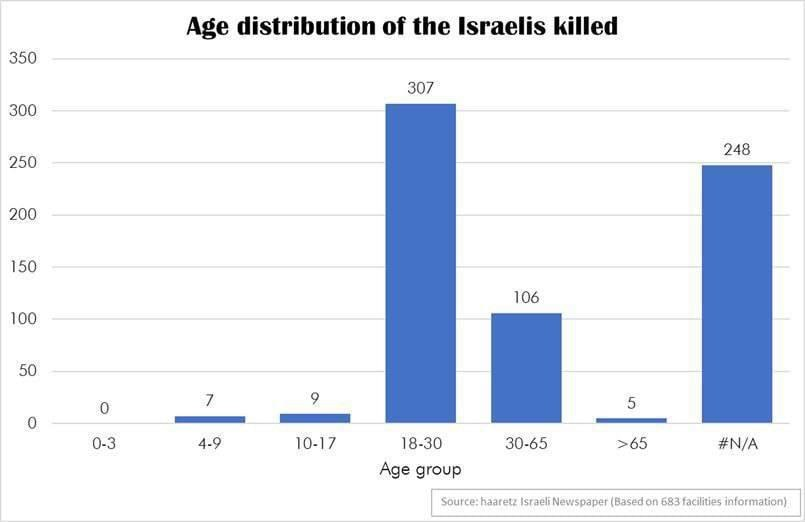
On October 26, the Ha’aretz list had 902 names (515 of whom had photos) and categorized 556 of these as civilians, 59 as police, 14 as rescue, and 273 as soldiers (10 Nepali students and 14 Thai workers are included as well).
For 635/902 of these, no detail is provided about where the deaths happened. The largest single death toll in this list is the Re’im music festival, where 195 Israelis were killed according to this list.
The proportion of adults killed was 498/540 of the dead who have an age indicated. The October 26 list includes 20 children in total: 8 children ages 4-9 and 12 children aged 11-16. Five of these children were killed in in Be’eri, 4 in Nir Oz, 4 in Kukhleh (last names Alkra’an and Abu Sabaakh), 2 in Dimona, 1 in Arara (last name Abu Jama). Four were 17 years old, and the other 498 were between 18-65 years old. Eighteen of the dead with age indicated were senior citizens over 65.
The Battle of Nir Am: The Economist
An episode of the Economist’s podcast, the Intelligence, called “The Day Hamas Came”, describes what a battle with the Qassam fighters looked like from the point of view of Adam, a dual-pistol wielding Kibbutz dweller from Nir Am who “knew how to fight”.
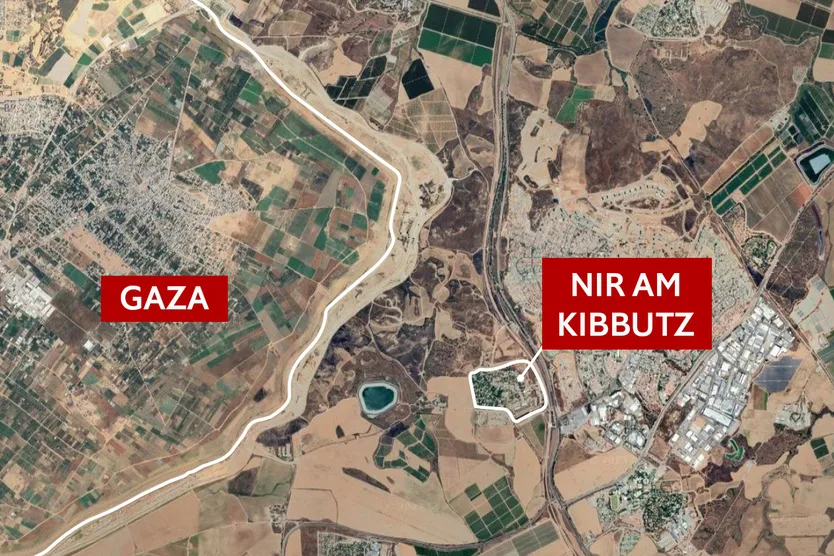
The same story was written up here for the magazine. In the story, Adam describes his kibbutz, Nir Am, as a militarized fortress with a gate strong enough that a truck could not be driven through it if closed.
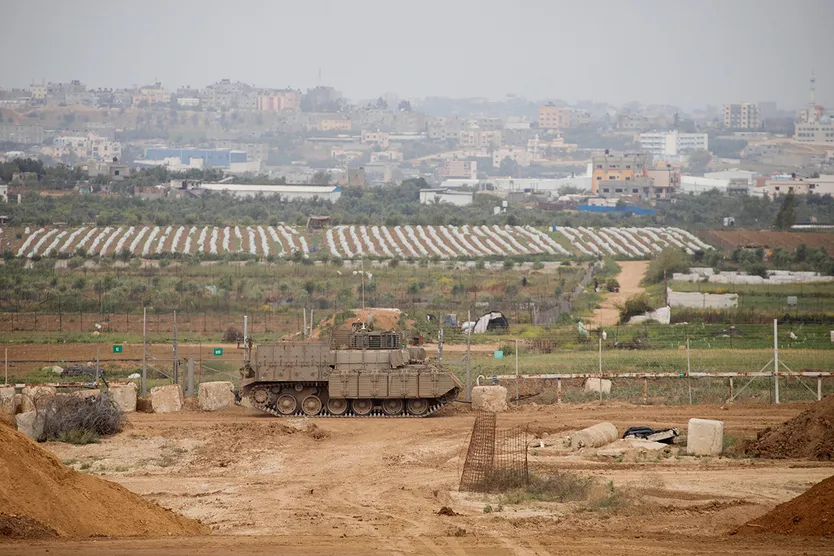
The kibbutz has its own militia, the KK, and its own armory. When the attack started, Adam went to the KKK commander and then to the armory, and organized the defense of the kibbutz. He personally shot one of the Palestinian fighters three times in the body and delivered the coup de grace with a shot to the head. Some of the kibbutz’s agricultural laborers, Palestinians from Gaza, were killed in the crossfire. The kibbutz’s defenders held off the Palestinian fighters until the Israeli police and army arrived. According to Adam, while the kibbutz lost people, virtually all of the attackers were killed.
In summary: this account from a survivor describes an attack on a fortified community, a two-way battle between armed groups, concluding with the death of all the attackers.
The Battle on Kibbutz Be’eri, described in the NYT Daily
The New York Times’s podcast, the Daily, featured another kibbutz survivor of the October attack, this time from Kibbutz Be’eri. 44 year old Golan Abitbol who describes his community as one of 1,000 people. Like his dual-pistol wielding compatriot Adam, Mr. Abitbol heard the alarm in the morning and immediately got his 9mm pistol, locked his family in the shelter, took a firing position in the front of his home. Soon he was exchanging gunfire with a group of Palestinian fighters. “You don’t think,” Mr. Abitbol said. “You act like a warrior.” The enemy moved on to the next house, and Mr. Abitbol saw them a house on fire. As in kibbutz Nir Am, the Israeli military eventually came to the rescue with some heavy armor. When Mr. Abitbol came out of his house, he saw a tank parked on the street. “They told us to close the eyes of the young kids so they won’t see the dead bodies of the terrorists lying outside,” he said. His fortress, kibbutz Be’eri, had been burned he estimated that one hundred people had been killed: “I don’t know how many. I couldn’t count… 1 out of 10 is dead,” he said, in his community of 1,000.
Mr. Abitbol provided his assessment of what happened and of the attackers – they were “not human beings”, he said, but “vicious killers”, “evil”, “animals”, and the attack was a “second Holocaust”. What he described, however, was not a death camp but a battle between armed attackers and armed defenders during which civilians were killed and other civilians taken captive.
Friendly fire, crossfire in Israeli media
Mondoweiss published on October 22 a review of evidence available at that time of possible “friendly fire” deaths in which Israelis died as a result of Israeli military action. One major piece of evidence reviewed was an Israeli interview, republished by the Electronic Intifada, with Yasmin Porat, another survivor from Kibbutz Be’eri, who witnessed the Israeli retaking of the kibbutz. She said the Israeli army “eliminated everyone, including the hostages. There was very, very heavy crossfire.” Another article cited is from the Guardian by a journalist who went on an Israeli-Army guided tour of kibbutz Be’eri on October 11, who described the destruction: “Building after building has been destroyed, whether in the Hamas assault or in the fighting that followed, nearby trees splintered and walls reduced to concrete rubble from where Israeli tanks blasted the Hamas militants where they were hiding. Floors collapsed on floors. Roof beams were tangled and exposed like rib cages.” A military commander told Ha’aretz that his unit “fought inside the kibbutz, from house to house, with the tanks.” “We had no choice.”
Mondoweiss cites an October 20th Ha’aretz article going into more detail about the Israeli counterattack: “…only on Monday night and only after the commanders in the field made difficult decisions — including shelling houses with all their occupants inside in order to eliminate the terrorists along with the hostages — did the IDF complete the takeover of the kibbutz. The price was terrible: at least 112 Be’eri people were killed. Others were kidnapped. Yesterday, 11 days after the massacre, the bodies of a mother and her son were discovered in one of the destroyed houses. It is believed that more bodies are still lying in the rubble.”
A survivor’s account from the kibbutz of Nir Oz describes fighting, Palestinian attackers burning houses, followed by looting, and finally an attack by an Israeli attack helicopter when one woman died – possibly from Israeli fire. Some snippets of a WhatsApp group chat from residents of Nir Oz were published in an Israeli newspaper and and show residents chatting with one another awaiting the Israeli military, describing terrorists walking around outside speaking Arabic. Another video shows what appear to be crossfire incidents at the Re’im music festival.
Another inquiry into the deaths on October 7 was published by Max Blumenthal in the Grayzone. In addition to the damage at kibbutz Be’eri characteristic of high explosives fired from tanks, Max also shows how footage of charred remains of victims at the music festival were characteristic of Hellfire missiles fired by Israeli helicopters.
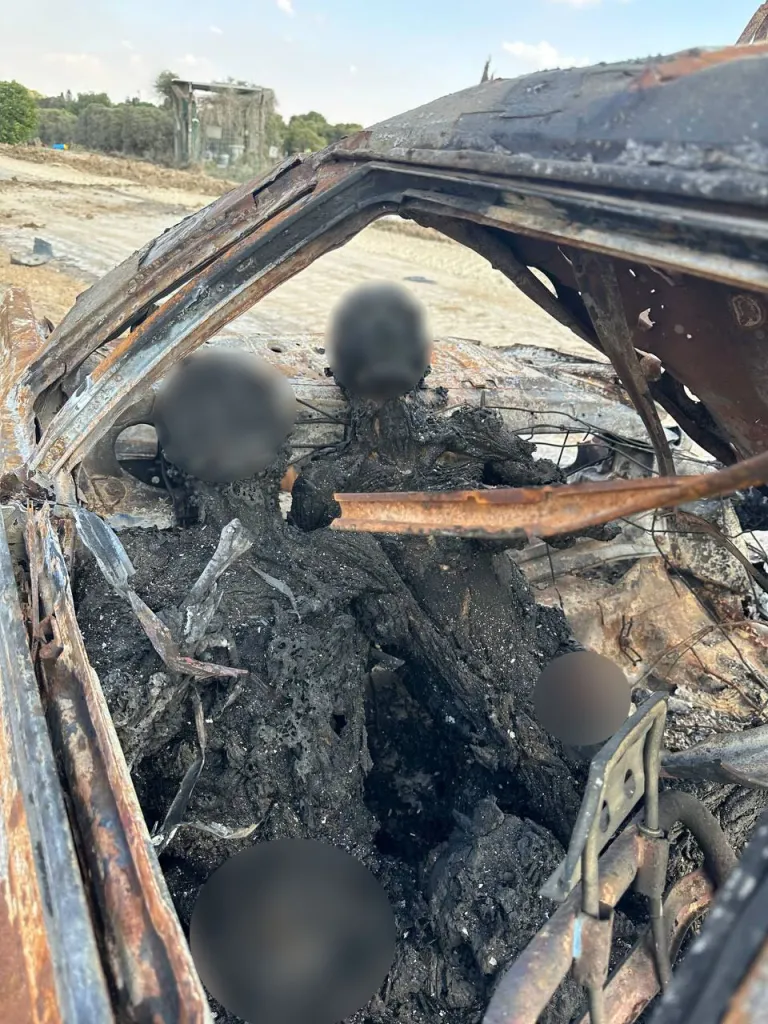
Military analyst Scott Ritter believes (discussed at 1:06 of this video) that most deaths were friendly fire:
“Israel’s lying to itself and the world because Israel doesn’t want the truth to come out about October 7, the absolute failure – political failure, military failure. And they definitely don’t want to talk about October 8. That’s the day they really don’t want to talk about. Because that’s the day that this undisciplined mob of Israeli Defense Force poured back into the settlements and slaughtered the settlers that were there… if they release the autopsies of all the bodies they picked up, you’ll find that the majority of them, more than the majority, were killed by 5.56mm rounds fired by Israel. There’s enough eyewitness testimony that supports this. And Israel doesn’t want to talk about this.”
Urban warfare and civilian casualties
For a comparison of the methods used by armed organizations and civilian casualties, the Palestinian attack on October 7 could be compared to the battle of Shuja’iya in 2014, described by Israeli participants in the battle in the report by Breaking the Silence, This is How We Fought in Gaza.
Scott Ritter, on the program DD Geopolitics, described how the various decisions by Hamas’s armed wing could have been made. He compares October 7, 2023 with the World War 2 Normandy campaign and the battle for Caen. The British and Canadians had hoped to seize the city in a day, but the Germans moved three divisions into the city and it was a “bad battle” in which tens of thousands of French civilians lost their lives. The British and Canadians, Ritter said, would “go in, throw a hand grenade, oops, family of six, sorry, too bad so sad, wrong place wrong time, keep going. Because if you pause and cry, you get killed.” Like the allies in Caen, the Palestinian fighters were “being actively resisted – Israeli forces were surging into the area, they were making contact with Hamas, they met Hamas in the kibbutzim. It’s an active war zone. A lot of people died. And a lot of them were civilians caught in the crossfire.”
On the question of the civilians captured by Hamas, Ritter elaborated. “Why did they remove the women and children?” Ritter described a mission, Operation Eagle Claw, when Delta Force attempted to rescue hostages held in Iran. As they were setting up, “a busload of religious pilgrims drove through the site after we had landed. We captured the bus. We couldn’t let them go. So we put them all on a C-130… we took them hostage for operational security reasons. Do you think it’s possible Hamas had these women and children and thought if we keep them alive they’re going to make a phone call, we’ve got to get them out with us. Do you think that could have happened? I don’t know… I’m not saying Hamas didn’t commit any atrocities. I’m not in a position to know. The Israelis have a lot of footage of Hamas fighters turning corners and shooting people. Is that terrorism? Is that terrorism or are they assaulting a military position, from their standpoint?”
Reports of atrocities all source back to the Israeli military
Reports of atrocities all trace back to the Israeli military and are rejected by Hamas categorically. The worst reports – of sexual violence, decapitated babies, burned babies – are all sourced back to the Israeli military and reported by the corps of pro-genocide Western reporters. These include a report in the Daily Mail based on testimony from a pseudonymous morgue worker named Shari who said it was “worse than the holocaust”, a visit by a journalist to a forensic pathology center showing photos of hands, plastic bags, and unidentifiable burned remains, a screening of Go Pro footage to 100 pro-genocide reporters, and the like. In all of these, specifics are removed, ostensibly out of either respect or simply because the horror is too great – the result is to maintain the mystique of acts that are beyond human comprehension. Acts that also, according to these sources, took place during active battles with the Israeli military.
As far as footage that does not trace back to the Israeli military: There is video footage – from cellphones, security cameras, etc. – of Palestinians looting and even engaging in undisciplined attacks on civilians. The men in these videos do not appear uniformed or equipped as Hamas’s armed wing or any of the other factions. There were men who left Gaza through the fence once it was destroyed and were caught on video engaging in crimes. It is possible that these individuals were responsible for the crimes that occurred, and not Hamas’s armed wing who were engaging with the Israeli army and police.
Conclusion: What is known about October 7
Gathering these Western and Israeli sources: there were a series of attacks on October 7 by Hamas’s armed wing on military bases and fortified kibbutzes that resulted in gun battles in which many armed personnel and many civilians died. Many Israeli military personnel and civilians were taken captive. Hamas has said the civilians will be released unconditionally (and some have been) and the military personnel will be traded for Palestinian political prisoners in a prisoner exchange.
The Israeli army also claims that Hamas’s armed wing committed atrocities, claims which Hamas rejects. There is footage from sources other than the Israeli military suggesting both that many Israelis died in crossfire and friendly fire incidents and that Palestinians who escaped from Gaza once the fence was breached committed looting and other crimes.
Meanwhile the Kirbys and Bidens deny Palestinian casualty numbers.
We are approaching complete polarization: soon no claims made by Palestinians will be believed by the pro-genocide Western bloc and no claims sourced to the Israeli military will be credible to the anti-genocide bloc. There will be no reason to talk to one another and no desire on either side to do so.
It is too obvious to say, but this bodes ill for solutions based on dialogue or negotiation.
The Israeli military’s claims of extraordinary and unfathomable atrocities on October 7 have become the principal justification for the current genocide, which is no exception to the historical rule that genocides are not built on facts, but on lies.
WWCiv 26: How World War One Started
A horrible event shocks the world. The affected power, enraged, threatens war and gives an ultimatum. Looking around for allies, it’s given a “blank cheque” by its powerful patron – one of the great powers of the world. With that patron’s guarantee, the march to war starts. But the smaller power, about to be invaded, also has powerful allies, who mobilize their forces in turn. Once the mobilization and counter-mobilization begins, the march to war seems irreversible. Then, the power who wrote the blank cheque decides to strike first – pre-emptively, to try to take out one of its enemies before facing the others. We’re talking about 1914, and how WW1 started.
AER 129: War on Gaza on day 22
Joined by Jon Elmer and Nora Barrows-Friedman from The Brief / Electronic Intifada to talk about the War on Gaza, including the preparation for ground invasion, the siege, and the attack of October 7.
World War Civ 25: Tragic Week in Spain 1909
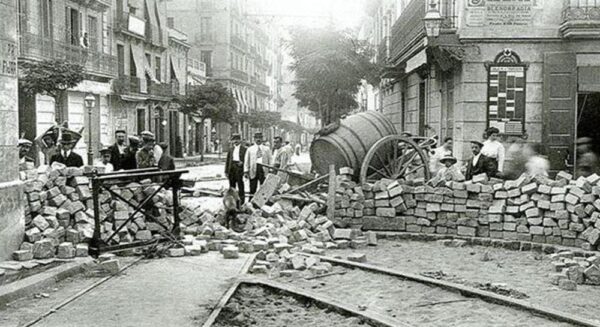
The near-revolution in Spain in 1909 turns out to be more of a cause of World War 2 than a cause of World War 1 but it includes anarchism, conspiracy, revolution, and ends in a show trial. Our final pause before we roll into the immediate causes of WW1.
World War Civ 24: Why socialists failed to stop the war
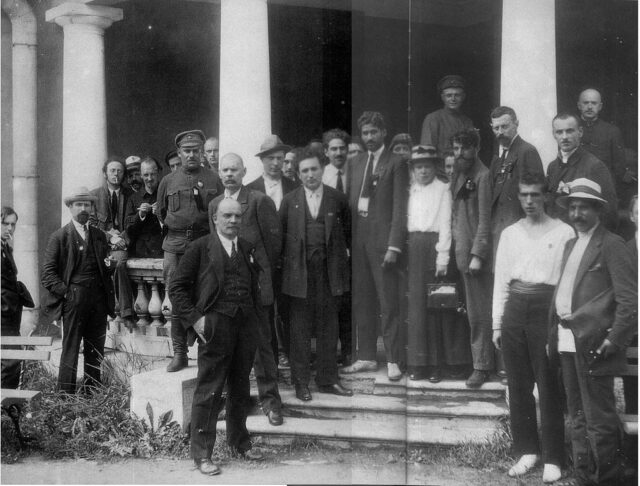
Leading up to 1914 socialist movements all over Europe, notably in France and Germany, had become so strong that they were in the very halls of power. But when faced with the onset of the Great War, the established socialists blinked, unwilling to risk their heard-earned position and possibly be arrested and have their parties driven underground again. This is precisely what they should have done, argued Lenin in 1915. We discuss this possible missed opportunity – why the socialists failed to stop the war before it started.