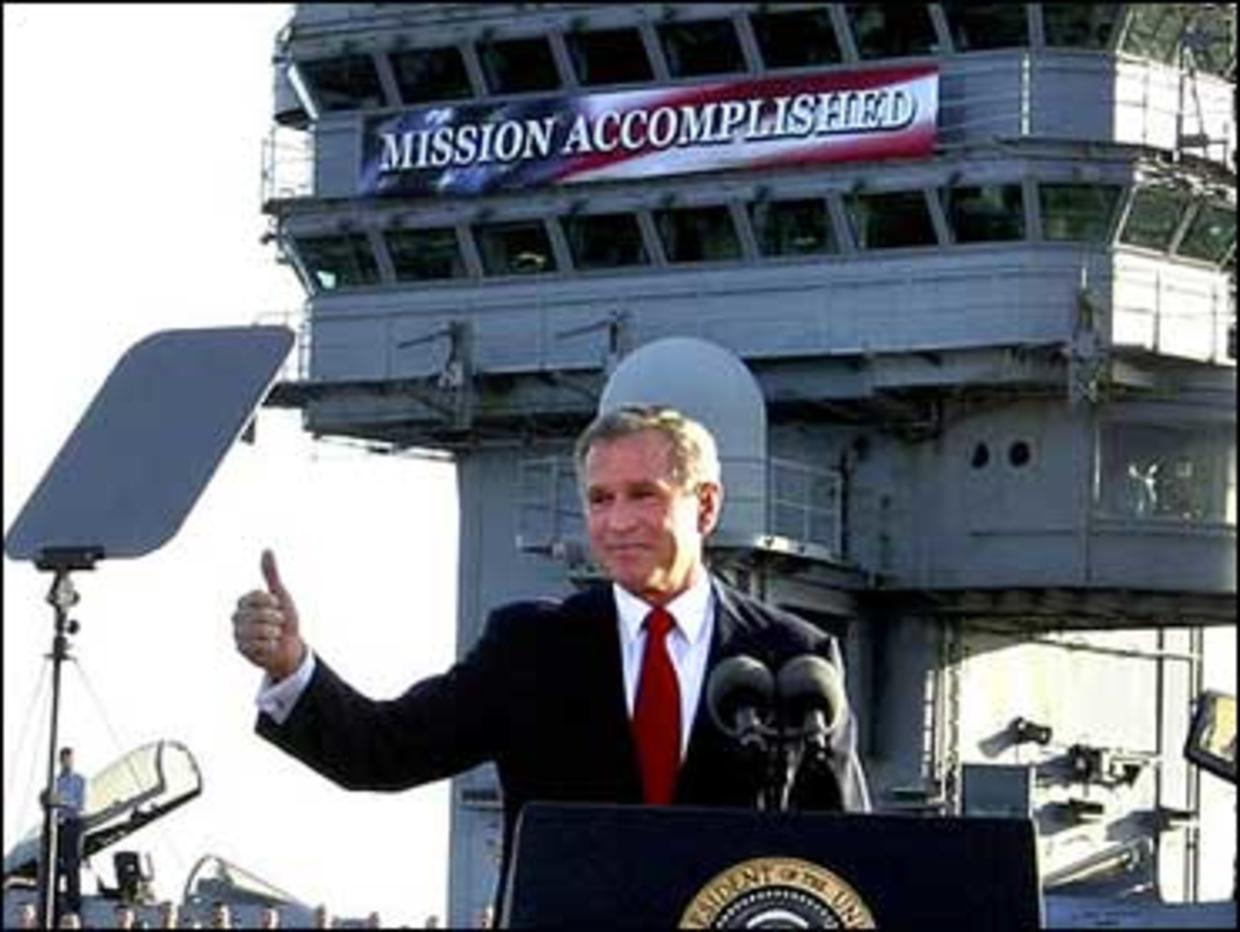
After months of threatening a Rafah invasion, Israel finally went in. They quickly took the civilian crossing with Egypt – in violation of the peace treaty negotiated between the two countries to Israel’s great advantage in the 1970s. They planted Israeli flags at the crossing, blasted the sign saying “I love Gaza”, and declared a kind of “Mission Accomplished” moment.
But like George W Bush’s speech which was supposed to be the end of the Iraq war but was actually the beginning of the Iraq insurgency and a major step in the long-term erosion of American supremacy, Israel’s declaration of victory is premature.
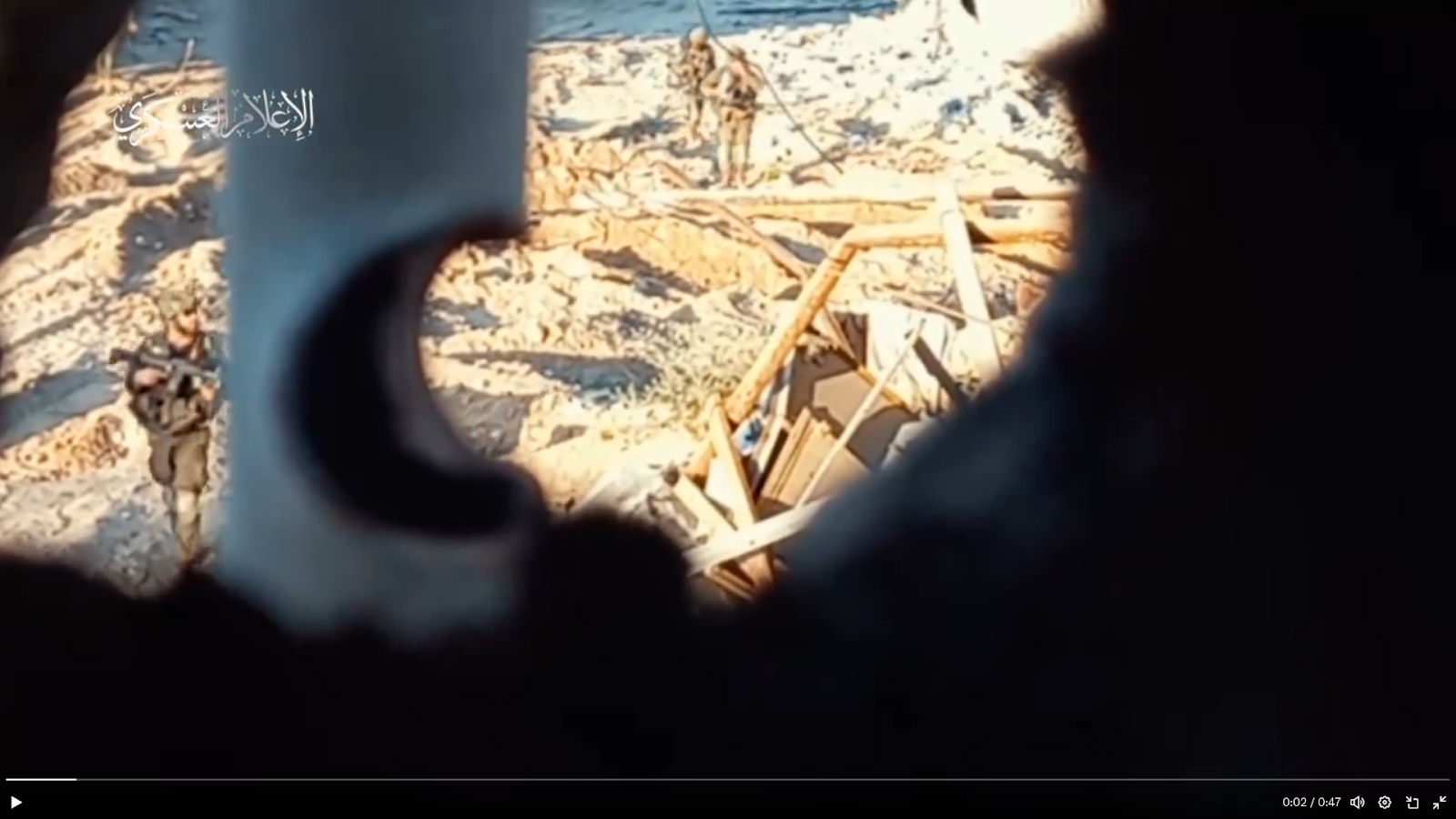
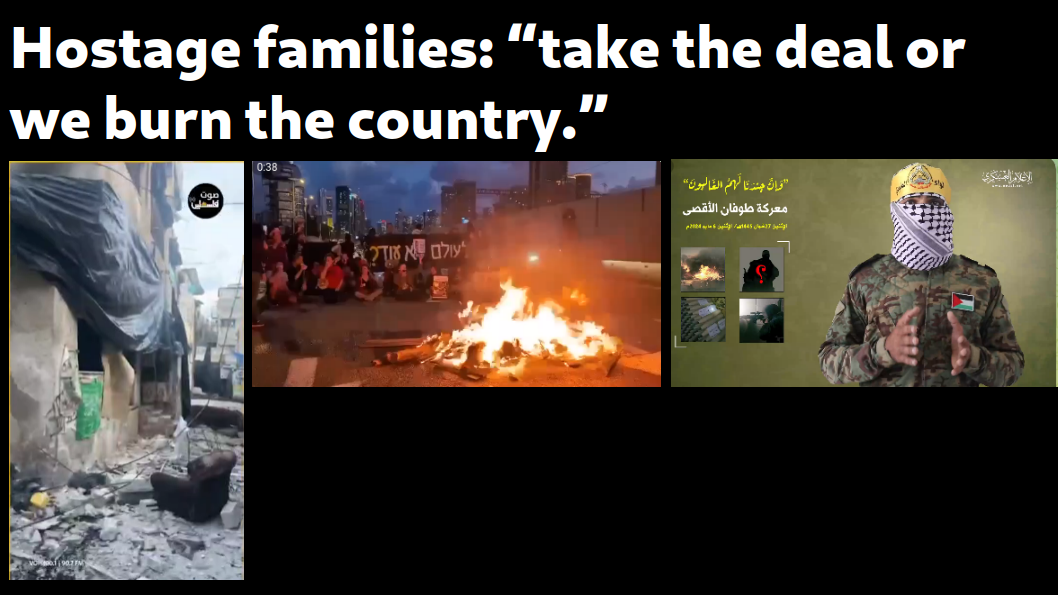
Over the next few days, Palestinian resistance groups initiated a series of operations (many of which they recorded in dramatic field videos) at a tempo nearly unmatched in the war, now in its eighth month. Resistance spokesman Abu Obeida told listeners that the fighters had scored hits on 100 Israeli military vehicles in 10 days in Rafah in the south of Gaza, Jabalia in the north, and Zeitoun in the north (from which the Israelis have since withdrawn). Israeli soldiers, Abu Obeida said, were suffering casualties “by the dozen”.
Under heavy fire in both Rafah and Jabalia, Israel is likely to withdraw from these areas as well. We can then expect a return to aerial bombardment and siege warfare on the starving population. Then more raids, perhaps into the middle of Gaza, during which Israel will lose more soldiers and more vehicles, before withdrawing. Then a period of bombing, then more raids. All the while, Lebanon’s Hizbollah will be hitting military installations on Israel’s northern border with escalating firepower and Yemen’s Ansarallah will be tightening a blockade on ships trading with Israel.
Based on the experiences of the 2006, 2008/9, 2012, 2014, and 2021 wars, Israel would have been expected to have accepted a ceasefire by now, having settled for the demonstration effect of killing between 40,000 – 200,000 or more (according to an estimate made by Ralph Nader) and unwilling to bear the growing costs in soldiers’ lives, displaced Israelis, and economic difficulties.
Why has Israel been so determined this time, compared to previous times? Is it the case that, having mobilized around half a million men, that the numbers of casualties sustained in these ground operations is bearable by Israel, even if Israeli casualties reach the thousands or even tens of thousands?
This is, likely, the calculation. Israel has mobilized all available troops and the US has provided all the firepower Israel can wield. But this approach of maximal firepower and maximum mobilization – of overkill and of over-mobilization – has disconnected Israel from normal military calculations and normal strategic thinking, rendering it vulnerable to the resistance’s counter-strategies.
To understand this vulnerability, let’s break down Western wars in history into three types: Clausewitzian, counterinsurgency, and genocidal.
Clausewitz says war is policy by other means; Counterinsurgency wars are about controlling a population; Genocidal wars are about destroying the foundations of life.
Clausewitz’s book On War uses the campaigns of Frederick the Great, the Prussian king who fought with his European neighbours, and of Napoleon, who fought all the rest of Europe combined (while also fighting a genocidal war against Haiti, but we’ll leave that aside for this article). In these wars, the goal is to inflict losses on the enemy’s military to compel the loser to do the winner’s bidding.
In colonial counterinsurgency wars, the goal is population control. Insurgent leaders are targeted for assassination. Insurgent and insurgency-suspected organizations are dismantled by arrest and imprisonment, physical destruction, and sabotage. Compliant leaders are installed and supported. Populations are overawed and terrorized by campaigns of torture and demonstrative massacres, including “punitive raids”. Recent examples of these wars are the US wars on Iraq and Afghanistan, and general Israeli behavior in the West Bank.
In colonial genocidal wars, the goal is extermination. Food sources are targeted – both stored food and crops. Masses of people are killed indiscriminately including women, children, noncombatants. Survivors of massacres are driven into unlivable areas to die and ringed with enough firepower to kill them if they try to escape. Many of the US “Indian Wars” followed this pattern (see Stannard’s American Holocaust and Grenier’s The First Way of War) as did the German genocides of the Herero in 1905 and the Nama in 1908, reported in, e.g., The Kaiser’s Holocaust.
Israel has been trying to conduct a genocidal war on Gaza since 2005. The idea was to surround Gaza with the Gaza fence and the ring of settlements known as the Gaza envelope; to use automated weapons, AI targeting, and frequent “mowing the lawn” aerial massacres to prevent exit without being labor-intensive; and to gradually render the entire Gaza Strip unlivable by the destruction of farmer’s fields, denial of coastal fishing, and an ever-constricting siege of food supplies.
The strategy was foiled by the Palestinians in Gaza, who managed to keep making Gaza livable while also generating a military resistance capable of counterattack (the notorious rockets) and ultimately, on October 7 2023, of breaching the ring of firepower built to keep them contained in their long-term death trap.
To counter the Palestinian strategy, since October 7th, Israel has tried to further constrict the area through total siege, bringing about famine; destroy every hospital to deepen the unlivability of the strip; and finally to use their ground forces to break Gaza into smaller enclaves in the hope that each enclave might be made uninhabitable in a way that the entire Gaza strip could not be.
In response to this, the Palestinian resistance has maintained steady military pressure on Israeli troops forming the individual rings of fire to try to enclave Gaza, forcing the Israelis to withdraw after taking losses each time. The network of tunnels and the resilient local weapons industry has made it impossible for Israel to destroy the armed resistance, even as the Palestinian civilian population is targeted for genocide.
Now we can return to a discussion of why overkill and overmobilization haven’t brought Israel to victory.
Overkill means the ability to threaten is gone. Israel’s doctrine of massively disproportionate violence against civilians (called the Dahiya doctrine for a neighbourhood Israel destroyed in Lebanon) has culminated in Gaza in the most appalling string of war crimes that could, if an actual system of international justice were to materialize, at some point see its leaders in jail for crimes. But in the military context, the consequence is that Israel cannot use the threat of firepower to try to get compliance. If they are going to exterminate you no matter what, if they shoot anything that moves, if they attack hospitals – then there’s no benefit to complying and no additional penalty for defiance, since they’ll kill you in any case if they get the chance.
Overmobilization means most soldiers have nothing to do. The transformation into rubble of most of the urban surface of Gaza renders any counterinsurgency warfare strategy moot: there are no flows of people to try to control by setting up checkpoints, no one able to go to work or school as the schools and workplaces have been destroyed; no functioning civilian institutions to try to recruit spies and informants from; all leadership has moved underground. Would-be counterinsurgent troops have nothing to do except wander around in the rubble waiting to be ambushed from unseen tunnels. The Israelis have shaped the battlefield into one that gives them no role but to take a position, fire endless amounts of US-provided ammunition into the distance, and wait to be attacked.
Israeli soldiers hanging aroundIsraeli soldiers walking in the rubble
While the mobilization of half a million troops means that losses of dozens of soldiers per day can be sustained for a very long time, these huge numbers can’t really be brought to bear on the enemy even if the Israelis were to try to go into the tunnels, which they thus far have not been.
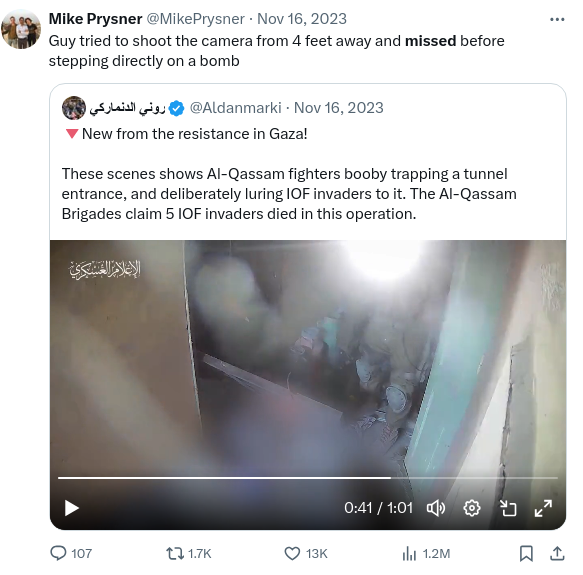
Mockery aside, the fact is warfare in the tunnels means multiplication of such incidents manyfold.
The Israeli army is much more than a military force: it is the melting pot meant to create social cohesion (now failing) in a country composed of people from all over the world with nothing in common. As Rabbi Yaakov Shapiro notes in The Empty Wagon, the Israeli Defence Forces officer training course contains modules like “What is Judalism? The uniqueness of the Jewish people; the people and land in a Jewish perspective; War and the army in a Jewish perspective; is Judaism a religion, a way of life, or a constitution?; the identity of the Jewish people.” Ben Gurion envisioned the army as the place where the “admixture of people which flows in from foreign exiles will be cleansed, refined and purified from harmful, foreign dross in the melting pot of Jewish brotherhood and through military discipline.” Shapiro notes, “sounds more like a rehab than an army.” Only a tiny fraction of this half million would have the qualities to even be accepted into, let alone complete, a training course on knife fighting in dark tunnels. Even the basics of staying out of windows or infantry cover for armored vehicles doesn’t seem to have been learned.
Meanwhile the seeping of the Hannibal doctrine – in which a soldier should expect to be killed by his comrades rather than risk becoming a captive and a potential bargaining chip to swap for thousands of Palestinian prisoners – into every corner of Israeli life since its application against masses of Israelis on October 7th and its pervasiveness in the army cannot but erode the confidence of the ordinary soldier. Not only does the Israeli army not have an ethos of “no man left behind”, the ethos is “don’t get captured or your comrades will kill you because your life is worth less to us than the Palestinian prisoners we’re torturing…”
Keeping bad news from the Israeli public is a high priority for the regime, and that seems to extend to the army as well, as soldiers don’t appear to learn lessons from their engagements with the resistance. Keeping this huge force in the field, supplied, and above all propagandized, is costly in proportion to its size – while military results do not appear to be.
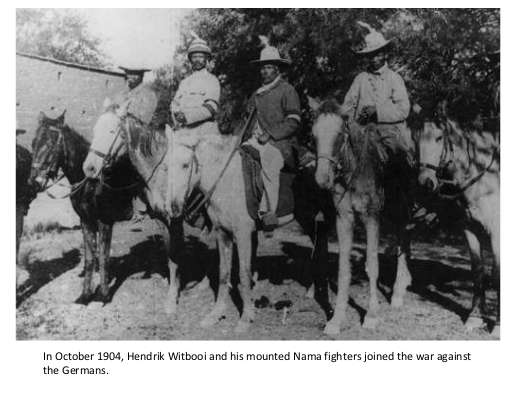
In 1905, the Germans were losing the war to the Nama. 20,000 Germans, succumbing to thirst and driving themselves mad, were chasing 2,000 nimble Nama cavalry, led by Hendrik Witbooi, around in the desert endlessly.
Nama noncombatants had fled to the bush where they suffered from hunger hiding from the Germans. The Germans finally tried to convince the noncombatants to surrender by using missionaries, who promised to alleviate the starvation in exchange for surrender. They lied: when the Nama surrendered, they were sent on further death marches and into (perhaps a German innovation) the world’s first death camp on Shark Island. When the Germans couldn’t complete the genocide by war, they did so by deception.
But that’s also a trick that expires, and a century later, the Palestinians won’t be deceived.
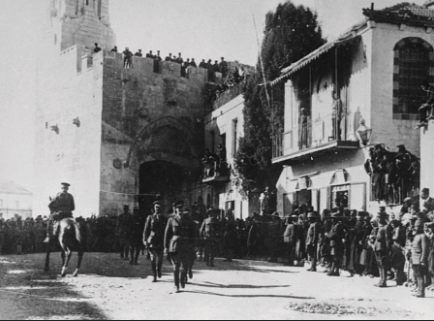
General Allenby, Sharif Hussein and his son Feisal, and their handler TE Lawrence array the forces of the British Empire and the Arab Revolt against the Turco-German forces in Palestine. The battle starts in Gaza and ends with Allenby walking into the Jaffa Gate of Jerusalem. The story of the fateful campaign that brought British imperialism to Palestine (and Lebanon, and Syria…). We note that the British found Gaza to be a “fortress” from which it was impossible to dislodge the Turkish forces; Justin felt TE Lawrence was overrated, just another imperialist; and we compare admiration of the stoicism with which Allenby took news of his son’s death, with an analogous situation today.
On the Anti-Empire Project Youtube Channel there are frequent situation reports or Sit Reps that are posted late at night. Not all of them are reposted here to this podcast, but we’re posting this one on the day of the Rafah invasion. A breakdown of the ceasefire negotatiations and an assessment of where the war is at. With Jon Elmer.
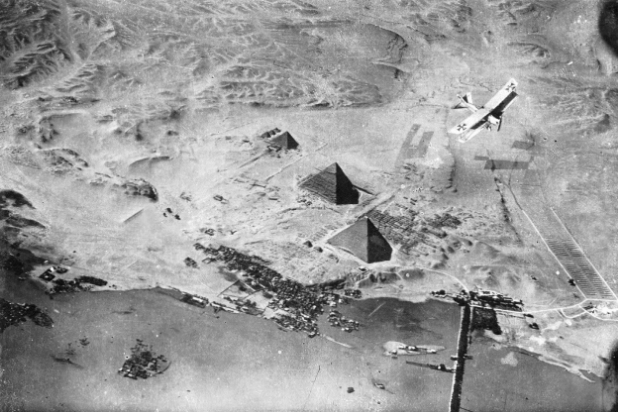
From crashing test flights to close air support and strategic bombing – on the breakneck innovation in aerial warfare over the course of WW1. An issue with some implications today, you’ll agree?
There is no case of nonviolent anticolonial struggle
The US struggle for civil rights, remembered as the nonviolent movement of Martin Luther King, was also the movement of the Deacons for Defense in Louisiana, the movement of the Mississipi Regional Council of Negro Leadership which could “speedily mobilize substantial and deadly firepower” including E.W. Steptoe who had “guns all over the house, under pillows, under chairs”, of Robert Williams of Monroe, North Carolina’s NAACP who said in 1959 that “we must be willing to kill if necessary”, the movement of a night-long battle with police in Albany, Georgia in 1962 and in Birmingham, Georgia in 1963, when “every day of riots was worth a year of civil rights demonstrations”.
The Indian Freedom struggle, remembered as the nonviolent movement of MK Gandhi, was also the movement of the Hindustan Republican Army, of Chandrasekhar Azad and of Bhagat Singh, of the Telengana Uprising of 1946, of the Tamil Nadu anti-feudal struggle of 1943, of the underground guerrilla struggles after Quit India in Odisha, West Bengal, Bangalore and elsewhere, of the Toofan Sena in Maharashtra, of Indian National Army of Subhas Chandra Bose, and of the Naval Mutiny of 1946.
The two most iconic tales of the deployment of strategic nonviolence turn out, upon historical examination, to have been armed struggles, replete with violence.
Through an analysis of the work of Gene Sharp (“Gene Sharp’s Neoliberal Nonviolence” part 1 and part 2), writer and academic Marcie Smith has revealed the existence of a sort of “nonviolence industrial complex”, a network of institutions linked to the US foreign policy establishment, dedicated to two things: 1. steering opposition to US-backed states and projects in nonviolent directions, and 2. to using methods of nonviolent insurgency as a part of a set of tactics (including covert, violent action) to destabilize US targets.
The jewels in the narrative crown of this nonviolence network are the US civil rights movement and the Indian Freedom Struggle, which is why I devoted the two previous articles in this series to showing that these were in fact armed struggles.
The narrators of the nonviolence network have one other weapon: quantitative analysis. But this weapon too, turns out to be a plastic replica.
In their book Why Civil Resistance Works, Erica Chenoweth and Maria J. Stephan claim to have proven through statistical analysis that nonviolence is more effective than violence. Their analysis is worth detailed examination since it claims to have the authority of a huge dataset and logistic regression proving the chances of success are higher with nonviolence.
But what did they actually do? They made a list of several hundred revolutions from the 20th century (nearly all of which were in fact violent), coded some struggles as violent and others not, coded some struggles as successful and others not (in fact many of the successes delivered the countries and their economies directly over for imperialist plunder), and then after a quantitative assessment which amounts to counting the number of successful cases of each type, found that their “nonviolent” coded struggles had a higher chance of success. These nonviolent-coded struggles include:
the South African struggle (including its armed wing, Umkhonto we Sizwe);
and the many East European color revolutions.
the Palestinian Intifada;
A quick skim of any of these histories show that these were all violent struggles. The data reveal the conclusion the authors believed at the outset and for which they coded their data. Why Civil Resistance Works is historical falsification covered with a quantitative mystique.
To determine the veracity of their analysis we need examine only those events coded as both nonviolent and successful. Nonviolent failures are of no interest, since they do not bolster the nonviolence narrative. Neither violent successes nor failures are of interest either, since to the nonviolence industry armed struggles are already failures.
The database published with the book contains 57 nonviolent successes. There are two types of movements analyzed in the database: movements for regime change and movements for secession. There are no nonviolent successes for secession movements: all 57 nonviolent successes are regime change successes. There are only 4 secession successes out of 46 attempts in the database (Croatia, Tigray, Bangladesh, and Aceh from Indonesia starting in 1976-2005). All of these were violent.
Philosophers of science know that there is a complicated set of human decisions that go into the translation of things occurring in nature into statistical data. Even such decisive phenomena as birth and death can only be entered in a spreadsheet as “0” and “1” by the declaration of a doctor. Of all the types of data to translate into “0”s and “1”s on a spreadsheet, historical data is the worst. Was the French Revolution a success, a failure, or is it too early to tell? In history, some failures are necessary prerequisites for future success; some processes simply cannot be classified as one or the other (Chenoweth and Stephan include a “limited success” category to try to capture these).
The relevant point here is that the coding of these 57 events as both “nonviolent” and “successful” ranges from deeply problematic to utterly preposterous.
Going through them:
In this database, the Palestinian liberation struggle apparently started in 1973, was violent, and a failure. The Intifada, 1987-1990, is considered a nonviolent partial success. The 1979 overthrow of the Shah of Iran, which I won’t dispute was successful, is coded as a nonviolent process – which would be a surprise to the guerrilla fighters and defectors who fought the Shah’s soldiers in the streets. The 2005 Cedar Revolution in Lebanon is coded as a success, but it did not change the regime and Lebanon’s political system continued as before.
The Cedar Revolution is not the only “color revolution” (short-hand for a US-backed regime change operation in a US enemy country led by US-trained political and media cadres) coded as a nonviolent success. Indeed a good part (14 of the 57) of the nonviolent successes are East Europe color revolutions: 1989 Germany, 1981 Poland, 1989 Hungary, 1989 Czech, 1989 Slovakia, 1989 Bulgaria, 1990 Russia, 1989 Estonia, 1989 Latvia, 1989 Lithuania, 2001 Ukraine, 2003 Georgia, 1989 Kyrgystan, 2005 Kyrgistan. In the background of all of these color revolutions was the threat of US-led NATO expansion and US nuclear war, as well as the fact of US violent covert operations. Three more of these East Europe nonviolent successes – 1999 Croatia, 2000 Yugoslavia, 1989 Slovenia – are from the incredibly violent US-led dismembering of Yugoslavia in a series of civil wars (described in, e.g., Michael Parenti’s book To Kill a Nation and Diana Johnstone’s book Fool’s Crusade).
NATO bombed bridge in dismembered Yugoslavia, 1999, one of the nonviolent successes in the database.
In Africa, in addition to coding the South African anti-apartheid struggle as nonviolent (which would be news to umKhonto we Sizwe, the armed wing of the African National Congress), and the Ghanaian, Zambian, and Malawi Independence struggles as nonviolent (they were not), the majority of African nonviolent successes in the database were mass mobilizations to press for elections. These were: 1989 Mali, 2000 Ghana, 1993 Nigeria, 2001 Zambia, 1992 Malawi, 1991 Madagascar, 2002 Madagascar, 1985 Sudan (in active civil war at the time).
In East Asia, the 1960 April Revolution in Korea (in which 186 people were killed) is coded as a nonviolent success, as is the 1986 People Power Revolution in the Philippines (after decades of guerrilla struggle and notable defections from the military). East Timor, widely recognized to have suffered a genocide from the 1970s to the 1990s, is coded as having had a nonviolent success in 1988, despite Independence coming in 1999 after a long guerrilla war. A 1973 popular uprising in Thailand, that had bomb explosions and dozens of deaths in riots, is coded as a nonviolent success. So, too, in Thailand, a long-running political crisis in 2005 that culminated in a military coup in 2006, is coded as a nonviolent success.
In the Americas, the database includes as nonviolent successes a 1931 naval mutiny in Chile, a 1944 armed revolution in Guatemala, 1958 Venezuela (which featured attacks on security services headquarters and resulted in the awful Punto Fijo pact), a clear failure to overthrow the system in Mexico in 1987, and struggles against dictatorships in Argentina (1977 and 1986), Uruguay (1984), and Chile (1983), all of which had prominent guerrilla movements. The database cites 2002 in Venezuela as a nonviolent success, but there were two things that happened in April 2002 in Venezuela: a violent coup against Chavez and its reversal when the army refused to endorse the coup: the coup failed, the the successful reversal of the coup involved military moves.
In Europe, a 1974 military coup in Portugal is coded as a nonviolent success. Of the churning conflicts, revolutions, and civil wars in Germany in the 1920s that culminated in the rise of Nazism in the 1930s and the most violent events in human history so far, 1923 in Germany is coded as a nonviolent success.
There is, however, a specific type of conflict coded as a nonviolent success in the database that recurs in different parts of the world, in which a spent dictatorship gives way, in the face of a basically nonviolent popular movement, to an election. About eight of the 57 nonviolent successes belong to this pattern: 1963 and 1974 in Greece, 1977 in Bolivia, 1984 in Brazil, 1985 in Haiti (which led to a military coup and additional years of mobilization until Aristide was elected, then violently overthrown again…), 1990 Guyana, 2000 Peru, and 2001 in the Philippines. This particular set of eight cases (five of which took place in the Americas) could be used as evidence for the argument that, under the right circumstances, largely nonviolent popular mobilization can reverse a stolen election or force a weakened government to agree to elections. It does not prove at all that nonviolent movements have a better chance of success than violent ones. But even in these cases, the threat of violence existed.
There is value in analyzing and comparing movements of resistance in history. There may even be value in coding them and calculating probabilities. But there is no value to be had in building a model for probability of success based on violence and nonviolence by miscoding failures as successes and armed struggles as nonviolent.
We never needed a database to tell us that under some circumstances a social and political struggle can be kept on the nonviolent plane. The key factor is the investment elites have in maintaining the policy that is being challenged. Union struggles can often succeed in winning wage and working conditions improvements nonviolently. Every election where the loser congratulates the winner and there is a peaceful transfer of power is an example of a successful nonviolent struggle. But colonialism, struggles over land, in which oppressors have racial ideas of superiority over the oppressed? In these cases, whether it succeeds or fails, armed struggle alone has a chance. Only by wielding falsified histories and models can the nonviolence storytellers argue otherwise.
Palestine 2018: the final proof of the uselessness of nonviolence in anticolonial struggle
And so we turn to Palestine, a colonial struggle over land, in which the oppressors have racial ideas of superiority over the oppressed and are, since 2023, engaging in active genocide. Palestine has been an area of focus for the nonviolence industry for decades.
A February 2024 paper by the Center for Constitutional Rights has shown that US anti-terror legislation was “driven by anti-Palestinian agendas from the beginning.” The nonviolence industry has had a similar Palestine focus from the beginnings of Gene Sharp’s Albert Einstein Institute. The 1987-1989 Intifada was an object of fascination for Sharp and for the nonviolence industry. Sharp’s Journal of Palestine Studies article in 1989, “The Intifadah and Nonviolent Struggle”, identifies him as the author of the 1973 book The Politics of Nonviolent Action as well as the author of Almuqawama Bila Ounf (Nonviolent Resistance), published in Jerusalem by the Palestinian Center for the Study of Nonviolence in 1986. In the article, Sharp argues – quantitatively again – that 85% of the intifada has been nonviolent. He simply asserts that armed struggle and nonviolent struggle are “not easily mixed to advantage” – and so the Palestinians should go from 85% to 100% nonviolent. After the usual arguments absolving Israelis of responsibility for the violence they mete out on Palestinians and the normal nonviolence argument that the the colonial repression faced by the victims is their fault for provoking their oppressors, Sharp suggests Palestinians go on a 21-day hunger strike, followed by “whistling or wailing at night, especially in dark streets” and “having the youths standing peacefully, not fleeing, holding small Palestinian flags, their right hands outstretched in a gesture of friendship.” Sharp dangles recognition before well-behaved Palestinians: “The shift to fully nonviolent struggle would also make possible more active support for Palestinian independence in Western Europe and the United States.”
After months of genocide, starvation, and the gleeful mass murder of tens of thousands of children, all filmed and celebrated across Israeli society and by Israel’s supporters in the West, Sharp’s arguments are striking for their absurdity as well as their vulgarity.
But Sharp was not alone.
Pakistani activist and academic Eqbal Ahmed made the argument to Palestinians numerous times. He reported to journalist David Barsamian in 1996 (published in the 2000 book Confronting Empire) that he’d told a group of Arab students in the US after the 1967 war that “armed struggle was supremely unsuited to the Palestinian condition,” that “Israel’s fundamental contradiction was that it was founded as a symbol of the suffering of humanity at the expense of another people who were innocent of guilt,” and that “you don’t bring (the contradiction) out by armed struggle. In fact you suppress this contradiction by armed struggle.” He told them in 1968 that
“This is a moment to fit ships in Lebanon and say, ‘we’re not going to destroy Israel. That is not our intent. We just want to go home.’ Reverse the symbols of Exodus. See if the Israelis are in a mood to sink some ships. They probably will. Let them do so. Some of us will die. Let us die.” Eqbal Ahmed imagined if Arafat were to “take on the role of a Gandhi or a Martin Luther King and announce tomorrow, ‘I must stop these settlements. They violate the spirit of Oslo. We are committed to peace. You are making war. We do not want to use violence against you. Peacefully we will march against you. We will sit in. We will clog the roads, start a full-scale movement, and discipline the Palestinians not even to throw stones, intifada-style, because Israelis will use and justify bullets against stones. They will use soldiers against children. Don’t even give them that.’ Israel will divide. It will divide as a society the way America divided. I would keep it divided until it makes peace.”
But Eqbal Ahmed, despite being an insightful anti-colonial strategist, was wrong about the histories he cited (Gandhi and Martin Luther King) and wrong about what would happen in the face of Palestinian non-violence, which did not divide Israel but incited Israel to ever-more intense racism.
Norman Finkelstein wrote a whole book (What Gandhi Says) trying to assimilate lessons from Gandhi to the Palestinian struggle. His conclusions are ambivalent to say the least, since at times he writes things like “it might fairly be said that Gandhi fostered a death cult.” The book ends up being a presentation of the self-contradictory politics in Gandhi’s writing, not the practical manual of civil resistance Finkelstein may have hoped to create when he picked up Gandhi’s 100 volumes of writing as an aid for the US-based academic and activist “to think through a nonviolent strategy for ending the Israeli occupation of Palestinian lands.”
Palestinians took up these ideas in good faith for years – in better faith than the method deserves. Hundreds of Palestinians died trying to do nonviolent struggle. So too did a handful of friends of Palestine, including Rachel Corrie, Tom Hurndall, and others in the International Solidarity Movement.
Eqbal had suggested finding out “if the Israelis were in the mood to sink some ships.” They were – they already had been in 1967, if we count the USS Liberty – but in 2010 a nonviolent flotilla tried to go to Gaza*. Israel boarded the ships, killed some of the activists, and arrested, mistreated, and deported the rest.
Israelis attacked the Mavi Marmara as it tried to break the blockade on Gaza in 2010
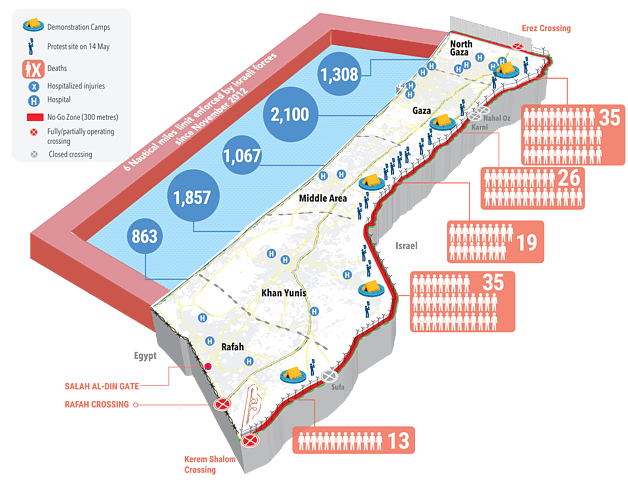
But the culmination of the nonviolent vision, the maximum horizon of all nonviolence, the controlled scientific experiment of perfect nonviolence, occurred in the Great March of Return in Gaza in 2018. It proved that nonviolence does not work. From a scientific standpoint, the nonviolence debate ended in 2018.
As Gene Sharp’s article on the First Intifada opened the debate on nonviolence in Palestine, Jehad Abusalim’s article, “The Great March of Return: An Organizer’s Perspective”, in the same journal, closed the debate on the topic.
The Great March of Return started, Abusalim reports, with a facebook post by Abu Artema on January 7, 2018. Abu Artema asked, “What could the occupation bristling with arms do to a mass of human beings advancing peacefully? Kill ten, twenty, or fifty of them? And then what? What could it do in the face of an unwavering mass peacefully marching?” Abu Artema and others worked to make it happen and organized for months, calling for a date in March:
“To the surprise of all concerned, an estimated 30,000–45,000 people showed up on the first day of the Great March of Return. And on that day, Israeli snipers shot dead 17 Palestinians and injured some 1,400 others.32 The mainstream international media instantaneously referred to the carnage as “rioting” and “clashes” but to those on the ground in Gaza, it was beyond shocking: how could nonviolent protests unleash such fury as to cause Israel to kill 17 peaceful protesters and maim or injure another 1,400? That is how, from the very first day, bloodshed came to define the protest.”
By the end of the protest, cold-blooded Israeli snipers had killed 226 Palestinians and methodically injured 30,000. For the Israelis, it was sport. The Western media fluidly and easily lied about the march, its nature, and the murderous Israeli response. Neither Israel nor its sponsors faced any crisis or internal division about what they were doing to the Palestinians. Neither Israel nor the West paid any cost for inflicting these tens of thousands of Palestinian casualties.
Abu Artema, the protest organizer interviewed by Abusalim in the article, seems bereft of ideas at the end – he feels that more international mobilization is needed, some tool that prevents Israel from “targeting Palestinians in such a horrific way” and to “prevent the occupation from using propaganda to prime the public for slaughtering us.” The nonviolence industry was unable to come up with any such tools: the slaughter of Palestinians at the Great March of Return was not the fault of the nonviolent protesters any more than the genocide in 2023-24 was the fault of the Palestinian armed groups. Israel is a genocidal state: then as now, it is doing what it is organized to do.
Six years later, Palestinians are waging an armed struggle against the Israeli military in Gaza and the West Bank. The Israeli military has chosen to accept military casualties and defeats on the battlefield (including the methodical destruction of its armored vehicles and groups of soldiers) to focus entirely on conducting a genocide against Palestinian civilians, with the central goal being the destruction of all of Gaza’s hospitals and educational institutions and the murder of patients and medical personnel, while blocking food and water from reaching people. Palestinians’ allies in Lebanon, Iran, Syria, Iraq, and Yemen are all engaging militarily with Israel and its Western sponsors. In the region, for the time being, the nonviolence case is closed.
Back in America though, in the solidarity movement, with the expansion of campus protests in April 2024, along with police repression all over the US, the nonviolence debate will rise again.
anti-genocide students face the cavalry in Texas
Anti-genocide students demand universities – which turned out, to the surprise of the students and faculty, to be investment banks that sometimes teach classes – divest from the military industry feeding the genocidal state. The pro-genocide establishment has called the police to crush the protests. What will be the outcome? Nonviolent or violent? Success or failure?
*As I write this, another nonviolent international flotilla is planning to leave from Turkey to Gaza.
Justin Podur: I’m here to discuss nonviolence with the panelists Sina Rahmani and Zeyad Nabulsy. And I wanted to start with the philosophical. And Zeyad is kind of a philosophical person who’s here.
Zeyad Nabulsy: Okay, I’ll introduce myself. I’m Zeyad and most of my research is on modern African intellectual history including African philosophy and history of science.
Justin Podur: It was your idea to discuss nonviolence.
Zeyad Nabulsy: I think in terms of the philosophical angle. So, so here is one way to explain why nonviolence is prevalent as a kind of trope that gets invoked in a lot of contemporary political discourse and in a lot of contemporary moral discourse. So think of like somebody who’s a Kantian, if you look at a certain approach to moral philosophy, it’s saying, okay, look, the world is a horrible place, basically, and I want to get out of this world with my hands as clean as possible. I think that’s more or less an accurate gloss of like what a Kantian would think. Once you have that point of view, I think then it becomes about fetishizing things like non-violence, fetishizing non-violence, and it becomes sort of a normative debate about what is right and wrong from a moral standpoint. And it’s not that these debates are not important, but I think when we’re talking about politics we’re talking about what is also efficacious, because sometimes the way people talk about this, they say something like violence never works, which, as a descriptive claim, is utterly false. So I that that’s where I think we should focus. That’s my view.
Justin Podur: So, normative. You mean, how one should behave?
Zeyad Nabulsy: Yes, precisely.
Justin Podur: So if you want to make the world a better place, you shouldn’t do violence. That kind of idea, because violence hurts the person you’re doing violence to.
Zeyad Nabulsy: Right. And it hurts you. So some people say, it dehumanizes you.
Justin Podur: Is that true?
Zeyad Nabulsy: Here’s the problem. I think the normative or moral standpoint becomes very inadequate for actually understanding concrete political issues. Under what conditions is violence acceptable? We don’t actually discuss any concrete case studies. So Palestine will be one of our central case studies. So my inclination is to think about how do these organizations work? What is efficacious? I know that sounds sort of Machiavellian, and it is. But I think that’s also like an element of Marxism is to, like, reject this moralistic, normative discourse.
Justin Podur: I’m all for moralistic discourse. I am. I think it’s a great thing to do to figure out how to be a good person and what what to do to be a good person in the world. You can build that abstract kind of house out of a series of premises. But when you get into a concrete political situation, then you have many, many, many more variables. And then to say that if someone is trying to kill you, if someone is doing Machiavellian, cold blooded politics against you, for you to say, I’m not going to do that in return, that could be immoral. You could be enabling something worse. So there are norms that work in simple situations or laboratory situations that don’t translate to the real world. So maybe that’s reason enough to reject starting from a normative perspective. I don’t know, are nonviolent people better people?
Sina Rahmani: This is bullshit. This is all bullshit. Like this entire idea, the world is this infinitely diverse place full of thousands of years of civilizational violence and and terror. The idea that you can break off history at a nice fictional point and say, oh, from now on, we do no violence. It’s a stupid liberal idea that ultimately says more about the discourse itself and the people who are trapped in it, i.e. all of us. Because once again, we have to realize that, like we talk about politics, we actually live in extremely depoliticized societies. All of us, especially in the English speaking world at least, whereby corporate media and the cultural wars that are curated by corporate media in alliance with academia curate a set of talking points for every semester, all pre-prepared. There’s a very small agenda of what gets discussed and it’s all done within this tiny bandwidth or narrow spectrum of this option. So all of this entire discourse is itself false, because what we’re doing is just doing political theory. The political theory of what is good and what is bad, which is totally stupid. And especially when it comes to the question of violence. A definition of violence is the guy with a Kalashnikov and a Keffiyeh as if that’s the only form of political violence, as if there isn’t political violence unfolding every day in late capitalist society everywhere. And it’s class and it’s race and it’s gendered, and it’s got all kinds of all kinds of complications and nuances based on the social context. And so the very idea that we can speak in theoretical terms, global theoretical terms about a stupid fake thing called nonviolence, it’s one of the one of the weird things that we absorbed as radicalism, which is sold to us as radicalism. So like WTO protest and all that stuff that the Gen X kids did. My contention is that this is just this is the conversation itself is false. But we should read this article.
Justin Podur: To skip ahead to the conclusion of this whole discussion from my perspective, is that the entire dichotomy is fake. The debate is fake, the dichotomy is fake. There’s no meaningful way to debate violence versus nonviolence in politics.
Sina Rahmani: It’s all a big red herring conversation.
Justin Podur: Violence. There’s no nonviolence. Both are always present. To divide it artificially into one and the other, it’s like, I can’t think of a great analogy. I’ve been thinking about analogies, and I think it’s like, imagine dividing fighting into punches with your right hand and punches with your left hand, and saying punches with your left hand are off limits, but punches with your right hand are are fine. You create this taboo when there’s no meaningful difference between those two things.
Zeyad Nabulsy: And can I just add something with that analogy? You’re banning using your left hand only on one side. So it’s asymmetric. That’s very important because your opponent doesn’t care. They’re like, okay, you’re an idiot, then I’m going to take advantage of it. Thank you.
Sina Rahmani: It’s a symptom of the fact that our depoliticized era is trapped under this stupid memorial rubble of World War two, the defeat of the Nazis and the rise of American Pax Americana as some kind of end of epoch in human history. Nonviolence and the institutionalization of it through activists and through the work of Gene Sharp, specifically the the presentation of the Third Reich as the antithesis to liberalism itself, with its with its weird, diabolical cousin, communism. Both of these are two wings of authoritarian politics that were thorough handedly defeated by liberalism in 1991, such that mediocre neocon philosophers were announcing the end of history.
Justin Podur: Let’s take it back to Domenico Losurdo’s book about nonviolence. Losurdo is a philosopher. But great history. He wrote The Counter History of Liberalism, which I would highly recommend to everybody. And then he has this book about nonviolence. And a lot of it’s got Gandhi, but the the chronological thing that he starts with is the so-called non resistors. So there were these abolitionists, white abolitionists, Christian religious people who were against slavery in the mid 19th century. You know, it’s from 1808 when when Britain, stopped the slave trade, they were pushing for abolition in America. And these people were they were very, very specific that they did not support any slaves uprising. So they were very careful. They broadcast that from everywhere. They were like, we don’t want slaves to take up arms. We don’t want slaves to rise up. Slaves should suffer and show their by their suffering that they’re human beings, Christians, etc and Losurdo talks about what happened in the 1840s. There were these thousands of riots, most of them against abolitionists, lots of them to do with politics and elections and stuff.And some of these some of these white abolitionists were lynched. They were killed by pro-slavery people. And he kind of tracks some of these non-resistance people. And the changes in their views as more and more of them are getting killed by pro-slavery and they gradually start at least supporting some kind of defensive violence, at least for themselves. They may not support a slave revolt, but they start saying, well, these people are, you know, we’re against violence, against human beings, but these are not human beings. William Lloyd Garrison being the the biggest example of this. Of course, there were black abolitionists like the people described in a book called Force and Freedom who were always about armed abolition, and John Brown put an end to the debate. He was like, “yeah, we’re not going to have this nonviolence debate anymore.” And, you know, so that that kind of was the closing of that chapter of nonviolence.
Sina Rahmani: But then they had an entire war about slavery. That’s how much nonviolence means to the United States. They had a full scale war across the entirety of their country.
Justin Podur: You know Brown wanted to start that war sooner, right? Brown was like, “we need to get this war going.” And a lot of his abolitionist Christian comrades were like, no, we we can’t have slaves, doing violence. That would be violence, right? And Brown just wasn’t having it. He didn’t win that debate at the debating society. But he did win it.
So the next time we pick up the nonviolence thread in terms of global movements is Gandhi. And Losurdo talks about how Gandhi wants organized medics, medical brigades to fight for the British in World War One. And his whole thing was like, we don’t have to shoot or kill people, but we can show how courageous we are on the battlefield. And by showing that we are real men, we could convince the British to let us free, give us freedom. Losurdo says that it’s more about co-optation than nonviolence than nonviolent resistance. There’s a whole discussion worth having about what the difference is.
So now we’re into modes of resistance. So if we’re talking about resistance we’re talking about trying to fight back. And, you have Gandhi, you have Martin Luther King a little bit later. And these people are talking about fighting back. So how about how about the efficacy of nonviolent resistance?
Zeyad Nabulsy: We can’t really discuss efficacy without talking about context. So global context is one factor. So for example in evaluating the success or failures of Gandhi, the movement for independence in India, you have to look at the global context. You have to look at like the internal balance of power. But people just want to talk abstractly how “nonviolence works”. Maybe under some circumstances it does. Other circumstances, it simply doesn’t. I’ll give you an example where it didn’t: in the 50s, the PAIGC (African Party for the Independence of Guinea and Cape Verde), the party which liberated Guinea-Bissau and Cape Verde eventually from Portuguese rule, at first they tried having, peaceful worker strikes and so on. In 1959 [note: the Pijiguiti massacre in Port of Bissau, August 3, 1959] there was this massive massacre, basically the Portuguese just shot the protesters. And after that they turn towards a people’s guerrilla war because it’s clear in this context that the Portuguese will not give up without a struggle. And there is a political economy explanation for that. Because Portugal was so weak as an economic power, it couldn’t have a neocolonial relationship with its African colonies. It’s not like France, not like Britain. So after the Portuguese left they were not the main neocolonial power in either Guinea-Bissau or Cape Verde or even Angola. That’s why I think the history itself is very important beyond just the normative philosophical debates about “is nonviolence good or bad?” They’ve been given an outsized importance.
Sina Rahmani: In 2021, the idea that you can confront some of the most powerful police institutions, instruments of state violence, most advanced in the world are deployed on any population. Modern police is two centuries old. It developed in the colonial setting. The very fact that we can even be at this point where where the tiny, irrelevant class of eggheads and liberals and writers and journalists and all of their hangers on, the tiny class of them, circulate position papers around this abstract topic as if it means anything to anyone. It’s more of a reflection of the poverty of our discourse. Our understanding of politics is so juvenile that we could even entertain this logic, that if you just protest enough, the state will change its mind, because that’s how democracy works. This is not how states work.
Justin Podur: We have Gandhi and Gandhi’s got a really interesting history because he joins the Congress when the Congress is really like a loyal opposition talk shop. So they’re just talking, right? They’re signing petitions, they’re writing letters. It really is a cooptation machine. And Gandhi gets them into so-called organizing, mobilization, mass mobilizations. He involves millions of people. That’s a whole other level above what they were doing. Right? But there is another history of the Independence movement, outside the Congress Party, over the decades that Gandhi was involved. And I have yet to study this properly. I have been trying to find sources. It’s hard to find sources. But there was lots of terrorism. There was lots of bomb throwing. There was lots of violence. I mean I’ve talked about 1857. I’m trying to sort out what was going on prior to Indian independence in the decades before. There was Bhagat Singh, who threw a bomb and was hanged. There were lots of people who were hanged. During World War two, there was the Indian National Army of Subhash Bose, who was trained by the Japanese.It was a sign to the British that he was able to recruit and organize an actual military invasion of India. There was apparently a mutiny in 1946 of sailors in India.
So the writing on the wall in terms of violence was also going on. And there’s also critiques of Gandhi by people like Ambedkar, who was one of the leaders of the untouchables, who was saying… Gandhi would go on a fast to try to coerce untouchables not to seek certain affirmative action type provisions in the law. And Ambedkar had this thing where he was like: that’s great, Gandhi, that’s so great that you’ve chosen this non-coercive method of, non-violent coercion against me and the untouchable community. So what happens if you finish your fast and die of hunger on your hunger strike? Do you think that all of your gentle, kind supporters will not be enacting reprisals against the untouchable community? Because I sure think they will. I sure think this this non coercion threat is actually a massive gun pointed at the head of our community if you die.
On the Martin Luther King front, there’s a book called Negroes with Guns. There’s a book called We Will Shoot Back. There’s another one called This Non-Violent Stuff Will Get You Killed. They talk about how many of these Martin Luther King followers were actually armed and walked around armed because they’re like, are you crazy? Of course I’m armed, you know? But so for them, nonviolence was not a way of life. It was a very specific tactical choice.
Sina Rahmani: We know so little about the outside world that we could go so far and tell things to other people that, oh, this kind of politics is bad. This kind of politics is good. But of course, what we are doing is reacting to the media we consume. Right? Which is itself ridiculous. No, you’re not talking about world politics. You’re talking about the thing you saw on the nightly news broadcast.
Justin Podur: So fraudulent liberals in the US, these non resisters were saying it’s wrong to do violence to try to change slavery. But they’re not counting the lashes, right? Like every lash. You would think that every lash that takes place in the field to get somebody to speed up their cotton harvesting, you would think that would be considered violence, because if someone’s lashing a white person, that sure as hell counts as violence, right? Does daily violence count?
Zeyad Nabulsy: Does it count? I was reading this this book, it’s sort of like an oral history of Nasserism, in Arabic. He talks about these villages in Upper Egypt or southern Egypt where up until like the 50s if you’re like a regular peasant or something, if you’re walking and you see one of the notables of the town, you have to dismount, you bow down. That’s a form of violence!
Justin Podur: Of course it is. What if you don’t do that? What if you are walking along and don’t do that? What will happen to you if you don’t do that?
Zeyad Nabulsy: Imagine you’re a dad with your kids and then you have to grovel in front of this guy, just like on a daily basis. But this violence is rendered invisible.
Justin Podur: Okay, so when you first brought up the idea of doing an episode on nonviolence, I immediately thought of this two part article by Marcie Smith on the non-site dot org (part 1, part 2). And it’s about Gene Sharp. And Gene Sharp is what Marcie Smith describes as a defense intellectual. He worked at Harvard his whole life, starting in the 50s. And there’s a whole ideology, a really well developed ideology from the 1950s on that Gene Sharp takes up. He calls his institute the Albert Einstein Institute. He gets some kind of early endorsement from Einstein, and he takes up these symbols: Gandhi, Martin Luther King, these different nonviolent icons. But he develops a whole system. The ideological system is: the contradiction in the world is between violence and nonviolence. Violence is when you impose your will on someone else, when you do harm, to impose your will on someone else. And out in the world, the people that are doing this the most are states, regardless of their political orientation. Nation states are doing violence to people every day. And the way to combat this violence is by overthrowing these states in a nonviolent way, through non-revolutionary nonviolence.
So under this rubric of revolutionary nonviolence, there’s a whole playbook of 198 tactics to undermine the legitimacy of the regime. You go and you get beaten up before the cameras to show the regime no longer has legitimacy. You involve more and more people because it’s nonviolent. So more people can, in theory, get involved than if it was a violent struggle where it biases it towards men. They do training in, in nonviolent skills. And we’ll get to like the effect on the American movement first next. But one important premise in Gene-Sharpism is: the contradiction is not class, okay? The contradiction is violence and nonviolence. It’s states. It’s dictatorship versus something called authoritarianism.
Sina Rahmani: Stupidest fucking premise in the world.It’s such a liberal view of the world, a bourgeois liberal. Exactly what Marx talks about: this bourgeois reification of the world as located in this private individual, circulating freely as a commodity, as an object of the market, and subject to the rules of some kind of agreement or like whatever social contract with the state.
Justin Podur: And Smith also puts it in a Cold War context where because there’s this danger of nuclear war with the Soviet Union at any point and because there’s McCarthyism, so you can’t be a communist in the US. The result is that to make an assault against these communist regimes, the US is very interested in nonviolent organization and nonviolent movements that are not going to escalate into war, but they’re still trying to overthrow the regimes. They’re trying to take away the ability of communist states to do both good things and bad things, destroy the whole state.
Zeyad Nabulsy: The authoritarian non-authoritarian taxonomy is very interesting because this is such an abstract way of thinking about these things. People don’t think of the US as an authoritarian state. For example a black kid in some like heavily policed inner city area – for you, the US is an authoritarian state. Of course, I’m the cop, you know, like walk by something. He makes you stand there for three hours or something just to humiliate you, maybe physically beats you. So it’s always the question of where in the state is authority being used and the threat of violence is being invoked, and against whose interests and for whose interests.
Justin Podur: Us have concentration camps? Yes. The US have prison camps.
Sina Rahmani: The US has prison camps. Slave labor. But the US isn’t authoritarian because I can tell Trump to fuck off. As if that is the beginning and end point of political subjectivity. And then on top of that, the US is also the source of the world’s most nasty “revolutionaries”. So in the case of all those regime change operations that will probably get to in this conversation, those people are “revolutionaries” and the US supports them. So on the one hand, the US fights its own revolutionaries with the most violent political, legal, juridical police force that’s ever been enacted. Like if you do anything against the state in your court in this country, you are going to jail for decades, and maybe you can get five years off if you rat on all your friends and they will hammer you and they will destroy your family’s finances, your finances, your name. They’re so authoritarian. They go and fish for collaborators and get people to offer things. They conduct political assassinations, like against the Black Panthers. I remember there’s some neocon critic, some general who was critical of the neocons. He died of a heart attack. Gee, I wonder. And then this is the liberal viewpoint that no, I am civilized subject. I’m a subject, a modern subject of a civilized liberal state and enshrined in the legal fictions of all.
Zeyad Nabulsy: The funny point about this liberal approach is it’s almost like there is this idea that there is an interiority that’s not expressed in your actions. So you could have a history of like murdering people for 150 years. But you’re not a murderer. It’s what you are inside that counts. It’s this essence that never expresses itself in action. It’s hidden somewhere.
Sina Rahmani: Sharp was working directly with the American deep State. Yeah. The idea that you can have transformational change in the state apparatuses or plural of them, whatever you want to call them, that, that can take some sort of radical form like, and the symbols that we recognize to this day, like the raised fist and all that stuff, like, I mean, that has its own weird history too, right? Because it was appropriated from the Panthers. There’s probably a deeper story, probably. But like that image, though, the image of radicalism as a performance. It’s a performance.
Understanding that in how many examples could we start at the top of our head? Ukraine? How obvious is it to say what happened in Ukraine? Was this colour revolution that that the US has more or less admitted? I mean, that’s the thing, like with all these fucking deep state operations or whatever, like it’s not even like we’re the tinfoil hat. They admit to this stuff. They’re happy to because of course, the Empire, this is all in pursuit of the Empire. And fundamentally, most Americans either don’t care or approve of their empire’s actions because they implicitly understand. And this is what they realise is one of the few things they actually understand about politics, that the comforts of their lives are built directly upon the exploitation of the global South.
Justin Podur: In Sharp’s ideology, exploitation is not violence. Okay, so capitalism is not violence. All the profit and paying someone peanuts. That’s not violence, right? Campaigning non-violently to lower the minimum wage is not violence.
So everybody heard about the color revolutions. And a lot of I think conspiracy people are like, this is George Soros behind it. But George Soros may be funding these kinds of operations, but the thinking, the playbook is not conspiratorial. It’s called Strategy for a Living Revolution. And it’s a book and it’s translated. Just read it.He tells you what they’re doing.
Sina Rahmani: All of this is to say that the things that we recognized and are represented to us as revolutions fit this mold, and the ones that don’t trouble us and need to be turned back.
Justin Podur: So Hong Kong, the Arab Spring, even the Tiananmen Square movement had Gene Sharp fingerprints on it.
Sina Rahmani: Libya, Ukraine, Egypt, Egypt. Like they were getting that money, too, right? And they came out against Mubarak, their own ally. They were feeding the enemies of their own ally. This training, this cookie cutter training. They had their own satellite phones. It’s a playbook. And there’s literally an author to it. And they published it.
Zeyad Nabulsy: So it’s not even a conspiratorial thing. I just want to go back to Justin’s point about like whether exploitation is violent or not. And I think it’s not even that we have to say that exploitation is violent. But why is exploitation, a thing which might lead to massive violence or presupposes massive violence, not important for somebody like Gene Sharp?
Justin Podur: And it’s like you were saying, the threat of violence is is what underlines the whole thing. You want to find out if you if you live in a non-violent society, try to organize a union at your workplace. And tell your boss. Hey, boss, we’re a union now and we demand a raise. See what happens. So tell your boss we’re now taking over decision making in terms of investments. See what happens to you. See how that works for you, right? Any institution you’re in? It depends on the threat of violence.
Zeyad Nabulsy: And I think the point about action is really important because you could have a society that’s authoritarian, that allows some kind of freedom of expression, but doesn’t allow you to organize freely because that’s really the significant threat.
Sina Rahmani: Scream all you want about it. Nothing will change. If that doesn’t summarize American life, that they can’t even get basic health care. Like the country that crows about human rights all around the world that has a whole class of people, a diverse Benetton ad class of people, professionals who themselves identify as human rights professionals. And they’re a product of a culture that doesn’t even feed its own citizens properly.It’s a failed state, and it’s designed to be a failed state.
Justin Podur: We have gun rights in America. Do Black people have gun rights in America? Did Philando Castile not get shot for having a gun, by a police officer?
Sina Rahmani: It’s all so insulting that as if the violence of everyday life, the class racialized gendered like across these multiple axes of power and privilege and how society values certain lives and disowns others figuratively and literally, the fact that we can’t even articulate them, and instead we have these asinine conversations about other countries and then deem them to be good or bad. And then meanwhile, our state, our own state apparatus are supporting the most violent forces that ever existed, reactionaries that would never succeed by any liberal test. Like all the US academics who promoted the the proxy war on Syria as some kind of liberation, as if they would even be in the same room as some FSA people.
Justin Podur: But listen, George Lakey is the protege of Gene Sharp, that brings nonviolent revolution to America in a big way and through various movements. There’s a great letter in this Marcie Smith article by a guy who left the nonviolence movement. And he became a Marxist, and he explained why he doesn’t buy this Gene Sharpism anymore. So Lakey’s ideology, which gets into the Ruckus Society, which gets into Central America, gets into the Battle of Seattle, the anti-globalization movement. It’s full of nonviolence. So imposing your will on other people is nonviolent is violence. Hierarchy is violence. So you construct your movement out of affinity groups, and decision making is done by consensus. There’s no hierarchy, there’s no leadership, there’s diversity of tactics. And they do these trainings, nonviolence trainings. It’s always nonviolence training and skills. And they’re everywhere. And then there’s an academic component, there’s academics who wrote this quantitative study called Why Civil Resistance Works: The Strategic Logic of Nonviolence. So they classified all these movements, hundreds of movements across the world, and they rated them as a “1” if they succeeded. If they didn’t succeed, they got a “0”. And it turns out that you’re twice as likely to succeed if you’re nonviolent than if you are violent! These are the numbers. The numbers don’t lie. So he brings it home.
There was a debate that I watched just before during the anti-globalization movement between Ward Churchill and George Lakey – violence, nonviolence. And unfortunately, Churchill said some of the stuff we’re saying here. Lakey said if you have a violent strategy, I’d like to hear it. And he laid out his nonviolent strategy for revolution. So it was kind of like a vacuum thing, right?
Because anti-communism clears out anything that smacks of Leninism. Build a party, build unions. Organize the people, arm the people, take over, make change. That’s what the different communist parties do. So that’s not allowed. You can’t even talk about that because of McCarthyism. So now there’s this vacuum. And then here comes Sharp and Lakey with revolutionary nonviolence, affinity groups, freedom, overthrow the state, attack its legitimacy, overthrow it and keep overthrowing it until something good happens. Right?
Zeyad Nabulsy: A game of chance, until you get a good hand.
Justin Podur: But ultimately, here’s the thing. Because I read Why Civil Resistance Works. And I looked at the data, they published their, their data set, and I tried to do some analysis of their data. And it’s interesting how you code it, right? How you code it, because I think the First Intifada in Palestine was coded as a success.
Sina Rahmani: What are they fucking talking about? American academics are so stupid.
Justin Podur: Where I’m going is this: I think that the Palestinians are the ultimate target of this whole thing.
Sina Rahmani: The US is the ultimate target.
Justin Podur: No, I don’t think so. I think the whole thing is leading to, why can’t Palestinians be nonviolent? And if you think about it, Finkelstein wrote a book about this too. Finkelstein wrote a book called What Gandhi Says.
Sina Rahmani Shut up.
Justin Podur: He read thousands of pages of Gandhi’s writings, he wrote a book about what Gandhi actually says. So he creates these tables about what Gandhi says. And he was like, I studied Gandhi because I wanted to know about the efficacy of nonviolence for the Palestinian movement. And during the brief war on Gaza in 2021, Finkelstein was in an interview, I think, on The Katie Halper Show. And he was like, I’m really sad about this because I think it’s going to discredit nonviolence.
Zeyad Nabulsy: I just pulled it up on my phone because I wanted to get the dates. Right. So if you look at the nonviolent marches in Gaza, right? March 2018. Palestinians were being shot down, and what were these nonviolence people doing?
Sina Rahmani: Collecting checks as professionals of nonviolence.
Zeyad Nabulsy: At the performative level, they remember that nonviolence is actually important to them when Palestinians fire back, when they do violence. But otherwise they have this amnesia. They’re like, oh, I don’t know, violence, non-violence. I have no idea. Honestly, it’s not even a serious project.
Justin Podur: That’s exactly what what Finkelstein said. He said, look, people, you know, Hamas people have said, we tried nonviolence in 2018. And I just think it’s a shame because now they’re going to think that violence…
Zeyad Nabulsy: …and they would be right to think that. Any rational human being faced with these circumstances would arrive at that conclusion. It’s not some crazy, fanatical thing. It’s like, okay, we tried this.
Sina Rahmani: It’s an irrelevant thing for us to even think about. The location of our critique in this conversation is always extraterritorial. his is what it’s like from outside, based in the most violent society ever to have existed, that sits atop a mountain of indigenous people’s skulls and bones.Every day that we’re digging up their children that we eradicated in schools. And then we have the audacity to sell this. The fundamental, profound, blood stained legacy of the supposed European enlightenment, as if it is ever something that could ever be even discussed, as nonviolent, as if the French Revolution was some nonviolent thing. Are you kidding me? The guillotine memes that still circulate. Politics is violence, and revolutionary violence is part of any political struggle. If it was a real struggle to overturn something important enough that somebody would fight back. If something was so easy to throw over, you could just bring out a bunch of corny ass placards and perform for the camera so you can get 30 seconds of airtime in the Buffalo fucking NBC affiliate. That’s this is about how we consume the world.
Zeyad Nabulsy: If you look at historically when Israel has made concessions, it’s always sort of in the aftermath of a war when you inflicted material damage on them or you made them think, okay, actually, we could get screwed over here. That’s it. There is no other path to success with Israel.
Justin Podur: Revolutionary nonviolence does not say we move their conscience. They attacked the regime’s legitimacy.
Sina Rahmani: Legitimacy to what audience?
Justin Podur: Orwell talks about why Gandhi worked on the British because the British have a free press. And Gandhi wouldn’t have worked on the Nazis because they were more authoritarian.
Sina Rahmani: Blah blah.
Justin Podur: So I’ve gone to nonviolence trainings. You know, when I was in the protests in Quebec City in 2000 and April 2001. April. So before September 2001. There were nonviolence trainings by people who came up from the US like trained types. The international solidarity movement that was doing nonviolence in solidarity with Palestinians. I did that in 2002. And occupy was nonviolence, too, in 2010. I was already kind of aged out. I didn’t do very much with occupy in 2010. But I did go, I visited occupy a few times. They did all those nonviolence things, the consensus process. It’s criticized by Marcie Smith in her article too. The insistence on consensus actually makes it very difficult to get anything done. It gives everybody a veto, including people who want to sabotage your your thing. And so there’s all kinds of underhanded things, I suppose, that people do to make sure that, you know, they don’t get consensus blocked. But if you’re not sophisticated enough to do that…
Zeyad Nabulsy: Can we say something like briefly about the global effects of that? Because I think one of the global effects is it’s basically hollowed out all of these historically radical parties and various parts in the global South and turned them into activists who go attend workshops. You see that in every like Communist party, in every country in the world, now I’m working for this NGO. So it has this very pernicious effect globally.
Sina Rahmani: They manufacture a class of people who have an inordinate amount of discursive power to set a kind of media agenda.
Zeyad Nabulsy: Yeah, it’s like a managerial class for politics, basically political activism. Instead of, you know, you work in a bank or something, you’re some human rights activist.
Justin Podur: You’re an organizer.
Sina Rahmani: Never trust anyone who has human rights in their professional biography.
Zeyad Nabulsy: I think that sage advice.
Sina Rahmani: Is that a good way to end this episode?
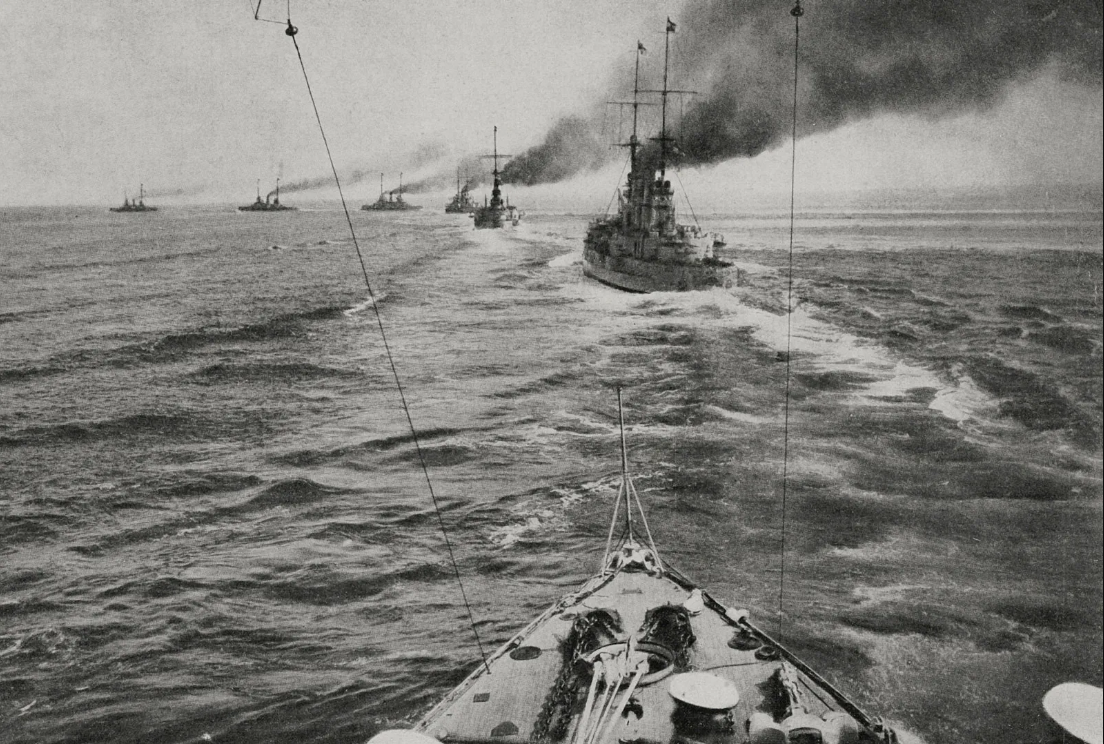
It could be argued that World War I was decided at sea. The British blockade; the Germans try unrestricted submarine warfare, and massive consequences follow. We talk about Jutland, Skaggerak, the Luistania, and civilian hardships, in the war at sea.
Some struggles can be kept nonviolent, but decolonization never has been—certainly not in India
[This article is the second in what I believe will be a series of 3 articles. The first one talked about the armed elements in the supposedly “nonviolent” struggle for civil rights in the US South, and showed that that struggle was not, in fact, a “nonviolent” struggle. The current article does the same, but for the supposedly “nonviolent” struggle for Indian Independence. The third will talk about Palestine.]
If there is a single false claim to “nonviolent” struggle that has most powerfully captured the imagination of the world, it is the claim that India, under Gandhi’s leadership, defeated the mighty British Empire and won her independence through the nonviolent method.
Nonviolence could never defeat a colonial power that had conquered the subcontinent through nearly unimaginable levels of violence. India was conquered step by step by the British East India Company in a series of wars. While the British East India Company had incorporated in 1599, the tide turned against India’s independence in 1757 at the battle of Plassey. A century of encroaching Company rule followed—covered in William Dalrymple’s book The Anarchy—with Company policy and enforced famines murdering tens of millions of people.
In 1857, Indian soldiers working for the Company rose up with some of the few remaining independent Indian rulers who had not yet been dispossessed—to try to oust the British. In response, the British murdered an estimated (by Amaresh Mishra, in the book War of Civilisations) 10 million people.
The British government took over from the Company and proceeded to rule India directly for another 90 years.
From 1757 to 1947, in addition to the ten million killed in the 1857 war alone, another 30-plus million were killed in enforced famines, per figures presented by Indian politician Shashi Tharoor in the 2016 book Inglorious Empire: What the British Did to India.
A 2022 study estimated another 100 million excess deaths in India due to British imperialism from 1880 to 1920 alone. Doctors like Mubin Syed believethat these famines were so great and over such a long period of time that they exerted selective pressure on the genes of South Asian populations, increasing their risk of diabetes, heart disease, and other diseases that arise when abundant calories are available because South Asian bodies have become famine-adapted.
By the end, the independence struggle against the British included all of the methods characteristic of armed struggle: clandestine organization, punishment of collaborators, assassinations, sabotage, attacks on police stations, military mutinies, and even the development of autonomous zones and a parallel government apparatus.
A Chronology of India’s Violent Independence Struggle
In his 2006 article, “India, Armed Struggle in the Independence Movement,” scholar Kunal Chattopadhyay broke the struggle down into a series of phases:
1905-1911: Revolutionary Terrorism. A period of “revolutionary terrorism” started with the assassination of a British official of the Bombay presidency in 1897 by Damodar and Balkrishna Chapekar, who were both hanged. From 1905 to 1907, independence fighters (deemed “terrorists” by the British) attacked railway ticket offices, post offices, and banks, and threw bombs, all to fight the partition of Bengal in 1905. In 1908, Khudiram Bose was executed by the imperialists for “terrorism.”
These “terrorists” of Bengal were a source of great worry to the British. In 1911, the British repealed the partition of Bengal, removing the main grievance of the terrorists. They also passed the Criminal Tribes Act, combining their anxieties over their continued rule with their ever-present racial anxieties. The Home Secretary of the Government of India is quoted in Durba Ghosh’s book Gentlemanly Terrorists:
“There is a serious risk, unless the movement in Bengal is checked, that political dacoits and professional dacoits in other provinces may join hands and that the bad example set by these men in an unwarlike province like Bengal may, if it continues, lead to imitation in provinces inhabited by fighting races where the results would be even more disastrous.”
Ghosh outlines some more of these cases:
“In Bengal, the Alipore Conspiracy Case, Midnapore Conspiracy Case, the Howrah Gang Case, and other conspiracy trials enabled the government to detain those involved with secret and underground political groups. Relying on a century-old piece of security legislation that included the Regulation III of 1818, the government also passed the Indian Criminal Law Amendment Act of 1908 and the Defence of India Act in 1915 to bring political violence against the state under control.”
But, as Ghosh argues, the imperialist response wasn’t solely to pass draconian laws. On the contrary, they made concessions—growing concessions—toward independence and other demands by the “terrorists,” and tried to disproportionately reward their “nonviolent” interlocutors from the Congress. Bengal was reunited; the British moved their capital from Calcutta to Delhi to get away from the terrorist movement in that province.
Revolutionary Struggles 1914-1918: With the end of the Swadeshi movement of 1905 to 1907 began what was called, simply, the “Terrorist Movement” from 1907 to 1917. The terrorists opened with an attack on Bengal Lieutenant Governor Andrew Fraser in Midnapore in 1907. During WWI, the Ghadar movement tried to overthrow British rule multiple times—a (foiled) rebellion in February 1915 led by Rash Behari Bose and another (foiled) raid in Calcutta planned for Christmas Day 1915. Revolutionaries in Bengal raided arms depots, obtained military assistance from Germany, fought a pitched battle against the British in September of 1915 at Chasakhand, and even operated internationally in places like the U.S. and Japan. Revolutionary leaders Chittapriya Ray Chaudhuri and Jatindranath Mukherjee both died in this battle.
The response by the British to the terrorist movements in their colonial possessions was to pass wartime laws: the Defence of the Realm Act in Ireland, and the Defence of India Act. But also to make concessions.
Turning point in 1919: The Amritsar massacre of 1919 was a massacre of hundreds of protesters dissenting from Britain’s desire to extend wartime measures indefinitely through the 1919 Rowlatt Act. After the slaughter, the British engaged in an orgy of racial violence and ritual humiliation, making Indians crawl on their knees down streets, for example. After 1919, Gandhi also led a nonviolent campaign, the non-cooperation movement. What is less known, documented by Durba Ghosh, is that the terrorist movement was in constant contact with Gandhi and the Nehrus (both Motilal and Jawaharlal) throughout this period. The British passed the repressive 1919 Rowlatt Act, but also passed the first Government of India Act and the Montagu Chelmsford Reforms, promising self-government in some distant future.
Also, recall that in 1919 the British also fought an unsuccessful war with Afghanistan and unsuccessfully invaded the new Soviet Union. These violent, military conflicts set the context for the changes the imperialists were forced to make in India.
Interwar Revolutionary Struggle
In the history of the 1920s, the most visible face of the Indian struggle was Gandhi’s non-cooperation movement. But there was an uprising in South India as well, in Malabar in 1921, which the British tried to steer in a communal direction and ended up crushing by force.
The 1920s and 1930s were a time of constant acts of armed struggle. In the 1920s, the Hindustan Republican Association engaged in “patriotic robberies” like one in Kakori, after which four of the leaders were hanged and three others sentenced to life in prison. In 1929, Bhagat Singh and Batukeswar Dutt threw a bomb in the Central Legislative Assembly.
In 1925 and 1930, the British passed two Bengal Criminal Law Amendment Acts. The 1930 amendment was put in force on March 25. On April 18, the Indian Republican Army with Surya Sen and 60 terrorists led a raid on the Chittagong Armory:
“The raid was an elaborately planned attack in which revolutionaries managed to occupy major colonial sites, including the European club, police armoury, and the telephone and telegraph office. The raiders cut off all communications with officials in other parts of India, gathered arms, and hoped to terrorize the British while they enjoyed a Friday evening at their club.”
Also in 1930, Odisha saw a tribal uprising against the British in which villagers battled police—Sainath talked to some of the veterans of this uprising in Last Heroes, chapter 2.
In 1931, the British hanged Bhagat Singh, Shivaram Rajguru, and Sukhdev Thapar. They murdered Chandra Sekhar Azad in a park in Allahabad. They passed the Bengal Suppression of Terrorist Outrages Act in 1932, but terrorism continued.
In 1935, the British made a major concession, another Government of India Act, which expanded the franchise and promised the Congress leaders that they would eventually become the rulers (on the British imperialist timeline). The quid pro quo was that these Indian leaders would suppress the terrorists. Among the British weapons was nonviolence, including the Civil Disobedience movement. The Congress leaders knew, however, that without some terrorism, their leverage with the British would be zero. So they played their own game, quietly supporting the terrorists at times, publicly denouncing them at others, while conducting civil disobedience within a framework of rules that involved jail time for nonviolent actors and British assassination and hanging for terrorists who wouldn’t play the civil disobedience game. Violent struggle was the price paid by the “terrorists” so that the nonviolent could sit at the table to negotiate with the imperialists.
In Chapter 4 of Lost Heroes, Sainath spoke to bomb-maker Shobharam Gaharwar, active in Rajasthan and elsewhere in the 1930s and 1940s, who confirmed the ubiquity of bomb-making activity during the independence struggle:
“We were in great demand at that time! I have been to Karnataka. To Mysore, Bengaluru, all sorts of places. See, Ajmer was a prominent centre for the Quit India movement, for the struggle. So was Benares [Varanasi]. There were other places like Baroda in Gujarat and Damoh in Madhya Pradesh. People looked up to Ajmer, saying the movement is strong in this town and that they would follow the footsteps of the freedom fighters here. Of course, there were many others, too.”
Quit India 1942 and Disillusionment: For Lost Heroes, Sainath spoke to veterans of the armed struggle in Punjab as well as in the south in the Telangana People’s Struggle, led by Sundarayya. Known as the Telangana Uprising of 1946, it was a multiyear struggle over an immense area, and in addition to battles with feudal landlords, police, and hired goondas, he reports:
“At its height, the Veera Telangana Porattam spread across almost 5,000 villages. It touched over three million lives across some 25,000 square kilometres. In the villages under their control, this people’s movement set up a parallel government. That included the creation of gram swaraj committees or village communes. Close to one million acres of land were redistributed amongst the poor. Most official histories date the Communist-led uprising as occurring from 1946-51. But great agitations and revolts were already underway there from late 1943.”
Another southern state, Tamil Nadu, was the site of an immense anti-feudal struggle at the same time as the Quit India movement of 1942. Sainath spoke to veteran R. Nallakannu:
“We’d fight them at night, throw stones—those were the weapons we had—and chase them away. Sometimes, there would be pitched battles. This happened several times during the protests that came in the 1940s. We were still boys, but we fought. Day and night, with our kind of weapons!”
In one village in Odisha in August 1942, activists took over and declared themselves magistrates, beginning to administer justice. They were quickly arrested, but once locked up they immediately began organizing the prisoners, as they told Sainath:
“They sent us to a prison for criminals. We made the most of it… In those days, the British were trying to recruit soldiers to die in their war against Germany. So they held out promises to those who were serving long sentences as criminals. They promised that anyone who signed up for the war would be given 100 rupees. Each of their families would get 500 rupees. And they would be free after the war.
We campaigned with the criminal prisoners. Is it worth dying for Rs 500 for these people and their wars? You will surely be amongst the first to die, we told them. You are not important for them. Why should you be their cannon fodder?
After a while, they began to listen to us. They used to call us Gandhi, or simply, Congress. Many of them dropped out of the scheme. They rebelled and refused to go.”
In West Bengal, Bhabani Mahato organized logistics for underground fighters in the Quit India struggle. Activist Partha Sarati Mahato told Sainath how it went:
“Only a few better-off families in the village were to prepare meals for however many activists in hiding there [in the forest] were on a given day. And the women doing this were asked to leave the cooked food in their kitchen.
They did not know who it was who came and picked up the food. Nor did they know who the individuals were that they were cooking for. The resistance never used people from the village to do the transportation. The British had spies and informants in the village. So did the feudal zamindars who were their collaborators. These informants would recognize locals carrying loads to the forest. That would endanger both the women and the underground. Nor could they have anyone identifying the people they sent in—probably by nightfall—to collect the food. The women never saw who it was lifting the meals.
That way, both were shielded from exposure. But the women knew what was going on. Most village women would gather each morning at the ponds and streams, tanks—and those involved exchanged notes and experiences. They knew why and what they were doing it for—but never specifically for whom.”
The Toofan Sena
In 1943, the Toofan Sena, the armed wing of the prati sarkar (or provisional government) of Satara, declared independence from British rule in the Indian state of Maharashtra. Sainath describes the reach of this autonomous zone:
“With its headquarters in Kundal, the prati sarkar—an amalgam of peasants and workers—actually functioned as a government in the nearly 600 villages under its control, where it effectively overthrew British rule. Hausabai’s father, the legendary Nana Patil, headed the prati sarkar. Both sarkar and sena had sprung up as disillusioned offshoots of the Quit India movement of 1942.
Nana Patil, as well as other leaders, including Captain Bhau, led a bold train robbery on June 7, 1943. “It is unfair to say we looted the train,” the captain told Sainath. “It was money stolen by the British rulers from the Indian people that we took back.” Captain Bhau also objected to the notion that the prati sarkar was an “underground movement.”
“‘What do you mean underground government?’ growls Captain Bhau, annoyed by my use of the term. ‘We were the government here. The Raj could not enter. Even the police were scared of the Toofan Sena.’… It organized the supply and distribution of [food grain], set up a coherent market structure, and ran a judicial system. It also penalized moneylenders, pawnbrokers, and landlord collaborators of the Raj.”
Another Toofan Sena member reported to Sainath how they went about punishing informers:
“When we discovered one of these police agents, we encircled his home at night. We would take the informer and an associate of his outside the village.
We would tie up the ankles of the informer after placing a wooden stick between them. He was then held upside down and beaten on the soles of his feet with sticks. We touched no other part of his body. Just the soles.’ No visible marks were there on the body from the feet up. But ‘he couldn’t walk normally for many days’. A powerful disincentive. And so came the name patri sarkar [note: in Marati, the word ‘patri’ means ‘wooden stick’]. ‘After that we would load him on the back of his associate who would carry him home.”
The Indian National Army
In 1938, the Indian National Congress saw Subhas Chandra Bose become president. He was immensely popular, with an independent power base. While respectful of Gandhi, he was not committed to nonviolence. He was ousted from the party in 1939. In 1941, during World War II, Bose formed the Indian National Army, backed by Imperial Japan, whose goal was to liberate India by force. The same year, Nehru was transferred to Lucknow Jail where he spent time with many imprisoned terrorists. When Gandhi’s Quit India movement was crushed in 1942 within months, Bose and the INA fought on, and Bose was killed in 1945.
Imprisoned for journalism, Bengaluru-based H.S. Doreswamy described his encounter with Indian National Army prisoners whose massacre he witnessed in 1943:
“Once, when we were in prison in Bengaluru (1942-43), it was midnight, and a group of captives was brought in. They came in shouting slogans, and we thought they were more of our people. But they weren’t. They were Indian military personnel. We were told they were officers but didn’t know for sure. We didn’t know their ranks.
There were fourteen of them—from different states. They had decided to leave the British Indian military and join Netaji Bose’s Indian National Army (INA). They tried to leave the country. And were on their way to Burma [now Myanmar] when they were arrested. All fourteen of them. They were brought to Bengaluru and court-martialled. And sentenced to death by hanging.
We interacted with them. They wrote down, with their blood, a letter to all of us. It said, ‘We are so happy that you are 500 here. This country, this Bharat Mata, requires the blood of so many people. We are also a part and parcel of that effort. We have also pledged to give our lives to this country’s cause.’ That is what they wrote… ‘We heard that all of them were lined up in a row and shot dead—all of them—at one time… They knew it. That they were going to their death. But they were very cheerful. That’s why they gave us that letter written in blood addressed to all of us.’”
When the British tried to execute INA officers for treason at the symbolic Red Fort in Delhi, they ended up with an uprising. In 1946, a Naval Mutiny centered in Mumbai was suppressed at huge cost to the British: Their Indian Empire had unraveled. In his book on the naval mutiny, Pramod Kapoor notes that while Quit India was called in 1942, Independence followed very quickly after the 1946 Naval Mutiny. A look at the chronology suggests that the mutiny was more decisive than the nonviolent campaign in bringing about Independence.
The British quickly partitioned the subcontinent, poisoned the chalice, and handed it over to their chosen Indian Congress interlocutors.
As H.S. Doreswamy put it: “When the Britishers left the country, they did so with three formulae. One, to form Pakistan and Hindustan. Two, to keep the people in both countries divided on communal lines. And three: those 562 princely states—they were free to join or stay out of this Indian Union.” The princely state plot was foiled by the post-independence government, but the communal plot and the partition plot both succeeded. So did the sponsorship of the myth that Indian independence sprung from a series of nonviolent campaigns, and not the same processes of armed national liberation struggle that occurred in India as everywhere else in the world that faced a similar situation.
The Harm Caused by the Nonviolence Myth
The nonviolence myth helped preserve feudalism. Like slavery and segregation in the U.S., colonialism in India was overthrown by violence. But also like the U.S., the myth of nonviolence has done real damage to India’s polity. Gandhi’s spiritual successor, Vinoba Bhave, traveled the country trying to convince landowners to conduct a voluntary land reform (contrast this with the violent land reforms enacted in neighboring China, described in Fanshen by William Hinton).
Vinoba Bhave’s was a nonviolent campaign of land reform which kept feudalism largely intact in India. Ironically, Vinoba Bhave was known to have threatened the landowners with violence—explicitly stating that by voluntarily giving up some land, the landowners could save themselves from future violent revolution. Again, we see nonviolent leaders putting the poor in the position of the supplicant, asking for crumbs from the rich based on some distant possibility of revolution instead of working to organize the poor for that revolution.
The nonviolence myth does not produce nonviolent societies. One of the central arguments for nonviolence dating at least back to Gandhi is that nonviolent means lead to better ends. Noam Chomsky put it this way in the 1967 debate with Hannah Arendt:
“It seems to me, from the little we know about such matters, that a new society rises out of the actions that are taken to form it, and the institutions and the ideology it develops are not independent of those actions; in fact, they’re heavily colored by them, they’re shaped by them in many ways. And one can expect that actions that are cynical and vicious, whatever their intent, will inevitably condition and deface the quality of the ends that are achieved. Now, again, in part this is just a matter of faith. But I think there’s at least some evidence that better results follow from better means.”
Since Gandhi’s nonviolence argument was based on the notion that means and ends are inseparable and that the choice of violent means would lead to violent ends, it should follow that the central importance of nonviolence in the Indian freedom struggle led to India being a particularly nonviolent country after independence. Italian communist author Domenico Losurdo, in his book Nonviolence: A History Beyond the Myth, answers that one: “[F]ar from being the embodiment of the ideal of non-violence, India today is one of the most violent countries on earth. Armed clashes between the different religious and ethnic groups are widespread; in particular, massacres of Muslims and Christians are recurrent.”
The inseparability of means and ends is an argument against nonviolence. Nonviolence is a means that involves begging the powerful for concessions and inviting them to do violence without consequences for themselves: it leads to a society with an elite that feels complete impunity to do horrific violence while facing opponents that will try, at worst, to melt their hearts through an example of suffering. It turns oppressors into worse people, drunk on power and feeling no consequences.
Decolonization Is a Violent Process, and India Was No Exception
As Losurdo tells it in his book, nonviolence is an ideal that was developed in the UK and U.S. to ensure that resistance to slavery would be ineffective—for keeping resistance to one of the most vile institutions ever invented within controllable bounds. Christian pacifists and Quakers developed it because they did not want to participate in the violence of slavery. Very few of them were moved to fight slavery violently.
Gandhi’s Indian enemies have argued that it is these Christian, Anglo-American roots from which Gandhian nonviolence springs, and not from Hindu notions of ahimsa or satyagraha. In the end, Indian people did not behave like otherworldly sages. They did what all colonized people do: they fought an armed struggle for independence.
Shorn of the myth of nonviolence, what are the lessons of the real Indian independence struggle and how do they fit into our understanding of social change? It is clear that some struggles—for improved wages or working conditions, better municipal services, or other struggles for equality within a community—can be kept on the nonviolent plane. Colonialism, based on racial oppression and dehumanization, cannot be, and India is not an exception. Like colonialism itself, the absence of a nonviolent solution to colonialism is tragic, but the sooner the reality is recognized by advocates of social change, the better.
This article was produced by Economy for All, a project of the Independent Media Institute.
Among the many changes wrought by WW1 was an irrevocable change in the status of women. “Munitions girls”, women running the Paris Metro and the buses in London, policewomen and auxilaries. We conclude with some notes on a conscription crisis in Canada that also played a role in women getting the vote.
The conditions may not have been optimal but they didn’t look to be getting better – so the Irish Revolutionaries made their move in Easter 1916. A week of urban warfare followed – the revolutionaries lost – but they succeeded in transforming the Irish question forever and setting the nation on the inevitable road to independence.