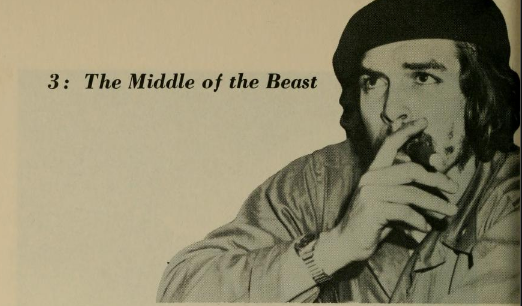
The myth always starts the same. It’s a quote attributed to Che Guevara, by American antiwar activist Jerry Rubin. He visited Cuba and wrote about it in his book Do It! Scenarios of Revolution. Page 20:
“Che stood before us in the Ministry of Labor auditorium… We were 84 Amerikan students visiting Cuba illegally in 1964… As Che rapped on for four hours, we fantasized taking up rifles. Growing beards… Joining Che to create revolutions throughout Latin America. None of us looked forward to returning home to the political bullshit in the United States. Then Che jolted us out of our dream of the Sierra Madre. He said to us: “You North Amerikans are very lucky. You live in the middle of the beast. You are fighting the most important fight of all, in the center of the battle. If I had my wish, I would go back with you to North America to fight there. I envy you.”
Some questions arise.
-
Did this happen? Jerry Rubin is the sole source, and his reliability is questionable. He abandoned activism in 1972 to become a businessman, selling wellness and supplements and producing quotes like “wealth creation is the real American revolution”, and books like The War Between the Sheets: What’s Happening with Men in Bed.
-
Was Che being diplomatic? This was a diplomatic visit, after all. Che could have said this for any number of reasons – including wanting to send these Americans back home so they wouldn’t stay.
-
Is this quote a sufficient basis to build a sense of where on the globe the most strategic location for a political “fight” would be?
I’m inclined to think that Che probably said something like this, to be diplomatic, and that it has been taken much more seriously than it should be. After all, after this Che Guevara went first to Congo, and then to Bolivia, not to the US. His revealed preferences show what sites he thought were strategic and which not.
A few years after Rubin’s 1964 visit to Cuba, another Jewish American antiwar activist, in the course of setting out tasks for the American peace movement, argued in 1969 that the peace movement had not yet amounted to very much or had much influence on America’s consciousness. The more important variable, Chomsky argued, was the Vietnamese resistance. In American Power and the New Mandarins, he wrote: “Nevertheless, those who have devoted themselves to working for peace in Vietnam can only be saddened by the realization that they have failed to create the consciousness in this country that we have no right to win a military victory. It is the miraculous heroism of the Vietnamese resistance that has forced these tentative moves towards peace in Vietnam.”
On the one hand, Rubin invoked Che Guevara to argue that the US revolution was the most strategic revolution; on the other, Chomsky recognized that the US movement had no meaningful effect on the situation, that only the Vietnamese resistance had changed the equation.
In 2012, Norman Finkelstein wrote a book called Knowing Too Much: Why the American Romance with Israel is Coming to an End. In April 2026, the Jewish Electorate Institute published a poll finding that, after 3 full years of openly committing genocide, rape, and torture before the world, Israel was understood by 87% of American Jews as having the “right to exist as a Jewish homeland.” 83% of American Jews believed that criticism of Israel was antisemitic.
In his 1980 book A People’s History of the United States, writer and nonviolence advocate Howard Zinn described the American system’s genius like this:
“The American system is the most ingenious system of control in world history. With a country so rich in natural resources, talent, and labor power the system can afford to distribute just enough wealth to just enough people to limit discontent to a troublesome minority. It is a country so powerful, so big, so pleasing to so many of its citizens that it can afford to give freedom of dissent to the small number who are not pleased.”
Zinn’s conclusion is right, but one premise is wrong. America is not “a very wealthy country” because it is “rich in natural resources, talent, and labor power.” America is a very wealthy country because it is a parasitic apparatus draining the wealth and resources of the entire Global South to it. Political economists like Jason Hickel, analyzing value transfer, unequal exchange, and drain, explain the dynamics. Everything from the dollar as reserve currency and dollar recycling mechanisms, monopolies of intellectual property and patents, the (low) pricing of raw materials from poor countries and (high) pricing of services from rich ones, to US control over international institutions (including financial ones), gives the US trillions of free, drained value from Asia, Africa, and Latin America.
America didn’t get into this parasitic position through “talent”, either. It nudged its predecessor, England, off the throne and into a gentle second-hand parasitic place. That America had the resources to nudge England off came from a prior theft: the theft of the North American continent (through genocide) and the theft of millions of African people whose labor and freedom was stolen (through slavery).
He goes on to explain why America hasn’t had a revolution:
“One percent of the nation owns a third of the wealth. The rest of the wealth is distributed in such a way as to turn those in the 99 percent against one another: small property owners against the propertyless, black against white, native-born against foreign-born, intellectuals and professionals against the uneducated and unskilled. These groups have resented one another and warred against one another with such vehemence and violence as to obscure their common position as sharers of leftovers in a very wealthy country.”
Zinn adds an ideological reason to his material argument: “The idea of saviors has been built into the entire culture, beyond politics. We have learned to look to stars, leaders, experts in every field, thus surrendering our own strength, demeaning our own ability, obliterating our own selves.” Fifty years later, every TV show, cartoon, and Hollywood blockbuster is some variant of superhero, “chosen one” narrative: things have gotten far more extreme than Zinn described.
He hoped that Americans could one day unite and “succeed in doing what the system itself has never done-bring about great change with little violence.” The tactics he believed would work were nonviolent ones: “demonstrations, marches, civil disobedience; strikes and boycotts and general strikes; direct action to redistribute wealth, to reconstruct institutions, to revamp relationships; creating-in music, literature, drama, all the arts, and all the areas of work and play in everyday life-a new culture of sharing, of respect, a new joy in the collaboration of people to help themselves and one another.” Such a nonviolent movement, Zinn said, “would be a new kind of revolution, the only kind that could happen, I believe, in a country like the United States.”
Zinn believed that the US had divided its population into prisoners and guards. The title of this rousing concluding chapter to his book? The Coming Revolt of the Guards.
To these Jewish American activist-writers of the 20th century, a major, nonviolent, but nonetheless revolutionary change in the American status quo was coming, at some point in the future. 14 years after Finkelstein’s prediction of the romance coming to an end, Jewish American support for genocidal Israel is basically total. Meanwhile, 46 years after Zinn’s prediction, is it safe to say the “Revolt of the Guards” is probably not coming? And if not, could the promise that it will appear around the corner itself not some kind of pacification, release valve?
Looking at the record since, say, 1917, there have been revolutions, near-revolutions, and successfully rolled-back revolutions in many countries, but nothing close to one in the US. It could well be that a revolution in the US, forcing elites into exile in places like England and Israel to plot their return, would be the most strategic thing that could happen. But that enthusiasm has to be curbed by the record, and the record would suggest that it is much harder to have a revolution in the US (or another Western country) than in the rest of the world. It could be that the conditions in the core are the least conducive to revolution and that revolution would only occur there after a lot of revolutions in the periphery.
If it were easier, or as easy, it would have happened already.
Because we’re trying to figure out the reason for the absence of something, the truth is it’s impossible to know. A few have ventured to name the reasons over the decades.
Material Bribery. Zinn’s hypothesis, that US elites give enough wealth to enough people that they identify with elites instead of the people, is an explanation that has been offered in many different forms from Lenin (“labor aristocracy”) to Sakai (“the mythology of the white proletariat”) and many times in between.
Psychological / status bribery. Beyond bribery, the idea from Du Bois that racism gives the privileged a “public and psychological wage”, suggests that elites have more than just cash and toys to distribute, but also psychological privileges and pleasures in a racist system. Watching Israeli society and its supporters publicly enjoying the razing of cities, agriculture, infrastructure, and the torture, rape, and killing of children shows that there is some kind of “psychological wage” at work in participation in genocide.
Propaganda. One of the major industries of the West is propaganda. Propaganda for the Global South is manufactured in the north. News media, social media, high culture, pop culture, the academy – all are manufactured at massive scale and weaponized from the core outwards. The principal targets and most brainwashed by propaganda are its Western producers. Those minds would be among the hardest to free.
Co-optation. America is also the epicentre of the production of ideologies specifically to capture and redirect dissent and revolutionary energy: the ideology of democracy and electoralism (in which parties all work for the same goals), the ideology of human rights and the rule of law (for some), the belief that free speech and awareness alone can make revolution, the idea that nonviolence can be a substitute for armed struggle, all work to ensure every movement fizzles. Co-optable movement leaders are promoted into electoral and non-governmental organization (NGO) machinery.
Murder and Prison. But the emphasis on, to put it crudely, the bribery of a privileged minority (Zinn’s argument), even when added to the world’s most comprehensive and sophisticated propaganda apparatus (Chomsky’s argument), and co-optation engine (through electoralism, nonviolence and free speech ideologies, etc.) can take emphasis away from a major factor that has been openly on display especially in the past three years: violent repression.
Chomsky used to claim that violent repression was something that happened in the Global South, but in the Global North the consequences of dissent were less severe because of past struggles and won freedoms. But that isn’t true. When the co-optation engine fails, George Jackson wrote (in Blood in My Eye, quoted in an MROnline article by Colin Jenkins): “Take protest too far, however, and they will show their other face. Doors will be kicked down in the night and machine-gun fire and buckshot will become the medium of exchange.”
Movement leaders in the US are assassinated before they can amass a large following (as occurred as recently as BLM in the 2020s). The US doesn’t just have a big middle class, it also has the world’s biggest prison population in a system of prison camps, surveillance, house arrest, parole, and custody. US police train in Israel and kill thousands of Americans every year. American tech companies, the foundation of the economy, have surveillance as their core business. Student encampments were crushed through force. Police raid, entrap, and infiltrate activist spaces as one of their core functions. Polls might show majorities want health care or are against a war – but majorities don’t get what they want. In the words of George Jackson: “The ultimate expression of law is not order–it’s prison.”
When leftists from the global north and the global south argue online, Westerners might end up getting shut down with something like: “Shut up and go make a revolution where you are.” Fine. Shut up, Westerner. It’s as good a way as any to end a pointless argument.
But those who would take that advice ought to know that while the global north is unequivocally more materially comfortable because of all the stolen wealth, it is not an easier location to “go and make a revolution”. Based on the lack of one in history, we can conclude it’s harder.
If Che Guevara wasn’t merely being diplomatic, if he really did envy Rubin, his envy was misplaced.