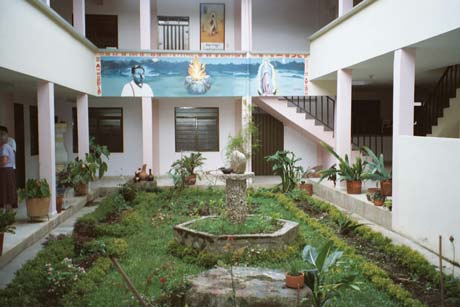
Padre Antonio Bonanomi has been part of the movement in Northern Cauca since the 1980s. The role of the mission in Toribio was crucial since Alvaro Ulcue’s arrival and strengthening of CRIC even earlier. As an outsider, from Italy, who has been in the community for decades and shared its problems, Bonanomi brings a unique perspective to the movement.
JP: How and when did you get here?
AB: I came officially at the beginning of 1988, but I had passed through before. I got here and saw a process already underway. It started in 1980 and was already 8 years old. Alvaro Ulcue had already been dead for 4 years. At the time, they were evaluating Proyecto Nasa. Some of the advisors who had been here from the start came to do a long evaluation. I was able to attend this, and through this, I was able to understand a lot about where the process was and where it was going.
I came here with a lot of ideas. It is one thing to see and hear about it from Bogota, but it is another to see it here, its life and voice. At the time, the group here at the mission still played a central role. One of the sisters was the secretary, another the treasurer. After the evaluation, I saw the need for some new lines of work.
First, we needed to build capacity in the community to lead the process.
Second, we needed to revive some of the nearly-dead programs: the youth, the women’s program, they had suffered after Alvaro Ulcue’s death and were necessary to revive the community.
Third, we needed to take the project beyond Toribio.
Since 1990, the growth of the project to other spaces really began. In 1987, Jambalo began its ‘Proyecto Global’. In 1990, there were two more: ‘Proyecto Unidad Paez’ in Miranda, and ‘Proyecto Integral’ in Caloto. In 1991, two more projects in different parts of the zone grew up. These projects continue the experience of Proyecto Nasa here, and have the same objectives, methods, and spirit.
Structurally, there were three elements. The Assemblies, the School of Community Animators, and the various Programs that took place under the overall project.
JP: Watching the assemblies work as very efficient decision-making bodies with huge numbers of people is amazing. Where does this come from?
AB: Part of it is tradition. But the methodology is newer. It comes from liberation theology of the 1960s and 1970s. The method is called ‘see, judge, and act’. It was actually grown here in Colombia. The three parts, to see, gather, analyze the situation in commissions; to judge to see if it corresponds to the overall plan; and act, to translate it into a part of the work plan. These sorts of methods are used in the consciousness-raising of Paulo Freire: creating consciousness for liberation. That’s the methodology. The tradition is that people like to meet: there have always been assemblies. But before Alvaro Ulcue brought this methodology, the assemblies were ones where one person would talk and the rest would listen.
Alvaro taught that each and every person had to learn to think, to give an opinion, to decide, and act. The assemblies are a huge part of life here. There are four major assemblies each year, at each level. That is 24 assemblies a year, each 3 days long… I used to go to them all, so I would spend 80 days of the year in assemblies!
JP: What about the school of animators?
AB: Each project needed facilitators to help people lead the process. So the facilitators were trained at this school. Many of the current indigenous governors and council members are from this process.
JP: And the programs? What are the traditions behind the ‘Planes de Vida’ (life plans)?
AB: This society, like every society, has to deal with this problem: how do you combine tradition with modernity. I don’t mean ‘modernization’, roads, and all that. I mean the positive things about modernity: changes in gender relations, ideas of individual liberty. A living society has to be able to take these things in without losing its identity. And this process has done so. This is a process, a culture, that is alive. It is flexible. So long as my body is alive, I can ingest something, assimilate it, and make it a part of me. The Nasa are the same. This is no museum! And so, it is partly tradition and partly from outside. The people always had a ‘Plan de Vida’. That is how the movement started: a declaration for territory, authority, law, spirituality, all intrinsic.
The development planning process is just a part of this. It is a small part of the overall ‘Plan de Vida’.
Education is an important program. In 1996, we started to look at how we could have university education here: perhaps a campus of another university. In 1997, an institute at the University of Medellin, began a program in social science emphasizing language and anthropology. We had our first graduating class last year. This year is the second. Many of the leaders of the process come from that program.
In 2000, we began a program of ethno-education. In 2001, we had a program in economy and agro-industry.
JP: I heard some preoccupation in the assemblies over this: elders were worried that the young people would be educated here and then leave.
AB: Opportunities are limited, and we try to give them to those who are already working for the community. At Juan Tama, one project produces 30 tonnes of trout every 3 months. This is a source of protein for the community, and it’s a source of revenue. The project was done by people trained here, and committed to creating something here.
JP: Part of the project is taking over the municipal governments to use them for the development plan. The insurgency views this as ‘collaboration’, and would say that if they are not in armed rebellion, they aren’t in rebellion at all.
AB: It is a different logic. The logic here is a search for a new way of doing politics. To transform power. The armed struggle is a search for power. The indigenous don’t want to be ordered around by anyone.
Here is an example. When the FARC ordered all municipal politicians to step down or die, many of them quit. Many of them were killed. Here in Toribio, the mayor was from the movement, Gabriel Pavi. There was an assembly, of 6000 people. He asked the community if he should quit. They said: we chose you, we oblige you to stay. Gabriel hid in Cali for a week, but after the assembly he came back. The community decides. The mayor does not exist to serve the government, but to serve the people.
Another illustration of the difference in world-view. There is a letter that the FARC published on May 28, 2001. It explicitly denounces the CRIC. We analyzed the letter very carefully. It is most expressive. For many years, the FARC loved the indigenous. Until the 1980s, before the indigenous recovered the land, it was good. Before 1980, the FARC used to want to recover the land, so they could struggle together. But after 1980, the indigenous had the land and the FARC began to act in a very authoritarian way. That is when the problem started. Before that, it was a common land struggle. When FARC took a more hierarchical line and power structure, things changed. Quintin Lame organized itself, calling M-19 for help, and were actually fighting FARC. Those years of love ended. There is an ideological and political difference.
There is a recognition by both that the state is the main enemy. The problem is that the FARC is essentially a state-in-waiting. The Nasa are not against the FARC: it is a struggle for the land, it is a struggle for autonomy, that is shared. But the logic of power, and an ideology that neglects culture or seeks to replace one state with another, isolates the indigenous. They are treated like servants, pack mules – and the saying goes that a mule is a mule whether it is carrying shit or gold. Put simply, if you are against the state, the indigenous are with you. If you want to make a new one, they are not.
JP: How has the process survived such a complicated situation?
AB: We are trying to open dialogues, within and outside the country. I realized in the 1990s that the situation was getting more complicated. Until around 1998, even, you could move around freely. But the guerrillas were growing, and then the paramilitaries appeared. This is a key corridor. The guerrilla chief has always said that they will be here as long as they exist.
Alone, we are very weak. In 1997-8, we began to work with the Afro-Colombians. This is difficult. There was a lot of mutual disrespect. It was shameful because each community believed the stereotypes about the other. It was actually easier to work with intellectuals and campesinos in the interior of the country: but this was more important. We were able to open spaces in Italy: we go each year to exchange with this ‘civil society encuentro’. All these lines are the fruit of the assemblies.
The indigenous have won some space. Baltazar Garzon, the spanish supreme court judge, was here. Proyecto Nasa won the UNDP sustainable development award. These sorts of things provide some protection. The worst part is that each side thinks we’re firmly with the other. I always say I don’t know who it is that’s going to kill me.
JP: It is a strange experience to witness all this, because on the one hand there is this amazing process. On the other there are heavily armed military police and soldiers, bombs going off. It is a liberated territory and an occupied one.
AB: The Nasa are living two processes. One is internal, built on dreams. The Nasa are always dreaming. They have workshops, projects. They believe all this will pass. Their historical experience tells them the rest will pass. We won’t pass. They say, it’s tough, but La Violencia was worse, the war of 1000 days was worse, the spanish conquest was worse. Their resistance, their patience, is in this context. I hear a bomb going off and I get stressed – they are not. Instead, they are planning: they are occupied, but they are having their development planning assemblies. For them, the conflict will pass. For me, I say – how can we have autonomy when we are occupied. They say – we act as if we are free. We are occupied. But the occupiers will eventually leave, and we will continue to plan and dream.
JP: The indigenous position is a hard one to try to explain to outsiders, in some ways especially those who are against neoliberalism, US intervention, and paramilitarism: they think FARC is simply the only answer.
AB: It is difficult for outsiders to understand. I spoke on the situation in Italy recently, and the communists were there. They couldn’t understand why the FARC were not on our side.
JP: Seeing all this in motion and comparing it to the situation in Canada, I wonder what we can learn; I wonder whether the situation is so different that there are no lessons that can be learned. You are able to compare with Italy. What do you think?
AB: There are some universals. First, if a process is not of the grassroots, it has no future. The world is full of pyramids. But pyramids are for museums. You know the ones. Egypt, Guatemala, these are museums. Well all pyramids belong in museums. A process has a future if it is of the grassroots.
Second, a process should be holistic. Not only material, not only spiritual, not only the individual, not only the community, not only tradition, or innovation. It has to be holistic, and address the needs of a whole person and a whole community.
These two are fundamental, and can serve any process. The idea of trying to construct on a culture is very limited. Cultures are always moving, renovating, changing. 16 years ago we had one culture here. Today we have another. It isn’t that the people have lost their identity. You were different when you were five years old than you are now. But you were still you. The same is true here.
The most beautiful part of a living process is that it goes on. I know personally. I used to be so important in this process: people used to ask me: ‘Padre, what do we do?’ Today they don’t ask. They say: ‘Padre, here’s what we’re doing.’